Copyright to IJIRSET www.ijirset.com 378
PERFORMANCE OF ALKALI ACTIVATED
SLAG WITH VARIOUS ALKALI
ACTIVATORS
D.V.S.P. Rajesh
1, A. Narender Reddy
2, U. Venkata Tilak
3, M. Raghavendra
4M. Tech Student, Department of Civil Engineering, Bapatla Engineering College, Bapatla, Andhra Pradesh, India1
B. Tech Student, Department of Civil Engineering, Bapatla Engineering College, Bapatla, Andhra Pradesh, India2,4
Senior Lecturer, Department of Civil Engineering, Bapatla Engineering College, Bapatla, Andhra Pradesh, India3
Abstract: The need to meet a sustainable development is now an important challenge to the cement industry. The production of OPC is responsible for about 7% of the world‟s CO2 emission, a major contributor to the green house
effect which is implicated in global warming and climatic changes, lead to the search for more environmentally viable alternative to cement. One of those alternative material is alkali activated slag (AAS) where ground granulated blast furnace slag is used not as partial replacement to cement but also as a sole binder in the production of concrete. The overall aim of the study was to investigate the potential of alkali activated slag as a sole binder in producing concrete. The performance of alkali-activated slag concrete with sodium silicate, sodium hydroxide, sodium carbonate as activator are used at 4% Na2O(by weight of slag) and 4% of hydrated lime by total weight of solid binder content if
used as a retarder. The scope of the work covered four mixes: - Normal OPC mix and three alkali activated slag mixes of the same binder content and the same water binder ratio. The fresh concrete properties studied were setting time and workability and the Engineering properties studied are compressive strength was measured in 1,7,28 days, split tensile strength was measured in 7,28 days and flexure, punching shear strength was compared in 12 days only. The AAS concrete with different activators investigated was found to achieve good workability comparable with that of OPC. Sodium silicate, sodium hydroxide activated slag mixes sets very quickly. AAS concrete is much more sensitive to curing where if there is no addition of retarder (hydrated lime) to the mix. Among AAS mix sodium silicate was the best; sodium carbonate was the second; and sodium hydroxide was third in terms of compressive, split tensile strengths and in terms of flexure strength and punching shear strength sodium hydroxide was best; sodium carbonate was second; sodium silicate (water glass) was third.
Keywords: Alkali Activated Slag (AAS) Concrete, Ground Granulated Blast Furnace Slag, OPC, Compressive Strength, Split Tensile Strength, Flexure Strength and Punching Shear Strength.
I. INTRODUCTION
Portland cement clinker is made from calcinations of limestone and siliceous material where de-carbonation occurs according to reaction:
CaCO3 CaO + CO2
The total emission of CO2 per kg of cement clinker produced is 0.53 kg from the decarbonisation of calcite, plus 0.33
kg from the burning process plus 0.12kg from the generation of electrical power required, making a total of 0.98kg. Therefore, for every ton of cement clinker produced, an approximately equal amount of carbondioxide is released into atmosphere (Davidovits, 1991). The world cement industry contributes some 7% to the total man made CO2 emission
(Malhotra, 1999). This leads to the search for more environmentally viable alternatives to Portland cement. One of these alternative materials is alkali-activated slag (AAS), in which ground granulated blast-furnace slag (GGBS) is used not as a partial replacement for cement but as a sole binder itself in the production of concrete. This will produce an environmentally friendly concrete. The use of slag cement has advantages due to its excellent cementations properties over Ordinary Portland cement (OPC). Various studies had investigated ways to enhance the reactivity of the slag. One of the economic ways of activation is alkali activation. The alkalis that are going to be used in this dissertation are sodium silicate (Na2SiO3), sodium carbonate (Na2CO3) and sodium hydroxide (NaOH). There are many slag like
Copyright to IJIRSET www.ijirset.com 379 activated by OH- ions supplied in other ways such as addition of sodium hydroxide or silicate. Alkali activated slag is not a widely known and used construction material. Most of the research has been done at the material development stage dealing with paste and mortar specimens to study the material chemistry and microstructure. The scope of the work covers a normal strength OPC control mix, AAS mixes with the same binder content and the same w/b ratio. The AAS concrete comprise three mixes with slag as the sole binder activated with three alkalis sodium silicate, sodium carbonate and sodium hydroxide with a dosage of 4% Na2O. The normal water curing was used.
II. MATERIALS
The materials used in this investigation are OPC, GGBS, Alkali Activators, Fine and Coarse Aggregates.
A. Cement
Ordinary Portland cement, conforming to the requirements of – IS 12269: 1987 was used in this investigation. The following Chemical properties are produced by the manufacturer.
TABLEI
CHEMICAL PROPERTIES OF CEMENT
Description In%
SiO2 21.3
Al2O3 4.5
Fe2O3 4.0
MgO 2.4
CaO 63.1
Na2O 0.1
K2O 1.2
SO3 2.2
B. Slag
The Ground Granulated Blast-Furnace Slag (GGBS) used was obtained from the Toshali Cements pvt. Ltd., It complied with BS: 6699-1992 and the Chemical properties are produced by the manufacturer.
TABLEII
CHEMICAL PROPERTIES OF SLAG
Description In%
Magnesium Oxide 8.29 Sulphur Content 0.29 Sulphide Sulphur 0.54 Loss on Igition NIL Insoluble Residue 0.46
Chloride 0.014
Moisture Content 0.48 Manganese content 0.26 Glass content 94.00 Finess(m2/kg) 360
Soundness NIL
C. Sodium Silicate Powder
Powder form of sodium silicate was used in the investigation. It has a molecular ratio SiO2: Na2O (Ms) =3.21 with
29.2% of SiO2 and 9.1% of Na2O by weight.
D. Sodium Carbonate
Sodium carbonate powder. It is almost 99.5 % pure. The powder is used to make solution of required dosage in water.
E. Sodium Hydroxide Pellets
Sodium hydroxide pellets. It is 97 % pure. The pellets are used to make solution of required dosage in water.
F. Water
Distilled water available at the laboratory was used throughout the investigation.
Copyright to IJIRSET www.ijirset.com 380 Medium graded sand and 20-mm natural round uncrushed gravel was used. The density of aggregates in different conditions is given in Table III.
TABLEIII PROPERTIES OF AGGREGATE
Relative density property Sand Gravel
Oven dried 2.62 2.62
Saturated and Surface dried 2.63 2.63
Apparent 2.65 2.65
III. MIX DESIGN PROCEDURE
The proportioning of a concrete mixture is based on determining the quantities of the ingredients which, when mixed together and cured properly will produce reasonably workable concrete that has a good finish and achieves the desired strength when hardened. This involves different variables in terms of water to cement ratio, the desired workability measured by slump and cement content and aggregate proportions. The mix is M30 Grade. Mix design is done according to Indian standard recommended method of concrete mix design IS 10262-1982.
A. Mix Proportions and Mix Notations
The notation for the mixes is as follows:
CM: Ordinary Portland cement (OPC) control mix with w/c=0.43.
SS4: Sodium silicate powder -activated slag concrete mixture with Na2O content of 4% by weight of slag with
w/c=0.43.
SH4: Sodium hydroxide-activated slag concrete mixture with Na2O content of 4% by weight of slag with w/c=0.43.
SC4: Sodium carbonate-activated slag concrete mixture with Na2O content of 4% by weight of slag and with w/c=0.43.
TABLEIV
DETAILS OF MIX PROPORTIONS
Mix No Type of Binding Material Binding Material
(kg/m3)
Type of Activator
Activator
(kg/m3)
(4%)
Fine Aggregate
(kg/m3)
Coarse Aggregate+(10%
RCA)(kg/m3)
Lime (kg/m3)
4% by weight of slag
W/b
CM OPC 420 562.8 1209.6 0.43
SS4 Slag 420 NaOH 21.67 562.8 1209.6 16.8 0.43
SH4 Slag 420 Na2CO3 28.72 562.8 1209.6 16.8 0.43
SC4 Slag 420 Na2SiO3 16.8 562.8 1209.6 16.8 0.43
IV. WORKABILITY
The workability of concrete describes the homogeneity and the ease of mixing, handling, placing, compacting and finishing of the concrete (or mortar). Workability or rheology of fresh concrete is the term traditionally been used in concrete technology to embrace all the necessary qualities. The test used is slump test.
TABLEV
THE SLUMP AT 5MINUTES
Activator Slump(mm)
CM 135
SS4 145
SH4 110
SC4 125
A. Result and Discussion
Copyright to IJIRSET www.ijirset.com 381 V. SETTING TIME
A. Test procedure
The test was carried out in accordance to IS4031 (part 5)1988 using the vicat‟s apparatus. The apparatus consists of steel needle which acts under a prescribed weight of 300
1 g to penetrate the mortar. The penetration was repeated for every 10 min and during the interval the sample was kept in a chamber under a controlled temperature (20
2)oC and 90% relative humidity. Two different needles were used to determine the initial and final setting. The initial set needle was a right cylinder of diameter 1.13
0.05 mm. The initial setting time was recorded when the sample is sufficiently stiff so that the needle penetrates no deeper than 4
1 mm from the bottom. The final set needle is a similar needle with an attachment that helps to identify when it penetrates the mortar to a depth of only 0.5 mm. The setting values are related to many variables such as cement composition and temperature and the typical data on setting of different types of cement are shown in Table below.TABLEVI
SETTING TIME OF MIXES
Cement Type Initial Setting(h:min) Final Setting(h:min)
OPC (CM) 0:30 3:10
SS4 0:20 0:50
SH4 0:10 0:30
SC4 1:0 2:15
B. Result and Discussion
Among the mixes of the same w/c ratio and binder content the addition of slag prolongs the setting time. The sodium silicate activated slag mortar with modulus of silica (Ms=1) and 4 % Na2O dosage has shorter setting time of all the
mixes and Na2CO3 activated slag mortar exhibited longer setting times (Initial and Final) among AAS mortar mixes.
From the above table it is evident that the addition of 4% hydrated lime by weight of slag prolongs the final setting time of sodium silicate activated slag by 50 minutes.
VI. ENGINEERING PROPERTIES
The Engineering properties of concrete including the Compressive Strength, Split Tensile Strength, Flexural Strength and Punching Shear of different concrete mixes OPC and three AAS mixes with different activators. The influence of curing conditions at different ages is presented.
A. Compressive Strength Test
Compressive Strength is an important criterion used to evaluate the quality of concrete. The Compressive Strength is done as determined in IS456:2000 and two samples were tested at 1, 7 and 28 days, and the average results are reported.
TABLEVII
COMPRESSIVE STRENGTH AT DIFFERENT AGES
Cement or Slag mix 1- Day Strength(Mpa) 7-Day Strength(Mpa) 28-Day Strength(Mpa)
CM 9.5 25.08 38.10
SS4 12.46 22.87 31.09
SH4 12.04 23.66 27.32
SC4 05.73 20.03 29.15
Fig. 1 Compressive Strength Result in Graphical Representation
Copyright to IJIRSET www.ijirset.com 382 It can be seen in Fig.1 that Na2SiO3(SS4) with a dosage of 4% Na2O by weight of slag achieved higher compressive
strength (31.09 MPa at 28 days respectively in water curing) in comparison with all the other mixes. Na2CO3(SC4)
activated concrete exhibited second highest compressive strength (29.15 MPa at 28 days) among alkali-activated concrete mixes. NaOH(SH4) activated slag concrete mix has compressive strength 27.32 Mpa at 28 days.
C. Split Tensile Strength Test
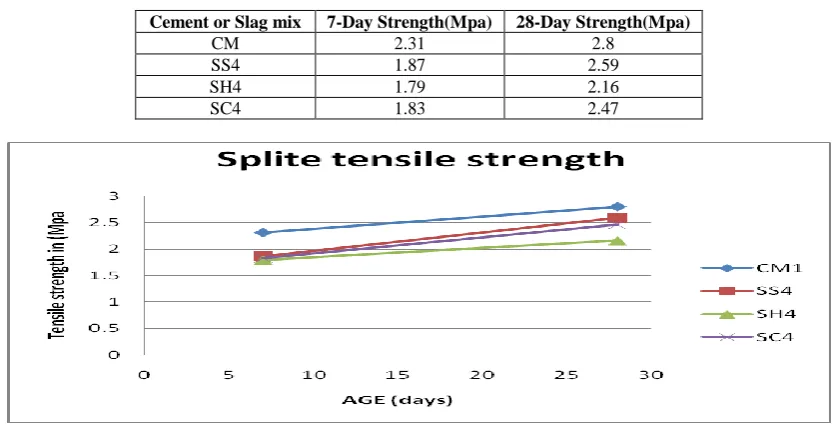
The Splitting Tensile Test is a simple test to perform and it is believed that it leads to a close value of direct tensile strength. The test was performed as described in IS 5816: 1999 and three samples were tested at the ages 7 and 28 days for water curing and average values are reported.
TABLEVIII
SPLIT TENSILE STRENGTH AT DIFFERENT AGES
Cement or Slag mix 7-Day Strength(Mpa) 28-Day Strength(Mpa)
CM 2.31 2.8
SS4 1.87 2.59
SH4 1.79 2.16
SC4 1.83 2.47
Fig. 2 Split Tensile Strength Result in Graphical Representation
D. Result on Split Tensile Strength
The results in above table show that among AAS concrete mixes, SS4 showed the highest value of tensile strength around 2.59 MPa at 28 days followed by SC4 (2.47 MPa). SH4 showed the lowest value (2.16 Mpa).
E. Flexural Strength Test
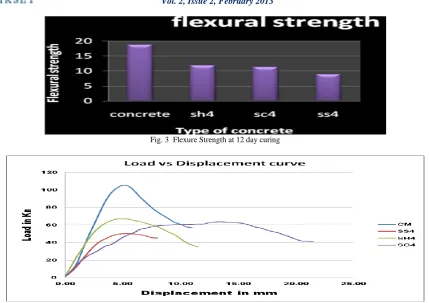
The Flexural Strength of concrete mixes was measured according to I.S.9399:1979. Samples of 150x150x700 mm were cast in order to perform the Flexural Strength Test and two samples were tested for curing at the age of 12 day and average are reported.
TABLEIX
FLEXURE STRENGTH AT 12DAY AGE
Cement or Slag mix 12-Day Strength(Mpa)
CM 1.87
SS4 0.89
SH4 1.18
Copyright to IJIRSET www.ijirset.com 383 Fig. 3 Flexure Strength at 12 day curing
Fig. 4 Load Vs Displacement of Flexure Strength
F. Results on Flexural Strength
From the above figure we can observe effect of curing on all different mixes. The highest flexural strength is shown by concrete mix where the lowest flexural strength is shown by Na2SiO3 activated concrete mix (SS4). Almost all AAS
concrete shows comparable values of flexural strength with concrete mixes. Among AAS concrete NaOH (SH4) shows higher flexural strength followed by Na2CO3 activated slag mix (SC4) and then finally the least flexural strength is
given by NaSiO3 (SS4).
G. Punching Shear Test
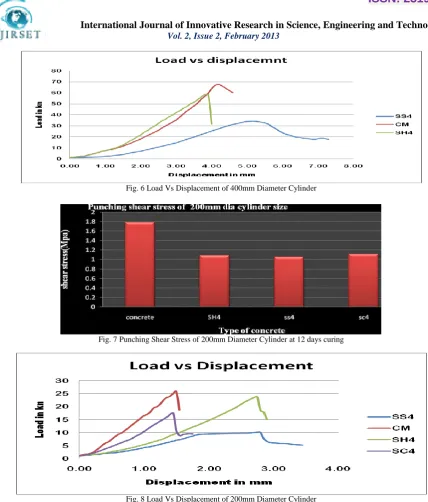
To find out the Punching Shear Strength a series of tests of micro concrete specimens has been carried out. Three circular slabs for each three different thickness„d‟ were cast, cured, and loaded to failure. The concrete mix ratio of cement: sand: gravel: water (by weight) was 1: 1.34: 2.88: 0.43. The maximum size of the aggregate is 20mm.The sizes of the specimens are 400mm, 200mm and the height of the specimens they have a relation one fourth of the diameter of the specimen. The mix concrete is done by as per IS code provisions and AAS concrete mixtures are done separately in different mixers BS 1881: part 125:1986. The specimens were curing up to 12days. The below graphical figures, show the variation in punching shear for different concrete mixers at particular size cylinder specimen.
Copyright to IJIRSET www.ijirset.com 384 Fig. 6 Load Vs Displacement of 400mm Diameter Cylinder
Fig. 7 Punching Shear Stress of 200mm Diameter Cylinder at 12 days curing
Fig. 8 Load Vs Displacement of 200mm Diameter Cylinder
H. Results on Punching Shear
The above figures show the different concrete and different sizes of specimens punching shear stress. In the above graphs the concrete gives the higher strength when compare the AAS concrete. The graph show the lower size specimen gives the higher strength when compare to the higher size specimen. All these three AAS concrete NaOH (SH4) gives the higher strength when compare the Na2CO3 and Na2SiO3 gives the very lower value.
CONCLUSION
Overall it can be concluded that AAS concrete has a great potential and presents a viable alternative to OPC to help in decreasing the effect on the environment in terms of energy conservation and less CO2 emissions. Sodium silicate
activated slag concrete sets rapidly with the higher Na2O dosage resulting in shorter setting time. The setting time can
be prolonged by adding hydrated lime to mix, which increases the final setting time more when compared to initial setting time. Out of all these three activators NaOH is best ; Na2CO3 was the second; Na2SiO3 was the third in terms of
Copyright to IJIRSET www.ijirset.com 385 concrete mixes, NaOH gives higher punching strength when compared to the other two AAS mixes. Na2SiO3 gives the
very less strength compare to all mixes.
REFERENCES
[1] Abbas A, Fathifazl G, Isgor OB, Razaqpur AG. Durability of recycled aggregate concrete designed with equivalent mortar volume method. Cem Concr Comp (2009).
[2] Atis CD., Bilim C., Celik O. (2007) “ Influence of activator on the strength and drying shrinkage of alkali-activated slag mortar”, Construction
and Building Materials, cited in Elsevier Science Direct.
[3] Anderson, Ronny; Gram, Hans-Erik, (1987), „Properties of alkali activated slag concrete‟, Nordic Concrete Research, (6), 7-18.
[4] Bakharev, T.; Sanjayan, J.G.; Cheng, Y.B. (1999). “Alkali activation of Australian slag cements.” Cement and Concrete Research, 29(1), 113-120.
[5] Bakharev, T.; Sanjayan, J.G.; Cheng, Y.B. (2000). “Effect of admixtures on properties of alkali-activated slag concrete.” Cement and Concrete
Research, 30(9), April 2001, 1367-1374.
[6] Bakharev, T.; Sanjayan, J.G.; Cheng, Y.B. (2001). “Resistance of alkali-activated slag concrete to carbonation”, Cement and Concrete
Research, 31, 1277-1283.
[7] Basheer, P. A. M. (2001). “Permeation analysis.” Handbook of analysis techniques in concrete science and technology, V.S. Ramachandran and J.J. Beaudoin, eds., William Andrew publishing, 985 p.
[8] Bougara, Lynsdale, Ezziane (2007). “Activation of Algerian slag in mortars”, Construction and Building materials, cited in Elsevier Science Direct.
[9] I.S.4031:1988 (part 5) “Determination of initial and final setting time of of cement by vicat‟s apparatus. ”Indian standards “. [10] I.S.5816:1999 “Method of test for split tensile strength of concrete”.”Indian standards “
[11] I.S 6461:19729(part 3) “Mixing, laying, compaction, curing and other construction aspect.” “Indian standards “. [12] I.S 9013:1978 “method of making ,curing and determining compressive strength of concrete. “Indian standards “. [13] I.S.9399:1979. “ Method of finding the flexural strength of concrete”. “Indian standards “.
[14] Rahal K. Mechanical properties of concrete with recycled coarse aggregate. Build Environ 2007.
[15] Saud, A. O. (2002). “Performance of alkali-activated slag concrete”, The University of Sheffield, Sheffield.
[16] Talling B. and Brandstetr (1989), “present state and future of alkali activated slag concretes”, proceedings of the third International Conference on fly ash, silica Fume, slag and natural pozzolans in concrete, Trondheim, SP114-72, 1519-1546.
[17] Wang S.D., Pu X., Scrivener K.L. and Pratt P.L. (1995). “Alkali activated slag cement and concrete: A review of properties and problems”, Advances in cement research, (27), 93-102.
[18] Wang S. D. (1991), “Review of recent research on alkali activated concrete in China”, Magazine of concrete research, (154), March, 29-35. [19] Vladimir Zivica, 2006. “Effects of type and dosage of alkaline activator and temperature on the properties of alkali-activated slag mixtures”,
Construction and Building Materials, cited in Elsevier Science Direct.
[20] Van Jaarsveld, J.G.S., Van Deventer, J.S.J., and Lukey, G.C. (2002). “The effect of composition and temperature on the properties of flyash- and kaolinite- based geopolymers.” Chemical Engineering Journal, 89, 63-73.
[21] Deja, J. and Malolepszy, J., (1989). “Resistance of alkali activated slag mortars to chloride solution.” 3rd International conference on the use of
Fly Ash, Silica Fume, Slag & Natural Pozzolans in concrete, ACI SP-114, Trodheium, Norway, 1547-1561.
[22] Douglas, E. and Brandstretr, J., (1990). “A preliminary study on the alkali activation of granulated blast furnace slag.” Cement and Concrete
Research, 20(5), 746-756.
[23] Chen, Z. and Liao, X. (1992), “The selection of stimulation agents for alkali-slag cement. 9th International Congress on the Chemistry of
Cement, New Delhi, India, III, 305-310.
[24] Gifford P.M. and Gillot J.E. (1996), “Alkali-silica reaction (ASR) and alkali-carbonate reaction (ACR) in activated blast furnace slag cement (ABFSC) concrete”, Cement and Concrete Research, 26(1), 21-26.
[25] Kutti, T., Malinowski, R. and Srebnik M., (1982), “Investigation of mechanical properties and structures of alkali activated blast furnace slag mortars.” Silicates industries, 149-153.
[26] Glukhovsky V.D. (1980), “High strength slag alkaline cements”, Proc. 7th Int. Congress on the Chemistry of Cement, Paris.
[27] Lynsdale, C. J. and sit, W.L. (1992), “The influence of curing on the early age properties of concrete incorporating PFA and slag.” An
International Workshop on Blended Cements, Singapore, 37-42.
Biography
Mr. D.V.S.P. Rajesh pursuing his M.Tech (Structures) from Bapatla Engineering College, Bapatla. His area of research is Structures and Alternative cementitious materials.
Mr. A. Narender Reddy pursuing his (4/4) B.Tech (Civil Engineering) from Bapatla Engineering College, Bapatla. His area of research is Structures and Alternative cementitious materials.
Copyright to IJIRSET www.ijirset.com 386 Mr. Venkata Tilak Uppalapati received his MSc Structural Engineering (Eng) from Sheffield University, United Kingdom and B.Tech Civil Engineering from Bapatla Engineering College, Bapatla. He is the only MSc student from India who got distinction in the year 2008 from „The Civil and Structural Engineering Department‟, Sheffield University, UK. He is currently Lecturer in the Department of Civil and Strutural Engineering, Bapatla Engineering College (Autonomous), Bapatla. Previously he worked as a Structural Design Engineer at Artefact Projects Limited. is research interests include alkali activation of Pozzolanic materials, static non-linear analysis, Alternative cementitious materials, Improving Ductility of Concrete by alternative materials.
Mr. M. Raghavendra pursuing his (4/4) B.Tech (Civil Engineering) from Bapatla Engineering College, Bapatla. His area of research is Structures.