Comparison through Dynamic Groups and
Asymmetric Computations
Ken Goss and Wei Jiang Departmenet of Computer Science Missouri University of Science and Technology
{ken.goss, wjiang}@mst.edu
Abstract. Within recent years, secure comparison protocols have been proposed using binary decomposition and properties of algebraic fields. These have been repeatedly optimized and increased in efficiency, but have seemingly reached a plateau. We propose a new approach to this problem that takes advantage of dynamic group sizes for intermediate calculations and asymmetric computations among participating parties. As a consequence, according to our analysis, communication and compu-tation costs have been brought to a very low and efficient level. Partic-ularly, the communication costs have been considerably reduced both in order as well as the dominating term’s order of magnitude. In addition, our proposed protocol requires no secure multi-party multiplication in-vocations in contrast to those required by the existing protocols, leading to inefficient constructions of secure comparisons.
1
Introduction
A need for the ability to perform secure computation in a practical manner is increasing proportionally to the need of our society to securely analyze the data we are amassing, and that at increasingly fantastic rates.
At the heart of many analysis problems is the simple comparison operator which has been identified, repeatedly, as a computational bottleneck for further performance improvements [1]. Considering a variety of problems, the compar-ison operator will be heavily used in many cases. These problems range from the traditional problem of the Millionaires presented by Yao is considered [2], secure auctioning [3], as well as queries on a secure database [4]. Thus, finding an efficient approach solving this problem - in any given situation - will have a positive performance effect on the rest of the overall system’s performance. The boost in performance from improving comparisons will naturally be proportional to the use of this operation in the overall system. This result is well known from the work of Amdahl and his eponymous Law [5].
problem with various benefits and costs. Within the realm of secret sharing, two main classes of these approaches to providing a secure comparison exist. First, there are approaches based on binary decomposition. Another class of proto-cols exploits properties of finite field arithmetic. This is done through indirect comparisons with transformed values, which are logically combined to form the results of the desired comparison.
In general, the approaches currently known have been steadily improving. However, it seems that a plateau has been reached. These approaches represent constant rounds solutions, but the costs of their communications are still high with respect to the values on which they operate. This is at least partially due to the trade-off made in each of their work to achieve constant rounds. In order to achieve constant rounds, greater local computations and communications costs were sacrificed. This is related to the results for unbounded fan-in multiplication given in the work of Bar-Ilan and Beaver [6]. Given that these approaches require this result to be able to reduce their round complexity to a constant, and by self-admission [7], it seems unlikely to drop considerably further within the currently explored veins of inquiry. It is our desire to present a different approach.
1.1 Our Contributions
An important link in the extant work in the field is that all the current secret sharing based protocols are symmetric; that is, all parties perform identical com-putations on their locally held shares of the data. We propose an asymmetric secure comparison protocol, based on secret sharing, that allows for greater effi-ciency than previous protocols with respect to required execution rounds, local computational requirements and communications. In our proposed protocol, the following features lead to the efficiency gain:
– Without using Shamir’s secret sharing scheme, no two parties need to execute the exact same instructions.
– This asymmetry allows for the control of individual pieces of knowledge to further minimize computation and communication complexities.
– It is important to note, however, that this introduction of asymmetry makes the resulting protocol more difficult to prove secure in general, as well as more difficult to secure against malicious adversaries specifically.
– Additionally, where possible, we take advantage of differing representations of values and field magnitudes for randomization and intermediate secure computations. This further reduces computation and communication costs.
– Most notably, by making use of the groupZ2, we are able to computexor
locally, without secure multiplications.
our proposed protocol requires 5 rounds, and the communication costs are on the order of 7`log2`+ 26`+ 11 log2`+ 32 bits for private inputs consisting of at most` bits such that`= log2N for some N defining the group used for the underlying secret sharing scheme and sufficiently large to represent the values being compared. No secure multi-party multiplication invocations are required. Furthermore, our local computations are guaranteed to be less than those of the other protocols currently extant in the literature. This is due to our local operations being almost exclusively shifts, additions and multiplications, in a simple sense. We do not rely heavily on a large number of group elements being multiplicatively inverted, nor do we require solutions to a large set of systems of equations to be solved. Many of these operations are required by other works.
The communication complexities are described in terms of the required num-ber of bits to be transmitted. This is a sharp contrast to the common convention of the currently optimized works in the area requiring a communication com-plexity represented by a count of secure multiplication invocations. The compar-isons that follow are all calculated under the assumption that all the schemes are employing the secret sharing scheme chosen by their designers. A single secure multiplication under the Shamir secret sharing scheme requires, for m parties, assuming appropriate choices for the degree and threshold,m(m−1)` bits to be communicated between the parties. For 3 parties and a protocol re-quiring 24`+ 26 log2`+ 4 multiplication invocations, this results in more than 144`2+ 156`log
2`+ 24`bits to be transmitted, a distinctly larger quantity than
our proposed protocol. This is calculated directly from analyzing the number of bits required for a secure multiplication according to the method common for Shamir’s secret sharing scheme [8]. The communication requirements and the number of required rounds would both grow even more, if these protocols were implemented under additive secret sharing because secure multiplication under additive secret sharing is more expensive (in rounds and bits transmitted) than that under Shamir’s secret sharing. For all the following analysis, we assume 3 parties, the same as we propose for our own protocol. We then simply multiply the number of bits required for a single Shamir secure multiplication by the number of expected multiplication invocations to yield the figures we present. For our protocol consisting of an arbitrary number of parties, the complexity is dependent on both ` and m. We also generalize the analysis of the existing protocols when we discuss this extension separately in Section 5.2.
reality, the communication complexity of a reveal is the same as that of a se-cure multiplication under Shamir secret sharing. Due to these reasons, it is not considered negligible from our perspective, and this is why we draw the readers attention to this looseness in the cited analysis. In the analysis of our protocol, we make no use of such simplifications or insignificance assumptions. In contrast, the included complexity analysis for our protocol is exact.
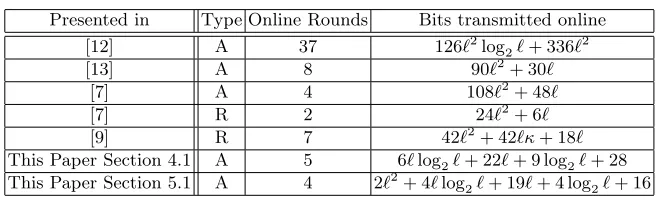
Additionally we differ with respect to the round complexity analysis given by [9], in that we have a more strict definition of of a computational round, as discussed in Section 4.3. This stricter definition leads to a somewhat higher count of rounds than that given in the analysis published by the authors. To summarize the extant work in the field with respect to round and communication complexities, we offer Tables 1 and 2 based on the summary present in [7]. The following complexities for our table have been obtained directly from the table in the referenced work by the method mentioned previously. Similar to the work of Reistad and Toft [7], the “A” denotes arbitrary input in the group used for the secret sharing scheme, while “R” denotes a domain of input which is restricted to a proper subset of the group. Here, it is very clear that the communication costs of our protocol are significantly less than any other of which we are aware, by a considerable factor on the dominating term and a reduction of order overall. Non-constant round secret sharing based secure comparison has not gained much attention from the research community since it can be straightforwardly implemented. As the domain of the values being compared increases, commu-nication cost generally dominates local computation cost. Thus, recent research has been primarily focused on reducing the communication complexity. Homo-morphic encryption based secure comparison protocols do exist [10, 11]. Their main advantage is that, at minimum, only two parties are needed to perform the necessary computations. However, they are computationally more expen-sive than secret sharing based approaches. In this paper, we limit our scope to constant-round secret sharing based secure comparison protocols.
Table 1.Online round and communication complexity for secure comparison protocols
Presented in Type Online Rounds Bits transmitted online
[12] A 37 126`2log2`+ 336`
2
[13] A 8 90`2+ 30`
[7] A 4 108`2+ 48`
[7] R 2 24`2+ 6`
[9] R 7 42`2+ 42`κ+ 18`
This Paper Section 4.1 A 5 6`log2`+ 22`+ 9 log2`+ 28
This Paper Section 5.1 A 4 2`2+ 4`log2`+ 19`+ 4 log2`+ 16
Table 2.Overall round and communication complexity for secure comparison protocols
Presented in Type Overall Rounds Bits transmitted overall
[12] A 44 1104`2log2`+ 1254`
2
[13] A 15 1674`2+ 30`
[7] A 10 918`2+ 2592`log2`+ 144`
[7] R 8 162`2+ 216`log2`+ 30`
[9] R 9 60`2+ 60`κ+ 18`
This paper Section 4.1 A 5 7`log2`+ 26`+ 11 log2`+ 32 This paper Section 5.1 A 4 2`2+ 5`log
2`+ 23`+ 6 log2`+ 22
is used to identify which of the values is greater through differences found with respect to earlier calculated intermediate values. These differences are used to build shares of the final result.
1.2 Organization
The rest of the paper is organized as follows: In Section 2, we present and dis-cuss a closely related secure comparison protocol that is fundamental to several protocols analyzed in this paper. Next, in Section 3, we enumerate and describe the necessary properties of a secret sharing scheme adopted in our protocol, and provide discussion related to their complexity and composition in our work. We also introduce the adversary models and the security settings for our protocol. Then, we present our protocol in detail in Section 4, describing its functional-ity and procedure along with analysis concerning its complexfunctional-ity, securfunctional-ity, and correctness. Our proposed protocols to follow are intended for various scenarios, and complexity preferences. Our first proposed protocol, discussed in section 4.1, deals with values that are privately held by two of the parties. Our second pro-posed protocol represents a potentially desirable trade-off in complexity and is discussed in Section 5.1. Finally, we discuss how our protocol can be generalized to larger groups of parties than merely three, and suggest an approach in which our protocol can be transformed to handle values which already exist in a bitwise shared format. We conclude by summarizing our contribution in Section 6, and indicate areas for future research directions.
2
Related Work
Methods also exist for the implementation of this functionality based on homomorphic encryption [11, 20–22]. These operate on a very different set of principles and security guarantees than our present work, and in general, are prone to be less efficient than methods based on secret sharing schemes [23]. This is due primarily to the comparatively large keys required to assure secu-rity [24]. Without some fundamental change regarding this requirement and the assumptions of public key cryptography, is unlikely to be significantly reduced. While homomorphic encryption based secure comparison protocols are neces-sary in the two-party setting, in this paper, we focus on secret sharing based approaches which requires at least three parties.
The two main approaches based on secret sharing, as introduced earlier, are methods based on changing the representation of the shared values via bit de-composition [12], and those employing a series of tests related to the properties of finite field arithmetic [13]. Later improvements and optimizations to each of these methods have been published subsequent to the original proposition of the first of each approach. We have chosen to present and discuss the work of Damg˚ard et al [12] due to the foundational place in the literature, clear repre-sentation of the underlying principles it represents, and relation to our general approach. Some of the optimizations on this method were proposed in [7, 9, 13]. The latter strategy, that of exploiting properties of finite field arithmetic seeks to affect a comparison through intermediate comparisons and some logic to bring the meaning of these intermediate comparisons together to form the desired solution. This method was introduced in the work of Nishide and Ohta [13]. Other optimizations have since come which cut back on the complexity and number of intermediate calculations necessary based on some restrictions to the domain of values which are shared and compared [7, 25]. We do not give these results as thorough a treatment due to the drastic difference in the approach, unrelated to our methods, though their complexities are important for consideration relative to the results of others as well as comparison with the complexity of our proposed solution which are all reported in Tables 1 and 2.
2.1 Damg˚ard et al
The first known constant rounds result in this area is due to the work of Damg˚ard et al [12]. In this setting, secretly shared values must first be bit decomposed among the parties involved in the computation. Alternatively, the values may exist as bitwise shares initially. This means the protocol takes as input bit decom-posed shares of the private values to be compared. If this procedure is necessary, though expensive, it is potentially beneficial when other bit-wise operations may be seen as advantageous. If other bit-wise operations are desirable, the cost in-curred in this scheme for bit decomposition may be amortized somewhat across all those sub-protocols which require it.
that bit location down to the least significant bit, all bits are set. Next, from least to most significant bits, a pairwise subtraction is computed finding the difference between each bit and the next most significant bit in the series. The result from this step is a series of bitwise shares such that all shared bits are shares of zero with at most one exception: the location of the most significant difference between the two original inputs. The last several steps perform secure bitwise multiplications to extract the value of the original input at the location of the most significant difference. The key steps are given in Algorithm 1.
Algorithm 1: BIT-LT from Damg˚ard et al [12]
Input:bitwise shares of integersa, bdenoted [a]B,[b]B with individual bits
denoted [a0]p. . .[a`−1]pwhere`=dlog2pe
Output:shares of the single bit result [c]p
1 begin
2 fori= 0, . . . , `−1do 3 [ei]p←XOR([ai]p,[bi]p)
4 end
5 ([f`−1]p, . . . ,[f0]p) = PRE∨([e`−1]p, . . . ,[e0]p)
6 [g`−1]p= [f`−1]p
7 fori= 0, . . . , `−2do 8 [gi]p←[fi]p−[fi+1]p
9 end
10 fori= 0, . . . , `−1do 11 [hi]p←MULT([gi]p,[bi]p)
12 end
13 [h]p←P`i=0−1[hi]p
14 Output [h]p
15 end
Though there is a fairly high computational complexity and communication cost, this important result demonstrates constant rounds secure comparison is indeed possible and well within feasibility.
3
Preliminaries
limits on computational power, can do no better than a random guess on what the original values may have been. This security is similar in principle to the unconditional security guarantees of the one-time pad, which has the weakness of inability to reuse the pad due to leaks in information. In the setting of secret sharing, no such concerns exist. For each and every share, new uniform random values are selected, used, and distributed, which removes the risk for information leakage from padding value reuse. If a shared value is revealed, its former shares may no longer be securely used without risk of information disclosure.
3.1 Operations and Notations in Linear Secret Sharing Schemes
We require that any secret sharing scheme to be used have the ability to perform the following operations:
– Share: given a particular valuex, generate shares ofx, denoted by [x]Pj
N, in
a group defined by a modulus N for each party Pj. This must be done in
a way that they can be uniquely recombined in a method applicable to the scheme to reconstruct the original value.
– Reveal: a sufficient number of shares [x]Pj
N can be recombined to reveal the
original valuex.
– Add with a public constant: given shares [x]Pj
N, and a public constant c,
execute the necessary operations to calculatec+ [x]Pj
N = [c+x] Pj
N. In a linear
secret sharing scheme, this can be done locally.
– Add shares: given two shared values [x]Pj
N and [y] Pj
N, calculate the sum of
their values in a shared form. This can be executed without communications by using the addition operation implemented in the secret sharing scheme, i.e., [x]Pj
N + [y] Pj
N = [x+y] Pj
N.
– Multiplication by a public constant: given shares [x]Pj
N, and a public
con-stantc, execute the necessary operations to calculate c[x]Pj
N = [cx] Pj
N. In a
linear secret sharing scheme, this can be done locally without communication among the parties.
3.2 Random Shift
In our protocol, we will make use of a random permutation. This permutationπ is encoded as an integer inZ`requiring log2`bits. We use a specific kind of cyclic
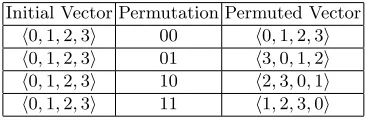
location, for our protocol, the location of the bit flagging the index of the most significant bit difference, be able to be moved to any other array location with a uniform probability. In our use, every other element in the array is meaningless and uniformly random by design, and therefore does not leak any information, whether it maintains some relative position with respect to the bit location of interest or not. Our use is similar to this type of shift permutation in [7]. Con-sider a trivial example for a vectorv consisting of 4 entriesv=h0,1,2,3i; thus, π ∈ {0,1,2,3} or equivalently in binary form π ∈ {00,01,10,11}. If we are interested in the ability to move the bit position 0 to any position within the array, consider the uniform random choice between the options presented in the application of the permutation for each the options demonstrated in Table 3.
Table 3.Small Cyclic Permutation Illustration
Initial Vector Permutation Permuted Vector h0,1,2,3i 00 h0,1,2,3i h0,1,2,3i 01 h3,0,1,2i h0,1,2,3i 10 h2,3,0,1i h0,1,2,3i 11 h1,2,3,0i
Clearly, 0 can be in any vector location with equal probability following the application of the permutation. This amounts to a uniform random shift in the elements which would effectively hide its previous location. Again, we do not care at all about any of the values of other elements, or their locations - in either an objective or relative sense. Thus, this permutation approach efficiently, securely, and correctly achieves our desire to hide the sole piece of information about which we have concern.
3.3 Security Definitions and Adversary Model
Aside from the correctness and efficiency of any of the extant protocols, an important consideration is the security guarantee that can be derived from their execution. Toward the end of proving security, we have generally followed the proof style and conventions, as well as the information theoretic expansions on security proof developed by Cr´epeau et al [26] and Goldreich [27]. The goal in this setting is to demonstrate for an arbitrary functionality f, there exists an equivalence of information disclosure between the ideal execution of a protocol and a real execution of a protocol implementing the same ultimate functionality. The “ideal” model is defined as a protocol implementing the desired func-tionality f corresponding to the desired function the parties wish to compute, in a highly idealized setting. As an example, an ideal protocol trivially imple-mented for two semi-honest parties by algorithm A = A1, A2 consists of each
f simply returns the outputu∈U andv∈V to A1 andA2respectively, where
U and V are the output domains. There is also an auxiliary input z ∈ {0,1}∗ available to both parties. In the case that a component ofAis compromised and behaves maliciously, the only possible changes that can be done are alterations in their input or output. The uand v are underscored in this presentation so that they can be notationally distinguished from the real model outputs. This model is denoted
(u, v) = IDEALf,A(z)(x, y)
The “real” world model is defined as a protocol implementing functionality f corresponding to the desired result via the execution of a protocolpconsisting of admissible algorithmsB=B1, B2. The private inputs,x∈X, andy∈Y, are
accepted as parameters. An auxiliary inputz∈ {0,1}∗is also available to both parties. The return of this operation is the set of outputs from the execution of the protocol which follows from the interaction ofB1 andB2. The real model is
symbolically represented as
(u, v) = REALpf,B(z)(x, y)
What is required for perfect security in this case is the demonstration of the equivalence of information disclosure via messages and outputs in interaction which is denoted as
IDEALf,A(z)(x, y)≡REAL p
f,B(z)(x, y)
Here, the protocol implemented in the real model is perfectly secure if there exists a pair of algorithmsA =A1, A2 admissible in the ideal model for every
set of algorithmsB=B1, B2 which are admissible in the real model (where the
same parties are honest), for all x ∈X, y ∈ Y, z ∈ {0,1}∗. For this definition, “admissibility” or “equivalence” is related to information disclosed in the process of protocol execution. An algorithm is admissible if no additional information can be gleaned from the communications implementing its functionality than would be the case in the ideal setting. This is to say that for all outputs in the domainsU andV, and all possible inputs from the domainsX, and Y, as well as the additional inputZ:
P(u, v|x, y, z) =P(u, v|x, y, z)
which simply indicates that the joint probability distributions for the outputs are indistinguishable, regardless of the computational power of the adversary. This means there exists no method by which they can be distinguished or separated at all. Thus, the real model is information theoretically secure. This is instrumental as we make arguments for the uniformly random distributions from which our messages, shares, randomizations, and outputs are constructed.
4
The Proposed Protocol
inter-mediate computations are not symmetric among the three parties. Expansions to larger numbers of parties are fairly trivial, and can be done based directly on the three-party examples given in the following section. Each protocol considers a different scenario.
– The first protocol allows for a group of three parties to securely compare two private inputs held by two of the three parties. The purpose of the third party is to facilitate secret sharing based secure computations.
– The second protocol presents an option concerning the protocol complexity, with a lower number of rounds.
– For both of the preceding cases, we present an extension of our protocols, and it assumes that the three parties do not know the values they compare, and that they are already shared in a bit decomposed format. This is similar to [12], listed in Tables 1 and 2.
Each proposed protocol targets a unique class of applications. However, they together cover most scenarios related to secure comparison based applications.
4.1 Key Steps and Correctness Analysis for Protocol 1
The main steps of our first proposed protocol are presented in Algorithm 2. Without loss of generality,P1 has a private inputaandP2 has a private input
b. At the end, the protocol returns the secret shares of the comparison result to only P1 and P2. The comparison result 1 indicatesa ≥b, and 0 otherwise.
At the beginning of the algorithm, an indexing variable i is defined for arrays of shared values. Unless otherwise noted, i is used to span the entire array. There are two instances in Step 5 when this is not the case. Overall, a few key design principles are important to recall: 1)xorcan be done locally inZ2,
without secure multiplication or communication, 2) we employ a summation of bits to avoid other costly multiplications and required communication, and 3) switching groups in which the shares are constructed allows us to further reduce communication costs.
Aside from groupsZN and Z2, we also make use of a groupZN2. We define N2 to be a prime such thatdlog2`e+ 1 < log2N2 <dlog2`e+ 2. This is due
to the use of the values which will be shared in this group. By inspection in the protocols to follow, specifically Step 5, the maximum possible value which may be shared in this group is 2(`+ 1)−1 related toγ00. Thus, the modulus should
have sufficient bitwidth to represent these values, and this gives us the bounds we have defined for its modulus. It is known that a prime must exist in this range from the proof of Bertrand’s Postulate which states that, for all n > 3 there exists at least one primepsuch thatn < p <2n[28–30].
The protocol unfolds as follows along with correctness justifications. In the following discussions, note that we refer to values without the level of specificity that is given in the algorithm. For example, shares ofabelonging toP1 andP2
inZ2 may simply be referred to as [a]. For full details please reference the given
Algorithm 2: SC(hP1, ai,hP2, bi,hP3,⊥i)→(hP1,[f]PN1i,hP2,[f]PN2i)
Input:Public info:N andN2,N > N2,N is an integer and the modulus of the
secret sharing scheme,`is the required bitwidth for the domain ofa andb,N >2`.N
2 is a prime such that
dlog2`e+ 1<log2N2<dlog2`e+ 2, 0≤i≤`, andj∈ {1,2}
Output:f is secretly shared betweenP1andP2.f= 1 ifa≥b; otherwise,
f= 0 1 P1
(a) a= 2a+ 1 (b) sa←Piai
(c) Generateri, r0i∈RZ2,r00∈RZ2,τi∈RZ∗N2, and random shiftπ (d) Generate [ai]
Pj
2 , and [sa] Pj
N2
(e) Send [ai]P22, [sa]PN22,ri,r0i,r00,τi andπtoP2
2 P2
(a) b= 2b (b) Generate [bi]
Pj
2
(c) Send [bi]P21 toP1
3 Pj
(a) [ei] Pj
2 ←[ai] Pj
2 + [bi] Pj
2
(b) [ei]P21←ri−[ei]P21, ifri= 1
(c) Send [ei] Pj
2 toP3
4 P3
(a) ei←[ei]P21+ [ei]P22
(b) Generate [ei] Pj
N2 (c) Send [ei]
Pj
N2 toPj 5 Pj
(a) [ei]PN12 ←ri−[ei]
P1
N2, ifri= 1 (b) [ei]PN22 ← −[ei]
P2
N2, ifri= 1 (c) [γ`0]
Pj
N2←[e`]
Pj
N2 (d) [γi0]
Pj
N2 ←[γ
0
i+1]
Pj
N2+ [ei]
Pj
N2, fori=`−1, . . . ,0 (e) [γ`]
Pj
N2←[γ
0
`] Pj
N2 (f) [γi]
Pj
N2 ←[γ
0
i+1]
Pj
N2+ [γ
0
i] Pj
N2, fori=`−1, . . . ,0 (g) [γi]PN12 ←[γi]
P1
N2−1 (h) [ui]
Pj
N2←τi[γi]
Pj
N2 (i) [vi]
Pj
N2←Shiftπ
[ui] Pj
N2
(j) Send [vi] Pj
6 P3
(a) vi= [vi]PN12+ [vi]
P2
N2modN2
(b) Find the unique indexk, wherevk= 0
(c) Generate [hi] Pj
2 , wherehk= 1 andhi= 0 fori6=k
(d) Send [hi] Pj
2 toPj
7 Pj
(a) [h]Pj
2,B←shift
−1
π
[h]Pj
2,B
(b) [h0i] Pj
2 ←[hi] Pj
2 −[ai] Pj
2
(c) [h0i] P1
2 ←r
0
i−[h
0
i] P1
2 , ifr
0
i= 1
(d) Send [h0i] Pj
2 toP3
8 P3
(a) h0i←[h0i]P21+ [h
0
i]P22
(b) Generate [h0i] Pj
N2 (c) Send [h0i]
Pj
N2 toPj 9 Pj
(a) [h0i] P1
N2←r
0
i−[h
0
i] P1
N2, ifr
0
i= 1
(b) [h0i]PN22← −[h
0
i]PN22, ifr
0
i= 1
(c) [s0a] Pj
N2←
P i[h 0 i] Pj N2 (d) [f]Pj
N2 ←[sa]
Pj
N2−[s
0
a] Pj
N2 (e) [f]P1
N2 ←[f]
P1
N2+ 1 (f) [f]Pj
N2 ←2
−1[f]Pj
N2 (g) [f]P1
N2 ←r
00−
[f]P1
N2, ifr
00
= 1 (h) [f]P2
N2 ← −[f]
P2
N2, ifr
00
= 1
(i) Send [f]Pj
N2 toP3 10 P3
(a) f←[f]P1
N2+ [f]
P2
N2 (b) Generate [f]Pj
N
(c) Send [f]Pj
N toPj
11 Pj
(a) [f]P1
N ←r
00
−[f]P1
N, ifr
00
= 1 (b) [f]P2
N ← −[f] P2
N, ifr
00
– Step 1: In the first step, P1 generates the necessary values for later
per-mutation and randomization. The private input of P1 is also doubled and
incremented before shares are generated. Finally, the shares for P2 along
with other values for later use are transmitted toP2.
– Step 2: This step consists ofP2generating shares of twice the private input
it holds and sending one share toP1. The two private values are modified in
this manner (either doubled or doubled and incremented) in order to inject one sure difference into the calculation in the values to be compared. This is done specifically in the least significant bit position. In this way we avoid what would have otherwise been a risk for protocol failure leading to an information leak in the case of equality.
– Step 3: In Step 3, all parties compute a bitwise xor, and P1 additionally
randomizes its shares by the uniform random bits which make upri. Both
P1 andP2 send the resulting shares toP3.
– Step 4:P3 uses the two shares received to rebuild the re-randomized secret
and generate new shares, now in a group defined byN2. This amounts to a
mapping of shares between groups Z2 →ZN2. Note that, due to the addi-tional randomization from Step 3, no information is leaked in this process.
– Step 5: Recall that the shares fromP1 were randomized, so when they are
rebuilt by P3, no information will be leaked. This randomization must be
reversed so that the original values, now secretly shared in a new group, can be reclaimed. This is achieved through sharing the randomization vectorr between P1 and P2. When ri = 1, P1 computes ri −[ei] and P2 simply
computes the additive inverse of its share. This is accomplished in Steps 5(a) and 5(b) of Algorithm 2. These two parties now hold bitwise shares of the xor of their private inputs, each as elements in ZN2. In Step 5(d), the protocol proceeds by computing the prefix sum of the bits from most to least significant shares of bits. This results in a series of shares such that the most significant bits are shares of zero until the first bit difference is encountered, which is one. Following this position, all bits are non-zero and non-decreasing in value with each successive bit. In Step 5(f), to ensure that exactly one value in the array is equal to one, we iterate through the bit positions again performing a prefix sum of the values from most to least significant bit positions. This is the justification for the bounds which we have given for N2. If a and b have no bits in common, the vector [ei] will
consist of shares of all ones. Thus, the prefix sum of the shares of these values will yield, at most,`+1. Repeating this operation will yield a value of at most 2`+1; as a result, this serves as the defining factor for our bounds defined for N2. Finally,P1andP2subtract one from every share of this vector, thereby
ensuring that every value in the vector is non-zero with one exception, the location of the most significant bit difference. The values contained in the vector are multiplied by the vectorτ consisting of random values which are known toP1andP2. This is done to hide the intermediate calculated values
fromP3. Since we requireN2to be prime, these values inτi will not yield a
product equal to 0 under modulusN2when multiplied with any other group
preserve. Now, every array value related to every bit position is a non-zero and uniformly random value with one exception, the position related to the most significant bit difference. Finally, to hide this information fromP3, the
vector of values [ui] is shifted according to the random valueπagreed upon
betweenP1 andP2.
– Step 6: Coming to Step 6, P3 rebuilds the vector of these values and finds
the unique indexk containing the value zero. This player then constructs a bitwise series of shares inZ2 such that all shares are shares of zero with the
exception of the shares indexed byk. These shares are sent to their parties.
– Step 7: Upon receipt of these shares, the parties perform an inverse shift on the received vector to place the sole location containing a share of one back into the position related to the most significant bit difference. They then compute, for each location, the difference between the newly received vector of shares and the shares ofP1’s original input.P1 additionally randomizes
this result with the vectorr0, similar to what was done in Step 3(b). Similar again to what has preceded,P3reconstructs and performs another mapping
in the generation of new shares between groupsZ2 →ZN2. These have the intermediate randomizations removed by the parties in Step 9(a) and 9(b) as discussed with respect to Step 5(a) and 5(b).
– Step 8: HereP3 once again serves as an oblivious mapper between sharing
groups and distributes the shares randomized results of the calculation ofh0.
– Step 9: All values in the vectorh0 are summed byP1 andP2, and assigned
to shares of [s0a]. The difference [sa]−[s0a] is calculated. Because there is
exactly one bit difference betweenaand h0 in their binary representations, the sums of the set bits within these two values will have a difference of exactly magnitude 1. Calculating the difference [sa]−[s0a] results in either one
or its additive inverse inZN2 being assigned to shares off. Finally, since the result of the computation so far isf ∈ {1,−1}shared inZN2, it is necessary to map this set tof ∈ {0,1}, and bring the shares into the domain for the overall secret sharing scheme. The first part of these last steps is achieved throughP1 adding the value one to its share, thereby incrementing the set
of possible values to get shares of either zero or two, and then both parties multiply their shares by the multiplicative inverse of two. In the case that f is zero, it will remain unchanged, and in the case thatf is two, it will be reduced to one. Thus, the correct functionality has been achieved andf = 1 iffa≥b. All that remains is to map the shares into the appropriate group. As we have done previously, this shared valuef ∈ZN2 is re-randomized with another bitr00. This value is sent to P3.
– Step 10:For the last time,P3reveals the randomizedf and builds shares of
that revealed quantity inZN and returns these to the other parties.
– Step 11: As the last step of our proposed protocol, P1 and P2 remove the
temporary additional randomization from the shared result [f]N and hold
4.2 Security Analysis
For our security formulations and proofs to follow, we consider adversaries in the semi-honest or honest but curious model. We consider each player’s role independently, due to the asymmetry used in our protocol. For each case, we will analyze the protocol focusing on communicated information and opportunities for leaks, and we will conclude with a summary discussion of the equivalence necessary as summarized in Section 3.3 required for proving perfect security. Specifically, we discuss the steps toward a proof of the following equivalence assuming semi-honest adversaries
IDEALf,A(z)(x, y)≡REAL p
f,B(z)(x, y)
for our set of three algorithmsA=A1, A2, A3admissible in the ideal model for
every set of algorithmsB=B1, B2, B3which are admissible in the real model.
Semi-honestP1 The view ofP1during the execution of the proposed protocol
includes public domain information for inputs and outputs, and the value a which is the private input forP1. Additionally,P1generates random bit vectors
randr0, a random bitr00, the vector of random values in
ZN2τ, and the random shiftπ. In the course of execution, more values are exchanged; these consist of shares ofb,e,h, and h0.
– Step 1(c) and 1(d) are those which represent the generation of all the values P1will share withP2. Specifically, these are:ri, r0i, r00, τi, π,[ai]P22,and [sa]PN22.
– In Step 2(c), [bi]P21, theP1’s share ofP2’s bitwise shared input, is received. – Step 4(c) consists of the receipt of the vector [ei]PN12.
– The vector [hi]P21 is received in Step 6(d). – In Step 8(c), the vector [h0i]P1
N2 is received.
– Step 10(c) is the final communication in the scheme and consists of the receipt of [f]P1
N.
Since for each of the values listed above in the Steps 2-10,P1only receives one
share, it is impossible forP1to rebuild the actual values. This is immediate from
the security guarantees of the underlying secret sharing scheme. Thus, possession of a single share cannot leak information, andP1 can do no better than random
guess on the underlying value.
The values generated in Step 1(c) and 1(d) are all uniformly random, and each consists of use of the randomness source z provided in the real implementation of the protocol, which is permissible under the scheme used in the proof system. This use of the randomness source in no way violates the equivalence sought with the ideal model. These values are either shared via the generation of shares (e.g., only one of the two shares is sent to P2) or sent directly to P2 without
uniform random, do not pose any threat to the privacy of the protocol through their use in the manner we have described in the context of the protocol.
The final value retained as the result of the protocol’s completion is uniformly random and represents a share of the desired outcome from the evaluation of the functionality we implement.f is an element inZ2, and its shares are in a larger
group. Again, it is impossible to rebuild the underlying secret, or learn anything at all about it, from the possession of a single share. This is once more immediate from the underlying secret sharing scheme. Therefore,P1learns nothing beyond
what is known at the beginning of the execution of the protocol, namely, the value of the private input already held a, the public domain information, and anything which may be deduced from these data.
Semi-honestP2 The roles ofP1andP2are fairly similar, though not identical.
P2’s view of the protocol differs fromP1in only two ways, receipt fromP1of some
of the random values to be used to hide information from P3, and the manner
in which some of these values are used. The total execution view consists of the public domain information for inputs and outputs, and the valuebwhich is the private input forP2. P2 receives random bit vectorsrand r0, a random bitr00,
the vector of random values τi inZN2, and the random shift amount π. In the course of execution, more values are exchanged. These consist of shares ofa,sa,
e,h, andh0.
– Step 1(e), all valuesP1 shared with P2 are received. Specifically, these are:
ri, r0i, r00, τi, π,[ai]P22,and [sa]PN22.
– Step 4(c) consists of the receipt of the vector [ei]PN22.
– The vector [hi]P22 is received in Step 6(d). – In Step 8(c), the vector [h0i]P2
N2 is received.
– Step 10(c) is the final communication in the protocol and consists of the receipt of [f]P2
N.
The understanding of the security of the protocol, with respect to an honest-but-curious P2, is essentially the same as the case for P1. Since P2 is never in
possession of both shares of any of the secret shared values, the values rep-resented by the shares are impossible to reconstruct due to the properties of the secret sharing scheme. The possession of the true values of, for example,ri
in no way compromises any security principles since the value is used only to hide information fromP3 and allows for the removal of this additional
random-ization after the shares have been mapped into their new domain. Specifically, where P1 calculates, in Step 5(a), [ei]NP12 ← ri−[ei]
P1
N2, ifri = 1, P2 calculates [ei]PN22 ← −[ei]
P2
N2, ifri= 1.
SinceP2, parallel to many of the ideas presented with respect toP1, cannot
Semi-honest P3 The role ofP3 in the overall protocol is very different from
the other two. The view ofP3 during the execution of the proposed comparison
protocol includes the public domain information for inputs and outputs, receipt of the shares of the shared valuev, and bitwise shared valuese, andh.
– In Step 3(c), the shares [ei]P21 and [ei]P22. In Step 7(d), the shares [h0i] P1
2 and
[h0i]P2
2 are received. These are both bitwise shares of values related toaand
b, which are recombined to reconstruct the underlying values.
– Shares [vi]PN12 and [vi]
P2
N2 are received in Step 5(j) to reconstruct the random-ized values inZN2.
– Shares [f]P1
N2 and [f]
P2
N2 received in Step 9(i) are two random integers inZN2. P3 receives no shares of the output of the protocol, and holds no shares of
the inputs, so the above mentioned messages comprise the total view of the execution of the protocol from the perspective ofP3. The shares of these values
have been built from the original values based on the algorithm standard for the secret sharing scheme in use. SinceP3 receives all necessary information to
rebuild valueseandh0, and in fact does rebuild them, there would be a significant leaking of information for these cases if they were not additionally re-randomized by uniform values inZ2before the shares ofP1were sent toP3. This additional
layer of randomization allows for P3 to rebuild the shares and generate new
shares in a different group, namelyZN2, without gaining any knowledge about the true values themselves. In the case of Step 5, and the reception of the shares ofv, the only information of significance is the index of the bit position related to the most significant difference between the inputs. This position is flagged by being the only zero element in the array. This position is hidden by the permutationπ, so even though P3 once again rebuilds and maps the values to a
different group, no meaningful information can be gleaned.
P3 has no input and only processes results from others’ shared inputs. Since
the results have been uniformly re-randomized, they retain no information of the actual result beyond what can be ascertained in an ideal case. The best this player can do, independent on the availability of arbitrary computational power, is randomly guess in the domain what the correct values can be, without any means of verifying if the guessed values are indeed the true values. Thus, the protocol with respect to a semi-honestP3is information theoretically secure.
Security Summary Since for each of the preceding three cases, analyzing the set of algorithmsB =B1, B2, B3, these were seen to be admissible in the sense
that they neither yield nor leak information beyond that which is desired, and constitute a correct implementation of the desired functionality as discussed in Section 4.1, they are equivalent to a set of algorithmsA=A1, A2, A3which are
4.3 Complexity
The complexity of our protocol is analyzed from two perspectives: that of round complexity, and communications. We define a computationalround as consisting of any arbitrary amount of local computation accompanied by at most one send and receive cycle, as established and explained in [31]. The round complexity of our protocol is simply a constant since the number of cooperative steps executed by the overall protocol is fixed and independent of the size of the input values. Specifically, the number of required rounds is 5. All the following step numbers refer to the algorithm of our protocol given in Algorithm 2.
The first round consists of Steps 1-3 since this it is in this step that the parties are generating shares of values to be used, exchanging them, performing some computation and transmitting the response toP3. This is analogous to one send
and receive cycle with an arbitrary amount of local computation accompanying. During this phase, the most complex values to be communicated are generated and sent. Specifically, in Step 1(e), generating and sending [ai]P22, [sa]NP22,ri,r
0
i,
r00, τi and π requires the transmission of `log2`+ 5`+ 3 log2`+ 9 bits. Step
2(c) requires only `+ 1 bits in communication, and concludes round 1 since the next step is dependent on the values transmitted in this step. Now we get into the more strict send and receive relationship for the rest of the required rounds. Steps 3 and 4 together form a round since P1 and P2 calculate and
send values to P3, and receive back from P3 a response based on those values.
The same is true for pairs of Steps 5-6 and 7-8. Step 3(c) requires 2(`+ 1) bits in transmission, and 4(c) requires 2(`+ 1)(2 + log2`) bits. The next round
requires 2(`+ 1)(2 + log2`) bits for Step 5(i) and 2(`+ 1) bits for Step 6(d). The
penultimate round requires 2(`+ 1) bits to be sent in Step 7(d), and in step 8(c) 2(`+ 1)(2 + log2`) bits are communicated. The final round consists of Steps 9 and 10 in which 2(2 + log2`) and 2`bits are communicated respectively. The last step follows immediately from the values received in Step 10, and requires no further communication. Therefore, Step 11 is considered as a final part of round 5. For the total communication complexity, we consider the number of bits need to be transmitted, according to the steps in which they occur:
– Step 1: 3(`+ 1) bits for ri, r0i, and [ai]2P2, 1 forr00, (`+ 1)(2 +log2`) forτi,
1 + log2`forπ, and 2 + log2`for [sa]NP22. The total:`log2`+ 5`+ 3 log2`+ 9
– Step 2:`+ 1 for [bi]P21
– Step 3: 2(`+ 1) for [ei]P21 and [ei]P22
– Step 4: 2(`+ 1)(2 + log2`) for [ei]PN12 and [ei]
P2
N2
– Step 5: 2(`+ 1)(2 + log2`) for [vi]PN12 and [vi]
P2
N2
– Step 6: 2(`+ 1) for [hi]P21 and [hi]P22 – Step 7: 2(`+ 1) for [h0
i] P1
2 and [h0i] P2
2 – Step 8: 2(`+ 1)(2 + log2`) for [h0i]
P1
N2 and [h 0
i] P2
N2
– Step 9: 2(2 + log2`) for [f]P1
N2 and [f]
P2
N2
– Step 10: 2`for [f]P1
N and [f] P2
N
5
Protocol Variations
In this section, we address a couple alternatives for slight changes which may be made to our protocol to alter its complexity or expand its generality. The first such proposed alteration allows for a trade-off in complexity which could be desirable in some settings, trading the elimination of a computational round for a slightly increased communication complexity. The other suggests a manner in which it is possible to generalize our three-party protocol to any number of parties greater than three with only slight increase in communication costs.
5.1 Variation for Alternative Complexity
If round complexity is of greater concern than overall communication costs, we offer a trade-off which can be implemented with respect to our general protocol. There is a one round complexity reduction which is bought at the expense of an increase in the communication complexity. In order to affect this change, the protocol as given previously stands for Steps 1-7. Beginning with Step 8, alterations are necessary. We present the Algorithm 3 which consists of the necessary steps to replace in Algorithm 2. The only other alterations occur in Step 1(d)-(e) where sa is shared in ZN rather thanZN2. In addition, N is now required to be odd. Finally, Steps 10 and 11 are no longer necessary, and the protocol ceases with completion after the finish of Step 9.
Algorithm 3: Replacement steps for alternative complexity for
SC(hP1, ai,hP2, bi,hP3,⊥i)→(hP1,[f]PN1i,hP2,[f]PN2i)
Input:Public info:N andN2,N > N2,N is an odd integer and the modulus
of the secret sharing scheme,`is the required bitwidth for the domain ofaandb,N >2`.N2 is a prime such that
dlog2`e+ 1<log2N2<dlog2`e+ 2, 0≤i≤`, andj∈ {1,2}
Output:f is secretly shared betweenP1andP2.f= 1 ifa≥b; otherwise,
f= 0 8
8 P3
(a) h0i←[h0i] P1
2 + [h
0
i] P2
2
(b) Generate [h0i] Pj
N
(c) Send [h0i] Pj
N toPj
9 Pj
(a) [h0i] P1
N ←r
0
i−[h
0
i] P1
N, ifr
0
i= 1
(b) [h0i]PN2 ← −[h
0
i]PN2, ifr
0
i= 1
(c) [s0a] Pj N ← P i[h 0 i] Pj N
(d) [f]Pj
N ←[sa] Pj
N −[s
0
a] Pj
N
(e) [f]P1
N ←[f] P1
N + 1
(f) [f]Pj
N ←2
−1
[f]Pj
The communications required in this version of the protocol are as follows:
– Step 1: 3(`+ 1) bits for ri, r0i, and [ai]2P2, 1 forr00, (`+ 1)(2 +log2`) forτi,
1 + log2`forπ, and`for [sa]NP2 the total is`log2`+ 6`+ 2 log2`+ 7 bits – Step 2:`+ 1 for [bi]P21
– Step 3: 2(`+ 1) for [ei]P21 and [ei]P22
– Step 4: 2(`+ 1)(2 + log2`) for [ei]PN12 and [ei]
P2
N2
– Step 5: 2(`+ 1)(2 + log2`) for [vi]PN12 and [vi]
P2
N2
– Step 6: 2(`+ 1) for [hi]P21 and [hi]P22 – Step 7: 2(`+ 1) for [h0
i] P1
2 and [h0i] P2
2 – Step 8: 2`(`+ 1) for [h0i]P1
N and [h0i] P2
N
The result of this alteration results in a complexity of 2`2+ 5`log2`+ 23`+ 6 log2`+ 22. There is some change in the groups used for shared values, but
the functionality and overall procedure is changed in no substantive manner for the considerations of security and correctness. Therefore, we do not introduce detailed complexity and security discussion as we did for the primary version of our protocol. All the arguments are essentially the same.
5.2 Variation for Shared and Bit-decomposed Inputs
Similar to the previously referenced related protocol from [12], we can, with slight alteration, accept values which already exist in a shared and bitwise decomposed state as inputs to our protocol rather than only privately held values from two parties. This can allow arbitrarily many parties to be shareholders and still perform the comparison with minimal additional communication cost. Additive secret sharing is required due to its ability to recombine incomplete sets of shares into a share which is correct, and uniformly random, for a set of fewer parties. Recall that under additive secret sharing, shares of a value xare constructed, formparties and modulus N, according to the following equation:
[x]Pm
N =x−[x] P1
N − · · · −[x] Pm−1
N
where all [x]P1
N through [x] Pm−1
N are randomly selected elements ofZN and [x] Pm
N
satisfies the equation. Once these shares are distributed, all mparties hold an equal share of the secret, and all m are required to reconstruct the secret. If, however,P3throughPmwere to send their shares toP2, thenP2could sum them
with its own share and hold a new share which would allow for P2 and P1 to
compute functions without interaction from the rest of the parties. At the end of the desired functionality, shares can be redistributed to the remaining parties in a manner similar, though inverse, to the process by which they were combined. The share held byP2has gained no information since it is still uniform random,
– Step 1: 4(`+ 1) + 1 + (`+ 1)(2 + log2`) + 1 + log2`+ 2`(m−2) forqi,ri,
ri0,r00,τi,π, and [a0i] P1
2 , as well as [ai]P2k and [bi]P2k, where k= 3. . . m – Step 2:`+ 1 for [ai]P22
– Step 3: 2(`+ 1) for [ei]P21 and [ei]P22
– Step 4: 4(`+ 1)(2 + log2`) for [ei]PN12,[ei]PN22,[a0i] P1
N2,and [a 0
i] P2
N2
– Step 5: 2(`+ 1)(2 + log2`) for [vi]PN12 and [vi]
P2
N2
– Step 6: 2(`+ 1) for [hi]P21 and [hi]P22 – Step 7: 2(`+ 1) for [h0i]P1
2 and [h0i] P2
2 – Step 8: 2(`+ 1)(2 + log2`) for [h0i]P1
N2 and [h 0
i] P2
N2
– Step 9: 2(2 + log2`) for [f]P1
N2 and [f]
P2
N2
– Step 10: 2`for [f]P1
N and [f] P2
N
– Step 11: 2`(m−2) for [f]Pj,k
N , wherek= 3. . . mandj= 1,2
This leads directly to a total communication cost of 9`log2`+ 4m`+ 25`+
12 log2`+ 35 bits. Even though we are operating on already bit decomposed and
shared values, our protocol is still very efficient in comparison to others due to the fact that we share our bit decomposed values inZ2as opposed toZN. This
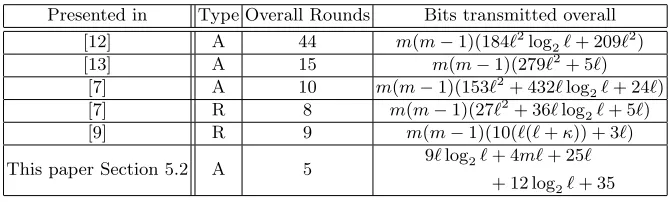
boosts efficiency through immediate savings in communication, but it is also the means by which we can computexorlocally without requiring secure multi-party multiplications. In the following we present Table 4, which clearly demonstrates that not only is our proposed protocol of lower asymptotic complexity in both mand`, and lower complexity in terms of required overall rounds, but it is also lower in the coefficients of the dominating terms, thus presenting a substantial reduction in required communication costs.
Table 4.Overall round and communication complexity for secure comparison protocols
Presented in Type Overall Rounds Bits transmitted overall
[12] A 44 m(m−1)(184`2log2`+ 209` 2
)
[13] A 15 m(m−1)(279`2+ 5`)
[7] A 10 m(m−1)(153`2+ 432`log2`+ 24`)
[7] R 8 m(m−1)(27`2+ 36`log2`+ 5`)
[9] R 9 m(m−1)(10(`(`+κ)) + 3`)
Algorithm 4: Replacement steps for shared, bit-decomposed inputs for SC(hP1,[ai]P21,[bi]2P1i. . .hPm,[ai]P2m,[bi]P2mi)→(hP1,[f]NP1i. . .hPm,[f]PNmi)
Input:Public info:N andN2,N > N2,N is an integer and the modulus of the
secret sharing scheme,`is the required bitwidth for the domain ofaand bwhich are bitwise shared among themparties,N >2`.N
2 is a prime
such thatdlog2`e+ 1<log2N2 <dlog2`e+ 2, 0≤i≤`, andj∈ {1,2}
Output:f is secretly shared between allP1. . . Pm.f= 1 ifa≥b; otherwise,
f= 0 1 P1
(a) [ai+1]P21= [ai]2P1 fori=`−1, . . . ,0
(b) [bi+1]P21 = [bi]2P1 fori=`−1, . . . ,0
(c) [a0]P21 ←0
(d) [b0]P21←0
(e) Generateqi, ri, r0i∈RZ2,r00∈RZ2,τi∈RZ∗N2, and random shiftπ (f) [a0i]
P1
2 ←qi−[ai]P21, ifqi= 1
(g) Sendqi,ri,r0i,r00,τi andπtoP2, and send [a0i] P1
2 toP3
Pk (k= 3. . . m)
(a) Send [ai]P2kand [bi]P2ktoP2
2 P2
(a) [ai+1]P22=
Pm
k=2[ai] Pk
2 , fori=`−1, . . . ,0
(b) [bi+1]P22 =
Pm
k=2[bi]
Pk
2 , fori=`−1, . . . ,0
(c) [a0]P22 ←1
(d) [b0]P22←0
(e) Send [ai]P22 toP3
3 Pj
(a) [ei] Pj
2 ←[ai] Pj
2 + [bi] Pj
2
(b) [ei]P21←ri−[ei]P21, ifri= 1
(c) Send [ei] Pj
2 toP3
4 P3
(a) ei←[ei]P21+ [ei]P22
(b) Generate [ei] Pj
N2 (c) a0i←[a
0
i] P1
2 + [ai]P22
(d) Generate [a0i] Pj
N2 (e) Send [ei]
Pj
N2 and [a
0
i] Pj
5 Pj
(a) [ei]PN12 ←ri−[ei]PN12, ifri= 1
(b) [ei]PN22 ← −[ei]
P2
N2, ifri= 1 (c) [ai]PN12 ←qi−[ai]PN12, ifqi= 1
(d) [ai]PN22 ← −[ai]
P2
N2, ifqi= 1 (e) [sa]
Pj
N2←
P
i[ai] Pj
N2 (f) [γ`0]
Pj
N2←[e`]
Pj
N2 (g) [γi0]
Pj
N2 ←[γ
0
i+1]
Pj
N2+ [ei]
Pj
N2, fori=`−1, . . . ,0 (h) [γ`]
Pj
N2←[γ
0
`] Pj
N2 (i) [γi]
Pj
N2 ←[γ
0
i+1]
Pj
N2+ [γ
0
i] Pj
N2, fori=`−1, . . . ,0 (j) [γi]PN12 ←[γi]
P1
N2−1 (k) [ui]
Pj
N2←τi[γi]
Pj
N2 (l) [vi]
Pj
N2←Shiftπ
[ui] Pj
N2
(m) Send [vi] Pj
N2 toP3 11 Pj
(a) [f]P1
N ←r
00
−[f]P1
N, ifr
00
= 1 (b) [f]P2
N ← −[f] P2
N, ifr
00
= 1 (c) Generate [f]Pj,k
N ∈RZN, fork= 3, . . . , m
(d) [f]Pj
N ←[f] Pj
N −
Pm
k=3[f]
Pj,k
N
(e) Send [f]Pj,k
N toPk, fork= 3, . . . , m
Pk (k= 3, . . . , m)
(a) [f]Pk
N ←[f] P1,k
N + [f] P2,k
6
Conclusion
Our contribution in this paper amounts to a proposed protocol for secure multi-partly computation, specifically comparison, which can be implemented very efficiently in a secret sharing scheme. Using dynamic groups for share creation as well as protocol asymmetry, we have significantly reduced both the local com-putation as well as the communication complexity for this vital operation (mul-tiple orders of magnitude less than other extant protocols as well as a reduction of order). It is our hope that our contributions thus far may be of immediate benefit to the academic and research communities for immediate use and ef-ficiency improvement of many other protocols and programs dependent on a secure multi-party comparison operator.
Our future work in this area includes an extended presentation of our proto-cols to include security guarantees for different adversary models. We also plan to formally present the generalization of our protocol to function in the more general setting of values which have already been secretly shared rather than those privately and locally held at the initialization of the protocol, or those which have already been bit decomposed in the secret sharing scheme. Further-more, we will investigate the necessary strategies to make our design applicable for Shamir’s secret sharing scheme.
References
1. Veugen, T., Blom, F., de Hoogh, S.J., Erkin, Z.: Secure comparison protocols in the semi-honest model. IEEE Journal of Selected Topics in Signal Processing9(7) (2015) 1217–1228
2. Yao, A.C.C.: Protocols for secure computations. In: Foundations of Computer Science. Volume 82., IEEE (1982) 160–164
3. Franklin, M.K., Reiter, M.K.: Secure auction systems (April 25 2000) US Patent 6,055,518.
4. Hamlen, K., Kantarcioglu, M., Khan, L., Thuraisingham, B.: Security issues for cloud computing. Optimizing information security and advancing privacy assur-ance: new technologies150(2012)
5. Amdahl, G.M.: Validity of the single processor approach to achieving large scale computing capabilities. In: Proceedings of the ACM April 18-20, 1967, spring joint computer conference, ACM (1967) 483–485
6. Bar-Ilan, J., Beaver, D.: Non-cryptographic fault-tolerant computing in constant number of rounds of interaction. In: Proceedings of the eighth annual ACM Sym-posium on Principles of distributed computing, ACM (1989) 201–209
7. Reistad, T.I., Toft, T.: Secret sharing comparison by transformation and rotation. In: International Conference on Information Theoretic Security, Springer (2007) 169–180
8. Bogdanov, D.: How to securely perform computations on secret-shared data. Mater’s Thesis (2007)
9. Reistad, T., Toft, T.: Linear, constant-rounds bit-decomposition. In: International Conference on Information Security and Cryptology, Springer (2009) 245–257 10. Toft, T.: Sub-linear, secure comparison with two non-colluding parties. In:
11. Lipmaa, H., Toft, T.: Secure equality and greater-than tests with sublinear online complexity. In: International Colloquium on Automata, Languages, and Program-ming, Springer (2013) 645–656
12. Damg˚ard, I., Fitzi, M., Kiltz, E., Nielsen, J.B., Toft, T.: Unconditionally secure constant-rounds multi-party computation for equality, comparison, bits and expo-nentiation. In: Theory of Cryptography Conference, Springer (2006) 285–304 13. Nishide, T., Ohta, K.: Multiparty computation for interval, equality, and
compar-ison without bit-decomposition protocol. In: International Workshop on Public Key Cryptography, Springer (2007) 343–360
14. Yao, A.C.C.: How to generate and exchange secrets. In: Foundations of Computer Science, IEEE (1986) 162–167
15. Malkhi, D., Nisan, N., Pinkas, B., Sella, Y., et al.: Fairplay-secure two-party com-putation system. In: USENIX Security Symposium. Volume 4., San Diego, CA, USA (2004)
16. Ben-David, A., Nisan, N., Pinkas, B.: Fairplaymp: a system for secure multi-party computation. In: Proceedings of the 15th ACM conference on Computer and communications security, ACM (2008) 257–266
17. Henecka, W., Sadeghi, A.R., Schneider, T., Wehrenberg, I., et al.: Tasty: tool for automating secure two-party computations. In: Proceedings of the 17th ACM conference on Computer and communications security, ACM (2010) 451–462 18. Songhori, E.M., Hussain, S.U., Sadeghi, A.R., Schneider, T., Koushanfar, F.:
Tiny-garble: Highly compressed and scalable sequential garbled circuits. In: Security and Privacy, 2015, IEEE (2015) 411–428
19. Pullonen, P., Siim, S.: Combining secret sharing and garbled circuits for effi-cient private IEEE 754 floating-point computations. In Brenner, M., Christin, N., Johnson, B., Rohloff, K., eds.: Financial Cryptography and Data Security, Berlin, Heidelberg, Springer Berlin Heidelberg (2015) 172–183
20. Blake, I.F., Kolesnikov, V.: One-round secure comparison of integers. Journal of Mathematical Cryptology3(1) (2009) 37–68
21. Damg˚ard, I., Geisler, M., Kroigard, M.: Homomorphic encryption and secure com-parison. International Journal of Applied Cryptography1(1) (2008) 22–31 22. Fischlin, M.: A cost-effective pay-per-multiplication comparison method for
mil-lionaires. Topics in Cryptology—CT-RSA 2001 (2001) 457–471
23. Kerschbaum, F., Biswas, D., de Hoogh, S.: Performance comparison of secure com-parison protocols. In: Database and Expert Systems Application, 2009. DEXA’09. 20th International Workshop on, IEEE (2009) 133–136
24. Barker, E.: Recommendation for key management—part 1: General (re-vision 4). http://nvlpubs.nist.gov/nistpubs/SpecialPublications/NIST.SP.800-57pt1r4.pdf (2016)
25. Reistad, T.I.: Multiparty comparison-an improved multiparty protocol for com-parison of secret-shared values (2009)
26. Cr´epeau, C., Savvides, G., Schaffner, C., Wullschleger, J.: Information-theoretic conditions for two-party secure function evaluation. In: EUROCRYPT, Springer (2006) 538–554
27. Goldreich, O.: Foundations of cryptography: volume 1, basic tools. Cambridge university press (2001)
28. Chebyshev, P.L.: M´emoire sur les nombres premiers. J. Math. Pures Appl. 17 (1852) 366–390
30. Erdos, P.: Beweis eines satzes von tschebyschef. Acta Scientifica Mathematica5 (1932) 194–198