Implementation of Emergency Call Notification -
Advanced PBX Feature using SIP protocol
Sunil. S
SKNCOE Pune
T. A. Chavan
SKNCOE Pune
Abstract-This paper provides implementation details of the “Emergency call notification IP-PBX advance feature using SIP protocol” using SIP Servlet technology implemented using Sailfin. This also provides details about the architecture and different SIP messages used by the system to notify the emergency call to the different designated watchers who can assist emergency caller. This notification shall be provided on the Android based mobile and hence it also specify the details of the Android application which handles the processing of Emergency Notification message sent by the system and also specify how it shows the notification with caller details. Implementation is based on SIP servlet technology which is standardized in Java Community Process (JCP).
Keywords- VOIP, SIP, Emergency Notification, Sailfin, PBX Advanced Feature, publish sip message message
1. INTRODUCTION
The SIP architecture is based on the Internet popular client server architecture model. SIP defines several logical entities with specific task. The entities can act either as endpoints or as servers. Endpoints, in general, are initiating SIP sessions.
Servers, in general, handle SIP message exchange during a session initiated by endpoints. SIP endpoints are User Agent (UA), Back-to- back User Agent (B2BUA) and SIP gateways. SIP servers’ can act as Registrar servers, Proxy servers and Redirect servers. SIP implementation brings some other types of SIP servers with some special functions, for example location servers, Presence servers, application servers, subscriber servers, etc. SIP is a protocol, in which the endpoints send a request which is answered by a response generated by the servers. In this paper, we focus on the Implementing Emergency call Notification SIP service creation approach using SIP Servlet API as a SIP dedicated programming tool.
First we analyse the SIP Servlet API and next we provide information about a converged communication service developed using the SIP Servlet technology, the Emergency call notification service.
It uses Sun Glass Fish Communications Server- Sailfin which acts as IP-PBX. SailFin is based on robust and scalable SIP servlets technology on top of a deployment-quality, Java EE-based GlassFish. It is JSR 289 compliant, and provides high- availability and clustering features, while integrating with existing GlassFish services. SIP (Session Initiation Protocol) and SIP Servlets are behind many popular services we enjoy today, like Voice-over-IP (VoIP) phone service, instant messaging, presence and web conferencing. SIP Servlets are going to play an even bigger part in building the next generation of Telecommunications services. SailFin adds SIP Servlets technology extension to
GlassFish Application Server. JSR 289 updates the SIP Servlets API and defines a standard application programming model to mix SIP Servlets and Java EE components. Java EE services, such as web services, persistence, security, and transactions, enable faster development of smarter communications-enabled applications
SailFin frameworks are available for: Solaris (SPARC and x86), Linux, Mac OS, and Windows.
2. SIP SERVLET ARCHITECTURE
The SIP Servlet API, standardized in Java Community Process (JCP) defines a container-based programming model for creation SIP services similar to the HTTP Servlet API. SIP Servlet API is a Java API interface which extends the functions of a generic Java Servlet API. The HTTP Servlet API has been also derived from generic Java Servlets API. The SIP Servlet API allows SIP servers and UAs to create and implement SIP communication services by means of Java Servlets technology. The purpose of the SIP Servlet API is to provide a standardized platform for developing and delivering SIP based services. The SIP Servlet API defines interfaces, abstractions and mechanisms, which allow creation of the service logic (Fig.1).
Figure- 1 SIP Servlet Architecture
decision on which applications (servlet) to invoke and in which order. The process is controlled by an occurrence of a specific SIP event (type of message, some header field value and so on). The container also manages the servlets lifecycle. The SIP servlet container is a part of an application server that can be built into a SIP server, or installed as an add-on component. Once the SIP servlet is invoked, it interacts with SIP UAs by exchanging SIP request and SIP response messages through the servlet container over defined network listening points. The servlet is initialized as a process of the Java Virtual Machine (JVM). Until its lifecycle is finished (by a servlet container), servlets functions are used each time the service is called. Communications between the SIP servlet and the SIP server (its servlet container) is done by means of Java objects. Java objects are used for modelling SIP messages. Using objects enables that all parts of received SIP messages are provided to the SIP servlet. The Servlet application then performs all actions required to achieve service behaviour and instructs the SIP servlet container to perform the next actions (for example, proxying message, fork message finish transaction, etc.). The SIP servlet may behave as an UAC (generation of SIP requests) or as a SIP server (serving SIP messages). The SIP servlet itself does not support statefull behaviour; this feature is realized at a servlet container level. The servlet container supports both types of SIP processing, stateless as well as statefull. The SIP servlet container is a part of a SIP server and provides networking functions of the SIP server to SIP servlets (low level functions).The SIP servlet container manages network listen points (the combination of the transport protocol, the port number and the IP address). It receives and transmits the SIP traffic through them.
In this way the SIP servlet may communicate through a network using the SIP. Servlet container maintains a lifecycle of SIP servlets. Based on servlet mapping, the container decides which servlet will be invoked and in which order. The rules are specified by the deployment descriptor (DTD). It is the SIP servlet container which provides servlet functionality to the SIP server. Like that the server is able to maintain services created by the servlet
technology. From the performance scalability point of
view, the SIP servlet accesses the system resources more effectively than the SIP CGI. The first service call initiates and starts SIP servlets. They remain active and their functions may be reused whenever the service is called again. The Servlet remains active until its lifecycle is finished by the container. New services can integrate multiple types of communications, such as telephony, web, mail, instant messaging, etc.
3. SIP SERVLET
The SIP Servlet AS represents Java EE framework used for the SIP services hosting. The SIP AS provides required SIP Servlet API for a logic implementation.
Typical implementation of the SIP Application Server based on JSR 289 [8] is as the converged container that contents implementation of the HTTP Servlet API container and SIP Servlet API container allowing the creation of converged web and SIP services. Besides this the SIP AS can provides an additional APIs of the Java EE
Naming and Directory Interface (JNDI), Java Database Connectivity (JDBC), Java Message Service (JMS) and JavaMail, Java Persistence API (JPA).Presently there are several SIP AS implementations as:
SailFin- It is a SIP servlet container extending popular GlassFish open source enterprise platform, developed under the lead of Sun Microsystems.
Mobicents- It is a SIP Servlet AS, a subproject of the Mobicents open source VoIP platform.
For the Emergency Call Notification feature service example development, the open source solution Sailfin has been used. Sailfin [9] is the SIP Servlet AS project, based on robust and scalable SIP servlets technology on top of Java EE-based GlassFish application server. Sailfin is JSR289 compliant and provide high-availability and clustering features, while integrating with existing GlassFish services.
4. EMERGENCY CALL NOTIFICATION FEATURE- When user dial any emergency number i.e 100 for police in India or 911 in USA, call goes to PSAP(Public Safety Answering Point). PSAP person answers the call and depending upon the user’s conversation, PSAP person informs users locations nearby police station or Hospital or Fire brigade and then police reaches to callers location to provide help. But this process takes lot of time and hence person may get died if person won't get help in time. If other persons like Security officer or some other dedicated people are informed when someone calls emergency numbers then these people can provide immediate help to the caller instead of waiting for police which takes long time. Advanced Emergency Notification feature attempts to address this situation by providing the capability of visually and audibly alerting dedicated persons phones when caller dials emergency number. i.e. Engineering colleges have different departments. We can dedicate each departments HOD to receive emergency call alert when some person makes emergency call. This document specifies functionality for “Emergency Call Notification to wired and wireless SIP based phone” feature.
6. DIFFERENT COMPONENTS
IP-PBX- This is the brain of the this feature which handles the main business logic of processing incoming calls and routing the call to PSTN PSAP user and also simultaneously sending Emergency call notification PUBLISH SIP messages to the designated users which includes emergency caller details like Name, Type of Emergency and Location of the caller. This is hosting the main logic of the Sending Emergency Call Notification to the SIP phones. This is achieved using Sailfin. This contains SIP Servlet which is managed by SIP Container in Sailfin framework.
The service logic is provided as a servlet application consisting from one or more SIP servlets running a specific service function. On a SIP server, more services are usually realized. It is a SIP servlet (also called server engine) container that takes a decision on which applications (servlet) to invoke and in which order. The process is controlled by an occurrence of a specific SIP event (type of message, some header field value and so on).
It sends PUBLISH message which also includes the type of Emergency. Currently it handles Medical, Police, Fire Brigade type of emergency. I.e. If user dials 100 then this will be considered as emergency type as Police and which can be used by the client to show the emergency type.
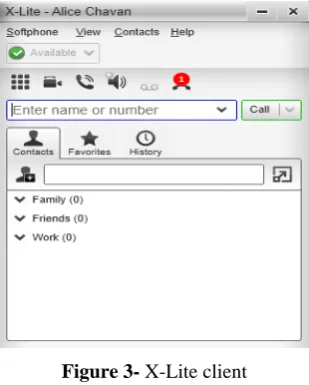
X-Lite SoftClient- X-Lite is a proprietary freeware VoIP soft phone that uses the Session Initiation Protocol. X-Lite is developed by CounterPath Corporation, a Vancouver based Software Company. This is SIP based soft client which is used to make and receive VOIP calls as shown in Figure-
Figure 3- X-Lite client
This is supported on Windows and Mac.
Sipdroid- This is Android based softclient which support standard SIP protocol. Sipdroid is a voice over IP (internet protocol, VoIP) application for the Android operating system using the Session Initiation Protocol. Sipdroid is open source free software released under the GNU General Public License. Upon receiving Emergency Call Notification message in PUBLISH message, it shows it in the notification window and starts ringing.
Figure- 4- sipdroid Client
If user wants to see more details of the Emergency call, user has to tap the notification window and then it will show emergency user details.
7. CONFIGURATION
Hardware-
1. LAN with minimum 3 ports.
2. 2 laptop devices with Windows 7
3. Android based mobile with Version 4.3 and above
Software-
1. Install X-Lite on 2 Laptop devices
2. Install modified sipdroid application in Android based mobile
3. Install Sailfin as IP-PBX and install SIP Servlet which will provide the emergency call notification feature.
Alice – Registered on his/her laptop device using X-Lite soft client. This user will make emergency call.
Bob – Registered on his/her laptop device using X-Lite soft client. This user will act as a PSAP user and hence receive the call.
Eve- Register on his/her Android based Mobile device using modified sipdroid application. This user will get the Emergency call notification when Alice makes an emergency call.
8. WORKING OF THE PROJECT
1. Emergency Call Origination by Alice
Figure 5- Call Flow showing Emergency Call Origination
2. Emergency call routing to Bob by IP-PBX-
Upon receiving INVITE from Alice IP-PBX SIP , it find that this is emergency call using the digit analysis table and then IP-PBX routes the call to Bob which is acting as PSAP user.
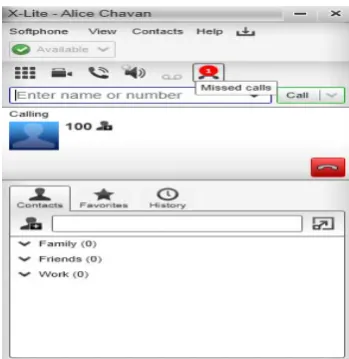
Bob soft phone X-Lite starts alerting.
Figure 6- Emergency call routing to PSAP
3. Emergency Call Notification to Eve by IP-PBX-
After call is routed to Bob, IP-PBX sends emergency call Notification to the Eve using PUBLISH SIP message with details of the emergency caller like Name of the caller, Type of Emergency and Location of the caller. Upon receiving PUBLISH messages, Eve mobile phone starts ringing and shows notification in the notification window of the mobile phone. To see emergency caller details, Eve need to open the Notification window and which show
Figure 7- Emergency Call Notification to Watcher
4. Emergency Call Notification Acknowledge by Eve-
Eve has to press Acknowledge button and then sipdroid stops the ringing.
5. Call Flow- Notification for Emergency call
6. SIP PUBLISH message-
PUBLISH sip:[email protected]:37673;transport=tcp SIP/2.0
Max-Forwards: 70 Content-Length: 289 Event: notify-feature-status Expires: 50
From:
<sip:[email protected]:62072>;transport=tcp;rinstance =86c28d071a53fa2a;tag=hxde33c1-k1
Call-Id: 192.168.1.100_102_7019846690870856124
<?xml version="1.0"?>
<feature name="emer-notify" status="alerting"> <call-Info>
<param pname="calling_name" pval="Alice Chavan"> <param pname="caller_loc" pval="SKN-G-R-50"> <param pname="alert_type" pval=" POLICE"> </Call-Info>
</feature-status>|#]
CONCLUSION
In this paper, I started with abstract details of how Emergency call Notification feature shall be implemented using different components and then gave more details about each component. Later on I gave details of working of the feature by giving snapshots. I have mentioned how Sailfin, X-Lite and Android based sipdroid works in achieving the project goal. Also provided some insight on the Sailfin and SIP Servelet container. Also explained emergency call notification feature and how it can be helpful.
REFERENCES
[1] J.Rosenberg,Schulzrinne H,Camarillo G, Johnston A,Peterson J, Sparks R, Handley M, and E. Schooler,”SIP: Session Initiation Protocol”, RFC 3261,June 2002.
[2] A.Johnston,M.Handley,S.Donovan,R.Sparks,C.Cunniangham,K.Sum mers.Session Initiation Protocol(SIP) Basic Call Flow,RFC 3665, December 2003.
[3] M.Handley,V.Jacobson, and C.Perkins, SDP: Session Description Protocol, IETF RFC 4566, July 2006.
[4] Sailfin SIP Servlet project, https://sailfin.dev.java.net/ [5] https://sailfin.java.net/
[6] SIP SERVICES USING SIP SERVLET API–THE INFOLINE
SERVICE by Pavel SEGEC
Journal of Information, Control and Management Systems, Vol.8, (2010), No.3
[7] http://developer.android.com/sdk/index.html
[8] Emegency Notification - Advanced PBX Feature using SIP protocol (IJCSIT)InternationalJournal of Computer Science and Information Technologies,Vol.5(1),2014,142-145 –Sunil S. ISSN:0975-9646
[9] COSMADOPOULOS, Y., KULKARNI, M.:SIP Servlet
Specification, version 1.1, 242 s., JSR 289 Expert Group, JSR-000289 Final Release, 2008
[10] RFC- 3903 - Session Initiation Protocol (SIP) Extension for Event State Publication