Correlated Sequence Attack on Reduced-Round
Simon-32/64 and Simeck-32/64
Raghvendra Rohit and Guang Gong
Department of Electrical and Computer Engineering, University of Waterloo, Waterloo, Ontario, N2L 3G1, CANADA.
{rsrohit, ggong}@uwaterloo.ca
Abstract. In this paper, we propose a novel cryptanalytic technique calledcorrelated sequence attackon block ciphers. Our attack exploits the properties of given key dependent sequences of lengthtto obtain other keyed sequences of same length withσ(0≤σ < t) computations of the non-linear function. We call these sequences (σ, t)-correlated sequences, and utilize them in a meet-in-the-middle attack for 2trounds. We apply this technique on Simon-32/64 and Simeck-32/64 block ciphers, con-struct (1,8)-correlated sequences and present the first 25-round attack on both ciphers. Next, we analyze the 8-th element of these sequences by considering the key scheduling algorithms and differential properties, and show that the attack can be improved by two rounds with the same complexities as of the 25-round attack. Overall, our technique is used to attack up to 27 rounds of both Simon-32/64 and Simeck-32/64 with a time complexity less than that of average exhaustive search and data complexity of 3.
Our attack extends the number of previously attacked rounds by 4 and has a success probability 1. This reduces the security margin of both these ciphers to 16%. Up to our knowledge, this is currently the best attack on Simon-32/64 and Simeck-32/64.
Keywords: Correlated sequences, Simon, Simeck, Meet-in-the-middle attack
1
Introduction
Over the past few years, lightweight cryptography has been actively discussed in academia and industry to target the challenges posed by resource constrained en-vironments such as RFID (EPC tags and NFC), IoT devices and sensor networks. As a result, several lightweight block ciphers such as HIGHT [15], PRESENT [7], LED [14], KATAN and KTANTAN [10], PICCOLO [23], SIMON and SPECK [5], SIMECK [30], SKINNY [6], GIFT [3] have been proposed. Recently, National Institute of Standards and Technology (NIST) intiated a call for the standard-ization of lightweight cryptographic primitives due to the noticeable lack of such standards [1,20].
in hardware due to its simple non-linear round function which consists of bitwise XORs and ANDs only. Later in CHES 2015, Yanget al. [30] proposed Simeck that has a smaller hardware footprint than Simon, by combining the good design components of both Simon and Speck.
Initially, the designers of Simon neither provided design rationale nor security evaluation, and Simeck adopts the similar structure. Accordingly, both ciphers attracted a lot of attention from the cryptographic community. Several papers have analyzed their security and investigated the parameter choices of the round function to get a deeper understanding of design rationale of these ciphers [2,8,
9,13,16,17,18,19,21,22,24,26,28,27,31]. Currently, the best cryptanalytic results on Simon and Simeck are reduced-round differential/linear and integral attacks. As a result, the average security margin1 of ten variants of Simon and three variants of Simeck is 29% and 20%, respectively [4,8,21,22]. The smaller versions, namely Simon-32/64 and Simeck-32/64, with blocksize and keysize, 32 and 64-bit, respectively, have security margin of 28%.
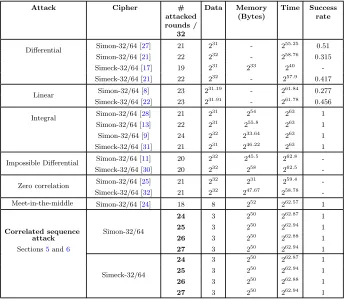
In this work, we propose a new attack calledcorrelated sequence attack and show that the application of this attack on Simon-32/64 and Simeck-32/64 re-duces their security margin to only 16%. Table 1 depicts a summary of the cryptanalytic results on Simon-32/64 and Simeck-32/64. In what follows, we list the contributions of this paper.
– We present a novel attack technique called correlated sequence attack on block ciphers. For a fixed key, we considertrounds of cipher as a keyed se-quence of lengtht, i.e, (s0, s1, . . . , st−1), wheresi is the state ati-th round.
Our attack exploits the properties of given keyed sequences of lengthtto ob-tain other keyed sequences of same length withσ(0≤σ < t) computations of the non-linear function. We call these sequences (σ, t)-correlated sequences. We show how to utilize these sequences in a meet-in-the-middle attack for 2t rounds. Unlike other attacks [16, 17, 22, 29], this attack works without the use of dedicated programming tools such as SAT/SMT or Mixed Integer Linear Programming solvers.
– We apply the method of correlated sequences on Simon-32/64 and Simeck-32/64, and provide the theoretical construction of (1,8)-correlated sequences. We show that all keyed sequences can be computed linearly from the keyed sequences whose 6-th element is zero.
– We use (1,8)-correlated sequences for 6 encryption and 6 decryption rounds in a meet-in-the-middle attack [12] and present the first 24 and 25 round key recovery attack on Simon-32/64 and Simeck-32/64.
– By incorporating the properties of correlated sequences, key scheduling al-gorithms and one round differentials, we show that 8-th element of these sequences can take atmost 215 values. As a result, we improve the key re-covery attack by 2 rounds with the same complexities as of the 25-round attack.
1
Table 1: Summary of attacks on Simon-32/64 and Simeck-32/64
Attack Cipher #
attacked rounds / 32 Data Memory (Bytes) Time Success rate
Differential Simon-32/64 [27] 21 2 31
- 255.25 0.51 Simon-32/64 [21] 22 232
- 258.76 0.315 Simeck-32/64 [17] 19 231
233
240 -Simeck-32/64 [21] 22 232
- 257.9
0.417
Linear Simon-32/64 [8] 23 2 31.19
- 261.84 0.277 Simeck-32/64 [22] 23 231.91
- 261.78 0.456
Integral Simon-32/64 [28] 21 2 31
254
263 1 Simon-32/64 [13] 22 231
255.8
263 1 Simon-32/64 [9] 24 232
233.64
263 1 Simeck-32/64 [31] 21 231 246.22 263 1
Impossible Differential Simon-32/64 [11] 20 2 32
245.5
262.8 -Simeck-32/64 [30] 20 232
258
262.5
-Zero correlation Simon-32/64 [25] 21 2 32
231 259.4 -Simeck-32/64 [32] 21 232
247.67
258.78 -Meet-in-the-middle Simon-32/64 [24] 18 8 252
262.57 1
Correlated sequence Simon-32/64
24 3 250
262.87 1 25 3 250
262.94 1
attack 26 3 250
262.88 1
Sections5and6 27 3 250
262.94 1
Simeck-32/64
24 3 250
262.87 1 25 3 250
262.94 1 26 3 250
262.88 1 27 3 250
262.94 1
The rest of the paper is organized as follows. In Section 2, we define the notations used throughout the paper and review the specifications of Simon and Simeck. Sections 3 and 4 present the definitions and basic properties of the correlated sequence attack and the construction of such sequences for Simon-32/64 and Simeck-32/64, respectively. In Section5, we show how we use correlated sequences to mount 25-round key recovery attack on Simon-32/64 and Simeck-32/64. In Section 6, we show that the attack can be improved by 2 rounds leading to 27 round key recovery attack. Finally, the paper is concluded in Section7.
2
Preliminaries
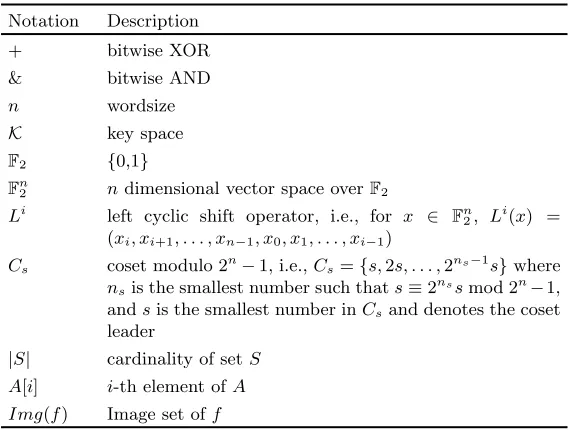
In this section, we give a brief description of Simon and Simeck. The notations used throughout the paper are defined in Table2.
2.1 Specification of Simon and Simeck
Table 2: Notations
Notation Description
+ bitwise XOR
& bitwise AND
n wordsize
K key space
F2 {0,1}
Fn2 ndimensional vector space overF2
Li left cyclic shift operator, i.e., for x ∈ Fn2, Li(x) =
(xi, xi+1, . . . , xn−1, x0, x1, . . . , xi−1)
Cs coset modulo 2n−1, i.e.,Cs={s,2s, . . . ,2ns−1s}where
nsis the smallest number such thats≡2nssmod 2n−1,
andsis the smallest number inCsand denotes the coset
leader
|S| cardinality of setS A[i] i-th element ofA Img(f) Image set off
adopts a Non-Linear Feedback Shift Register (NLFSR) based structure as depicted in Figure1. At each round, the state is updated non-linearly us-ing the function f(a,b,c)(x) = La(x)&Lb(x) +Lc(x) where (a, b, c) = (8,1,2). For r-round cipher, the (i+ 2)-th element of NLFSR sequence is given by si+2=f(8,1,2)(si+1) +si+ki where ki ∈ Fn2 is the i-th round subkey2 and 0≤i < r. Finally, the ciphertext is ther-th state of NLFSR, i.e., (sr+1, sr).
s1 s0
f(8,1,2)
n n kr−1,· · ·, k1, k0
n n
Fig. 1: Simon block cipher
Simeck-2n/mnwas proposed in CHES 2015 by Yanget al.[30] and adopts a similar structure as Simon. However, it has more efficient and compact hardware implementation because of reuse of the round function in the key scheduling algorithm. The shift parameters of Simeck are given by (a, b, c) = (5,0,1).
2
Forn= 16 and m= 4, r = 32 and the subkeys for i≥4 are calculated as follows.
Simon-32/64 key scheduling algorithm. ki+4 = Zi−4 + ki + ki+1 + L15(ki+1) +L13(ki+3) +L12(ki+3).
Simeck-32/64 key scheduling algorithm.ki+4=Zi−4+f(5,0,1)(ki+1) +ki.
The attack presented in this paper is not affected by the constants Zi and
the reader may refer to [5, 30] for more details of their respective key schedul-ing algorithms. From now onwards, we refer tof(a,b,c) as Simon-like non-linear function unless the parameter set (a, b, c) is explicitly mentioned.
3
Correlated Sequence Attack
In this section, we formally introduce the correlated sequence attack. We first define the correlated sequences of block ciphers. Next, we show how to use such sequences in a meet-in-the-middle (MitM) attack.
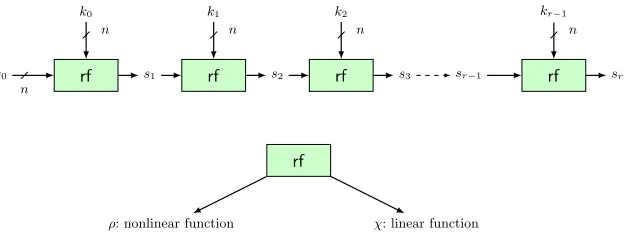
Consider an n-bit block cipher with r rounds and mn-bit master key k= (k0, k1, . . . , km−1) as depicted in Figure 2. Let si denote the state at i-th
round. Then, for 0≤i < r,si+1=rf(si, ki) whererfdenotes the round function,
and is generally a composition of two functions, namely i) a linear function χ and ii) a non-linear functionρ.
rf rf rf rf
s0 s1 s2 s3 sr−1 sr
k0 k1 k2 kr−1
n n n n
n
rf
ρ: nonlinear function χ: linear function
Fig. 2: Generic diagram of a block cipher
3.1 Correlated sequences
Definition 1 (Keyed sequence). Given k and 1 ≤ t < r. We say S(k,t) = (s0, s1, . . . , st−1) is a keyed sequence of length t, if si+1 = rf(si, ki) for
0≤i < t−1.
From Definition1, it is clear that we need to compute rf t times to obtain S(k,t). This implies thatρis computedttimes in total. Thus, to obtain another
sequenceS(k0,t)of same lengtht, the worst case is to computeρexactlyttimes. The idea of correlated sequences is “Given S(k,t) and k0 6= k, obtain the
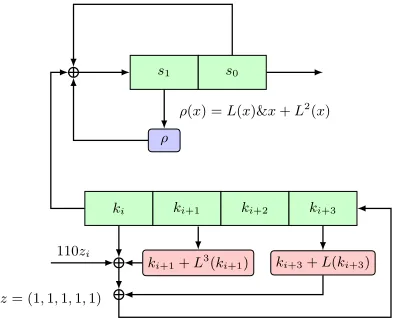
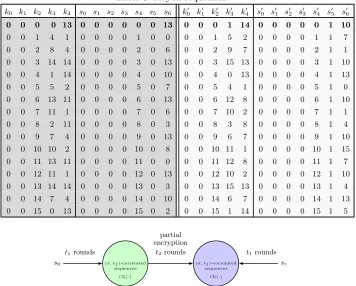
Example 1. Consider a 4-bit toy Simon-like block cipher with 8-bit blocksize and 16-bit key as depicted in Figure3. Let the non-linear function is given by ρ(x) = L(x)&x+L2(x) where x ∈
F42. The length seven keyed sequences are given in Table3. We note the following observations from Table3.
1. For allk, s4=k2,s5= 0 ands6=k2+k4. 2. For allk0,s04=k20,s50 = 1 ands06=k02+k40 +ρ(1). 3. For each row, k03=k3+ 1 ands06=s6+k4+k04+ρ(1).
s1 s0
ρ
ρ(x) =L(x)&x+L2 (x)
ki ki+1 ki+2 ki+3
ki+1+L3(ki+1) ki+3+L(ki+3) 110zi
z= (1,1,1,1,1)
Fig. 3: 4-bit toy Simon-like cipher
We now define the correlated sequences in Definition2.
Definition 2 ((σ, t)-correlated sequences). GivenS(k,t) and0≤σ < t. We sayS(k,t)andS(k0,t)are(σ, t)-correlated sequences ifS(k0,t)can be obtained from S(k,t)by computing the non-linear functionρexactly σ times.
Remark 1. σ= 0 =⇒ S(k,t)andS(k0,t)are linearly related.
Definition 3 (Correlated keys). Given S(k,t). We define correlated keys as the setCK(k) ={k0 |S(k,t) andS(k0,t)are (0, t)-correlated sequences}.
For example, in Table 3, for each row S(k,t) and S(k0,t) are (1,7) correlated sequences,|CK((0,0,0,0))|= 15 (gray colored rows) and|CK((0,0,0,1))|= 15 (light gray rows). Thus, to obtain all 32 sequences, we only need to compute S((0,0,0,0),5) andS((0,0,0,1),5)which requires only one computation of ρ.
3.2 MitM attack using correlated sequences
Let (s0, sr) denote the plaintext and ciphertext pair encrypted with the
Table 3: Keyed sequences
k0 k1 k2 k3 k4 s0 s1 s2 s3 s4 s5 s6 k00 k10 k02 k03 k40 s00 s01 s02 s03 s04 s05 s06
0 0 0 0 13 0 0 0 0 0 0 13 0 0 0 1 14 0 0 0 0 0 1 10
0 0 1 4 1 0 0 0 0 1 0 0 0 0 1 5 2 0 0 0 0 1 1 7
0 0 2 8 4 0 0 0 0 2 0 6 0 0 2 9 7 0 0 0 0 2 1 1
0 0 3 14 14 0 0 0 0 3 0 13 0 0 3 15 13 0 0 0 0 3 1 10
0 0 4 1 14 0 0 0 0 4 0 10 0 0 4 0 13 0 0 0 0 4 1 13
0 0 5 5 2 0 0 0 0 5 0 7 0 0 5 4 1 0 0 0 0 5 1 0
0 0 6 13 11 0 0 0 0 6 0 13 0 0 6 12 8 0 0 0 0 6 1 10
0 0 7 11 1 0 0 0 0 7 0 6 0 0 7 10 2 0 0 0 0 7 1 1
0 0 8 2 11 0 0 0 0 8 0 3 0 0 8 3 8 0 0 0 0 8 1 4
0 0 9 7 4 0 0 0 0 9 0 13 0 0 9 6 7 0 0 0 0 9 1 10
0 0 10 10 2 0 0 0 0 10 0 8 0 0 10 11 1 0 0 0 0 10 1 15
0 0 11 13 11 0 0 0 0 11 0 0 0 0 11 12 8 0 0 0 0 11 1 7
0 0 12 11 1 0 0 0 0 12 0 13 0 0 12 10 2 0 0 0 0 12 1 10
0 0 13 14 14 0 0 0 0 13 0 3 0 0 13 15 13 0 0 0 0 13 1 4
0 0 14 7 4 0 0 0 0 14 0 10 0 0 14 6 7 0 0 0 0 14 1 13
0 0 15 0 13 0 0 0 0 15 0 2 0 0 15 1 14 0 0 0 0 15 1 5
s0 sr
t1rounds t2rounds t1rounds partial
encryption
(σ, t1 )-correlated sequences
CK(·)
(σ, t1 )-correlated sequences
CK(·)
Fig. 4: MitM attack using correlated sequences
fort2rounds starting fromt1-th round and match the state values at (t1+t2)-th round.
Let Tf (resp. Tb) denote the number of computations of ρ to construct
(σ, t1)-correlated sequences and their corresponding CK(·) in forward (resp. backward) direction. Then, the time complexity in terms of the number of com-putations ofρis given byTonline=Tf+Tb+ 2|K|×tr2. Clearly,Tonline<2|K|.
Remark 2. The above attack returns 2n(m−1)keys that maps0tos
r. The correct
key can then be found out by performing an exhaustive search on the remaining knowndmn
n e −1 plaintext-ciphertext pairs.
4
Correlated Sequences of Simon-2
n
/4
n
and
Simeck-2
n
/4
n
4.1 Properties of Simon-like non-linear function
Property 1. Let s be the coset leader corresponding to the coset Cs, then for
0≤i <|Cs|, we have
1. f(a,b,c)(Li(s)) =Li(f(a,b,c)(s))
2. f(a,b,c)(s) =La−1(s) +Lb−1(s) +Lc−1(s), ifs= 011. . .1
| {z } n
.
Property 2. Let s = 0101. . .01
| {z } n
and a, b are not both simultaneously even or
odd, then
f(a,b,c)(s) =
(
s ifc≡0 mod 2 L(s) otherwise
Properties1 and 2 imply that we need to compute the values of f(a,b,c) for 2n−1
n coset leaders only. However, asf(a,b,c)is quadratic and the only linear term
involved in it isLc(.), we havef
(a,b,c)(x) =Lc(x) +z for all x∈Fn2 and some constant z ∈ Fn
2. As a result, we can partition the coset leaders based on the values of z. Since, f(a,b,c) is linear on each partition, we call such partition as z-linear segment set and formally define it in Definition4as follows.
Definition 4 (z-linear segment set). The z-linear segment set of f(a,b,c) is the set of coset leaders CLz given byCLz={s|f(a,b,c)(s) +Lc(s) =z}.
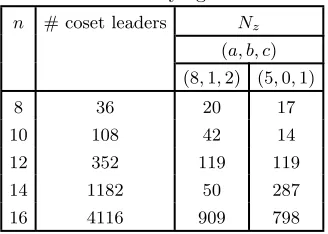
Table 4 lists thez-linear segment sets for n= 8 and (a, b, c) = (8,1,2), while the number ofz-linear segments (denoted byNz) for varyingnare presented in
Table5. (Note that sincen= 8, the shifts (8,1,2) is equivalent to (0,1,2).)
Example 2. In Table 4, consider z = 2 and 3 ∈ CL2. Then, for all x∈C3={3,6,12,24,48,96,192,129},f(8,1,2) is computed as follows.
x f(8,1,2)(x)
3 L2(3) + 2 = 14 6 L2(6) +L(2) = 28 12 L2(12) +L2(2) = 56
24 L2(24) +L3(2) = 112 48 L2(28) +L4(2) = 224 96 L2(96) +L5(2) = 193
192 L2(192) +L6(2) = 131
Table 4:z-linear segment sets forn= 8 and (a, b, c) = (8,1,2)
z CLz z CLz
0 {0, 1, 5, 9, 17, 21, 37, 85} 2 {3, 11, 19, 43} 6 {7, 23, 39, 87} 8 {13, 45}
14 {15} 16 {25}
18 {27, 91} 24 {29}
30 {95, 31} 32 {53}
34 {51} 38 {55}
50 {59} 56 {61}
62 {63} 78 {111}
102 {119} 126 {127}
255 {255} 13 {47}
Table 5: Number of z-linear segment sets for varyingn
n # coset leaders Nz
(a, b, c) (8,1,2) (5,0,1)
8 36 20 17
10 108 42 14
12 352 119 119
14 1182 50 287
16 4116 909 798
4.2 Construction of (1,8)-correlated sequences
Let (s0, s1) be any random 2n-bit value and K(k0,k1) =
{(k0, k1, k2, k3) |(k2, k3) ∈ Fn2 ×Fn2} be the set of 22n keys with k0 and k1 fixed to some constant value. Fort≥6 and 0≤i <2n, define
P(i, t,K(k0,k1)) ={(k, S(k,t))|k∈K(k0,k1) ands5=i}
as the set of keys and their corresponding sequences which mapss5 toi. We start with the simpler case, i.e., s5 = 0. First, we construct P(0,8,K(k0,k1)) and then show how to constructP(i,8,K(k0,k1)) using the knowl-edge ofP(0,8,K(k0,k1)).
P(0,7,K(k0,k1)). For each step, we denote the number of computations off(a,b,c) byTstep. We now present the details of each step as follows.
Step 1: Finding P(0,6,K(k0,k1)).We note that ∀k ∈K(k0,k1), S(k,4) is a con-stant sequence and requires only 2 computations of f(a,b,c). Hence, finding the keys for which s5 = 0 is equivalent to solve f(a,b,c)(X +k2) = k3+s3 where X =f(a,b,c)(s3) +s2. We use z-linear segments (see Definition4) to solve this equation. As a result,Tstep1 = 2 +Nz.
Remark 3. |P(0,6,K(k0,k1))|= 2
n, ass4=X+k2can take all 2n distinct values.
Step 2: Obtaining P(0,7,K(k0,k1)) from P(0,6,K(k0,k1)). Let (k, S(k,6)) ∈ P(0,6,K(k0,k1)) and consider the following relation s4 + s6. We have s4+s6=s4+ f(a,b,c)(s5) +s4+k4 = s4+ 0 +s4+k4 =⇒ s6 = s4+k4.
Thus,Tstep2 = 0.
Step 3: Obtaining P(0,8,K(k0,k1)) from P(0,7,K(k0,k1)). Let (k, S(k,7)), (k0, S(k0,7)) ∈ P(0,7,K(k
0,k1)) be such that s
0
4 = s6. Thus, f(a,b,c)(s6) = f(a,b,c)(s04) = k03+s3 (follows from Step 1). We note that such a pair always exists. This follows directly from Remark 3. We now evaluate s7 as follows: s7=f(a,b,c)(s6) +s5+k5=s3+k30 + 0 +k5=s3+k03+k5. Hence,Tstep3 = 0.
4.2.2 ComputingP(i,8,K(k0,k1))fromP(0,8,K(k0,k1)).We could use the sim-ilar construction shown above to get P(i,8,K(k0,k1)) for 1 ≤ i <2
n. However,
this would require 2n(2 +Nz) computations of f(a,b,c) in total. In Theorem 1, we show how to reduce this number to (2 + 2Nz).
Lemma 1. LetI(k0,k1)={k3|((k0, k1, k2, k3), S((k0,k1,k2,k3),6))∈P(0,6,K(k0,k1))} 3
and k= (k0, k1,0,I(k0,k1)[0]). Let 1 ≤k2 <2
n andk0 = (k0, k1, k2,I
(k0,k1)[k2]) be such thatk6=k0. Then, the following hold.
1. S(k,4)=S(k0,4)
2. s04=X+k2, where X=f(a,b,c)(s3) +s2 3. s0
6=s6+k4+k04+k2 4. s07=s3+k05+I(k0,k1)[k2+k
0
4] 5. s7=s3+k5+I(k0,k1)[k4] 6. |CK(k)|= 2n−1
Proof. 1. Since s0, s1, s2 and s3 are independent of k3, it follows that S(k,4)=S(k0,4).
2. We haves04=f(a,b,c)(s03) +s02+k2=f(a,b,c)(s3) +s2+k2 =⇒ s04=X+k2. 3. Consider the following relation s06+s6.
s06+s6=f(a,b,c)(s05) +s
0
4+k
0
4+f(a,b,c)(s5) +s4+k4 =s04+k04+s4+k4
=X+k2+k40 +X+k4 =⇒ s06=s6+k4+k40 +k2.
3 |
I(k0,k1)|= 2
n
4. Note that by Step 3 of construction of P(0,8,K(k0,k1)), we have s07=s3+k05+k003. Hence, we need to find the index j such that
I(k0,k1)[j] =k
00
3. This is equivalent to finding j for which s004 = s06. Since, s06+s04=k04 =⇒ j=k02+k04=k2+k04.
5. Follows directly from part 4.
6. The proof is trivial, as for all 2n−1 values ofk2,s0
6ands07can be computed
linearly. ut
Theorem 1. Let k = (k0, k1,0,I(k0,k1)[0]), (k, S(k,6)) ∈ P(0,6,K(k0,k1)) and ˜
k= (k0, k1,0,I(k0,k1)[0] +i)where 1≤i <2
n. Then, the following hold.
1. S(k,5)=S(˜k,5)
2. (˜k, S(˜k,6))∈P(i,6,K(k0,k1))
3. s6˜ =s6+k4+ ˜k4+f(a,b,c)(i)
4. s˜7=s3+i+ ˜k5+I(k0,k1)[ ˜k2+ ˜k4+f(a,b,c)(i)] 5. |CK(k)|=|CK(¯k)|= 2n−1
Proof. The proof of 1, 2, 3 and 4 is similar to Lemma1. For part 5, note that for 1≤j <2n, (k0, k1, j,I
(k0,k1)[j])∈CK(k) ⇐⇒ (k0, k1, j,I(k0,k1)[j] +i) ∈
CK(¯k). This follows because s5+ ¯s5 = k3+ ¯k3 =⇒ k3 + ¯k3 = i. Thus,
|CK(k)|=|CK(¯k)|= 2n−1. ut
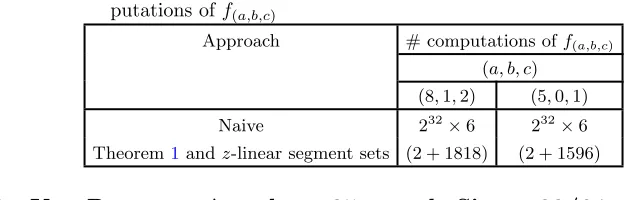
A brief comparison of different approaches with the number of computations off(a,b,c) to obtainP(i,8,K(k0,k1)) is provided in Table6.
Table 6: Comparison of different approaches with the number of com-putations off(a,b,c)
Approach # computations off(a,b,c)
(a, b, c) (8,1,2) (5,0,1)
Naive 232×6 232×6
Theorem1andz-linear segment sets (2 + 1818) (2 + 1596)
5
Key Recovery Attack on 25 rounds Simon-32/64 and
Simeck-32/64
In this section, we show the key recovery attack procedure on 25-round4 Simon-32/64 and Simeck-32/64. We utilize (1,8)-correlated sequences as de-scribed in Section4for 6 encryption and 6 decryption rounds in a MitM attack. As a result, we do partial encryption for 12 rounds, starting from round 6 and match the left half of state, i.e.,s19at 19-th round with the stored value.
In Algorithm 1, we present a generic procedure for recovering the secret key. It takes input as 3 known plaintext-ciphertext pairs encrypted either by
4
Simon-32/64 or Simeck-32/64 and returns the secret key. The attack procedure is divided into two phases, namely i)Offline phaseand ii)Online phase. The time complexities of both phases are given byTof f lineandTonline, where a subscript
(for e.g.,Tonline
i ) denotes the time complexity ofi-th step of the corresponding
phase. In what follows, we present the details of both phases.
Algorithm 1 Generic secret key finding algorithm
1: Input:{(s0
0, s01),(s025, s260 ),(s10, s11),(s125, s126),(s20, s21),(s225, s226)}
2: Output: secret keyk
3: CREATED(s025, s026) . Tof f line
4: functionFIND SECRET KEY(Input) . Tonline
5: K= EXTRACT KEYS(s00, s01, s025, s026)
6: fork¯∈Kdo
7: if Encrypt(s10, s11) equals (s125, s126)then
8: K1.append(¯k)
9: end if
10: end for
11: fork¯∈K1 do
12: if Encrypt(s20, s 2
1) equals (s 2 25, s
2 26)then
13: K2.append(¯k)
14: end if
15: end for
16: return(K2={k})
17: end function
5.1 Offline phase
In this phase, we construct 232 data structures that are used in the online phase to compute the value ofs19 for all 264 keys without doing any nonlinear oper-ation. For a fixed k24 and k23, we denote such a structure by D(k24,k23) where each structure has 3 rows, i.e.,row0,row1androw3. By Theorem1, we observe that for 0 ≤ i < 216, s19 can be computed linearly if s23, I
(k24,k23) and the index k22+k20+f(a,b,c)(i) are known for P(i,6,K(k24,k23))
5. Thus, we assign
D(k24,k23).row0 ← s23 and D(k24,k23).row1 ← I(k24,k23). To find the index value for each key, it is enough to store the values of ˜s6+f(a,b,c)(s23) + s24+ ˜k4
in D(k24,k23).row2, where ˜k = (k24, k23,0,I(k24,k23)[0] + i). This follows be-cause (˜k, S(˜k,8)) ∈ P(i,8,K(k24,k23)) and |CK(k)|= |CK(¯k)|= 2
16−1 (using Theorem1).
The function CREATEDin Algorithm2construct 232data strutures for all values ofk24andk23, while the function COMPUTEs19 evaluates the value of s19 for any key using the stored structures.
Complexities of offline phase. The memory required to store a
sin-gle structure is (1 + 216 + 216) × 16 bit. Thus, the total memory is given by 232×(1 + 216+ 216)×16 ≈ 250 bytes. The time complex-ity in terms of the number of computations of f(a,b,c) is given by
5
Algorithm 2 Constructing data structures for 6 decryption rounds
1: functioncreate D(s25, s26)
2: fork24= 0 to 216−1do
3: fork23= 0 to 216−1do
4: D(k24,k23).row0←s23 . T
of f line
0
5: D(k24,k23).row1←I(k24,k23) . T
of f line
1
6: TEMP = []
7: fori= 0 to 216−1do . T2of f line
8: ˜k= (k24, k23,0,I(k24,k23)[0] +i)
9: TEMP.append( ˜s6+X+ ˜k4) . X=f(a,b,c)(s23) +s24
10: end for
11: D(k24,k23).row2←TEMP
12: end for
13: end for
14: end function
Tof f line= 232(T0of f line+T1of f line+T2of f line) = 232(252 + Nz
25 +
Nz
25). From Table5, we haveNz = 909 (resp. 798) for Simon-32/64 (resp. Simeck-32/64).
Hence, the respectiveTof f lineare 238.19 and 238.
Algorithm 3 Obtainings19 from stored data structures
1: functioncomputes19(k24, k23, k22, k21, k20, k19)
2: if k22= 0then
3: δ=k21
4: else
5: δ=k21+D(k24,k23).row1[k22] 6: end if
7: s19=D(k24,k23).row0+δ+k19+D(k24,k23).row1[k22+k20+D(k24,k23).row2[δ]] 8: return(s19)
9: end function
5.2 Online phase
In this phase, we first find the set of keys that maps (s0
0, s01) to (s025, s026). The algorithmic details of this step is shown in Algorithm 4. The function EXTRACT KEYS in Algorithm 4 uses Lemma 1 and Theorem 1 in steps 9-12 and 22-25, respectively, and returns the set (K) of 248 keys6. The correct secret key can then be obtained by doing brute force search onKusing another two known plaintext-ciphertext pairs.
6
Complexity of online phase.The time complexity is calculated as follows:
T0online= 2 25
|{z}
2-round encryption
+ Nz
25
|{z}
# computations off(a,b,c)to getP(0,6,K(k0,k1 ))
T1online= 216× 12 25
| {z }
12-round encryption
T2online= Nz 25
|{z}
# computations off(a,b,c)to getP(i,8,K(k0,k1 ))
T3online= (232−216)× 12 25
| {z }
12-round encryption
Tonline= 232(T0online+T1online+T2online+T3online) + 248+ 216
| {z }
brute force
≈232(2 + 2Nz 25 + 2
32×12 25) + 2
48+ 216
≈264×12
25 ≈2 62.94.
The time complexity of complete attack is dominated byTonline≈262.94.
Remark 4. For the 24-round attack, the data and memory complexities are the same. However, the time complexity is 264×11
24 ≈2 62.87.
6
Improving Key Recovery Attack by 2 Rounds
In this section, we show how to improve the key recovery attack presented in previous section by 2 rounds with the same complexities as of the 25-round attack. For a fixed partition P(i,8,K(k0,k1)), we incorporate the properties of key scheduling algorithms (KSA) and one round differentials and show that P(i,9,K(k0,k1)) can be computed from P(i,8,K(k0,k1)) by computing f(a,b,c) at most 215 times. As a result, both forward and middle rounds can be extended by one round each, i.e., partial encryption starts from round 7 and matching is done at 20-th round. The results of the following two properties can be obtained directly by the definition ofP(i,8,K(k0,k1)) and key scheduling algorithms. We present the main result of this section in Lemma2.
Property 3 (Simon KSA and P(i,8,K(k0,k1))). Let n = 16, F : F
n
2 → F
n
2 be such that F(x) = f(8,1,2)(x+ ∆y) +x+Ln−1(x) +Ln−6(y) +Ln−8(y), where
y=I(k0,k1)[x] and ∆y=L
n−3(y) +Ln−4(y). Then,|Img(F(x))|≤2n−1.
Property 4 (Simeck KSA).Letn≥4,ki+4=f(5,0,1)(ki+1) +ki andi≥4. Then
Algorithm 4 Extracting keys that maps (s0, s1) to (s25, s26)
1: functionextract keys(s0, s1, s25, s26)
2: K= []
3: fork0= 0 to 216−1do
4: fork1= 0 to 216−1do
5: ObtainI(k0,k1) ands3 . T
online
0
6: k= (k0, k1,0,I(k0,k1)[0]) 7: s6=s4+k4
8: s7=s3+I(k0,k1)[k4]
9: forj= 0 to 216−1do .Lemma1
10: k0= (k0, k1, j,I(k0,k1)[j]) . j= 0 =⇒ k=k
0
, s06=s6, s07=s7
11: s06=s6+k04
12: s07=s3+k05+I(k0,k1)[j+k
0 4]
13: Encrypt (s07, s 0
6) for 12 rounds and gets 0
19 . T1online
14: if s019==computes19(k024, k230 , k022, k021, k020, k019)then
15: K.append(k0)
16: end if
17: end for
18: forz inz-linear segmet setsdo
19: forx∈CLz andx6= 0do
20: fori= 0 to|Cx|−1do
21: T =Lc(Cx[i]) +Li(z) . T2online
22: forj= 0 to 216−1do .Theorem1
23: ˜k= (k0, k1, j,I(k24,k23)[j] +Cx[i]) 24: s˜6=s6+k4+ ˜k4+T
25: s˜7=s3+Cx[i] + ˜k5+I(k0,k1)[j+ ˜k4+T]
26: Encrypt ( ˜s7,s˜6) for 12 rounds and get ˜s19 . T3online
27: if s˜19==computes19(˜k24,˜k23,˜k22,˜k21,˜k20,˜k19)then
28: K.append(˜k)
29: end if
30: end for
31: end for
32: end for
33: end for
34: end for
35: end for
36: return(K)
37: end function
Property 5 (Differential [16]). Letn≥4, ∆∈Fn2 be fixed. Then,
|Img(f(a,b,c)(x) +f(a,b,c)(x+ ∆))|≤2n−1.
Lemma 2. Given n = 16 and (a, b, c) = (8,1,2)/(5,0,1). Then, ∀(k, S(k,8)) ∈
P(i,8,K(k0,k1)),s7 can take atmost2
n−1 values.
– Case 1 : (a, b, c) = (8,1,2)
s7=f(8,1,2)(s6) +s5+k5=f(8,1,2)(s4+k4+f(8,1,2)(i)) +i+k5
=f(8,1,2)(X+k2+k4+f(8,1,2)(i)) +i+k5, X =f(8,1,2)(s3) +s2
=f(8,1,2)(C0+k2+ (L13(k3) +L12(k3))
+C1+k2+L15(k2) +L10(k3) +L8(k3) (Simon KSA)
HereC0andC1 are constants and given by:
C0=X+f(8,1,2)(i) +k0+k1+L15(k1) +Z0
C1=i+Z1+L13(Z0) +L12(Z0) +L13(k0) +L12(k0) = +k1+L13(k1) +L11(k1)
By Property3, s7can take atmost 2n−1 values.
– Case 2 : (a, b, c) = (5,0,1)
s7=f(5,0,1)(s6) +s5+k5=f(5,0,1)(s4+k4+f(5,0,1)(i)) +i+k5
=f(5,0,1)(X+k2+k4+f(5,0,1)(i)) +i+k5, X =f(5,0,1)(s3) +s2
=f(5,0,1)(∆ +k2) +C1+f(5,0,1)(k2) (Property4)
Similar to previous case, ∆ andC1are constants and given by:
∆ =X+f(5,0,1)(i) +k0+f(5,0,1)(k1) +Z0
C1=i+Z1+k1
The proof then follows from Property5. ut
From Lemma2, we note that for each partition P(i,8,K(k0,k1)),s7 can take atmost 215 values. In Algorithm 5, we compute the indices for which s7 values are same. We only evaluate f(a,b,c)(s7) for the distinct indices only. Hence, 215 computations of f(a,b,c) are needed to obtain P(i,9,K(k0,k1)). We incorporate Algorithm5in the online phase of the attack. The partial encryption then starts from (s8, s7) and matching is done at 20-th round.
Algorithm 5 Equal indices algorithm
1: functionget equal index(P(i,8,K(k0,k1)),I(k0,k1)) 2: INDICES = []
3: T =f(a,b,c)(i)
4: forj= 0 to 216−1do
5: k= (k0, k1, j,I(k0,k1)[j])
6: INDICES.append(I(k0,k1)[j+k4+T] +k5)
7: end for
Attack complexities.The data and memory complexities are same as 25-round attack. The time complexity is given by:
Tonline= 232(T0online+T
online
1 +T
online
2 +T
online
3 )
+ 248+ 216
| {z }
brute force
≈232(2 + 2Nz 27 + 2
31× 1 27+ 2
32×13 27) + 2
48+ 216
≈264×13
27 ≈2 62.94.
Remark 5. The complexities of 26-round attack are calculated accordingly.
7
Concluding Remarks
In this work, we have proposed correlated sequence attack and demonstrated its application on two lightweight block ciphers Simon-32/64 and Simeck-32/64. As a result, we presented the first 24, 25, 26, 27-round attack on these ciphers with data and memory complexities of 3 and 250 bytes, respectively. The time complexities are 262.87(resp. 262.94) for 24, 26 (resp. 25, 27)-round attacks.
We observe that correlated sequences play a crucial role in the security eval-uation, as improving the length of correlated sequences by 1 extends the number of attacked rounds by 2. Furthermore, we expect that the presented attack on Simon-32/64 and Simeck-32/64 can be improved by uplifting the coset leaders properties from the round function to partitions P(i,9,K(k0,k1)). It should be noted that our cryptanalytic technique has similar applications to other variants of Simon and Simeck, which we plan to investigate in our future work.
References
[1] NIST lightweight cryptography standardization process. https://csrc. nist.gov/CSRC/media/Projects/Lightweight-Cryptography/documents/ Draft-LWC-Submission-Requirements-April2018.pdf. Accessed 9 May 2018. [2] Abed, F., List, E., Lucks, S., and Wenzel, J. Differential cryptanalysis of
round-reduced simon and speck. In: Cid C., Rechberger C. (eds.), FSE 2014. LNCS, vol. 8540, pp. 525–545. Springer, Heidelberg (2014)
[3] Banik, S., Pandey, S. K., Peyrin, T., Sasaki, Y., Sim, S. M., and Todo, Y.
Gift: a small present. In: Fischer W., Homma N. (eds), CHES 2017. LNCS, vol. 10529, pp. 321–345. Springer, Cham (2017)
[4] Beaulieu, R., Shors, D., Smith, J., Treatman-Clark, S., Weeks, B., and Wingers, L. Notes on the design and analysis of simon and speck. Cryptology
ePrint Archive, Report 2017/560, 2017. https://eprint.iacr.org/2017/560. pdf.
[5] Beaulieu, R., Shors, D., Smith, J., Treatman-Clark, S., Weeks, B., and Wingers, L.The simon and speck families of lightweight block ciphers. Cryptol-ogy ePrint Archive, Report 2013/404, 2013.http://eprint.iacr.org/2013/404. [6] Beierle, C., Jean, J., K¨olbl, S., Leander, G., Moradi, A., Peyrin, T.,
Sasaki, Y., Sasdrich, P., and Sim, S. M.The skinny family of block ciphers and
[7] Bogdanov, A., Knudsen, L. R., Leander, G., Paar, C., Poschmann, A.,
Robshaw, M. J. B., Seurin, Y., and Vikkelsoe, C. PRESENT: An ultra-lightweight block cipher. In: P. Paillier and I. Verbauwhede (eds.), CHES 2007. LNCS, vol. 4727, pp. 450–466. Springer, Heidelberg (2007)
[8] Chen, H., and Wang, X. Improved linear hull attack on round-reduced simon with dynamic key-guessing techniques. In: Peyrin T. (eds), FSE 2016. LNCS, vol. 9783, pp. 428–449. Springer, Heidelberg (2016)
[9] Chu, Z., Chen, H., Wang, X., Dong, X., and Li, L.Improved integral attacks on simon32 and simon48 with dynamic key-guessing techniques. Security and Communication Networks 2018. https://doi.org/10.1155/2018/5160237. [10] De Canni`ere, C., Dunkelman, O., and Kneˇzevi´c, M. KATAN and
KTAN-TAN — A family of small and efficient hardware-oriented block ciphers. In: Clavier C., Gaj K. (eds.), CHES 2009. LNCS, vol. 5747, pp. 272–288. Springer, Heidelberg (2009)
[11] Derbez, P., and Fouque, P.-A. Automatic search of meet-in-the-middle and impossible differential attacks. n: Robshaw M., Katz J. (eds), Crypto 2016. LNCS, vol. 9815, pp. 157–184. Springer, Heidelberg (2016)
[12] Diffie, W., and Hellman, M. E. Special feature exhaustive cryptanalysis of the nbs data encryption standard. Computer 10(6), pp. 74–84. (1977)
[13] Fu, K., Sun, L., and Wang, M.New integral attacks on simon. IET Information Security 11(5), pp. 277–286. (2016)
[14] Guo, J., Peyrin, T., Poschmann, A., and Robshaw, M.The led block cipher. In: B. Preneel and T. Takagi (eds.), CHES 2011. LNCS, vol. 6917, pp. 326–341. Springer, Heidelberg (2011)
[15] Hong, D., Sung, J., Hong, S., Lim, J., Lee, S., Koo, B.-S., Lee, C., Chang, D., Lee, J., Jeong, K., et al. HIGHT: A new block cipher suitable for
low-resource device. In: Goubin L., Matsui M (eds.), CHES 2006. LNCS, vol. 4249, pp. 46–59. Springer, Heidelberg (2006)
[16] K¨olbl, S., Leander, G., and Tiessen, T. Observations on the simon block cipher family. In: R. Gennaro and M. Robshaw (eds.), CRYPTO 2015. LNCS, vol. 9215, pp. 258–269. Springer, Heidelberg (2015)
[17] K¨olbl, S., and Roy, A. A brief comparison of simon and simeck. In: Bogdanov A. (eds), LightSec 2016. LNCS, vol. 10098, pp. 69–88. Springer, Cham (2016) [18] Kondo, K., Sasaki, Y., and Iwata, T. On the design rationale of simon block
cipher: integral attacks and impossible differential attacks against simon variants. In: Manulis M., Sadeghi AR., Schneider S. (eds), ACNS 2016. LNCS, vol. 9696, pp. 518–536. Springer, Cham (2016)
[19] Liu, Z., Li, Y., and Wang, M. Optimal differential trails in simon-like ciphers. IACR Transactions on Symmetric Cryptology 2017 1, pp. 358–379. (2017) http: //dx.doi.org/10.13154/tosc.v2017.i1.358-379
[20] McKay, K., Bassham, L., S¨onmez Turan, M., and Mouha, N.: Report on lightweight cryptography (NISTIR8114). (2017)
[21] Qiao, K., Hu, L., and Sun, S. Differential analysis on simeck and simon with dynamic key-guessing techniques. In: Camp O., Furnell S., Mori P. (eds), ICISSP 2016. LNCS, vol. 691, pp. 64–85. Springer, Cham (2016)
[23] Shibutani, K., Isobe, T., Hiwatari, H., Mitsuda, A., Akishita, T., and
Shirai, T. Piccolo: an ultra-lightweight blockcipher. In: Preneel B., Takagi T. (eds), CHES 2011. LNCS, vol. 6917, pp. 342–357. Springer, Heidelberg (2011) [24] Song, L., Hu, L., Ma, B., and Shi, D. Match box meet-in-the-middle attacks
on the simon family of block ciphers. In: Eisenbarth T., ¨Ozt¨urk E. (eds), LightSec 2014. LNCS, vol. 8898, pp. 140–151. Springer, Cham (2014)
[25] Sun, L., Fu, K., and Wang, M. Improved zero-correlation cryptanalysis on simon. In: Lin D., Wang X., Yung M. (eds), Inscrypt 2015. LNCS, vol. 9589, pp. 125–143. Springer, Cham (2014)
[26] Todo, Y., and Morii, M. Bit-based division property and application to simon family. In: Peyrin T. (eds), FSE 2016. LNCS, vol. 9783, pp. 357-377. Springer, Heidelberg (2016)
[27] Wang, N., Wang, X., Jia, K., and Zhao, J. Differential attacks on reduced simon versions with dynamic key-guessing techniques. Cryptology ePrint Archive, Report 2014/448, 2014. https://eprint.iacr.org/2014/448.pdf.
[28] Wang, Q., Liu, Z., Varıcı, K., Sasaki, Y., Rijmen, V., and Todo, Y. Crypt-analysis of reduced-round simon32 and simon48. In: Meier W., Mukhopadhyay D. (eds), Indocrypt 2014. LNCS, vol. 8885, pp. 143–160. Springer, Cham (2014) [29] Xiang, Z., Zhang, W., Bao, Z., and Lin, D.Applying milp method to searching
integral distinguishers based on division property for 6 lightweight block ciphers. In: J. H. Cheon and T. Takagi (Eds.), ASIACRYPT 2016. LNCS, vol. 10031, pp. 648–678. Springer, Heidelberg (2016)
[30] Yang, G., Zhu, B., Suder, V., Aagaard, M. D., and Gong, G. The simeck family of lightweight block ciphers. In: T. G¨uneysu and H. Handschuh (Eds.), CHES 2015. LNCS, vol. 9293, pp. 307–329. Springer, Heidelberg (2015)
[31] Zhang, K., Guan, J., Hu, B., and Lin, D. Integral cryptanalysis on simeck. ICIST 2016. IEEE, pp. 216–222. (2016)