HOTEL MANAGEMENT SYSTEM an
E-COMMERCE APPLICATION using
RESOURCE DESCRIPTION FRAMEWORK
(RDF)
A. Gauthami Latha1, R. Naga Raju1, Ch. Satyanarayana3, Y. Srinivas4 1
Department of Computer Science and Engineering, V.I.I.T, Duvvada, Visakhapatnam, A.P, INDIA
2
Department of Computer Science and Engineering, V.I.I.T, Duvvada, Visakhapatnam, A.P, INDIA
3
Department of Computer Science and Engineering, J.N.T.U.K., Kakinada, A.P, INDIA
4
Department of Information Technology, GITAM University, Visakhapatnam, A.P, INDIA
Abstract—The Semantic Web is an intelligent retrieval system, where the information is associated in a way that can be processed easily by machines, worldwide. At present, only human are able to understand the product information that is available online. The emerging semantic web technologies have the potential to extremely influence the further development of the Internet market. This paper provides a review and the background of Resource Description Framework (RDF), an web ontological language. This project specifically explains the Hotel Management based on the ontology language RDF. In this project we have applied the technique of Sparql Protocol and RDF Query Language [SPARQL] on RDF for semantic web mining on non RDF database. RDF is used to generate the customer details for the Hotel, JENA API is used to extract the order details, feedback from the customers and at the administrator side SPARQL query language is used, to retrieve the information depending on the query passed. Screen shots of the hotel management application were presented using Net Beans IDE.
Keywords - Hotel Management, Jena, Net Beans IDE,
Ontology, RDF, Semantic Web, Semantic Web Mining, SPARQL.
I. INTRODUCTION
In current technology, storage and retrieval of information from relational databases is done by using Structured Query Language (SQL), but the main disadvantage with the use of SQL, is that the accessing speed is low, and the load on the server is more. It does not work efficiently for large data bases and when the nested query is passed. The semantic web mining helps to overcome the limitations by using SPARQL on RDF.[7]. RDF is a frame work used to store the data and SPARQL is used to retrieve the information from RDF using Jena API.
A. Limitations of Current Web
In present world most of the web applications are based on relational databases to access the information, but it fails to gain the relevant information efficiently within short span of time [14, 15].
An illustration of the query possessing mechanism in SQL is given below. Let us consider an example, where we are interested in finding the population in a particular City of USA, particular area of interest, and transportation costs to travel, in order to determine the relationship between population density and public transportation costs, the mechanism adopted by SQL in retrieving the query are 1) To get information regarding the city, it takes the help
from Wikipedia.
2) To retrieve the data with respect to transportation cost, it takes the help from another source
3) And to extract the data regarding population, area and transportation cost, it combines the queries 1 and 2 which is a nested query. [14].
To access the relational database SQL needs nested queries, this increases the load on the server, there by the accessing time becomes high and finally results in the degradation of the performance. All these limitations can be overcome by using SPARQL.
The advantages of SPARQL are highlighted in this paper by considering a Hotel Management system as an example, which mainly focuses on the items available in the Hotel, the customer details and his feedback [1, 2]. In section II related terminologies are discussed. Section III introduces the architecture of hotel-management model, In Section IV case study is explained and the results obtained are summarized in Section V. Finally the conclusion is given in section VI.
II. RELATED TERMINOLOGY
A. Ontology
Ontology plays main role in searching the relevant documents in the semantic web, more over it helps in getting the accurate information. Ontology is the heart of the semantic web applications and it is metadata representation. Ontology consists of concepts (also known as classes), relations (properties), instances and axioms. Ontology is defined as a 4-tuple {C, R, I, Ai}, where C is a set of concepts, R is the set of relations, I, the set of instances and A, the set of axioms [5]. Several tools are available in literature, namely Altova, semantics, protégé, ontolingna, UNSPSC, Rosetta Net to generate the ontology automatically and Jena API for generating the ontology manually [10, 16]. OWL, FOAF, RDF is some of the ontology languages [15]. In the present paper, RDF is mainly focused
.
1) RDF (Resource Description Framework)
Consider the Customer with name is keeru and Mobile number of the Customer is 9392514180.
Here, the subject is Customer. The predicates can be either name or mobile number. And the objects can beare keeru or 9392514180
The syntactic representation is as follows: < Subject, predicate, object> < Customer, Name, Keeru> or
<Customer, Mobile Number, 9392514180>
The graphical presentation for the above example is shown in Fig. 1.
Fig. 1 RDF Graph Example B. Applications of RDF
1) Resource Discovery: RDF is used to discover the resources on the Web more easily.
2) Cataloguing: RDF will enable users to better describe the data and relationships available at a particular Web page, site or digital library.
3) Content Rating: RDF will allow content to be rated.
4) Digital Signatures: In E-Commerce, Collaboration, and other applications RDF will be a key to develop the “Web of Trust”.
C. Jena API
Jena is a Java framework for writing Semantic Web Applications. The Jena ontology API is intended to support programmers working with ontology data based on RDF. Specifically, this means support for OWL, DAML+OIL and RDFS [8, 15]. A set of Java abstractions extend the generic RDF Resource and Property classes to model more directly the class and property expressions found in ontology using these languages, and the relationships between these classes and properties, and the individuals created from them[9].
1) Conversion to RDF using Jena API:
Let us consider the following example - Customer Name - Keeru and City- Vizag. Table I shows the java program and the table II shows the related RDF that is generated for the example.
TABLE I. PROGRAM in JAVA
TABLE II. RDF GENERATED
D. SPARQL Query Language
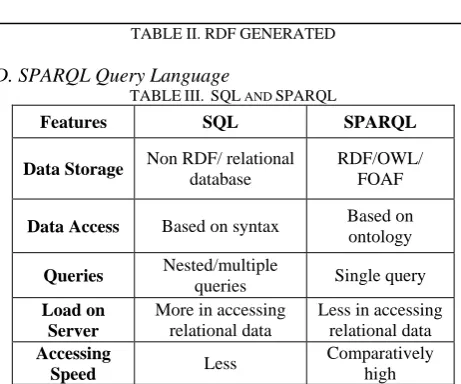
TABLEIII. SQL AND SPARQL
Features SQL SPARQL
Data Storage Non RDF/ relational
database
RDF/OWL/ FOAF
Data Access Based on syntax Based on
ontology
Queries Nested/multiple
queries Single query
Load on Server
More in accessing relational data
Less in accessing relational data
Accessing
Speed Less
Comparatively high
SPARQL is an RDF query language and protocol developed within W3C. SPARQL defines a standard query language and data access protocol used for RDF data model [3, 12]. SPARQL works for any data source that can be mapped to RDF. Jena provides the ARQ query engine which is a complete implementation of the SPARQL query language [4]. SQL is for relational database whereas SPARQL is for Semantic Web.
In section I.A the limitations of the current web are presented. SPARQL overcomes the limitations of SQL. Using SPARQL, the application can be accomplished by a single query that merges the appropriate data source. The comparisons between SQL and SPARQL are presented in Table III.
III. ARCHITECTURE
A customer should first register himself/herself, once the registration process is completed, he gains the privileges to order the items and also to express his feedback. Once the customer provides the information, the non- RDF database is updated and converted to RDF simultaneously by using Jena API. Administrator will know the customer feedback regarding the hospitality provided by the management by .passing query using SPARQL through HTML browsers. The SPARQL maps to RDF file, retrieves the results and display it in the HTML browser. Administrator will know the customer information to develops their business through some fields which include
1) Id- Customer identify 2) Feedback type
Through customer id, administrator will get the particulars regarding the customer, feedback type enables to know the identity of the customer who has given a particular feedback
public class x extends Object { public static void main (String args[]){ Resource node;
Model m = ModelFactory.createDefaultModel (); String users = "http://somewhere/users"; String username = "keeru";String city = "vizag"; Property Username = m.createProperty (users + "Username"); Property City = m.createProperty (users + "City");
node=
m.createResource("http://somewhere/users").addProperty(User name, username).add Property(City, city);
m.setNsPrefix ("users", users);m.write (System.out);}}
<rdf:RDF
xmlns:users="http://somewhere/users"
xmlns:rdf="http://www.w3.org/1999/02/22-rdf-syntax-ns#"
xmlns:users="http://somewhere/" >
<rdf:Description rdf:about="http://somewhere/users"> <users:City>vizag</users:City>
<users:Username>keeru</users:Username> </rdf:Description> </rdf:RDF>
Name
Keeru
9392514180 Customer
I R R
A 1
L th in
n this case t Registration & RDF generated
A. Custo
1) Custo
Let us conside he GUI Form n the Fig. 3 an
Fig. 3
the ontology & Feedback s d and is shown
IV. CA
omer Side omer/User Reg
er the Registra ms for Registra nd Fig. 4 with
3 Screen shot of C
agent will cr imultaneously n in the Fig. 2
ASE STUDY
gistration & F
ation Form an ation and Fee h the help of sc
Customer Registr
Fig. 2 Architect
reate the RDF y. Using Jen 2.
Feedback For
nd Feedback F edback is as sh
creen shots.
ration form
ture of Hotel Man
F for na the
rms:
Form, hown
2)
In th Regi
nagement System
Fig. 4 Sc
Customer
his case the istration and F
m
creen shot of Cus
rs RDF for Fe
ontology age Feedback simu
stomer Feedback
eedback and R
ent will create multaneously.
form
Registration:
R C g p F < < < < B 1 w b s c
TABLE IV. R
The RDF Registration Customer/Use generated for presented the Feedback RDF <Subject, pred <users: Userna <users:Comme <users:Email> B. Administrat 1) Case 1. Ava
At th wants to know be viewed as screen shot. Th customer detai
F
<use <users: F
<user <us <u <use <us < <us < <users: < us < <use < us
< use < users: <users:
RDF for REGISTR
in table 4 de and Feedb r. In the sam
multiple us e syntax of F also represen dicate, object>
ame>keeru</u ents>notbad< >keerthi.n@g
tor Side ailable Custom
he administrat w the details o
shown in the he SPARQL- ils are represe
Fig. 5 Screen sho
<rdf: Descriptio <users: Id <users: Pwd>ke
ers: State>Andhr
eedbacktype>com
rs: Comments>no
<users: Street>v
sers: Cleenilyness <users: Fid users: Fname>kee
rs: Internetaccess <users: Security sers: Mobile>939
<users: Sex>fe
<users: Address> sers: Username>k
<users: Country>I
:Email>keerthi.n
sers: Mobile>939
<users: City>bhim
ers: Roomservice sers: Expectation
</users: ers: comments > n
Email>keerthi.n
: Arrivaldate>07/
</rdf: D
RATION & FEE
escribes the fe ack Forms me way the sers at a tim
RDF, the nts their featu >. Like
users: Userna </users:Comm gmail.com</us
mer/User Det
or side, when of the custom following Fig query that is ented as shown
ot of available cus
on rdf: nodeID="A
d>2</users: Id>
eerutha</users: P
ra Pradesh</use
mplaint</users: F
ot bad</users: C
vnagar</users: St s>2</users: Cleen d>4</users: Fid>
erthana</users: F s>2</users: Intern y>3</users: Secur
2514180</users:
female</users: Se >30gf</users: Add
keeru</users: Us
India</users: Co
92514180</ users
mavaram</users e>2</users: Room
s>Exceeded exp
Expectations>
not bad</users: c
/07/2011</users: Description>
EDBACK FORM
eatures of bot of the s RDF can als me. Section I Registration ures in the form
ame> ments>
sers:Email>
tails:
n the adminis mers registered g. 5 in the for passed to view n in the table V
stomer A0">
Pwd> rs: State> Feedbacktype> omments> treet> nilyness> Fname> netaccess> rity> Mobile> ex> dress> sername> untry> users:Email> s:Mobile>
: City> mservice>
ectations
comments> users: Email> Arrivaldate> MS th the single so be II.A.1 and mat – trator d, can rm of w the V. 2). C parti selec follo repre the F the c TABLE V Case2: Custom
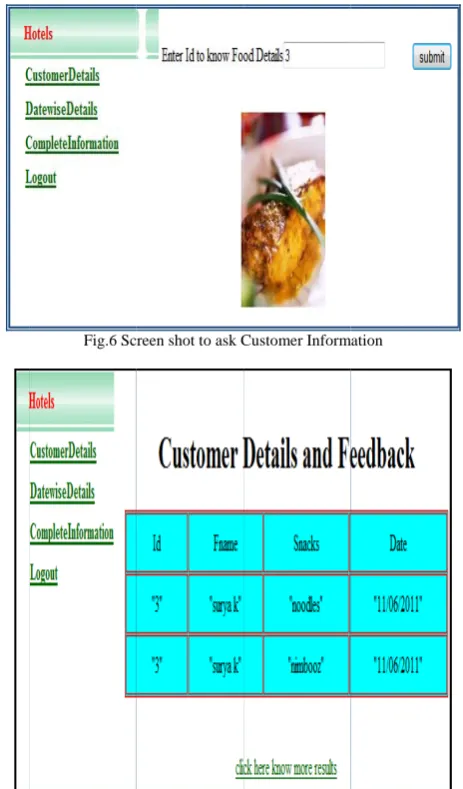
In this case, icular details o cted by a cus owing Fig. 6
esented in the Fig. 8, after ex customer ID.
Fig.6 Sc
Fig. 7 Screen PREFIX user SELECT DIS ?City ?State FROM <http WHERE { ? ?element user ?Fname . ?element user ?State . }
V. QUERY to RET CUSTOM
mer/ User Id:
if the admin of the single c stomer, he can 6 and Fig. e table VI. Th
xecuting the S
reen shot to ask C
n shot for custom rs: <http://fake
STINCT ?User
://fakestd/users element users: rs: Id ?Id . ?elem
rs :City ?City .?
TRIEVE AVAIL MERS
nistrator want customer and n have the de 7. The rela he final result
SPARQL[4] q
Customer Inform
mer information w estd/users# > rname ?Id ?Fna
s#>
Username ?Use ment users: Fna
?element users: LABLE
ts to know th the food men etails as in th ated query
is as shown i query related t
mation
T C I o f F TABLE VI.QUER
Case 3) Custom
n this case, if of the custom feedback type Fig. 8 and Fig.
Fig.
Fig. 9 Screen sho PR
SELECT
WHERE
users:
RY to ACCESS C
mer/User Fee
f the administ mers, food item
e. That has b . 9.
. 8 Screen shot fo
ot for results of c EXPEC REFIX users: <h
T DISTINCT ?
FROM <http E {? element us
Id ?Id. ?elemen
?element user ?element use
CUSTOMER INF “3”
edback
trator wants to ms and feedb been shown a
or customer feedb
customers with fe CTATIONS” http://fakestd/u
?Id ?Fname ?S
p://fakestd/users ers: Id \""+Id+"
nt users: Fnam
rs: Snacks ?Sna ers: Date ?Date.
FORMATION w
o know the d back form thr as in the follo
back type.
edback” EXCEE users#>
Snacks ?Date
s#>
"\”. ?element
me ?Fname.
acks. .} with ID details rough owing EDED TAB Tabl the q feedb gene 9 an as Sh The form The on N Base quer S p e e d T i m e
B LE VII. QUER
le VII give co query passed.
back type “E erated based o nd the corresp hown in the ta
results obtain m of graphs.
F
F
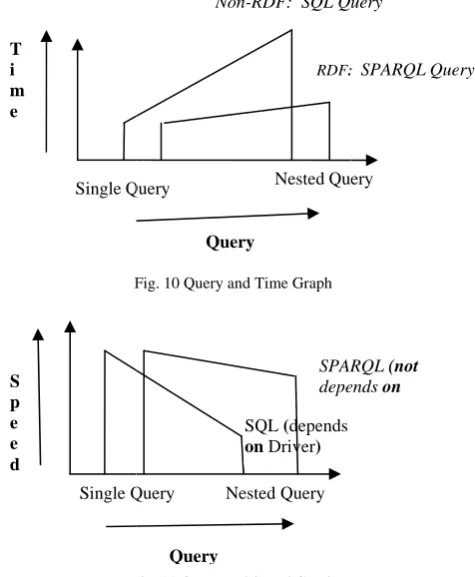
Fig. 10 show Non- RDF da ed on the quer ry with respect Single Q PREFIX SELECT ?Snacks ?D
FR WHERE { Expectation users: User ?City.?ele users: ?Fid.?elem users:Ema E Single Q
RY to ACCESS C FEEDBA
omplete detail In this the que Exceeded expe on the query th ponding SPAR
able VII.
V. RESU ned from the p
Fig. 10 Query and
Fig. 11 Query and
ws the perform atabase and R ry passed, i.e.
t to the time ta Query Ne
Query
X users :<http
T DISTINCT ?I Date ?Fid ?Mob
?Expecta ROM <http://fa { ?element us ns +"\" . ?elemen rname? Usernam ment users: Sna : Date? Date.?e ment users: Mo ail ?Email elem Comments?ele Expectations? E Quer Query Non USTOMER DET ACK
ls of the custo ery is generate ectation”. The hat is as show RQL Query th
ULTS aper are tabul
d Time Graph
d Speed Graph
mance of SQL RDF databas either single q aken by each estedQuery
SQL (depends
on Driver)
SPAR depe
p://fakestd/user
Id ?Username bile ?Email ?Co ations
akestd/users#> sers:Expectatio nt users:Id ?Id. me?element use acks? Snacks?e element users: F obile ?Mobile.?e ment users:Com ement users: Expectations.} ry NestedQu n-RDF: SQL Q
RDF:
TAILS BASEDon
omers based o ed based on th e final result wn in the figur
hat is passed
lated in the
L and SPARQ se respectively
query or neste database. RQL (not ends on rs#> ?City omments ons \""+ ?element ers: City element Fid element mments? ery uery
: SPARQLQue
SQL is a driver dependent Query language, so initially it can be seen that the query retrieval speed using SQL is faster as the number of nested queries increases, the load on driver increases by this means relational speed will be effected. Where as in SPARQL, it is independent of drivers and hence optimal relation can be achieved as shown in the Fig. 11.
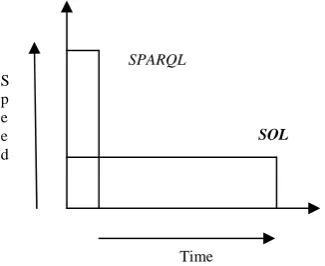
Fig. 12 Time and Speed Graph
Figure 12, shows that in less time, the accessing speed of data in SPARQL is high compared to SQL, as SQL is time consuming to retrieve the data within limited speed.
VI. CONCLUSION
This paper introduces the reader to the concept, applications and background of web mining in particular to hotel management. Screen shots of hotel customer details and feedback are provided using SPARQL an Ontology Language - an overview of RDF language and its usefulness in analysing web mining data is presented. This paper has shown the usefulness of web mining in extracting key words, link analysis of key words and search queries. Web mining of the hotel customer responses makes it
known to management what hotel services need to be improved.
REFERENCES
[1] Richard S. Segall, Qingyu Zhang , Mei Cao “ Web-Based Text
Mining of Hotel Customer Comments Using SAS® Text Miner and
Megaputer Polyanalyst® “
http://www.docstoc.com/docs/43446814/WEB-BASED-TEXT- MINING-OF-HOTEL-CUSTOMER-COMMENTS-USING-SAS-TEXT
[2] Richard S. SEGALL, Qingyu ZHANG “Web Mining of Hotel
Customer Survey
Data”www.iiisci.org/journal/CV$/sci/pdfs/QS911DU.pdf”
[3] K. Selc¸uk Candan, Huan Liu, and Reshma Suvarna “Resource
Description Framework: Metadata and Its Applications” www.sigkdd.org/explorations/issue3-1/candan.pdf
[4] Hafiz Hammad Rubbani “Semantic
WebSolutions“www.itu.dk/~hammad/thesis /Final %20Thesis.pdf
[5] John Davies, Rudi Studer Paul Warren “Semantic Web Technologies
Trends and Research in Ontology-based Systems“
http://www.booku.com/Semantic-Web-Technologies/John-Davies/ebook_294748 .html
[6] “The RDF Advantages Page “http:// www .w3. org/RDF/advantages.html
[7] Michael K. Bergman “Advantages and Myths of RDF”
http://www.mkbergman. com/wp-content/ themes/ ai3/ files/ 2009 Posts /Advantages _Myths _RDF_ 090422. pdf, April 22, 2009
[8] “The Semantic Web: An Introduction”
http://infomesh.net/2001/swintro/
[9] “Jena – A Semantic Web Framework for Java “ http://openjena.org/ [10] “An Introduction to RDF and the Jena RDF API” http://jena.source
forge.net/ down loads.html
[11] Josef Petr_ak, Jan Zem_anek, and Vojt_ech Sv_atek “Case Study on
Linked Data and SPARQL Usage for Web Application Development” http://jspetrak. name /files/PAPER-znalosti2010.pdf
[12] Pierre- Antoine Champin “RDF Tutorial” www710.univ- lyon1.
fr/~champin /rdf-tutorial/rdf-tutorial.pdf, April 2001,
[13] Steven Lynden, Isao Kojima, Akiyoshi Matono, and Yusuke
Tanimura “Adaptive Integration of Distributed Semantic Web Data
“www.cs.rmit.edu.au/~e76763 /tiger _ref/lkmt10-dnis.pdf”
[14] Lee Feigenbaum “WhySPARQL“
http://www.thefigtrees.net/lee/blog/2008/01/why_sparql.html
[15] Peter Mika-“Social Networks and the Semantic Web” http://
dare.ubvu. vu.nl /bitstream /1871/ 13263 /5/ 7915.pdf [16] Altova editor www.altova.com
Time
SPARQL
SQL S