Economic multiple model predictive control for HVAC systems - A
1case study for a food manufacturer in Germany
23
Tobias Heidrich a, Jonathan Grobe a, Henning Meschede a, Jens Hesselbach a
4
a Department for Sustainable Products and Processes (upp), University of Kassel, Kassel, 34125, Germany
5
7
Keywords: Model Predictive Control, HVAC, Climate control, Flexible Control Technologies
8
9
A B S T R A C T
10
The following paper describes an economical, multiple model predictive control (EMMPC) for an air
11
conditioning system of a confectionery manufacturer in Germany. The application consists of a
12
packaging hall for chocolate bars, in which a new local conveyor belt air conditioning system is used
13
and thus the temperature and humidity limits in the hall can be significantly extended. The EMMPC
14
calculates the optimum energy or cost humidity and temperature set points in the hall. For this purpose,
15
time-discrete state space models and an economic objective function with which it is possible to react
16
to flexible electricity prices in a cost-optimised manner are created. A possible future electricity price
17
model for Germany with a flexible EEG levy was used as a flexible electricity price. The flexibility
18
potential is determined by variable temperature and humidity limits in the hall, which are oriented
19
towards the comfort field for easily working persons, and the building mass. The building mass of the
20
created room model is used as a thermal energy store. Considering electricity price and weather
21
forecasts as well as internal, production plan-dependent load forecasts, the model predictive controller
22
directly controls the heating and cooling register and the humidifier of the air conditioning system.
23
24
1.
Introduction and problem description
25A constantly increasing scarcity of resources, increasing emissions and the global warming proven in
26
many scientific studies require differentiated and comprehensive solutions [1] [2] [3]. In addition to a
27
more efficient use of resources, the conversion of the energy supply system to an increased use of
28
renewable energies is also decisive for achieving these goals, which in turn leads to an increase in
29
balancing fluctuating residual loads in the electricity grid. With regard to the global energy demand it
30
can be seen that about one third s caused in the building sector [4], of which about half of the energy
31
demand is accounted for by building heating, ventilation and air conditioning (HVAC) [5] [6]. In view
32
of these circumstances, energy efficiency measures and the use of more flexible energy supply
33
technologies in the building sector and in the field of building air conditioning are substantial solutions
34
to the challenges described.
35
In the field of building HVAC, high energy saving potentials can be exploited in many ways. Scientific
36
research focuses on different air routing concepts, the further development of the various components
37
of an air conditioning system and, above all, the improvement of control technology [7] [8] [9]. Due to
38
the volatile nature of wind and solar energy demand has to be made more flexible. Hence, energy
39
demand can be adopted to energy supply and therefor stabilise the energy system through demand
40
response on the one hand and increase the utilisation rate of renewable energy systems on the other
41
hand [10] [11].
42
By developing and implementing an economical, multiple, model predictive control (EMMPC), this
43
flexibility potential can be realised in an energy- or cost-optimised manner. Demand response can be
44
fulfilled by integrating future, flexible electricity price models based on electricity supply and demand.
45
For the flexible operation of the air conditioning the air mass of any hall is used as thermal energy
46
storage. Hence, allowing a range of temperature and humidity specifications is key requirement [12]
47
[13] [14]. Especially in industries, these ranges are often not given due to fixed settings and strict
48
specifications of the product. Flexible and efficient control of full air conditioning systems requires the
49
solution of complex tasks. Time-varying internal and external disturbances affect the controlled system,
50
many processes involve time delays, the system goes through many operating conditions, and the
51
required energy can also have variable price structures. An efficient control approach should therefore
52
be able to take into account time-dependent disturbances, map a wide range of operating conditions and
53
process variable price structures.
54
With regard to the current state of research, this paper applies an advanced EMMPC approach for the
55
flexible operation of air conditioning systems in industrial productions. Hereby, the EMMPC approach
56
combines both, the approach of multiple and economic MPC to control and optimise non-linear systems
57
under several constraints. The realisation of the flexible air conditioning is shown for a real case of a
58
packaging hall for chocolate bars. The product has strict temperature and humidity specifications.
59
Therefore, the implementation of a new, local conveyor belt air conditioning system is indispensable to
60
soften up these specifications for the hall [12] [15][14].
61
62
2. State of research
63Due to the manifold tasks that an air conditioning system has to fulfil, the system control is highly
64
complex. Depending on the design and application, the air temperature, humidity, air volume flow and
65
air mixtures (fresh air/exhaust air ratio) must be adjusted and controlled. Since these variables influence
66
each other, the degree of complexity increases significantly. For these reasons, a combination of
67
different control approaches and sequence circuits, which control the respective sub-components and
68
bring them into a meaningful connection, is often necessary to ensure efficient plant operation. In the
69
field of efficient and flexible building air conditioning, a large number of scientific studies can be
70
considered.
71
The publication of Afram and Janabi-Sharifi (2014) [16] gives a good overview of control approaches
72
used or under development for air conditioning systems. A distinction is made between "classic
73
control", "hard control", "soft control", and "hybrid control" for air conditioning systems as well as
74
further approaches that cannot be assigned to these categories. The classic control corresponds to the
75
state of the art and are widely and practically applied. The classic control methods for HVAC systems
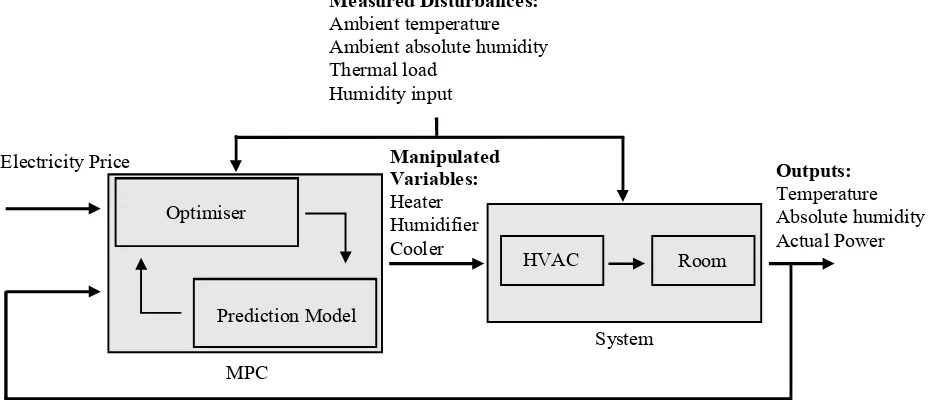
76
include two-point controllers (on/off), proportional (P), proportional integral (PI), and proportional
77
integral differential (PID) controllers. The so-called "hard control" for air conditioning systems include
78
gain scheduling, optimum control, robust control, model predictive control (MPC) and nonlinear and
79
adaptive control. MPC, as described in this publication, use previously created models of the system to
80
be controlled to predict and optimise future system behaviour under changing boundary conditions.
81
Such controllers can be used both as a replacement for classic controllers and can also perform
higher-82
level control tasks.
83
So-called fuzzy controllers or the use of artificial neural networks are summarised under the term "soft"
84
or "soft control". These comparatively new methods for controlling HVAC systems can replace both
85
higher-level and local controllers and perform a wide range of tasks. Fuzzy controllers are based on
if-86
then-else instructions and require a sufficiently deep understanding of the system to be controlled.
Artificial neural networks, on the other hand, are trained with data, the understanding of the system is
88
irrelevant [17]. Ruano et al. (2016), for example, investigated a predictive control in which a neural
89
network predicts building and system behaviour and is optimised by including weather forecasts [18].
90
"Hybrid control techniques" deal with a combination of soft and hard control approaches [17].
91
Furthermore, the hierarchical arrangement of different controllers is also subject of some research. For
92
example, MPC controllers can be used as so-called "super visory control", which in turn transmit
higher-93
level setpoints to underlying control structures - this can also be another MPC controller [19] [20].
94
Publications dealing exclusively with the comparison of control methods for air conditioning systems
95
and providing a comprehensive overview of the state of research favour the use of MPC to solve the
96
challenges of flexible operation mentioned above [16] [21]. In both studies, the authors summarise that
97
classical regulatory approaches are primarily suitable for less complex regulatory tasks. Outside the
98
previously defined operating point, classic controllers often work too slowly or react too aggressively,
99
for example. The soft methods require either a very extensive understanding of the system to be
100
controlled or comprehensive measured value analyses. In addition, the acceptance of so-called
"black-101
box" approaches, such as the soft approaches, is not widespread in industry; an introduction is usually
102
very lengthy and impractical due to too little data. In opposite to that, hard methods like MPC require a
103
complex and rigorous mathematical investigation of the system. The identification of linear subareas in
104
the system behaviour, which is necessary for control using hard control techniques over non-linear
105
operating ranges, often proves to be difficult and very complex. Nevertheless, the authors emphasize
106
that the model predictive approach as a hard control technology is particularly well suited for complex
107
control tasks in the field of air conditioning due to its capabilities and can fulfil the aforementioned
108
tasks.
109
The many advantages are offset above all by the high and complex programming effort. A sufficiently
110
precise understanding of the system is just as necessary as correspondingly modern hardware and
111
software. The use of MPC controllers is primarily based on linear process models [16] while its
112
definition is very challenging and not standardised. Especially for multi-variable systems with many
113
non-linearities in system behaviour, as they often occur in building air conditioning and increase
114
significantly due to the increasing complexity of an air conditioning system. However, the integration
115
of so-called multiple MPC controllers or adaptive MPC control structures offers great prospects of
116
success in controlling non-linear controlled systems in an optimised manner [22] [23].This is where the
117
publication comes in and is intended to contribute to the implementation and realisation of an EMMPC
118
for HVAC systems.
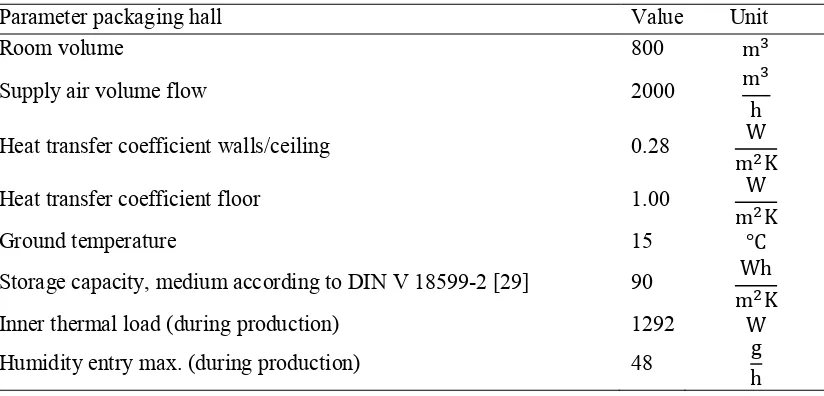
119
120
3. Methodology and fundamentals of the used model predictive control
121The developed, model-predictive control uses a linear, time-invariant (LTI) and time-discrete prediction
122
model of the system to be controlled (time-discrete state space models of an air conditioning system
123
with a connected building) to calculate future state and output changes over a finite prediction horizon.
124
The aim is to minimise the set point deviation (fixed controlled variable, energy or costs) over the
125
prediction horizon.
126
In order to determine the best possible control variable sequence for minimising the target function
127
within a prediction horizon, an optimisation problem is solved. The prediction horizon describes the
128
entire period under which the optimisation takes place. Up to a pre-determinable time step, optimised
129
control signals of the MPC controller and adapted predicted boundary conditions are considered. The
130
number of time steps over which predicted, optimised control signals are calculated is defined by
defining the control horizon. The control horizon is at most as long as the prediction horizon, which
132
usually corresponds to half of the prediction horizon based on the calculation duration. At the end of
133
the control horizon, the last control signal is kept constant until the end of the prediction horizon. [22]
134
[23]
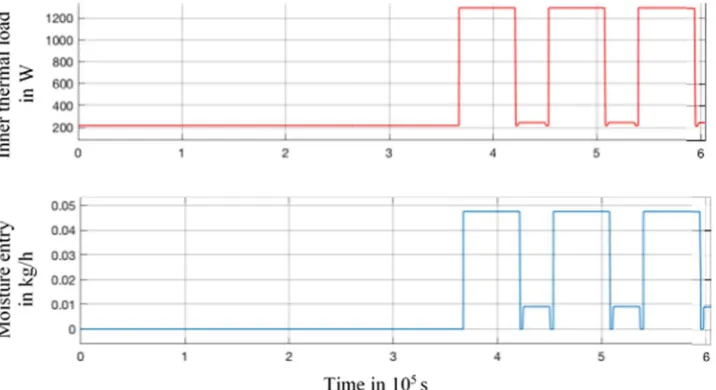
135
Individually defined limitations of output and control variables are included in the optimisation problem
136
via slack variables. The first optimum control variable value is used for controlling the system. The
137
measured actual values as well as current control and disturbance variables are used for the subsequent
138
time step for the new calculation of the optimum control variable sequence.
139
The system to be controlled consists of physical models of a building and a HVAC system, which are
140
described in more detail in section 4. From these physical models linear, time-discrete state space
141
models are derived, which function as prediction models as part of the MPC as shown in figure 1. Using
142
the optimisation algorithm, optimised control signals adapted to the boundary conditions are transmitted
143
to the system to be controlled. The MPC directly controls the heating and cooling coil as well as the
144
humidifier with control signals (manipulated variables). The control signals are limited between 0 and
145
1. The fans are not controlled via MPC and are operated with a constant volumetric flow of 2000 m³/h.
146
The condition of the supply air is composed of fresh air conditions and the respective conditioning of
147
the climate functions controlled via the control variables. The temperature and humidity of the indoor
148
air is calculated from the proportion of indoor air, supply air and outdoor temperature.
149
A schematic overview of the structure and functionality of the MPC is given in the following figure
150
(fig. 1).
151
Figure 1: Schematic structure of the model predictive control system
152
153
Air cooling in the model can be realised with two processes: either a dehumidification process
154
(condensate formation) or dry cooling (without condensate formation) is applied. This behaviour cannot
155
be represented in one linear system, since a latent phase transition occurs after reaching the saturation
156
temperature. Consequently, for both cases a multiple model predictive controller with two different
157
prediction models is used in the following. If condensate formation occurs, the prediction model A is
158
switched over to the prediction model B. The two prediction models are based on a multiple model
159
predictive controller. The two prediction models are generated around different operating points (with
160
and without condensation) by linearizing the whole model. Due to the thermal inertia of the system, a
161
time step of 900 s is applied.
162
Optimiser
Manipulated Variables: Heater Humidifier Cooler
Electricity Price Outputs:
Temperature Absolute humidity Actual Power Measured Disturbances:
Ambient temperature Ambient absolute humidity Thermal load
Humidity input
MPC
Prediction Model
Room HVAC
163
3.1 Time Discrete State Space Model
164
The developed MPC uses, as described before, time-discrete LTI systems instead of time-continuous
165
systems. Hence, the equation of state does not describe the derivative ẋ(t) of the states, but the states of
166
discrete, future sampling times x(k+1). The matrices AD (state matrix) and BD (input matrix) of the time-167
discrete state space representation result from the general solution of the temporal course of the state
168
variable x from time t0. 169
Accordingly, the matrices AD and BD are formed at the sampling times T. The sampling time is the 170
duration of a time step in the discrete system. The matrices C (output matrix) and D (feedthrough
171
matrix) remain unchanged in comparison to the time continuous system [24] [25]:
172
The time-discrete representation used is as follows:
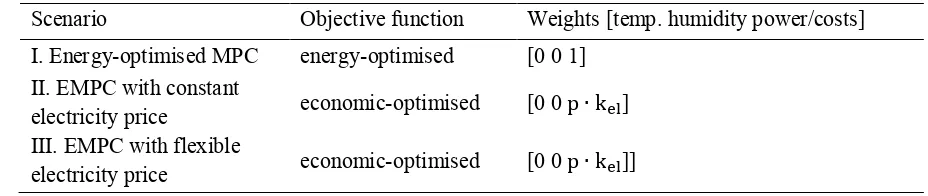
173
input equation: x(k + 1) = A x(k) + B u(k)
output equation: y(k) = Cx(k) + Du(k) (1)
174
3.2 Optimisation problem and solution methods
175
The core of the developed MPC is an optimisation algorithm for calculating the optimal control variable
176
sequence z :
177
z = [u(k|k) u(k + 1|k) . . . u(k + p − 1|k) ε ] (2)
The deviations of the actual values from the target values of the controlled system are minimised over
178
the prediction horizon, taking restrictions into account. The objective function J(z ) consists of four
179
parts:
180
J(z ) = J (z ) + J (z ) + J∆ (z ) + J (z ) (3)
Output Reference Tracking:
181
J (z ) = w,
s r (k + i|k) − y (k + i|k) (4)
Manipulated Variable Tracking:
182
J (z ) = w,
s u (k + i|k) − u, (k + i|k) (5)
Manipulated Variable Move Suppression:
J∆ (z ) =
w∆,
s u (k + i|k) − u (k + i − 1|k) (6)
Constraint Violation:
184
J (z ) = ρ ϵ (7)
The output variables y(k) can be described with the internal prediction model, the current states x(k)
185
and inputs u(k). From this it follows that the objective function J(z ) depends only on the decision
186
variable z . [23]
187
In each step of a sequence {x } , an approximate quadratic subproblem is formed from the first and
188
second derivatives of the objective function at point x .
189
By defining weights and scales, the aggressiveness of the control signals can be adjusted by defining
190
the suppression of changes.
191
The described objective function is minimised by the method of sequential quadratic programming
192
(SQP) which is an extension of quadratic programming (QP) and one of the most effective methods for
193
solving nonlinear, nonlinear-restricted optimisation problems [26].
194
195
3.3 Multiple Model Predictive Control
196
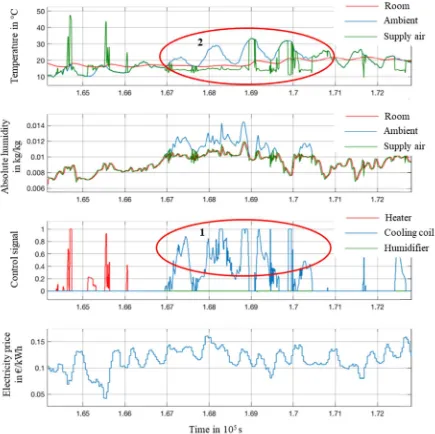
In order to keep the deviations between a linear model for control and the real system small over a larger
197
working range, there is the possibility of multiple model predictive control (MMPC). With the MMPC,
198
several controllers with different internal models and parameters are combined in a block and selected
199
via an additional input ("switch"). Depending on the environmental and operating conditions, the most
200
suitable time-discrete state space model can be selected to calculate the optimum control variable
201
sequence for the system.
202
203
3.4 Economic Model Predictive Control
204
The aim of the economic, model-predictive regulation is to minimise monetary costs. The objective
205
function is formulated in such a way that the current and predicted electricity price multiplied by the
206
current and predicted output over the prediction horizon p is minimised. The suppression of changes in
207
the control variables ∑ ∑ (du ∙ W ) and the minimisation of restriction violations W ∙ ϵ
208
remain the same in comparison to set point compliance or energy optimisation.
209
J (z ) = (P ∙ k ) + (∆u ∙ W∆ ) + W ∙ ϵ (8)
The room temperature and absolute humidity of the room air are kept above restrictions in the comfort
210
field.
211
212
In this section, the analysed system based on a real confectionery manufacturer and the models used to
214
calculate flexibility and savings potentials are described. The system consists of a packaging hall for
215
chocolate bars, which are cooled by a novel, local air-conditioning system introduced by Heidrich et al.
216
[12] and a connected air-conditioning system for providing conditioned are to the rest of the hall within
217
the limits of the comfort field for workers.
218
Without local air-conditioning of the chocolate bars, the entire hall would have to be air-conditioned to
219
18°C and 50 % relative humidity in order to avoid deformation of the chocolate, which begins to melt
220
at 18°C, condensation effects on the chocolate bar, which is cooled from the aisle to the conveyor belt
221
at around 14-15°C, and problems with electrostatic charging of the packaging cardboard [14] [27] [28].
222
In the hall, there are also packaging machines and medium-heavy working staff emitting heat and water.
223
The number of staff depends on the shift (production in operation, no production, cleaning shift).
224
In order to be able to model the hall, extensive measurements were carried out and physical models of
225
the hall and the technical building equipment were created in MATLAB/SIMLUNK. The most
226
important parameters for modelling the system can be found in the table below.
227
228
Table 1: Important key parameters of the modelled packaging hall
229
Parameter packaging hall Value Unit
Room volume 800 m
Supply air volume flow 2000 m
h
Heat transfer coefficient walls/ceiling 0.28 W
m K
Heat transfer coefficient floor 1.00 W
m K
Ground temperature 15 °C
Storage capacity, medium according to DIN V 18599-2 [29] 90 Wh
m K
Inner thermal load (during production) 1292 W
Humidity entry max. (during production) 48 g
h
230
The models used for the room, the air conditioning system and the boundary parameters (internal loads,
231
electricity prices, weather) are described below.
232
233
4.1 Physical building model
234
The physical room model used is based on a building model from the CARNOT toolbox (Conventional
235
And Renewable eNergy systems Optimisation Toolbox) [30], which is freely available for
236
MATLAB/SIMUNLINK.
237
The thermal heat-up and cooling behaviour is calculated by integrating the heat flow balance ∑ Q̇
238
divided by the thermal storage capacity of the building mass m ∙ c over time.
239
ϑ(t) = ∑ Q̇
The change of the absolute air humidity is calculated analogously to the thermal behaviour.
240
241
4.2 Physical air conditioning system model
242
The HVAC system consists of an electric pre- and post-heater, a cooling register, which is supplied
243
with cold by a compression chiller, an electrically operated steam humidifier, a supply and exhaust fan
244
and is operated with 100% fresh air.
245
The HVAC simulation model is based on the physical laws of the Mollier diagram [31]. Furthermore,
246
characteristic curves of the manufacturer are used for modelling the cooling supply (compression chiller
247
with flow temperature of -1 °C) and steam humidification (3 bar of saturated steam).
248
249
4.3 Boundary parameters - internal load
250
The internal thermal and water loads necessary for an optimised, model-predictive control of an air
251
conditioning system are determined by real active power measurements of the machines in the hall,
252
calculations for the heat of illumination according to VDI 2078 [31], humidity and heat emission of the
253
persons in the hall according to VDI 2078 and the influence of the local air conditioning by transfer of
254
laboratory results.
255
The following figure shows the temporal course of the determined, smoothed, internal loads as a
256
function of time depending on the production plan. The maximum is reached during running production
257
(three days per week). When production is switched off there is only a low thermal load due to the
258
standby operation of the switch cabinets and machines. During the cleaning shift after every production
259
shift the room lighting is switched on and a few hard-working employees are in the hall.
260
Figure 2: Scaled internal loads of the production hall over seven days
261
262
4.4 Boundary parameters - weather data
263
The weather data used for simulation and prediction consist of historical hourly values for air
264
temperature and absolute humidity of the surroundings. These are test reference year data of a central
265
German city (i.e. Kassel) in the observation period 1988-2007. Averaged weather data sets are
266
understood as test reference years, which represent a typical weather course of one year. Real forecast
267
values are indispensable for a later, real application operation and can be considered by the developed
control. However, historical weather data sets is used to determine savings and flexibility potentials, as
269
these can cover a long period of time and reflect the expected value without annual deviations.
270
271
4.5 Boundary parameters - electricity price data
272
Two electricity price scenarios are defined for the analysis of an economic, model predictive control, a
273
constant and a flexible model:
274
1. In the status quo scenario a standard, constant total electricity price (13.18 ct/kWh) for industrial
275
customers in Germany is chosen.
276
2. In opposite to that, the second scenario reflects a possible future electricity price model of a
277
dynamized renewable energy levy (EEG levy) and electricity procurement via the day-ahead
278
exchange market in Germany. The current static EEG levy due in Germany, which is levied to
279
promote renewable energies in Germany, is replaced by a dynamic EEG levy, which is calculated
280
via the day-ahead exchange electricity price using a certain factor.
281
= - ℎ ∙
282
This multiplier must be successively recalculated and determined for the differential cost
283
compensation for Germany. For the following simulations, a factor of 1.9 has been defined.
284
Furthermore, limits of the flexible EEG allocation upwards and downwards are foreseen. The upper
285
limit of the dynamic EEG levy consists of twice the German, static EEG levy, the lower limit is 0,
286
negative electricity prices are no longer possible according to this model. [32] [33]
287
In addition to the electricity price incidental electricity costs are considered in all analysed scenarios
288
corresponding to the average costs of 4.28 ct/kWh for German industrial customers with an annual
289
consumption of 160 to 20,000 MWh [34].
290
The exchange electricity price generally has two maximums and two minimums per day. Since the loads
291
are to be shifted from a high tariff to a tariff as low as possible, a prediction of at least 12 hours is
292
necessary. Regarding a time step of 900 s and a prediction horizon of 12 hours, this results in 48
293
prediction steps. To reduce calculation efforts the control horizon is set to 20 steps, i.e. 5 hours.
294
Comparable to the weather forecast, real electricity price forecast is also indispensable for real
295
operation. The electricity price forecast is included in the developed MPC approach by downloading
296
real electricity prices from EEX for the next day (day-ahead electricity prices) and script-based further
297
processing. However, as already described in the section on weather forecasting, historical electricity
298
price time series over longer periods are better suited for calculating flexibility and savings calculations.
299
300
4.6 MPC constraints
301
The constraints used to create the MPC do not vary in all considered scenarios. The constraints include
302
the permissible temperature and humidity limits in the room as well as the control variable limitation.
303
Both, the temperature as well as the air humidity depend on the limits of an average comfort field. The
304
control variable limitation resulting from the air conditioning system control are as follows:
305
16°C ≤ Room temperature ≤ 24°C
306
0,005 kg/kg ≤ Absolute humidity Room ≤ 0,009 kg/kg
307
0 ≤ Control variable heating/moisture/cooling ≤ 1
308
4.7 MPC weights
310
The different weights of the sub-target functions that are required to create the MPC are described
311
below. In all scenarios, the control variables should not adhere to a value and therefore have a weight
312
of 0. The weight of the change suppression of the control variables is set to 0.1. This reduces the upswing
313
and downswing of the control values that is too fast.
314
The weightings of the control variables vary depending on the scenario, which are described in section
315
5. A distinction is made between two cases:
316
1. The energy-optimal control keeps the indoor temperature and humidity above limits in the comfort
317
field. The weights of the first two model outputs (indoor temperature and absolute humidity) are 0.
318
The third output (i.e. power) is to be minimised hence it receives a weight of 1.
319
2. The regulation with economic objective function receives quasi the current electricity price as
320
weight for the achievement. This is multiplied by 10, since this setting thus has a similar weight as
321
with the energy-optimal regulation and better results are obtained. The temperature and humidity
322
of the room are no longer included in the target function.
323
324
5. Scenario description and results
325In order to evaluate the flexibility and savings potentials, the previously described control variants of
326
the MPC at different seasons are analysed.
327
First, three days in January are graphically examined in order to illustrate a possible load shift (scenario
328
I-III). Subsequently, electricity consumption and costs incurred by the three different operating variants
329
are compared over 20 days in January. Since the weather influences change strongly in the summer, the
330
load management potential is finally illustrated by a flexible electricity price and EMPC for 10 days in
331
July.
332
The energy-optimal scenario I serves as a comparison for the scenarios in which load management is
333
carried out. Scenarios II and III use the economic objective function in which the current AHU system
334
output multiplied by the current electricity price over the prediction horizon is minimized. In the second
335
scenario a constant electricity price is assumed, in the third scenario a flexible electricity price as
336
described above is used. Table 1 shows an overview of the simulated scenarios.
337
338
Table 2: Overview of the simulated scenarios
339
Scenario Objective function Weights [temp. humidity power/costs]
I. Energy-optimised MPC energy-optimised [0 0 1] II. EMPC with constant
electricity price economic-optimised [0 0 p ∙ k ] III. EMPC with flexible
electricity price economic-optimised [0 0 p ∙ k ]]
340
5.1 Comparison scenario I: Energy-optimised MPC - 3 days in January
341
In this scenario, the energy consumption of the air conditioning system is minimized. The weights for
342
temperature and absolute humidity are 0. The comfort field is maintained by the restrictions. The weight
343
for the performance of the system components is 1. The weight for the output of the system components
is 1. The target value for the output is 0. Thus, the summed quadratic deviation of the power from 0
345
over the prediction horizon is minimized.
346
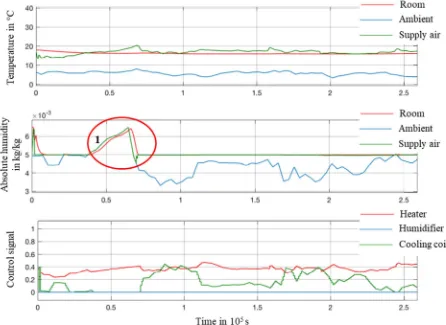
As shown in figure 4, the room temperature is kept at the lowest limit of 16°C, as this is the least amount
347
of energy required for supply air conditioning. The absolute humidity of the outside air is not raised by
348
the humidifier if it is above the lower limit of 5 g/kg. Since the HVAC system is operated with 100 %
349
fresh air from the outside, the absolute humidity of the room, provided that it remains within the
350
specified limits, depends on the conditions of the fresh air, as can be seen in area 1 of figure 4.
351
Figure 3: Energy-optimised MPC over three days in January
352
353
5.2 Scenario II: Cost-optimised MPC (EMPC) with constant electricity price - 3 days in January
354
In this scenario, the economic objective function is used to minimize costs. The output is multiplied by
355
the current costs in each time step and minimized by adding up the prediction horizon. The electricity
356
price in this scenario is constant at 13.18 ct/kWh. Therefore, this is a simultaneous energetic and
357
economic optimisation. The difference between this regulation and the regulation in scenario I is that
358
the current power consumption of the air conditioning system is no longer included in the target function
359
as a square but linear value. As a result, energy cost peaks are no longer minimized, as they no longer
360
flow disproportionately into the target function.
361
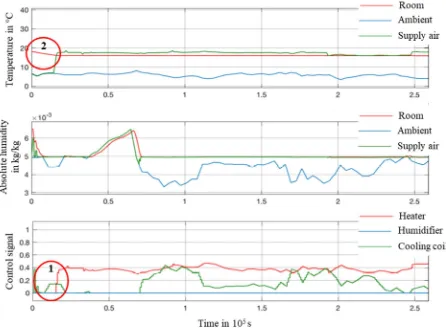
The behaviour is very similar to the previous scenario I. However, in contrast to scenario I, the heating
362
coil remains switched off during the first hours (area 1, figure 5), so that the room temperature drops
363
more quickly (area 2, figure 5). The room air restrictions
364
Figure 4: Energy-optimised and cost-optimised EMPC with constant electricity price over three days in
366
January
367
368
5.3 Scenario III: Cost-optimised MPC with flexible electricity price - 3 days in January
369
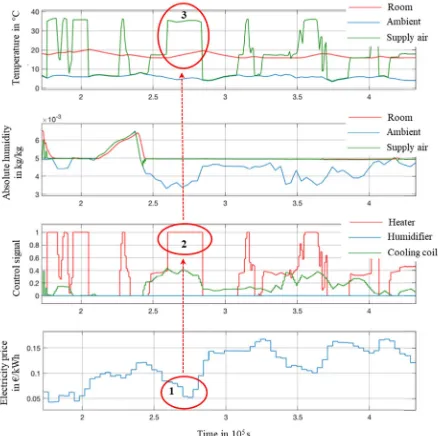
In this scenario, a flexible electricity price is used as described in Section 4.6. This results in electricity
370
price changes of up to 10 cents (figure 6). The indoor temperature varies between 16 and 21°C. The
371
control variables of the heating coil vary between 0 and 1. Especially in low-price phases (area 1, figure
372
6) and before a sudden price increase, the heating register (area 2, figure 6) prematurely heats up the
373
room (area 3, figure 6). The humidifier is only activated when the absolute humidity falls below 5g/kg.
374
Load shifts are possible s shown in figure 6.
Figure 5: Cost-optimised EMPC with flexible electricity price over three days in January
376
377
5.4 Winter case - comparison of control variants over 20 days in January
378
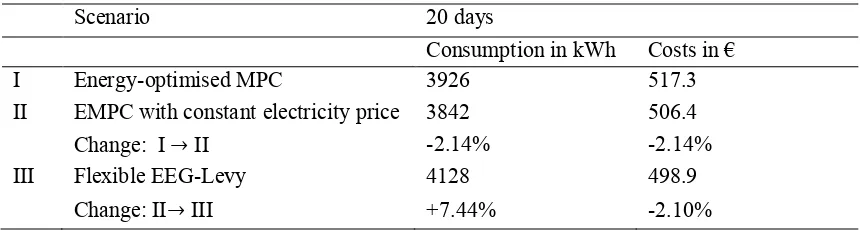
Three scenarios were simulated over the first 20 days in January of the reference year. The energy
379
consumption and the energy costs incurred by the air conditioning system are shown in Table 2. The
380
relevant changes are also shown.
381
The comparison between energy-optimised control and EMPC already shows a reduction in energy
382
consumption and a resulting cost reduction of 2.14%. Scenario III, with lower energy consumption, will
383
henceforth be used as a comparison scenario.
384
The results of the simulation with dynamic EEG allocation show a reduction in costs of 2.10% compared
385
to the energy-optimal scenario with changed target function and constant electricity price. However,
386
energy consumption increases by 7.44%. This higher energy consumption is due to the fact that the
387
room temperature for storing the shifted energy is raised, resulting in higher heat losses.
388
Table 3: Energy consumption and costs over 20 days in January under different scenarios
390
Scenario 20 days
Consumption in kWh Costs in € I Energy-optimised MPC 3926 517.3 II EMPC with constant electricity price 3842 506.4
Change: I → II -2.14% -2.14%
III Flexible EEG-Levy 4128 498.9
Change: II→ III +7.44% -2.10%
391
5.5 Summer case - EMPC with flexible electricity price over 10 days in July
392
In addition to the winter case, 10 days in summer (days 191-200) are simulated with an electricity price
393
including dynamic EEG allocation (see scenario III). It is investigated, to which extent the cooling
394
register can contribute to load management. The results are shown in figure 7.
395
In summer most of the energy is needed to dehumidify the supply air (area 1, figure 7). Since the room
396
air is exchanged relatively fast it is not possible to store energy by shifting the dehumidification output.
397
There is no correlation between the electricity price and the control signal of the cooling register. The
398
outside air is cooled by dehumidification. Therefore, despite high outside temperatures, low inside
399
temperatures must be noted (area 2, figure 7). A shift before cooling loads is therefore also not possible
400
and load management cannot be carried out under such weather conditions.
Figure 6: Cost-optimised EMPC with an electricity price with dynamic EEG allocation over ten days
402
in summer
403
However, if one additionally varies the building weight, cost savings of 2.1% (90 thermal storage
404
capacity according to DIN V 18599-2 [29]) and 3.0% (120 thermal storage capacity [29]) can be
405
achieved for the heating case compared to the energy-optimised control.
406
Halvgaard, Poulsen, Madsen and Jørgensen [35] calculated cost savings of 25-35% through an
407
economic model predictive control of concrete core activation. These significantly higher savings are
408
due to the slower type of building air conditioning. The energy can be better stored in the heavy concrete
409
ceilings before the rooms are slowly air-conditioned. Building component activation or storage in e.g.
410
water reservoirs are other approaches to thermal energy storage in buildings which can be used for load
411
management.
412
413
The paper illustrates an economic multiple model predictive control of a HVAC that can either meet
415
room temperature and humidity targets, minimise energy consumption or alternatively minimise
416
economic costs through a flexible electricity pricing model.
417
As a case study, a production hall for the packaging of chocolate bars is used, which are locally
air-418
conditioned by a cross-flowing displacement ventilation for conveyor belts, so that the room air
419
condition can be kept within a comfort zone with the help of restrictions and does not have to depend
420
on the product requirements of the chocolate (18°C, 50% relative humidity) [12]. The internal loads of
421
the production hall as well as weather data influence the system as disturbance variables and are taken
422
into account by the MPC controller. To evaluate the EMMPC controller, various scenarios are evaluated
423
taking seasonal weather influences into account.
424
Electricity costs in winter can thus be reduced by 2.1% compared to energy-optimised control.
425
However, energy consumption increases by 7.44% due to higher heat losses when the room temperature
426
is temporarily raised. It could also be shown that a larger thermal storage capacity of the building can
427
increase the potential for load shifting.
428
For example, in order to be able to include a mixed air chamber, which causes even stronger
non-429
linearities in the system behaviour, in a MPC control system, the extension of the MMPC by further
430
MPC controllers is currently being worked on. In addition, the coupling to a production plan-dependent
431
activation time optimisation adapted to the hall and outdoor air conditions, which determines an optimal
432
start time for the air-conditioning of the hall, is in progress. In this way, energy consumption can be
433
further reduced [13].
434
In order to demonstrate the functionality also in real operation, the coupling with full HVAC system
435
with connected climate chamber, in which also internal loads can be simulated, is under construction.
436
A further starting point is the creation of adaptive, self-learning state space models, which are generated
437
on the basis of real measurement data in order to further improve the prognostic capability and thus the
438
accuracy of the optimal control variables.
439
The publication shows that the use of an economic model predictive control is suitable for the efficient
440
and economic prognostic guided control of HVAC plants, which could actively participate in load
441
management. It is also shown that the approach of a multiple model predictive control can particularly
442
control non-linear behaviour of typical HVAC processes like dry and wet cooling. Thus, EMMPC can
443
be seen as a promising approach to optimise the flexible operation of complex HVAC systems.
444
However, even more in-depth development work is required to map even more complex systems on the
445
one hand and to be able to control real systems in real time on the other.
446
447
Acknowledgments
448The contents of this paper have been acquired within the cooperation project „Smart Consumer – Energy
449
efficiency through systemic coupling of energy flows by means of intelligent measurement and control
450
technology”. The Project is funded by the German Federal Ministry for Economic Affairs and Energy
451
(FKZ: 03ET1180).
452
453
454
455
Nomenclature
457x(t): State vector
458
u(t): System input vector
459
y(t): System output vector
460
A: State matrix
461
B: Input matrix
462
C: Output matrix
463
D: Feedthrough matrix
464
y: Plant output
465
u: Manipulated variable
466
z : Optimal control variable sequence
467
J(z ): Objective function
468
n: Number of plant output variables or manipulated variables
469
p: Prediction horizon (number of intervals)
470
w: Tuning weight
471
s: Scale factor
472
r: Reference
473
k: Current control interval
474
ρ : Constraint violation penalty weight
475
ϵ : Slack variable at control interval k
476
∑ Q̇: Heat flow balance in W
477
m: Building mass in kg
478
c : Specific heat capacity at constant pressure J/kg ∙ K
479
ϑ(t): Temperature at time t
480
t: Time in s
481
P : Total power consumption of the HVAC system (without fan power consumption) in kW
482
k : Electricity price in (€/kWh) / s
483
484
485
486
487
488
References
490[1] United Nations, Climate Change, available at
http://www.un.org/en/sections/issues-491
depth/climate-change (accessed on October 2018).
492
[2] NASA, Global Climate Change - Vital Signs of the Planet, available at https://climate.nasa.gov/
493
(accessed on October 2018).
494
[3] R.K. Pachauri, L. Mayer (Eds.), Climate change 2014: Synthesis report, Intergovernmental Panel
495
on Climate Change, Geneva, Switzerland, 2015.
496
[4] A.P. Patwardhan, L. Gomez-Echeverri, N. Nakićenović, T.B. Johansson (Eds.), Global Energy
497
Assessment (GEA), Cambridge University Press, Cambridge, 2012.
498
[5] L. D&R International, 2011 Buildings Energy Data Book, Pacific Northwest National
499
Laboratory, 2012.
500
[6] L. Pérez-Lombard, J. Ortiz, C. Pout, A review on buildings energy consumption information,
501
Energy and Buildings 40 (3) (2008) 394–398.
502
[7] G. Guyot, M.H. Sherman, I.S. Walker, Smart ventilation energy and indoor air quality
503
performance in residential buildings: A review, Energy and Buildings 165 (2018) 416–430.
504
[8] R. Hitchin, C. Pout, D. Butler, Realisable 10-year reductions in European energy consumption
505
for air conditioning, Energy and Buildings 86 (2015) 478–491.
506
[9] K. Zhang, X. Zhang, S. Li, X. Jin, Review of underfloor air distribution technology, Energy and
507
Buildings 85 (2014) 180–186.
508
[10] H. Meschede, Increased utilisation of renewable energies through demand response in the water
509
supply sector – a case study, Rio de Janeiro, Brazil, 2018.
510
[11] D. Khripko, S.N. Morioka, S. Evans, J. Hesselbach, M.M. de Carvalho, Demand Side
511
Management within Industry: A Case Study for Sustainable Business Models, Procedia
512
Manufacturing 8 (2017) 270–277.
513
[12] T. Heidrich, A. Alimi, L. Grothues, J. Hesselbach, O. Wünsch, Cross-flowing displacement
514
ventilation system for conveyor belts in the food industry, Energy and Buildings 179 (2018)
515
213–222.
516
[13] T. Heidrich, H. Dunkelberg, T. Weiß, J. Hesselbach, Flexibilization of Energy Supply Using the
517
Example of Industrial Hall Climatization and Cold Production, Kassel University Press GmbH,
518
Kassel, 2017.
519
[14] J. Wagner, Lokale Klimatisierung temperatursensibler Produkte. Dissertation, Kassel University
520
Press GmbH, Kassel, 2016.
521
[15] T. Heidrich, Energieeffizienzsteigerung in der Süßwarenindustrie durch lokale Klimatisierung
522
und systemische Kopplung von Energieströmen. DLG session - innovative energy technologies
523
in the food industry, Hannover 2016.
524
[16] A. Afram, F. Janabi-Sharifi, Theory and applications of HVAC control systems – A review of
525
model predictive control (MPC), Building and Environment 72 (2014) 343–355.
526
[17] D.S. Naidu, C.G. Rieger, Advanced control strategies for HVAC&R systems—An overview:
527
Part II: Soft and fusion control, HVAC&R Research 17 (2) (2011) 144–158.
[18] A.E. Ruano, S. Pesteh, S. Silva, H. Duarte, G. Mestre, P.M. Ferreira, H.R. Khosravani, R. Horta,
529
The IMBPC HVAC system: A complete MBPC solution for existing HVAC systems, Energy
530
and Buildings 120 (2016) 145–158.
531
[19] K.F. Früh, D. Schaudel, U. Maier, R. Bleich (Eds.), Handbuch der Prozessautomatisierung:
532
Prozessleittechnik für verfahrenstechnische Anlagen, 5th ed., DIV Dt. Industrieverl., München,
533
2015.
534
[20] Y. Ma, A. Kelman, A. Daly, F. Borrelli, Predictive Control for Energy Efficient Buildings with
535
Thermal Storage: Modeling, Stimulation, and Experiments, IEEE Control Syst. 32 (1) (2012)
536
44–64.
537
[21] F. Belic, Z. Hocenski, D. Sliskovic, HVAC Control Methods - A review. 19th International
538
Conference on System Theory, Control and Computing (ICSTCC), 2015 October 14-16, Cheile
539
Gradistei, Romania.
540
[22] A. Bemporad, M. Morari, N.L. Ricker, Model Predictive Control Toolbox – Getting Started
541
Guide, 2017.
542
[23] A. Bemporad, M. Morari, N.L. Ricker, Model Predictive Control Toolbox – User’s Guide, 2017.
543
[24] J. Lunze, Regelungstechnik 2: Mehrgrößensysteme, Digitale Rechnung, 8th ed., Springer
544
Vieweg, Berlin, 2014.
545
[25] J. Lunze, Regelungstechnik 1: Systemtheoretische Grundlagen, Analyse und Entwurf
546
einschleifiger Regelungen, 6th ed., Springer, Berlin, 2007.
547
[26] J. Nocedal, S.J. Wright, Numerical Optimization, Springer Science+Business Media LLC, New
548
York, NY, 2006.
549
[27] S. Schirmer, T. Heidrich, J. Wagner, J. Hesselbach, Steigerung der Energieeffizienz einer
550
klimatisierten Produktionshalle, HLH (July/August) (2016) 38–40.
551
[28] J. Wagner, M. Schäfer, A. Schlüter, L. Harsch, J. Hesselbach, M. Rosano, C.-X. Lin, Reducing
552
energy demand in production environment requiring refrigeration—A localized climatization
553
approach, HVAC&R Research 20 (6) (2014) 628–642.
554
[29] German engineering standard, DIN V 18599-2: 2011-12 - Energy assessment of buildings -
555
Calculation of the useful, final and primary energy demand for heating, cooling, ventilation,
556
domestic hot water and lighting - Part 2: Useful energy demand for heating and cooling of
557
building zones.
558
[30] FH Aachen, CARNOT Toolbox 2018, available at
https://fh-559
aachen.sciebo.de/index.php/s/0hxub0iIJrui3ED and
560
https://de.mathworks.com/matlabcentral/fileexchange/68890-carnot-toolbox (accessed on
561
October 2018).
562
[31] Association of German Engineers, VDI-Wärmeatlas, 11th ed., Springer Vieweg, Berlin, 2013.
563
[32] Frontier Economics, Costs and benefits of dynamizing electricity price components as a means
564
of making demand more flexible, 2016 Report for the German federal ministry of Economics
565
and Energy (BMWi), Frontier Economics Ltd, London.
566
[33] Dr. Thies F. Clausen, Der Spotmarktpreis als Index für eine dynamische EEG - Umlage, Talk at
567
AG Flexibility of the BMWi,August 19th 2014, Berlin, available at
https://www.agora-568
energiewende.de/veroeffentlichungen/der-spotmarktpreis-als-index-fuer-eine-dynamische-eeg-569
umlage/ (accessed on October 2018).
[34] BDEW (Federal Association of Energy and Water Management), Composition of electricity
571
prices for industry in Germany in 2016 and 2017, available at
572
https://de.statista.com/statistik/daten/studie/168571/umfrage/strompreis-fuer-die-industrie-in-573
deutschland-seit-1998/ (accessed on October 2018).
574
[35] R. Halvgaard, N.K. Poulsen, H. Madsen, J.B. Jorgensen, Economic Model Predictive Control for
575
building climate control in a Smart Grid, in: IEEE PES innovative smart grid technologies
576
(ISGT), 2012: Conference] ; 16 - 20 Jan. 2012, Washington, DC, USA, Washington, DC, USA,
577
IEEE, Piscataway, NJ, 2012, pp. 1–6.
578