The NUSTAR program at FAIR
Overview and present status of the project
Alexander Herlert1,afor the NUSTAR Collaboration
1FAIR GmbH, Planckstr. 1, 64291 Darmstadt, Germany
Abstract. The NUSTAR Collaboration brings together several hundred scientists to form one of the four scientific pillars of the future FAIR facility. NUSTAR aims at the exploita-tion of intense radioactive beams with energies up to 1.5 GeV/u in order to explore nuclei with large neutron or proton excess. The project has evolved over the last years and now reached a state where a large fraction of the core program is financed, partly built, and even ready for operation. With the signing of the FAIR convention in 2010 and the start of construction, the sub-projects in NUSTAR gain momentum and look forward to commis-sioning and first beams in this decade. The present status of the project will be presented, focusing on the instrumentation to be applied in the various experimental areas behind the Super-FRS fragment separator, which is the central instrument of NUSTAR.
1 Introduction
Ten years ago, in October 2003, the NUSTAR Collaboration decided on its name with the acronym standing for the three main topics covered by the participating groups and scientists: Nuclear Struc-ture, Astrophysics, and Reactions. Since then, the project evolved from initial ideas - bases on suc-cessful experiments at GSI and other radioactive beam facilities worldwide - via scientific and tech-nical proposals to a final collection of proposed experiments which aim at the exploitation of the rare isotope beams at the future FAIR facility.
NUSTAR will be one of the four experimental pillars of the FAIR research program and has been presented on several occasions (see e.g. [1–3]). Rather than one large detector system, NUSTAR is a collection of sophisticated experimental setups, spread over several experimental areas in order to address fundamental physics questions related to exotic nuclei: e.g. limits of existence of nuclei, dependence of the nuclear force on the proton-neutron-ratio, explanation of collective phenomena, or understanding astrophysical processes.
While having a common physics scope, the NUSTAR experiments differ in the approach to study exotic nuclei: From decay and high-precision spectroscopy with gamma and neutron detectors, to precision mass measurements in traps and storage rings or reaction studies of relativistic beams, dedi-cated setups will be built and operated to make use of the beams provided by FAIR and especially the fragment separator Super-FRS. The present manuscript will give an overview on the planned experi-mental setups and the present status.
ae-mail: alexander.herlert@fair-center.eu
C
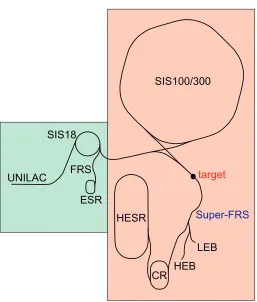
Figure 1. Schematic overview of the accelerator complex of the future FAIR facility. On the left-hand side the already existing accelerator components (the linear accelerator UNILAC and the synchrotron SIS18) of the present GSI facility are shown. On the right-hand side the new accelerator complex of the FAIR facility is shown. For details see text.
2 Accelerator complex and Super-FRS
The FAIR facility will use part of the existing accelerator infrastructure of GSI. Already now, the linear accelerator UNILAC as injector of stable ions and the SIS18 synchrotron as secondary accelerator stage are available for experiments at the subsequent fragment separator FRS and the adjacent ESR storage ring. As shown in Fig. 1, the FAIR facility will enlarge the accelerator complex by a variety of components.
Modularized Start Version of FAIR the Collector Ring (CR) will be the first one available from the future storage ring complex.
Rare isotopes will be produced via projectile fragmentation of all primary beams up to 238U and via fission of238U at the target station. Due to the relatively large amount of kinetic energy released in the fission reactions, the Super-FRS is designed as a large acceptance device in order to cope with the large phase space. Furthermore, the Super-FRS will provide a gain in transmission for uranium fission products of more than one order of magnitude as compared to the present FRS fragment separator. In the case of projectile fragments similar gain factors are expected. As in the case of the FRS, the Super-FRS will use theBρ−ΔE−Bρmethod, i.e. a two-fold magnetic rigidity analysis in front of and behind a specially shaped energy degrader. In addition, fully ionized product fragments are required in order to reach a clean isotopic separation.
The Super-FRS as part of the accelerator complex is planned and constructed under the respon-sibility of the FAIR@GSI project division of GSI. However, since the Super-FRS is the central in-strument, serving all NUSTAR experiments with rare isotope beams, the NUSTAR Collaboration is supporting the local groups and experts at GSI. A dedicated Super-FRS Collaboration within NUS-TAR has been formed for this purpose. In addition, it is foreseen to use the Super-FRS as a stand-alone experiment taking advantage of its capabilities as high-resolution separator. The physics case is presently being defined and will soon enrich the NUSTAR physics program.
3 Experiments
The NUSTAR experiments are located in different areas behind the Super-FRS fragment separator: the low-energy branch, the high-energy branch, and the ring branch as mentioned above. The latter is connected to the Collector Ring (CR) where the dedicated experimental equipment will be installed. With the staging of FAIR, i.e. the Modularized Start Version as an initial phase and a subsequent upgrade to the full FAIR facility, two of the NUSTAR experiments, ELISe and EXL, will be realized
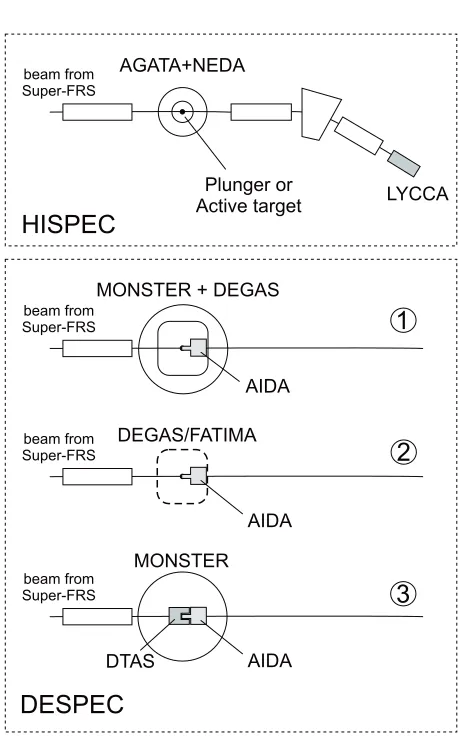
Figure 3. Schematic overview of the HISPEC/DESPEC experiment with different configurations by use of various combinations of the planned instrumentation.
at a later time. However, in the case of EXL, options for a realization of part of the experimental program using existing facilities at GSI (e.g. the ESR storage ring) are discussed. In the following, the different experiments and their status will be presented.
3.1 Low-energy branch
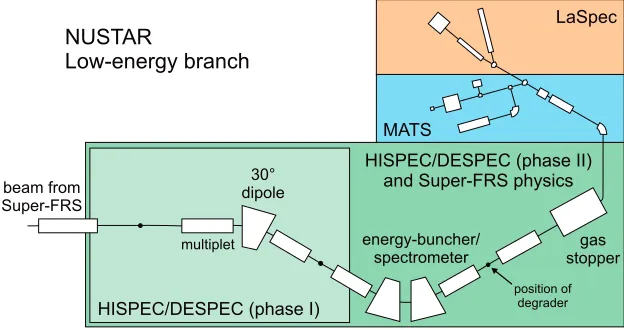
In Fig. 2 a schematic overview of the beam lines planned at the low-energy branch is shown. The first stage is dedicated to the HISPEC/DESPEC experimental setups, which will be introduced in detail below. This first section of the LEB beam line is also part of the energy buncher with its three 30◦ dipole magnets and additional ion optics (e.g. quadrupole and sextupole magnets) arranged in several multiplets.
momentum spread of the ion beam is reduced before the radionuclides enter the gas stopper. In a recent design change, the ion-optical layout of the energy buncher was adjusted to achieve a dispersion matching to the Super-FRS [8] which allows one to use the the energy buncher as a high-resolution spectrometer and at the same time improve the performance of the degrader.
A prototype of the gas stopper with a stopping volume of 1m length has been successfully tested off-line [9] using219Rn ions from alpha decay of223Ra. This new prototype operates at cryogenic temperatures in order to ensure the purity of the helium which is used as stopping gas. Additional on-line tests were performed recently [6] and a new design for NUSTAR is on the way which will provide even higher stopping efficiencies and shorter extraction times.
The captured ions are guided by radio frequency fields to an exit bore of the gas catcher for subsequent low-energy re-acceleration to the adjacent experiments MATS and LaSpec, where the ions are subjected to laser spectroscopy or are trapped for mass measurements and trap-assisted decay studies. Since the intensities of beams sent to MATS and LaSpec are orders of magnitude smaller than the primary and secondary beams in the LEB cave, both experiments (MATS and LaSpec) will reside in a separate building with less shielding.
3.1.1 HISPEC/DESPEC
As shown in the top panel of Fig. 3, the HISPEC experiment uses the AGATA germanium detector array [10, 11] to measure gamma rays that are emitted from excited nuclear states after interaction of the radioactive beams impinging on the secondary target. AGATA is combined with beam tracking and identification detectors as well as a charged particle detector, e.g. HYDE (a HYbrid DEtector array), or a plunger device for state lifetime measurements. Furthermore, an active target can be installed. The outgoing radioactive nuclides are identified event-by-event by measuring the time-of-flight, the energy loss and the total energy with the LYCCA setup [12]. Finally, the NEDA neutron detector array [13] can be installed around the AGATA array in order to be used for neutron-knockout reactions and charge-exchange reactions at high energies (above 100 MeV/u) and stripping reactions as well as multi-nucleon transfer (deep-inelastic) reactions at low and medium energies (10-100 MeV/u).
A prototype setup of HISPEC has been installed and operated at GSI for first tests and experiments, which is called PreSPEC [14, 15]. After a successful commissioning campaign in 2012, additional tests and on-line runs of PreSpec are planned at the FRS of GSI in 2014 before a scheduled break at GSI of two years for the overhaul of the UNILAC and SIS18 for the operation for FAIR.
The DESPEC experiment is located at the same focal plane of the LEB energy buncher as the HISPEC experiment (see Fig. 3). Thus, in order to perform experiments for DESPEC, the HISPEC equipment has to be removed temporarily. At a later stage of the NUSTAR facility, it is planned to position DESPEC and its detectors at the focal plane behind the energy buncher. This will allow one to operate HISPEC and DESPEC in the same measurement campaign. However, the gas stopper needs to be de-installed for such a combination of experimental setups.
Depending on the physics case of interest, several combinations of DESPEC detector setups can be used. The most common ones are shown in Fig. 3. In all cases the AIDA setup, the Advanced Implantation Detector Array, is used for the deposition of the incoming radioactive ions. AIDA em-ploys a stack of double sided silicon strip detectors in order to measure the position and energy of the implanted ions. Furthermore, the energy of beta and alpha decays can be probed, i.e. AIDA is used as an active stopper.
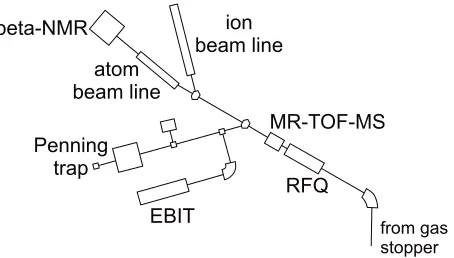
Figure 4.Beam lines of the MATS and LaSpec experiments. Both experiments are connected with a common beam line to the LEB gas stopper. For details see text.
measurements to determine the energy of the neutrons. AIDA (Advanced Implantation Detector Ar-ray) is fully constructed and ready for operation while DEGAS is still in the planning phase. For the neutron detector system MONSTER [16] some prototype detectors have been built including a demonstrator mounting frame for first tests.
The second setup combines AIDA with a mixture of DEGAS and FATIMA detectors, the latter being used to perform fast-timing measurements, i.e. determination of level lifetimes in the range from a few picoseconds to several nanoseconds. The third setup uses DTAS [17], a total absorption spectrometer, in order to measure beta strengths in beta-decay. This requires the highest possible efficiency and energy resolution of the spectrometer. Furthermore, it is planned to measure strength far from stability, which is challenging in the case of very neutron-rich nuclei due to beta-delayed neutrons. Thus DTAS is combined with the MONSTER neutron detector.
Not shown in Fig. 3 is the additional setup BELEN [18] (beta-delayed neutron detector), which is a compact detector dedicated to the detection of beta-delayed neutrons using 3He counters. Similar to FATIMA and DTAS, BELEN can be combined with AIDA or a movable tape for deposition of the incoming exotic ions.
3.1.2 MATS
Mass measurements with Penning traps and storage rings [19] have improved the knowledge of ground state properties of exotic nuclides throughout the chart of nuclides. With the MATS experiment it is planned to pursue high-precision mass measurements on nuclide produced at FAIR, reaching far out as much as possible to rare isotopes, especially very neutron-rich nuclides relevant for astrophysical applications.
The layout of the MATS experiment is shown in Fig. 4 and a general description is given in the technical design report [20]. Being connected to the LEB gas stopper, the MATS system receives beams at low energy (up to 60keV) and produces defined ion bunches with a radiofrequency buncher and cooler in order to be able to capture the exotic ions in a Penning trap. The mass measurement is performed by determining the cyclotron frequency of the stored ions in the confining homogeneous magnetic field with high precision.
MATS at the FAIR facility, while for example the EBIT, for the production of highly charged ions and spectroscopy, may be added at a later stage.
Although the MATS experiment follows a common scheme of ion-manipulation (cooling, selec-tion) and thus its design is fixed as described in the TDR, latest developments in ion detection or measurement techniques are taken into account which will enter most likely in the final system to be installed at the low-energy branch. One of the most promising developments is the phase imag-ing technique [23, 24] which allows one to perform high-precision mass measurements with a lower amount of statistics. Furthermore, the MR-TOF-MS systems as installed at the ISOLTRAP mass spectrometer at ISOLDE/CERN [25] or in combination with the prototype LEB gas stopper men-tioned above [26], have proven to add a new facet to ion manipulation and mass measurements [27].
3.1.3 LaSpec
As shown in Fig. 4, the LaSpec experiment is connected to the LEB gas catcher, sharing a common beam line with MATS. This will also enable a flexible application of radioactive beams. LaSpec will use complementary techniques including collinear laser spectroscopy and beta-NMR in order to measure ground-state properties of exotic nuclei. Depending on the elemental properties of the ions of interest, an ion beam line for charged particles and an atom beam line for neutral atoms (after neutralization of the incoming ion beam in a cell filled with a low pressure alkali metal vapor) will be available.
The experiment is described in detail in [20, 28]. The 40-60keV ion bunches from the RFQ cooler and buncher are transported toward the LaSpec beam lines. The main work horse will be the collinear laser spectroscopy setup where both neutral atoms and ions will be addressed. The two dedicated beam lines will share a common optical detection system which will be moved back and forth depending on the required beam line. Due to the availability of a RFQ cooler and buncher, it will be possible to obtain a background suppression for the optical detection due to the gating on the arrival of an ion bunch of a few micro seconds. This will also allow laser spectroscopy of species with yields as low as 100 ions/s. In the case of neutral atoms the collinear laser spectroscopy can be combined with, e.g., single-particle detection in order to enhance the efficiency by use of resonance ionization.
In addition to collinear laser spectroscopy, the production of polarized beams by use of optical pumping and subsequent beta-asymmetry detection and beta-NMR are envisaged. This technique, applicable to all beta-decaying nuclides with non-zero spin, has proven to be successful and allows the determination of nuclear magnetic dipole and electric quadrupole moments. Yields as low as a few thousand ions/s and half-lives ranging from a few ms up to several seconds are feasible.
Similar to MATS, a prototype setup is installed at the Univeristy of Mainz [21]. In addition, further tests and development of techniques are pursued at other radioactive ion beam facilities, e.g., ISOLDE/CERN or Jyväskylä, in order to further push the limits of sensitivity and accuracy.
3.2 High-energy branch
Figure 5.Schematic overview of the R3B experiment.
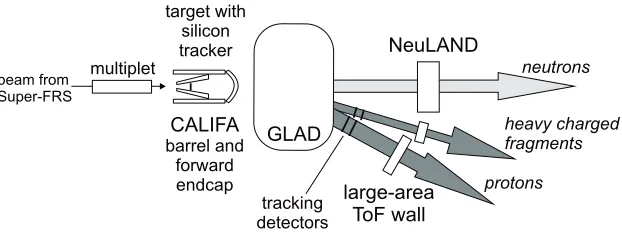
charged products in order to be able to detect in coincidence neutrons in the forward direction. The GLAD large-gap dipole magnet has been built by CEA Saclay and will be delivered to GSI for first tests in 2014.
Special detector systems have been designed for the detection of neutrons downstream and of photons and particles around the target region (see overview in Fig. 5). For the neutron detector NeuLAND (new large-area neutron detector) the technical design has been fixed with the aim to provide a high detection efficiency, a high resolution, and a large multi-neutron-hit resolving power. NeuLAND will employ plastic scintillators distributed as 3000 individual submodules with a size of 5×5×250 cm3and arranged in 30 double planes with 100 submodules providing an active face size of 250×250 cm2and a total depth of 3 m. It will be possible to divide NeuLAND into two detector units if needed. Presently, two new NeuLAND double-planes have been built with 300 scintillator bars and 600 corresponding photo-multipliers. It is envisaged to have for first tests about 20% of detector available for physics experiments at GSI. NeuLAND will be completed in stages until the FAIR facility will start operation.
The reaction target is surrounded by the CALIFA calorimeter [30], which is divided into a barrel that covers angles up to 45circand a forward front-cap for the forward angles (in direction toward the GLAD magnet). It is planned to use about 2000 individual CsI crystals for the barrel and a mixture of LaBr3and LaCl3 crystals for the front-cap in order to detect gamma rays and light ions. The design of the barrel has been fixed while the design of the front-cap is in progress. A first stage (including a demonstrator) for the CALIFA barrel is financed and presently under construction.
In the case of reactions where the region of low momentum transfer is of highest interest, the application of an active target is beneficial, i.e. using gas at the same time as target and detection medium, as it provides high resolution detection of very slow target-like recoil particles with high efficiency. The design of the R3B active target is in progress.
An additional essential part of the R3B experiment is the target recoil detector, which is required to detect light recoil particles in coincidence with the heavy fragments, neutrons, and the gamma rays. The aim is to study elastic, inelastic, and quasi-free scattering as well as knockout and breakup reactions. It will be possible to perform tracking with high efficiency and acceptance at an energy resolution better than 1 MeV. The design has been finalized and it is fully funded. It is planned to use a three-layer structure of silicon micro-strip detectors in a lamp-shade form. A first stage of the system is ready for tests.
detectors for the identification of the incoming ion beam from Super-FRS. These tracking detectors are required to identify particles and their kinematics before and after the reaction target (momentum, angle, and position), where the resolution has to be good enough to achieve unique isotope identifica-tion. With an additional large-area ToF wall detector, it is planned to study fission and spallation in relativistic heavy-ion collisions where the time-of-flight resolution shall resolve isotopes around the massA=200 region.
A future extension of the R3B setup is an additional spectrometer placed behind the GLAD dipole magnet with a magnetic rigidity of 15 Tm, which shall be operated as zero-degree spectrometer. The aim is to obtain a momentum resolutionΔp/pof the order of 10−4by use of tracking of the particles in the spectrometer.
3.3 Ring branch
In general, storage rings provide unique conditions for precision experiments with stable and exotic nuclei. It is possible to cool the stored highly charged ions by use of stochastic and electron cooling, i.e. to reduce their energy spread either after initial production, secondary reactions or after decay processes in the storage ring. Due to ultra-high vacuum conditions and cooling of the ions, the storage for long times up to several hours is possible. For a comprehensive overview see [31].
The experiments ILIMA (isomeric beams, lifetimes, and masses) [32], ELISe (electron-ion scat-tering in a storage ring) [33], and EXL (exotic nuclei studied in light ion induced reactions at the NESR storage ring) [34] rely on the availability of the NESR (new experimental storage ring) as it will provide electron cooling for the stored exotic nuclei. Since the NESR is not part of the Modular-ized Start Version of FAIR, the initial physics program of the NUSTAR storage ring experiments is based on the exploitation of the CR (Collector Ring) and additional opportunities at the HESR (High-Energy Storage Ring) and ESR as well as CRYRING, with the latter presently being installed at GSI and linked to the ESR storage ring (not shown in Fig. 2).
3.3.1 ILIMA
With the ILIMA experiment it is planned to study exotic nuclei with the aim to measure masses, lifetimes and decay modes of ground and isomeric states being limited to radionuclides with a half-life above 10μs. Being able to probe single ions and making use of the production of very exotic nuclei at FAIR, a wide range of short-lived isotopes can be addressed for the first time. The wealth of data provided by ILIMA will give important input to the investigation of nuclear structure and nuclear astrophysics.
The mass measurement program can be realized in the CR, which is designed to allow for the operation in the isochronous ion-optical mode, a prerequisite for isochronous mass spectrometry. To this end, time-of-flight detectors will be applied in one of the straight sections of the CR. As mentioned above, the injection of heavy ions from CR into the HESR might be possible in order to perform Schottky mass spectrometry [35] on nuclides with half-lives of a few seconds.
experiments at intermediate energies. It is planned to perform light-ion reactions in inverse kinematics by using novel storage-ring techniques and a universal detector system. The latter requires high resolution and a large solid angle coverage in order to obtain kinematically complete measurements. The detector system shall be installed at the internal target of the NESR and comprises a silicon target-recoil detector for charged particles, detectors for gamma rays and slow neutrons detectors, all mounted in the vicinity around an internal gas-jet target. The detector system is completed with forward detectors for fast ejectiles (both charged particles and neutrons) and an in-ring heavy-ion spectrometer. The two main detector systems are the Silicon Particle Array (ESPA) for detection of light charged particles and the Gamma and Particle Array (EGPA) for the detection of punch-through particles and gamma-rays. Although not in the Modularized Start Version (MSV) of FAIR, the EXL collaboration is working on the detector development [37]. In addition, the possibilities to run at the ESR are looked into.
4 Conclusion
About one third of the NUSTAR experiment funding is covered by a contribution from the FAIR member states and associates to the overall construction budget. Full funding is established with additional funds from member states (outside the FAIR budget) and other contributing partners. Most of the technical design reports will be prepared in the next two years and the construction phase will start for the remainder of the equipment not built yet.
HISPEC and DESPEC are ready for operation with final versions of some components and proto-types or first stages for the other systems. Similarly MATS and LaSpec have operational first stages of their final setups and further development is ongoing. The R3B setup with the construction of its large acceptance dipole magnet GLAD being completed and the production of NeuLAND and CAL-IFA barrel in progress is also well underway. In the case of ILIMA, besides the construction of the Super-FRS, the final technical design of the CR collector ring is monitored as the implementation of the ILIMA detectors is crucial for the envisaged physics program. In addition, the design of the detec-tors is in progress. While ELISe is awaiting the upgrade of the FAIR facility with the NESR (beyond the Modularized Start Version), the EXL experiment may start by adapting its program and detectors to the optional operation at the ESR or HESR. Finally, the physics exploitation of the Super-FRS as a stand-alone experiment is presently being defined.
Acknowledgements
The support from H. Simon, J. Gerl, M. Gorska, and T. Nilsson in the preparation of this manuscript is acknowl-edged.
References
[1] B. Rubio, T. Nilsson, Nucl. Phys. News16, No. 1, 9-14 (2006) [2] T. Nilsson, Eur. Phys. J. Special Topics156, 1-12 (2008) [3] T. Aumann, Riv. Nuovo Cimento35, 1-28 (2012)
[4] H. Geisselet al., Nucl. Instrum. and Meth. B204, 71-85 (2003) [5] M. Winkleret al., Nucl. Instrum. and Meth. B266, 4183-4187 (2008) [6] W.R. Plaßet al., Nucl. Instrum. and Meth. B317, 457-462 (2013) [7] J.S. Winfieldet al., Nucl. Instrum. and Meth. A704, 76-83 (2013) [8] H. Geisselet al., Nucl. Instrum. and Meth. B317, 277-283 (2013) [9] M. Ranjanet al., Eur. Phys. Lett.96, 52001 (2011)
[10] J. Simpson, J. Phys.: Conf. Ser.41, 72-80 (2006)
[11] S. Akkoyunet al., Nucl. Instrum. and Meth. A668, 26-58 (2012) [12] P. Golubevet al., Nucl. Instrum. and Meth. A723, 55 (2013) [13] G. Jaworskiet al., Nucl. Instrum. and Meth. A673, 64-72 (2012) [14] J. Gerl, Acta Phys. Pol. B40, 767-778 (2009)
[15] C. Domingo-Pardoet al., Nucl. Instrum. and Meth. A694, 297-312 (2012) [16] A.R. Garciaet al., JINST7, C05012 (2012)
[17] A. Montaner Pizáet al., AIP Conf. Proc.1541, 179 (2013)
[18] M.B. Gómez-Hornilloset al., J. Phys. Conf. Ser.312, 052008 (2011) [19] K. Blaum, Phys. Rep.4251-78 (2006)
[20] D. Rodríguezet al., Eur. Phys. J. Special Topics183, 1-123 (2010) [21] J. Ketelaeret al., Nucl. Instrum. and Meth. A594, 162-177 (2008) [22] J. Ketelaeret al., Phys. Rev. C84, 014311 (2011)
[23] S. Eliseevet al., Phys. Rev. Lett.110, 082501 (2013) [24] S. Eliseevet al., Appl. Phys. B114, 107-128 (2014)
[25] R.N. Wolfet al., Int. J. Mass Spectrom.349-350, 123-133 (2013)
[26] W.R. Plaß, T. Dickel, C. Scheidenberger, Int. J. Mass Spectrom.349-350, 134-144 (2013) [27] F. Wienholtzet al., Nature498, 346-349 (2013)
[28] W. Nörtershäuser, P. Campbell, Hyperfine Interact.171, 149-156 (2006) [29] Z. Sunet al., IEEE Transact. Appl. Supercond.20, 222-225 (2010) [30] B. Pietraset al., Nucl. Instrum. and Meth. A729, 77-84 (2013) [31] Yu.A. Litvinovet al., Nucl. Instrum. and Meth. B317, 603-616 (2013)
[32] P.M. Walker, Yu.A. Litvinov, H. Geissel, Int. J. Mass Spectrom.349-350, 247-254 (2013) [33] A.N. Antonovet al., Nucl. Instrum. and Meth. A637, 60-76 (2011)