Learning with Errors in the Exponent
¨
Ozg¨
ur Dagdelen
∗TU Darmstadt
Sebastian Gajek
NEC Research Labs
Florian G¨
opfert
TU Darmstadt
Abstract
We initiate the study of a novel class of group-theoretic intractability problems. Inspired by the theory of learning in presence of errors [Regev, STOC’05] we ask if noise in the exponent amplifies intractability. We put forth the notion ofLearning with Errors in the Exponent (LWEE) and rather surprisingly show that various attractive properties known to exclusively hold for lattices carry over. Most notably are worst-case hardness and post-quantum resistance. In fact, LWEE’s duality is due to the reducibility to two seemingly unrelated assumptions: learning with errors and the representation problem [Brands, Crypto’93] in finite groups. For suitable parameter choices LWEE superposes properties from each individual intractability problem. The argument holds in the classical and quantum model of computation.
We give the very first construction of a semantically secure public-key encryption system in the standard model. The heart of our construction is an “error recovery” technique inspired by [Joye-Libert, Eurocrypt’13] to handle critical propagations of noise terms in the exponent.
Keywords: Lattice theory, group theory, public-key encryption, existential relations, double hardness
1
Introduction
Since the introduction of public-key cryptography in the ground-breaking paper of Diffie and Hellman [DH76], cryptographic systems with versatile functionality have been introduced. Deeming the system secure is a delicate task. One typically conducts a polynomial-time reduction to a computational problem conjectured to be intractable. Proofs of such nature give the strongest qualitative and quantitative arguments. On the flip side, reductions reveal the Achilles’ heel of any cryptosystem. Security holds as long as no polynomial-time algo-rithm solves the underlying problem. Since the introduction of contemporary cryptography a central concern has been to identify computational-intractable problems and assess their hardness.
Among the most carefully scrutinized cryptographic problems are probably the discrete logarithm in finite groups and factorization. Shor’s celebrated theorems [Sho94, Sho97a] curtailed for the first time the confidence of founding cryptosystems on group-theoretic as-sumptions. He showed the existence of polynomial-time solvers for integer factorization and discrete logarithm computation in the non-classical quantum computation model. Re-searchers have then begun to look for alternative computational problems. In this line of work Regev explored a lattice problem class known as learning with errors (LWE) [Reg05]. Given a distribution of noisy equations (a, b = ha,si+e)∈ Zn
q ×Zq where e is taken from
a small Gaussian error distribution, the problem comes in two flavors. The search problem is to compute s whereas the decisional pendant asks to distinguish (a, b) from random ele-ments inZnq ×Zq. There are several convincing arguments to believe inLWE’s intractability
[Reg10]: First, the best known solvers run in exponential time and even quantum algorithms do not seem to help. Second, learning with errors is a generalization of learning from parity with error, which is a well-studied problem in coding theory. Any major progress in LWE
will most likely cause significant impact to known lower bounds of decoding random lin-ear codes. Lastly and most importantly, breaking certain average-case problem instances of
LWEbreaks all instances of certain standard lattice problems [Reg05, Pei09, LM09, BLP+13]. Against the background an armada of cryptosystems has been proposed with versatile prop-erties [Reg05, LP11, GPV08, Gen09, ABB10a, ABB10b, CHKP10, BV11a, BGV12, Bra12]. Taking the findings from lattices in presence of errors into account we carry on the study of noise as a non-black box intractability amplification technique. Specifically, we ask does noise effect the intractability of group-theoretic problems as well? If so, is cryptogra-phy possible in groups where noise terms propagate in the system and may easily distort the cryptographic task? Apart from the theoretical interest, our work has concrete practical mo-tivation. Recently, large-scale electronic surveillance data mining programs put in question the security provided by present cryptographic mechanisms. (See also the IACR statement and mission on mass surveillance.1) One of the problems is that many security protocols in
the wild are based on a single intractability problem and we do not know the exact security. What if somebody has found a clever way to factor numbers? This already suffices to decrypt most of the TLS-protected Internet traffic and eavesdrop emails, social network activities,
and voice calls.2 Note, answering any of the above questions in an affirmative way advertises
a novel family of computational assumptions with hardness and robustness properties in the superposition of group and lattice theory.
1.1
Our Contribution
Blending Group and Lattice Theory. As an initial step towards approaching above
questions, we introduce the notion of learning with errors in the exponent (LWEE). The assumption reconciles the group theoretic structure of discrete-log related problems with the algebraic simplicity of lattice theory. The technical idea behind can be summarized as planting anLWEsample (a, b =ha,si+e)∈Zn
q×Zq in the exponent of a generatorg of some
groupGof orderq. More precisely, the distribution consists of samples (ga, gha,si+e)∈
Gn×G
where a is sampled uniformly from Zn
q, and s ←R χns, e ←R χe from some distributions
χs, χe. Similar to LWE, learning with errors in the exponent comes in two versions: The
search version asks to compute the secret vector s while in the decisional variant one is supposed to distinguish LWEE samples from a randomly sampled group elements.
Existential Relations. In an attempt to confine learning in presence of errors in the
exponent, we prove that the assumptions inherits the hardness from both theories. While striving for the existential relation to the family of group-theoretic assumptions, we infer a rather surprising connection to the (search) representation problem (`-SRP), introduced by Brands [Bra93]. Given a tuple of uniformly sampled elements g1, . . . , g`, h from G, the `-SRP asks to compute x1, . . . , x` ←χ for some distribution χ such that Π`i=1g
xi
i =h. Note
that the`-SRPproblem for`= 1 is essentially identical to the computational Diffie-Hellman problem. We give a tight reduction from `-SRP to the search version of the LWEE problem. Looking at the decisional learning with errors in the exponent problem, we first put forth the decisional pendant of the representation problem (`-DRP): Given a tupleg, g1, . . . ,
g`, gx1, . . . , gx`, hfromG, wherex1, . . . , x` ←χare sampled from some distributionχ,`-DRP
asks to distinguish between Π` i=1g
xi
i =hand a randomly sampled valuehinG. Observe that
`-DRP coincides with the decisional Diffie-Hellman (DDH) problem for ` = 1 and uniform distribution over Zq. In the same vain as done for the k-linear assumption [Sha07], we show
(in Appendix A) that`-DRPbecomes progressively harder to solve in Shoup’s generic group model [Sho97b]. We then show thatDRP reduces to LWEEwhich implies that if we select a group Gfor which DDHis believed to be hard, the hardness carries over to an instantiation of LWEE in that group G. It is worth mentioning that both of our reductions from the RP
problem are tight. They hold for (potentially non-uniform) distributionsχ, if the underlying
RP problem is hard for representations sampled from the same distribution.
Investigating the relation to lattices, we show that an algorithm solving either the search or decisional LWEE problem efficiently can be turned into a successful attacker against the search or decisionalLWE problem. Our reductions are tight and hold as well for (potentially
2TLS’s preferred cipher suite makes use of RSA-OAEP to transport the (master) key in the key
non-uniform) distributionχ if LWE is hard for secret s sampled from the same distribution.
A concrete Cryptosystem. We give a construction of a public-key encryption
scheme. One may size the magnitude to which the RP and LWE intractability contribute to the overall security of the system. The selection of parameters (e.g., modulus, dimension) offers a flexibility to fine-tune the cryptosystem’s resilience against progress in attacking the underlying RP or LWE problem or the evolution of quantum computers. Concretely, one may choose to make the scheme short, post-quantum secure, or double-hard. We discuss candidate parameter choices in Section 4.3. We remark that our construction serves the sole purpose of showcasing the possibility of designing cryptosystems based on “errors in the ex-ponent”. In practical applications, a combination of two encryption systems, say El-Gamal and Regev encryption, and each system encrypting information-theoretically a share of the message, would be given the preferred choice.
1.2
Our Techniques
The idea behind our scheme is reminiscent of Regev’s public-key encryption scheme. In a nutshell, the public key is an LWEEinstance (gA, gAs+x)∈
Gn×n×Gn. Ciphertexts consist
of two LWEE instances C = (c0, c1) where c0 = gAr+e0 encapsulates a random key r ∈ Znq
and c1 =ghb,ri+e1·gαµ encrypts the message µ(we discuss the exact value ofα below). The
tricky part is the decryption algorithm. All known LWE-based encryption schemes require some technique to handle the noise terms. Otherwise, decryption is prone to err. Regev’s technique ensures small error terms. One simply rounds c1 −c0s to some reference value
cb indicating the encryption of bit b. While rounding splendidly works on integers, the
technique fails in our setting. In contrast to addition and multiplication of group elements, there are no known polynomial-time algorithms for geometric operations. In fact, recovering the most significant bit—a basic operation for rounding—is conjectured to be a hard problem [FPSZ06].
Our first attempt thus was to scale the noise with some scalar t such that all error terms areeven. The advantage of even noise terms has been demonstrated in many constructions of fully homomorphic encryption as a technique to “round to the closest” bit [BV11b, BV11a, BGV12, CCK+13]. We would then round to the closest bit “in the exponent” using the Goldwasser-Micali trick of computing the Jacobi symbol [GM82]. (Essentially, the Jacobi symbol computes the least significant bit of the exponent). The crux of the technique is that it works as long as the error in the exponent does not wrap around the order q of the group. Otherwise, error terms might become odd and decryption fails (since 2 - q). To solve the problem one might feel tempted to also choose even q. However, Brakerski and Vaikuntanathan prove that the scaled version of LWE, where samples are of the form (ai,ai·s+t·ei) for some scalar t, is equivalent to the standard LWE assumption as long as
scalart and modulusq are coprime [BV11b]. In other words, ift is even in our construction,
qmust be odd. For bothtandq even, unfortunately, there exists an efficient least significant bit recovery algorithm (without any trapdoor) and the whole encryption system collapses.
and Libert [JL13] and recover partial bits of the discrete logarithm. The main idea is to tweak the modulus in a smart way. Given composite modulus N =pq with p0, q0, such that
p = 2kp0 + 1 and q = 2kq0 + 1 are prime, there exists an efficient algorithm for recovering the k least significant bits of the discrete logarithm. We choose the parameters so that the sum of all error terms in the exponent is (with high probability) at most 2k−`. This leads
to a “gap” between error bits and those bits covert by the discrete log instance. We plant the message in this gap by shifting it to the 2k−`’s bit, where` is the size of the message we
want to decrypt. Hence, we choose α = 2k−` in our construction to shift the message bits
accordingly.
1.3
Previous Work
Brickell and McCurley [BM92] to the best of our knowledge were the first to study cryp-tographic algorithms under hedged hardness assumptions. The authors propose a variant of Schnorr’s identification scheme [Sch90] secure assuming the intractability of discrete log-arithms in a group of composite order N. Their scheme is witness-hiding and sound if factoring and computing discrete logarithms are simultaneously hard. Assuming factoring is easy, their scheme degenerates to soundness under theDL assumption.
Learning with errors in the exponent has a different nature. LWEE remains intractable despite the fact that there exists an attacker breaking either of the underlying problems as long as the peer assumption remains hard in presence of the breaker. It is well known that to factorN, it suffices to be able to compute the discrete log moduloN; to compute the discrete log moduloN, it suffices to factor and compute the discrete log modulo primes. Learning with errors in the exponent builds upon two orthogonal assumptions. For appropriate parameter choices breaking one assumption will not degenerate the security of the system, unless the partner assumption is secure in presence of the breaker or significant progress is made in reconciling the representation and learning with errors problem.
We also mention the work of Gentry and Halevi [GH11]. They give a fully homomor-phic encryption construction from a lattice-based somewhat homomorhomomor-phic encryption and ElGamal encryption scheme. Instead of squashing the decryption function, they compress ciphertexts from the homomorphic scheme into a single ElGamal ciphertext. Similar to our work, their work attempts to build encryption schemes upon lattice and group-theoretic as-sumptions, but it provides no hedged security. For the proof to come through they require both the LWE and DDH assumption to simultaneously hold.
1.4
Extensions and Open Problems
While learning with errors in the exponent is an interesting concept in its own right, it requires further thorough inspection. Here we point out a few possible directions for future research:
underlying assumptions contribute to the overall security.
• We are unaware of any existential relation between the representation and learning with errors assumption neither in the classical nor quantum model of computation. In fact, any insight would require progress in solving the hidden subgroup problem (HSP) in certain finite Abelian and non-Abelian groups. Shor’s discrete-log quantum algorithm crucially relies on the HSP in Abelian groups. However, efficient quantum algorithms for the HSP in non-Abelian groups are unknown as they would give an efficient algorithm for solving the unique shortest-vector problem, being a special case of the shortest vector problem (SVP) [Reg04].
• Clearly, building further cryptosystems based on the search or decisional variant of learning with errors in the exponent is an interesting direction. A candidate to look at is the Naor-Reingold pseudorandom function which bears reminiscence to the structure of learning with errors in the exponent [NR04]. Recall, the NR pseudorandom function is defined as fs(a) = gΠaisi where g generates a group G of prime order q, the input
to the function a is an integer in bit representation ai ∈ {0,1} and the seed is s∈Znq.
It would be interesting, if one can get a tight reduction to LWEE from a slightly modified construction fs(a) = g
P
aisi where a
n = 1 and sn is the error term. Further,
it would be interesting to investigate, if one could derive security for weak secrets, leakage-resilience, or key-dependence thanks the embeddedLWE instance. Goldwasser et al. have shown that LWE bears many attractive robustness guarantees for this purpose [GKPV08].3
2
Preliminaries
In this section we introduce some notation and recall the representation and learning with errors problem for both the search and decision variant. No decisional pendant of the rep-resentation problem has been introduced. We give a formal definition and show that the decisional version is as least as hard as the decisional Diffie-Hellman problem.
2.1
Notation
Random Sampling, Negligibility and Indistinguishability. If Dis a probability dis-tribution, we denote byd←R Dthe process of sampling a value drandomly according toD.
In case S is a set, then s ←R S means that the value s is sampled according to a uniform
distribution over the set S. We write [m] for the set {0,1, . . . , m−1}. The expression dxc
denotes the nearest integer to x∈R, i.e., dxc=dx−0.5e.
A functionε() is called negligible (in the security parameterκ) if it decreases faster than any polynomial poly(κ) for some large enough κ. An algorithm A runs in probabilistic
3In a nutshell, this is so becauseLWE as ”assumption” can be shown to hard despite weak secrets, i.e.
polynomial-time (PPT) ifAis randomized—uses internal random coins— and for any input
x ∈ {0,1}∗ the computation of A(x) terminates in at most poly(|x|) steps. If the running
time of an algorithm is t0 ≈t, we mean that the distance between t0 and t is negligible. Let X = {Xκ}κ∈N and Y = {Yκ}κ∈N be two distribution ensembles. We say X and Y
are (t, )-computationally indistinguishable if for every PPT distinguisher A with running time t, there exists a function (κ) such that |Pr[A(X) = 1]−Pr[A(Y) = 1]| ≤ (κ) (and we write X ≈(t,) Y). If A is PPT and (κ) is negligible, we simply say X and Y are
(computationally) indistinguishable (and we write X≈Y). We say a distribution ensemble
X ={Xκ}κ∈N has (high) min-entropy, if for all large enough κ, the largest probability of an
element in Xκ is 2−κ. We say a distribution ensemble X = {Xκ}κ∈N is well-spread, if for
any polynomial poly(·) and all large enough κ, the largest probability of an element in Xκ
is smaller thanpoly(κ). (In other words, the max-entropy of distributions inX must vanish super-logarithmatically.) Under the Gaussian distribution Dσ with parameter σ > 0, the probability of sampling an integerx∈Z is proportional to exp[−x2/(2σ2)].
Vectors and Matrices in the Exponent. We denote vectors by bold lower case letters and matrices by bold upper case letters. The ith row of a matrix A is denoted by A[i], the
jth element of a vector a is denoted by a
j, To ease notation we sometimes write ai for the
ith row vector, and ai,j for the element in the ith row andjth column of matrixA. LetG be
a group of order q, g a generator ofG, a a vector in Znq, and A a matrix in Zmq×n. We use
the notation ga ∈
Gn to denote the vector ga def= (ga1,· · · , gan) and gA ∈ Gm×n to denote
the matrix gA def= (ga1,· · · , gam)>.
Computations in the Exponent. Givenga and b, the inner product of vectors aand b
in the exponent, denoted by gha,bi, is
n
Y
i=1
(gai)bi =
n
Y
i=1
gai·bi =gPni=1ai·bi =gha,bi .
Likewise, a matrix-vector product in the exponent, given a vector v and gA for a matrix
A= a1 a2 . . . an
can be performed by
n
Y
i=1
(gai)vi =
n
Y
i=1
gai·vi =gPin=1ai·vi =gAv .
Adding (and subtracting) in the exponent is computed via element-wise multiplication (and division) of the group elements ga·gb=ga+b.
Quadratic Residuosity. LetGbe a group of prime orderp. The Legendre symbol verifies whether an element a∈Gis a quadratic residue, i.e.,x2 ≡amodpfor some x. If
L(a, p) := a(p−1)/2 = 1, this is the case; otherwise
are odd primes, one uses its generalization, namely the Jacobi symbol, which is defined as
J(a, N) =Qki=1L(a, pi). Note that J(a, N) = 1 does not imply that a is a quadratic residue
modulo N. However, if J(a, N) = −1, a is certainly not. The set of quadratic residues modulo N is denoted by QRN := {a2 : a ∈
Z∗N}. By JN we denote the subgroup of all
elements from Z∗N with Jacobi symbol 1, i.e., JN = {a ∈ Z∗N : J(a, N) = 1}. Note that
QRN is a subgroup of JN. It is widely believed that one cannot efficiently decide whether
an element a ∈JN is a quadratic residue moduloN if the prime factors of N are unknown.
(For more details, we refer to Appendix B.1.)
2.2
Standard Group-Theoretic Problems
We recall in the meanwhile standard assumptions of discrete log and Diffie-Hellman. For our proofs, we need slightly generalized versions of the problem statements to handle exponents chosen from some distributionχwith (at least) minimal entropy. Throughout the paper, let
G be a group of order q and g be a generator of G. We implicitly include g and q in the
description of G when the meaning is clear from the context.
Def inition 2.1 (Discrete Log). Let χ be a distribution over Z∗q, and let x ←R χ. The Discrete Logarithm(DLG,χ) problem is(t, )-hard if any algorithmA, running in timet, upon
input gx, outputs x with probability at most .
We now formulate a slightly generalized version of the Diffie-Hellman problem for distri-butions with (minimal) entropy.
Def inition 2.2(Diffie–Hellman). Let χbe a distribution over Z∗q, and let y←Rχ. Further,
let x, z be uniformly sampled from Z∗q.
• The Computational Diffie–Hellman (CDHG,χ) problem is (t, )-hard if any algorithm A,
running in time t, upon input (gx, gy), outputs gxy with probability at most .
• The Decisional Diffie–Hellman(DDHG,χ) problem is (t, )-hard if
(gx, gy, gxy)≈(t,) (gx, gy, gz).
The idea of taking into account well-spread and min-entropy distributions χin groupsG of prime orderq is due to Canetti [Can97]. There, the assumption is an essential ingredient towards implementing the random oracle in the standard model.
We will also make use of the rank hiding assumption introduced by Naor and Segev [NS09] (and later extended by Agrawal et al. [ADVW13]). It was proven to be equivalent to the
DDHG,χ assumption for groups of prime order and uniform χ [NS09].
Def inition 2.3(Rank Hiding). LetG be a group of orderq with generatorg, andi, j, n, m∈
N satisfying i, j ≥1. The Rank Hiding problem (RHG,i,j,m,n) is (t, )-hard if
{(G, q, g, gM) :M←RRki(Zmq×n)} ≈(t,) {(G, q, g, gM) :M←R Rkj(Zmq×n)}
where Rkk(Zmq×n) returns an m ×n matrix uniformly random from Znq×m with rank k ≤
2.3
Representation Problem
The representation problem in a group G assumes that given l random group elements
g1, . . . , gl ∈G and h ∈ G it is hard to find a representation x∈ Z`q such that h =
Q`
i=1g
xi
i
holds. Brands builds an electronic cash system based on the problem. The assumption has found little application since then, until its applicability to leakage-resilient cryptosystems have been investigated [KV09, ADVW13, DV14].
We now state a more general version of the search representation problem where vector
x←Rχ`is sampled from a distributionχwith (at least) min-entropy and where an adversary
is given m≥1 samples instead of a single one.
Def inition 2.4 (Search Representation Problem). Let χ be a distribution over Zq, and
`, m be integers. Sample M ←R Zmq×`, h ←R Zmq , and x ←R χ`. The Search Representa-tion Problem (SRPG,χ,`,m) is (t, )-hard if any algorithm A, running in time t, upon input
(g, gM, gx, gMx), outputsx0 ∈
Z`q such that gMx 0
=gMx with probability at most. If χ is the
uniform distribution, we sometimes skip χ in the index and say that SRPG,`,m is (t, )-hard.
Brands proves the equivalence of the representation problem and the discrete logarithm problem for uniform χ and m = 1. It is easy to verify that the reduction holds for every distribution for which the discrete logarithm problem holds.
For establishing the relations to the learning with errors in the exponent problem (cf. Section 3.2), we need a decisional variant of the representation problem. To our surprise, the decisional version has not been defined before, although the assumption is a natural gener-alization of the decisional Diffie-Hellman problem to`-tuples (similar in spirit as the`-linear problem in G [Sha07]). Given ` random group elements g1, . . . , g` ∈ G and gx1, . . . , gx` ∈G
where x1, . . . , x` ←RZ∗q, it is hard to decide if h=
Q`
i=1g
xi
i orh is a random group element
in G. Our definition below generalizes this problem to the case, where m ≥ 1 samples are given to an adversary andx1, . . . , x` are sampled from any min-entropy distribution χ.
Def inition 2.5 (Decisional Representation Problem). Let χ be a distribution over Z∗q, and
`, m be integers. Sample M ←RZmq×`, h←R Zmq , and x←Rχ`. The Decisional Representa-tion (DRPG,χ,`,m) problem is (t, )-hard if
(g, gM, gx, gMx)≈(t,) (g, gM, gx, gh).
If χ is the uniform distribution over Z∗q, we say DRPG,`,m is (t, )-hard.
Note that the DRPG,χ,`,m problem can be stated in the framework of the Matrix-DDH
assumption recently introduced by Escala et al. [EHK+13]. We give evidence that the family
of DRPG,χ,`,m problems is a class of progressively harder problems (with increasing `) and
thus put another class of hardness problems to the arsenal of [EHK+13]. We defer proofs of following propositions to Appendix A and C.1.
Proposition 2.6. If DRPG,χ,`,m is (t, )-hard, then for any `, m≥ 1 with t0 ≈ t and
Proposition 2.7. In the generic group model DRPG,χ,`+1,m is hard for distribution χ with
minimal entropy, even in presence of a DRPG,χ,`,m-oracle.
Note that theDRPG,χ,1,1-problem withχbeing the uniform distribution overZq coincides
with the decisional Diffie-Hellman (DDH) problem. Hence, we obtain the corollary that for uniform distributions χ, the decisional Diffie-Hellman problem implies the representation problem DRPG,χ,`,1 for `≥1. In fact, Proposition 2.6 suggests a stronger argument.
Assum-ing the decisional Diffie-Hellman problem holds for well-spread and min-entropy distributions
χ, then the DRPG,χ,`,1 holds for χ and `≥1.
While Propositions 2.6 and 2.7 show that the hardness of the DRP problem progres-sively increases with`, the following proposition states that the problem remains hard with increasing number of samplesm. More precisely, we show that DRPG,χ,`,m is hard as long as DRPG,χ,`,1 and the rank hiding problem (cf. Definition 2.3) is hard. The proof can be found
in Appendix C.
Proposition 2.8. IfRHG,m,m+1,m+1,2`+1 is(t, )-hard andDRPG,χ,`,mis(t
0, 0)-hard in a cyclic
groupGof orderq, then for any distributionχe and anym >0witht0 ≈tand00≤(1−)−10 DRPG,χ,`,m+1 is(t, 00)-hard.
2.4
Learning with Errors
The learning with errors assumption comes as a search and decision lattice problem. Given a system of m linear equations with random coefficients ai ∈ Znq in the n indeterminates s
sampled from some distributionχs and biased with some errorei from the error distribution
χe, it is hard to compute vectorsor distinguish the solutionbi =Pni ais+ei from a uniform
element inZq.
Def inition 2.9 (Learning with Errors). Let n, m, q be integers and χe, χs be distributions
over Z. For s←R χs, define the LWE distributionLLWEn,q,χe to be the distribution over Z
n q ×Zq
obtained such that one first draws a←RZnq uniformly, e←Rχe and returns(a, b)∈Znq×Zq
with b =ha,si+e. Let (ai, bi) be samples from LLWEn,q,χe for 0≤i < m=poly(κ).
• The Search Learning With Errors (SLWEn,m,q,χe(χs)) problem is (t, )-hard if any
algo-rithm A, running in time t, upon input (ai, bi)i∈[m], outputs s with probability at most
.
• The Decisional Learning with Error (DLWEn,m,q,χe(χs)) problem is (t, )-hard if
(ai, bi)i∈[m]≈(t,) (ai, ci)i∈[m]
for a random secret s←Rχs.
A typical distribution for the error is a discrete Gaussian distribution with an appropriate standard deviation. There are several proposals for the distribution of the secret. While the uniform distribution is the most standard one, it is shown that setting χs = χe, known as
the “normal form”, retains the hardness of LWE [Mic01, ACPS09]. We also note that the learning with errors problem where the error is scaled by a constant α relatively prime to q
is as hard as the original definition [BV11b]. The “scaled” LWE distribution then returns (a, b) with a←R Znq and b =ha,si+αe.
2.5
Public-Key Encryption
In a public-key encryption, the encryptor holds a public key and encrypts a message such that the holder of the corresponding secret key reconstructs the message plaintext.
Def inition 2.10. A public-key encryption scheme (PKE) is a tuple of three algorithms PKE
= (Setup, Encrypt, Decrypt) such that:
• Thekey-generation algorithmKeyGen takes as input a security parameter 1κ. It outputs a public key pk and a secret key sk.
• The encryption algorithm Encrypt takes as input the public key pk and a message m ∈ M. It outputs a ciphertext c.
• Thedecryption algorithm Decrypt takes as input the secret keysk and a ciphertext c. It
outputs a message m.
We require that for all security parametersκ, all tuples(pk,sk)←RKeyGen(1κ), all messages
m∈ M, we have m=Decrypt(sk,Encrypt(pk, m))with probability negligibly close to 1.
Semantic security of a public-key encryption scheme against chosen-plaintext attacks is defined as an experiment between the challenger and adversary as follows:
Experiment ExpIND-CPA-b
PKE,A (κ):
Setup: The challenger runs Setupon input 1κ. A is given pk.
Challenge: At some point,Acomes up with two messagesm0, m1 subject to the restriction
that |m0|=|m1|. A is given Encrypt(pk, mb).
Guess: A comes up with a guess b0. The output of the experiment is defined as b0.
The advantage of adversaryAin violating plaintext privacy of thePKEscheme is the absolute value of the difference between the experiment for b = 0 and the experiment forb = 1.
AdvIND-CPA
PKE,A(κ) =| Pr [Exp IND-CPA-0
PKE,A (κ) = 1]−Pr [Exp IND-CPA-1
PKE,A (κ) = 1] |.
Def inition 2.11 (IND-CPA Security). A public-key encryption system PKE = (Setup, En-crypt, Decrypt) isindistinguishable under chosen-plaintext attacksor simplyplaintext private, if for all polynomial-time adversaries A we have that AdvIND-CPA
3
Learning with Errors in the Exponent
In this section we define learning with errors in the exponent and explore relations to known intractability problems.
3.1
Definition
For self-containment, the assumption is stated both as a search and decision problem over a groupGof orderq, and exponents sampled from distributionsχe, χsoverZ. We demonstrate
the versatility and general utility of the assumption in Section 4.
Def inition 3.1 (Learning with Errors in the Exponent). Let Gbe a group of order q where
g is a generator of G. Let n, m, q be integers and χe, χs be distributions over Z. For any
fixed vector s∈Zn
q, define theLWEE distribution LLWEEG,n,q,χe to be the distribution overG
n×
G
obtained such that one first draws vectora←RZnq uniformly, e←Rχe and returns (ga, gb)∈
Gn×Gwithb =ha,si+e. Let(gai, gbi)be samples fromLLWEE
G,n,q,χe andci be uniformly sampled
from Z∗q for 0≤i < m=poly(κ).
• TheSearch Learning With Errors in the Exponent(SLWEEG,n,m,q,χe(χs)) problem is(t, )
-hard if any algorithm A, running in time t, upon input (gai, gbi)
i∈[m], outputs s with
probability at most .
• The Decision Learning With Errors in the Exponent (DLWEEG,n,m,q,χe(χs)) problem is
(t, )-hard if
(gai, gbi)
i∈[m]≈(t,) (gai, gci)i∈[m]
for a random secret s ←R χns. If χs is the uniform distribution over Zq, we write
DLWEEG,n,m,q,χe.
We let AdvDLWEE/SLWEE
G,n,m,q,χe,χs(t)denote a bound on the value for which the decisional/searchLWEE
problem is (t, )-hard.
One may interpret learning with errors in the exponent in two ways. One way is to implant an error term from a distributionχe into the Diffie-Hellman exponent. Another way
to look at LWEE is as compressing an LWE instance within some group G of order q.
3.2
Relations to Group and Lattice Problems
To clarify the hardness ofLWEE, we establish a connection to the representation and learning with errors problem. We summarize our main results in following four propositions. Proofs appear in Appendix C.
Proposition 3.2. If SRPG,χs,`,m is (t, )-hard in a cyclic group G of order q, then for any
distribution χe and any number of samples m > 0 SLWEEG,`,m,q,χe(χs) is (t
Proposition 3.3. If SLWEn,m,q,χe(χs) is (t, )-hard, then for any cyclic group G of order q with known (or efficiently computable) generator SLWEEG,n,m,q,χe(χs) is (t
0, )-hard with t0 ≈t.
Proposition 3.4. If DRPG,χs,`,m is (t, )-hard in a cyclic group G of order q, then for any
distribution χe and any number of samples m > 0 DLWEEG,`,m,χe(χs) is (t
0, )-hard with t0 ≈t.
Proposition 3.5. If DLWEn,m,q,χe(χs) is (t, )-hard, then for any cyclic group G of order q
with known (or efficiently computable) generatorDLWEEG,n,m,χe(χs)is(t
0, )-hard with t0 ≈t.
Discussion. The essence from above propositions is that there exist tight reductions
from the search (resp. decision) learning with errors in the exponent problem to either the search (resp. decision) representation problem and the search (resp. decision) learning with errors problem. This has several interesting property preserving implications. As a corollary we infer that for appropriate parameter choices LWEE preserves the hardness and
robustness properties of the representation and/or learning with errors problem. Essentially
thenLWEEboils down to the security of either of the two underlying problems. This way, the cryptosystem can be instantiated to leverage leakage resistance and post-quantum hardness thanks LWE [GKPV08, Reg05]. On the flip side, the cryptosystem may offer short instance sizes through the underlyingRPproblem (when instantiated on elliptic curves). Of particular interest for many emerging applications is the partnering of the two hardness assumptions. One may choose parameters such that bothRP andLWE hold. We call the casedouble-hard, which appeals to provide in some sense hedged security.
3.3
On the Generic Hardness of LWEE
With Proposition 3.2-3.5 in our arsenal we conjectureLWEE to be harder than either of the underlying RP or LWE problems. The argument is heuristic and based on what is known about the hardness of each intractability problem. We refer to Appendix B for a recap and concrete security parameters.
Fix parameters such that RP and LWE problem instances give κ bits security. The only obvious known approach today to solve the LWEE instance is to first compute the discrete logarithm of samples (gai, gbi) and then solve the LWE problem for samples (a
i, bi). Note
that an adversary must solve n2 +n many discrete logarithms because the secret vector
s is information-theoretically hidden, if less than n samples of LWE are known. Solving
N :=n2+ndiscrete logarithms in generic groups of orderqtakes time√2N qwhile computing a single discrete logarithm takes time pπq/2 [KS01, HMCD04].4 In fact, this bound is
proven to be optimal in the generic group model [Yun14]. Note, parameters for LWEE are chosen such that computing a single discrete logarithm takes time 2κ. Hence, in order to solve the LWEE instance for N = O(κ2), one requires time √2
π √
N ·2κ + 2κ > 2κ+2 log(κ).
This shows that generically the concrete instance of LWEE is logarithmically harder in the security parameter κ.
4
Public-Key Encryption from LWEE
In this section we give a construction of a provably secure public-key bit encryption scheme with a reduction to the decisional learning with errors in the exponent assumption in the standard model.
4.1
Our Construction
The scheme is parameterized by positive integersn, k, ` < k and Gaussian parametersσs, σe.
KeyGen: Sample prime numbersp0 and q0, such that p= 2kp0+ 1 andq = 2kq0+ 1 are prime. Set N = pq and M = 2kp0q0. Sample s ←
R Dnσs, A ←R Z
n×n
M and x ←R Dnσe and
compute b=A>s+x. Sample g ∈JN \QRN of order M. The public key consists of pk= (g, gA, gb, N), and the secret key of sk= (p,s).
Encrypt(pk, µ): To encrypt` bits µ∈ {0,1, . . .2`−1}given public key pkchoose r←RDnσs, e0 ←RDnσe and e1 ←RDσe. Use g
A, r and e
0 to compute gAr+e0, and gb, r and e1 to
compute ghb,ri+e1. The ciphertext isc
0, c1 with
c0 =gAr+e0, c1 =ghb,ri+e1 ·g2
k−`µ .
Decrypt(sk,(c0, c1)): To decrypt the ciphertext (c0, c1) given secret key sk = (p,s), first
compute ghs,Ar+e0i and then h = c
1/ghs,Ar+e0i. Run Algorithm 1 to synthesize v =
logg(h) mod 2k and return 2k−v`−1
.
Algorithm 1:
Input: Generator g of a group with order p−1 = 2kp0,p and k Output: k least significant bits of logg(h)
begin
a= 0, B = 1;
for i∈ {1, . . . , k} do z ←L(h, p)2i mod p; t ←L(g, p)a
2i modp; if z 6=t then
a←a+B;
end B ←2B;
end return a end
for a modulus being a multiple of 2k is proven in [JL13, Section 3.2]. Second, noise in the
exponent does not overlap with the message. To this end, we need to bound the size of the noise.
Lemma 4.1 (adapted from [LP11][Lemma 3.1]). Let c, T be positive integers such that
σs·σe≤
π c
T
p
nln(2/δ) and
c·exp(1−c
2
2 )
2n
≤2−40.
Then, for x,s ←R Dnσe,r,r0 ←R D
n
σe, e1 ←R Dσe, we have |hx,ri − hs,e0i+e1| < T with
probability at least 1−δ−2−40.
We are now ready to prove the following theorem.
Theorem 4.2. Let c, T be as in Lemma 4.1. Then, the decryption is correct with probability at least 1−δ−2−40.
Proof. To see that the above scheme decrypts properly the message µ, observe first that
canceling out the term ghs,ui from c1 gives the encryption of µ with some small noise term
in the exponent. That is,
h=ghb,ri+e1+2k−`µ−hs,Ar+e0i =ghA>s,ri+hx,ri+e1−hs,Ari−hs,e0i+2k−`µ=ghx,ri−hs,e0i+e1+2k−`µ.
As Algorithm 1 recovers the k least significant bits of
hx,ri − hs,e0i+e1+ 2k−`µ mod p0q02k,
we have
v =hx,ri − hs,e0i+e1+ 2k−`µ mod 2k.
Lemma 4.1 for T = 2k−`−1 shows thathx,ri − hs,e0i+e1 <2k−`−1, and therefore
j v
2k−`
m
=
h
x,ri − hs,e0i+e1+ 2k−`µ mod 2k
2k−`
=
h
x,ri − hs,e0i+e1
2k−`
+µ=µ
4.2
Security Analysis
We now proceed to the security analysis. In the forthcoming Section 4.3, we discuss concrete parameter choices for different security levels
Theorem 4.3. LetG=hgibe the cyclic group generated by g. If DLWEEG,n,n+1,q,Dσe(Dσs)is
Proof. In a high level, our proof works as follows. Instead of showing IND-CPA security via a direct argument we show that the distribution (pk,c0, c1) is indistinguishable from the
uniform distribution over (Gn×n ×G2n+1). That is, a ciphertext (c
0, c1) under public key
pk appears completely random to an adversary. This holds, in particular, in the IND-CPA experiment when the adversary chooses the underlying plaintext. We prove the theorem via a series of hybrid arguments, Hybrid0 to Hybrid2, where in each consecutive argument we make some slight changes with the provision that the adversary notices the changes with negligible probability only. In the following, we use the abbreviations u = Ar +e0 and
v =hb,ri+e1+ 2k−`µ.
Hybrid0: In this hybrid we consider the original distribution of the tuple
(pk,(c0,c1)) = (gA, gb, gu, gv).
Hybrid1: In this hybrid we modify the distribution and claim
(gA, gb, gu, gv)≈c(gA 0
, gb0, gA0r+e0, ghb0·ri+e1 ·g2k−`µ)
for a uniformly sampled elementsgA0, gb0 ∈
Gn×n×Gn. We argue that any successful
algorithm distinguishing between Hybrid0 and Hybrid1 can be easily turned into a suc-cessful distinguisher B in the DLWEEG,n,n,q,Dσe(Dσs) problem. The DLWEE-adversary
B is given as challenge the tuple (gA, gb) and is asked to decide whether there exist
vectorss←RDσs,x←R D
n
σe such that g
b=gA>s+x
orgb was sampled uniformly from
Gn.
Let Pr[Hybridi(t)] denote the probability of any algorithm with runtime t to win the IND-CPA experiment in hybrid i. Then, we have
Pr[Hybrid0(t)]≤Pr[Hybrid1(t)] +AdvDLWEE
G,n,n,q,Dσe,Dσs(t).
Hybrid2: In this hybrid we modify the distribution and claim
(gA0, gb0, gA0r+e0, ghb0·ri+e1 ·g2k−1µ)≈
c(gA 00
, gb00, gu0, gv0·g2k−1µ)
for a uniformly sampled elements gA00, gb00, gu0, gv0 ·gµ ∈ G(n+1)×n×
Gn+1. We argue
that any successful algorithm distinguishing between Hybrid1 and Hybrid2 can be eas-ily turned into a successful distinguisher B in the DLWEEG,n,n+1,q,Dσe(Dσs) problem.
Note thatgb0, ghb0·ri+e1 is an additional sample from theLWEEdistribution from which
gA0, gA0r+e0 is sampled.
We have
Pr[Hybrid1(t)]≤Pr[Hybrid2(t)] +AdvDLWEE
G,n,n+1,q,Dσe,Dσs(t).
Note that now all exponents are uniformly distributed, and, in particular, independent of µ and thus, independent of b in the IND-CPA game. Hence, any algorithm has in
Hybrid2 exactly a success probability of 1/2.
4.3
Candidate Instantiations of our Encryption Scheme
We give three possible instantiation to derive a system with short key sizes, post-quantum security or double hardness. Throughout this section we instantiate our scheme such that the encryption scheme from Section 4.1 encrypts only a single bit. Wlog, parameters can easily be upscaled to many bits.
The Classical Way. We obtain the shortest key and ciphertext sizes when instantiating
LWEE parameters such that the underlying DRP is intractable, and neglecting the hardness of the underlying LWE.5 In Appendix B.1 we recall some groups where we believe DRP is hard to solve. Our encryption scheme works in the groupJN :={x∈ZN : J(x, N) = 1}for N =pq withp, q being k-safe primes. In fact, we can even take safe primes p, q (i.e., k = 1) since we do not need any noise in the exponent if we neglect the underlying LWE hardness. Thus, we embed the message to the least significant bit in the exponent. For this reason, we can sample g ←RJN/QRN where hgi has order 2p0q0. Since the LWE instance within LWEE
is not an issue here we select n =m = 1, σs=∞ and σe = 0.
We obtain 80-bit security for the underlying DRPproblem if we choose safe primespand
q such that logp = logq = 565 (see Table 3 in Appendix B.1). Table 1 lists possible key sizes for our encryption scheme. Recall that the public key consists of pk= (g, gA, gb, k, N)
(i.e., 4 group elements if we fix k = 1) and the secret key of sk= (p,s).
Sizes / Security ≈80-bit ≈128-bit ≈256-bit public-key size 0.565 kbytes 1.500 kbytes 7.500 kbytes secret-key size 0.212 kbytes 0.563 kbytes 2.813 kbytes ciphertext size 0.283 kbytes 0.750 kbytes 3.750 kbytes
Table 1: Key sizes for our encryption scheme basing security on DRP.
The Post-Quantum Way. Here we give example instantiations of our encryption scheme when it is based on a presumably quantum-resistant LWEE assumption. That is, we select parameters such that the underlying LWE assumption is intractable without relying on the hardness ofDRP. For this, we modify the scheme slightly by choosing fixed values for p0 and
q0 instead of sampling. A good choice is k = 15, since it allows to choose p0 = 2 and q0 = 5, which are very small prime numbers such that 2kp0+ 1 and 2kq0+ 1 are prime. For the LWE
modulus, this leads to M = 2kp0q0 = 327680. Like Lindner and Peikert [LP11], we choose
the Gaussian parameter such that the probability of decoding errors is bounded by 1%. We choose furthermore the same parameter for error and secret distribution (i.e. σs=σe =σ),
since a standard argument reduces LWE with arbitrary secret to LWE with secret chosen according to the error distribution. For this choice of k, p0 and q0, we obtain 80-bit security
5Admittedly the keys are only shorter for 80-bit security. This is the case, as there exists subexponential
by choosing n= 240 and σ= 33.98. Table 2 lists the key sizes when our encryption scheme is instantiated with parameters corresponding to Table 4 in Appendix B.2.
Sizes / Security ≈80-bit ≈128-bit ≈256-bit public-key size 235 kbytes 417 kbytes 1233 kbytes secret-key size 0.976 kbytes 1.302 kbytes 2.237 kbytes ciphertext size 0.980 kbytes 1.306 kbytes 2.241 kbytes
Table 2: Key sizes for our encryption scheme basing security on LWE.
The Hardest Way (Double-Hardness). The most secure instantiation of our encryp-tion is such that even if one of the problems DRP or LWE is efficiently solvable at some point, our encryption scheme remains semantically secure. Selecting parameters for double hardness, however, is non-trivial.
To select appropriate parameters for the case of double hardness, we apply the following approach: For a given security level (say κ = 80), we select N such that the Number Field Sieve needs at least 2κ operations to factor N. Following Table 3, we choose logN = 1130. Since factoring N must also be hard for McKee-Pinch’s algorithm, which works well when (p-1) and (q-1) share common factor, k must be chosen such that N1/42−k ≥ 2κ,
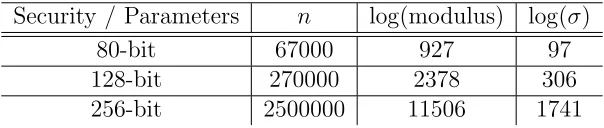
i.e. k ≤ log(4N) −κ. This leads to k = 203. Given N and k, we can calculate the sizes of the primes log(p0) ≈ log(q0) ≈ 362 and log(p) ≈ log(q) ≈ 565 and the LWE modulus log(M) ≈ 927. Taking n = 67000 and σ = 297 from Table 5, Lemma 4.1 shows that the
algorithm decrypts correctly with high probability. Other security levels κ (e.g., κ = 128 and κ= 256) can be achieved with theLWE instances depicted in Table 5 in Appendix B.2. We note that extrapolation to such large dimensions hardly give a good estimation for the hardness of LWE. Hence, one has to take these parameters for double hardness with care. The corresponding key and ciphertext sizes of our scheme are admittedly very large and unpractical, but they shall serve as a feasibility of double hardness in the first place.
Acknowledgements
The authors would like to thank Steven Galbraith and Dan Bernstein to point to a bug in a previous version of the paper, and the attendees of the Cryptography Workshop in
Oberwolfachfor their valuable feedback. ¨Ozg¨ur Dagdelen is supported by the German Federal
Ministry of Education and Research (BMBF) within EC-SPRIDE.
References
EU-ROCRYPT 2010, volume 6110 of Lecture Notes in Computer Science, pages 553–572. Springer Berlin Heidelberg, 2010.
[ABB10b] Shweta Agrawal, Dan Boneh, and Xavier Boyen. Lattice basis delegation in fixed dimension and shorter-ciphertext hierarchical IBE. In Tal Rabin, editor,
Advances in Cryptology CRYPTO 2010, volume 6223 ofLecture Notes in
Com-puter Science, pages 98–115. Springer Berlin Heidelberg, 2010.
[ACPS09] Benny Applebaum, David Cash, Chris Peikert, and Amit Sahai. Fast crypto-graphic primitives and circular-secure encryption based on hard learning prob-lems. In Shai Halevi, editor, Advances in Cryptology - CRYPTO 2009, volume 5677 of Lecture Notes in Computer Science, pages 595–618. Springer Berlin Hei-delberg, 2009.
[ADVW13] Shweta Agrawal, Yevgeniy Dodis, Vinod Vaikuntanathan, and Daniel Wichs. On continual leakage of discrete log representations. In Advances in Cryptology - ASIACRYPT 2013 - 19th International Conference on the Theory and Appli-cation of Cryptology and Information Security, Bengaluru, India, December 1-5,
2013, Proceedings, Part II, pages 401–420, 2013.
[AFG13] Martin R. Albrecht, Robert Fitzpatrick, and Florian G¨opfert. On the efficacy of solving lwe by reduction to unique-svp. Cryptology ePrint Archive, Report 2013/602, 2013. http://eprint.iacr.org/.
[Bab86] L. Babai. On Lovasz lattice reduction and the nearest lattice point problem.
Combinatorica, 6(1):1–13, 1986.
[Bac84] Eric Bach. Discrete logarithms and factoring. Technical Report UCB/CSD-84-186, EECS Department, University of California, Berkeley, Jun 1984.
[BGV12] Zvika Brakerski, Craig Gentry, and Vinod Vaikuntanathan. (Leveled) fully ho-momorphic encryption without bootstrapping. In Proceedings of the 3rd
In-novations in Theoretical Computer Science Conference, pages 309–325. ACM,
2012.
[BLP+13] Zvika Brakerski, Adeline Langlois, Chris Peikert, Oded Regev, and Damien
Stehl´e. Classical hardness of learning with errors. In Proceedings of the 45th
annual ACM symposium on Symposium on theory of computing, pages 575–584.
ACM, 2013.
[BM92] Ernest F. Brickell and Kevin S. McCurley. An interactive identification scheme based on discrete logarithms and factoring. Journal of Cryptology, 5(1):29–39, 1992.
[Bon98] Dan Boneh. The decision Diffie-Hellman problem. In JoeP. Buhler, editor,
Algorithmic Number Theory, volume 1423 ofLecture Notes in Computer Science,
[Bra93] Stefan A. Brands. An efficient off-line electronic cash system based on the representation problem. Technical report, Amsterdam, The Netherlands, The Netherlands, 1993.
[Bra12] Zvika Brakerski. Fully homomorphic encryption without modulus switching from classical GapSVP. In Reihaneh Safavi-Naini and Ran Canetti, editors, Advances
in Cryptology CRYPTO 2012, volume 7417 of Lecture Notes in Computer
Sci-ence, pages 868–886. Springer Berlin Heidelberg, 2012.
[BV11a] Zvika Brakerski and Vinod Vaikuntanathan. Efficient fully homomorphic en-cryption from (standard) LWE. In Foundations of Computer Science (FOCS),
2011 IEEE 52nd Annual Symposium on, pages 97–106. IEEE, 2011.
[BV11b] Zvika Brakerski and Vinod Vaikuntanathan. Fully homomorphic encryption from ring-LWE and security for key dependent messages. In Phillip Rogaway, editor, Advances in Cryptology – CRYPTO 2011, volume 6841 of Lecture Notes
in Computer Science, pages 505–524. Springer Berlin Heidelberg, 2011.
[Can97] Ran Canetti. Towards realizing random oracles: Hash functions that hide all partial information. In Jr. Kaliski, BurtonS., editor, Advances in Cryptology
CRYPTO ’97, volume 1294 of Lecture Notes in Computer Science, pages 455–
469. Springer Berlin Heidelberg, 1997.
[CCK+13] Jung Hee Cheon, Jean-S´ebastien Coron, Jinsu Kim, MoonSung Lee, Tancr`ede
Lepoint, Mehdi Tibouchi, and Aaram Yun. Batch fully homomorphic encryption over the integers. In Thomas Johansson and PhongQ. Nguyen, editors, Advances
in Cryptology – EUROCRYPT 2013, volume 7881 ofLecture Notes in Computer
Science, pages 315–335. Springer Berlin Heidelberg, 2013.
[CHKP10] David Cash, Dennis Hofheinz, Eike Kiltz, and Chris Peikert. Bonsai trees, or how to delegate a lattice basis. In Henri Gilbert, editor, Advances in Cryptology
EUROCRYPT 2010, volume 6110 ofLecture Notes in Computer Science, pages
523–552. Springer Berlin Heidelberg, 2010.
[CN11] Yuanmi Chen and PhongQ. Nguyen. BKZ 2.0: Better lattice security estimates. In DongHoon Lee and Xiaoyun Wang, editors, Advances in Cryptology
ASI-ACRYPT 2011, volume 7073 ofLecture Notes in Computer Science, pages 1–20.
Springer Berlin Heidelberg, 2011.
[Cop96] Don Coppersmith. Finding a small root of a bivariate integer equation; factoring with high bits known. In Ueli Maurer, editor, Advances in Cryptology
EURO-CRYPT 96, volume 1070 ofLecture Notes in Computer Science, pages 178–189.
Springer Berlin Heidelberg, 1996.
[CS06] An Commeine and Igor Semaev. An algorithm to solve the discrete logarithm problem with the number field sieve. In Moti Yung, Yevgeniy Dodis, Aggelos Kiayias, and Tal Malkin, editors, Public Key Cryptography - PKC 2006, vol-ume 3958 ofLecture Notes in Computer Science, pages 174–190. Springer Berlin Heidelberg, 2006.
[DG06] Alexander W. Dent and Steven D. Galbraith. Hidden pairings and trapdoor DDH groups. In Florian Hess, Sebastian Pauli, and Michael Pohst, editors,
Algorithmic Number Theory, volume 4076 ofLecture Notes in Computer Science,
pages 436–451. Springer Berlin Heidelberg, 2006.
[DH76] Whitfield Diffie and Martin Hellman. New directions in cryptography.
Informa-tion Theory, IEEE TransacInforma-tions on, 22(6):644–654, 1976.
[DV14] Ozg¨¨ ur Dagdelen and Daniele Venturi. A second look at Fischlin’s transformation.
InProgress in Cryptology - AFRICACRYPT 2014 - 7th International Conference
on Cryptology in Africa, Marrakesh, Morocco, May 28-30, 2014. Proceedings,
pages 356–376, 2014.
[EHK+13] Alex Escala, Gottfried Herold, Eike Kiltz, Carla R`afols, and Jorge L. Villar. An
algebraic framework for Diffie-Hellman assumptions. In Advances in Cryptology - CRYPTO 2013 - 33rd Annual Cryptology Conference, Santa Barbara, CA,
USA, August 18-22, 2013. Proceedings, Part II, pages 129–147, 2013.
[FMR99] G. Frey, M. M¨uller, and H.-G. R¨uck. The Tate pairing and the discrete logarithm applied to elliptic curve cryptosystems. Information Theory, IEEE Transactions on, 45(5):1717–1719, 1999.
[FPSZ06] Pierre-Alain Fouque, David Pointcheval, Jacques Stern, and Sebastien Zimmer. Hardness of distinguishing the MSB or LSB of secret keys in diffie-hellman schemes. In ICALP, pages 240–251. Springer, 2006.
[FS97] R. Fischlin and C.P. Schnorr. Stronger security proofs for RSA and Rabin bits. In Walter Fumy, editor,Advances in Cryptology EUROCRYPT 97, volume 1233 of
Lecture Notes in Computer Science, pages 267–279. Springer Berlin Heidelberg,
1997.
[Gen09] Craig Gentry. A fully homomorphic encryption scheme. PhD thesis, Stanford, CA, USA, 2009.
[GH11] Craig Gentry and Shai Halevi. Fully homomorphic encryption without squashing using depth-3 arithmetic circuits. InProceedings of the 2011 IEEE 52nd Annual
Symposium on Foundations of Computer Science, FOCS ’11, pages 107–109,
[Gir91] Marc Girault. An identity-based identification scheme based on discrete loga-rithms modulo a composite number. In IvanBjerre Damgrd, editor, Advances
in Cryptology EUROCRYPT 90, volume 473 of Lecture Notes in Computer
Science, pages 481–486. Springer Berlin Heidelberg, 1991.
[GKPV08] Shafi Goldwasser, Yael Kalai, Chris Peikert, and Vinod Vaikuntanathan. Ro-bustness of the learning with errors assumption. In In ICS. 2010. [GPV08]
[GRS08, 2008.
[GM82] Shafi Goldwasser and Silvio Micali. Probabilistic encryption & how to play men-tal poker keeping secret all partial information. In Proceedings of the fourteenth
annual ACM symposium on Theory of computing, STOC ’82, pages 365–377,
New York, NY, USA, 1982. ACM.
[GPV08] Craig Gentry, Chris Peikert, and Vinod Vaikuntanathan. Trapdoors for hard lattices and new cryptographic constructions. InProceedings of the 40th annual
ACM symposium on Theory of computing, STOC ’08, pages 197–206, New York,
NY, USA, 2008. ACM.
[HK09] Dennis Hofheinz and Eike Kiltz. The group of signed quadratic residues and applications. In Shai Halevi, editor, Advances in Cryptology - CRYPTO 2009, volume 5677 of Lecture Notes in Computer Science, pages 637–653. Springer Berlin Heidelberg, 2009.
[HMCD04] Yvonne Hitchcock, Paul Montague, Gary Carter, and Ed Dawson. The efficiency of solving multiple discrete logarithm problems and the implications for the security of fixed elliptic curves. International Journal of Information Security, 3(2):86–98, 2004.
[JL13] Marc Joye and Benot Libert. Efficient cryptosystems from 2k-th power residue
symbols. In Thomas Johansson and PhongQ. Nguyen, editors, Advances in
Cryptology EUROCRYPT 2013, volume 7881 of Lecture Notes in Computer
Science, pages 76–92. Springer Berlin Heidelberg, 2013.
[JS13] Tibor Jager and J¨org Schwenk. On the analysis of cryptographic assumptions in the generic ring model. J. Cryptology, 26(2):225–245, 2013.
[KS01] Fabian Kuhn and Rene Struik. Random walks revisited: Extensions of pol-lard’s rho algorithm for computing multiple discrete logarithms. In 8th Annual
Workshop on Selected Areas in Cryptography (SAC), Toronto, Ontario, Canada,
August 2001.
[KV09] Jonathan Katz and Vinod Vaikuntanathan. Signature schemes with bounded leakage resilience. InAdvances in Cryptology - ASIACRYPT 2009, 15th Interna-tional Conference on the Theory and Application of Cryptology and Information
[KY05] Aggelos Kiayias and Moti Yung. Efficient secure group signatures with dynamic joins and keeping anonymity against group managers. In Ed Dawson and Serge Vaudenay, editors, Progress in Cryptology Mycrypt 2005, volume 3715 ofLecture
Notes in Computer Science, pages 151–170. Springer Berlin Heidelberg, 2005.
[LL95] Chae Hoon Lim and Pil Joong Lee. Security and performance of server-aided RSA computation protocols. In CRYPTO, pages 70–83, 1995.
[LM09] Vadim Lyubashevsky and Daniele Micciancio. On bounded distance decoding, unique shortest vectors, and the minimum distance problem. In Shai Halevi, editor, Advances in Cryptology - CRYPTO 2009, volume 5677 ofLecture Notes
in Computer Science, pages 577–594. Springer Berlin Heidelberg, 2009.
[LN13] Mingjie Liu and Phong Q. Nguyen. Solving BDD by enumeration: An update. In Ed Dawson, editor, Topics in Cryptology CT-RSA 2013, volume 7779 of
Lecture Notes in Computer Science, pages 293–309. Springer Berlin Heidelberg,
2013.
[LP11] Richard Lindner and Chris Peikert. Better key sizes (and attacks) for LWE-based encryption. In Aggelos Kiayias, editor, Topics in Cryptology CT-RSA 2011, volume 6558 of Lecture Notes in Computer Science, pages 319–339. Springer Berlin Heidelberg, 2011.
[LV00] Arjen K. Lenstra and Eric R. Verheul. Selecting cryptographic key sizes. In Hideki Imai and Yuliang Zheng, editors, Public Key Cryptography, volume 1751
of Lecture Notes in Computer Science, pages 446–465. Springer Berlin
Heidel-berg, 2000.
[Mic01] Daniele Micciancio. Improving lattice based cryptosystems using the Hermite normal form. In Cryptography and Lattices, International Conference, CaLC
2001, Providence, RI, USA, March 29-30, 2001, Revised Papers, pages 126–145,
2001.
[Mil75] Gary L. Miller. Riemann’s hypothesis and tests for primality. In Proceedings
of seventh annual ACM symposium on Theory of computing, STOC ’75, pages
234–239, New York, NY, USA, 1975. ACM.
[MOV93] A.J. Menezes, T. Okamoto, and S.A. Vanstone. Reducing elliptic curve loga-rithms to logaloga-rithms in a finite field. Information Theory, IEEE Transactions on, 39(5):1639–1646, 1993.
[MP98] JF McKee and RGE Pinch. Further attacks on server-aided RSA cryptosystems.
Unpublished manuscript, 1998.
[NS09] Moni Naor and Gil Segev. Public-key cryptosystems resilient to key leakage. In
Advances in Cryptology - CRYPTO 2009, 29th Annual International Cryptology
Conference, Santa Barbara, CA, USA, August 16-20, 2009. Proceedings, pages
18–35, 2009.
[Pei09] Chris Peikert. Public-key cryptosystems from the worst-case shortest vector problem: extended abstract. InProceedings of the 41st annual ACM symposium
on Theory of computing, STOC ’09, pages 333–342, New York, NY, USA, 2009.
ACM.
[PH78] S.C. Pohlig and M.E. Hellman. An improved algorithm for computing logarithms over GF(p) and its cryptographic significance (corresp.). IEEE Transactions on
Information Theory, 24(1):106–110, 1978.
[Pol78] John M Pollard. Monte Carlo methods for index computation (mod p).
Mathe-matics of computation, 32(143):918–924, 1978.
[Reg04] Oded Regev. Quantum computation and lattice problems. SIAM J. Comput., 33(3):738–760, 2004.
[Reg05] Oded Regev. On lattices, learning with errors, random linear codes, and cryp-tography. In STOC, pages 84–93, 2005.
[Reg10] Oded Regev. The learning with errors problem (invited survey). In IEEE
Con-ference on Computational Complexity, pages 191–204. IEEE Computer Society,
2010.
[Sch90] C.P. Schnorr. Efficient identification and signatures for smart cards. In Gilles Brassard, editor, Advances in Cryptology CRYPTO 89 Proceedings, volume 435
ofLecture Notes in Computer Science, pages 239–252. Springer New York, 1990.
[SE94] C.P. Schnorr and M. Euchner. Lattice basis reduction: Improved practical al-gorithms and solving subset sum problems. Mathematical Programming, 66(1-3):181–199, 1994.
[Seu13] Yannick Seurin. New constructions and applications of trapdoor DDH groups. In Kaoru Kurosawa and Goichiro Hanaoka, editors, Public-Key Cryptography
PKC 2013, volume 7778 of Lecture Notes in Computer Science, pages 443–460.
Springer Berlin Heidelberg, 2013.
[Sha07] Hovav Shacham. A Cramer-Shoup encryption scheme from the linear assump-tion and from progressively weaker linear variants. Cryptology ePrint Archive, Report 2007/074, 2007. http://eprint.iacr.org/.
[Sho94] Peter Shor. Algorithms for quantum computation: discrete logarithms and fac-toring. In 35th Annual Symposium on Foundations of Computer Science, 1994
[Sho97a] Peter Shor. Polynomial-time algorithms for prime factorization and discrete logarithms on a quantum computer. SIAM Journal on Computing, 26(5):1484– 1509, 1997.
[Sho97b] Victor Shoup. Lower bounds for discrete logarithms and related problems. In
EUROCRYPT, pages 256–266, 1997.
[Yun14] Aaram Yun. Generic hardness of the multiple discrete logarithm problem. Cryp-tology ePrint Archive, Report 2014/637, 2014. http://eprint.iacr.org/.
A
Justifying the DRP assumption in the Generic Group
Model
To gain confidence about the decisional representation problem we justify the assumption in the generic group model [Sho97b]. We emphasize however that proofs in the generic group model have to be considered with much care. They do not provide a lower complexity bound in any specific group. It is also known that there exist operations that are easy to compute when instantiated in a specific group, but they are hard in the generic group [JS13]. To sum up, proofs in the generic group model should be treated as proofs in related idealized, but imperfect models, such as the random oracle or ideal cipher model: They give stronger confidence than no security argument at all.
A.1
Complexity Lower Bound
In the generic model, elements in G are encodings of random strings. Algorithms are not given “actual” representations of the group elements, but rather operate via their “handles”. Admissible group operations are performed by oracles that maintain a list of handles and encodings. Note that this formalism allows an algorithm for testing equality, since two elements are identical if they have the same handle. Two oracles perform operations between the elements, computing the group actions (multiplication and exponentiation) in G. We also provide an oracle which allows an algorithm to make use of a (`−1)-DRP solver. We show thereby that the `-decisional representation assumption becomes strictly weaker by increasing `. For sake of simplicity, in the proof below we assume that m = 1. We note that one can easily extend it to the case where multiple samples (m > 1) are given to an adversary.
Let ξ : Z∗q → {0,1}∗ be the encodings of elements in
G which maps all X ∈ Z∗q to
the string representation ξ(X) of gX ∈
G. Let {ai}`i=1
r ←− Z∗
q, {xi}`i=1
r ←− Z∗
q, c r ←− Z∗
q,
Tb = g P
iaixi, T
1−b = gc for b r
←− {0,1}. We show that no generic algorithms A given
g, g{ai}`i=1, g{xi}`i=1, T0, T1 making at mostq oracle queries can guess the value of b with
prob-ability greater that 1/2 +O((q + 2`+ 2)2/p) where p is the group order. Note that g{ai}
Theorem A.1. Let A be an algorithm that solves the `-Decisional Representation Problem
in a group of order p in the generic group model while making at most q oracle queries.
Then, its success probability is upper bounded by 12 +(q+2`p+2)2.
Proof. Assume thatξ is a random encoding function for G whereGis of prime order p. We
show that if A makes at most q oracle queries, then
P r
A
p, ξ(1),{ξ(ai)}`i=1,{ξ(xi)}`i=1,
ξ(t0), ξ(t1)
=b
{ai}`i=1,{xi}`i=1
r ←−Zp,
c←−r Zp, b r
←− {0,1}, tb =Piaixi, t1−b =c
≤
1 2+
(q+ 2`+ 2)2
p .
We will simulate the view of A. The simulation proceeds as follows. We maintain a list of pairs, L = {(Fk, ξk) : k = 0, . . . , τ1−1}, under the invariant that at the τth-step, it
holds that τ1 = τ + (2`+ 3). Informally, list L contains the handles and encodings of the
group elements during the game. More precisely, we keep track of elements handled by Aas polynomialsFk in the commutative ringR =Zp[A1, . . . , A`, X1, . . . , X`, C] ; the ξk ∈ {0,1}∗
are random encodings of the polynomials.
We initialize at step τ = 0 the list L by setting F0 = 1, {Fi = Ai}i`=1, {F`+i = Xi}`i=1,
F2`+1 = T0, and F2`+2 = T1. Note that all polynomials except Tb are of degree at most 1.
For the corresponding encoding ξk we choose distinct strings from {0,1}∗. We assume that A makes only queries on strings previously retrieved from her oracles, since we can make them arbitrarily hard to guess. We then begin the game by giving A the encodings ξk for
k ∈[1,2`+ 2] while keeping the corresponding internal handlesFk secret. The oracle queries
as simulated as follows.
Multiplication/Division. A query consists of two operands ξi, ξj with 1 ≤ i, j ≤ τ1 and
a flag bit interpreted as multiplication or division of the two group elements. Let
τ10 = τ1 + 1. To perform the group operation, perform the polynomial addition or
subtractionFτ0
1 =Fi±Fj depending on whether multiplication or division is requested.
If the resultFτ10 =Fkfor somek ≤τ1matches a polynomial already stored in the listL,
then set ξτ10 ←ξk. Otherwise, sample a fresh random string from{0,1}∗\{ξ1, . . . , ξτ1}.
Finally, add (Fτ0
1, ξτ10) to list L.
Exponentiation. A query consists of one operand ξi with i ∈ [τ1] and an integer r ∈ Zp
interpreted as raising the group element behind ξi to the power ofr. Let τ10 =τ1 + 1.
To perform the group operation, perform a scalar multiplication to the polynomial Fi,
i.e., Fτ10 =Fi·r. If the result Fτ10 =Fk for some k ≤ τ1 matches a polynomial already
stored in the list L, then set ξτ10 ←ξk. Otherwise, sample a fresh random string from {0,1}∗\{ξ
1, . . . , ξτ1}. Finally, add (Fτ10, ξτ10) to listL.
Decide `−1-DRP. A query consists of 2·(`−1) + 1 encodingsξi1, . . . ξi2·(`−1)+1 withij < τ1
for allj. The oracle checks whether the group elements for those encoding represent a genuine (`−1)-DRP tuple. To this end, check whether Fi2·(`−1)+1 =
P`−1
j=1Fij ·Fij+`−1.