A Technical Analysis of Image Stitching Algorithm
Pranoti Kale1, K.R.Singh2
Department of Computer Technology, YCCE, Nagpur (India)
Abstract—Image stitching is used to integrate information from multiple images with overlapping fields of view in order to produce a panoramic view with all the contents fitted into a single frame.Image stitching literature shows that image stitching is still a challenging problem for single and panoramic images. In recent years many algorithms have been proposed widely to tackle image stitching problem. In this paper we present a detail review of all the recent approaches proposed to tackle the image stitching issue. In addition we also discuss the image stitching process for the understanding of the reader.
Keywords—Panorama, Image stitching, Multiple-Constraint Corner Mapping.
I. INTRODUCTION
Image stitching is a sub branch of computer vision. Image stitching is basically combining two or more different images to form one single image that is panorama. The word panorama is derived from the Greek words ‘pan’ and ‘horama’. ‘pan’ means everything and ‘horama’ means to view, and thus it means all round view. Panorama images can be created in a variety of ways, from the first round painting in the 18th and 19thcenturies.The aim of stitching is to increase image resolution as well as the field of view; people used image stitching technology in topographic mapping.A topographic map is a type of map characterized by large-scale detail and quantitative representation of relief, using contour lines.
Typically, a camera is capable of taking pictures within the scope of its view only; it cannot take a large picture with all the details fitted in one single frame. Panoramic imaging resolves this problem by combining images taken from different sources into a single image. Such images are useful for surveillance applications, video summarization, remote sensing etc. Image stitching algorithms create the high resolution photo mosaics used to produce today's digital maps and satellite photos. Creating high resolution images by combining smaller images are popular since the beginning of the photography. There should be nearly exact overlaps between images for stitching and common region between images. The images of same scene will be of different intensities, scale and orientation.
This paper is organized as follows: in section 2 we present main steps required for image stitching. Furthermore, section 3 presents a detailed summary on approaches to tackle image stitching is presented. In section 4 we discuss the image stitching model. In section 5, we discuss the literature of image stitching algorithms and in section 6 we conclude the paper.
II. THE MAIN STEPS OF IMAGE STITCHING
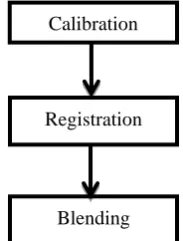
Image stitching is a process of combining different images to form one single image. The image stitching can be divided into three main steps: image calibration, image registration, and image blending [1], as shown in figure 1. Image calibration produces an estimate of the intrinsic and extrinsic camera parameters.Inimage registration, multiple images are compared to find the translations that can be used for the alignment of images. After registration, these images are merged together to form a single image. In the following subsections, these main steps are discussed briefly.
Fig. 1: The main steps of image stitching
A. Calibration
Image calibration aims to minimize differences between an ideal lens model and the camera-lens combination that was used. These differences are resulted from optical defects such as distortions and exposure differences between images [1]. Intrinsic and extrinsic camera parameters are recovered in order to reconstruct the 3D structure of a scene from the pixel coordinates of its image points. Extrinsic camera parameters define the location and orientation of the camera reference frame with respect to a known world reference frame. Intrinsic camera parameters link the pixel coordinates of an image point with the corresponding coordinates in the camera reference frame [2].
B. Image Registration
Image registration is defined as the process of aligning two or more images which are captured from different point of perspectives. The purpose of image registration is to create geometric correspondence between images. Therefore, we can compare images and apply other steps appropriately [3]. Image blending is processed to make the transition from one image to another image smoother. So, the joint between two images can be removed.
Calibration
Registration
C. Image Blending
Image blending is applied across the stitch so that the stitching would be seamless. There are two popular ways of blending the images [4]. One is called alpha “feathering” blending, which takes weighted average of two images. The cases that alpha blending works extremely well is when image pixels are well aligned to each other and the only difference between two images is the overall intensity shift. Another popular approach is Gaussian pyramid [3] that essentially merges the images at different frequency bands and filters them accordingly. The lower the frequency band, the more it blurs the boundary. Gaussian pyramid blurs the boundary while preserving the pixels away from the boundary.
III. IMAGE STITCHING APPROACHES
Image stitching is the process of combining two or more different images to form one single image. On a broader scale there are two main approaches for image stitching.
Direct techniques Feature-based techniques
The direct techniques workby directly minimizing pixel to pixel dissimilarities. And, the feature-based techniques work by extracting a sparse set of features and then matching these to each other.
A. Direct Techniques
The direct technique depends on comparing all the pixel intensities of the images with each other. Direct techniques minimize the sum of absolute differences between overlapping pixels or use any other available cost functions. These methods are computationally complex as they compare each pixel window to others. They are not invariant to image scale and rotation.
The main advantage of direct methods is that they make optimal use of the information available in image alignment. They measure the contribution of every pixel in the image. However, the biggest disadvantage of direct techniques is that they have a limited range of convergence [5].
B. Feature-based Techniques
The simplest way to find all corresponding feature points in an image pair is to compare all features in one image against all features in the other using one of the local descriptors [5]. For image stitching based on feature-based techniques, feature extraction, registration, and blending are different steps required for doing image stitching.
Feature-based methods begin by establishing correspondences between points, lines, edges, corners or other geometric entities. Characteristics of robust detectors include invariance to image noise, scale invariance, translation invariance, and rotation transformations. There are many feature detector techniques, such as Harris [6], Scale-Invariant Feature Transform (SIFT) [7], Speeded Up Robust Features (SURF) [8], Features from Accelerated Segment Test (FAST) [9], PCA-SIFT [10] and ORB [11] techniques.
Harris corner detector [6] is used to detect the features. It uses a normalized cross-correlation of intensity values to match them. Harris corner is not invariant to scale changes and cross correlation. The well-known SIFT [7] technique is very robust, but the computation time is not feasible for real-time applications. Whereas, SURF [8] improves the computation time of SIFT by using an integral image for fast local gradient computations on an image.Binary feature descriptors are described with a binary string such as Oriented FAST and RotatedBRIEF (Binary Robust Independent Elementary Features) (ORB) [11] technique which is trying to keep track of the popularity with SIFT and SURF. It is extremely fast operation, while sacrificing very little on performance accuracy. ORB is scale and rotation invariant, robust to noise and affine transformations. The ORB algorithm is actually a combination of the FAST key point detection, and the BRIEF keypoint descriptor algorithm modified to handle oriented keypoints.
Feature-based methods have the advantage of being more robust against scene movement. They are potentially faster and they have the ability to recognize panoramas by automatically discover the adjacency relationships among an unordered set of images. These features make them ideally suited for fully automated stitching of panoramas taken by casual users [12].
IV. IMAGE STITCHING MODEL
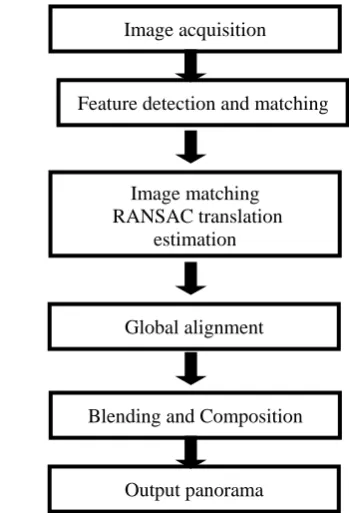
In this section, a complete image stitching model is discussed. As shown in figure 2, the image stitching model consists of five stages: images acquisition, features detection and matching, RANSAC estimation, global alignment, and image blending. In the following subsections, the main stages of image stitching are described in detail.
Fig. 2: The block diagram of general panoramic image stitching model [5]
Image acquisition
Feature detection and matching
Image matching RANSAC translation
estimation
Global alignment
Blending and Composition
A. Image acquisition
The first stage of image stitching is the image acquisition stage. Image acquisition can be broadly defined as the action of retrieving an image from some sources. Typically, images can be acquired for panoramic imaging by a handheld camera [3].
B. Features detection and matching
The second step in image stitching process is the features detection which is considered as the main image stitching stage. Features can be defined as the elements in the two or more input images. It relies on the idea that instead of looking at the image as a whole, it could be advantageous to select some special points in the image and perform a local analysis on these ones.
Feature detection forms an important part of image stitching algorithm. Online image processing algorithms need real-time performance. Thus the speed at which features are detected is crucial in many applications, such as visual Simultaneous localization and mapping (SLAM), image registration [13], 3D reconstruction, and video stabilization which are needed to match corresponding image features between multiple views. The detected corners or feature points need to be described unambiguously so that the correspondence between multiple views can be computed reliably. Real-time processing requires the feature detection, description, and matching to be as fast as possible.
To provide a better feature matching for image pairs, corners are matched to give quantitative measurement. Corners are good features to match. The features of corners are more stable features over changes of viewpoint. The other most important feature of corner is that if there is a corner in an image than its neighbourhood will show an abrupt change in intensity.
On the other hand, local feature descriptors describe a pixel (or a position) in an image through its local content. They are supposed to be robust to small deformations or localization errors, and give us the possibility to find the corresponding pixel locations in images which capture the same amount of information about the spatial intensity patterns under different conditions [14].
There are many requirements of a local feature detector, such as it should be invariant to translation, rotation, scale, affine transformation, presence of noise, and blur. It must be robust to occlusion, clutter, and illumination changes. It should also be repetitive. Finally, there should be enough points to represent the image with time efficiency.
In literature most widely used feature descriptors are SURF [8], PCA-SIFT [10], SIFT [15], HOG [16].
C. Homography using RANSAC
After we have the information of feature matching of all pictures, we can use this useful information to do image matching. In image matching step, we are going to find out which picture is a neighbour of another picture, and find the correctly feature matching set we need for next step of all feature matching set.
RANSAC (Random Sample Consensus) is a non-deterministic algorithm, because it doesn’t ensure to return acceptable results. It is used to estimate parameters for Homography of a mathematical model from a set of observed data which contains outliners iteratively.
RANSAC loop involves selecting four feature pairs (at random); compute Homography H (exact); compute inliers, keep largest set of inliers, and finally it re-compute least-squares H estimate on all of the inliers.
D. Global alignment
The most relevant technique is bundle adjustment, which is a photogrammetric technique to combine multiple images of the same scene into an accurate 3D reconstruction. The aim of this step is to find a globally consistent set of alignment parameters that minimize the miss-registration between all pairs of images. Initial estimates of the 3D location of features in the scene must first be computed, as well as estimates of the camera locations. Then, bundle adjustment applies an iterative algorithm to compute optimal values for the 3D reconstruction of the scene and camera positions, by minimizing the log-likelihood of the overall feature projection errors using a least-squares algorithm [17].
In order to do this, we need to extend the pairwise matching criteria to a global energy function. Once we havecomputed the global alignment, we need to perform local adjustments such as parallax removal to reduce double images and blurring due to local mis-registration. Finally, if we are given an unordered set of images to register, we need to discover which images go together to form one or more panoramas [12].
E. Blending and composition
Once we have registered all of the input images with respect to each other, we need to decide how to produce the final stitched image. This involves selecting a final compositing surface, e.g., flat, cylindrical. Finally, we must decide how to blend them in order to create an attractive looking panorama.
The first step to be made is how to represent the final image. If only a few images are stitched together, a natural approach is to select one of the images as the reference and to then warp all of the other images into the reference coordinate system. The resulting composite is sometimes called a flat panorama. Since the projection onto the final surface is still a perspective projection, hence straight lines remain straight.
To build a cylindrical panorama, a sequence of images is taken by a camera mounted on a levelled tripod. If the camera focal length or field of view is known, each perspective image can be warped into cylindrical coordinates. Two types of cylindrical warping are forward warping and inverse warping. In forward warping, the source image is mapped onto cylindrical surface, but it can have holes in the destination image (because some pixels may never get mapped there). Therefore, we use inverse mapping where each pixel in the destination image is mapped to the source image. Since the mapping is unlikely to be exactly on the pixel values, bilinear interpolation is used to calculate the colours at the destination pixels [18].
Once the source pixels have been mapped onto the final composite surface, the second step is to blend them in order to create an attractive looking panorama. If all of the images are in perfect registration and identically exposed, this is an easy problem (any pixel combination will do). There are many different pixels blending methods used in image stitching, such as feathering image blending, gradient domain and Image Pyramid blending [11].
Featuring image blending is a technique used in computer graphics software to smooth or blur the edges of afeature; it is the simplest approach, in which the pixel values in the blended regions are, weighted average from the two overlapping images. Sometimes this simple approach doesn't work well (for example in the presence of exposure differences). But if all the images were taken at the same time and using high quality tripods, therefore, this simple algorithm produces excellent results. An alternative approach to multi-band image blending is to perform the operations in the gradient domain. Here, instead of working with the initial color values, the image gradients from each source image are copied; in a second pass, an image that best matches these gradients is reconstructed. Copying gradients directly from the source images after seam placement is just one approach to gradient domain blending. Another important approach of image blending is Image Pyramid blending; the imagepyramid is actually a representation of the image by a set of the different frequency-band images (i.e. Hierarchical representation of an image at different resolution). Image pyramid provides many useful properties for many applications, such as noise reduction, image analysis, image enhancement, etc
.
Laplacian pyramid is an algorithm using Gaussian to blend the image while keeping the significant feature in the meantime. It downsizes the image into different levels (sizes) with Gaussian. Later, it expands the Gaussian in to the lower lever and subtracts from the image in that lever to acquire the Laplacian image. This Laplacian Pyramid is the true useful member of the image pyramid. Each layer of this pyramid is the band-pass image. We can now do some things to the specific frequency just like in the frequency domain. We also see that even after its frequencies are shown, the local features of the image are still there.
V. LITERATURE REVIEW OF IMAGE STITCHING
Over the period of last several years, many approaches have been proposed for image stitching. A multiple constraint corner matching approach and the
resultant faster image stitching has been proposed in [19]. This approach reduces the number of iterations of traditional RANSAC algorithm. A feature-based alignment algorithm and blending algorithm to produce a high quality image has been proposed in [17]. It removes the transition between the aligned images, and can successfully be able to create panorama image. An adaptive uniform distribution SURF algorithm for image stitching has been proposed in [20]. It reduces computation complexity and is suitable for image matching. An efficient approach for panoramic view creation to enlarge the field of view which uses RANSAC algorithm for matching the SURF features has been proposed in [8]. It eliminates the need to extract features from the unnecessaryportions of the input image. An image mosiacing algorithm which is based on random corner method has been proposed in [21]. It avoids corner redundancy; remove false matched corner pair effectively. A feature based framework of stitching a clear/blurred image pair has been proposed in [12]. It shows a feature based deblurringalgorithm based on the projective warping model for blind deblurring of the blurred image. A new algorithm for image registration and stitching has been proposed in [13]. This algorithm is not universally applicable; it has been customized to be used to generate single images of surfaces such as a conveyor belt or undercarriage of vehicles, which cannot be captured by a single photo.An algorithm that adopts the seam carving/inserting operator and exploits an adaptive colour blending algorithm, has been proposed in [22]. It produces a stitched image without visible artifacts including the ghosteffects, the unconformity of the structure, and the visible colour differences. A low-complexity image stitching algorithm has been proposed in [23]. It is suitable for embedded systems, which allows users to generate a good-quality panoramic image even the photos have rotation and zooming actions. A feature-based image registration algorithm considering the mobile devices with limited computing power has been proposed in [24]. The proposed method has been implemented on a mobile device with low computational power and small memories.
VI. CHALLENGES OF IMAGE STITCHING
VII. CONCLUSION
We have reviewed different approaches used by different researchers for image stitching. The comparative study of reviewed work is presented in the summarized form. In this review paper we have discussed the three main steps of image stitching, which consist of calibration, registration and blending.
We have also discussed two main approaches of image stitching namely, direct techniques and feature-based techniques.
Furthermore, we have discussed general panoramic image stitching model. The image stitching model consists of image acquisition, feature detection and matching, image matching, global alignment and finally blending and composition.
The literature review of image stitching shows that there is a space for improving the stitching process by using multiple constraints corner mapping algorithm.
REFERENCES
[1] K.Shashank, N.SivaChaitanya, G.Manikanta, Ch.N.V.Balaji, V.V.S.Murthy, “A Survey and Review Over Image Alignment and Stitching Methods”, International Journal of Electronics & Communication technology, vol.5, pp.50-52, march 2014
[2] Zhengyou Zhang, “A Flexible New Technique for Camera Calibration”, IEEE Transactions on Pattern Analysis and Machine Intelligence, pp. 1330-1334, nov 2000
[3] Mrs.Hetal M. Patel, “Comprehensive Study and Review of Image Mosaicing Methods”, International Journal of Engineering Research & Technology (IJERT), Vol. 1, pp.1-9, nov 2013
[4] Deng.Y. andZhang.T., “Generating Panorama Photos”, International Society for Optics and Photonics, pp. 270-279, 2003
[5] Ebtsam Adel, Mohammed Elmogy, HazemElbakry, “Image Stitching based on Feature Extraction Techniques: A Survey”, International Journal of Computer Applications, vol.99, no.6, pp.1-8.
[6] W. Zhao, S. Gong, C. Liu, and X. Shen, “A self-adaptive Harris corner detection algorithm,” Computer Engineering, vol. 34, no. 10, pp. 212–214, 2008.
[7] Oh-Seol Kwon and Yeong-Ho Ha, “Panoramic Video using Scale-Invariant Feature Transform with Embedded Color-Scale-Invariant Values”, IEEE Transactions on Consumer Electronics, Vol. 56, No. 2, May 2010
[8] R.Karthik, A.AnnisFathima,V.Vaidehi, “Panoramic View Creation using Invariant Momentsand SURF Features”, IEEE International Conference on Recent Trends in Information Technology (ICRTIT), pp. 376-382, july 2013.
[9] Rosten. E. and Drummond.T., “Machine Learning for High-speed Corner Detection”, European Conference on Computer Vision, vol.1, pp. 430-443, 2006.
[10] Ke Yan and Rahul Sukthankar, “PCA-SIFT: A more distinctive representation for local image descriptors”, IEEE Computer Society Conference on Computer Vision and Pattern Recognition, vol. 2, 2004.
[11] A.V.Kulkarni, J.S.Jagtag, V.K.Harpale, “Object recognition with ORB and its Implementation on FPGA”, International Journal of Advanced Computer Research, pp. 164-169, 2013.
[12] Xianyong Fang, “Feature Based Stitching of a Clear/Blurred Image Pair”,IEEE International Conference on Multimedia and Signal Processing, vol. 1, pp. 146-150, 2011.
[13] Chaminda Namal Senarathne, ShanakaRansiri, PushpikaArangala, AsankaBalasooriya, Dr. Chathura De Silva, “A Faster Image Registration and Stitching Algorithm”, IEEE 6th International
Conference on Industrial and Information Systems, pp. 66-69, aug 2011.
[14] Jubiao Li and Junping Du, “Study on Panoramic Image Stitching Algorithm”, IEEE 2nd Pacific-Asia Conference on Circuits,
Communications and System (PACCS), vol. 1, pp. 417-142, 2010 [15] Zhen Hua, Yewei Li, Jinjiang Li, “Image Stitch Algorithm Based on
SIFT and MVSC”, IEEE 7th International Conference on Fuzzy
Systems and Knowledge Discovery, vol. 6, pp. 2628-2632, aug 2010. [16] Dalal. N. and Triggs, B., “Histograms of Oriented Gradients for
Human Detection”, IEEE Computer Society Conference on Computer Vision and Pattern Recognition, vol. 1, pp. 886-893, 2005. [17] RussolAbdelfatah, Dr.HaithamOmer,”Automatic Seamless of Image
Stitching”, Computer Engineering and Intelligent Systems, vol. 4, no. 11, pp. 7-13, 2013.
[18] Chen-Hong Yuan, Jeng-Shyang Pan, Ming-Hwa Sheu and Tzu-Hsiung Chen, “Fast Image Blending and Deghosting for Panoramic Video”, IEEE 9th International Conference on Intelligent Information
Hiding and Multimedia Signal Processing, pp. 104-107, oct 2013. [19] Minchen Zhu, Weizhi Wang, Binghan Liu, and Jingshan Huang, “A
Fast Image Stitching Algorithm via Multiple-Constraint Corner Matching”, Hindawi Publishing CorporationMathematical Problems in Engineering, vol. 2013, pp. 1-6, sep 2013.
[20] Ze-lang Wang, Fang-hua Yan, Ya-yuZheng.”An Adaptive Uniform Distribution SURF for Image Stitching”, IEEE 6th
International conference on Image and Signal Processing (CISP), vol. 2, pp. 888-892, 2013.
[21] Deepak Kumar Jain, GauravSexena,Vineet Kumar Singh, “Image mosaicing using corner technique”, IEEE International Conference on Communication Systems and Network Technologies, pp. 79-84, may 2012.
[22] Hyo-Kak Kim, Kwang-Wook Lee, June-Young Jung, Seung-Won Jung, and Sung-JeaKo, “A Content-Aware Image Stitching Algorithm for Mobile Multimedia Devices”, IEEE Transactions on Consumer Electronics, vol. 57, pp. 1875-1882, no. 4, nov 2011. [23] Tao-Cheng Chang, Cheng-An Chien, Jia-Hou Chang, and Jiun-In
Guo, “A Low-Complexity Image Stitching Algorithm Suitable for Embedded Systems”, IEEE International Conference on Consumer Electronics (ICCE), pp. 197-198, jan 2011.
[24] Hyung Il Koo and Nam Ik Cho, “Feature-based Image Registration Algorithm for Image Stitching Applications on Mobile Devices”,