Scholarship@Western
Scholarship@Western
Electronic Thesis and Dissertation Repository
8-22-2012 12:00 AM
Generating Log File Analyzers
Generating Log File Analyzers
Ilse Leal Aulenbacher
The University of Western Ontario
Supervisor
James H. Andrews
The University of Western Ontario Graduate Program in Computer Science
A thesis submitted in partial fulfillment of the requirements for the degree in Master of Science © Ilse Leal Aulenbacher 2012
Follow this and additional works at: https://ir.lib.uwo.ca/etd Part of the Software Engineering Commons
Recommended Citation Recommended Citation
Leal Aulenbacher, Ilse, "Generating Log File Analyzers" (2012). Electronic Thesis and Dissertation Repository. 780.
https://ir.lib.uwo.ca/etd/780
This Dissertation/Thesis is brought to you for free and open access by Scholarship@Western. It has been accepted for inclusion in Electronic Thesis and Dissertation Repository by an authorized administrator of
(Spine Title: Generating Log File Analyzers)
(Thesis Format: Monograph)
by
Ilse Leal Aulenbacher
Graduate Program in Computer Science
Submitted in partial fulfillment of the requirements for the degree of
Master of Science
School of Graduate and Postdoctoral Studies The University of Western Ontario
London, Ontario July, 2012
c
SCHOOL OF GRADUATE AND POSTDOCTORAL STUDIES
CERTIFICATE OF EXAMINATION
Supervisor Examiners
James H. Andrews Dr. Lucian Ilie
Supervisory Committee Dr. Marc Moreno Maza
Dr. Jagath Samarabandu
The thesis by Ilse Leal Aulenbacher
entitled
GENERATING LOG FILE ANALYZERS
is accepted in partial fulfillment of the requirements for the degree of
Master of Science
Date Chair of Thesis Examining Board
Abstract
Software testing is a crucial part of the software development process, because it helps developers ensure that the software works correctly and according to stakehold-ers’ requirements and specifications. Faulty or problematic software can cause huge financial losses. Automation of testing tasks can have a positive impact on software development, by reducing costs and minimizing human error. Software testing can be divided into three tasks: choosing test cases, running test cases on the software under test (SUT) and evaluating the test results. To evaluate test results, testers need to examine the output of the SUT to determine if it performed as expected. Programs often store some of their outputs in files known as log files. The task of evaluating test results can be automated by using a log file analyzer. The main goal of this thesis is to design an approach to generate log file analyzers based on a set of state machine specifications. Our analyzers are generated in C++ and are capable of reading log files from disk or shared memory areas. Regular expressions have been incorporated, so that analyzers can be adapted to different logging policies. We analyze the purpose and benefits of this framework and discuss differences with a previous implementation based on Prolog. In particular, we discuss the results of a series of experiments that we performed in order to compare the performance between Prolog–based analyzers and C++ analyzers. Our results show that C++ analyzers are between 8 and 15 times faster than Prolog–based analyzers.
Keywords: Software Testing, Test Oracles, Log File Analysis
Acknowledgments
I would like to thank Dr. Jamie Andrews for his support, guidance and patience. Professor, thank you for believing in me and for giving me the opportunity to learn so much from you. It has been an honor and a privilege to work with you.
I would like to acknowledge the financial support of the National Council of Sci-ence and Technology in Mexico (Consejo Nacional de Ciencia y Tecnolog´ıa) and the Institute of Electrical Research in Mexico (Instituto de Investigaciones El´ectricas).
I would like to thank the Department of Computer Science and its wonderful faculty and staff for their support and teachings.
To my beloved husband, Andr´es Ayala Garc´ıa, thank you for loving, inspiring and supporting me each step of the way.
There are not enough words to express my gratitude to my parents, who made a lot of sacrifices so that I could get a good education and fulfill my dreams.
I would like to honor my late grandparents Margarita de Leal, Juanito Leal, Ilse de Aulenbacher and Carlos Aulenbacher. Your example has inpired me all of my life. I love you all so much.
My dear Opa Carlos, you passed away this year while I was writing this thesis. I know you are now in heaven with our beloved Oma. Thank you for sharing so many things with me and for being my mentor and friend. You will always be in my heart. Mein lieber Opa, ich vermisse dich.
Finally, I would like to thank all of my family and friends in Mexico and Canada. Thank you for your help, kind words and for being there for me.
Table of Contents
Certificate of Examination ii
Table of Contents v
List of Figures ix
1 Introduction 1
1.1 Test oracles . . . 2
1.2 Log files and logging policies . . . 3
1.2.1 Log files and shared memory areas . . . 3
1.3 Log File Analyzers . . . 4
1.4 Thesis focus . . . 6
1.5 Thesis organization . . . 6
2 Related Work 8 2.1 Analysis of server logs . . . 8
2.2 Test oracles . . . 9
2.2.1 The oracle assumption . . . 10
2.2.3 Deriving oracles automatically . . . 12
2.3 Generating log file analyzers . . . 13
2.3.1 Log files . . . 13
2.3.2 Expected program behavior . . . 14
2.3.3 Log File Analyzers . . . 15
2.3.4 Log File Analysis Language . . . 16
2.3.5 Log file analyzer generation . . . 17
2.4 Other related work . . . 18
3 The Log File Analyzer Generator 19 3.1 The LFAL 2.0 specification . . . 20
3.1.1 The elements of an LFAL 2.0 program . . . 20
3.1.2 New features in the LFAL 2 language . . . 22
3.2 Scanning and Parsing LFAL 2.0 . . . 23
3.2.1 Lexical Analysis . . . 23
3.2.2 Syntax Analysis . . . 23
3.3 The log file analyzer generator . . . 24
3.3.1 Base libraries . . . 24
3.3.2 Machine Classes . . . 25
3.3.3 The Log File Analyzer Program . . . 26
3.4 Analyzing log files . . . 27
4.1 C++ Analyzers . . . 37
4.2 Pattern definitions . . . 38
4.3 Dynamic and static analyzer machines . . . 41
4.3.1 Static analyzer machines . . . 41
4.3.2 Dynamic analyzer machines . . . 44
4.4 New types of actions in transitions . . . 46
4.4.1 “Error” transitions . . . 46
4.4.2 “Ignore” and “stay” transitions . . . 47
4.4.3 “Doing” transitions . . . 50
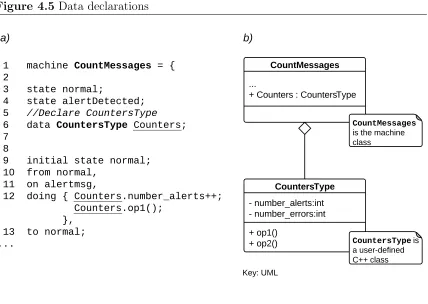
4.5 Data declarations . . . 50
4.6 Shared memory integration . . . 52
5 Evaluating the Performance of Log File Analyzers 55 5.1 Performance experiments for LFAL 1.0 and LFAL 2.0 . . . 56
5.1.1 Experiment design . . . 57
5.1.2 The LFAL 1.0 BG/L Analyzer . . . 59
5.1.3 The LFAL 2.0 BG/L Analyzer . . . 63
5.1.4 Results . . . 66
5.2 Performance experiments for shared memory analyzers . . . 68
5.2.1 Reading from disk . . . 70
5.2.2 Reading from memory . . . 71
5.3 Logging overhead in disk versus memory . . . 73
5.3.1 Results . . . 74
5.4 An example temporal filter analyzer . . . 76
6 Conclusion 81
6.1 Conclusion . . . 81
6.2 Future work . . . 84
Vita 89
List of Figures
2.1 A simple log file by Andrews [15] . . . 14
2.2 Analyzer machines for the elevator controller by Andrews [15] . . . . 16
2.3 An example of a LFAL specification by Andrews [15] . . . 17
3.1 Log File Analyzer Generation Process . . . 32
3.2 A simple example of a LFAL 2.0 program . . . 33
3.3 The original LFAL specification, by Andrews [15] . . . 33
3.4 The LFAL 2.0 specification, part 1 . . . 34
3.5 The LFAL 2.0 specification, part2 . . . 35
3.6 An LFAL 2.0 program with two machine classes . . . 36
4.1 A pattern definition . . . 39
4.2 An example of a static machine . . . 42
4.3 An example log file . . . 43
4.4 An example of a dynamic machine . . . 44
4.5 Data declarations . . . 51
file is being written by two processes. At the same time, a log file analyzer is accessing the log file in shared memory. . . 53
5.1 The four log patterns used in our experiments. The name of the pat-terns (bold underlined) are followed by a corresponding regular expres-sion (bold). Below each pattern, a sample log entry from the BG/L log file. . . 59
5.2 The bgl01 analyzer in LFAL 1.0. This analyzer matches and counts one pattern. . . 60
5.3 The bgl02 analyzer in LFAL 1.0. This analyzer matches and counts two patterns. . . 60
5.4 The bgl03 analyzer in LFAL 1.0. This analyzer matches and counts three patterns. . . 61
5.5 The bgl04 analyzer in LFAL 1.0. This analyzer matches and counts four patterns. . . 62
5.6 The CPU user time for bgl01, bgl02, bgl03 and bgl04. The x axis represents the percentage of the log file that was analyzed and the y
axis represents the number of milliseconds of user CPU time it took on average to run the analyzer. . . 63
5.7 The CPU system time for bgl01, bgl02, bgl03 and bgl04. The x axis represents the percentage of the log file that was analyzed and the y
axis represents the number of milliseconds of system CPU time it took on average to run the analyzer. . . 64
5.8 The bgl04 analyzer in LFAL 2.0. This analyzer matches and counts four patterns. . . 65
5.9 The CPU user time for bgl01, bgl02, bgl03 and bgl04. The x axis represents the percentage of the log file that was analyzed and the y
axis represents the number of milliseconds of user CPU time it took on average to run the analyzer. . . 66
represents the percentage of the log file that was analyzed and the y
axis represents the number of milliseconds of system CPU time it took on average to run the analyzer. . . 67
5.11 The CPU user time ratio between LFAL 1.0 and LFAL 2.0 for bgl01, bgl02, bgl03 and bgl04. The x axis represents the percentage of the log file that was analyzed and the y axis represents the LFAL1:LFAL2
ratio. . . 68
5.12 The CPU system time ratio between LFAL 1.0 and LFAL 2.0 for bgl01, bgl02, bgl03 and bgl04. The x axis represents the percentage of the log file that was analyzed and the y axis represents the LFAL1:LFAL2
ratio. . . 69
5.13 A sample program that illustrates how to create a log file in a shared memory area using LFAL 2.0’s base libraries. . . 78
5.14 A table that summarizes the results of our experiment to compare the performance of analyzers that read the BG/L log file from disk or shared memory . . . 79
5.15 A table that summarizes the results of our experiment to measure the time to write the BG/L log file in both shared memory and disk. . . . 79
5.16 A log file analyzer that filters system log file. . . 80
Chapter 1
Introduction
Although we might not be aware of it all the time, software plays an important role
in our lives. From our appliances at home, to the planes we take, software is involved.
Software testing is a crucial part of the software engineering process, because it helps
testers to find and correct faults before releasing a program to the public.
A very important part of the testing process is evaluating test results. This is achieved
through the use of test oracles. A test oracle captures the inputs and outputs of the
software under test (SUT) and determines whether the SUT execution was correct or
incorrect. Test oracles are difficult to implement in part because of the complexity
involved in capturing the inputs and outputs of a program. An alternative is to
analyze log files. Oracles that analyze log files are known as log file analyzers. It is
already a common practice for developers to instrument their code so that relevant
events are logged to a file. The resulting log files are used for debugging purposes.
We are interested in generating oracles capable of analyzing log files, in order to
determine if they reveal faults in the SUT.
to derive. For that reason, attempting to write an ad-hoc analyzer for each program
we develop would not be practical and would require a lot of effort. The main focus
of this thesis is to design a framework in which log file analyzers are automatically
generated from the specification of a program’s expected behavior.
1.1
Test oracles
The wordoracle, comes from the Latin nounoraculum and from the verborare which
means “to speak”. In the past, this word was used to refer to a priest or priestess
acting as a medium through whom advice or prophecy was sought from the gods in
classical antiquity. In its modern use, oracle refers to a person or thing regarded as
an infallible authority or guide on something [12]. In the context of software testing,
an oracle refers to a mechanism capable of determining if the software under test
(SUT) output is correct or incorrect.
Software testing can be divided into three tasks: choosing test cases, running test
cases on the SUT and evaluating the test results [15]. The task of evaluating test
results is often taken for granted and considered to be straightforward. In fact, this
assumption is known as the oracle assumption [34]. Test oracles are indeed a very
important part of software testing and should not be overlooked or underestimated.
As we will see in the next chapter, many oracle designs capture a program’s inputs
and outputs directly. Even though that is the classic approach to writing oracles, it
can be difficult to implement and can greatly increase the difficulty of writing a test
oracle. For that reason, our thesis focuses on oracles that analyze log files produced
1.2
Log files and logging policies
Logs have been used to record important information, even before computers were
first invented. For example, logs have been kept for ships. To this day, such logs are
used to recreate the events that happened during past wars or to discover immigration
patterns [6]. With the advent of computers and with the increasing complexity of
software, developers found themselves in the need to record important events for
their programs. In practice, developers often use log files to recreate the events
that happened during the execution of a program, allowing them to debug their
programs. That is, they instrument their code so that important events, warnings or
error messages get saved into a text file. The information that can be obtained from
analyzing a log file depends on the what types of events the developer decides to log.
We refer to this as a logging policy.
1.2.1
Log files and shared memory areas
Log files are also very useful to debug real-time programs. Since real-time programs
are time-sensitive, it is often infeasible to use standard debugging tools. In my own
professional experience, log files are very useful to debug real-time systems. While
participating in the development of a real-time monitoring system [16], we noticed
that log files were our main point of reference for troubleshooting or debugging
pro-cesses. However, logging events into a disk file can affect the performance of real-time
systems. Therefore, we opted to log events to a shared-memory area [19]. Shared
Memory is the fastest form of inter-process communication (IPC) available [30]. It
Storing a log file in a shared memory area has various benefits. For instance, if a
system is comprised of several processes, each process could log events into a single
shared memory area. In that way, we would be able to analyze a time-ordered log
with the interactions of the different processes, instead of having to merge several
logs manually. In addition, reading and writing logs to memory helps minimize the
overhead of logging. It is faster to read and write from memory than from a disk.
Taking into consideration the above-mentioned experience, in this thesis we will
ad-dress the problem of logging overhead by adding shared memory integration to our
log file analyzers. This new capability will make log file analyzers not only capable
of reading logs from files, but also from shared memory areas. We will also describe
a simple-to-use library we developed so that programs can easily create log files in a
shared memory area.
1.3
Log File Analyzers
Having described the role of test oracles in software testing and the uses of log files,
we will discuss log file analyzers in more detail. As we mentioned before, log file
analyzers can be defined as oracles that process log files produced by programs.
In order to apply log file analysis, we need to make some basic assumptions regarding
the software environment. These assumptions are known as the log file analysis
assumptions and were introduced by Andrews [15]:
1. The SUT writes a record of events to a log file.
pre-cisely the SUT should write to the log file and under what conditions.
3. It is possible to write a log file analyzer program that takes a log file as input
and either accepts the log file or rejects it with an informative error message.
These assumptions are important because they dictate the conditions under which
we can generate log file analyzers for the SUT. The logging policy is particularly
important, because the SUT must log events of interest so that the log file analyzer
can correctly assess the log file.
A log file analyzer processes the messages contained in the log file and determines
whether the SUT that generated such log file executed correctly or incorrectly. A log
file is considered to reflect a correct program execution, if the log messages it contains
are consistent with the expected program behavior.
For example, suppose we were looking at the log file produced by the software
con-trolling an ATM. Let us assume that such software has a logging policy that records
a message for each relevant transaction. Let us also suppose that we examine the log
file and find a line indicating that a user has entered his PIN incorrectly, followed
by a line indicating that such user was granted access to “his” account. Of course,
this is not part of the ATM’s expected behavior. Therefore, such a log file would be
considered incorrect. An ATM should not give access to unauthorized users. In fact,
such a log file would reveal that the ATM software is not working as expected. To be
able to specify the expected behavior of any program, we need to have a language that
allows us to express how a program should work. We express a program’s expected
behavior in a language called Log File Analysis Language (LFAL), which was first
1.4
Thesis focus
The main focus of this thesis is to generate log file analyzers from a set of
speci-fications. Our research builds upon previous work by Dr. James H. Andrews, who
proposed a framework in which the expected program behavior is expressed as a set of
state machines in LFAL (Log File Analysis Language). The LFAL program is
trans-lated into Prolog code. Upon compilation, a log file analyzer is obtained [13]. One of
our objectives is to extend LFAL so that we can incorporate new features that make
analyzers more flexible. We will discuss the purpose and benefits of these features.
Another objective is to generate analyzers based on the C++ language instead of
Prolog. This will allow us to take advantage of the power of C++ and support the
new features of the extended LFAL. We also evaluate the performance of our C++
analyzers and compare it against Prolog-based analyzers.
The results of our experiments show that log file analyzers based on C++ are between
8 and 15 times faster than Prolog–based analyzers. These experiments, along with
the example C++ analyzers that we present in this thesis, illustrate the benefits of
making log file analyzers more flexible. For example, support for regular expressions
makes C++ analyzers capable of processing log files that contain complex log message
patterns.
1.5
Thesis organization
Chapter 1 contains an introduction to our topic by explaining some basic concepts and
the purpose of our research. In chapter 2, we give an overview of related work on test
3, we describe the design of our log file analyzer generator. We begin by explaining
the extensions made to LFAL and presenting the new language specification. We then
describe the basic libraries, which contain functionality needed by all analyzers. These
libraries include a state machine class and shared-memory management routines.
We also describe the design of our log file analyzer generator, which translates a
LFAL specification into C++ code. We conclude the chapter explaining how log
file analyzers are used. We explain the benefits of generating log file analyzers in
C++ instead of Prolog in chapter 4. We also describe the new features introduced
to the LFAL language in more detail. In chapter 5, we describe the experiments we
conducted to evaluate the performance of C++ log file analyzers. In chapter 6, we
Chapter 2
Related Work
In this chapter we give an overview of work related to log file analyzer generation. We
begin by describing related work on analysis of server logs. We then give an overview
of work done in the area of test oracles. We also discuss the area that is most related
to our research: generation of log file analyzers.
2.1
Analysis of server logs
A log can be defined as a record of the events occurring within the systems and
networks of an organization. Logs are composed oflog entries. Each log entry contains
information related to a specific event that has occurred within a system or network
[22]. The field of log file analysis is as ample as the variety of uses for logs. Some uses
include debugging and troubleshooting systems. Other uses include recording user
actions and investigating malicious activity. A significant amount of the work on log
Servers generate large log files that contain messages, which help system
administra-tors to monitor a system and identify failures. Oliner and Stearley [26], studied logs
generated by five supercomputers in order to understand their behavior. The authors
recognize that even though system logs are the first place system administrators go
to find the cause of a problem, there is a pressing need for better tools to process and
understand log files. This task is often complicated by the lack of operational context
in logs, which capture the system’s expected behavior. To facilitate the analysis of
large logs, they developed a filtering algorithm that reduces a set of alerts to a single
initial alert per failure. Oliner et al. describe a tool known as Sisyphus, which uses
an unsupervised data mining algorithm for anomaly detection [27]. This tool helps
system administrators discover relevant information in large log files, even if they do
not know what they are looking for. Log entries are sorted so that entries considered
most “interesting” or “abnormal” are given more importance.
Web traffic analysis is another important application of log file analysis. Server log
parsers analyze raw traffic data from server logs. These data can be visualized and
manipulated in Web browser windows [23]. An example is AWStats, which generates
Web, streaming, ftp or mail server statistics, graphically [2]. Other examples of Web
log analyzers include Analog [1], Webalizer [11] and Sawmill Analytics [8].
2.2
Test oracles
In the previous section, we discussed what seems to be the most evolving and
de-veloped area of log file analysis: analysis of server logs [33]. This thesis, however,
focuses on log file analysis applied to the analysis of software. As we mentioned in
file analysis to software testing, in particular, to the evaluation of test results. Test
oracles are used for this task, because they evaluate whether the output of a program
is correct or incorrect. In Andrews’ framework, a log file (produced by a program
execution) is analyzed to determine if it reveals a failure in the software under test.
In fact, a log file analyzer is a type of oracle. Therefore, it is important to discuss
previous work in the area of test oracles.
2.2.1
The oracle assumption
As mentioned in chapter 1, software testing can be divided into three tasks: choosing
test cases, running test cases on the SUT and evaluating test results [15]. Weyuker,
defined an oracle as a mechanism that checks for the correctness of a program
execu-tion. Weyuker also coined the termoracle assumption, which refers to the belief that
the tester is routinely able to determine the program correctness on the test data [34].
Because of the oracle assumption, the task of evaluating test results is often
consid-ered “straightforward”. Therefore, it is common practice to have the tester examine
the results of a program execution by hand. The problem with this approach, is that
is assumed that the tester will know the correct answer.
Many papers on oracles refer to the importance of test oracles. Testing without an
oracle can cause loss of time, due totester misconception. That could cause the tester
to “fix” a program that was already correct. Conversely, the tester might believe that
the program is correct, thereby releasing a program with errors [34].
In some cases, the task of evaluating test results is relegated to having the tester
examine a program’s output manually. However, such practice is neither reliable nor
as-surance of system correctness. If we do not have a reliable way to evaluate whether
a test case was successful or not, we cannot confidently ascertain the correctness of
a program. In Richardson et al.’s words: “If the testing process does not determine
whether the system behaves correctly, there is nothing to be gained by performing
the tests” [29]. These last words might seem too definitive and many testers might
argue that all stages of software are valuable and important. However, it is important
to recognize that much of the research on software testing has focused on the
devel-opment and analysis of input data [34]. In fact, research literature on test oracles is a
relatively small part of the research literature on software testing [17]. Therefore,
re-searchers that work with test oracles have tried to raise awareness on the importance
oracles in the software testing process.
2.2.2
Deriving oracles
In the previous section, we discussed the importance of test oracles in the software
testing process. The reader might be wondering why it is that test oracles are not
always used. The explanation is that oracles are not particularly easy to derive. For
instance, Peters and Parnas [28] recognize that the documentation used to generate
an oracle can be almost as complicated as the software under test.
Richardson et al. [29] derive oracles from a program’s specifications. This requires
a mapping from the name space of the test data, to the name space of the oracle
information. The oracle information represents the expected behavior of a program.
The authors express this expected behavior as a set of assertions. An assertion is a
logical expression specifying a program state that must exist, or a set of conditions
monitor program is used to verify the assertions. Any unsatisfied assertion identifies
an inconsistency between the expected program behavior and the specification-based
oracle.
Memon et al. [25] developed a technique to develop an automated Graphic User
In-terface (GUI) test oracle. The GUI is modeled through operators that represent GUI
actions in terms of their preconditions and effects. The test oracle automatically
derives the expected states (the expected program behavior). An execution
moni-tor obtains the current state of the GUI. The oracle compares the two states and
determines if the GUI is performing as expected.
2.2.3
Deriving oracles automatically
Peters and Parnas [28], describe an interesting approach, capable of automatically
generating test oracles from tabular documentation. This work is closer to our
re-search objective, because its focus is not limited to describing a method for deriving
oracles. Rather, the main objective is to achieve the automatic generation of test
oracles from program documentation.
The authors argue that if program documentation is mathematical, it is possible to
de-rive an oracle from it. Therefore, the expected program behavior is captured through
relational documentation, which is written using tabular expressions. In contrast with
assertions, the documentation is separate from the code, rather than embedded in it.
This facilitates analysis and review separate from the implementation. A Test Oracle
Generator (TOG) generates wrappers that call the functions to be tested. The test
case is executed by calling the wrappers instead of the real functions. Finally, the
2.3
Generating log file analyzers
In this section, we will discuss the framework proposed by Andrews [13] [15] [14] [35]
in which log file analysis is applied to software testing. In fact, Andrews’ log file
analyzers are test oracles that determine if a log file reveals a fault in the software
under test (SUT). This section provides much of the concepts and background needed
to understand this thesis. Henceforth, we will refer to Andrews’ approach as Log File
Analysis (LFA).
2.3.1
Log files
A log file is defined as a sequence of log lines. In LFA, a log file line is defined as a
sequence of keywords, strings and numbers beginning with a lowercase alphanumeric
character. Log lines begin with a keyword, separated by blanks and terminated by
a new-line. A keyword is a sequence of alphanumeric characters and underscores
beginning with a lowercase letter. Figure 2.1 shows an example of a log file [15] from
a hypothetical elevator controller program. We can observe that each line begins with
a keyword, for example go up, go down, etc.
To illustrate the concepts behind LFA, we will use the elevator controller program
and the log file in figure 2.1 as a running example. Let us first understand how the
log file in this example is interpreted:
• A user, who is in the third floor, calls the elevator (line call 3).
Figure 2.1 A simple log file by Andrews [15]
2.4 Other Related Research
Customized test oracle specifications have been used in some application areas, such as protocol testing. Bochmann et al. [43] report on one scheme in which ESTELLE specifications are translated into Pascal oracles. This paper can be seen as a generalization and formal definition of such techniques.
Research in test case generation often includes genera-tion of expected results for the specific test cases generated. For instance, Gueraichi and Logrippo [14] discuss deriving TTCN test suites, including expected results, from LOTOS specifications of protocols; Donat [9] generates test cases from more general, logic-based specifications, including inputs and expected outputs. Our work on test case generation is only in the early stages, but we do allow the creation of oracles not specific to given test cases.
Finally, there are two studies by independent researchers that we are aware of that also use the LFA assumptions. Feather, in his study of lightweight formal methods for spacecraft control software [12], analyzed the sequence of events produced by test runs on the software. The events in his study contained sensor data and actuator commands, were stored in a sequence-sensitive database, and were analyzed using database queries given to a special database tool. Qiao and Zhang, in their study of testing communica-tion safety properties of distributed systems [36], built a customized tool that checks log files produced by the systems under test. The lines in the log files recorded communication events and the log file analyzer checked that a protocol had been correctly followed.
3 FOUNDATIONS AND LANGUAGE
In this section, we describe the foundations of LFA and the language that we use to describe log file analyzers. First, we give a definition of the format of a log file that will be used in this paper. Then, we formally define analyzers as collections of state machines and discuss some of the design decisions we made concerning our definitions. We show how log file analyzers can be related to first order logic, define the Log File Analysis Language (LFAL) based on first order logic, and discuss the implementation of that language. Finally, we discuss some issues concerning the completeness of the proposed formalism.
3.1 Log Files
For simplicity, we impose some restrictions on the format of log files. A keyword is a sequence of alphanumeric characters and underscores beginning with a lower-case letter. A string is a sequence of characters enclosed in double quotes. A numberis a sequence of digits, possibly preceded by a minus sign and possibly followed by a period and a sequence of digits. Alog file lineis a sequence of keywords, strings, and numbers, beginning with a keyword, all of which are separated by blanks and terminated by a new-line. We refer to the set of all log file lines asL. Alog fileis a sequence of log file lines.
Fig. 1 shows part of a log file from a hypothetical program, one of whose tasks is to control an elevator. We will use the program as a running example. Assume that the log file is interpreted as follows: A user on the third
floor called the elevator; the elevator started to go up, reached the second floor and then the third and then stopped; the door opened on floor three at time 103325; the door closed at time 103340; etc. Assume that times such as 103325 are timestamps in seconds since some arbitrary event. Consider further the following requirements for the elevator controller:
1. The door of the elevator must be closed if the elevator is moving.
2. The elevator must not be moving when the
controller program terminates.
3. The door must never stay open more than 30 seconds.
Given a log file from the elevator controller, we can check whether the log file reveals a fault in the controller. Note that thecallandreachlines are not relevant to checking the requirements given, though they might be relevant to checking other requirements; only the lines such asgo_up anddoor_openare relevant. The result is two separate but interdependent “threads” of log file reports that are arbitrarily interleaved. Such interleaved threads of informa-tion are common in log files.
3.2 Log File Analyzers
The considerations in the last section suggest a view of a log file analyzer program as a set of simpler programs, each of which attends to only one or a few threads of information in the file and each of which checks for only one or a few closely related requirements. We take the further step of viewing these simpler programs as state machines running in parallel. Each state machine “notices” only a subset of the lines in the file and makes transitions triggered by the log file lines that it notices. A state machine reports errors if it notices a log file line, but cannot make a transition on it. We write the state machines so that this happens if and only if the log file reveals a failure of the SUT. Like the Statecharts formalism [15], this view allows parallel components to be expressed succinctly and builds on a simple, intuitive model of computation.
636 IEEE TRANSACTIONS ON SOFTWARE ENGINEERING, VOL. 29, NO. 7, JULY 2003
Fig. 1. A simple log file.
• The elevator stops (line stop) and the door opens on floor 3, at time 103325
(lines stop and door open 103325).
• The elevator door closes on floor 3, at time103340(linedoor close 3 103340). The rest of the lines are interpreted in a similar way.
2.3.2
Expected program behavior
Throughout section 2.2, we gave an overview of different ways to derive oracles.
Oracles need to capture the expected program behavior in some way. The first step
would be to list a set of requirements for the elevator controller [15].
2. The elevator must not be moving when the controller program terminates.
3. The door must never stay open more than 30 seconds.
Having enumerated the requirements to be checked, we can now examine the log file
to see if it reveals any fault in the controller. Log files often contain several threads
of information. For instance, if we wanted to check requirements 1, 2 and 3, we
would need to pay attention to lines such as door open,go up and stop. Lines with
keywords reach or call are not relevant for requirements 1, 2 or 3. In fact, such
lines might be relevant to checking other requirements. Threads of information are
often arbitrarily interleaved in log files.
2.3.3
Log File Analyzers
Taking into consideration the fact that log files often contain interleaved threads of
information, a log file analyzer can be viewed as a set of simpler programs. Andrews
[15] explains that each program “notices” a set of log lines that represent a thread of
information, to check one or more closely related requirements. More formally, these
programs are state machines running in parallel. Each state machine recognizes or
“notices” only a subset of the lines in the file and makes transitions triggered by the
log file line it notices.
State machines in a log file analyzer report an error when one of these conditions
occur:
• A line is not noticed
Figure 2.2 shows an example of two state machines that check for the elevator
con-troller requirements outlined in section 2.3.1. The machine shown at the left checks
requirements 1 and 2. The machine at the right checks for requirement 3.
Figure 2.2 Analyzer machines for the elevator controller by Andrews [15]
We define ananalyzer machineas a 6-tuplehX;!; i; F ; N;!i, where:
. Xis the machine’sidentifying name,
. !is a countable set ofstates,
. i2!is theinitial state,
. F!!is the set offinal states,
. N!L is the set of log file lines noticed by the machine, and
. !!!"N"! is the transition relation, such that
!ðs; l; s1Þ and!ðs; l; s2Þiffs1¼s2.
The transition relation is defined to be deterministic so that the analyzer does not have to backtrack in order to determine whether a log file is acceptable. Given a particular analyzer machine m, we will refer to its components as hXm;!m; im; Fm; Nm;!mi and occasionally
abuse notation by identifying m with Xm. An analyzer
machine is like a finite state machine, except for two main differences: Its set of states can be countably infinite and it can restrict its attention to a subsetNof the possible lines of the file. The reasons for these differences will be made clear in Section 3.3. We define alog file analyzerto be a countable set of analyzer machines.
As an example, see Fig. 2, which gives the name, set of states, initial and final states, and transition relation for two log file machines. The usual conventions for depicting state machines are used; final states are indicated by double ovals, the initial state is indicated by a small arrow, and conditions on transitions appear in square brackets. The left hand state machine, called door_safe, can check an elevator controller log file for the first and second requirements from Section 3.1. The right hand machine,
no_delay, can check for the third requirement, that the door is open for no more than 30 seconds. Note that, in
no_delay, the lower state is parameterized on the variable
T1. We use this notation to signify thatno_delayhas an infinite set of states with names of the form open(0),
open(1),open(2),. . .. Note also that the transitions to and from the openstates refer to this parameter. We use this notation to signify that, for all timestampsT1, the state with name open(T1)has a collection of transitions from
closed, each triggered by a log file line of the form
door_open I T1, and also has a collection of transitions to
closed, each triggered by a log file line of the form
door_open I T2, whereT2-T1is less than or equal to 30. To complete the analyzer machine specifications, we specify that the setNof noticed lines fordoor_safeis all the lines of the formsgo_up,go_down,stop,door_open I T, and
door_close I T; and the set N of noticed lines for
no_delayis all the lines of the formsdoor_open I Tand
door_close I T.
Consider the log file analyzerelevatorA consisting of the two machines door_safe and no_delay. This analyzer is able to check for all three requirements. We now define the operational semantics of the analyzers to make this notion more precise.
We define a configuration of a log file analyzer Aas a function that assigns, to each machinem2A, a state in!m.
Theinitial configurationof an analyzerAis that in which all machines are in their initial states. We say that a configuration C of a log file analyzer A rejects a log file linelif either:
. For all m2A, l62Nm (that is, no machine in A
noticesl) or
. For somem2A,l2Nm, but there is nos2!msuch
that!ðCðmÞ; l; sÞ(that is, some machine inAnoticesl
but cannot make a transition on it in its current state).
For example, if analyzer elevatorA is in the configuration C such that Cðdoor safeÞ ¼moving and
Cðno delayÞ ¼closed, then it rejects any line of the form
door_open I Tbecause, although no_delaycan make a transition on the line,door_safecannot. It also rejects any line of the formreach Iorcall I; we would have to add another analyzer machine to elevatorA to explicitly ignore such lines (see below).
Given an analyzerA, configurationC, and log file linel, if C does not reject l, then nextðC; lÞ is defined as the configurationC0such that
. Ifl62Nm, thenC0ðmÞ ¼CðmÞ;
. Otherwise,C0ðmÞis the statessuch that!mðCðmÞ; l; sÞ. ANDREWS AND ZHANG: GENERAL TEST RESULT CHECKING WITH LOG FILE ANALYSIS 637
Fig. 2. Analyzer machines for the elevator controller. Left: A machine that checks for requirements 1 and 2. Right: A machine that checks for requirement 3.
It is important to note that log file analyzers are composed ofinfinite-state machines.
This is necessary because log files often contain data that must be remembered by
an analyzer to judge a later line. For example, in figure 2.2 at the right, we can
observe the no delay machine, where the state open is parameterized. That allows
the analyzer to “remember” the time at which the elevator door was opened and thus,
determine if the door stayed open for more than 30 seconds.
2.3.4
Log File Analysis Language
Andrews introduced the Log File Analysis Language (LFAL), which is used to specify
the expected program behavior. This expected behavior is represented in the form of
We can observe that the language is a straightforward representation of theno delay
machine that defines the initial state of the machine, the transitions along with their
corresponding conditions and the final state.
Figure 2.3 An example of a LFAL specification by Andrews [15]
script. The translator translates an LFAL analyzer specifica-tion into the Prolog axiomatizaspecifica-tion of the theory that induces the intended analyzer. The clauses for thenotices
relation are not given explicitly in LFAL; the translator assumes that each machine notices all and only the lines used in its transitions. A transition condition is defined in LFAL as a Prolog goal. Log file analyzers may also include any Prolog program text in order to define any auxiliary predicates used in the conditions. Fig. 6 shows the Prolog translation of the machine shown in Fig. 5.
After translating the LFAL program into Prolog clauses, the LFAL compiler script invokes a Prolog compiler on the resulting program together with the library, which is also written in Prolog. The resulting native-code executable file can then be run on a log file of interest. The executable displays a report stating that the log file conforms to our specification or explaining why it does not.
To this point, we have considered only analyzers specified in their own source files, separate from the SUT code. However, they could in the future be specified in comments within SUT code, in the manner of Anna [29] or Chechik and Gannon’s approach to SCR [8], and later extracted to build the analyzer. This may be desirable in some situations where it is important to maintain the analyzer and the SUT together in one source file.
3.7 Generality Issues
One of the common concerns raised about the state machine approach to LFA is the fear that it might not be general enough, that is, that it can apply only to simple tasks or to tasks involving only state-based software. However, the ability to place upon transitions conditions that refer to arbitrary predicates makes the language Turing-complete, in the sense that any program giving a complete record of
its input and output could accurately be evaluated for correctness by an LFAL analyzer.
More practically, we can ask whether an approach based on countable state machines generally results in analyzers that are compact, easy to write, and useful. Leveson et al. [27] state that even, in complex, safety-critical systems, it is reasonable to assume “that there are relatively few [hazardous] states. . .and that these can be determined.” This suggests that there is no inherent barrier to state-based LFA applying to such conformance testing problems as long as there is enough information in the log file to determine whether a hazardous state has arisen. We have studied the application of LFA to a complex, system-level, safety-critical specification [2] and have found no difficulties inherent to the LFA approach.
Moreover, the approach does not apply only to problems that have a natural expression in terms of state machines. The description of the dictionary class, to be given in the next section, is not usually thought of in terms of state machines. Its simple and compact expression in LFAL suggests that oracle specifications can approach the con-ciseness and precision of algebraic specifications [40].
4 EMPIRICAL STUDIES
There are a number of important questions that need to be answered empirically about LFA, including questions about usability, breadth of applicability, and development time, as compared to other formal and conventional software development methods. We have applied LFA to a number of different applications and specifications, both simple and complex, and at both the unit level and the system level. Some of this work is reported on in [2] and other work is ongoing. However, more detailed study will require empirical research with users, which is relatively expensive and complex. Before embarking on such research, it makes sense to first study whether the approach can meet certain performance and effectiveness requirements and how it compares with alternative approaches.
We therefore undertook empirical studies on the performance and effectiveness of LFA in one of the important applications of test oracles: as test result checkers for random test data. In this section, we describe the results of these studies.
We first explain the motivation of our research into this subject and then describe an initial case study we performed on random unit testing. We then discuss an experiment motivated by the case study and some more detailed experiments that were undertaken to clarify the first experiment’s results. Finally, we draw conclusions from the experiments and discuss the implications with respect to the most important variable we did not attempt to measure, development time.
4.1 Motivation
These experiments involve the question: What is the most useful application of formal and semi-formal methods to the process of unit testing?
Several authors ([10], [18], [21], [23]) have proposed test suite generation and/or test oracle generation from formal or semi-formal specifications of units. However, the test
640 IEEE TRANSACTIONS ON SOFTWARE ENGINEERING, VOL. 29, NO. 7, JULY 2003
Fig. 5. The definition of theno_delaymachine from theelevatorA
analyzer in LFAL.
Fig. 6. The translation into Prolog of theno_delaymachine from Fig. 5.
2.3.5
Log file analyzer generation
The implementation of LFA includes a translator, an auxiliary library and a compiler
script. The translator translates an LFAL specification into Prolog code. The
com-piler script compiles the Prolog code and produces an executable that can be used to
analyze log files.
Log file analysis has been applied to several lab-built pieces of software such as an
elevator controller and a heater monitor [15] and to two pieces of commercial software
[35]. While it proved to be useful, the use of the Prolog as the target programming
language posed some difficulties that could be addressed by using a more familiar
2.4
Other related work
To conclude this chapter, in this section we present related work on log file analysis,
applied to software engineering in general.
Chang and Ren [18] developed a Test Behavior Language (TBL), which uses
pa-rameterized patterns as logical predicates. Using TBL, software properties can be
validated through execution traces. The authors define patterns through regular
ex-pressions. As we will see in the following chapters, we incorporate the use of regular
expressions to our work to make log file analyzers more flexible and adaptable.
Tan et al. [31] introduced a framework called SALSA, which stands for “Analyzing
Logs as State Machines”. Its objective is to derive a program’s control flow in terms
of state machines. This information is derived from log files. It is very different
from Andrews’ approach in that its objective is to derive state machines from a log
file, while Andrews uses state machines to capture the expected program behavior a
priori. SALSA is intended to help developers understand what a program is doing by
helping them visualize a program execution in terms of state machines. In contrast,
Chapter 3
The Log File Analyzer Generator
In this chapter, we describe the design of our Log File Analyzer Generator. We
begin by discussing the LFAL 2.0 language in section 3.1. We explain how LFAL 2.0
programs are transformed into C++ code in section 3.3. Finally, we describe how log
file analyzers are used as oracles to analyze log files and reveal faults in the software
under test (SUT) in section 3.4.
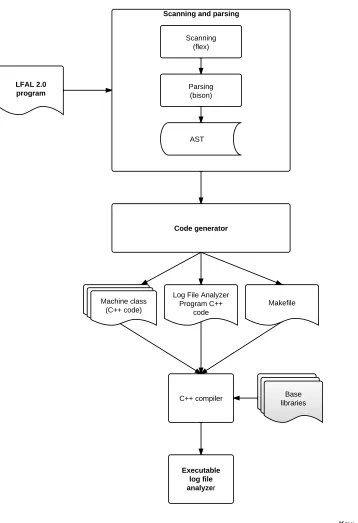
Figure 3.1 shows a high-level view of the architecture of our Log File Analyzer
Gen-eration Process, by illustrating its different stages. The process starts with an LFAL
2.0 program. This code is scanned and parsed resulting in an abstract syntax tree
(AST) (see section 3.2). The AST is analyzed by the code generator and the following
files are generated: C++ code for machine classes (see section 3.3.2), a Makefile and
C++ code for the log file analyzer program (see section 3.3.3). Using the Makefile
and a C++ compiler, these files are compiled and linked with the base libraries (see
section 3.3.1). At the end of the process, we obtain an executable log file analyzer
3.1
The LFAL 2.0 specification
In section 1.3 in chapter 1, we mentioned that to analyze a log file, we need to have
captured a program’s expected behavior. We use the Log File Analyzer Language
(LFAL), which was introduced by Andrews [13], for that purpose. One of the
objec-tives of this thesis is to extend LFAL so that we can incorporate new features that
take advantage of the C++ programming language and make log file analyzers more
flexible. Henceforth, we will refer to our extended version of LFAL as LFAL 2.0.
In this section, we describe the LFAL 2.0 language specification. In section 3.1.1, we
give an overview of the different elements of an LFAL 2.0 program. In section 3.1.2,
we introduce the new elements of the LFAL 2.0 language and its specification.
3.1.1
The elements of an LFAL 2.0 program
LFAL 2.0 captures a program’s expected behavior as a set of state machines. A state
machine is composed of a set of unique states, an initial state and one or more final
states. A machine changes from one state to another through transitions. Transitions
are triggered by events [32].
An LFAL 2.0 program can be seen as a set of analyzer machines. Transitions in
analyzer machines are triggered by log lines. An analyzer machine has the same basic
• State definitions, which define the states of an analyzer machine. States can
have state variables. For example, a state can be declared as state RECEIVED
(int Time). The state would be RECEIVED and the state variable would be
Time.
• Initial state definition, which specifies the state in which an analyzer machine is at the start.
• Transitions. These elements define the way analyzer machines change from
one state to another. Transitions can include conditions and, if successful, cause
the analyzer machine to change to another state. As we will see in the next
section, transitions in LFAL 2.0 are very flexible and can involve other actions
besides changing the machine state.
• Final states. An analyzer machine can have one or more final states. These
indicate the state the analyzer machine must be in, before exiting.
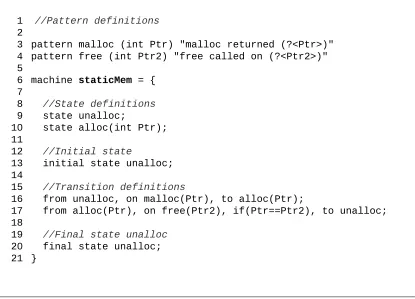
Figure 3.2 shows an example of an LFAL 2.0 program with the definition of an
analyzer machine calledelevatorState(see line 5). This LFAL 2.0 program specifies
the expected behavior of a very simple elevator controller program. We can observe
that elevatorState has two state definitions: on service and normal (lines 8 and
9). The initial state for elevatorState is on service (line 12). Lines 15 and 16
contain the transitions, which change the state of the analyzer machine triggered by
the go on service or go off service lines. The final state definition is shown on
line 19. We will describe in more detail how the machine in this example works in
3.1.2
New features in the LFAL 2 language
LFAL 2.0 retains the elements of the original LFAL, which include the basic analyzer
machine elements outlined in section 3.1.1.
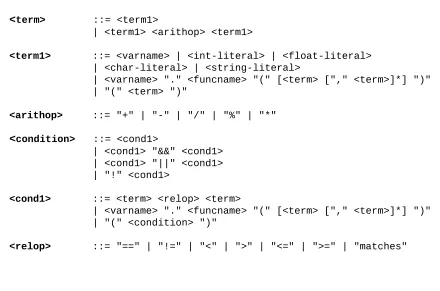
Figure 3.3 shows a summarized version of the original specification of LFAL [15] in
Backus Normal Form (BNF). Figures 3.4 and 3.5 show the BNF specification of the
LFAL 2.0 language.
LFAL 2.0 extends LFAL by incorporating the following new elements:
• Pattern definitions. Used to incorporate regular expressions into analyzers
(see rule <pat-def>in figure 3.5). An example of a pattern definition in LFAL
2.0 is shown in figure 3.2, lines 2 and 3.
• Data declaration. This element can be used to incorporate C++ objects into
analyzers (see rule <data-decl> in figure 3.5).
• State definitions. LFAL 2.0 supports C++ data types. Therefore, in LFAL
2.0, states need to be declared together with their state variables names and
types (see rule <state-def>in figure 3.5). An example of the syntax is shown
in figure 3.2, lines 8 and 9.
• Transitions. The original version of LFAL allows the user to define a series
of transitions for the analyzer. This remains true for LFAL 2.0. However,
by introducing new kinds of actions, transitions in LFAL 2.0 are much more
flexible. For example, a transition can be defined to execute C++ code, create
or delete an analyzer machine object, show a specific error message, etc. (see
LFAL 2.0 program are shown in figure 3.2, lines 15 and 16.
We will explain the purpose and benefits of these elements in more detail in chapter
4.
3.2
Scanning and Parsing LFAL 2.0
3.2.1
Lexical Analysis
The analysis of the syntax of a program can be divided in two parts: lexical
analy-sis (also called scanning or lexing) and parsing. This section focuses on the lexical
analysis of LFAL 2.0.
Scanning divides the input into meaningful pieces, known as tokens. Scanners work
by looking for patterns of characters in the input. These patterns are known asregular
expressions [24]. In terms of lexical analysis, LFAL 2.0 is defined by a set of reserved
words. We implemented our lexical analyzer using Flex. Flex is an open-source tool
for generating programs that perform pattern-matching on text [4]. Our scanner
works in conjunction with a parser. When a token is recognized, our scanner passes
it to the parser so it can be processed.
3.2.2
Syntax Analysis
Syntax analysis is also known as parsing. A parser is a program that reads a stream
be represented as a set of rules like the ones shown in figures 3.4 and 3.5. These rules
specify how tokens in LFAL 2.0 can be combined to define a log file analyzer. We
implemented our parser using Bison. Bison is an open-source parser generator [3].
The scanner generated by Flex processes the input (a LFAL 2.0 program), detects
tokens and passes them to the Bison parser. Our Bison parser builds an Abstract
Syntax Tree (AST), which is a representation of the syntactic structure of input
written in a programming language [24].
3.3
The log file analyzer generator
In the previous section, we explained how LFAL 2.0 is parsed to obtain an AST.
This AST contains the LFAL 2.0 program structure. It is used by the Log File
Analyzer Generator to produce C++ code. The generated C++ code can be divided
in two parts: the code for machine classes and the code for the log file analyzer
main program. These two parts, together with several base libraries, are compiled
and linked to produce an executable log file analyzer. In this section we describe
how machine classes, libraries and the log file analyzer work together to provide the
necessary functionality for a log file analyzer.
3.3.1
Base libraries
We have developed a set of libraries that encapsulate the basic functionality needed
by all machine classes. In this way, we minimize the amount of generated code, thus
avoiding the generation of repetitive code. Therefore, the C++ code for these classes
through mechanisms such as inheritance or aggregation.
Our base libraries contain the following functionality:
• State Machine. Contains the basic functionality needed for the analyzer
ma-chines to work. It includes routines that manage the machine’s transition table
and states.
• Log File Parser. Contains the data structures and methods that analyzer
machines need to recognize certain lines (regular expressions) in a log file.
• Shared Memory Management. Contains data structures and methods to
create, open, and delete shared memory areas. In addition, this library contains
methods to create and manage log files in a shared memory area.
3.3.2
Machine Classes
LFAL 2.0 programs can have one or more analyzer machines. Each analyzer machine
can check for one or more requirements. That is, an LFAL 2.0 program can have
one or more types of analyzer machines, each noticing a different set of lines and
requirements. We refer to them as machine classes. Figure 3.6 shows an example of
an LFAL program with two machine classes: doors (shown in lines 10–29) and mem
(lines 31–46). We will use figure 3.6 as a running example to illustrate the concepts
presented here.
The log file analyzer generator produces C++ code for each machine class. That is,
for this example, it would generate a class for the analyzer machine doors and for
In our implementation, each machine class has a transition table in the form of an
array of structures. Each transition record contains the source and target states and
a pointer to a transition method. Transition methods contain C++ code that defines
theaction to execute. The most common action is to change the state of the machine.
However, depending on the contents of the LFAL 2.0 program, the transition method
might contain other C++ code such as conditions or actions specified by the user. In
the next chapter, we will describe the advanced features of LFAL 2.0 in more detail.
3.3.3
The Log File Analyzer Program
Once C++ code is generated for the machine classes, the code generator has the
necessary elements to generate C++ code for the main log file analyzer program.
This program instantiates the machine classes and processes the log file.
In general, the log file analyzer program performs the following actions:
1. Open log file, standard input or shared memory log file, according to the option
specified at the command line.
2. Instantiate parser object and configure. This sets up the parser to match log
file lines.
3. Initialize machine classes. For each machine class:
(a) Create and initialize transition table
(b) Instantiate machine class and add to vector of analyzer machines
4. The log file analyzer program enters an infinite loop that ends until the entire
log file is processed. Inside the loop, the analyzer performs the following actions:
(a) Read log file line
(b) Determine whether the read line is noticed by a machine
(c) For each machine in the vector of analyzer machines:
i. If the line is noticed by the machine, call its transition method.
ii. Display error message if applicable. For example, if the machine
no-ticed the line but was unable to make a transition, an error message
will be displayed.
5. At end of file, report whether the log file was accepted or rejected.
3.4
Analyzing log files
Once the log file analyzer generation is complete, the executable log file analyzer can
be used to determine if a log file reveals errors in a program.
In this section, we present two examples that illustrate how our generated log file
analyzer processes log files.
Our first example is the LFAL 2.0 program shown in figure 3.2. This LFAL 2.0
program specifies a log file analyzer consisting of one machine class: elevatorState.
An elevator is usually known to be “on service” when it is being controlledexclusively
by an operator who inserts a key inside the keyhole in its control panel. This state
is meant to indicate that the elevator is undergoing some kind of maintenance. Once
The elevator system is expected to start up on service and eventually be taken off
service in order to operate normally. After some time, the elevator might be put
on service again to perform repair or maintenance tasks and then taken off service
again. This is expected to happen several times. Evidently, a log file produced by
the elevator controller software should reflect that the elevator was on service before
the controller program exited.
TheelevatorStateanalyzer machine checks that the following requirements are met:
1. The elevator state alternates from being “on service” to being in normal
oper-ation mode (“off service”) and vice versa
2. The elevator system starts up and shuts down while “on service”
Lines 2 and 3 define two patterns: go on service and go off service. These
patterns define two regular expressions. For instance, the line ‘‘elevator put on
service’’ would be matched by the pattern go on service on line 2. Lines 9 and
10 show the two possible states for this machine: on service and normal. Line 12
sets on service as the initial state of the machine. The analyzer machine’s
transi-tions are defined in lines 15 and 16. When the machine recognizes (or “notices”) a
line such as ‘‘elevator taken off service’’, the machine changes to the state
‘‘normal’’. Similarly, if the analyzer machine notices a line of the type‘‘elevator
put on service’’, the analyzer machine will transition to the on service state.
Line 19 defines the final state. Therefore, when the end of the log file is reached, the
machine should be in the state on service.
If we translated our example LFAL 2.0 program shown in figure 3.2 with our log
analyzer. Let us suppose we gave the resulting log file analyzer the following log file
as an input:
1 elevator taken off service
2 elevator put on service
In this case, the log file analyzer would accept this log file. The line ‘‘elevator
taken off service’’ would cause the analyzer machine elevatorState to
transi-tion to the statenormal. Then, the line‘‘elevator put on service’’would cause
the machine to transition to the state on service. Since we have reached the end of
the log file, the analyzer reports that the log file is correct.
Let us look at an example of a log file that would cause this example log file analyzer
to report an error:
1 elevator taken off service
2 elevator put on service
3 elevator taken off service
The process for the first two lines would be identical as in the previous example.
How-ever, the third line ‘‘elevator taken off service’’ causes the elevatorState
analyzer machine to transition to the normal state. Therefore, when the log file
an-alyzer reaches the end of the file, the anan-alyzer machine would not be on the required
state on service. Therefore, the log file above would be rejected, because the
an-alyzer detected that the elevator was in normal operation mode when the elevator
controller program ended.
Let us analyze a slightly more complicated example. Figure 3.6 shows an LFAL 2.0
in the previous example which checks that the elevator starts and ends “on service”)
and doors. In this case, let us suppose that we are trying to determine if an elevator
controller program is working correctly by analyzing two aspects of its operation: its
status (off/on service) and the doors. To define the expected program behavior, we
write the LFAL 2.0 code shown in figure 3.6. Let us suppose we want to check for
the following requirements:
1. The elevator starts and ends in the expected state (on service).
2. The states alternate as expected.
3. The elevator door must never be open while the elevator is moving.
4. The elevator door must not stay open more than 30 seconds.
To check for these requirements, we define two machine classes: elevatorState,
which checks for requirements 1–2, and doors, which checks for requirements 3–4.
We have mentioned that log file analyzers can process different threads of information.
This example will give an example of that. Let us suppose we have the following log
file:
1 elevator taken off service
2 door open at 1
3 door close at 5
4 go up
5 door open at 8
It is important to note that the machine doors has slightly more complicated
tern definitions. In figure 3.6, lines 4 and 5, we can observe two examples of
pat-terns with variables. For instance, the pattern ‘‘door open (int VAR1)’’ in line
4, defines a regular expression where the variable VAR1 saves a timestamp as an
integer (int). Therefore, the line ‘‘door open at 1’’ would be matched by the
‘‘door open (int VAR1)’’ pattern. The value 1 would be stored in the variable
VAR1. We will discuss patterns in more detail in chapter 4, section 4.2.
TheelevatorStatemachine will notice line 1 (elevator taken off service). The
doors machine won’t. Similarly, elevatorState won’t notice line 2 (door open at
1) butdoorswill. We can observe that each analyzer machine processes two different
threads of information in the same log file. The log file analyzer will reject this log
file, because after reading line 4 of the log file, the doors machine will be in the
state moving. After reading line 5, doors will try to make a transition. However,
by looking again at the code in figure 3.6, we notice that there is no transition from
the state moving to the state open(int T1). TheelevatorState notices line 6 and
transitions to the state on service. This log file would therefore berejected because
it reveals a fault in the elevator controller program (i.e. the doors analyzer machine
detected that the elevator’s door was opened while it was moving).
In this chapter we gave an overview of our log file analyzer generator. We discussed
the LFAL 2.0 language and provided some basic examples. In the next chapter, we
Figure 3.2 A simple example of a LFAL 2.0 program
Chapter 4
New Features in Analyzers
In chapter 3, section 3.1.2 we gave an overview of how LFAL 2.0 was extended to
support new features.
In this chapter, we describe the new features of LFAL 2.0 analyzers in more detail
and we explain the benefits that they provide. In addition, we provide examples that
illustrate how these new features are used in log file analyzers.
4.1
C++ Analyzers
The most notable difference between the original version of LFAL and LFAL 2.0 is
that log file analyzers are generated in the C++ programming language instead of
Prolog. We decided to use C++ because we expect LFAL 2.0 analyzers to have better
performance with respect to their Prolog counterparts. In addition, C++ is a more
![Figure 2.1 A simple log file by Andrews [15]IEEE TRANSACTIONS ON SOFTWARE ENGINEERING,](https://thumb-us.123doks.com/thumbv2/123dok_us/7783267.1286569/26.612.257.544.115.367/figure-simple-le-andrews-ieee-transactions-software-engineering.webp)
![Figure 2.2 Analyzer machines for the elevator controller by Andrews [15]ANDREWS AND ZHANG: GENERAL TEST RESULT CHECKING WITH LOG FILE ANALYSIS](https://thumb-us.123doks.com/thumbv2/123dok_us/7783267.1286569/28.612.116.541.187.410/analyzer-machines-elevator-controller-andrews-andrews-checking-analysis.webp)
![Figure 2.3 An example of a LFAL specification by Andrews [15]640IEEE TRANSACTIONS ON SOFTWARE ENGINEERING,](https://thumb-us.123doks.com/thumbv2/123dok_us/7783267.1286569/29.612.110.544.176.338/figure-example-lfal-specication-andrews-transactions-software-engineering.webp)
![Figure 3.3 The original LFAL specification, by Andrews [15]](https://thumb-us.123doks.com/thumbv2/123dok_us/7783267.1286569/45.612.127.543.120.673/figure-original-lfal-specication-andrews.webp)