ISSN (Print) : 2320 – 3765 ISSN (Online): 2278 – 8875
I
nternational
J
ournal of
A
dvanced
R
esearch in
E
lectrical,
E
lectronics and
I
nstrumentation
E
ngineering
(An ISO 3297: 2007 Certified Organization)
Vol. 5, Issue 4, April 2016
Mobility Aware Ant Colony based Dynamic
Source Routing Optimization for VANET
Rajesh Kumar M
M. Tech, Department of TCE, CMR Institute of Technology, Bengaluru, India
ABSTRACT: VANET is an important application of communications and networking. VANET leverages the potentially transformative capabilities of wireless communications and networking to make surface transportation safer, smarter and greener. Various VANET applications have been developed to improve traffic safety, mobility and environmental protection. Vehicular Ad-hoc networks nodes are a dynamic nature and challenging for finding and maintaining routes. In this paper we are proposing Routing Algorithm based on ant colony optimization and DSR protocol.
KEYWORDS: VANET, Ant Colony, DSR Routing Protocol.
I.INTRODUCTION
A Vehicular Ad-Hoc Network or VANET is a technology that has moving vehicles as nodes in a network for creating a mobile network. We can say that VANET turns each and every vehicle into a wireless node, allowing cars to connect to each other which are 100-300 meters apart and, in turn, create a wide range of network. As cars fall out due to signal range and drop out of the present network, other cars can join in to connect vehicles to one another so a mobile Internet can be created. It is assumed that the first systems in which it is integrated are police and fire vehicles to communicate with one another to provide safety. It is a term which is used to describe the spontaneous ad hoc network that is formed over vehicles moving on the roads. Vehicular networks are very fast emerging for deploying and developing new and traditional applications. It is characterized by rapidly changing topology, high mobility, and ephemeral, one-time interactions.
The challenges in Vehicular Ad-hoc Networks are the communication link lifetime is very short and less path redundancy present; density of unpredictable node is there, strict application requirements make routing and network quite challenging. Vehicular Ad-hoc networks are difficult to manage due to high speed between vehicles and result is topology changes. No significant power constraints, especially in sensors the limited battery power is a challenge in VANET. Networking challenges in VANET is a main area of work for routing security efficiency and collision avoidance. Intelligent Transportation system faces many challenges in application, routing, power management etc. There are many challenges in applications of communication for collision warning, road obstacle warning, cooperative driving, intersection collision warning, and lane change assistance etc.
Vehicular Ad-hoc networks nodes are a dynamic nature and challenging for finding and maintaining routes. In Vehicular Ad-hoc networks, different protocols were proposed for routing and they provides routing the different messages for different purposes. In Vehicular Ad-hoc networks there are different routing strategies have been defined based on architecture and need of applications or scenarios. In VANET, the routing protocols are categorized into five types: Topology, Position, broadcasting, Clustering, and Geo cast routing protocol. These protocols are characterized based on area / application where they are most suitable.
ISSN (Print) : 2320 – 3765 ISSN (Online): 2278 – 8875
I
nternational
J
ournal of
A
dvanced
R
esearch in
E
lectrical,
E
lectronics and
I
nstrumentation
E
ngineering
(An ISO 3297: 2007 Certified Organization)
Vol. 5, Issue 4, April 2016
routing table as a bases to forward packets They are further divided into proactive and reactive protocols. The main protocol used is AODV, DSV, DSR and other protocols.
II.RELATED WORK
Hao Dong et al [4], In this paper, an improved AODV protocol with ACO algorithm is used in VANET .The basic information like speed and position of the vehicle are used as heuristics information and using it a better route selection is done. By different modification of pheromone evaporation rate the nodes in the network can choose better route in two main discover steps with higher possibilities .The experimental results show that the new protocol has more effective performance than traditional AODV and it could find optimum route more quickly. The results also show that handoff frequency is reduced in given time. It also improves the routing path duration and the transmission efficiency of message.
Jamal Toutouh et al[9], in this paper author gave a parallel particle swarm intelligence based protocol(pPSO) to solve the problem of AODV routing optimization problems in VANETs. It uses the master-slave paradigm to evaluate all the swarm particles. Montecarlo method is used for analyzing the results; the results of PSO and pPSO are compared. It was found from the work that PSO (Particle Swarm Intelligence) obtained better results than sequentially optimized by Garcia nieto.
Er. GurpreetSingh et al [11], in this paper, author gave an approach for optimizing vehicle routing problem which is based on ant colony optimization, it also decides the open and closed routes for school buses. It not only decides the best route to follow but it also reduces the total distance travelled. The simulation shows that open routes are best for the school buses then closed routes.
Abubakar Aminu et al [10], in this work author gave Qos inspired routing strategy using artificial agents called ants. The technique proposed gave efficiency to traffic and sustainability to modern cities. The bio-inspired technique called Ant colony optimization is the biggest motivation for this work. The foraging behavior of ants and the pheromone trails are used as heuristic measures and the routing decisions are done.
III.PROPOSED SYSTEM
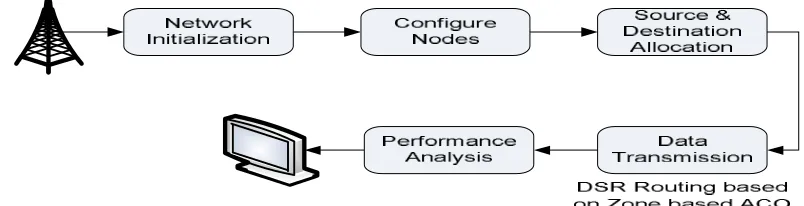
In this section, Architecture of Our proposed system is explained as shown in Figure 1It includes Network Initialization, Configure Nodes, Source and Destination allocation, Data transmission and Performance Analysis.
a) Network initialization:
Network initialization will be done with specified area and nodes are defined.
b) Configure Nodes:
In VANET, the nodes have to configure as mobile vehicular nodes.
c) source and destination
Source node and Destination nodes are allocated by the users.
d) Data transmission:
For data transmission we used DSR routing protocol which is based on zone based ACO. The results are evaluated in performance evaluation phase
ISSN (Print) : 2320 – 3765 ISSN (Online): 2278 – 8875
I
nternational
J
ournal of
A
dvanced
R
esearch in
E
lectrical,
E
lectronics and
I
nstrumentation
E
ngineering
(An ISO 3297: 2007 Certified Organization)
Vol. 5, Issue 4, April 2016
i. Ant colony optimization algorithm:
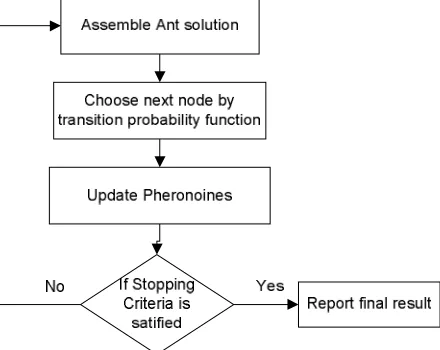
Ant colony optimization algorithm is a metaheuristic algorithm which is inspired by foraging behavior of ants. Pheromone is a potent form of hormone that can be sensed by ants as they travel along trails. It attracts ants and therefore ants tend to follow trails that have high pheromone concentrations. Ants attracted by the pheromone will lay more pheromone on the same trail, causing even more ants to be attracted. The Main mechanisms on which ACO works are as follows:
Figure 2: Shows flowchart of ACO algorithm.
ii. Zone based ACO Algorithm:
In our algorithm the network is divided into zones. For routing the packets, we follow a proactive approach within the zone and a reactive approach between the zones. The radius length measured in hops determines the size of the zone. A vehicle can exist within two overlapping zones and the zones can vary in size. A vehicle is categorized as interior vehicle, boundary vehicle and exterior vehicle. All the vehicles within a zone having a hop distance of less than the radius are known as interior vehicles. The overlapping vehicles within the zones with the hop distance equal to the radius are known as boundary vehicles and the vehicles with the hop distance greater than the radius are known as exterior vehicles.
The two main phases of routing are, route discovery and route maintenance can either happen within the zone or between zones. We have used two routing tables: Intra zone routing table and Inter zone routing table. The Intra zone routing table proactively updates the information within the zone, whereas, the Inter zone routing table tracks the information between the zones, on demand. During route discovery and maintenance, we have used five different types of ants. These are: internal forward ants, external forward ants, backward ants, notification ants, error ants. The data structure of the ant contains Source, Destination, and Sequence number, Type, Hops, Speed, Position and Path. They are positive feedback, negative feedback, randomness and multiple communications.
iii. DSR Protocol:
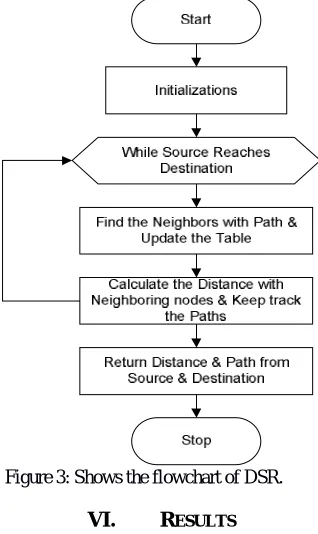
DSR Protocol is a on demand reactive routing protocol. . DSR is beacon-less and does not require periodic hello packets. The approach of DSR is flooding the route request packets dynamically in network and through destination node replies the request and carries the route-traversed packet in its header. it composed by two mechanisms that work together to allow route discovery and route maintenance in the adhoc network. Route discovery is the mechanism in which source node S sends a packet to a destination node D. Followed by obtaining a source route to D.
ISSN (Print) : 2320 – 3765 ISSN (Online): 2278 – 8875
I
nternational
J
ournal of
A
dvanced
R
esearch in
E
lectrical,
E
lectronics and
I
nstrumentation
E
ngineering
(An ISO 3297: 2007 Certified Organization)
Vol. 5, Issue 4, April 2016
for up-to-date routing and loop free information to the intermediate nodes. With the addition of this technique, the route is in the header of each data packet, and other nodes are forwarding and cache the routing for future use.
Figure 3: Shows the flowchart of DSR.
VI. RESULTS
In this section explains results of Evaluation of Network performance parameters of QOS. Parameters are:
a. Routing Overhead:
In the field of networking, Routing Load is defined as the total number of routing packets transmitted per data packet.
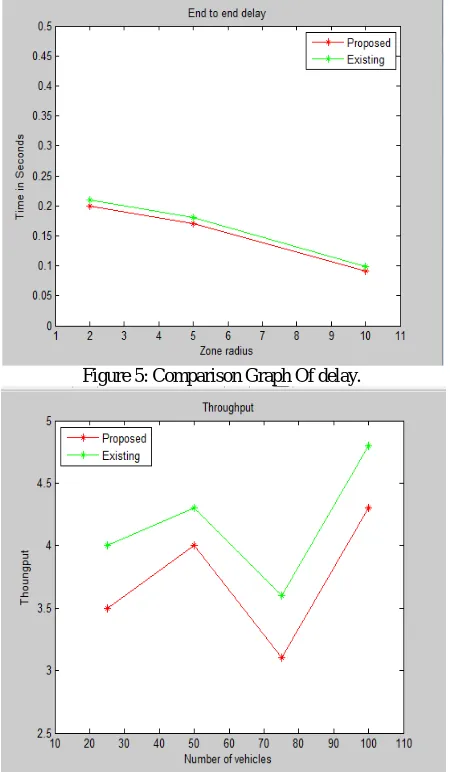
b. End-to-End Delay:
It is defined as the average time taken by a data packet from source to destination. It also includes the delay caused by route discovery process and the queue in data packet transmission. Only those data packets are counted which are successfully delivered to destination.
c. Throughput:
This metric considers the ratio between the total bits that source node is able to inject to the network and reach destination node within a particular time frame. For example, if x number of bits are delivered within t time at a node then the throughput at the node can be defined as .
ISSN (Print) : 2320 – 3765 ISSN (Online): 2278 – 8875
I
nternational
J
ournal of
A
dvanced
R
esearch in
E
lectrical,
E
lectronics and
I
nstrumentation
E
ngineering
(An ISO 3297: 2007 Certified Organization)
Vol. 5, Issue 4, April 2016
Figure 4: Comparison Graph of Routing Overhead.
Figure 5: Comparison Graph Of delay.
ISSN (Print) : 2320 – 3765 ISSN (Online): 2278 – 8875
I
nternational
J
ournal of
A
dvanced
R
esearch in
E
lectrical,
E
lectronics and
I
nstrumentation
E
ngineering
(An ISO 3297: 2007 Certified Organization)
Vol. 5, Issue 4, April 2016
V.CONCLUSION
In this paper we have proposed Routing algorithm based on ant colony optimization and DSR protocol .The main Objective to use ACO is it can easily adapt to the routing in mobile ad hoc networks because it has the features of dynamic topology, evaluation of link transmission quality, path selection in feasible time and distributed management control uses information available in vehicular networks such as the vehicles’ position and speed in order to design an ant based algorithm that performs well in the dynamics of such networks. Three parameters are consider to evaluated discovered paths routing Overhead, delay time, throughput. Following results were observed within experimental analysis
Increasing accuracy of path finding with considering changes in environment.
Decreasing delay time in network.
High throughput compared to existing method.
REFERENCES
[1] Correia, Sergio Luis OB, Joaquim Celestino, and Omar Cherkaoui. "Mobility-aware ant colony optimization routing for vehicular ad hoc networks." Wireless Communications and Networking Conference (WCNC), IEEE, 2011.
[2] Doolan, Ronan, and Gabriel-Miro Muntean. "Time-Ants: An innovative temporal and spatial ant-based vehicular Routing Mechanism." Intelligent Vehicles Symposium Proceedings,. IEEE, 2014.
[3] Silva, Rodrigo, Heitor Silvério Lopes, and Walter Godoy Junior. "A Heuristic Algorithm Based on Ant Colony Optimization for Multi-objective Routing in Vehicle Ad Hoc Netwoks."
[4] Dong, Hao, et al. "Multi-Hop Routing Optimization Method Based on Improved Ant Algorithm for Vehicle to Roadside Network." Journal of Bionic Engineering Vol. 11, No.3, pp. 490-496, 2014.
[5] Sahoo, Rashmi Ranjan, et al. "A trust based clustering with Ant Colony Routing in VANET." Computing Communication & Networking for Advance Research in Engineering and Technology, Vol.2, No.5, 2014.
[6] Souza, Alisson B., et al. "Stable multicast trees based on Ant Colony optimization for vehicular Ad Hoc networks." Information Networking (ICOIN), 2013 International Conference on. IEEE, 2013.
[7] Cloudin, S. "Reliable routing strategy for data communication in vehicular adhoc networks." Sustainable Energy and Intelligent Systems (SEISCON 2012), IET Chennai 3rd International on. IET, 2012.
[8] Toutouh, Jamal, and Enrique Alba. "Parallel Swarm Intelligence for VANETs Optimization." P2P, Parallel, Grid, Cloud and Internet Computing, Seventh International Conference on. IEEE, 2012.
[9] García-Nieto, José, Jamal Toutouh, and Enrique Alba. "Automatic tuning of communication protocols for vehicular ad hoc networks using metaheuristics."Engineering Applications of Artificial Intelligence, Vol.23, No.5, pp. 795-805, 2010.
[10] Mu’azu, Abubakar Aminu, Low Jung Tang, and Ibrahim A. Lawal. "Bio-Inspired QoS Routing Approach for Mobile Data Collection in
VANETs."IEEE, Vol.3, No.1, 2001.