Improved Timing Attacks on ECDSA
Vikram Singh
∗Abstract
We improve the timing attack on ECDSA in [1] by Brumley and Tuveri. We use the Gaussian heuristic to analyse the length of er-ror vectors in the lattice Close Vector Problem in order to deter-mine the problems which are theoretically solvable. Then we cost each solution using a strengthened lattice reduction algorithm and Schnorr-Euchner enumeration to determine which problems are prac-tically solvable. The original work by Brumley and Tuveri resulted in OpenSSL’s ECDSA being updated to remove the timing informa-tion they exploited, so that applicainforma-tion is not vulnerable to our im-provements. However we publish this work as a general advance in side-channel recovery techniques which may be applicable in related scenarios.
Keywords: Cryptography, Lattice, ECDSA, OpenSSL, TLS, Side-channel, Timing Attack, Digital Signature Scheme, HKZ-reduction, Lattice Enumeration
1
Introduction
Digital signature schemes such as ECDSA underpin authentication in cryp-tographic protocols such as TLS. Traditional cryptanalysis has a good under-standing of the strength of such schemes. However, increasingly, side-channel information is being used to demonstrate exploitability of these schemes due to weaknesses in implementations. In [4], Howgrave-Graham and Smart de-scribed how a theoretical side-channel giving a small number of bits of the ephemeral private keys used in DSA, could be used to construct a lattice
for which solving a Close Vector Problem recovers the static private key. Later, Brumley and Tuveri in [1], identified such a side-channel which man-ifests itself as a timing correlation to the number of leading zero ephemeral private key bits occurring in the Montgomery’s ladder algorithm for elliptic curve multiplication in the OpenSSL 0.9.8o implementation of ECDSA. They demonstrated this experimentally to recover the static private key from a re-mote TLS server after of the order of a thousand signatures. In accordance with their recommendation for a mitigating countermeasure, the OpenSSL implementation was patched to remove the timing vulnerability.
Our work presents improvements to the original timing attack. We acknowl-edge that the results are no longer applicable to the implementation of Mont-gomery’s ladder in OpenSSL, but the results may be relevant in related sce-narios and nonetheless represent a general advance in the applicability and efficacy of lattice techniques to such side-channel recoveries.
We shall summarise Brumley and Tuveri’s approach in Section 2, and present the lattice attack in Section 3. Our contribution focuses on solving the lattice attack, we do not repeat the timing attack. Brumley and Tuveri use LLL-reduction and Babai rounding to recover the closest vector and we aim to improve on this.
The problem space is parameterized by the number of signatures and the number of leading zero bits given by the side-channel. We begin with an analysis of the length of the error vector in Section 4, and use the Gaus-sian heuristic to determine the region of the problem space where the closest vector is indeed likely to be the desired solution. This region has a theoret-ical solution by CVP provided we can afford to find the closest vector. We assess the practical cost in Section 5 by considering an improved but more expensive reduction than LLL, namely HKZ-reduction, which interpolates an exact method to find shortest vectors in low-dimensional subspaces with the approximate method of LLL. We consider the cost of Schnorr-Euchner enumeration on this reduced basis: first to find the closest vector; and then by extending the search radius to enumerate more distant lattice vectors and reach the desired solution, thus extending the theoretically solvable region. We use the size of the search tree as a bound on the enumeration cost.
exploit-ing the side-channel information we have not used, and costexploit-ing improved enumeration methods. Finally, Section 9 concludes.
2
ECDSA Side-Channel
Let E be an elliptic curve and Gbe a point on E of prime order p. To sign a message m with the static private key x, the signer chooses an ephemeral private key y and computes
b ≡(m+xf)y−1 (mod p)
where f ≡([y]G)x (mod p).
The most expensive part of signature generation is the scalar multiplication in the elliptic curve so it is important that this is implemented as efficiently as possible. However, differences in the time taken to compute [y]Gcan also leak information about the ephemeral private key y.
Brumley and Tuveri [1] noted that for binary curves OpenSSL 0.9.8o used a Montgomery ladder whose length depended on log2(y). This meant that
scalar multiplication, and so signature generation, was faster for ephemeral private keys that had a greater number of leading zeroes. Turning this around, by timing a large number of signatures they could assume that the fastest ones corresponded to ephemeral private keys with a certain number of leading zeroes. Given enough of these it was then possible to use the lat-tice attack from [4] to recover the ephemeral private keys and thus the static private key.
fastest timings as an approximation to those whose ephemeral keys have a particular number, a, of leading zeroes.
The lattice CVP is solved using Sage’s implementation of LLL-reduction to produce what is hopefully a nearly orthogonal lattice, then using Gram-Schmidt orthoganalization and Babai rounding to estimate the closest vec-tor. In case the filtered signatures contain too many false positives - that erroneously have fewer than a leading zeroes - then a subset is randomly re-sampled from the fastest signatures until few enough false positives are present. “Few enough” is preferably zero, but they acknowledge the CVP sometimes solves in the presence of small errors because the desired solution can still be the closest vector.
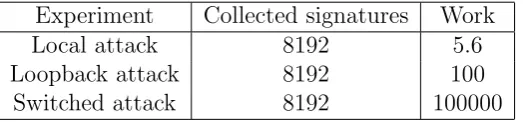
We shall try to extract comparable results from their paper by focusing on 7 leading zeroes. They find that 43 correctly filtered signatures gives a lattice that solves with good probability in a short time. For each experiment they collect 8192 signatures and re-sample a subset of 43 from the fastest 64 until their CVP succeeds. We’ll use their estimate of the number of random re-samplings until they select a filtered set with no false positives to estimate the work required. This is presented in Table 1. They find that recovery of the static private key is feasible for all their experimental scenarios, and performing 8192 signatures only takes a few minutes.
Experiment Collected signatures Work
Local attack 8192 5.6
Loopback attack 8192 100
Switched attack 8192 100000
Table 1: Average work (number of size 43 lattice attacks) to recover static private key given that the filtered set is selected from the top 64 timings
3
Lattice attack
Recall that, to sign a message m with the static private key x, the signer chooses an ephemeral private key y and computes
b ≡(m+xf)y−1 (mod p)
If we have n signatures, then we obtain a set ofn equations
bi ≡(mi+xfi)y−i 1 (mod p).
We can rearrange these to give a set of equations of the form
yi+Cix+Di ≡0 (mod p)
where Ci ≡ −fib−i 1 (mod p) and Di ≡ −mib−i 1 (mod p). Further, using the
equation for i= 0 to cancelx we obtain
yi+Aiy0+Bi ≡0 (mod p)
where Ai ≡ −CiC0−1 (mod p) andBi ≡Di−D0CiC0−1 (mod p).
Suppose now that we know the leading bits ofyi; that is, for someµi we have
yi =zi+ 2µiz00i
where 0≤zi <2µi and z00i is known. This then gives
zi+siz0+ti ≡0 (mod p)
where si =Ai and ti = 2µizi00+Ai2µ0z000+Bi.
The key point is that the solutions zi to the equations above are shorter
than would be expected for random equations of this form. We can therefore attempt to recover the ephemeral private keys via a Close Vector Problem. Consider the lattice
A=
−1 s1 s2 . . . sn−1
0 p 0 . . . 0
0 0 p 0
..
. . .. ...
0 0 0 . . . p
.
Then we see that
(−z0, k1, . . . , kn−1)A−(0, t1, . . . , tn−1) = (z0, . . . , zn−1)
where ki ∈ Z are such that zi+siz0 +ti = kip. Thus, we want to find the
4
Close vectors
There is an estimate in [4] of the number of signatures needed to recover the ephemeral private keys from the lattice under the assumption that the Close Vector Problem is being solved using Babai’s nearest plane algorithm with an LLL-reduced basis. Similarly, [1] provides experimental evidence of success rates when Babai’s rounding algorithm is used with an LLL-reduced basis. We will take a slightly different approach and consider the number of signatures required to guarantee that the solution to the Close Vector Problem gives the desired answer regardless of the method of solving it.
To be confident of recoveringz from the Close Vector Problem we need that
||z|| is at most half the length of the shortest vector in L. We shall use the standard notation of λ1(L) for the length of the shortest vector. The
Gaussian heuristic estimates this for a random lattice of dimension n as
λ1(L)'
r
n
2πedet(L)
1/n
where det(L) is the determinant of the lattice. In our case it is clear that det(L) = pn−1, so we have
λ1(L)'
r
n
2πep
(n−1)/n.
Now we need to estimate ||z||. For simplicity we will assume that µ0 =µ1 =
· · ·=µn−1 =µ. We then have an upper bound
||z|| ≤√n2µ.
However, viewing the zi as independent random variables chosen uniformly
from the interval [0,2µ−1], we see that the expected squared-length of z is
E(||z||2) = n(2µ+1−1)(2µ−1)
6 .
Consequently, we can bound the expected length of z by
E(||z||)≤
r
n(2µ+1−1)(2µ−1)
6 '
r
n
32
µ (1)
and so we should expect z to be recoverable from the Close Vector Problem whenever
2µ ≤
r
3 8πep
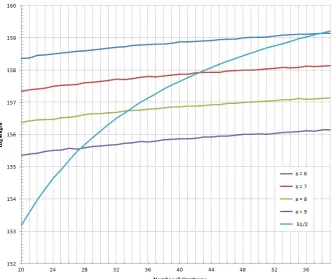
Figure 1: Log2 length of error vector z, and half short vector, for B-163
In the case of the binary curve B-163 where we know a = 163−µ leading bits of the ephemeral private keys this corresponds to the values in Table 2.
a 5 6 7 8 9
n 93 60 44 35 29
Table 2: Expected number of signatures required for B-163
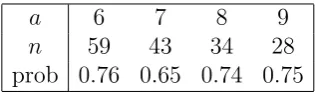
Experiments show that the mean length of the observed error is close to the bound on the expected length, but that the Gaussian heuristic slightly under-estimates the length of the actual shortest vector in the lattices. This means that the crossover points, see Figure 1, are marginally lower in practice, as shown by Table 3.
a 6 7 8 9
n 59 43 34 28 prob 0.76 0.65 0.74 0.75
Table 3: Observed number of signatures required for B-163 and the proba-bility of success
are needed to solve the lattice problem with a reasonable probability and for
a = 6 this is a significant improvement on the results in [1].
5
Lattice enumeration
The dimension of the lattices we are using is low enough that we can consider lattice enumeration to solve the Close Vector Problem. In its simplest form, this is a depth-first search through a tree whose leaves are all the lattice vectors within a given distanceRof the target vector. IfRis chosen correctly then enumeration (without any form of pruning) is guaranteed to find the closest vector.
The cost of lattice enumeration is exponential and depends on the quality of the basis. Following the complexity analysis in [3], the number of nodes visited at level k by Schnorr-Euchner enumeration [5] can be estimated as
Hk =
1 2
Vk(R) Qn
i=n+1−k||b ∗ i||
(2)
where b∗i is the i-th basis vector after Gram-Schmidt orthogonalization, and
Vk(R) = Rkπk/2Γ(k/2 + 1)−1 is the volume of the k-dimensional sphere of
radiusR. In our case, we will takeR to be the bound on the expected length of the error vector from (1).
The ratio ||b∗i||/||b∗i+1|| is approximately constant for a reduced basis, where this constant depends on the reduction algorithm. For example, [2] suggests that in practice LLL will produce a basis with ||b∗i||/||b∗i+1|| ' 1.0439. The argument in [3] would then give an estimate of the number of nodes visited at level k as
Hk'(1.0439)(n−k)k/22O(n).
Instead we will estimate the average number H of nodes visited by reducing the lattice for the curve B-163 and applying equation (2) directly, see Table 4. Again, as the dimension of our lattices is relatively low, we will use the stronger HKZ-reduction rather than the standard LLL-reduction.
a 6 7 8 9
n 59 43 34 28 log2(H) 12.6 7.44 4.92 3.55
Table 4: Estimated log2 number of nodes visited by enumeration for B-163 using HKZ-reduced bases
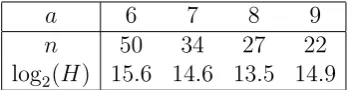
In fact, we can go further and estimate the cost of enumerating up to the bound given by (1) as we reduce the dimension of the lattices, see Figure 2. When the number of signatures drops below the crossover bounds specified in Table 3, we cannot guarantee that the ephemeral private keys are given by the shortest error vector. However, lattice enumeration will find all error vectors whose length is at most the expected length of z, so we can use secondary testing to identify the desired solution. This allows us to reduce the dimension of the lattices used while still limiting the total number of nodes visited by enumeration to a reasonable level, say 216. The number of signatures necessary are extracted into Table 5.
a 6 7 8 9
n 50 34 27 22 log2(H) 15.6 14.6 13.5 14.9
Table 5: Number of signatures required for B-163 with HKZ-reduced bases and lattice enumeration limited to 216 nodes
In particular, we see that for a = 7 the lattice attack will succeed with 34 signatures, if we are willing to increase the number of nodes visited in lattice enumeration by a factor of around 27.
6
Implications
Figure 2: Estimated log2 cost of lattice enumeration up to the bound (1) using HKZ-reduced bases for B-163
the leading a = 7 bits set to zero. However, noise in the timing information means that their filtered set contains a number of false positives, as shown in Table 6.
N 4096 8192 16384
Local attack 17.92 1.48 0.05 Loopback attack 17.06 4.01 0.90 Switched attack 19.40 8.96 11.81
Table 6: Average false positive counts for B-163 witha = 7 from [1]
in Table 7.
N 4096 8192 16384
Local attack 41.0 2.40 0.08 Loopback attack 38.0 6.75 1.44 Switched attack 47.0 16.4 22.9
Table 7: log2 CVP attempts for B-163 with a = 7 andn= 43
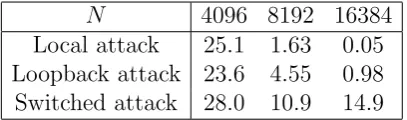
We can improve on this in two ways. Firstly, from the previous section we see that the lattice attack can succeed with only 34 signatures if we are willing to use lattice enumeration with secondary testing. The lattice attack will be more expensive by a factor of 27, but for the remote attack over a switched network this is more than offset by the reduction in the number of times the lattice attack needs to be performed as shown in Table 8.
N 4096 8192 16384
Local attack 25.1 1.63 0.05 Loopback attack 23.6 4.55 0.98 Switched attack 28.0 10.9 14.9
Table 8: log2 lattice enumeration attempts for B-163 with a= 7 and n = 34
Secondly, we can weaken the assumption on the leading bits and instead perform the lattice attack for a= 6. Unfortunately, Brumley and Tuveri do not indicate how many of the false positives in their filtered set correspond to ephemeral private keys where the leading 6 bits are still all zero. We will estimate the number of “doubly false positives” by assuming it is proportional to the number of false positives in the filtered set; e.g. if there are 17.92 false positives in a filtered set of 64 then 5.02 = 1764.92 ×17.92 of these will be doubly false positive. In this case, Table 5 tells us we need to select a set of 50 signatures with no doubly false positives for the lattice enumeration attack to succeed. We give these results in Table 9, presenting a considerable further improvement.
7
Reducing number of signatures
N 4096 8192 16384 Local attack 11.9 0.07 0.00 Loopback attack 10.7 0.54 0.03 Switched attack 14.3 2.76 4.89
Table 9: Estimate log2 lattice enumeration attempts for B-163 with a = 6 and n = 50
required to recover the static private key or reduce the number of signatures that need to be collected, N. The probability of a B-163 signature having a
leading zero bits is 2−a+1 because the top bit is (almost) always 0 due to the group size being only just larger than 2162. However, timing noise means we
cannot perfectly identify the signatures with a (or more) leading zeroes. If
we could identify perfectly then the number of signatures for which we can expect to recover the static private key is given by Table 10 where we solve by closest vector, and by Table 11 where we do more work by solving by enumeration up to the nearest 216 vectors.
a 6 7 8 9
n 59 43 34 28
N 1888 2752 4352 7168
Table 10: Expected total number of signatures required if no timing noise and solve by closest vector
a 6 7 8 9
n 50 34 27 22
N 1600 2176 3456 5632
Table 11: Expected total number of signatures collected if no timing noise and solve by enumeration up to 216
Thus, it’s actually better to assume fewer leading zero bits.
8
Future Work
The timing attack lets us predict the number of lead zeroes, ai, for a
shorter times have more lead zeroes. We could imagine scaling each column of the lattice by our best estimate of 2ai, and this would, in effect, re-balance
for the varying ai in the error norm. Where we are confident of ai we could
also include the information that the next bit down is set, reducing the num-ber of unknown ephemeral private key bits by one. Further work thus first requires an analysis of the accuracy of the mapping from time to number of lead zeroes, and how this affects the lattice problem. The work should then subsequently exploit the full information given varying ai for each signature.
We consider the size of the search tree as an upper bound on the lattice enumeration work. However, improvements which prune branches of the tree with a low probability of containing the solution, should be considered. Most notably, this should include the technique of Extreme Pruning defined by Gama, Nguyen and Regev in [3], which gives an order of magnitude com-plexity speedup compared to Schnorr-Euchner enumeration.
9
Conclusion
We have performed an analysis of the length of error vectors in the Brumley and Tuveri attack, and used it to determine the cost of recovering the static private key by Schnorr-Euchner lattice enumeration with secondary testing, even when the desired solution is not the closest lattice point to the target vector. We’ve shown this reduces the number of signatures required and allows us to solve the higher-dimensional problems arising where we assume fewer lead zero bits are set.
References
[1] B.B. Brumley and N. Tuveri. Remote Timings Attacks are Still Practical.Proceedings of the 16th European conference on Research in computer security, pages 355-371, Springer-Verlag, 2011.
[2] N. Gama and P.Q. Nguyen. Predicting lattice reduction.
[3] N. Gama, P.Q. Nguyen, O. Regev. Lattice enumeration using extreme pruning. EUROCRYPT’10, pages 257-278, Springer-Verlag, 2010.
[4] N.A. Howgrave-Graham and N.P. Smart. Lattice Attacks on Digital Signature Schemes. Designs, Codes and Cryptography, Volume 63, Issue 3, pages 283-290, Kluwer Academic Publish-ers, 2001.
[5] C.P. Schnorr and M. Euchner. Lattice basis reduction: im-proved practical algorithms and solving subset sum problems.
Mathematical Programming: Series A and B, Volume 66, Issue
2, pages 181-199, Springer-Verlag, 1994.
![Table 6: Average false positive counts for B-163 with a = 7 from [1]](https://thumb-us.123doks.com/thumbv2/123dok_us/7909673.1313364/10.595.121.446.140.399/table-average-false-positive-counts-b.webp)