A preliminary version of this paper appears in Proceedings of the 14th ACM Conference on Com-puter and Communications Security, CCS 2008, ACM Press, 2008. This is the full version.
Identity-based Encryption with Efficient Revocation
Alexandra Boldyreva∗ Vipul Goyal† Virendra Kumar‡
Abstract
Identity-based encryption (IBE) is an exciting alternative to public-key encryption, as IBE eliminates the need for a Public Key Infrastructure (PKI). Any setting, PKI- or identity-based, must provide a means to revoke users from the system. Efficient revocation is a well-studied problem in the traditional PKI setting. However in the setting of IBE, there has been little work on studying the revocation mechanisms. The most practical solution requires the senders to also use time periods when encrypting, and all the receivers (regardless of whether their keys have been compromised or not) to update their private keys regularly by contacting the trusted authority. We note that this solution does not scale well – as the number of users increases, the work on key updates becomes a bottleneck. We propose an IBE scheme that significantly improves key-update efficiency on the side of the trusted party (from linear to logarithmic in the number of users), while staying efficient for the users. Our scheme builds on the ideas of the Fuzzy IBE primitive and binary tree data structure, and is provably secure.
Keywords: Identity-based encryption, revocation, provable security.
∗
School of Computer Science, College of Computing, Georgia Institute of Technology, 266 Ferst Drive, Atlanta, GA 30332, USA. E-mail: [email protected]. Supported in part by NSF CAREER award 0545659 and NSF Cyber Trust grant 0831184.
†
Dept. of Computer Science, University of California, Los Angeles, CA, USA. E-mail: [email protected]. The author was supported in part from grants from the NSF ITR and Cybertrust programs (including grants 0627781, 0456717, and 0205594), a subgrant from SRI as part of the Army Cyber-TA program, an equipment grant from Intel, a Microsoft Research Fellowship, an Alfred P. Sloan Foundation Fellowship, and an Okawa Foundation Research Grant.
‡
Contents
1 Introduction 3
1.1 Motivation . . . 3 1.2 Related work . . . 3 1.3 Contributions . . . 4
2 Notation and Conventions 5
3 Revocable IBE and its Security 5
3.1 Syntax of Revocable IBE . . . 5 3.2 Security of Revocable IBE . . . 7
4 Main Construction 8
5 Addressing CCA Security 20
6 Revocable ABE and Fuzzy IBE 29
7 Conclusions 30
1
Introduction
1.1 Motivation
Identity (ID)-based encryption, or IBE for short, is an exciting alternative to public-key encryption, which eliminates the need for a Public Key Infrastructure (PKI) that makes publicly available the mapping between identities, public keys, and validity of the latter. The senders using an IBE do not need to look up the public keys and the corresponding certificates of the receivers, because the identities (e.g. emails or IP addresses) together with common public parameters are sufficient for encryption. The private keys of the users are issued by a trusted third party called the private key generator (PKG). Ideas of identity-based cryptography go back to 1984 and Shamir [24], but the first IBE scheme was constructed by Boneh and Franklin only in 2001 [6], building on the progress in elliptic curves with bilinear pairings.
Any setting, PKI- or identity-based, must provide a means to revoke users from the system, e.g. if their private keys get compromised. In a PKI setting a certification authority informs the senders about expired or revoked keys of the users via publicly available digital certificates and certificate revocation lists.
As a solution to this problem for IBE, Boneh and Franklin [6] suggested that users renew their private keys periodically, e.g. every week, and senders use the receivers’ identities concatenated with the current time period, e.g. “week 15 of 2008”. Notice that since only the PKG’s public key and the receiver’s identity are needed to encrypt, and there is no way to communicate to the senders that an identity has been revoked, such a mechanism to regularly update users’ private keys seems to be the only viable solution to the revocation problem. This means that all users, regardless of whether their keys have been exposed or not, have to regularly get in contact with the PKG, prove their identity and get new private keys. The PKG must be online for all such transactions, and a secure channel must be established between the PKG and each user to transmit the private key. Taking scalability of IBE deployment into account, we observe that for a very large number of users this may become a bottleneck.
We note that alternatively, in order to avoid the need for interaction and a secure channel, the PKG may encrypt the new keys of non-revoked users under their identities and the previous time period, and send the ciphertexts to these users (or post them online). With this approach, for every non-revoked user in the system, the PKG is required to perform one key generation and one encryption operation per key update. We note that this solution, just as the original suggestion, requires the PKG to do work linear in the number of users, and does not scale well as the number of users grow. The goal of the paper is to study this problem and find solutions to alleviate it.
1.2 Related work
Efficient revocation is a well-studied problem in the traditional PKI setting, e.g. [18, 21, 1, 20, 19, 11, 12]. However in the setting of IBE, there has been little work on studying the revocation mechanisms. Hanaoka et al. [15] propose a way for the users to periodically renew their private keys without interacting with the PKG. The PKG publicly posts the key update information, which is much more convenient. However, each user needs to posses a tamper-resistant hardware device. This assumption makes the solution rather cumbersome.
to stop helping the user. But we want to focus on a much more practical standard IBE setting where users are able to decrypt on their own.
The goal of broadcast encryption is to prevent revoked users from accessing secret informa-tion being broadcast. The broadcast encrypinforma-tion soluinforma-tions, however, and in particular ID-based broadcast encryption ones, do not directly translate into solutions for our problem. In broadcast encryption, a non-revoked user can help a revoked user gain access to the sensitive information being broadcast (since this information is the same for all parties). On the other hand, in the IBE setting a revoked user, or the adversary holding its private key, should not be able to decrypt messages even if it colludes with any number of non-revoked users.
Thus, to the best of our knowledge, the solution proposed by Boneh and Franklin in [6] remains the most practical user revocation solution in the IBE setting.
1.3 Contributions
We propose a new way to mitigate the limitation of IBE with regard to revocation, and improve efficiency of the previous solution. We want to remove interaction form the process of key update, as keeping the PKG online can be a bottleneck, especially if the number of users is very large. At the same time we do not want to employ trusted hardware and we want to significantly minimize the work done by the PKG and users.
First we define the Revocable IBE primitive and its security model that formalizes the possible threats. The model, of course, takes into account all adversarial capabilities of the standard IBE security notion. I.e. the adversary should be able to learn the private keys of the users with identities of its choice, and in the case of chosen-ciphertext attack to also see decryptions under the private key of the challenge identity of the ciphertexts of its choice. The adversary should not be able to learn any partial information about the messages encrypted for the challenge identity. In addition we consider the adversary having access to periodic key updates (as we assume this information is public) and being able to revoke users with IDs of its choice. The adversary should not be able to learn any partial information about the messages encrypted for any revoked identity when the ciphertext is created after the time of revocation (i.e. for the ID containing the time past the revocation time).
We show that it is possible to reduce the amount of work a PKG has to do for key updates and the total size of key updates to logarithmic in the number of users, while keeping the key update process non-interactive, and encryption and decryption efficient.
Our idea is to build on the Fuzzy IBE construction by Sahai and Waters [23]. The Fuzzy IBE primitive provides some sort of error-tolerance, i.e. identities are viewed as sets of attributes, and a user can decrypt if it possesses keys for enough of (but not necessarily all) attributes a ciphertext is encrypted under. At the same time, colluding users cannot combine their keys to decrypt a ciphertext which none of them were able to decrypt independently.
is possible. We provide more details and present the full construction in Section 4.
While our scheme provides major computation and bandwidth efficiency improvements at the stage of key update, it also permits efficient encryption and decryption. We show that our scheme provably guarantees security assuming the decisional bilinear Diffie-Hellman (DBDH) problem is hard, which is a quite common assumption nowadays (cf. e.g. [3, 23, 25, 14]).
We also show two ways to address chosen-ciphertext attack. Our first solution is to modify our scheme by additionally employing a strongly-unforgeable one-time signature scheme in a manner somewhat similar to that from [7, 14]. We also show that it is possible to employ the Fujisaki-Okamoto (FO) transform [9, 10]. Security of the latter solution relies on the random oracle model [2], but unlike the former solution, it is generic, in that it can be applied to any Revocable IBE scheme.
Since the existing Fuzzy IBE schemes are only secure in the weaker selective-ID model [8], where the adversary has to declare the challenge identity up front, with the above approach we can only achieve selective-ID security as well. We leave it as an interesting open problem to achieve full security without such limitation.
Finally we note that the problem of revocation is equally important for Fuzzy IBE and attribute-based encryption (ABE) [14] schemes. While the same periodic key update solution due to Boneh and Franklin applies, it similarly limits scalability. We show that it is possible to extend our techniques to provide efficient non-interactive key update to Fuzzy IBE and ABE schemes.
2
Notation and Conventions
Let Ndenote the set of natural numbers and Rdenote the set of real numbers. Forn∈N, let Zn denote the set of integers modulo nand Z∗n denote the setZn\0. We denote by {0,1}∗ the set of all binary strings of finite length. Ifx is string then|x|denotes its length in bits and ifx∈Rthen |x| denotes its absolute value. If x, y are strings then xky denotes the concatenation of x and y, and we assume that x and y can be efficiently and unambiguously recovered from xky. If κ ∈ N then 1κ denotes the string consisting of κ consecutive “1” bits. We denote byφ the empty set. If
x, y are strings then xky denotes the concatenation of x and y, and we assume that x and y can be efficiently and unambiguously recovered from xky. If S is a finite set then s←$ S denotes that
s is selected uniformly at random from S . We will often write s1, s2, . . . , sn
$
← S as a shorthand fors1
$
←S;s2 $
← S;. . .;sn
$
←S. When describing algorithms,a←b denotes that ais assigned the value b. If A is a randomized algorithm and n ∈ N, then a ←$ A(i1, i2, . . . , in) denotes that a is assigned the outcome of the experiment of runningA on inputsi1, i2, . . . , in. IfAis deterministic, then we drop the dollar sign above the arrow. If S={s1, s2, . . . , sn}, then {xs}s∈S denotes the set {xs1, xs2, . . . , xsn}. An adversary is an algorithm. By convention, the running time of an adversary
includes that of its overlying experiment. All algorithms are assumed to be randomized and efficient (i.e. polynomial in the size of the input), unless noted otherwise. In the rest of the paperκ∈Nis the security parameter,n(·) denotes a polynomial inκ, but for simplicity we use the notation n.
3
Revocable IBE and its Security
3.1 Syntax of Revocable IBE
Definition 3.1 [Revocable IBE]Anidentity-based encryption with efficient revocationor simply Revocable IBE scheme RIBE = (S,SK,KU,DK,E,D,R) is defined by seven algorithms and has associated message space M, identity space I and time space T. We assume that the size of T is polynomial in the security parameter. Each algorithm is run by either one of three types of parties - key authority, sender or receiver. Key authority maintains a revocation list rland state st. Revocation listrlcan be part of statest, but we keep it explicit for clarity. In what follows, we call an algorithm stateful only if it updatesrlorst. We treat time as discrete as opposed to continuous. • The stateful setup algorithm S (run by key authority) takes input security parameter 1κ and number of usersn, and outputs public parameterspk, master keymk, revocation listrl(initially empty) and statest.
• The stateful private key generation algorithm SK (run by key authority) takes input public parameters pk, master key mk, identityω ∈ I and statest, and outputs private key skω and an updated state st.
• Thekey update generation algorithm KU (run by key authority) takes input public parameters pk, master key mk, key update time t ∈ T, revocation list rl and state st, and outputs key updatekut.
• The deterministicdecryption key generationalgorithmDK(run byreceiver) takes input private keyskω and key updatekut, and outputs decryption keydkω,t or a special symbol⊥indicating that ω was revoked. (We say an identity ω was revoked at time t if revocation algorithm R was run bykey authority on input (ω, t, rl, st) for any rl, st.)
• Theencryption algorithmE (run by sender) takes input public parameterspk, identityω∈ I, encryption timet∈ T and messagem∈ M, and outputs ciphertextc. For simplicity and wlog we assume thatω, tare efficiently computable from c.
• The deterministic decryption algorithm D (run by receiver) takes input decryption keydkω,t and ciphertext c, and outputs a message m ∈ M or, a special symbol ⊥ indicating that the ciphertext is invalid.
• The statefulrevocation algorithm R(run bykey authority) takes input identity to be revoked
ω∈ I, revocation timet∈ T, revocation listrland statest, and outputs an updated revocation listrl.
The consistency condition requires that for allκ∈Nand polynomials (inκ)n, allpkandmkoutput by setup algorithmS, allm∈ M, ω ∈ I, t∈ T and all possible valid statesstand revocation lists1
rl, if identity ω was not revoked before or, at time t then the following experiment returns 1 with probability 1:
(skω, st)← SK$ (pk,mk, ω, st) ; kut← KU$ (pk,mk, t, rl, st) dkω,t← DK(skω,kut) ; c← E$ (pk, ω, t, m)
If D(dkω,t, c) =m then return 1 else return 0.
Remarks. Note that we differentiate between the terms “private key” and “decryption key”. One can also define the decryption key generation algorithm that instead of private key skω takes input the decryption key for the previous time perioddkω,t−1. We do not further discuss this
version here since it is not used in our construction.
1
3.2 Security of Revocable IBE
We define the selective-revocable-ID security for Revocable IBE schemes. Our security model cap-tures the standard notion of selective-ID security but it also takes into account possible revocations. Since we explicitly consider time periods, in the beginning of the experiment in addition to the challenge identity the adversary also declares the challenge time. Just as in the standard slective-ID security definition the adversary can request to learn users’ keys. In addition we let the adversary to revoke users of its choice (including the challenge identity) at any period of time and see all key updates. Unlike in the standard security model, we allow the adversary to learn the private key for the challenge identity, but only if it was revoked prior to or at the challenge time. The adversary is given a ciphertext of one of the two messages of its choice encrypted for the challenge identity and time. It has to guess which of the messages was encrypted.
First we define (selective) security against chosen-plaintext attack and then show how to extend the definition to chosen-ciphertext attack.
Definition 3.2 [sRID Security] Let RIBE = (S, SK, KU,DK,E,D,R) be a Revocable IBE scheme. The adversary first outputs the challenge identity and time, and also some information
stateit wants to preserve. Later it is given access to three oracles that correspond to the algorithms of the scheme. The oracles share state.2 Since we use the simplified notation for the oracles, we define them now:
• The private key generation oracle SK(·) takes input identityω and runsSK(pk,mk, ω, st) to return private key skω.
• The key update generation oracle KU(·) takes input time t and runs KU(pk,mk, t, rl, st) to return key update kut.
• Therevocation oracleR(·,·) takes input identityωand timetand runsR(ω, t, rl, st) to update rl.
For adversary A and number of usersndefine the following experiments: Experiment Expsrid−cpaRIBE,A,n(1κ)
b← {$ 0,1}
(ω∗, t∗, state)←$ A(1κ) (pk,mk, rl, st)← S$ (1κ, n)
(m0, m1, state)←$ ASK(·),KU(·),R(·,·)(pk, state)
c∗ ← E$ (pk, ω∗, t∗, mb)
d←$ ASK(·),KU(·),R(·,·)(pk, c∗, state) If b=dreturn 1 else return 0. The following conditions must always hold:
1. m0, m1 ∈ Mand |m0|=|m1|.
2. KU(·) and R(·,·) can be queried on time which is greater than or equal to the time of all previous queries i.e. the adversary is allowed to query only in non-decreasing order of time3.
2To be more formal we could define a single oracle that maintains the state and invokes these oracles as subroutines.
We do not do it for simplicity.
Also, the oracleR(·,·) cannot be queried on time tifKU(·) was queried on t.4
3. IfSK(·) was queried on identityω∗ thenR(·,·) must be queried on (ω∗, t) for any t≤t∗. We define the advantage of the adversaryAdvsrid−cpaRIBE,A,n(κ) as
2·Pr h
Expsrid−cpaRIBE,A,n(1κ) = 1 i
−1.
The schemeRIBE is said to besRID-CPA secure if the functionAdvsrid−cpaRIBE,A,n(·) is negligible in κ
for any efficientA and polynomial n.
Chosen-ciphertext attack. We extend the above definition in the standard way to take into account chosen-ciphertext attack. Whenever the adversary is given the oracles, it is also given the decryption oracleD(·) that takes input ciphertextcand runsD(dkω∗,t, c) to return messagemor⊥.
The usual restriction is that D(·) cannot be queried on challenge ciphertext c∗. The advantage of the adversaryAdvsrid−ccaRIBE,A,n(κ) andsRID-CCA security are defined analogously to the CPA setting.
4
Main Construction
Intuition. At a high level we build on the (large universe) construction of Fuzzy IBE [23] and the binary tree data structure. We briefly recall the Fuzzy IBE primitive ideas and the basics of the construction.
In the Fuzzy IBE construction from [23], users’ keys and ciphertexts are associated with sets of descriptive attributes. A user’s key can decrypt a particular ciphertext only if some number of attributes (so called “error-tolerance”) match between the ciphertext and the key. The number of attributes used to encrypt and the error-tolerance are fixed during the setup. Security of Fuzzy IBE requires that different users should not be able to pool their attributes together in order to decrypt a ciphertext which none of them were able to decrypt individually. To prevent collusions, the key generation algorithm of Fuzzy IBE generates a random polynomial (of degree one less than the error-tolerance) for each user. This polynomial is used to compute keys corresponding to a set of attributes. Since all the keys are computed on different polynomials, they cannot be combined in any meaningful way.
In our IBE scheme messages are encrypted for two “attributes”: identity of the receiver and time period. The decryption key is also computed for attributes identity and time, on a first-degree polynomial, meaning both attributes of the decryption key must match with those of a ciphertext in order to decrypt. We split the decryption key in two components corresponding to identity and time that we call private key and key update respectively. The private key is issued to each user by the key authority,5 just like regular private keys in IBE. The key update is published by the key authority and is publicly available to all users. To be able to decrypt a ciphertext a user needs both the private key and the key update. Thus, when the key authority needs to revoke a user it may simply stop publishing key updates for that user. As we recalled above, in Fuzzy IBE the polynomial of a decryption key is selected at random to prevent collusion between different keys. Using Fuzzy IBE in a naive way would thus require computing key updates for each user separately. We use a different approach to reduce the number of key updates that key authority
4
This is because we assume that the key update is done at the end of the time periodt.
needs to compute. We use a binary tree of heighth (with at least as many leaves as the number of users in the system) and assign a random polynomial to each node of the tree. Next, we associate each user to a unique leaf node. Every user gets keys (corresponding to its identity) computed on polynomials of all nodes on the path from the leaf node corresponding to that user to the root node. To be able to decrypt a ciphertext encrypted with time t, any user just needs one key update (corresponding tot) computed on any one of the polynomials of nodes on the path from the leaf node of the user to the root node. Thus, when no user is revoked, key authority just needs to publish the key update computed on the polynomial of the root node. When a subset of the users is revoked,key authorityfirst finds the minimal set of nodes in the tree which contains an ancestor (or, the node itself) among all the leaf nodes corresponding to non-revoked users. Then, key authority
publishes key updates on polynomials of the nodes in this set. We first address chosen-plaintext attack only, and later show how to extend the scheme to resist chosen-ciphertext attack as well.
Before we give a formal description of the scheme, we define bilinear maps (aka. pairings). Bilinear maps and group generator. Let G,GT be groups of prime order p (so they are cyclic). A pairing is an efficiently computable map e:G×G → GT such that the following two conditions hold:
• Bilinearity: For allg1, g2 ∈Gand x, y∈Z, we have e(gx1, g
y
2) =e(g1, g2)xy.
• Non-degeneracy: For any generatorg of G,e(g, g) is a generator ofGT. Note thate(·,·) is symmetric sincee(gx, gy) =e(g, g)xy =e(gy, gx).
A bilinear group generator G is an algorithm that on input 1κ returns ˜G, which is a description of groups G,GT of order p and the bilinear map e as defined above, and also p and a generator
g of G. There can be numerous such prime order bilinear group generators. We will not specify a particular one but will use it as a parameter to the hardness assumption that we use for our security proof. The description of a group should specify the algorithms for group operations (multiplication, inverse and pairing), the algorithm for testing group membership, and also the random group element sampling algorithm. Here and further in the paper we assume that the group elements are uniquely encoded as strings.
Construction. We now specify the scheme RIBE[G] = (S,SK,KU,DK,E,D,R) in detail. We assume that all users agree on how time is divided by time periods and how each time period is specified, e.g. by days and “04.14.08”. In ourRIBE scheme messages are encrypted using identity and time. Identity is a string associated with any user, e.g. an email “[email protected]”. Time indicates when the ciphertext is supposed to be decrypted, e.g. on 04.14.08. The message space MisGT. The identity spaceI is{0,1}∗, and the time spaceT is an arbitrary bitstring set of size polynomial in the security parameter. We require that the strings specifying identities and times can be distinguished, e.g. by reserving the most significant bit (MSB) 0 for identity strings and 1 for time strings. In our construction the identity and time strings are mapped to unique elements of Z∗p (if needed, a collision-resistant hash function {0,1}∗ → Z∗p can be used). From now on for simplicity we assume that identity and time are distinguished elements in Z∗p.
For x, i∈Z, setJ⊆Zthe Lagrange coefficient ∆i,J(x) is defined as ∆i,J(x)
def
= Y
j∈J, j6=i
x−j i−j
u1 u2 u3 u4 u5
u1 u2 u3 u4 u5
No user is revoked
Useru3is revoked
Nodes for key updates output by KUNodes Nodes marked as revoked by KUNodes
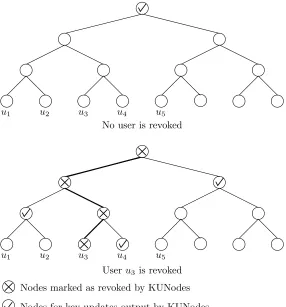
Figure 1: A pictorial description of the actions of KUNodesfunction used in Construction 4.1.
For x∈Z, g∈GT,J⊆Z, h1, . . . , h|J|∈G,we define
Hg,J,h1,...,h|J|(x) def
= gx2
|J|
Y
i=1
h∆i,J(x)
i
.
Our construction uses the binary tree data structure, so we introduce some notation here. We denote byroot the root node. Ifvis a leaf node then Path(v) denotes the set of nodes on the path from v toroot (both v and root inclusive). Ifv is a non-leaf node then vl, vr denote left and right child ofv. We assume that nodes in the tree are uniquely encoded as strings, and the tree is defined by all of its nodes descriptions.
We also define a functionKUNodesthat is used to compute the minimal set of nodes for which key update needs to be published so that only non-revoked users at time t are able to decrypt ciphertexts.6 The function takes input a binary tree T, revocation list rl and time t and outputs
a set of nodes, which is the minimal set of nodes in T such that none of the nodes in rl with corresponding time ≤ t (users revoked on or before t) have any ancestor (or, themselves) in the set, and all other leaf nodes (corresponding to non-revoked users) have exactly one ancestor (or, themselves) in the set. The function operates as follows. First mark all the ancestors of revoked nodes as revoked, then output all the non-revoked children of revoked nodes. Refer to Figure 1 for
6
a pictorial depiction. Here is a formal specification.
KUNodes(T, rl, t)
X,Y←φ
∀(vi, ti)∈rl
ifti ≤tthen add Path(vi) to X ∀x∈X
ifxl∈/X then addxl toY ifxr∈/X then addxr toY IfY=φthen add roottoY
ReturnY
We are now ready to present the description of Revocable IBE. We could not use the algorithms of the Fuzzy IBE construction from [23] in a black-box manner. The reason is that there the polynomial for each key is picked independently by the key generation algorithm. And in our construction some polynomials need to be shared by different keys. After we provide the details for each algorithm, we give some intuition and relation to the construction from [23] following “//” sign.
Construction 4.1 LetG be a prime order bilinear group generator. LetJ be{1,2,3}. • Setup S(1κ, n):
( ˜G, p, g)← G$ (1κ) ; a←$ Zp; g1 ←ga; g2, h1, h2,h3 $
←G. Letrlbe an empty set and T be a binary tree with at least nleaf nodes.
Return pk= (g, g1, g2, h1,h2, h3),mk=a; rl , st=T.
// Besides the additional outputs of rl and st, it is essentially the same as Setup of Fuzzy IBE where 2 out of 2 attributes need to be matched.
• Private Key Generation SK(pk,mk, ω, st):
Parse pk as (g, g1, g2, h1, h2, h3), mk as a, stas T.7 Pick an unassigned leaf node v from T
and store ω in that node. ∀x∈Path(v)
ifax is undefined, then ax←$ Zp, store ax in nodex,
rx
$
←Zp; Dx ←g2axω+aHg2,J,h1,h2,h3(ω)
rx ;
dx←grx.
Return skω={(x, Dx, dx)}x∈Path(v), st.
// We note thatax above fixes first-degree polynomialqx(y) =axy+acorresponding to node
x. The algorithm computes the ω-components of the decryption key using the polynomials of all the nodes on the path from leaf node corresponding toω to the root node.
7
Every nodexinT stores an elementax ∈Zp and in addition, every leaf node stores an identityω. If no such
• Key Update GenerationKU(pk,mk, t,rl, st): Parsepkas (g, g1, g2, h1, h2, h3),mkasa,stasT.
∀x∈KUNodes(T, rl, t)
rx
$
←Zp; Ex←g2axt+aHg2,J,h1,h2,h3(t)
rx;
ex ←grx.
Return kut={(x, Ex, ex)}x∈KUNodes(T,rl,t).
// The algorithm first finds a minimal set of nodes which contains an ancestor (or, the node itself) of all the non-revoked nodes. Then it computes the t- component of the decryption key using the polynomials of all the nodes in that set.
• Decryption Key GenerationDK(skω,kut):
Parseskω as{(i, Di, di)}i∈I,kut as{(j, Ej, ej)}j∈J for some set of nodesI,J. ∀(i, Di, di)∈skω,(j, Ej, ej)∈kut
If ∃(i, j) s.t.i=j thendkω,t ←(Di, Ej, di, ej) Else (if skω and kutdon’t have any node in common) then dkω,t ← ⊥.
Return dkω,t.
// Above we can drop the subscripts i, j since they are equal, i.e. dkω,t = (D, E, d, e). The algorithm finds components ofskω andkut which were computed on the same polynomial.
• EncryptionE(pk, ω, t, m): Parsepkas (g, g1, g2, h1, h2, h3).
z←$ Zp; c1 ←m·e(g1, g2)z; c2 ←gz;
cω ←Hg2,J,h1,h2,h3(ω)
z; c
t←Hg2,J,h1,h2,h3(t)
z. Return c= (ω, t, cω, ct, c1, c2).
// The Encryption algorithm is essentially the same as that of Fuzzy IBE.
• DecryptionD(dkω,t, c):
Parsedkω,t as (D, E, d, e),c as (ω, t, cω, ct, c1, c2).
m←c1
e(d,cω)
e(D,c2) t
t−ω e(e,ct)
e(E,c2) ω
ω−t
. Return m.
// The decryption algorithm is essentially the same as that of Fuzzy IBE.
• RevocationR(ω, t, rl, st):
Consistency. If identityωwas not revoked before or, at timet, then we will show thatD(dkω,t, c) =
m wheredkω,t, mand care computed as per the consistency requirement in Section 3.1.
From the definition ofKUNodeswe see that if ω was not revoked before or, attthen the set of nodes output byKUNodeshas one ancestor (or, the node itself) of the leaf node associated withω
which implies that there will be a common node in skω and kut and henceDK will not output ⊥. Now from the above construction we have that for a, ax, z, rω, rt∈Zp:
g, g2, h1, h2, h3 ∈G, g1 =ga
dkω,t = (D, E, d, e) , where D=g2axω+aHg2,J,h1,h2,h3(ω)
rω ,
E=gaxt+a
2 Hg2,J,h1,h2,h3(t)
rt , d=grω , e=grt ,
c= (ω, t, cω, ct, c1, c2) , wherecω =Hg2,J,h1,h2,h3(ω)
z ,
ct=Hg2,J,h1,h2,h3(t)
z, c
1=m·e(g1, g2)z , c2 =gz.
So, D(dkω,t, c)
= c1
e(d, cω) e(D, c2)
t
t−ω e(e, ct)
e(E, c2)
ω
ω−t
= m·e(g1, g2)z
×
e(grω, H
g2,J,h1,h2,h3(ω)
z) e(gaxω+a
2 Hg2,J,h1,h2,h3(ω)rω, gz) t−tω
×
e(grt, H
g2,J,h1,h2,h3(t)
z) e(gaxt+a
2 Hg2,J,h1,h2,h3(t)rt, gz) ωω−t
= m·e(g1, g2)z
1 e(gaxω+a
2 , gz)
t−tω
×
1 e(gaxt+a
2 , gz)
ωω−t
= m·e(g1, g2)z
×
1 e(g(axω+a)(
t
t−ω)+(axt+a)( ω ω−t)
2 , gz)
= m·e(g1, g2)z
1
e(ga2, gz) =m·e(g1, g2) z 1
e(g2, g1)z
= m.
Remarks. The functionKUNodesneeds to be executed only whenrlhas changed, sokey authority can store the output ofKUNodesand use it untilrl changes. If the number of users exceedsn, the capacity of the current tree, it is possible to extend the tree and permit n more users as follows. Take an “empty” tree of the same size and connect the roots of the current and new trees to the new parent root node. Now the combined tree has 2nleaf nodes, and new users can be accommodated. Each user will need an additional private key component computed on the polynomial of the new root node. This new private key component can be encrypted (under the corresponding identity and time) and published.
r= 0 1< r≤n/2 n/2< r≤n
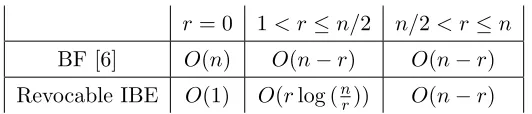
BF [6] O(n) O(n−r) O(n−r) Revocable IBE O(1) O(rlog (nr)) O(n−r)
Table 1: Key update complexity comparison. Above n is the total number of users and r is the number of revoked users.
We compare the worst case complexity of our scheme with that of the general revocation solution suggested by Boneh-Franklin [6] that we outlined in the Introduction. Table 1 summarizes the results. The complexity analysis for our construction follows directly from Theorem 1 of [1], as the number of necessary key updates in our scheme corresponds to the number of nodes returned by functionKUNodes, and a similar function on the binary tree was used in [1].
As the table shows, our scheme represents a significant improvement over the Boneh-Franklin solution for small values of r. For larger values of r (especially as it reaches close to n), this advantage is lost. We however note that asr becomes large, our scheme can be “reset” to keep key update efficient (by running the setup algorithm again which will make the revocation list empty and releasing new private keys for only non-revoked users).
In terms of encryption and decryption, our construction is slightly less efficient than the existing IBE schemes. E.g. the decryption algorithms of IBEs by Waters [25] and Boneh-Boyen [3] require 2 pairing computations (the slowest computation compared to group operations and exponentia-tions), and our scheme requires 4. Encryption in the schemes of [25, 3] is dominated by 3 and 4 exponentiations, while our scheme uses 12. We chose Waters and Boneh-Boyen constructions for comparison because they are the most efficient IBE schemes secure in standard (RO devoid) model under standard assumptions. This may be a reasonable price to pay for the significant improve-ment in key-update efficiency, which may become a bottleneck for a large number of users. We note that the size of secret keys is larger in our scheme, a user needs to store up to 3h = 3 logn
group elements.
We note that using the suggestion from [22], efficiency of our scheme, and in particular, its encryption algorithm, can be improved, if a hash function is used in place of the function H. Security analysis in this case will need to rely on the random oracle (RO) model [2]. This will improve the number of exponentiations in encryption to 4 while the decryption algorithm will still be dominated by 4 paring operations. In contrast, the cost of encryption and decryption in the Boneh-Franklin scheme [6] is dominated by one pairing each.
Security. Even though different users have their private keys computed on the same polynomial this does not introduce insecurity inRIBEas opposed to Fuzzy IBE. In our scheme collusion among different users is possible, however such collusion is not useful. No matter how many revoked users try to collude, they will still be unable to decrypt a ciphertext for a new time period, as they cannot obtain the necessary decryption key component. One might be tempted to reduce the security of RIBE to the security of Fuzzy IBE since, after allRIBE uses Fuzzy IBE as its base construction. However, we want to point out that such a straightforward reduction of security in a black box manner does not seem possible. The main reason for this is that in Fuzzy IBE each time key generation algorithm is run it chooses a random polynomial and then computes the key using that polynomial however, inRIBE it is essential that private key and key update be computed on some fixed polynomials.
prob-lem, which we now recall.
Definition 4.2 [Decisional bilinear Diffie-Hellman ] Let G be a prime order bilinear group generator. The decisional bilinear Diffie-Hellman (DBDH) problem is said to be hard for G if for every efficient adversary A its advantageAdvdbdhG,A (k) defined as
Pr h
ExpdbdhG,A -real(1κ) = 1 i
−Pr h
ExpdbdhG,A -rand(1κ) = 1 i
is a negligible function inκ, and where the experiments are as follows: Experiment ExpdbdhG,A -real(1κ)
( ˜G, p, g)← G$ (1κ) ; x, y, z←$ Zp
X ←gx; Y ←gy; Z←gz;W ←e(g, g)xyz
d←$ A(1κ,G˜, p, g, X, Y, Z, W) Return d
Experiment ExpdbdhG,A -rand(1κ)
( ˜G, p, g)← G$ (1κ) ; x, y, z, w←$ Zp
X ←gx; Y ←gy; Z←gz;W ←e(g, g)w
d←$ A(1κ,G˜, p, g, X, Y, Z, W) Return d
We now state the security result.
Theorem 4.3 Let G be a prime order bilinear group generator and RIBE[G] = (S,SK,KU,DK,
E, D,R) be the associated Revocable IBE scheme defined by Construction 4.1. Then for any adversary A attacking sRID-CPA security of RIBE with n users, whose running time is tA and
who asks qp private key generation queries, qk key update generation queries and qr revocation queries, there exists an adversary Bsolving DBDH problem for G such that
Advsrid−cpaRIBE,A,n(κ)≤4·AdvdbdhG,B (κ), (1)
where the running time ofB,tB=tA+O(κ3).
Proof: We construct an adversaryBfor the DBDH problem associated withG. Bgets (1κ,G˜, p, g,
B(1κ,G˜, p, g, X, Y, Z, W) : (ω∗, t∗, state)← A$ (1κ)
g1 ←X, g2 ←Y
Pick random second-degree polynomials f(x), u(x) with coefficients inZp, s.t. u(x) =−x2 forx=ω∗, t∗, o.w. u(x)6=−x2
Fori= 1,2,3 :hi ←g2u(i)gf(i)
pk←(g, g1, g2, h1, h2, h3)
Letrl be an empty set andT be a binary tree with at least nleaf nodes. Pick a leaf nodev∗ from T and a random bitrev
Run Aand answer its queries to theSK(·),KU(·), R(·,·) oracles using the subroutines defined.
(m0, m1, state0) $
← ASK(·),KU(·),R(·,·)(1κ,pk, state)
b← {$ 0,1}
c∗1 ←mb·W, c2∗ ←Z, c∗ω ←Zf(ω
∗)
, c∗t ←Zf(t∗) c∗ ←(ω∗, t∗, cω∗, c∗t, c∗1, c∗2)
d← A$ SK(·),KU(·),R(·,·)(1κ,pk, c∗, state0)
If any of the oracles abort return 1 Else if b=dreturn 1 else return 0
Now, we present the subroutines for answering the oracle queries. These subroutines use the functions that we define here. For i, j, l, r0 ∈Zp, S={0, j} define
F1(i, j, l, r0)def= g2l∆j,S(i) g −f(i)
i2+u(i) 1
g2i2+u(i)gf(i)
r0
!∆0,S(i)
,
F2(i, r0) def
=
g
−1
i2+u(i)
1 gr
0∆0,S(i)
.
SK(ω) :
Ifrev= 0 and ω=ω∗ then abort Ifrev= 1 and ω=ω∗ then:
v←v∗,
∀x∈Path(v)rx←$ Zp
if@lx thenlx ←$ Zp and store lx in node x
Dx ←g2lxHg2,h1,h2,h3(ω ∗)rx, d
x←grx Ifrev= 0 and ω6=ω∗ then:
Pick an unassigned leaf nodev from T and store ω in nodev
∀x∈Path(v)r0x←$ Zp,
if@lx thenlx ←$ Zp and store lx in node x
i←ω, j←t∗, l←lx, r0←r0x
Dx ←F1(i, j, l, r0), dx←F2(i, r0)
Ifrev= 1 and ω6=ω∗ then:
Pick an unassigned leaf nodev from T and store ω in nodev
if@lx thenlx
$
←Zp and store lx in node x
i←ω, l←lx, r0 ←rx0 ∀x∈(Path(v)\Path(v∗))
j←t∗
Dx ←F1(i, j, l, r0), dx←F2(i, r0)
∀x∈(Path(v)∩Path(v∗))
j←ω∗
Dx ←F1(i, j, l, r0), dx←F2(i, r0)
Returnskω ={(x, Dx, dx)}x∈Path(v)
R(ω, t) :
For all leaf nodesv associated with identity ω, add (v, t) to rl
KU(t) :
Ifrev= 1 and t=t∗ and ∀t≤t∗ we have that (ω∗, t)∈/rl, then abort Else ift=t∗ then:
∀x∈KUNodes(T, rl, t), rx
$
←Zp
Ex←gl2xHg2,h1,h2,h3(t ∗)rx, e
x←grx Ifrev= 1 and t6=t∗ then:
∀x∈(KUNodes(T, rl, t)\Path(v∗))
r0x←$ Zp, i←t, j←t∗, l←lx, r0 ←r0x
Ex←F1(i, j, l, r0), ex ←F2(i, r0)
∀x∈(KUNodes(T, rl, t)∩Path(v∗))
r0x←$ Zp, i←t, j←ω∗, l←lx, r0 ←r0x
Ex←F1(i, j, l, r0), ex ←F2(i, r0)
Ifrev= 0 and t6=t∗ then: ∀x∈KUNodes(T, rl, t)
r0x←$ Zp, i←t, j←t∗, l←lx, r0 ←r0x
Ex←F1(i, j, l, r0), ex ←F2(i, r0)
Returnkut={(x, Ex, ex)}x∈KUNodes(T,rl,t)
Analysis. f(x) being a random polynomial ensures thath1, h2, h3 are random so,pkhas the right
distribution. For i = 1,2,3 hi = g2u(i)gf(i) which implies Hg2,h1,h2,h3(x) = g
x2+u(x)
2 gf(x). Since
x = ω∗, t∗ u(x) =−x2, then H
g2,h1,h2,h3(ω
∗) = gf(ω∗), H
g2,h1,h2,h3(t
∗) =gf(t∗). If W =e(g, g)xyz, then c∗1 = mb ·W = mb ·e(g1, g2)z, cω∗ = Zf(ω
∗)
= gzf(ω∗) = Hg2,h1,h2,h3(ω ∗)z, c
t∗ = Zf(t ∗)
=
gzf(t∗) =Hg2,h1,h2,h3(t
∗)z. So, if B is in Expdbdh-real
G,B (κ) thenc∗ is a well-formed ciphertext of mb. Otherwise, ifW =e(g, g)w for a randomw, then c∗1 =mb·W =mb·e(g, g)w, sow being random and independent from x, y, z ensures that c∗1 is also random and thus c∗ hides bit b information-theoretically. In what follows let g1=ga (to simplify notation).
Case 1. rev = 1, ω =ω∗ inSK(ω) oracle simulation: Define ax = ω1∗(lx−a). Then Dx = gaxω
∗+a
2 Hg2,h1,h2,h3(ω ∗)rx, d
distribution.
Case 2. rev = 0, ω 6=ω∗ inSK(ω) oracle simulation: Define ax = t1∗(lx−a), rx= (r0x−ω2+au(ω))∆0,S(ω). Then
F2(i, r0) =
g
−1
i2+u(i)
1 gr
0∆0,S(i)
= gr
0− a i2+u(i)
∆0,S(i)
=
gr
0
x−ω2+au(ω)∆0,S(ω)
= gr0x
and
F1(i, j, l, r0) = g
l∆j,S(i)
2
g
−f(i)
i2+u(i) 1
!
g2i2+u(i)gf(i)r
0!∆0,S(i)
= g2l∆j,S(i)
g
−af(i)
i2+u(i)
g2i2+u(i)gf(i)
r0∆0,S(i)
= gl∆j,S(i)
2
g2ag2i2+u(i)gf(i)
−a i2+u(i)
gi22+u(i)gf(i)r
0∆0,S(i)
= g2l∆j,S(i)
g2a
g2i2+u(i)gf(i)
r0− a
i2+u(i)
∆0,S(i)
= gl∆j,S(i)+a∆0,S(i)
2
g2i2+u(i)gf(i)
r0− a i2+u(i)
∆0,S(i)
= g2l∆j,S(i)+a∆0,S(i)Hg2,h1,h2,h3(i)
r0− a i2+u(i)
∆0,S(i)
= glx∆j,S(ω)+a∆0,S(ω)
2 Hg2,h1,h2,h3(ω)
r0
x−ω2+au(ω)
∆0,S(ω)
= gaxω+a
2 Hg2,h1,h2,h3(ω)
rx.
So,skω has the right distribution.
Case 3. rev = 1 andω 6=ω∗. Similar arguments as above apply if we define
ax= ω1∗(lx−a), rx = (rx0 −ω2+au(ω))∆0,S(ω) for nodes on the path of v ∗ and
ax= t1∗(lx−a), rx = (r0x− ω2+au(ω))∆0,S(ω) for rest of the nodes.
Similar arguments as above apply for all cases in KU(t) oracle simulation if we define: In caserev = 0
ax= t1∗(lx−a), rx = (r0x− t2+au(t))∆0,S(t) for all nodes. And, in caserev = 1
ax= ω1∗(lx−a), rx = (r0x−t2+au(t))∆0,S(t) for nodes on the path ofv∗ and
Note that we are defining ax consistently in both oracle simulations, i.e. in case rev = 0, ax =
1
t∗(lx−a) for all nodes, and in caserev= 1,ax= ω1∗(lx−a) for all nodes on the path fromv∗ to the root node,ax = t1∗(lx−a) for rest of the nodes. Also note that values lx which are stored in node
x, and identitiesωwhich are stored in leaf nodes of tree Thave the right distribution and also that they are modified only bySK(ω) oracle. KU(t) andR(ω, t) oracles do not modify them. Similarly, revocation listrlis modified only byR(ω, t) oracle. SK(ω) andKU(t) oracles do not modify them. Thus, oracles maintain the state and revocation list consistently and with right distribution. Claim 4.4 Let sreal,srand denote the events that none of the oracles abort in ExpdbdhG,B -real(1κ),
ExpdbdhG,B -rand(1κ) respectively. Then,
Pr [sreal] = Pr [srand]≥ 1 2.
Proof: We will prove the claim in two parts. First we will show that Pr [sreal] = Pr [srand] and then we will show that Pr [sreal]≥ 12.
First part is easy to see. The probability thatSK(ω) and KU(t) oracles abort depends on the bit
rev which is chosen independently from whether B is inExpdbdhG,B -real(1κ) orExpdbdhG,B -rand(1κ). So, Pr [sreal] = Pr [srand]. Now it remains to show that Pr [sreal]≥ 12.
Condition 3 of Definition 3.2 says that SK(ω) oracle can be queried on ω∗ only if R(ω, t) oracle was queried on (ω∗, t) for any t≤t∗. Thus, we have
Pr [ω =ω∗]≤Pr [ (ω∗, t)∈rl, ∀t≤t∗] ⇒ 1−Pr [ω=ω∗]≥Pr [ (ω∗, t)∈/rl, ∀ t≤t∗]
⇒ 1−Pr [ω=ω∗]≥Pr [ (t=t∗)∧((ω∗, t)∈/rl, ∀ t≤t∗) ].
We see thatSK(ω) oracle aborts if rev= 0 and ω=ω∗ and KU(t) oracle aborts ifrev = 1, t=t∗
and ∀t≤t∗(ω∗, t)∈/ rl. Thus,
Prsreal = Pr [ (rev= 0)∧(ω=ω∗) ]
+ Pr [ (rev = 1)∧(t=t∗)∧((ω∗, t)∈/ rl, ∀ t≤t∗) ] = Pr [rev= 0 ]·Pr [ω=ω∗]
+ Pr [rev = 1 ]·Pr [ (t=t∗)∧((ω∗, t)∈/rl, ∀ t≤t∗) ] ≤ 1
2Pr [ω=ω
∗
] + 1
2(1−Pr [ω =ω
∗
]) ≤ 1
We have shown above that whenBis inExpdbdhG,B -real(1κ) and none of the oracles abort, thenB is simulating the exact experimentExpsrid−cpaRIBE,A,n(1κ) forA. So,
PrhExpdbdhG,B -real(κ) = 1 | sreali≥PrhExpsrid−cpaRIBE,A,n(1κ) = 1i.
When B is in ExpdbdhG,B -rand(1κ) and none of the oracles abort then as explained earlier bitb is information-theoretically hidden fromA. So,
PrhExpGdbdh,B -rand(κ) = 1 | srandi≤ 1 2. Also, since B outputs 1 when either of the oracles aborts, so
Pr h
ExpdbdhG,B -real(1κ) = 1 | sreal
i = 1,
PrhExpdbdhG,B -rand(1κ) = 1 | srandi= 1 Thus,
AdvdbdhG,B (κ) = Pr
h
ExpdbdhG,B -real(1κ) = 1
i
−Pr h
ExpdbdhG,B -rand(1κ) = 1
i
= Pr [sreal]·PrhExpdbdhG,B -real(1κ) = 1|sreali
+ Prsreal·Pr h
ExpdbdhG,B -real(1κ) = 1|sreal
i
−Pr [srand]·PrhExpdbdhG,B -rand(1κ) = 1|srand
i
−Pr
srand
·PrhExpdbdhG,B -rand(1κ) = 1|srandi
≥ 1 2 ·
Pr
h
ExpdbdhG,B -real(1κ) = 1|sreal
i
−Pr h
ExpdbdhG,B -rand(1κ) = 1|srand
i
≥ 1 2 ·
PrhExpsrid−cpaRIBE,A,n(1κ) = 1i− 1 2
≥ 1 4 ·Adv
srid−cpa RIBE,A,n(κ).
Finally we observe thattB =tA+O(κ3) asBdoes only a constant number of modulo
exponen-tiations and multiplications and picks a constant number of random group elements (recall that by convention tA includes the time of the experiment including computations done by the oracles.˙
5
Addressing CCA Security
We suggest two ways to construct RIBE schemes that resist chosen-ciphertext attacks. Our first solution is a modification of our main construction. Our second solution is generic in that it is based on any sRID-CPA secure scheme, though CCA security relies on the RO model.
IBE to modify our Revocable IBE scheme. Changes are mainly in the encryption and decryption algorithms. We employ a strongly-unforgeable one-time signature scheme (cf. [4] that recalls the primitive and its security definition). The setup algorithm of the new scheme is very similar to the one in Fuzzy IBE where 2 out of 3 attributes of ciphertexts should match with those of the decryption key. The private key generation and key update generation algorithms are very similar to those of RIBE except that we now use second-degree polynomials as opposed to first-degree polynomials in RIBE. The encryption algorithm runs the key generation algorithm of one-time signature to obtain a signing key and verification key and then encrypts the message with three attributes: identity, time and verification key. Then it signs the resulting intermediate ciphertext using the signing key. The decryption algorithm verifies the signature, and that ciphertext is properly formed (by using a ciphertext sanity check due to [13]) before decrypting.
LetGbe a bilinear group generator andOT S = (SGen,Sign,Ver) be a strongly-unforgeable one-time signature scheme. Let RIBE[G] = (S,SK,KU,DK,E,D,R) be the scheme of Construction 4.1. We define RIBECCA[G,OT S] = (S0, SK0,KU0,DK, E0,D0,R) by specifying the differences fromRIBE. Here we require that identities, time periods and the verification keys for the one-time signature output by SGen are mapped to distinguished elements inZ∗p (e.g., by pre-pending “00”, “01” and “11” to strings of these types and then using a collision-resistant hash function that maps {0,1}∗ toZ∗p. LetJbe{1,2,3,4}.
• Setup S0(κ, n):
Everything is the same as in S except that pk has an additional element h4 $
← G and pk= (g, g1, g2, h1, h2, h3, h4).
• Private Key Generation SK0(pk,mk, ω, st):
Everything is the same as in SK except that now we pick a random second-degree poly-nomial qx(y) with coefficients in Zp and the same restriction that qx(0) = a. Parse pk as (g, g1, g2, h1, h2, h3, h4),mkasa,stasT. Pick an unassigned leaf nodev fromT and storeω
in that node. ∀x∈Path(v)
ifqx is undefined, then pick a random second-degree polynomialqx, s.t. qx(0) =aand store qx in node x
rx←$ Zp; Dx ←g2qx(ω)Hg2,J,h1,h2,h3,h4(ω)
rx ; d
x ←grx Return skω={(x, Dx, dx)}x∈Path(v), st.
• Key Update GenerationKU0(pk,mk, t,rl, st): Parsepkas (g, g1, g2, h1, h2, h3, h4),mk asa,stasT.
∀x∈KUNodes(T, rl, t)
rx
$
←Zp; Ex←g2qx(t)Hg2,J,h1,h2,h3,h4(t)
rx ; e
x ←grx Return kut={(x, Ex, ex)}x∈KUNodes(T,rl,t).
• EncryptionE0(pk, ω, t, m):
Parsepkas (g, g1, g2, h1, h2, h3, h4)
(sigk, vk)←$ SGen(1κ).
z←$ Zp; c1 ←m·e(g1, g2)z; c2 ←gz; cω ←Hg2,J,h1,h2,h3,h4(ω)
ct←Hg2,J,h1,h2,h3,h4(t)
z; c
vk←Hg2,h1,h2,h3,h4(vk)
z
c←(ω, t, cω, ct, cvk, c1, c2)
σ←Sign(sigk, c) Return ˜c= (c, σ, vk).
• DecryptionD0(dkω,t,˜c):
Parsedkω,t as (D, E, d, e), ˜c as (c= (ω, t, cω, ct, cvk, c1, c2), σ, vk)
IfVer(vk, c, σ)6= 1 then return⊥. Else pickr1, r2, r3
$
←Zp Ife(c2, Hg2,J,h1,h2,h3,h4(ω)
r1 ·H
g2,J,h1,h2,h3,h4(t)
r2 ×H
g2,J,h1,h2,h3,h4(vk)
r3)6=
e(g, cr1
ωcrt2crvk3) then return⊥ Else m←c1
e(d,c
ω)
e(D,c2)
t−tω e(e,c
t)
e(E,c2) ωω−t Return m.
One can verify that consistency follows directly from consistency ofOT S and RIBE.
RIBECCA Security. We claim the following.
Theorem 5.1 LetGbe a prime order bilinear group generator,OT S = (SGen,Sign,Ver) be a one-time signature scheme and RIBECCA[G,OT S] = (S0, SK0,KU0,DK,E0, D0, R) be the associated Revocable IBE scheme as per construction above. Then for any adversaryAattacking sRID-CCA security of RIBE withn users, whose running time is tA and who asks qp private key generation queries,qkkey update generation queries,qr revocation queries andqddecryption queries, there ex-ist an adversaryBsolving DBDH problem forGand an adversaryF attacking strong unforgeability of OT S such that
Advsrid−ccaRIBE,A,n(κ)≤4·AdvGdbdh,B (κ) +Advsuf−otsOT S,F(κ), (2) where the last term refers to the advantage ofF breaking strong unforgeability ofOT S (cf. [4] for the definition) andtB ≈tF ≈tA+qd(log2tpn) +O(k3).
attributes if they overlap with the challenge set of attributes in fewer than the threshold number of attributes.
Proof:We construct an adversaryBfor the DBDH problem associated withG. Bgets (1κ,G˜, p, g, X,
Y, Z, W) as input and it has to return a bitd. It is going to use A. B(1κ,G˜, p, g, X, Y, Z, W) :
(ω∗, t∗, state)← A$ (1κ)
g1 ←X, g2 ←Y
sigk∗, vk∗ ←$ SGen(1κ), uk∗←01kvk∗, luk∗ ←$ Zp
Pick random third-degree polynomials f(x), u(x) with coefficients inZp, s.t. u(x) =−x3 forx=ω∗, t∗, uk∗, o.w. u(x)6=−x3
For i= 1,2,3,4 :hi ←g2u(i)gf(i)
pk= (g, g1, g2, h1, h2, h3, h4)
Let rlbe an empty set and Tbe a binary tree with at least nleaf nodes Pick a leaf node v∗ fromT and a random bitrev.
Run A and answer its queries to theSK0(·),KU0(·),R(·,·),D0(·) oracles using subroutines defined below
(m0, m1, state0) $
← ASK0(·),KU0(·),R(·,·),D0(·)
(1κ,pk, state)
b← {$ 0,1}
c∗ω←Zf(ω∗), c∗t ←Zf(t∗), c∗uk←Zf(uk∗), c1∗←mb·W, c∗2←Z
c∗←(ω∗, t∗, c∗ω, c∗t, c∗uk, c∗1, c∗2)
σ∗ ←Sign(sigk∗, c∗). ˜
c∗←(c∗, σ∗, vk∗).
d← A$ SK(·),KU(·),R(·,·),D(·)(1κ,pk,c˜∗, state0)
If any of the oracles abort return 1 Else if b=dreturn 1 else return 0
Now, we present the subroutines for answering the oracle queries. Subroutines forSK0(·),KU0(·),R(·,·) oracles are very similar to those in the Proof of Theorem 4.3, but we give them here too for the sake of completeness. The oracles use the functions that we define here.
Fori, j, l, r0∈Zp, uk←uk∗, luk←luk∗, S={0, j, uk} define
F1(i, j, l, r0)def= g
l∆j,S(i)+luk∆uk,S(i)
2 g
−f(i)
i3+u(i) 1
g2i3+u(i)gf(i)
r0
!∆0,S(i)
F2(i, r0) def
=
g
−1
i3+u(i)
1 gr
0∆0,S(i)
.
SK0(ω) :
Ifrev= 0 and ω=ω∗ then abort Ifrev= 1 and ω=ω∗ then
v←v∗,
∀x∈Path(v)rx
$
if@lx thenlx
$
←Zp and store lx in node x
Dx ←g2lxHg2,h1,h2,h3,h4(ω ∗)rx, d
x←grx Ifrev= 0 and ω6=ω∗ then
Pick an unassigned leaf nodev from T and store ω in nodev
∀x∈Path(v)r0x←$ Zp
if@lx thenlx ←$ Zp and store lx in node x
i←ω, j←t∗, l←lx, r0←r0x
Dx ←F1(i, j, l, r0), dx←F2(i, r0)
Ifrev= 1 and ω6=ω∗ then:
Pick an unassigned leaf nodev from T and store ω in nodev
∀x∈Path(v)r0x←$ Zp if@lx thenlx
$
←Zp and store lx in node x
i←ω, l←lx, r0 ←rx0 ∀x∈(Path(v)\Path(v∗))
j←t∗
Dx ←F1(i, j, l, r0), dx←F2(i, r0)
∀x∈(Path(v)∩Path(v∗))
j←ω∗
Dx ←F1(i, j, l, r0), dx←F2(i, r0)
Returnskω ={(x, Dx, dx)}x∈Path(v)
R(ω, t) :
For all leaf nodesv associated with identity ω, add (v, t) to rl
KU0(t) :
Ifrev= 1, t=t∗ and ∀t≤t∗ (ω∗, t)∈/rl then abort Else ift=t∗ then:
∀x∈KUNodes(T, rl, t), rx
$
←Zp
Ex←gl2xHg2,h1,h2,h3,h4(t ∗)rx, e
x←grx Ifrev= 1, t6=t∗ then
∀x∈(KUNodes(T, rl, t)\Path(v∗))
r0x←$ Zp, i←t, j←t∗, l←lx, r0 ←r0x
Ex←F1(i, j, l, r0), ex ←F2(i, r0)
∀x∈(KUNodes(T, rl, t)∩Path(v∗))
r0x←$ Zp, i←t, j←ω∗, l←lx, r0 ←r0x
Ex←F1(i, j, l, r0), ex ←F2(i, r0)
Ifrev= 0, t6=t∗ then ∀x∈KUNodes(T, rl, t)
r0x←$ Zp, i←t, j←t∗, l←lx, r0 ←r0x
Ex←F1(i, j, l, r0), ex ←F2(i, r0)
D0(˜c) :
Parse ˜c as (c= (ω, t, cω, ct, cuk, c1, c2), σ, vk)
We assume thatω=ω∗, t=t∗, o.w. such a decryption query can be trivially replied by generating a decryption key usingSK(ω) and KU(t) oracles IfVer(vk, c, σ)6= 1 (i.e. invalid ciphertext), then abort
IfVer(vk, c, σ) = 1 and vk=vk∗, then return a random bit IfVer(vk, c, σ) = 1 and vk6=vk∗ then
First do a ciphertext sanity check onc (as explained in Section 5) Ifc passes sanity check then generatedkω,uk= (D, E, d, e) as follows
uk←01kvk, rω, lω, lt, r0uk←$ Zp, S ← {0, ω, t}
D←glω
2 Hg2,h1,h2,h3,h4(ω)
rω, d←grω
E ←glω∆ω,S(uk)+lt∆t,S(uk)
2
· g
−f(uk)
uk3+u(uk) 1
guk2 3+u(uk)gf(uk)r
0
uk
!∆0,S(uk)
e←
g
−1
uk3+u(uk)
1 gr
0
uk
∆0,S(uk)
Now use dkω,uk to decrypt c as follows
m←c1
e(d,cω)
e(D,c2) uk
uk−ωe(e,cuk)
e(E,c2) ω
ω−uk
Return m
Analysis. Justification mostly follows directly from the Proof of Theorem 4.3 except for the jus-tification for the simulation of the decryption oracle that we present here. Note that inRIBECCA, only 2 out of 3 attributes need to be matched between a ciphertext and decryption key for suc-cessful decryption, as opposed to 2 out of 2 attributes in RIBE. Therefore, in the decryption algorithm, the ciphertext component corresponding to the verification-key attribute is used only for the ciphertext sanity check and not for actual decryption. However, the decryption oracle needs to use this ciphertext component for decrypting ciphertexts encrypted for the challenge identity and challenge time. The decryption oracle will therefore fail to decrypt malformed ci-phertexts, in particular those ciphertexts whose verification key components are invalid. So, the ciphertext sanity check which discards all such ciphertexts with a very high probability, ensures that the decryption oracle will be able to answer all but a negligible fraction of valid decryption queries. Let q(y) be a second-degree polynomial. Let g1 = ga (to simplify notation). Define
q(0) = a, q(ω) = lω, q(t) = lt, ruk = (ruk0 − a
uk3+u(uk))∆0,S(uk) then as in Section 6.3 of [23] we
can show that D = g2q(ω)Hg2,h1,h2,h3,h4(ω)
rω, d = grω, E = gq(uk)
2 Hg2,h1,h2,h3,h4(uk)
ruk, e = gruk.
From the consistency condition ofRIBECCA it follows that decryption ofcusing dkω,uk will yield the right message. Hence Bcorrectly simulates the decryption oracle except for the event when A queries a ciphertext (c, σ, vk∗) to the decryption oracle where (c, σ)6= (c∗, σ∗) andVer(vk∗, c, σ) = 1. We denote this event by forge. Note that the definition of forge is essentially the same as in the Proof of Theorem 1 of [4] but we write it here too for the sake of completeness. Event forge also includes the case where Aqueries (c, σ, vk∗) before receiving the challenge ciphetext in which case (c, σ) may or may not be equal to (c∗, σ∗). Now, it is easy to see that (c, σ, vk∗) can be used to forge a signature of OT S with probability Pr [forge]. Namely one can construct an adversary F
Thus, from Theorem 4.3 and decryption oracle oracle simulation we have Advsrid−ccaRIBE
CCA,A,n(κ) ≤ 4·Adv
dbdh
G,B (κ) + Pr [forge]
≤ 4·AdvdbdhG,B (κ) +Advsuf−otsOT S,F(κ). The above implies the statement of the theorem.
We note that alternatively we could utilize simulation-sound NIZK proofs in a way similar to the construction of CCA secure Fuzzy IBE in [23], but our construction is more efficient.
Generic CCA construction. The Fujisaki-Okamoto (or FO for short) transform [10, 9] is a generic transform to convert a CPA secure public key encryption scheme to a CCA secure one in the RO model. The transform can also be applied to IBE schemes as shown in [16]. Here we show how to apply the FO transform to Revocable IBE schemes. Unlike the previous approach, this solution is generic in that it applies to any Revocable IBE scheme. If applied to our construction (the only secure Revocable IBE scheme currently known), then we suggest to use its more efficient RO modification we discussed, since the FO transform also relies on the RO model.
Let RIBE = (S,SK,KU,DK,E,D,R) be any Revocable IBE scheme as per Definition 3.1. We can construct another Revocable IBE schemeF O-RIBECCA = (S0,SK,KU,DK,E0,D0,R) as
follows (we only specify the differences fromRIBE). Let (M,I,T) and (M0,I,T) be the (message space, identity space, time space) ofRIBE and F O-RIBECCA resp. LetCOIN S be the set from where E draws its random coins. We require that for every m ∈ M0, σ ∈ {0,1}κ we have that
mkσ ∈ M. To make the use of randomness explicit we use notation r ← COIN S$ ; E(·,·,·,·; r) as opposed to the traditional shorthand E(·,·,·,·). The setup algorithm S0(1κ, n) follows S. In addition, it specifies a hash function H : {0,1}∗ → COIN S and outputs it as part of public parameters pk0. The encryption and decryption algorithms are as follows.
• EncryptionE0(pk0, ω, t, m):
σ← {$ 0,1}κ; r← H(mkσkωkt)
c← E(pk, ω, t, mkσ; r) Return c.
• DecryptionD0(dkω,t, c):
m0 ← D(dkω,t, c)
Parsem0 asmkσ; r← H(mkσkωkt)
Ifc=E(pk, ω, t, mkσ; r) then return melse return⊥.
Consistency follows from the justification of the consistency requirement for RIBE.
Before we present the security analysis ofF O-RIBECCA, we define a propertyγ-uniformity for Revocable IBE schemes.
γ-uniformity. The γ-uniformity property has been defined earlier in the context of public key encryption schemes [10] and identity-based encryption schemes [26]. Here we define it for Revocable IBE schemes.
γ(m, c) = Pr h
r← COIN S$ :c=E(pk, ω, t, m;r) i
.
We say that RIBE is γ-uniform if for any ω ∈ I, t ∈ T, m∈ M and any ciphertext c output by E,γ(m, c)≤γ.
F O-RIBECCA Security.
Theorem 5.3 Let RIBE be aγ-uniform Revocable IBE scheme with message spaceM, identity space I, time space T and set of coins COIN S for its encryption algorithm. Let H be a hash function mappingM×I ×T toCOIN S (modeled as the RO) andF O-RIBECCA be the associated Revocable IBE scheme as per construction above. Then for an adversary A attacking sRID-CCA security of F O-RIBECCA with n users, whose running time is tA and who asks qd decryption queries and qh random oracle queries, there exists an adversary B attacking sRID-CPA security of RIBE such that
Advsrid−ccaF O-RIBE
CCA,A,n(κ)≤
Advsrid−cpaRIBE,B,n(κ) +1 2
·
1 1−γqd
+ qh
2κ − 1
2 , (3)
where the running time ofB,tB≈tA+κqh .
Proof: We construct an adversary B attacking sRID-CPA security of RIBE using adversary A attacking sRID-CCA security ofF O-RIBECCA (in RO model). It has access to SK(·),KU(·) and R(·,·) oracles. It needs to simulate random oracle RO(·) (for hash function H) and decryption oracleD0(·).
BSK(·),KU(·),R(·,·)(1κ) : (ω∗, t∗, state)← A$ (1κ)
Return (ω∗, t∗, state) and get backpk
RunA and answer its queries to theSK(·),KU(·) andR(·,·) oracles by using own oracles. ForRO(·) and D0(·) oracles use subroutines defined below (m0, m1, state0)← A$ SK(·),KU(·),R(·,·),D
0(·),RO(·)
(1κ,pk, state)
σ0, σ1← {$ 0,1}κ
Return (m0kσ0, m1kσ1, state0) and get backc∗
d← A$ SK(·),KU(·),R(·,·),D0(·),RO(·)
(1κ,pk, c∗, state0)
If any of the oracles orA aborts then for i∈ {0,1} find a tuple (mikσi, ω, t, r) in the list stored byRO. If such a tuple is found returni else return 1
Else if neither the oracles norA aborts returnd
Below we present the subroutines for answeringRO(·) and D0(·) oracle queries.
RO(mkωkt) :
If (m, ω, t) was queried before then return the corresponding r
D0(c) :
Computeω, t from c
Find a tuple (m, ω, t, r) stored by RO(·) oracle, such thatc=E(pk, ω, t, m; r) If no such pair found then abort
Else parsem asm0kσ where m0 ∈ M0 and σ ∈ {0,1}κ Returnm0
Analysis. Let the challenge bit for the adversary B beb. Define the following events.
abort: Decryption oracle aborts in the sRID-CCA experiment simulated by B.
succA: A succeeds in the sRID-CCA experiment simulated byB, given that abortdoes not occur.
succB: B succeeds in the sRID-CPA experiment, given thatabort does not occur.
queryb: Aqueries (mbkσb, ω, t, r) to the random oracle in the sRID-CCA experiment simulated by B.
queryb0: Aqueries (m¯bkσ¯b, ω, t, r) to the random oracle in the sRID-CCA experiment simulated by
B.
Pr [succA] = Pr [succA | queryb] Pr [queryb]
+PrsuccA | ¬queryb∧queryb0Pr¬queryb∧queryb0
+PrsuccA | ¬queryb∧ ¬queryb0Pr¬queryb∧ ¬queryb0
Pr [succB] = Pr [succB | queryb] Pr [queryb] +Pr
succB | ¬queryb∧queryb0 Pr
¬queryb∧queryb0
+Pr
succB | ¬queryb∧ ¬queryb0 Pr
¬queryb∧ ¬queryb0
.
From the description of Bwe have Pr [succB | queryb] = 1,
Pr
succB | queryb0 = 0,
Pr
succA | ¬queryb∧ ¬queryb0 = Pr
succB | ¬queryb∧ ¬queryb0
.
Thus we have
Pr [succB]−Pr [succA] = (1−Pr [succA | queryb]) Pr [queryb]
−PrsuccA | ¬queryb∧queryb0Pr¬queryb∧queryb0
≥ −Pr
¬queryb∧queryb0
.
But, we know that the probability that A queries a (m¯bkσ¯b, ω, t, r) tuple to the random oracle is
at most 2−κ, because σ¯b is a randomly chosenκ-bit value that is information theoretically hidden
from A. So,
Also, Pr [succA] =Advsrid−ccaF O-RIBE
CCA,A,n(κ) + 1/2. So,
Pr [succB]≥Advsrid−ccaF O-RIBE
CCA,A,n(κ) +
1 2−
qh 2κ .
It remains to estimate Pr [¬abort]. The eventabortoccurs whenAqueries the decryption oracle for some ciphertext without querying the random oracle for the randomness that was used to generate the ciphertext. From the definition of γ-uniformity Definition 5.2, we know that this can happen with probability at mostγ. Thus,
Pr [¬abort]≤(1−γ)qd ≈(1−γq
d). Therefore,
Advsrid−cpaRIBE,B,n(κ)≥(1−γqd)
Advsrid−ccaF O-RIBE
CCA,A,n(κ) +
1 2 −
qro 2κ
−1 2 . Thus, Equation (3) follows from the above,
Advsrid−ccaF O-RIBE
CCA,A,n(κ)≤
Advsrid−cpaRIBE,B,n(κ) +1 2
1 1−γqd
+ qro
2κ − 1 2 . The above implies the statement of the theorem.
6
Revocable ABE and Fuzzy IBE
Key-policy attribute-based encryption (KP-ABE) [14] is a generalization of Fuzzy IBE which allows the authority to specify more advanced decryption policies. In KP-ABE, as in Fuzzy IBE, each ciphertext is labeled by the sender with a set of descriptive attributes. However, each private key is associated with an access tree that specifies which type of ciphertexts the key can decrypt. A particular key can decrypt a particular ciphertext only if the ciphertext attributes satisfy the access tree of the key. The problem of revocation of attributes is as relevant to KP-ABE as the problem of identity revocation is relevant for IBE. There is no solution known other than the frequent key update for all attributes. As we explained in the Introduction this solution does not scale well. We extend our ideas to construct a key-policy attribute-based encryption with efficient revocation or simplyRevocable KP-ABE. Here we just explain how we obtain a Revocable KP-ABE and that will imply a Revocable Fuzzy IBE as well. The security of our construction holds only in a weaker selective revocation list model, where the adversary must declare in advance all the users to be revoked prior to the challenge time.