CONSTRAINTS TO IMPLEMENTATION OF LIFE SKILLS CURRICULUM IN SECONDARY SCHOOLS IN KIAMBU COUNTY,
KENYA
ELOSE MATHENGE E55/CE/15609/08
A RESEARCH PROJECT SUBMITTED TO THE DEPARTMENT OF EDUCATION MANAGEMENT, POLICY AND CURRICULUM STUDIES IN FULFILMENT OF THE REQUIREMENT FOR THE AWARD OF DEGREE OF MASTERS OF EDUCATION, KENYATTA
UNIVERSITY
ii
DECLARATION
STUDENT’S DECLARATIONI confirm that this research project is my original work and has not been presented in
any other university for consideration. The project has been completed by referenced
sources duly acknowledged. Where text, data (including spoken words), graphics,
pictures or tables have been borrowed from other works- including the internet, the
sources are specifically accredited and references cited using the current APA system
and in accordance with anti-plagarism regulations.
Elose Mathenge Date
E55/CE/15609/08
Supervisor’s declaration
This project has been submitted for appraisal with our approval as the university supervisors.
Dr.Wilfrida Itolondo, PhD Date
Department of Educational Management, Policy and Curriculum Studies,
Kenyatta University
Prof. John A. Orodho, PhD Date
Department of Educational Management, Policy and Curriculum Studies,
iii
DEDICATION
This project is dedicated to my parents Wilfred Mathenge and Sophia Njoki, who
sacrificed to educate me. I also dedicate to my husband for his moral support
iv
ACKNOWLEDGEMENT
I acknowledge the support and input of everyone who contributed to the success of
this research project. My greatest appreciation goes to my supervisors Prof. John. A.
Orodho and Dr. Wilfrida Itolondo for their effort in reading and correcting my work. I
would also like to thank the staff in the department of Educational, Management,
Policy and Curriculum Studies, School of Education, for all the assistance they
accorded me. I also extend my appreciation to the respondents who participated in
filling in the questionnaires and to my interviews. I also wish to acknowledge my
family members; my husband and my brother Moses. I also appreciate my colleagues;
Gladys, Faith and Milka for their input in refining my work. Finally I would like to
v
TABLE OF CONTENT
DECLARATION... ii
DEDICATION... iii
ACKNOWLEDGEMENT ... iv
TABLE OF CONTENT ...v
LIST OF TABLES ... ix
LIST OF FIGURES ...x
ABBREVIATIONS AND ACRONYMS ... xi
ABSTRACT ... vi
CHAPTER ONE:INTRODUCTION AND BACKGROUND OF THE STUDY .1 1.1 Introduction ...1
1.2 Background of the Study ...1
1.3 Statement of the Problem ...8
1.4 The Purpose of the Study ...8
1.5 Objectives of the Study ...8
1.6 Research Questions ...9
1.7 Significance of the Study ...9
1.8 Assumptions of the Study ...10
1.9 Limitations of the Study...11
1.10 Delimitations of the Study ...11
1.11 Theoretical Framework ...12
1.12 Conceptual Framework ...14
1.13 Operation Definitions of Central Term ...16
CHAPTER TWO ...17
LITERATURE REVIEW ...17
2.1 Introduction ...17
2.2 Supervision of the Teaching and Learning of LSE by the Principals ...17
2.3 Teachers and Learners Attitudes towards Teaching and Learning of LSE ...18
2.4 Teacher Training ...19
2.5 Teaching Methods ...19
vi
2.7 Assessment ...24
2.8 Research Gaps ...24
CHAPTER THREE:RESEARCH METHODOLOGY ...26
3.1 Introduction ...26
3.2 Research Design...26
3.3 Location of the Study ...27
3.4 Target Population ...27
3.5 Sampling Technique and Sample Size ...28
3.5.1 Sampling Techniques ...28
3.5.2 Sample size ...29
3.6 Research Instruments ...30
3.6.1 Pilot Study ...30
3.6.2 Validity of Research Instruments...31
3.6.3 Reliability of Research Instruments ...31
3.7 Data Collection Procedures ...32
3.8 Data Analysis Procedures ...32
3.9 Ethical Considerations ...32
3.9.1 Confidentiality and Privacy ...33
3.9.2 Anonymity ...33
3.9.3 Informed Consent...33
CHAPTER FOUR:PRESENTATION OF RESULTS AND DISCUSSIONS ...34
4.1 Introduction ...34
4.2 Response Rate ...34
4.3 General Characteristics of the Respondents ...35
4.3.1 Gender ...36
4.3.2 School Type ...36
4.3.3 Professional Training ...37
4.3.4 Life skill lessons ... 38
vii
4.5 The Students’and Teachers’ Attitude towards Learning and Teaching of LSE
respectively ...41
4.6 The types of in-service training that the teachers have been exposed to ...45
4.7 The teaching and learning resources available for the teaching LSE ...47
4.8 The measures put in place by the curriculum developers to ensure effective implementation ...49
CHAPTER FIVE:SUMMARY, CONCLUSIONS AND RECOMMENDATIONS ...52
5.1 Introduction ...52
5.2 Summary ...52
5.2.1 Extent to which principals have supervised the teaching and learning of the Life Skills Education ...52
5.2.2 The students ‘and teachers ‘attitude towards learning and teaching of LSE ... 53
5.2.3 Types of in-service training the teachers have been exposed to ...53
5.2.4 Teaching and learning resources available for the teaching LSE ...54
5.2.5 Measures put in place by the curriculum developers to ensure effective implementation ...54
5.3 Conclusions ...55
5.4 Recommendations ...56
5.4.1 Policy recommendations ...56
5.4.2 Recommendation for Further Studies ...57
REFERENCES ...58
APPENDICES ...61
Appendix A: Questionnaire for Life Skills Education Teacher...61
Appendix B. Student Questionnaire ...65
Appendix C: Interview Schedule for Assistant Director Cross-cutting issues at KICD ...69
Appendix D: Interview schedules for Principals ...70
viii
Appendix F: Research Budget ...72
Appendix G: Research Authorization form Graduate School ...73
Appendix H: Research Authorization from NACOSTI ...74
Appendix I: Research Permit ...75
Appendix J: Research Authorization from County Commissioner ...76
ix
LIST OF TABLES
Table 3.1: Distribution of the sample respondents in Kiambu County ...29
Table 4.1: Teacher’s responses on Attitudes towards Teaching and learning LSE .42 Table 4.2: Student’s responses on Attitudes towards Teaching and learning LSE ..43
Table 4.3: Teacher’s responses on the availability of resources ...45
Table 4.4: Student’s responses on the teaching methods ...46
Table 4.5: Teacher’s responses on the availability of resources ...47
x
LIST OF FIGURES
Figure 1.1: Conceptual representation of the implementation of LSE and the various
variables that affect the implementation process ...15
Figure 4.1: Response rate ...35
Figure 4.2: Genders of the Respondents...36
Figure 4.3: School Type ...37
Figure 4.4: Training ...38
Figure 4.5: Life Skills Lessons ...39
xi
ABBREVIATIONS AND ACRONYMS
AIDS - Acquired Immune Deficiency Syndrome ESAR - Eastern Southern Africa Region
EFA - Education for All
H.I.V - Human Immunodeficiency Virus K.I.E - Kenya Institute of Education
KICD - Kenya Institute of Curriculum Development LISP - Life Skills Promoters
LSE - Life Skills Education
MOEst - Ministry of Education of Science and Technology NAYA - Network of Adolescence Youth for Africa
NACOSTI- National Commission for Science, Technology SCT - Social Cognitive Theory
STI - Sexually Transmitted Diseases TACS - Teachers Advisory Centres TOTs - Trainer of Trainers
UNICEF - United Nations Children’s Fund
vi
ABSTRACT
1
CHAPTER ONE
INTRODUCTION AND BACKGROUND OF THE STUDY
1.1 Introduction
This chapter presents the background of the study, statement of the problem, purpose
of the study, objectives of the study, research questions, significance of the study,
assumptions, limitations, delimitations, significance of the study, theoritical
framework, conceptual framework and operational definition of central terms.
1.2 Background of the Study
Education is one of the most important aspects of life when it comes to development
of an individual. It enables human beings to deal with the demands and challenges of
everyday life in such a manner that depicts critical and creative thinking. Life Skills
Education as a subject is taught in primary and secondary schools and its core goal is
to equip the learner with psycho-social knowledge and experience that would help
him or her to: solve pertinent problems, think critically and creatively, make practical
decisions, practice good communication skills, build and uphold healthy relationships,
intervene in assisting those in need as well as lead a proper and productive life. It is a
well-planned course of behaviour modification approach that is centred on the
development of psycho-social skills necessary to lead a good life. It goes beyond the
normal provision of information to the advancement of developing an individual in a
wholesome manner (Nzomo, 2005).
A report on National Life Skills stakeholders education forum prepared in July 2007,
states that there exists many challenges facing young people in the world today, as a
2
economic which may contribute to health and social problems among individuals in
the society. Manifestation of such conditions includes stress, low self-esteem and low
self efficacy. When the psychological and social needs of the youth are not met, they
become maladjusted, with a big number resorting to drug and substance abuse,
irresponsible sexual behavior, increased crime rate, violence, riots, suicidal tendencies
and general indiscipline (Banyard et al 1998).
The LSE curriculum of secondary schools equips the learners with psycho-social
competences that enable them to appreciate the need for life skills in everyday life.
Moreover, the curriculum enable them to acquire values, attitudes and help them
develop skills that will enable them to become useful members of the society,
appreciate the fact that they are unique human beings, promote self-esteem, acquire
the ability to cope with life stresses and appreciate the critical need for healthy
co-existence and demonstrate their willingness and ability to practice the acquired skills
to consistently relate and co-exist with their friends and colleagues in such a way as
fulfill social expectations, acquire skills that can help them make informed and
appropriate decisions when confronted with challenging life occurrences. Moreover,
LSE training is expected to help the learners to deal with new issues that are
confronting humanity on daily basis. It also helps them to develop and apply life skills
that inculcate the ability to performance in education especially in subjects or
questions that require critical and creative thinking.
The LSE develop and helps the learner to apply life skills that promote formation of
positive behavior and change as well as being alert on their rights and social
3
therefore, helps the learners to gain valuable information and develop positive
attitudes towards life in general (KIE, 2008; Wachira, 2010).
The need to apply Life Skills as a practical response to the challenges facing the
humanity and specifically young people has been discussed in a plethora of
international platforms.
Such forums include: the Convention on the Rights of the Child as well as the
International Conference on Population and Development, and Education for All. One
of these forums was the UNGASS Declaration which articulates that; at least 90% of
young people by year 2005 and 95% by the years 2010 have access to education,
information and services necessary to develop life skills needed to reduce their
vulnerability to STIs especially HIV infection, in meaningful partnership with young
people, their parents/guardians, educators as well as health care providers, (UNGASS
Declaration, 2010).
The Convention on the Rights of the Child Article 19 No.1: protection from abuse and
neglect, articulates that parties must take all necessary educational measures to protect
the child from all forms of mental or physiological violence, abuse, neglect,
maltreatment or exploitative actions including sexual abuse. Article 28, rights on
education, states that the parties recognize the right of the child to education and shall
take any measures to encourage regular attendance at schools and reduction of
dropout rate. Article 29 No. 1c: goals on education, states that the parties agreed that
the education of the child shall be directed to the preparation of the child for
responsible life in a free society, in the spirit of understanding peace, tolerance,
4
groups. Article 33, on drug abuse, states that the parties shall take appropriate
measures including educational measures to protect children from use of narcotic
drugs and psychoactive substances (Conventional of the Right of the Child, United
National general assembly 20th November 1989).
The World Health Organization stipulates five main areas of Life Skills that are
believed to be important and which are applicable across different socio-cultural
settings (UNICEF, 2002). They include problem solving, decision making, critical
and creative and thinking, communication skills as well as interpersonal relations.
There are compelling reasons explaining the worldwide application of Life Skills
Education. For instance, Baylies, (1998) explains that the thought of Life Skills as an
important educational subject originated from North America. Since then, many
countries in the world are now contemplating introducing Life Skills Education as a
remedy to unresponsive traditional education systems, which seem to be out of touch
with the current realities of social and economic life. The WHO asserts that there is an
increasing rate of adoption of Life Skills Education as a primary preventive
mechanism of students’ unrests in schools as well as quelling the problem of school
dropouts. Application of Life Skill Education has resulted to improved foundation for
learning skills, which are highly in demand in today’s job market (WHO/nt/mental
health/media/en/30 19/8/2011).
The United General Assembly Special Sessions (2016), recommended adoption of
efficient and practical primary prevention mechanisms that protect children and youth
from indulging into drug and substance abuse by providing them with valuable
5
promoting useful skills and appropriate opportunities to choose better lifestyles as
well as develop good parenting and healthy natural environments.
Tindrebeogo (2003), emphasis on teaching of LSE in schools because, they admit
children between the ages of 5-18. This is the stage where many changes are taking
place and they are very vulnerable to the psycho-social changes. The school, in his
view, is therefore an ideal place to inculcate life skills. These are significant formative
years for acquisition of long-term behaviour and self-directed skills, hence educators
need to take advantage of this stage to impart useful skills and avert the misfortunes
attributed to this age category.
Modern education stresses on academic knowledge. Prioritizing academic knowledge
without giving attention to acquisation of psycho-social skills is very incomplete
when preparing young learners for the many challenges that galvanize our world
today (wiki.educator.org). Currently, our school curriculum emphasis on examination
performance.
According to Monitoring and evaluation of HIV/AIDS education report (1999), there
was a significant difference between knowledge and positive behaviour change
among young learners. Life Skills Education, was therefore, perceived as the basic
gap measure, hence the importance of incorporating it into both the basic and tertiary
curriculum. It was in this background that, in the year 2000, Life Skills Education was
introduced in Kenyan primary and secondary schools. The Ministry of Education then
decided to adopt a curriculum and set up instructional materials for standard 1-8 and
form 1-4, through financial support from United Nations Children Funds(UNICEF).
6
group of teachers from three UNICEF assisted districts were trained on Life skills
Education for implementation in a few primary and secondary schools. This was
done through integration of the content in all the subjects to equip students and
teachers with adaptive ability and positive behaviour that would enable them deal
effectively with the demands and challenges of every day life. The major content
materials that were integrated were on HIV/AIDS, drug and substance abuse.
(Nzomo, 2006).
Following the meeting between between MOE and UNICEF in mid 2005, it was
agreed that a study tour be undertaken in Zimbabwe and Malawi to observe and draw
lessons from their experiences in implementing Life Skills Curriculum over several
years in the learning institutions. The team observed that implementation of LSE
independently was more effective. ( Nationa Life Skills Stalkholders Education
Forum report, 2006).
Prior to the introduction of LSE there was the national Life skills stakeholders
education forum at K.I.E renamed as KICD in 2006 which recommended that: Life
skills be taught as an independent subject and be allocated one lesson per week.
Secondly the forum also recommended the In-service training of teachers especially
those who teach Religious Education and the Head of Department guidance and
counselling who would later implement Life Skills Education. The Kenya Institute of
Curriculum Development was mandated to prepare and publish a curriculum and
curriculum support materials on LSE for distribution at all levels. The research was
seeking to establish the adequacy of in-service program to LSE teachers and the
7
They recommended that the stakeholders take their roles as follows: Ministry of
Education was to assess and ensure the implementation of Life Skills Curriculum,
strengthen the orientation of the teachers, monitor and evaluate the implementation
process. Parents on the other hand were to give the goodwill while the teachers were
to impart and support the teaching of Life skills. The current study was seeking to
establish whether the teachers were teaching the Life Skills Education consistently.
In 2007 a directive was issued by the MOEST indicating that Life Skills Education be
included in the school timetable in all secondary schools once a week (Manual for
National Life skills stakeholders Education Forum, (2006). The Teachers Advisory
Centre tutors were selected from the districts and trained on life skills to train Trainer
of Trainers. This study was to find out whether LSE is allocated in the timetable.
Network of Adolescence and Youth for Africa (NAYA Kenya, 2008) launched the
second Adolescent International Conference, organized by the African regional office
of planned parenthood. NAYA conducted a survey in both primary and secondary
schools in Kenya, to assess the situation and ascertain the extent to which Life Skills
Education was being implemented in Kenya. The survey was put into the public light
in 2011, at a time when rapid assessment report of effectiveness of Life skills
education in Kenya was being delivered.
The implementation of Life Skills Education in managing the emerging issues is
however dependent on the various factors within and outside the school. The
important factors within the school includes the teachers and students attitudes
towards the subject, teaching/learning resources, LSE teachers’ competencies and the
8 1.3 Statement of the Problem
There is a heightened worry over the increasing cases of teenage pregnancy, abuse of
drugs and harmful substances, poor academic performances, students’ unrests, high
school dropout rate, suicidal tendencies, increased criminal activities among other
social evils that have been condemned in the society amongst the youths in Kiambu
County. The grounds of these problems are considered to be related to inadequate
knowledge on Life Skills Education which should equip the learners with
psychosocial competencies, ability to make clever decision, solve pertinent problems
facing them and the society, apply creative and critical thinking effectively,
communicate efficiently, form and build healthy relationships. (Abobo and Orodho
2014). The challenges facing the young people are hindering the policy of the
Ministry of Education to provide quality Education for All (EFA). Therefore there
was the urgent need to establish the constraints to the implementation of Life Skills
Education in Kiambu County.
1.4 The Purpose of the Study
The purpose of the study was to investigate the constraints to implementation of Life
Skills Education in Secondary Schools in Kiambu County, Kenya.
1.5 Objectives of the Study
The specific objectives of the study were:
1. To establish the extent to which principals have supervised the teaching and
learning of the Life Skills Education in Kiambu County.
2. To determine the students’and teachers’attitude towards learning and teaching
9
3. To establish the types of in-service training the teachers of LSE have been
exposed to in Kiambu County.
4. To find out the teaching and learning resources available for the teaching LSE
in Kiambu County.
5. To find out the measures put in place by the curriculum developers at KICD to
ensure effective implementation of LSE in Kiambu County.
1.6 Research Questions
The study was guided by the following research questions
1. To what extent have principals supervised the teaching and learning of Life
Skills Education in Kiambu County?
2. What is the students’ and the teachers’ attitude in the learning and teaching of
LSE in Kiambu County?
3. Which types of in-service training have the teachers of LSE been exposed to in
Kiambu County?
4. Which teaching and learning resources have these teachers of LSE been
provided with in Kiambu County?
5. What measures have been put in place by the curriculum developers at KICD to
ensure effective implementation of LSE in Kiambu County?
1.7 Significance of the Study
The information obtained from this study will be significant to the stakeholders in
Kiambu county. The findings will give useful insights to the curriculum developers on
10
review the existing learning resources that have been recommended for use in primary
and secondary schools and recommend the development of more resources.
The findings may also benefit the principals. It will act as an awareness tool in
schools where the implementation is not taking place. It may help them facilitate the
in-service training of the LSE teachers to equip them with appropriate skills. It may
also help them to be more proactive in supervision of teaching and learning of LSE.
The findings will assist the LSE teachers to evaluate their attitude towards the
implementaion of Life skills education. This may help them to become more
committed in teaching the subject. It may create interest in in-service training to equip
them with the required skills in teaching Life skills. Teachers will help create interest
in the students, making them actively participating in the learning process. This study
revealed the learners response in the teaching and learning which may help them
work on their attitude on LSE and see its important in equipping them with skills that
help them to cope with daily life challenges.
1.8 Assumptions of the Study
1. It was assumed that teachers of Life Skills Education had been exposed to some
training through workshops, seminars and in-service and therefore were capable
of responding to the questionnaire administered
2. The students, teachers and principals sampled represented the whole population.
3. The study respondents willingly and truthfully provided information upon which
11 1.9 Limitations of the Study
1. The study was limited in public schools only because it was where teachers feel
reluctant to implement LSE because it was not directly examinable. For more
comprehensive result, the researcher would have gathered information from
Teachers Service Commission and quality assurance but was limited only to
students, teachers, and principals and Assistant Director cross-cutting issues from
KICD because of time.
2. There was a limitated published literature on LSE due to the fact that it is
relatively a new area.
3. Resources was a limitation.
1.10 Delimitations of the Study
1. The study was limited to 25 out of 248 public secondary schools in Kiambu
County, for a more conclusive result all the schools counties should have been
included.
2. Although the subject is compulsory only a few students were sampled in each
12 1.11 Theoretical Framework
This study employed Problem-Behaviour Theory, which was coined by Jessor and
Jessor (1977) and social learning or Social Cognitive Theory (SCT) by Albert
Bandura(1986). According to problem-Behavior Theory, adolescent’s behavior is a
product of complex multiple interactions between human beings and their immediate
environment. This theory’s main concern is the relationship among personality system
(expections, beliefs as well as attitudes towards self and society as a whole),
perceived environmental system (friends’ and parents’ perceptions, behavioral
attitudes), and behavioral system (social acceptability of different behaviors).
As far as this study was concerned, there was need to find out the constraints to
implementation of Life Skills Education. The skills intended to be learnt are important
because it is through topics such as critical thinking, effective communication and
negotiation that are taught to empower the teenagers to promote positive behavior
change.
The Social Cognitive Theories (SCT) by Albert Bandura, argues that, human
operations results from a product of evolving interplay of individual behavioral and
influences from the environment. For instance, people’s interpretation of the results of
their individual behavior affects their immediate environments as well as their
personal factors. This in turn, influences their future behavior. Bandura’s (1986),
concept is anchored on this foundation. He argues about reciprocal determinism,
where individual factors in the form of cognition, affect biological events while
behavior and environmental influences create interactions that result in a triadic
13
In school for example, Social Cognitive Theory stated that teachers struggle to
improve academic learning processes and also the confidence of their students. When
SCT is used as a guiding framework, teachers can succeed in improving student’s
emotional states as well as correct their faulty self-description and habits (personal
factors), improving their learning skills and self-directed practices (behavior), and
alter the school classroom structures that may work to undermine students success.
The SCT is rooted in the view of human agency in which individuals are agents
proactively engaged in their own development and can make things happen by their
actions. Key to this sense of agency is the fact that, among other personal factors,
individuals possesses if directed intuitions that enables them to practice a measure of
control over their feelings, thoughts and actions than what other people think, believe
and feel influence their behavior. Bandura (1986), provided an explanation on how
human beings come to hold on certain understanding about them. Bandura asserts that
individuals should be viewed as both products and producers of their own
environments and of their social systems. Because human lives are not lived in
isolation, Bandura expanded the conception of human agency to include collective
agency. People work together on shared beliefs about their capabilities and common
aspiration to better their lives. The SCT was therefore applicable in this study in the
sense that the manner in which the teacher views Life Skills Education would
influence the approach to teaching Life Skills Education. If teachers felt that the
teaching of Life Skills is not their responsibility they would not prepare relevant and
suitable teaching and learning materials for Life Skills Education as they would feel
14
It was anticipated that if teachers considered Life Skills to be serious, they would
motivate the learners to like it and learners would acquire Life Skills to cope with
body changes for example skills for knowing and living with oneself, skills of
knowing and living with others and skills of effective decision- making (KIE, 2002).
Students would learn skills such as; self-awareness, self-esteem, coping with emotion,
assertiveness, effective communication and negotiation skills. The outcome of these
skills would be reduction of teenage pregnancies abortion, HIV/AIDs infection,
school dropout, poor performance drug and substance abuse and strikes in schools, on
the other hand, if the implementation is not effective, all these will be rampant.
1.12 Conceptual Framework
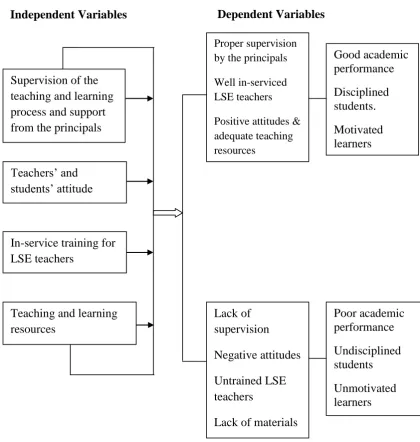
The framework below shows the relationships between the variables of the study.
According to the framework, the dependent variable in this study was effective
implementation of Life Skills Education in secondary schools. The independent
variables were: the availability teaching and learning resources, teachers’ and
learners’ attitude, supervision of teaching and learning of LSE by the school
principals. The conceptual frame work was used to show the relationships between
15
Figure 1.1: Conceptual representation of the implementation of LSE and the various variables that affect the implementation process
Teachers need to be trained appropriately to handle Life Skills Education in secondary
schools, teachers’ positive attitudes towards teaching enhances the same attitude of
their learners. The teachers also need proper resources to facilitate proper teaching
and learning which will lead to successful implementation of LSE. Finally for the
success of implementation of LSE supervision of the teaching process and support of
the school is Kenya.
Poor academic performance Undisciplined students Unmotivated learners Proper supervision
by the principals
Well in-serviced LSE teachers
Positive attitudes & adequate teaching resources
Supervision of the teaching and learning process and support from the principals
Lack of supervision
Negative attitudes
Untrained LSE teachers
Lack of materials Teachers’ and
students’ attitude
In-service training for LSE teachers
Teaching and learning resources KICD input Good academic performance Disciplined students. Motivated learners
16 1.13 Operation Definitions of Central Term
Life skills- Refers to the learned behaviours by teenagers that are necessary for effective living including requisite knowledge or conditions for development or
acquisition of such behaviour.
Life skills education- Refers to the education that adopts a comprehensive change approach that focuses on the development of a teenager in a holistic aspect.
Psychosocial- Refers to a concept that explains how mental abilities influence societal aspect of a person.
Stand-alone- Refers to the teaching of life skills education as a subject within time allocated on the timetable
Youth – Refers to the pupils in secondary school between ages 13-19 year. Dropouts –Refers to the learners who don’t complete their secondary education Implementation- Refers to the process of teaching and learning of Life Skills Education
In-service training-Refers to Life Skills Education training that teachers are exposed to Equip them with skills and competencies, so that the are able to implement the LSE
curriculum
Motivated learners-Refers to students who have self drive in the learning process
17
CHAPTER TWO
LITERATURE REVIEW
2.1 Introduction
This chapter presents review of related literature in line with the research objectives:
the principals’ attitudes towards implementation of LSE, the teachers’ and learners
attitudes towards teaching and learning of LSE, teacher training, the resource
materials and facilities, assessment and summary and gaps.
2.2 Supervision of the Teaching and Learning of LSE by the Principals
School principals are role players inside the core set up of school. Administrators add
to the effective execution of educational programs if they satisfy their part as
educational modules and instructional pioneers. (Ornstein & Hunkins, 1993). In their
role as curriculum and instructional leaders, the principals are required to invest
energy by monitoring teaching in the classroom, plan staff advancement programs and
modify school environment to enhance instructional process (Ornstein & Hunkins,
1993). Principals are then expected to take a major role in the training processes of the
Life skills teachers in their schools.
Prinsloo (2007) in South Africa found that an absence of responsibility by school
principals in making the program a win at the school level is a challenge facing the
implementation of the Life skills program. Some principals indicated that it was
difficult for them to support the implementation of Life skills because many learners
in their schools are careless, irresponsible and have no vision or mission in life. The
principals felt that there was little impact Life Skills Education could make on the
18
their schools. The principals’ excuse for their lack of commitment to make the Life
skills program a success in their schools may be considered as a negative attitude.
In Kenya, the principals complain of lack of time and overload which show a negative
attitudes and thus inadequate implementation. In this study, the researcher intended to
find out if the principals were supervising the teaching and learning of LSE as one of
the reason for ineffective implementation in Kiambu County.
2.3 Teachers and Learners Attitudes towards Teaching and Learning of LSE Thurstone (1931) defines attitudes as the effect for or against a psychological object.
Thurstone suggests that there is need to test people’s state of mind; this can be
accomplished by surveying people’s opinions and convictions which he considers to
be verbal articulations of demeanours. He recommends that there is need to test the
teachers’ mentality in relation to LSE. This is because teaching is a process guided by
educational values, personal needs and by a variety of beliefs or generalizations that
the teacher holds to be true. The research aimed at finding out how the teachers’
attitude affects the implementation of LSE.
The students likewise assume a critical role in the successful implementation of a
curriculum innovation. Just as teachers, students must accept a curriculum for it to be
successful (Orodho, Waweru, Getange & Miriti, 2013). It is when students respond to
the learning experiences they encounter in the curriculum with the cooperation of
their educators, that a successful implementation of a curriculum can be achieved at
classroom level. If these students see little importance in the curriculum activities
taught, they are not going to be motivated to participate to learn (Githinji, 2007). The
19 2.4 Teacher Training
A study in Zimbabwe on challenges facing the implementation of a Life skills
program Rembe (2006), point to the cascade model of teacher training as one of the
challenges in the implementation of the program. He notes that the cascade training
strategy of teachers is disappointing because few teachers are chosen and receive
training and they in turn, train others in schools and this leads to the required
information not to be transmitted properly and it consequently fails to equip teachers
with the requisite skills. The poor preparation of teachers under the cascade approach
was further undermined by the short duration of the courses (one to three days). Deep
conceptual content knowledge and skill development requires significantly more time.
The current study was seeking to establish how the in-service training has affected the
implementation of LSE.
In Kenya, through the use of the TOTs, KICD trained teachers at both the national
and provincial levels between 2008 and 2009. The Ministry of Education
recommended that two teachers with guidance and counselling certificate be trained
from each school and that they go and train their colleagues. The current study
established that after 2009 no more training of teachers on LSE had taken place.
2.5 Teaching Methods
The Life Skills Education syllabus and the teacher’s guide recommend that teachers
utilize participatory instructional methods in which students identify their own
problems, find solutions, and plan and carry complete effective action programs
(MOE, 2006). The participatory instructional methods assume that learning is best
20
cognitive psychologists like Piaget (1896-1980) believed trusted learners learn by
building their own language.
According to the studies of Abobo (2012), the findings show that the participatory
teaching and learning methods recommended for the teaching of LSE includes; case
studies, brainstorming, field visits, panel discussions, narrations, songs, group
discussion, debates, posters, role play, games, projects, poetry recitals and drama
(KIE, 2008). These are highlighted in the following paragraph.
Debates are discussions which involve two opposing parties with each group
expressing opinions or views about a given topic. Each group competitively attempts
to win the other to their side of the argument. When the discussion is over, the group
with more points becomes the winner (KIE 2008).
Case studies are true or imaginary, and describe a problem, situation or character.
There could be a dilemma where participants are required to come up with solutions
to a conflict. Sometimes it offers clues on how to solve a problem or provoke the
reader’s abilities to solve the problem (KIE, 2008). Case studies should be interesting,
appealing and relevant to the reader’s imagination. They are useful when the teacher
wants to appeal to the learners’ emotions, expect the learners to identify and
internalize the concepts and issues raised in the case, expects the learners to apply the
skills learned to solve similar problems when they encounter them and when he/she
wants them to appreciate that others undergo similar challenges. A case study can be
developed by a teacher or selected from already developed ones in relevant books
21
Role plays are short drama episodes in which participants experience how a person
feels in a similar real life situation. Role play can be used when: developing specific
skills such as negotiation, assertiveness, communication and self awareness;
discussing sensitive issues such as gender which the teacher may feel uncomfortable
with, clarifying new and unfamiliar concepts and demonstrating how a skill can be
applied in a given situation. Role plays are considered to require little preparation and
are not necessarily rehearsed. They should be as spontaneous as possible. However,
the teacher needs to bear in mind situations when and where to use them in the
teaching process (KIE, 2008).
Story-telling involves telling of narratives with particular themes based on actual
events. They give detailed information about an event in an interesting way while still
passing on a moral message. Stories can be composed or collected based on specific
themes of life skills such as assertiveness, negotiations and decision making (KIE,
2008). When reading or telling stories, they should be dramatic and larger than real
life experiences. The stories could be presented in a variety of ways by utilizing tonal
variation, facial expressions and audience involvement. Students should, therefore, be
encouraged to come up with their own stories from their communities or other
sources.
Games are interesting and exciting activities which have set rules. They can be used
when: clarifying difficult issues, discussing sensitive issues enhancing the quality of
interaction in a group, learning and practicing new life skills, increasing the
participants’ knowledge of each other and making presentations interesting (KIE,
22
Miming is acting without words but by use of gestures, signs, physical movement and
facial expression. Unlike drama, the idea or situation is solely communicated through
actions. Miming is suitable for communicating sensitive messages. It helps in
expressing messages which cannot easily be put into words (KIE, 2008).
Question and answer method is where the teacher or the learner tries to find out
information through asking questions and getting answers from respondents. It is
usually a flow of information from the teacher to the learner. It is an effective method
of teaching life skills education because it stimulates learners’ thinking and creativity.
It is therefore, central to effective teaching of LSE (KIE, 2008).
Songs and dances are musical compositions on topical issues and themes. They may
convey messages on contemporary issues in the society. They can be used in
characters’ value and reinforced. Songs and dances can be used to develop and
strengthen Life Skills such as self awareness, empathy, effective communication skills
and conflict resolution. They are normally used when one wants to pass culturally
sensitive messages in an interesting manner. Teachers can compose the songs or
request the learners to gather some or use already existing ones. The songs should be
interesting, appealing, easy to learn and familiar with the students. They can be
accompanied by dance, re-enforced by use of puppetry. Due to the interesting nature
of dances, they have appealing and immediate impact on the learner (KIE, 2008).
Poetry and recitals are compositions which capture events, themes and situations in a
short and precise manner. They communicate feelings, opinions, ideas, habits and
their experiences. They can be in the form of songs, recitations, chats or be
23
to people’s emotions to enable them adopt behavior towards a desired direction (KIE,
2008). This research therefore intended to identify the teaching methods utilized and
whether they were being used effectively to implement LSE in Kiambu County.
2.6 Resource Materials and Facilities
As indicated by KIE (1999), broad assortments of materials are fundamental for
effective teaching of any subject. These must be pertinent and intriguing to profit the
learning process. The teacher ought to decide the best assets for a particular lesson
and the good ought to be used as a part of the sanest and intelligent way to strengthen
a specific learning movement. Some resources can be purchased or sourced from the
environment or borrowed. They make learning of LSE intriguing, genuine and
agreeable and urge understudies to hold information (KIE, 2008).
On the utilization of teaching Aids, (Aila 2005), observed that they are critical
because they are utilized to expand learning, produce interest and make a
circumstance where the understudies could completely take part in the classroom
exercises. The materials and equipment introduced in the classroom setting ought to
be varied in order to provide the learner with many and varied opportunities for
him/her to acquire the learning they need (KIE, 2008). The study was to find out the
availability of learning resources and facilities.
In his study, Abobo (2012) found out that most of the sampled schools in Trans-Nzoia
lacked adequate teaching learning materials which included textbooks, teacher’s
guides, reference materials, charts, and video led to negative implementation. This
study therefore was to reveal the adequacy of teaching learning facilities whether they
24 2.7 Assessment
Assessment in the form of examinations influences curriculum implementation in that
due to the great value given to public examination certificates by communities and
schools, teachers tend to concentrate on subjects that are examinable and are thought
to promote academic excellence. This can affect the achievement of the broad goals
and objectives of the curriculum (Whitaker, 1993). Rooth’s (2005) study in South
Africa indicates that Life Orientation is not being taken seriously because it is not an
examinable subject. In some cases, it is not being taught at all despite the fact that it is
included on the timetable. In other schools, it is not even included on the timetable.
The non-examinable status of Life Orientation in South Africa is thus undermining its
implementation. The researcher was to find out whether by the fact that LSE is not
examinable was hindered the level of implementation.
2.8 Research Gaps
The literature reviewed in this study has shown that a Life skill Education has
attracted the attention of many researchers who have tackled the topics in different
perspectives. However various challenges continue to be encountered especially in
secondary schools in regard to achieving the intended outcomes of LSE. The study
recommends the work of the scholars but point out areas of concern that may have
lead to hardship in implementing LSE in Kenyan secondary schools.
For instance, Wachira (2010), explains various experiences in schools that have
shown low or no acquisition of Life Skills Education such as contracting HIV/AIDS,
unwanted pregnancy, drug addiction, broken families, school drop-outs, failure in
25
their study does not show what makes LSE ineffective in the population they studied.
Moreover, their study was based on the outcomes of poor delivery of LSE. This
present study was focussing on the constraints that have hindered proper practice of
holistic LSE in secondary schools.
Prinsloo, (2007), identified lack of commitment by some school principals as a major
hindrance to Life Skills Education. However this study was conducted in South Africa
which showed a different scenario from the Kenyan setup. His use of quantative
research design failed to account for opinion based responses. This study used both
quantative and qualitative methods in order to capture a wide source of knowledge.
Orodho, (2013), explains that students need to accept the life skills curriculum for its
successful implementation. However, their study does not explain the reasons why
students could fail to accept the curriculum. This study believed that failure of
students to accept a curriculum could have been influenced by underlying challenges
26
CHAPTER THREE
RESEARCH METHODOLOGY
3.1 Introduction
This chapter focuses on the research methods and procedures that were used in the
research. It describes the research design, location of the study, the target population,
the sampling techniques, research instruments, pre and piloting study, data collection
techniques, data analytical techniques, Logistical and Ethical Considerations.
3.2 Research Design
The study utilized descriptive survey design to explore the constraints facing the
implementation LSE curriculum. Descriptive study is a strategy of gathering data by
interviewing or administering a questionnaire to a sample of individuals
(Orodho,2009). It was choosen because it potrays what exists or wins, conditions and
connections as they are with the plan of utilizing information to legitimize current
conditions and practices or to enhance them. Because of this, it empowered the
researcher to establish the constraints limiting effective implementation of LSE in
secondary schools in Kiambu County. The technique was also utilized because it was
helpful in getting quantitative data regarding implementation LSE in schools.
Descriptive survey design was utilized as a part of preparatory and exploratory
studies, to enable research to gather information, summarize, present and interpret for
the purpose of classification.(Orodho, 2012), Borg and Gall (1985) note that
descriptive survey research is intended to produce statistical information about aspects
of education that interest policy makers and educators. The researcher gathered the
27
present and interpreted for the interest of the involved stakeholders by including a
broad category of partners the study fits within. The cross-sectional sub-sorts of
descriptive survey study designs.
3.3 Location of the Study
This study was carried out in Kiambu County which is situated in Central Region
adjacent to the northern border of Nairobi County. The County has 248 public
schools and 248 teachers in charge of guidance and counseling. Due to the fact that
Kiambu County is located near Nairobi County, there is a lot of interference of urban
influence. This influence can be reduced by effective implementation of LSE
curriculum, which is aimed at equipping the learners with skills to enable them cope
with the challenges in the society. In addition 176 of the total number of schools are
day schools, implying that most students are exposed to the psycho-social challenges
on a daily bases, hence the need to be empowered. The area was chosen because of its
accessibility and familiarity to the researcher. Mugenda (1999) argues that the ideal
setting for any study should be easily accessible to the researcher.
3.4 Target Population
According to Mugenda (1999), population is defined as entire groups of individual,
events or objects having a common observable characteristic. The target population
study was 248 public secondary schools in Kiambu County. The study population
comprised of 248 heads guidance and counselling teachers since they were incharge
of implementing the LSE curriculum in their respective schools. They were also
targeted to establish how their attitudes contributed to the implementation of LSE. In
28
record 2015, Kiambu County had 248 public schools, 248 principals, approximately
248 heads on guidance and counselling teachers.
In descriptive survey studies two categories of respondents are crucial, namely,
informed specialist and consumers (Luck and Ruben,1992). On this regard the study
also targeted the Assistant director incharge of cross-cuttings issues at KICD who is
directely involved with all the policies partaining LSE curriculum.
3.5 Sampling Technique and Sample Size 3.5.1 Sampling Techniques
A sample is a small group obtained from the accessible population. (Mugenda and
Mugenda, 1999). For the purpose of this study out of the 248 public secondary
schools, 25 secondary schools were sampled. According to Croswell (2013), 10% of
the total population is acceptable in a descriptive research.
Purposive sampling technique was used to select the study subject in which all the
categories: girls, boys and mixed secondary schools were included in the study. In
purposive sampling technique individuals are included in the sample because they are
judged to possess important, special and unique information that the researcher feels
that such information is a representation of that population. (Mugenda and Mugenda,
1999). From each category 3 boys, 4 girls and 18 mixed secondary schools were
selected. Simple random technique was used to select the 28 students from each of the
sampled schools.
Purpose sampling technique was used to sample one teacher who have been trained to
29
with the help of head of guidance and counselling teacher. All the principals of the
selected schools were sampled and interviewed. The Assistant Director in charge of
LSE curriculum in KICD was interviewed.
3.5.2 Sample size
The sample comprised of 25 secondary schools. Creswell (2013) observe that in
descriptive research, 10-20% of the total population is acceptable. Due to the large
number of schools in the area of study 10% sample size would give more
comprehensive results. A sample of 10% of the targeted population of students was
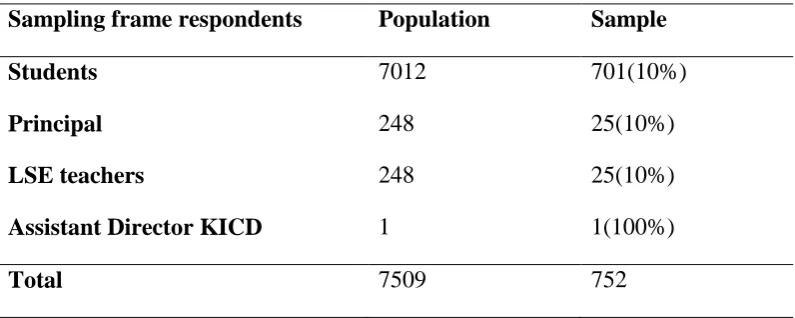
used for the purpose of this study i.e a total of 701 students. A total of 25 teachers
were expected to fill the questionaire which makes up 10% of the population. A total
of 25 principals which makes it 10% was to be interviewed and the Assistant Director
incharge of of Life Skills Curriculum at KICD. The entire sampling matrix will yield
to a total of 752 for the proposed study. The distribution for respondents is shown on
table 3.1.
Table 3.1: Distribution of the sample respondents in Kiambu County
Sampling frame respondents Population Sample
Students 7012 701(10%)
Principal 248 25(10%)
LSE teachers 248 25(10%)
Assistant Director KICD 1 1(100%)
30 3.6 Research Instruments
Curriculum Developers key informant Interview Schedule was designed to find out
the rationale for the introduction of Life Skills Eduaction in Kenya, the prior
preparation before introducing the subject. It was also used to provide more
information about resources needed for life skills eduaction.
The School Principal Interview Schedule was used for school principal to establish
how they support teachers of LSE, the creterion they used to select the teachers who
have been allocated the LSE lesson, what value they attach to the subject and their
frequency of supervision of its teaching.
Life Skills Eduaction Teachers Questionnaire was used to find out the teachers
attitude towards the subject, in-service trainings if any that teachers have been
exposed to, also find out challenges experienced in terms of time, resources and
personnel in the implementation process.
Students Questionnaire was designed to establish the students attitude towards Life
Skills Education. The method of teaching that they enjoy, the learning materials that
have been provided and consistency of teaching that was taking place in their classes.
3.6.1 Pilot Study
The purpose of the pilot study was to ensure validity and reliability of the instruments.
According to Murray (2009), piloting is important because it helps to identify
ambiguities of the items and vague questions for improvement. The questionnaires
were piloted in one secondary school that was not included in the main study. The
31
analyzed and the results used for approprite modification of the questionnaires. The
sample respondents then use the modified questionnaires during the main study. The
interview schedule was piloted on the principal of the same school. This helped the
researcher to establish the ambiguity and vagueness of the questions and aided in
making appropriate modifications.
3.6.2 Validity of Research Instruments
Validity is defined as the ability to produce findings that are in agreement with
theoretical or conceptual values. To enhance content validity, the research instruments
were appraised by the lecturers who are experts in the School of Education. A pre-test
was carried out to a population after which modification and corrections were then
made before the instruments were administered.
3.6.3 Reliability of Research Instruments
According to Amin (2005), reliability is defined as the level of internal consistency or
stability of the measuring device over time. An instrument is reliable when it can
measure a variable accurately and consistently and obtain the same results under the
same condition overtime. The study used tests re-test method. According to Orodho
(2009), tests re-test method involves administering the same instruments twice to the
same group of subject. The longer the time interval, the lower the reliability
coefficient is likely to be for research instrument to be found to be reliable the
32 3.7 Data Collection Procedures
The researcher obtained the letter of authorization from Kenyatta University Graduate
School to collect the data. The letter was used to apply for permit at National
Commission for Science, Technology and Innovation in order to be allowed to collect
data. The permit was obtained from NACOSTI. The copy of the permit was submitted
to the County Education Officer of Kiambu. The researcher pre-visited the selected
schools to make prior arrangements and establish a good rapport with the principals
before the commencement of the actual data collection. The questionnaires were
administered by the researcher with the help of LSE teachers in the selected schools.
They were filled in by the respective respondents and the researcher collected them.
On the other hand the interview schedule was administered by the researcher.
3.8 Data Analysis Procedures
Data was analyzed using both descriptive and inferential statistics. To analyze
quantitative data, statistical tally system was used to generate frequency counts from
the responses obtained so as to prepare frequency distributions. Percentages were
calculated from the responses out of the total study sample response per item.
Inferential statistics used were Pearson’s Correlations and ANOVA. Multiple
regressions were also performed to show the effect of the independent variables on
the dependent variable. The qualitative data was analyzed by categorizing similar
responses and drawing conclusion.
3.9 Ethical Considerations
Ethics has been defined as that branch of philosophy which deals with one’s conduct
33
guidelines which govern their profession Kovacs (1987). In the same light Dooley
(2007) asserts that, ethics involves the study of right and wrong conducts hence the
concern for ethics may be seen as part of the historical trend in civil and human rights.
3.9.1 Confidentiality and Privacy
Great care was taken to assure respondents that all information was to be
confidential. The researcher had to inform the respondents that no information was to
be shared to the third party. Also their information was not to be identified and was
only to be used for research.
3.9.2 Anonymity
The researcher ensured and assured the respondents that their individual identities
were not to be revealed whatsoever. Besides, no identifying information about the
individual or the institution was revealed in written form. The respondents were also
not required to write their names or any other information which is likely to disclose
their identity.
3.9.3 Informed Consent
The researcher explained to the respondents the nature and the purpose of the study
and the procedure to be used during the data collection so that they could participate
willingly. The respondents were also requested to give their consent concerning
34
CHAPTER FOUR
PRESENTATION OF RESULTS AND DISCUSSIONS
4.1 Introduction
This chapter contains the results and presentation of the findings of the study. The
study investigated the constraints to implementation of Life Skills Education in
Secondary Schools in Kiambu County. The study was pegged on the following
specific objectives; To establish the extent to which principals have supervised the
teaching and learning of the Life Skills Education; to determine the students’and
teachers’attitude towards learning and teaching of LSE respectively; to establish the
types of in-service training the teachers have been exposed to; to find out the
teaching and learning resources available for the teaching LSE; and to find out the
measures put in place by the curriculum developers to ensure effective
implementation. The study participants were issued with questionnaires, with the
principal and the director cross-cutting issues at KICD being interviewed to obtain the
data analyzd in this study. Descriptive statistics such as Percentages and Frequencies
were utilized. The analysis was done using SPSS. The findings were presented using
frequency tables, percentages, pie charts and bar graphs.
4.2 Response Rate
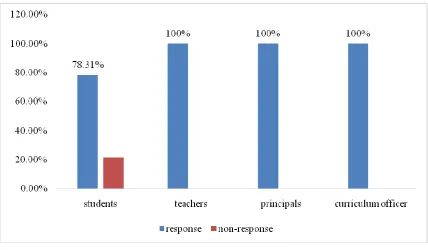
The questionnaires issued to the study participants were not all returned. Of the 25
teachers selected for participation in the study, all of them filled and returned the
questionniares representing a response rate of 100%. All the 25 (100%) of the
principles and the Assistant Director incharge of cross-cutting issues at KICD also
took part in the interview. The student questionniares were filled and returned by
35 Figure 4.1: Response rate
Source (Field data, 2017)
At least 549(78.31%) of the expected students participated in the study; on the other
hand, all the teachers, principals and the curriculum officer (100%) fully participated
in the study as shown on (fig 4.1) The response rate was deemed be sufficient for the
study as Orodho (2013), asserts that a response rate of 70% and above is adequate to
validate the findings of a study.
4.3 General Characteristics of the Respondents
The respondents were asked to provide general information as well their demographic
details in the questionnaires. The respondents were asked to indicate their gender, the
school level, the school type, type of training and whether the school offers life skill
36 4.3.1 Gender
The respondents were required to indicate their gender as indicated in figure 4. 2
Figure 4.2: Genders of the Respondents Source (Field data, 2017)
As displayed in the figure 4.2, majority of the principals were male, 18 (72%), while
female was 7(28%).On the other hand, 15(59.6%) of the teachers were female while
the remaining (10) 40.40% were male. Female students on the other hand, were the
majority 277 (50.4%) while the male students made up 272(49.6%) of the
respondents. The curriculum officer was a female respondent. The findings show that
most of the people in the school management were male while most learners in
secondary schools were female.
4.3.2 School Type
The respondents were asked to indicate their school level and school type. The
teachers indicated that the schools selected for the study were extra count, county and
37 Figure 4.3: School Type
Source (Field data, 2017)
As displayed in figure 4.3, majority of the teachers in the study were from mixed
schools 17(67.5%) and the students were majorly 297(54.1%) from mixed schools.
This implies that majority of the students and teachers who participated in the study
were from mixed schools.
4.3.3 Professional Training
The teachers were also asked to indicate the type of training they received in regards