Sphinx: A Compact and Provably Secure Mix Format
George Danezis
Microsoft Research, Cambridge, United Kingdom.Ian Goldberg
University of Waterloo,Ontario, Canada.
Abstract
Sphinx is a cryptographic message format used to relay anonymized messages within a mix network. It is more compact than any comparable scheme, and supports a full set of security features: indistinguish-able replies, hiding the path length and relay position, as well as providing unlinkability for each leg of the message’s journey over the network. We prove the full cryptographic security of Sphinx in the random oracle model, and we describe how it can be used as an efficient drop-in replacement in deployed remailer systems.
1. Introduction
Mix networks were proposed by David Chaum [7] in 1981 as an efficient means to achieve anonymous communications. A mix (or a mix node) is simply a message relay that accepts a batch of encrypted messages, decrypts them and sends them on their way. An observer of a mix node should be unable to link incoming and outgoing messages; this provides anonymity to the users of the network. A number of theoretical [12], [15], [9], [5], [21] as well as deployed systems [16], [8] have been proposed that further develop the idea of mixes. The Mixmaster network [16] is currently composed of about 25 reliable remailers, while the newer Mixminion [8], adding the ability to reply anonymously to messages, is composed of about 20 reliable nodes.
Anonymizing messages through a mix network comes at a cost: the messages are batched and therefore delayed, as well as padded to a standard length to prevent traffic analysis. Furthermore, multiple encryp-tion layers have to be used to encapsulate the routing information necessary to relay the message through a sequence of mixes. The cryptographic mechanism used to deliver this routing information to each intermediate mix, as well as to transform the message as it travels through the network, is called thecryptographic packet
format. The cryptographic mechanism is to some ex-tent independent from other traffic analysis protections offered by the mix network, as long as they guarantee that some aspects of the routing information, such as path length or position in the path, are not leaked [4]. The minimum overhead introduced by the crypto-graphic packet format impacts the types of traffic that can realistically be anonymized. Previous work, like Mixminion [8] and Minx [9] added an overhead of at least a full RSA ciphertext (at least 256 additional bytes for modern 128-bit security levels). Provable designs, such as the ones proposed by M¨oller [15], Ca-menish and Lysyanskaya [5] or Shimshocket al.[21], use multiple RSA-sized ciphertexts to relay informa-tion for each stage of the mixing, making the header necessary for anonymization many kilobytes long. Such formats may be acceptable for relaying large email messages, but add a significant overhead to short messages, the length of Instant Messaging or SMS messages (that are up to 160 characters.) It is therefore of great importance to devise cryptographic schemes that arecompactto efficiently anonymize those classes of traffic. Furthermore, anonymous replies rely on cryptographic addresses that are of similar size to the headers required to route messages thought the net-work. Compact packet formats directly lead to compact addresses and thus to cheaper receiver anonymity.
and provably secure packet format.
Our key contribution is Sphinx: a cryptographic packet format that can be used to route messages over a mix network. Sphinx provides all features expected by modern remailer applications:
• It provides bitwise unlinkability, making it cryp-tographically difficult to link incoming and out-going messages from a mix. This is the basic property all packet formats provide.
• It allows for paths up to an arbitrary maximum length, while hiding the number of hops a mes-sage has travelled so far, as well as the actual number of mixes on the path of a message. These are hidden even from the mixes that are processing the messages.
• The processing of reply messages is indistinguish-able from the processing of normal “forward” messages. The anonymity sets of both types of traffic are therefore confounded, providing greater protection for both.
• It resists any active tagging attacks, where the adversary modifies and re-injects messages to extract information about their destinations or content.
• It is compact: for 128-bit security, the overhead is only 32 bytes plus a single group element (not one per hop) plus 32 bytes of routing and integrity protection information per hop. The size of the group element can be as small as 32 bytes using Dan Bernstein’s Curve25519 elliptic curve library [3]; the element is the x-coordinate (in
GF(2255−19)) of a point on an elliptic curve. For example, the header of a Sphinx message with a maximum path length of 5 mixes can be encoded in as little as 224 bytes.
From a systems perspective, Sphinx is designed as a drop-in replacement for the Mixminion packet for-mat [8]. It makes the same systems and security assumptions as Mixminion, but is more compact and cryptographically provably secure. This means that Sphinx can be easily integrated with the Mixminion software to take advantage of the thousands of lines of robust client and server code. Our reference implemen-tation of Sphinx, which provides all of the functionality needed for clients, mix nodes, and the nymserver, and which works either over a 2048-bit prime field or Curve25519, is less than 600 lines of Python code (including simple tests).
Our description of Sphinx will proceed in the fol-lowing fashion: section 2 provides an overview of the threat model, requirements and design rationale of Sphinx; sections 3 and 4 provide a formal definition
of the cryptographic format and the associated proofs of security respectively. In section 5 we discuss the efficiency of the scheme and compare it with other pro-posals. Finally we provide some concluding remarks in section 6.
2. Design overview
Mix networks achieve anonymity by relaying mes-sages over a sequence of mixes, called the path. The sender cryptographically encodes a message, which is partially decoded by each mix along the path. As long as a single mix in the path is honest, meaning that it does not share its secrets with an adversary, the message will benefit from some anonymity.
2.1. Threat Model & Requirements
It is traditional to consider the security of crypto-graphic packet formats against an active adversary that is able to observe all traffic in the network, as well as to intercept and inject arbitrary messages. Furthermore, we assume that some, but not all, of the mixes in the path of a relayed message are corrupt; i.e., under the direct control of an adversary that knows all their keys, and other secrets, and is able to fully control their functioning. The principal aim of the adversary is to extract some information about the ultimate destination of mixed messages through inferring the final address or some of their contents. The security properties of cryptographic mix packet formats prevent or tightly control any such information leakage.
Specifically, Sphinx needs to ensure that if multiple messages enter an honest mix and are batched together, it is not feasible to link an output message to any input message with probability significantly higher than uniform. This is the fundamental requirement of any packet format. Yet modern packet formats also control the amount of information leaked to mixes (including dishonest mixes) along the path. A dishonest mix should not be able to infer either the full length of the path of a particular message, or its own position on that path. Simple traffic analysis detects if a mix is first or last on the path, so we do not consider this a compromise.
it reaches Alice. In both cases Alice benefits from anonymity properties, first as the sender of the message (sender anonymity) and the second time as the anony-mous receiver of a message (receiver anonymity). Nymservers [14] have been developed as services that make use of anonymous replies to bridge the world of mix networks with traditional email. Users can send normal email to pseudonymous email addresses, which are then routed through the mix network using anonymous reply blocks. We note that the network doesnotattempt to keep it a secret that Bob is talking to some particular pseudonym; we assume Bob’s email communication is likely to be unencrypted (though orthogonal end-to-end encryption mechanisms can of course also be used). What itdoes protect is the fact that that pseudonym belongs to Alice.
To increase the security of both sender- and receiver-anonymous messages, the two kinds of messages should use the same network and the same relay mechanisms. Hence it is a requirement of the crypto-graphic packet format that forward and reply messages be cryptographically indistinguishable; this makes the task of engineering packet formats more difficult. Tra-ditional methods for achieving non-malleability (such as providing a MAC over the full header and body of the relayed message) are not readily available, as the reply message body is unknown at the time the reply block is created.
Finally, Sphinx is required to be resistant to active attacks: an adversary can use any corrupt node to inject arbitrary messages into honest nodes in an attempt to extract information. Sphinx protects against replay attacks—where the adversary reinjects a previously seen message verbatim—and tagging attacks—where the adversary modifies a message before reinjecting it into the network. In neither event will Sphinx allow the adversary to learn any information about the final destination of the message or its contents. Other denial-of-service and flooding attacks (n−1attacks) [20] are not considered in the threat model, since they are not cryptographic in nature and are handled by orthogonal mechanisms [12], [13].
2.2. Design Rationale
Sphinx is based on the idea that a mix packet format should encapsulate enough information to cryptograph-ically secure a confidential and integrity-protected channel to each of the mixes on a message’s path. This requires keys to be shared, or distributed, securely to each of the mixes on the path, in order that they may decode the routing information, as well as other parts of the message. Traditionally, this has been done with
RSA [19] encryption, while Sphinx instead uses Diffie-Hellman [10].
At the heart of the Sphinx key distribution strategy lies a single element of a cyclic group of prime order satisfying the decisional Diffie-Hellman assumption. This element is used by each mix on the path to derive a secret that is shared with the original sender of the message—a set of keys that can be used for encryption, integrity protection, etc. are further extracted from this shared secret. The element used for key derivation cannot be transported unaltered throughout the path, however, as this would lead to linkable messages. To avoid this, the element is blinded at each mixing step to make it indistinguishable from any other output element. The blinding factors are extracted from the shared secrets, and so both senders and mixes can perform all operations necessary to extract keys used at each hop of the mix message processing. There are many possible choices for the cyclic group; two common ones are a subgroup of the multiplicative group of a prime field, and an elliptic curve group. The latter in particular leads to a very compact design, since for 128-bit security, group elements can be expressed in just 32 bytes, as opposed to 256–384 bytes for a prime field of similar strength.
Besides extracting the shared key, each mix has to be provided with authentic and confidential routing information to direct the message to the subsequent mix, or to its final destination. We achieve this by a simple encrypt-then-MAC mechanism. A secure stream cipher or AES in counter mode is used for encryption, and a secure MAC (with some strong but standard properties) is used to ensure no part of the message header containing routing information has been modified. Some padding has to be added at each mix stage, in order to keep the length of the message invariant at each hop.
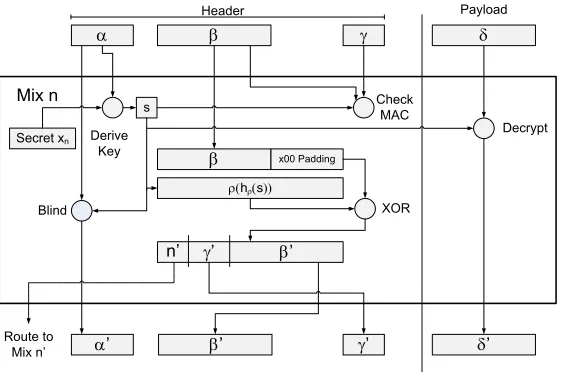
The steps involved in decoding and routing the message at each mix are rather simple. Their full technical description is provided in section 3.6 and is illustrated in the corresponding Figure 3. In summary: 1) The mix receives the message and, using the element from the cyclic group and its private key, extracts a set of shared session keys.
2) The MAC of the message is checked to ensure that the header has not been modified.
3) Some padding (of all zeros) is added at the end of the message to keep the length invariant. 4) The header of the message is decrypted
(in-cluding the newly added padding), the element blinded and the payload of the message de-crypted.
ex-tracted from the decrypted header, and the result-ing message is forwarded to the next destination.
Senders encode a message by deriving all session keys, wrapping the message in multiple layers of encryption, and calculating the correct message authen-tication codes for each stage of the journey. Calculating the correct MACs is not a trivial task: the successive layers of padding that are encrypted at each stage of the mixing have to be included in the integrity check. The MACs ensure that a modified header is detected immediately.
The payload of the message is kept separate from the mix header used to perform the routing. It is decrypted at each stage of mixing using a block cipher with a large block size (the size of the entire message), such as LIONESS [1]. In case the adversary modifies the payload in transit, any information contained in it becomes irrecoverable. Sender-anonymous messages contain the final address of the message, as well as the message itself as part of the payload, and so any modification destroys this information.
Anonymous replies are equally simple to construct: the intended receiver of the reply (who will benefit from the anonymity properties) builds a mix header addressed back to herself with no payload. This header acts as an anonymous reply address, and can be included in a message to give anyone the ability to reply. Some additional information, such as the address of the first mix hop, is also needed.
A reply is built by attaching a message to the reply address and routing it through the mix network. The processing of the reply message is identical to the processing of forward messages, leading to simplicity of implementation and larger anonymity sets.
3. Formal protocol description
3.1. Notation
Let κ be a security parameter. An adversary will have to do about 2κ work to break the security of
Sphinx with nonnegligible probability. We suggest using κ= 128.
Let r be the maximum number of nodes that a Sphinx mix message will traverse before being deliv-ered to its destination. We suggest r= 5.
Define the following:
G: A prime-order cyclic group satisfying the De-cisional Diffie-Hellman Assumption. G∗ is the set of non-identity elements of G. The element g is a generator ofG, and q is the (prime) order ofG, with
q≈22κ.
A number of hash functions, which we model by random oracles:
• hµ:G∗→ {0,1}κ, used to keyµ, below
• hρ:G∗→ {0,1}κ, used to keyρ, below
• hπ:G∗→ {0,1}κ, used to keyπ, below
• hτ : G∗ → {0,1}2κ, used to identify previously
seen elements ofG∗
• hb : G∗× G∗ → Z∗q, used to compute blinding
factors
We implement these functions with appropriately trun-cated SHA-256 hash functions.
µ : {0,1}κ × {0,1}∗ → {0,1}κ: a Message
Authentication Code (MAC). We normally model µ
as a pseudo-random function (PRF). However, in one part of the proof (section 4.2), the adversary gets to know the key to the MAC. In this case, simply being a PRF guarantees nothing, whereas we still want µ
with a known key to behave like a hash function. For this reason, we model µ as a random oracle in that section (which of course is stronger than a PRF). In a realistic implementation, we would use a MAC based on a hash function, such as SHA256-HMAC-128.
ρ : {0,1}κ → {0,1}(2r+3)κ: a pseudo-random
generator (PRG). A PRG is the basis for any stream cipher: the key is fed as an input to the PRG, which outputs a long pseudorandom string. This string is XORed with the plaintext to yield the ciphertext, or with the ciphertext to recover the plaintext. As above, in section 4.2 the adversary will be able to know the input to the PRG, which removes all of the PRG’s security properties. So again, for that section, we modelρas a random oracle. We can implementρwith any secure stream cipher, or any secure block cipher in counter mode, which operates in the same way.
π : {0,1}κ × {0,1}`π → {0,1}`π: a family of
pseudo-random permutations (PRPs). `π will be the
size of the message bodies that can be transmitted over Sphinx (plus κ bits of overhead). Given any
(k, x)∈ {0,1}κ×{0,1}`π, bothπ(k, x)andπ−1(k, x)
should be easy to compute. (The latter is the unique valuey∈ {0,1}`π such thatπ(k, y) =x.)π−1should
also be a family of pseudo-random permutations. We use the LIONESS [1] PRP to implementπ.
N ⊂ {0,1}κ: a set of mix node identifiers. Each
noden∈ N has a private keyxn∈RZ∗q and a public
keyyn =gxn∈ G∗. We assume the presence of a PKI
that publishes an authenticated list of all(n, yn)pairs.
D ⊂ {0,1}≤2rκ: a set of destination addresses,
0
r0
f1
0 f1
r1
f2
0 f2
r2
f3
XOR
XOR
XOR Scale: k
Figure 1. Construction of the filler strings φi for
ν = r = 4. Here, ρi is the final2(i+ 1)κbits of
ρ(hρ(si)).
from their email address. One of the elements ∗ ∈ D is distinguished.
The notation0a means the string of 0 bits of length
a, x[a..b] means the substring of x consisting of bits
a through b, inclusive (the leftmost bit ofx is bit 0), k denotes concatenation, |s| is the length of strings, andis the empty string.
3.2. Creating a mix header
This section describes the procedure to create a Sphinx mix message header. It is used as a subrou-tine for the procedures to create forward messages and single-use reply blocks in sections 3.3 and 3.4, respectively.
Input: a destination address ∆ ∈ D, an iden-tifier I ∈ {0,1}κ and a sequence of mix nodes
{n0, n1, . . . , nν−1} with ν ≤ r. It must also be the case that |∆| ≤(2(r−ν) + 2)κ.
Pick a randomx∈RZ∗q.
Compute a sequence of ν tuples
(α0, s0, b0), . . . ,(αν−1, sν−1, bν−1) as follows:
• α0=gx,s0=ynx0,b0=hb(α0, s0) • α1=gxb0,s1=ynxb10,b1=hb(α1, s1) • . . .
• αν−1 = gxb0b1···bν−2, sν−1 = y
xb0b1···bν−2
nν−1 ,
bν−1=hb(αν−1, sν−1)
Theαiare the group elements, thesiare the
Diffie-Hellman shared secrets, and the bi are the blinding
factors.
Compute the filler stringsφ0, . . . , φν−1:
n3 g3
n2 g2
n1 g1
r(hr(s2))
D I 0
r(hr(s3))
f3
b3
Concatenate XOR
b3
s3 MAC
b2
XOR
r(hr(s1))
b2
s2 MAC
b1
XOR
r(hr(s0))
b1
s1 MAC
b0
XOR s0
MAC
g0
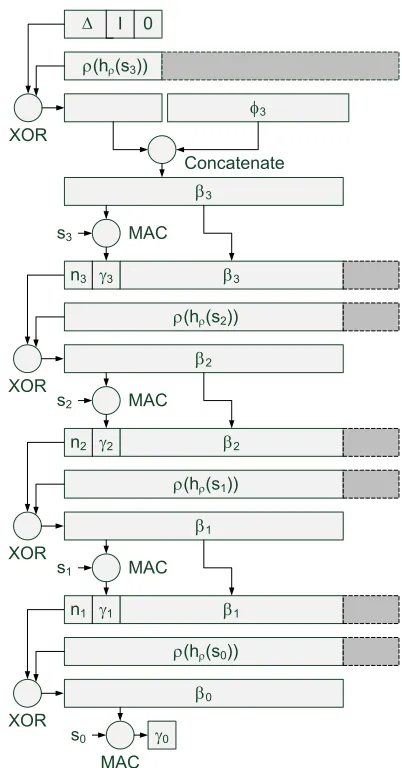
Figure 2. Construction of(β0, γ0)for a Sphinx mix
header, withν =r= 4. The construction ofφ3from
Figure 1 ensures that the truncated part of βi+1
equals the truncated part ofρ(hρ(si)), indicated by
the dotted lines and shading, for each0≤i < ν.
• φ0=
• For 0 < i < ν, φi = {φi−1k02κ} ⊕
n
ρ(hρ(si−1))[(2(r−i)+3)κ..(2r+3)κ−1] o
Note that |φi| = 2iκ. This step is illustrated in
Figure 1.
Compute a sequence of mix headers
Mν−1, Mν−2, . . . , M0 as follows:Mi = (αi, βi, γi)∈
G∗× {0,1}(2r+1)κ× {0,1}κ where:
• βν−1 = ∆kIk0(2(r−ν)+2)κ−|∆| ⊕ n
ρ(hρ(sν−1))[0..(2(r−ν)+3)κ−1] oo
kφν−1
• βi =
n
ni+1kγi+1kβi+1[0..(2r−1)κ−1] o
⊕
a b g d Payload Header
Mix n
Secret xn
s
b x00 Padding Derive
Key
Check MAC
a’ Blind
r(hr(s))
XOR
n’ g’ b’
Decrypt
d’ g’
b’ Route to
Mix n’
Figure 3. The processing of a Sphinx message((α, β, γ), δ)into((α0, β0, γ0), δ0)at Mixn.
• γi=µ(hµ(si), βi)for0≤i≤ν−1
The above step is illustrated in Figure 2.
Output: the mix header M0 and the sequence of shared secretss0, . . . , sν−1.
3.3. Creating a forward message
This section gives the procedure used to create a forward message to be sent through the Sphinx network.
Input:a messagem, a destination address∆and a sequence of mix nodes{n0, n1, . . . , nν−1}withν≤r. Compute the mix header M0 and the sequence of shared secrets s0, . . . , sν−1 as above, passing the distinguished element∗ ∈ Das the destination address and0κ as I. Compute:
• δν−1=π(hπ(sν−1),0κk∆km)
• δi=π(hπ(si), δi+1)for i=ν−2, . . . ,0 Output: the pair(M0, δ0)
The forward message is this pair (M0, δ0), and should be sent to n0.
3.4. Creating a single-use reply block
This procedure is used to create a single-use reply block.
Input: a destination address ∆ and a sequence of mix nodes {n0, n1, . . . , nν−1} with ν ≤r. ∆ should be the user’s own address.
Pick a random identifierI∈R{0,1}κ and compute
the mix headerM0and the sequence of shared secrets
s0, . . . , sν−1 as above.
Pick a random keyk˜∈R{0,1}κ.
Output: I, the tuple(˜k, hπ(s0), . . . , hπ(sν−1)), and the tuple (n0, M0,˜k).
Store the tuple(˜k, hπ(s0), . . . , hπ(sν−1))in a local table indexed byI. Send(n0, M0,˜k)to the nymserver over a secure channel, to be indexed under the user’s pseudonym. This can be done, for example, by encrypt-ing it with the nymserver’s public key, signencrypt-ing it with the pseudonym’s private key, and sending the message to the nymserver using the Sphinx forward channel.
3.5. Using a single-use reply block
When the nymserver receives a messagemdestined for a pseudonym, it will look up a previously unused
(n0, M0,k)˜ tuple indexed by that pseudonym. It will then send (M0, π(˜k,0κkm)) to n0 and remove the tuple from its index.
3.6. Message processing by mix nodes
Messages received by mix nodes are of the form
(M, δ) = ((α, β, γ), δ) ∈ G∗ × {0,1}(2r+1)κ ×
{0,1}κ× {0,1}`π. (The node should ensure that the
message is in this form; in particular, that α ∈ G∗.) When mix noden, with private key xn, receives such
a message, it proceeds as follows:
Compute the shared secret s = αxn. If h
τ(s) is
already in this node’s table of seen message tags, discard the message. (Note that this table can be flushed whenever the node rotates its private key.) Otherwise, continue by comparing γ to µ(hµ(s), β).
store hτ(s) in the table of seen message tag, and
continue by decrypting the suitably padded β (as a stream cipher, XORing the output of the PRG ρ) to getB ={βk02κ} ⊕ρ(hρ(s)).
Use the prefix-freeness ofN ∪ Dto uniquely parse a prefix of B as n∈ N ∪ D. (If this is not possible, the message is discarded.)
If n ∈ N is found: This message is destined for another Sphinx node. Compute the blinding factor
b =hb(α, s), and let α0 = αb. Let γ0 = B[κ..2κ−1],
β0 =B[2κ..(2r+3)κ−1], and δ0 =π−1(hπ(s), δ). Send
((α0, β0, γ0), δ0)ton. Figure 3 illustrates the processing steps involved in this case, as an example of how the decoding process works.
If n = ∗ is found: The current node is the exit node for a forward message. Letδ0 =π−1(h
π(s), δ).
Ifδ0[0..κ−1] = 0κ, parseδ0[κ..`π−1]as∆kmfor∆∈ D
using the prefix-freeness of D. If this is successful,
m should be a plaintext message, and is sent to ∆. Otherwise, the message has been tampered with and is discarded.
Otherwise, if n ∈ D\{∗} is found: The current node is the exit node for a reply message, andnis the owner of a pseudonym. Let I = B[|n|..|n|+κ−1] and
δ0 =π−1(h
π(s), δ). Send(I, δ0)ton.
3.7. Reply message processing by pseudonym
owners
Upon receiving (I, δ), a pseudonym owner looks up (and subsequently removes) (˜k, k0, . . . , kν−1) in its table indexed by I, and computes δ0 = π−1˜k, π(k0, π(k1,· · ·π(kν
−1, δ)· · ·))
and m = δ0[κ..`π−1]. If δ
0
[0..κ−1] = 0κ then accept m as the
received message.
4. Proof of security
From a cryptographic point of view, mix protocols like Sphinx share many properties with onion routing protocols. At a minimum, we desire our mix protocol to have all of the security properties of onion routing. In [5], Camenisch and Lysyanskaya give four prop-erties of an onion routing protocol: correctness, in-tegrity, wrap-resistence, and security, all detailed be-low. They show that any onion routing protocol having all of these properties realizes ideal onion routing func-tionality in the Universal Composability model [6]. This means that an adversary against a protocol with these four properties has no better chance of success than an adversary against an idealprotocol; that is, at a high level, one in which adversaries (even ones that
control some of the mix nodes) have no access to the underlying cryptographic implementation, but rather can observe only opaque identifiers for messages.
For our mix network, we would like, in addition to the above properties, that adversaries in the middle of a path should be unable to distinguish forward messages from replies (unlike the situation in [5]). It is clear that adversary nodes at the edges of the network— that is, nodes that deliver messages to users who are not themselves nodes—are necessarily able to distin-guish forward from reply messages: outgoing forward messages are in plaintext, since messages should be deliverable to arbitrary parties on the Internet who have no special software installed; on the other hand, outgoing reply messages to the pseudonym owner are encrypted. Entry nodes also receive forward messages from arbitrary end users, but receive reply messages from the nymserver (the forward and reply messages arecryptographicallyindistinguishable, however). But between the entry and the exit, nodes should be unable to distinguish the two cases.
Formally, under the assumptions on the components given in section 3.1, Sphinx realizes ideal onion routing functionality in the Universal Composability model (as defined in [5]), and also makes forward and reply messages indistinguishable to middle mix nodes. We prove this result in the following four sections.
4.1. Correctness
It is straightforward by inspection that the protocol works correctly in the absence of an adversary; that is, it processes the mix messages correctly, sends the right intermediate mix messages to the right mixes, and finally sends the right message to the right destination.
4.2. Integrity
The second requirement of [5] is that an adversary cannot construct a mix message that will travel through a path of more than N honest nodes, for some fixed boundN, except with negligible probability. We show that Sphinx satisfies this requirement, withN =r+ 1, even if we allow the adversary to know all private keys
xn in the system. (Note that the adversary knows the
nodes’ private keys, but the nodes still behave honestly, according to the protocol.) This last adversarial power is what necessitates modelling µ and ρas something stronger than the usual PRF and PRG notions. Again, for the purposes of this section, we treat them as random oracles.
Sphinx header, it is in fact possible to embed up tor+1
such identifiers, as long as the embedded∆ =∗and is very short (less thanκbits). This means an adversary can indeed construct a mix message that will have path lengthr+ 1. This is not a problem for our proof, since the proof only requires that there issomeupper bound on the path length. We show that an adversary cannot construct a mix message that results in a path length greater thanN =r+ 1, and that is sufficient.
We assume the adversary does significantly less than
2κ work, and show that the probability of producing a requisite mix message is negligible.
Let a mix message constructed by the adversary be ((α0, β0, γ0), δ0), and sent to node n0. That node processes it to produce((α1, β1, γ1), δ1), which is sent ton1, etc.
Node ni will successfully process a message and
send it on to the next node if and only if the following all hold:
• ni has never before (during the life of its current
private keyxni) processed a mix message with the
same αi (since the map αi 7→ α xni
i is bijective
andhτ is collision-resistant)
• γi=µ hµ α xni i
, βi
• there is a prefix ofBi={βik02κ} ⊕ρ(hρ(α xni i ))
which is in N ∪ D; this will be ni+1 if it is in N.
If these hold, then the firstκbits ofBi will beni+1 itself, the next κbits will beγi+1, and the remaining
(2r + 1)κ bits will be βi+1. Note that βi+1 = n
βi[2κ..(2r+1)κ−1]⊕ρ(hρ(α xni
i ))[2κ..(2r+1)κ−1] o
k n
ρ(hρ(α xni
i ))[(2r+1)κ..(2r+3)κ−1] o
. In particular, the leftmost 2κbits ofβi are used to construct ni+1 and the MACγi+1; the remaining(2r−1)κbits ofβi are
shifted left to form (after decryption by XORing with a substring of an output of ρ) the leftmost (2r−1)κ
bits ofβi+1; the rightmost2κbits ofβi+1 are simply a substring of an output ofρ.
Consider the following problem P: Let
f0, f1, . . . , f2κ−1 be a family of random oracles
with range {0,1}κ. Let ρˆ and ρ
0 be other random oracles with range {0,1}κ. (The domains do not
matter.) The problem is to find x and y such that
ˆ
ρ(x) = fρ0(x)(y). We claim that an adversary has only a negligible chance of solving problem P if he performs significantly less than2κ work.
Proof: For eachi∈ {0,1}m, letr
ibe the number of
times the adversary calledρ0 and had it outputi, and let Fi be the number of times he called fi. (We can
assume the adversary never calls ρˆon an input unless he also callsρ0 on that input.) Then the adversary has P
iriFi chances to solve problem P, and each chance
is successful with probability 2−κ. Let Abe the total number of calls the adversary makes to ρ0, and let
i∗ be the most common output, occurringA∗ of theA times. To maximizeP
iriFiwhile holdingPi(ri+Fi)
constant, the adversary should only queryfi∗, and not any of the otherfi. Suppose he does soB times. Then
his probability of success is bounded above by A2∗κ·B,
having doneA+B work.
IfA=B≈2κ(1−w1)for somew, then we expect to
findw-collisions in theAoutputs ofρ0, but notw+ 1 -collisions [17], so we expectA∗=w. Then the success probability is bounded above by A2∗κ·B =w·2−
κ w. If A = B ≈ 2m, then w = κ
κ−m, and this probability
bound is κ−κm·2m−κ, as required.
Note the difference between this problem and a standard collision problem (such as ρ(x) =ˆ f(y)), which would have success probability22m−κfor doing
2m work, and to a standard search problem (such as
ˆ
ρ(x) =f(x, y)), which would have success probability
2m−κ for doing2m work.
Now suppose an adversary can construct a mix mes-sage((α0, β0, γ0), δ0)which is successfully processed by mix nodesn0,n1, . . . ,nN, whose private keysxi
are known to the adversary. We will show that this means that the adversary can solve the above problem P.
Given such a message, the adversary can pro-cess it in the manner of each mix node in turn, to generate ((α1, β1, γ1), δ1), ((α2, β2, γ2), δ2), . . . ,
((αN, βN, γN), δN). Now since nodenN successfully
processes this last message, it must be the case that
γN =µ(hµ(αxNN), βN).
For notational convenience, for 0 ≤ i ≤ r, de-fine ρi(x)to beρ(x)[(2(r−i)+2)κ..(2r+3)κ−1]k02(r−i)κ;
that is, the last (2i + 1)κ bits of ρ(x), followed by 2(r−i)κ bits of zeros. Also define ρˆi(x) to be
ρ(x)[(2(r−i)+1)κ..(2(r−i)+2)κ−1]; that is, the block ofκ
bits of ρ(x) immediately preceding the bits selected for ρi(x). Finally, for 1≤i≤r+ 1, define ρ˜i(x)to
be ρ(x)[(2i−1)κ..(2i+1)κ−1].
A careful, but straightforward, calculation shows that γN = a0 ⊕a1 ⊕ · · · ⊕ aN−1, where aj =
ˆ ρj(hρ(α
xj
j )).
Similarly, βN =b0⊕b1⊕ · · · ⊕bN−1, wherebj=
ρj(hρ(α xj
j )).
Now consider the function
g(p0, k1, k2, . . . , kN−1, kµ) =
µkµ,(p0k02rκ)⊕
LN−1
i=1 ρi(ki)
. We claim that the adversary who does less than 2κ work
adversary could distinguish the situations is if it could generate a pair of inputs (p0, k1, k2, . . . , kN−1, kµ)
and (p0
0, k01, k02, . . . , kN0 −1, k0µ) which cause the
corresponding arguments of the call to µto be equal. Clearly we must havekµ=k0µ.
Let B = (p0k02rκ)⊕
LN−1
i=1 ρi(ki)
and B0 =
(p0
0k02rκ)⊕
LN−1
i=1 ρi(k0i)
. Note that the last 2κ
bits of B are just ρ˜N−1(kN−1), the last 2κ bits. of ρ(kN−1). If B = B0, then ρ˜N−1(kN−1) =
˜
ρN−1(k0N−1). Since the adversary has done less than
2κ work, he has only a negligible chance of finding
kN−1 6=k0N−1 with the last2κbits of ρ(kN−1) and
ρ(kN0 −1)equal. Thus, except with negligible probabil-ity,kN−1=k0N−1.
Now consider the block of 2κ bits before the final block of 2κ bits of B. This is just ρ˜N−2(kN−1)⊕
˜
ρN−1(kN−2). So if B = B0, and kN−1 = kN0 −1 as above, then we must have that ρ˜N−1(kN−2) =
˜
ρN−1(k0N−2), and as above, kN−2=k0N−2. Continu-ing in this way, we get that (k1, k2, . . . , kN−1, kµ) =
(k01, k02, . . . , kN0 −1, kµ0) except with negligible proba-bility.
Note that this logic would not have extended tok0, had it been included, since onlyκ, and not2κ, bits of
ρ(hρ(α0x0))are included inβN.
Finally, if B = B0 and (k1, k2, . . . , kN−1, kµ) =
(k01, k02, . . . , kN0 −1, kµ0), then clearlyp0=p00.
Let k= (k1, . . . , kN−1, kµ). Then we just showed
that the function g(p0,k) is indistinguishable from a true random oracle with less than 2κ work. Now let
fp0(k) =g(p0,k)⊕ρˆ1(k1)⊕· · ·⊕ρˆN−1(kN−1). Since the ρˆi do not call the random oracle µ, this is also
indistinguishable from a true random oracle.
But if the adversary constructed a mix message which was successfully processed by n0, . . . , nN,
then he has a solution to ρˆ0(k0) = fρ0 0(k0)(k), whereρ00(x) =ρ(x)[(2r+2)κ..(2r+3)κ−1]; namely,ki=
hρ(αxii) andkµ =hµ(αxNN). But this is just problem
P.
Therefore, since he has only a negligible probability of finding a solution to problem P with considerably less than 2κ work, he also has only a negligible
chance of constructing a mix message which will be successfully processed byN+ 1nodes, and the result is proven.
It is instructive to note where this proof relies on the fact that N > r. The key is that for
i ≤ r, the computation of γi contains bits from
β0. For example, γr =
Lr−1
j=0ρˆj+1(hρ(α xj
j ))
⊕
β0[(2r+1)κ..(2r+2)κ]. [Compare this to γN, above,
which equalled LN−1
j=0 ρˆj(hρ(α xj
j )), with no
compo-nent fromβ0.]
Since the computation of βr does not involve
these bits of β0, it is easy to find αx00, . . . , α xr−1
r−1 and β0 that satisfy γr = µ(hµ(αxrr), βr). Just
pick any αx0
0 , . . . , α xr−1
r−1, compute βr, and
let β0[(2r+1)κ..(2r+2)κ] = µ(hµ(αxrr), βr) ⊕
Lr−1
j=0ρˆj+1(hρ(α xj
j ))
.
4.3. Wrap-resistence
We need to show that given a mix message
((α0, β0, γ0), δ0), an adversary is unable to wrap it; that is, the adversary cannot produce a mix message
((α, β, γ), δ) such that a mix node (even one whose private key x the adversary can select) processing
((α, β, γ), δ)will yield ((α0, β0, γ0), δ0).
In order for the adversary to succeed, it is necessary thatαhb(α,s)=α0wheres=αx. We will show that an
adversary which makescqueries to the random oracle
hbcan find such an(α, x)pair with probability at most c
q−1; for an adversary that does less than2
κwork, this
is negligible.
The proof is simple: if the adversary outputs a correct (α, x) pair, then she must have queried the random oracle with(α, αx). But each (α, s)query to
the oracle yields a random value b∈RZ∗q. Sinceαis
a generator of G∗, the probability that αb equals the
givenα0 is q−11, and the result follows.
4.4. Security and Indistinguishability of
For-ward and Reply Messages
We need to show that an adversary controlling all nodes except one particular node, N, cannot distinguish mix messages entering node N, where each contains a
(∆, m)pair of the adversary’s choice, each has a path following node N of the adversary’s choice, and the messages can each be either forward or reply messages, as the adversary likes. Additionally, the adversary can see how N reacts to any mix message except one with a header matching the challenge message.
In particular, this would not only prove that the security property of [5] is satisfied, but also that forward and reply messages are indistinguishable to any party that does not know the exit node’s private key.
Formally: consider the following gameG. The ad-versary selects a sequence of mix nodesn0, . . . , nν−1 withν ≤r. One of these,nj, is the challenge node N.
The adversary can select the private keys xni ∈ Z
∗
q
for all i 6= j, but does not know xnj (he does
destination address ∆∈ D\{∗}, a message m, and a bitf that indicates whether this message should be a forward message (f = 1) or a reply message (f = 0). The adversary then selects a second set
n00, . . . , n0ν0−1 with ν0 ≤ r, and ∆0 ∈ D\{∗},
m0, and f0. It must be the case that
(n0, n1, . . . , nj) = (n00, n01, . . . , n0j), but it need
not be the case that the list of subsequent nodes after nj =n0j =N is the same (or even of the same
length).
The challenger randomly chooses a bit b and con-structs one of two mix messages as follows:
If b=0 and f=0: The challenger passes ∆ and {n0, . . . , nν−1} to the procedure of section 3.4 to create a single-use reply block. There is no need to store values in the local table, or to send (n0, M0,˜k) to the nymserver. However,M0and˜kare used, along withm, in the procedure of section 3.5 to construct the mix message((α0, β0, γ0), δ0)which it would send to
n0.1
If b=0 and f=1: The challenger passes ∆, m, and {n0, . . . , nν−1} to the procedure of section 3.3. This procedure returns the mix message ((α0, β0, γ0), δ0).
If b=1:The challenger performs the same actions as above, but uses the primed valuesn00, . . . , n0ν0−1,∆0,
m0 andf0 instead of their unprimed counterparts.
((α0, β0, γ0), δ0) is given to the adversary, whose job it is to determine b. The adversary can also give any mix message((α0, β0, γ0), δ0)to the challenge node
nj to see how it reacts, so long as (α0, β0, γ0) 6=
(αj, βj, γj). Here, as in [5,§4.2], we only care about
uniqueness of the header, not of the message body. We will show that the adversary cannot determine the value of b with significantly better chance than random guessing. Once we have proven this, we note that the ability of the adversary to individually select whether each of the two messages is a forward message or a reply message also implies our desired property
1. Following section 3.5, we assume for simplicity that all reply messages are delivered using the nymserver. However, this assump-tion is not essential. If Alice wishes to send a reply block directly to Bob, for Bob’s use in replying to her, she just modifies the procedure of section 3.4 to send him (n0, M0), omits ˜k from the tuple in her local table, and omits the π−1(˜k,·) step from the procedure of section 3.7. The proof then need only have one additional part: to show that an adversary cannot cryptographically distinguish replies output by the nymserver from replies output by a first noden0whose private key the adversary does not know. (Here, “cryptographically distinguish” excludes distinuguishing based on traffic analysis; that is, observing the origin of the message.) The remaining path in the two reply blocks should be the same, and the adversary is allowed to know all other nodes’ private keys. This is straightforward: the only salient difference between the messages is that the payload in the nymserver message isπ(˜k,0κkm)and in the other isπ−1(hπ(sn
0),0κkm). Both of these are indistinguishable
from a random string to an adversary that knows neither˜knorsn0.
that the adversary cannot distinguish forward messages from replies. This holds so long as there is even a single node yet to process the message whose private key the adversary does not know.
The advantage of the adversary is the difference between1/2and the probability the adversary guesses
bcorrectly. We wish to show that the advantage for an adversary that does significantly less than 2κ work is
negligible.
We use the usual method of hybrid games. We construct the modified game G1 by doing the same thing as G, except that we insist that j = 0. Since in game G the adversary can immediately act as nodesn0, . . . , nj−1to determine((αj, βj, γj), δj), the
adversary can win gameG1if and only if he can win game G.
GameG2 is the same asG1 except thats0 (in the procedure of section 3.2, called from section 3.3 in the case of a forward message or section 3.4 in the case of a reply message) is selected uniformly at random from G∗, as opposed to being calulated as s
0 = ynx0. An adversary that can distinguish gameG1 fromG2 can easily be used to distinguish(yn0, α0=g
x, s
0=ynx0) from (yn0, α0, z)for a randomz∈RG
∗, thus solving
the DDH problem in G∗, contrary to our choice of G∗. Here it is important that the adversary should not be allowed to query N with the challenge(α0, β0, γ0) header, since N would not be able to process it. That
γ must be a MAC on β with key hµ(α xn0
0 ) ensures that (α0, β, γ) 6= (α0, β0, γ0) will be rejected by N except with negligible probability. If any (α, β, γ) is submitted to N with α6=α0 such that N successfully processes the message, then the success of the MAC ensures that, again except with negligible probability, the adversary knew the MAC keyhµ(α
xn0
0 ). Sincehµ
is a random oracle, the adversary must have queried it withαxn0
0 . But if the adversary knows that last value, he can process the message just as well as N can, and the ability to query N does not help him.
Game G3 is the same as G2 except that β0, γ0, and δ0 are selected uniformly at random from their respective domains. If the adversary can distinguish games G2 andG3, then he can distinguish (with less work than2κ) the output ofρwith a random input from a random string, orµwith a random key from a random function, or π with a random key (hπ(s0)—with s0 being the randomly selected value from gameG2—in the case of forward messages, ork˜in the case of reply messages) from a random permutation, which he can do with only negligible probability, by our choice of
ρ,µ, andπ.
b), it is clear the adversary’s advantage is0. Since each game is indistinguishable from the one before to the adversary, except with negligible probability, we see that the adversary’s advantage in the original gameG
is negligible, as required.
5. Performance and Space Efficiency
In this section we give a brief overview of es-tablished cryptographic packet formats, and compare them to Sphinx both in terms of functionality as well as message size overhead. Throughout this section
p denotes the size of any public key element in a packet format, s denotes the size of the symmetric key elements (per hop), and r denotes the maximum number of hops that messages can be routed through (all sizes are in bytes). When comparing overhead sizes, we will attempt to match the 128-bit security offered by Sphinx. Some older designs only supplied 80-bit security, using 1024-bit RSA keys, for example. We will be generous to the competing formats and stipulate that an RSA or Diffie-Hellman modulus of 2048 bits (256 bytes) is sufficient to offer 128-bit security, even though NIST [2] suggests that 3072-bit moduli are more appropriate for that security level. In the elliptic curve setting, we use the usual figure of 256-bit (32-byte) elements (assuming only the x -coordinate of the elliptic curve point is required, or point compression is used) in order to achieve 128-bit security.
The Sphinx packet format relies on a single public key element, blinded at each stage of mixing, and for each hop a message authentication code and the appro-priate routing information. The cryptographic overhead sums to p+ (2r+ 1)s bytes in total for the header, and an additionalsbytes for integrity of the payload. The most costly operations involved in building a packet are the 2r public key operations. Relaying a Sphinx message requires only two public key oper-ations (the Diffie-Hellman and blinding operoper-ations), plus the check thatα∈ G∗, for some choices ofG∗. (In Curve25519, for example, this check does not involve a public-key operation, but inZ∗p, it does.)
Mixmaster [16] is an established remailer infrastruc-ture, with about 25 nodes with over 90% reliability according to Echolot statistics2 as of November 2008. The main cryptographic shortcoming of the format is the lack of support for anonymous replies. The now-aging design uses 1024-bit RSA for the asymmetric encryption part, encapsulating routing information and a 3-DES key to be used in CBC mode (with a changing
2. http://www.palfrader.org/echolot/
IV). Integrity is ensured through the use of an MD5 hash. The standard supports relaying messages over 20 hops—each hop adding a fixed 512 bytes of overhead. In total the equivalent of the routing header occu-pies 10240 bytes. Abstracting away from the concrete cryptographic mechanisms employed the length of a mixmaster header is (1 + p+ 8 + 8s + 31)r +s
bytes (including a version number, an IV and padding). Sphinx is shorter since it does not require a public key element for each hop, and does not require an IV, since all keys are only used once.
The first provable cryptographic packet format was due to M¨oller [15] and provided very similar func-tionality to the Mixmaster format—it supports sender-anonymous messages but not replies. The scheme makes use of multiple layers of DHAES/DSIES en-cryption. This requires an element of a cyclic group on which the Decisional Diffie-Hellman problem is hard, and a message authentication codeper hopof mixing. To achieve a similar level of security to Sphinx this introduces an overhead of 272 bytes (256 bytes for the group element and 16 bytes for the MAC) per hop in addition to any routing information. The length of a packet header can be abstracted as (p+s)r. As for Mixmaster the format length suffers from the fact that a separate public key element has to be included for each stage of mixing.
Camenisch and Lysyanskaya [5] provided formal definitions in the Universal Composability model, and a concrete, provably secure, packet format for mixing forward messages, which we call the CL05 format. The CL05 scheme separates the messages into a header and a payload. The header is composed of asymmetrically encrypted ciphertexts containing the address of the next hop. They rely on a CCA2-secure encryption scheme with tags, and the bulk of the encryption is performed using a pseudorandom permutation (that is, a block cipher). The length of the header in the CL05 scheme is rp+ (r+ 1)s—unsurprisingly very similar to M¨oller [15], given the shared design philosophy. It is worth noting that the CL05 scheme does support replies, with a very similar cost, but those are distin-guishable from sender anonymous messages.
Scheme Overhead Length Indistin. Security Z∗n ECC
Replies (p=256, s=16, r=5) (p=32, s=16, r=5) Mixmaster [16] (1 +p+ 8 + 8s+ 31)r+s no heuristic 2136 11761
M¨oller [15] (p+s)r no provable 1360 4001
Mixminion [8] 2[p+ (2s+ 2s)(r−1)] +s yes heuristic 1040 8481
CL05 [5] rp+ (r+ 1)s no provable 1376 4161
Minx [9] p+ (s+ 2)(r−1) yes broken 328 2321
SSH08 [21] pr yes provable 1280 1602
Sphinx p+ (2r+2)s yes provable 448 224
Table 1. Comparison between the lengths of different cryptographic packet formats in bytes. RSA schemes superscripted with (1) have been converted to use elliptic curve Elgamal (hencep0 = 2p), while
schemes superscripted with (2) use a simple Diffie-Hellman over EC. The parameterpdenotes the length
of asymmetric elements,sis the length of symmetric elements, whileris the maximum path length.
can encode information for more than 8 hops. Given that the OAEP overhead is about 2s and that a hash and a key is contained in each layer of the header (again 2s) the cost of both headers of Mixminion is
2[p+ (2s+ 2s)(r−1)] +sbytes. There exist no known attacks against this format, but at the same time it only comes with heuristic security arguments.
Minx [9] was the first attempt to achieve a very compact mix packet format. It uses raw RSA, and AES in IGE and bi-IGE modes, without any additional overhead for integrity checking. Instead it relies on the fragility and error propagation characteristics of bi-IGE to ensure no information is recoverable from tagging attacks. Like Mixminion, it encapsulates parts of RSA ciphertexts into previous plaintexts, making the headers quite small. Its abstract length is p+ (s+ 1)(r−1)
bytes (assuming only a single byte of routing data). The security argument underlying Minx is heuristic, however, and recent work [21] shows that there is indeed a polynomial-time attack against it, taking advantage of the naive use of raw RSA encryption.
Shimshocket al.[21] proposed a fix for Minx, which we denote SSH08. The SSH08 format encodes only keys in separate RSA headers destined to each mix, and for technical reasons does not use the compression technique employed by Mixminion and Minx. This leads to a cost of pr bytes. It is also worth noting that the encoding of a message relies on making one byte of the hash of the RSA plaintext collide with the one byte destination of the packet. That is, there is no way of telling hop iwhich node should be hop i+ 1
short of constructing a message whose hash happens to contain the (8-bit) identifier of the desired hopi+ 1. This requires, on average, about 256 RSA encryptions per hop to construct the message. This design choice makes the packet format quite compact, and easily portable to elliptic curves, at the cost of flexibility.
The sender can only communicate a very small amount of information to each mix, since it would have to find—using brute force—an element that decodes to the desired information.
Table 1 summarises the overhead lengths and other properties of each cryptographic packet format and compares them to Sphinx. Concrete lengths are illus-trated through the choice of two sets of parameters, in each case for a message that is capable of travelling on paths up to length r = 5. First the length of the header is calculated for cryptosystems based on the hardness of the discrete logarithm and RSA problems over number fields. To achieve 128-bit security we require p= 256 byte (2048-bit) asymmetric elements, ands= 16byte symmetric elements. We can see that in this context Sphinx outperforms all other secure pro-posals (note that Minx is not considered secure [21]).
A second comparison is made between Sphinx and other schemes when they are implemented using asymmetric primitives based on elliptic curves. In that context we substitute RSA encryption, used by most other schemes, with an EC-based version of Elgamal. This requires two asymmetric elements of total length
p0 = 2p. Sphinx and SSH08 on the other hand do not encrypt anything, and the asymmetric part of the header is only required to perform key derivation. As such they only use a single element of length
6. Conclusions
Sphinx is a compact and provably secure mix packet format, designed as a drop-in replacement for existing remailers.
Sphinx is flexible in two important ways: first, it al-lows the system designer to chose their preferred fam-ily of cryptographic primitives. With Diffie-Hellman over prime fields, Sphinx is the most compact format, with an overhead of 448 bytes to route through 5 mixes. The use of ECC makes it even more compact, with a header length of only 224 bytes. The com-pactness of the format allows novel applications of anonymity to flourish: short messages can be cheaply routed, supporting privacy for services like micro-blogging with a low cryptographic overhead.
Second, Sphinx can be trivially extended to act as a general-purpose secure transport between senders of messages and the intermediate mixes on a path. This means that system designers are free to choose any mix strategies, including those that rely on the sender providing detailed information to mixes about the processing of messages. Such strategies are cru-cial for blending high-and-low latency traffic [11], or preventing flooding attacks [13].
The security guarantees associated with Sphinx are very strong, and backed by reduction proofs to well-studied cryptographic primitives. Hence, we can say with high confidence that the short length of the packets does not lead to any reduction in security.
The line of research up to this state-of-the-art Sphinx design demonstrates that the cryptographic aspects of anonymous communications are now well understood and mature. Off-the-shelf packet formats are now available to route messages through any system, al-lowing designers of anonymity systems to concentrate on preventing traffic analysis and sorting out denial-of-service problems, as well as implementing robust business models around anonymous communications. Sphinx can act as a transport layer for any of these applications, ensuring that the cryptography of the anonymous transport is no longer a security worry.
Acknowledgements:The authors would like to thank Greg Zaverucha and Emilia K¨asper for comments on early drafts of this paper, as well as Steven Murdoch for suggesting micro-blogging as a potential applica-tion for Sphinx.
References
[1] Ross J. Anderson and Eli Biham. Two Practical and Provably Secure Block Ciphers: BEARS and LION. In
Dieter Gollmann, editor,FSE, volume 1039 ofLecture Notes in Computer Science, pages 113–120. Springer, 1996.
[2] Elaine Barker, William Barker, William Burr, William Polk, and Miles Smid. Recommendation for Key Management—Part 1: General (Revised). National In-stitute of Standards and Technology Special Publication 800-57, May 2006.
[3] Daniel J. Bernstein. Curve25519: New Diffie-Hellman Speed Records. In Public Key Cryptography 2006, pages 207–228, 2006.
[4] Oliver Berthold, Andreas Pfitzmann, and Ronny Standtke. The disadvantages of free MIX routes and how to overcome them. In H. Federrath, editor, Pro-ceedings of Designing Privacy Enhancing Technolo-gies: Workshop on Design Issues in Anonymity and Unobservability, pages 30–45. Springer-Verlag, LNCS 2009, July 2000.
[5] Jan Camenisch and Anna Lysyanskaya. A formal treatment of onion routing. In Victor Shoup, edi-tor, Proceedings of CRYPTO 2005, pages 169–187. Springer-Verlag, LNCS 3621, August 2005.
[6] Ran Canetti. Universally composable security: A new paradigm for cryptographic protocols. InFOCS, pages 136–145, 2001.
[7] David Chaum. Untraceable electronic mail, return addresses, and digital pseudonyms. Communications of the ACM, 4(2), February 1981.
[8] George Danezis, Roger Dingledine, and Nick Math-ewson. Mixminion: Design of a Type III Anonymous Remailer Protocol. InProceedings of the 2003 IEEE Symposium on Security and Privacy, pages 2–15, May 2003.
[9] George Danezis and Ben Laurie. Minx: A simple and efficient anonymous packet format. In Proceedings of the Workshop on Privacy in the Electronic Society (WPES 2004), Washington, DC, USA, October 2004.
[10] Whitfield Diffie and Martin E. Hellman. New directions in cryptography. IEEE Transactions on Information Theory, IT-22(6):644–654, 1976.
[11] Roger Dingledine, Andrei Serjantov, and Paul Syver-son. Blending different latency traffic with alpha-mixing. In George Danezis and Philippe Golle, ed-itors, Proceedings of the Sixth Workshop on Privacy Enhancing Technologies (PET 2006), pages 245–257, Cambridge, UK, June 2006. Springer.
[13] Dogan Kesdogan, Jan Egner, and Roland B¨uschkes. Stop-and-go MIXes: Providing probabilistic anonymity in an open system. In Proceedings of Information Hiding Workshop (IH 1998). Springer-Verlag, LNCS 1525, 1998.
[14] David Mazi`eres and M. Frans Kaashoek. The Design, Implementation and Operation of an Email Pseudonym Server. InProceedings of the 5th ACM Conference on Computer and Communications Security (CCS 1998). ACM Press, 1998.
[15] Bodo M¨oller. Provably secure public-key encryption for length-preserving chaumian mixes. InProceedings of CT-RSA 2003. Springer-Verlag, LNCS 2612, 2003.
[16] Ulf M¨oller, Lance Cottrell, Peter Palfrader, and Len Sassaman. Mixmaster Protocol — Version 2. IETF Internet Draft, 2003.
[17] Mridul Nandi and Douglas R. Stinson. Multicolli-sion Attacks on Some Generalized Sequential Hash Functions. IEEE Transactions on Information Theory, 53(2):759–767, February 2007.
[18] Birgit Pfitzmann and Andreas Pfitzmann. How to break the direct RSA-implementation of MIXes. In Proceedings of EUROCRYPT 1989. Springer-Verlag, LNCS 434, 1990.
[19] Ronald L. Rivest, Adi Shamir, and Leonard M. Adle-man. A method for obtaining digital signatures and public-key cryptosystems. Commun. ACM, 21(2):120– 126, 1978.
[20] Andrei Serjantov, Roger Dingledine, and Paul Syver-son. From a trickle to a flood: Active attacks on several mix types. In Fabien Petitcolas, editor, Proceedings of Information Hiding Workshop (IH 2002). Springer-Verlag, LNCS 2578, October 2002.