Attacks On a Double Length Blockcipher-based
Hash Proposal
Yiyuan Luo, Xuejia Lai
Department of Computer Science and Engineering, Shanghai Jiao Tong University
Abstract. In this paper we attack a 2n-bit double length hash func-tion proposed by Lee et al. This proposal is a blockcipher-based hash function with hash rate 2/3. The designers claimed that it could achieve ideal collision resistance and gave a security proof. However, we find a collision attack with complexity ofΩ(23n/4) and a preimage attack with complexity ofΩ(2n). Our result shows this construction is much worse than an ideal 2n-bit hash function.
1
Introduction
Cryptographic hash functions are one of the most important primitives in cryp-tography [20]. A hash function maps from inputs of arbitrary length to a binary sequence of some fixed length. A hash function usually consists of iteration of a compression function with fixed input and output length. One first designs a fixed domain compression function and then extends the domain to an arbitrary domain by iterating that function.
As flaws in popular classic hash functions MD5 [28] and SHA-1 [1] have been discovered [34,33], NIST has launched a competition for a new hash function standard SHA-3. Many of the popular ideas in the design of hash functions come from the design of block ciphers, either explicitly as for MDC-2 [12] and other schemes [21] or implicity as for MD5. Of the five finalists in the SHA-3 competition, two of them (BLAKE and Skein) are blockcipher-based designs and the other three are permutation-based designs, which are related to blockci-phers [24]. Thus, hash functions composed of blockciblockci-phers are worthy of study.
We say a compression function is single call or double call depending how many calls it makes to the underlying blockcipher. A blockcipher-based hash function may be a single block length (SBL) function, where the length of the output is equal to that of the blockcipher, or a double block length (DBL) function. where the length of the output is twice that of the blockcipher.
For a typical blockcipher such as AES, the block length is 128 bits, and a hash function with 128-bit output is no longer secure against the birthday attack. Thus, more and more works start to focus on blockcipher-based functions with longer output length [3,5,8,10,9,11,6,19,22,23,25,31].
iteration. Later, Stam [30] proposed a single call rate-1 DBL blockcipher-based supercharged compression that is opimally collision resistant up to a logarithmic factor. Their construction give ideal collision resistance but not ideal preimage resistance. Although Lucks and Stam claimed their construction has rate-1, their constructions are much slower than the real rate-1 compression functions in prac-tice due to the computation of polynomial multiplication.
For double call DBL hash functions, Knudsenet al.[13] discussed the security of DBL hash functions with rate 1 based on (n, n) blockciphers. Hohlet al.[7] discussed the security of compression functions of DBL hash functions with rate 1/2. Satohet al.[29] and Hattoriet al.[4] and Hirose [5,6] discussed DBL hash functions with rate 1 based on (2n, n) blockciphers.
Nandiet al.proposed a rate-2/3 DBL compression function which later was attacked by Knudsen et al. [14]. In [26], Peyrin et al. gave a general analysis of combining smaller compression functions to build a larger compression func-tion. Fleischmann et al. [3,2] address the collision resistance of two old DBL constructions known as Abreast-DM and Tandem-DM [16,15], later their proof of Tandem-DM was revised by Leeet al. [18]. In [25], ¨Ozen and Stam proposed a novel framework for DBL blockcipher-based hash functions.
In [17], Leeet al.proposed another rate-2/3 DBL construction using a Feistel structure. They build a (2n,2n)-blockcipherE∗ with 3-round Feistel structure from a (2n, n)-blockcipherE, and then embedE∗in PGV compression function, such as the Davies-Meyer structure. They proved the ideal collision resistance in the ideal cipher model, that is, the advantage of a adversary makesqqueries to the underlying blockcipher is upper bounded byΩ(q2/22n). Thus, the strength
bound of this proposal against a collision-finding attack isΩ(2n). Compare with
other proposals, the authors claimed that it is the most efficient DBL compres-sion function with ideal collicompres-sion resistance.
However, in this paper, we find a 23n/4 collision attack and a 2n preimage
attack on this construction. Thus it contradicts Leeet al.’s security proof. Our result shows that it is still an open problem to build ideal collision and preimage resistant DBL blockcipher-based hash functions with rate larger than 1/2.
2
Preliminaries
2.1 Iterated Hash Functions
A hash functionH :{0,1}∗→ {0,1}a usually consists of a compression function
F :{0,1}a× {0,1}b→ {0,1}a and an initial valueIV ∈ {0,1}a.An input M is
divided into theb-bit blocksm1, m2, . . . , ml,if the length ofM is not a multiple
ofb,M is padded using an unambiguous padding rule. Then,hi=F(hi−1, mi)
is computed successively for 1 ≤ i ≤ l and hl = H(M). Thus H is called an
iterated hash function. We use Merkle-Damg˚ard padding in this paper. The hash functionH should have the following properties:
Preimage resistance For a given outputy, it is intractable to find an input
Second-preimage resistance For a given inputx, it is intractable to find an inputx06=xsuch thatH(x) =H(x0).
Collision resistance It is intractable to find a pair of inputs xand x0 such that H(x) =H(x0) andx6=x0.
2.2 Ideal Cipher Model.
The ideal cipher model, also called the black box model, is a formal model for the security analysis of blockcipher-based hash functions. An ideal cipher is an ideal primitive that models a random block-cipher E : {0,1}k× {0,1}n 7→ {0,1}n.
Each key k ∈ {0,1}k defines a random permutation E
k = E(k,·) on {0,1}n.
An adversary is given forward or inverse queries to oraclesE, when he makes a forward query to E with (+, k, p), it returns the point c such that Ek(p) =c,
when he makes an inverse query to Ewith (−, k, c), it returns the pointpsuch that Ek(p) =c.
Without loss of generality, it is assumed that any adversary with forward and inverse queries asks only once on a triplet of a key, a plaintext and a ciphertext obtained by a query and a corresponding answer and there are no redundant queries.
2.3 Double-Block-Length Hash Function
Definition 1. Let F be a compression function composed of block ciphers, m
the number of message blocks in terms of the block length of the underlying blockcipher, and N the number of cipher calls in F. Then the efficiency rate r
defined below is an index of efficiency:
r=m
N.
The original definition of hash rate is in [13]. We realized that this definition is only related to the efficiency of the hash. It has no relationship to the key length of the underlying blockcipher. We can modify it to a more accurate definition we called security rate:
Definition 2. LetF be a compression function composed of blockciphers,mthe number of message blocks in terms of the block length of the underlying blockci-pher,N the number of cipher calls inF,K the key length of the blockcipher and
L the output length ofF. Then the security rate R defined below is an index of security:
R= m·L
N·K.
The security rate of a compression functionF can be seen as an index of the security of the function. Its security is related to the input and output length of
This definition is more general than the efficiency rate. The security rate of a classical Davies-Meyer compression function [27] based on a (n, n) blockcipher is 1, and the security rate will still be 1 even it is based on a (2n, n) blockcipher. This definition can also be applied to DBL blockcipher-based hash functions and thus reduces the complexity of classification of blockcipher-based hash functions. For DBL hash functions based on (2n, n) blockciphers, the efficiency rate is the same as the security rate since L=K= 2 in the definition 2. In the remaining part of this paper we use R to denote the security rate and r to denote the efficiency rate.
3
Lee
et al.
’s Proposal
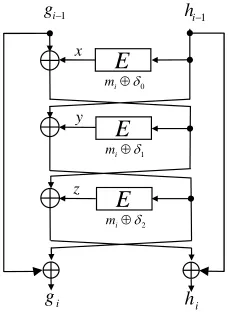
In [17], Lee et al. first designed a DBL cipher with 3-round Feistel structure using a blockcipher, then the cipher is embedded into a PGV-style compression function. Without loss of generality, they first considered the Davies-Meyer con-struction and proved its collision resistance. Then they claimed this proof can be extended to other constructions in a similar way. Thus we only need to consider the Davies-Meyer construction.
1
i
g− hi−1
i g
i h x
y
z
E
0 i m⊕δ
E
1 i m⊕δE
2 i m⊕δFig. 1.Leeet al.’s Rate−2/3 proposal.
Definition 3 (Lee et al.’s Proposal). Let E : {0,1}2n× {0,1}n → {0,1}n
be a blockcipher. Letδ0, δ1, δ2are distinct constants in{0,1}2n. The compression functionF :{0,1}2n×{0,1}2n → {0,1}2nis written as(g
Let x, y, z satisfy the following equations:
x=Emi⊕δ0(hi−1)
y=Emi⊕δ1(gi−1⊕x)
z=Emi⊕δ2(hi−1⊕y)
Then the output of the compression function (gi, hi)is:
gi=gi−1⊕y⊕hi−1
hi=hi−1⊕x⊕z⊕gi−1
The compression function is depicted in Fig. 1
4
The Security of the Construction
Lee et al. proved that the collision resistance of this construction can achieve an ideal security bound. That is, to find a collision inF with high probability, the adversary needs almost Ω(2n) queries to the underlying blockcipher. They
stated the following theorem.
Theorem 1. Let F be the above compression function, then in the ideal cipher model, for anyq, n≥1, the advantage of an adversary queries qtimes is
AdvF(q)≤(q−2)·(q−3)
2 ·(
1 2n−1)
2
≈Ω( q 2
22n).
We find a collision attack with complexity aboutΩ(23n/4) and a preimage attack with complexity about Ω(2n), thus we disprove Leeet al.’s conclusion.
1
i
g− hi−1
i g
x
y
E
0 i m⊕δ
E
1 i m⊕δΔ Δ
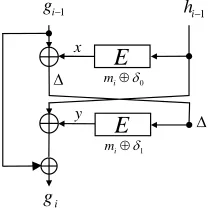
Theorem 2. Let F be the above compression function, then there exist a col-lision attack with complexity of about 2×23n/4 queries and a preimage attack with complexity of about3×2n queries to the underlying blockcipherE.
Proof. The idea is to first attack on the left half of the construction, which is shown is Fig. 2. We first construct a set of inputs {(mi, gi−1, hi−1)} all hitting
the same value ofgi, then we attack the right half of the construction.
– Collision attack:
1. Setmi to a constant.
2. Choose 23n/4 random distinct values of h
i−1 and compute the corre-sponding ciphertext x. Since E is an ideal cipher, we thus get 23n/4 distinct random pairs of (hi−1, x).
3. Choose 23n/4random distinct values of∆and compute the correspond-ing ciphertext y. Since E is an ideal cipher, we thus get 23n/4 distinct random pairs of (∆, y).
4. gi−1=x⊕∆and gi =hi−1⊕x⊕∆⊕y, since there are 23n/4 pairs of (hi−1, x) and 23n/4values of (∆, y). Using Wagner’s join technology [32], with complexityΩ(23n/4) we can find
23n/4×23n/4
2n = 2
n/2
values of (gi−1, hi−1) all hitting the same value of gi.
5. Sincehi=hi−1⊕z⊕∆, according to the birthday paradox, given 2n/2 random (gi−1, hi−1, mi), there exists two pairs colliding athiwith
prob-ability 0.39.
6. The adversary needs 2×23n/4+ 2n/2 queries to the blockcipher E and the total complexity is about 3×23n/4.
– Preimage attack:
1. Given the image (gi, hi), set mi to a constant.
2. Choose 2nrandom distinct values ofhi−1and compute the corresponding ciphertextx. SinceE is an ideal cipher, we thus get 2n distinct random
pairs of (hi−1, x).
3. Choose 2n random distinct values of∆and compute the corresponding
ciphertexty. SinceE is an ideal cipher, we thus get 2n distinct random
pairs of (∆, y).
4. gi=hi−1⊕x⊕∆⊕y, since there are 2n pairs of (hi−1, x) and 2nvalues of (∆, y). Using Wagner’s join technology, with complexityΩ(2n) we can find
2n×2n
2n = 2 n
values of (gi−1, hi−1) all hitting the given valuegi.
5. Since hi = hi−1 ⊕z ⊕∆, with high probability, there exists a pair (gi−1, hi−1) hitting at the imagehi.
6. The adversary needs 3×2n queries to the blockcipher E and the total
u t
In the above we show that the collision resistance and preimage resistance of this compression function are much worse than an ideal 2n-bit compression function. If we iterate this compression function and fix the initial value, we can also give aΩ(2n) preimage attack by using the meet-in-the-middle attack.
However, currently we cannot find an efficient collision attack using the above technology, thus we leave this as an open problem.
Although we only consider the Davies-Meyer construction, our attack can also be applied when the other 11 PGV-styles are used. We omit the details here since the attacks are similar.
5
Conclusion
In this paper we have investigated the security of a DBL blockcipher-based hash function proposed by Leeet al. They first extended an (2n, n) blockcipher to a (2n,2n) blockcipher by using 3-round Feistel structure, then embedded this blockcipher into a PGV-style construction, such as Davies-Meyer. We find collision attacks and preimage attacks that contradict their security proofs; we show that the security level of this construction is much worse than an ideal 2n-bit compression function.
Our result shows that it is still an open question whether an ideal collision resistant and preimage resistant DBL blockcipher-based compression function with hash rate larger than 1/2 exists.
References
1. FIPS. FIPS 180-1 Secure Hash Standard. Federal Information Processing Standard (FIPS), Publication 180-1, National Institute of Standards and Technology, US Department of Commerce, Washington D.C, 1995.
2. E. Fleischmann, M. Gorski, and S. Lucks. Security of cyclic double block length hash functions. InCryptography and Coding 2009, volume LNCS 5921, pages 153– 175. Springer-Verlag, 2009.
3. Ewan Fleischmann, Michael Gorski, and Stefan Lucks. On the security of tandem-DM. volume 5665 LNCS ofLecture Notes in Computer Science (including subseries Lecture Notes in Artificial Intelligence and Lecture Notes in Bioinformatics), pages 84–103, Leuven, Belgium, 2009. Springer Verlag.
4. M. Hattori, S. Hirose, and S. Yoshida. Analysis of double block length hash func-tions. Cryptography and Coding, Proceedings, 2898:290–302, 2003.
5. S. Hirose. A security analysis of double-block-length hash functions with the rate 1.
Ieice Transactions on Fundamentals of Electronics Communications and Computer Sciences, E89A(10):2575–2582, 2006.
6. S. Hirose. Some plausible constructions of double-block-length hash functions. In
Fast Software Encryption, volume LNCS 4047, pages 210–225, 2006.
8. Jialin Huang and Xuejia Lai. Chosen-plaintext linear attacks on serpent. IET Information Security, 7(4):293–299, 2013.
9. Jialin Huang and Xuejia Lai. Revisiting key schedule’s diffusion in relation with round function’s diffusion. Des. Codes Cryptography, 73(1):85–103, 2014.
10. Jialin Huang, Serge Vaudenay, and Xuejia Lai. On the key schedule of lightweight block ciphers. InINDOCRYPT 2014, volume LNCS 8885, pages 124–142. Springer-Verlag, 2014.
11. Jialin Huang, Serge Vaudenay, Xuejia Lai, and Kaisa Nyberg:. Capacity and data complexity in multidimensional linear attack. In CRYPTO 2015, volume LNCS 9215, pages 141–160, Istanbul, Turkey, 2015. Springer-Verlag.
12. ISO. ISO/IEC 10118 Information technology - Security techniques - Hash-functions, 1994.
13. L. R. Knudsen, X. J. Lai, and B. Preneel. Attacks on fast double block length hash functions. Journal of Cryptology, 11(1):59–72, 1998.
14. Lars R. Knudsen and Frederic Muller. Some attacks against a double length hash proposal. InASIACRYPT 2005, pages 462–473, 2005.
15. X. Lai. On the design and security of block ciphers, volume 1 ofETH Series in Information Processing. Hartung-Gorre Verlag, Konstanz, 1992.
16. X. Lai and J. L. Massey. Hash functions based on block ciphers. In R. A. Rueppel, editor, Advances in Cryptography-Eurocrypt’92, volume LNCS 658, pages 55–70. Springer-Verlag, 1992.
17. J. Lee, S. Hong, J. Sung, and H. Park. A new double-block-length hash function using Feistel structure. In J. H. Park et al., editor,ISA 2009, volume LNCS 5576, pages 11–20, 2009.
18. J. Lee and J. Steinberger. Multi-property-preserving domain extension using polynomial-based modes of operation. In Advances in Cryptology - EURO-CRYPT’10, volume LNCS 6110, pages 573–596, French Riviera, France, 2010. Springer-Verlag.
19. S. Lucks. A collision-resistant rate-1 double-block-length hash function. In Sym-metric Cryptography, number 07021 in Dagstuhl Seminar Proceedings, Dagstuhl, Germany, 2007. Internationales Begegnungs - und Forschungszentrum f¨ur Infor-matik (IBFI), Schloss Dagstuhl, Germany.
20. A. J. Menezes, P. C. van Oorschot, and S. A. Vanstone. Handbook of Applied Cryptography. CRC Press, 1997.
21. R. C. Merkle. One way hash functions and DES. In Advances in Cryptology -CRYPTO’89, volume LNCS 435, pages 428–446. Springer-Verlag, 1989.
22. M. Nandi. Towards optimal double-length hash functions. In INDOCRYPT’05, volume LNCS 3797, pages 77–89. Springer-Verlag, 2005.
23. M. Nandi, W. Lee, K. Sakurai, and S. Lee. Security analysis of a 2/3-rate double length compression function in the black-box model. InFast Software Encryption - FSE’2005, volume LNCS 3557, pages 243–254. Springer-Verlag, 2005.
24. NIST. Third (final) round candidates, 2010.
http://csrc.nist.gov/groups/ST/hash/sha-3/Round3/submissions-rnd3.html. 25. O. ¨Ozen and M. Stam. Another glance at double-length hashing. InCryptography
and Coding, 12th IMA International Conference, Cryptography and Coding 2009, volume LNCS 5921, pages 176–201. Springer-Verlag, Berlin, 2009.
27. B. Preneel, R. Govaerts, and J. Vandewalle. Hash functions based on block ciphers: A synthetic approach. In D.R. Stinson, editor, Advances in Cryptology - Proc. Crypto’93, volume LNCS 773, pages 368–378. Springer-Verlag, Berlin, 1993. 28. R. L. Rivest. The MD5 message digest algorithm. InRequest for Comments (RFC)
1321. Internet Activities Board, Internet Privacy Task Force, 1992.
29. Takashi Satoh, Mio Haga, and Kaoru Kurosawa. Towards secure and fast hash functions. IEICE Transactions on Fundamentals of Electronics, Communications and Computer Sciences, E82-A(1):55–62, 1999.
30. M. Stam. Block cipher based hashing revisited. InFast Software Encryption 2009, volume LNCS 5665, pages 67–83. Springer, Berlin, 2009.
31. John P. Steinberger. The collision intractability of MDC-2 in the ideal-cipher model. In Advances in Cryptology-Proceedings of EUROCRYPT 2007, volume LNCS 4515 ofLecture Notes in Computer Science, pages 34–51, Barcelona, Spain, 2007. Springer Verlag, Berlin.
32. D. Wagner. A generalized birthday problem. In M. Yung, editor,CRYPTO 2002, volume LNCS 2442, pages 288–303. Springer, 2002.
33. Xiaoyun Wang, Yiqun Lisa Yin, and Hongbo Yu. Finding collisions in the full SHA-1. In Victor Shoup, editor, Advances in Cryptology - CRPTO’05, volume LNCS 3621, pages 17–36, Santa Barbara, CA, USA, 2005. Springer-Verlag. 34. Xiaoyun Wang and Hongbo Yu. How to break MD5 and other hash functions. In