The Relation and Transformation between Hierarchical Inner
Product Encryption and Spatial Encryption
Jie Chen, Hoon Wei Lim, San Ling, and Huaxiong Wang Nanyang Technological University, Singapore
{hoonwei,lingsan,hxwang}@ntu.edu.sg
Abstract. Hierarchical inner product encryption (HIPE) and spatial encryption (SE) are two impor-tant classes of functional encryption (FE) that have numerous applications. Although HIPE and SE both involve some notion of linear algebra, the former works in vectors while the latter is based on (affine) spaces. Moreover, they currently possess different properties in terms of security, anonymity (payload/attribute-hiding) and ciphertext sizes, for example. In this paper, we formally study the re-lation between HIPE and SE. In our work, we discover some interesting and novel property-preserving transformation techniques that enable generic construction of an SE scheme from an HIPE scheme, and vice versa.
1 Introduction
The concept ofidentity-based encryption(IBE) [33, 5, 14, 20, 10, 36, 17, 37, 3] has been extensively studied, particularly in the past decade. It allows a public (encryption) key to be constructed based on some public identification information (or identifier). To encrypt a message, one needs only the intended recipient’s identifier and a set of public system parameters. The secret (decryption) key corresponding to a public key is generated by and obtained from a trusted authority.
Over the years, the concept of IBE has been generalized. Since identifiers in the context of IBE can be any arbitrary strings, public keys and their matching private keys can also be associated with attributes, policies, predicates and so on. In recent endeavors toward a more generalized notion of encryption, a new class of cryptographic primitive calledfunctional encryption (FE) [9, 32, 31, 18, 8, 21, 22, 26, 13] emerged. Generally, in an FE system for functionality F(·,·) defined over some key spaceK and some plaintext space X, an authority holding a master key can generate a key skv for v ∈ K that enables the computation of the function F(v,·) on encrypted data. More
precisely, the decryptor can computeF(v, x) from an encryption of x∈ X using skv [13]. In many applications, a plaintext x ∈ X is itself a pair (ind, m) ∈ I × M where ind is an element of an index spaceI andmis an element of a payload message spaceM. There are two types of secrecy in these applications: payload-hiding (with public index or non-anonymous) and attribute-hiding (with hidden index or anonymous) [21]. Roughly speaking, the former requires that only the message m be concealed from an adversary, while the latter requires that both the index indand the message m be concealed from the adversary. We note that when an FE scheme has v and ind as strings and F(v,(ind, m)) outputs the corresponding payload message m iff ind = v, it is essentially an IBE scheme. Given such flexibility and generalization, FE has numerous applications, particularly in the domains of access control, content distribution, mail filtering, data searching, broadcasting, tracing, and biometrics [31, 18, 30, 4, 35, 9, 8, 7, 12, 32].
encryption (ABE) [18, 4, 22, 26]. Given the rapid proliferation of various instantiations of FE, it seems to be a useful exercise to examine their relations. In this paper, we focus on investigating the relation between HIPE and SE.
1.1 Motivation
Inner product encryption (IPE) was first proposed by Katz, Sahai and Waters [21].1 In IPE,v∈ K
and ind ∈ I are vectors in Znq for some integer n and prime q. A ciphertext for x ∈ I can
be decrypted by a secret key skv for v ∈ K, that is F(v,(x, m)) = m, iff the inner product
x·v= 0. Subsequently, Okamoto and Takashima [25] proposed HIPE (or “delegatable” IPE), where
F((v1, . . . ,vr),((x1, . . . ,xh), m)) =mfor hierarchical vectors (v1, . . . ,vr)∈ Kand (x1, . . . ,xh)∈ I
iffr ≤handxi·vi = 0 for alli∈[r].2 Moreover, using the secret keysk(v1,...,vr)for (v1, . . . ,vr), one
can delegate a secret key for a deeper hierarchical vector (v1, . . . ,vr,vr+1)∈ K, i.e. key delegation.
From an IPE scheme, one can obtain an IBE scheme and a hidden-vector encryption (HVE) scheme. Moreover, we get other variants of public-key encryption schemes supporting polynomial evaluation, equality queries (which is also called keyword search [9]), subset queries, comparison queries, conjunctive normal form, and disjunctive normal form [8, 21]. By making use of the dele-gation mechanism in HIPE, the applications of IPE can be broaden and generalized to cover other cryptographic primitives such as hierarchical IBE (HIBE), generalized keyword search [1, 25], and delegatable HVE [34]. Indeed, (H)IPE is seen as a very powerful tool or building block for con-structing a broad range of public-key encryption schemes.
On the other hand, the notion of SE was proposed by Boneh and Hamburg [6]. Here, K corre-sponds to affine spaces inZnq, whileI corresponds to vectors inZnq. For a spaceS ∈ Kand a vector
x ∈ I, we have F(S,(x, m)) = m iff x∈ S. Furthermore, using the secret key skS for S, one can create a secret key for a subspace S0 ofS.
As illustrated in [6], SE is a very generalized encryption system in the sense that many other types of IBE, such as HIBE, inclusive IBE, co-inclusive IBE, broadcast HIBE and forward-secure IBE, are embedded in it. Moreover, we can construct a “product” scheme by embedding multiple instances of SE to obtain additional system properties. For example, an SE scheme can be extended to support multiple authorities by taking the product of the SE scheme and a broadcast scheme whose identities are the names of authorities. See [6, 19] for more embeddings of other cryptosystems into SE.
Although HIPE and SE are related in the sense that they both are instantiations of FE, the former works in vectors while the latter is based on spaces. We notice that existing HIPE schemes [22, 27, 28] possess some properties that are complementary to the SE scheme [6], and vice versa. For example, the HIPE schemes are fully secure and attribute-hiding (anonymous) but do not have short ciphertexts, while the SE scheme has short ciphertexts but is only payload-hiding (non-anonymous) and proven secured in the selective security model. Note that the main tool for constructing an HIPE scheme is dual pairing vector spaces (DPVS) [24, 25], which has very natural orthogonal structure by randomly generating a pair of orthonormal bases. However, one limitation of randomly generated a pair of orthonormal bases is that the size of each element of DPVS is
1In [21], IPE is called predicate encryption supporting inner products. We note that the term predicate encryption
typically refers to schemes with the attribute-hiding property. But, generally, the notion of (H)IPE also includes schemes with public index.
2
O(n), wherenis the dimension of the relevant vector space. Hence, the resulting ciphertexts, such as those in previous works [22, 27, 28], are at least O(n). Okamoto and Takashima [29] recently showed how to reduce the size of ciphertexts by randomly generating a pair of orthonormal bases with special form, such that the resulting HIPE scheme has constant-size ciphertexts. However, the size of ciphertexts is still relatively large in comparison with that of the Boneh-Hamburg SE scheme. Meanwhile, the security of the Boneh-Hamburg SE scheme is analyzed based on the conventional partitioning techniques [10, 11]. It seems difficult to construct an attribute-hiding SE scheme that enjoys full security proven using the partitioning strategy [36].
The main motivation for our work is to understand the relation between HIPE and SE. Partic-ularly, we are looking for an efficient “black-box” or generic construction of SE from HIPE and vice versa. Here, we first observe that there is a simple connection between SE and (non-hierarchical) IPE. It is indeed not difficult to transform an SE scheme to an IPE scheme. We note that the condition x·v= 0 in IPE holds iff x∈ S⊥(v), where S⊥(v) is the orthogonal space of v (i.e., the Euclidean space spanned byxsuch thatx·v= 0). This can be viewed asF(S⊥(v),(x, m)) =min
the SE setting. In other words, to generate a secret key associated with a vector v∈ K in an IPE scheme, we can run the key generation algorithm of an SE scheme for the spaceS⊥(v). Attrapadung and Libert [2] showed that an IPE scheme can be constructed from an SE scheme in a similar way. They obtained a selective secure, payload-hiding IPE scheme with short ciphertexts from the SE scheme of [6]. This, in turn, implies that given an SE scheme, we can derive an IPE scheme and a broad range of public-key encryption schemes with properties similar to those of the SE scheme.
1.2 Our Results
From studying the relation between HIPE and SE, we discover some interesting and novel tech-niques for constructing an SE scheme from an HIPE scheme, and vice versa, in such a way that transformation between an SE scheme and an HIPE scheme is property-preserving. The “bridging” between HIPE and SE using our techniques converts the problem of constructing an HIPE scheme with certain properties into a problem of constructing an SE scheme with the required (similar) properties, and vice versa. Our results can be summarized as follows:
(1) Although HIPE and SE are conceptually similar, namely they both involve some notion of linear algebra, their relation from a technical view point is less obvious. It is not at all trivial and clear how one could construct an HIPE scheme from an SE scheme, and vice versa. This is so because of the following reason. In HIPE,xi·vi = 0⇔xi ∈ S⊥(vi) for alli∈[r]. We require
that these orthogonal (Euclidean) spaces be independent from each other. However, in the SE setting, we make use of relations between (affine) spaces and their (affine) subspaces to allow key delegation. This seems to be a contradicting requirement from that for HIPE. Hence, there is no obvious way to directly construct an SE scheme from an HIPE scheme. Nevertheless, it seems more feasible to construct the latter from the former. One possible and natural way to do that is by making use of multiple SE schemes to construct an HIPE scheme such that each SE scheme generates a secret key for an orthogonal space associated with a specific level of a hierarchy. However, such transformation is complicated, inefficient and the security of key delegation is not guaranteed. Furthermore, it is likely that such transformation will not lead to generic construction of HIPE.
(2) By applying our techniques to the fully secure and attribute-hiding HIPE scheme under a simple assumption of [27], we immediately obtain an SE scheme possessing the same properties. Similarly, using our techniques, one can obtain a fully secure SE scheme with constant-size ciphertexts under a simple assumption and a selective secure and payload-hiding HIPE scheme with short ciphertexts from the HIPE scheme of [29] and the SE scheme of [6] respectively. (3) As a further contribution, we show how to derive a fully secure SE scheme supporting negation
(dealing with the absence of specific vectors) under a simple assumption from the scheme of [26]. That is, given a space S ∈ K and a vector x ∈ I, F(S,(x, m)) = m iff x6∈ S. Previous work has achieved only co-selective security [2].
1.3 Organization
We organize the rest of the paper as follows. In Section 2, we provide the definitions and security models of HIPE and SE. In Section 3, we introduce some concepts from linear algebra. Sections 4 & 5 present our property-preserving transformation techniques. We show how to construct SE from HIPE, and vice versa. In Section 6, we further discuss how our work can be extended, particularly to obtain a fully secure SE scheme supporting negation under a simple assumption. In Section 7, we make comparisons between existing and our derived schemes.
2 Definitions
In what follows, we borrow the definition and the game-based security model for FE from [13] which are adequate to define all encryption systems in this paper.
2.1 Functional Encryption
As in [13], we first describe a functionalityF of the syntactic definition of FE. The functionality F
describes the functions of a plaintext that can be learned from the ciphertext:
Definition 1. A functionality F defined over (K,X) is a function F: K × X → {0,1}∗ described as a (deterministic) Turing Machine. The set K is called the key space and the set X is called the plaintext space.We require that the key space K contain a special key called the empty key denoted
.
An FE scheme for the functionality F enables one to evaluateF(v, x) given the encryption of x and a secret key skv for v. The algorithm for evaluation F(v, x) using skv is called decrypt. More
precisely, an FE scheme is defined as follows:
v∈ K and x∈ X:
(pp,mk)←Setup(1λ) (generate a public and master secret key pair)
skv ←KeyGen(pp,mk, v) (generate a secret key for v)
ctx←Enc(pp, x) (encrypt a plaintext x)
y←Dec(pp,skv,ctx) (useskv to compute F(v, x) from ctx)
skv0 ←KeyDel(pp, v,skv, v0) (generate a secret key for v0 that satisfies a partial
order relation denoted as v0 v)
then we require that y=F(v, x) with probability1.
The empty key : The special key in K captures all the information about the plaintext that intentionally leaks from the ciphertext. The secret key foris empty and also denoted by . Thus, anyone can run Dec(pp, ,ctx) on a ciphertext ctx ← Enc(pp, x) and obtain all the information aboutxthat intentionally leaks fromctx. Take IBE for example,F(,(id, m)) outputs only|m|(the
length of message m) in the attribute-hiding setting while it outputs|m|and the identityid in the payload-hiding setting. Henceforth, we assume that every FE scheme contains the empty key in the key spaceK and we will not explicitly mention it.
We now define the security model for FE. For the plaintext pair (x(0), x(1)) of an adversary’s choice, we need the following requirement to make the experiment non-trivial:
F(v, x(0)) =F(v, x(1)) for all v for which the adversary hasskv. (1)
Then we define a security game for an FE scheme as follows:
Definition 3. Forβ = 0,1 define an experimentβ for an adversary A as follows:
– Sim.Setup: It runs (pp,mk)←Setup(1λ) and gives pp to A.
– Sim.Query: A adaptively makes repeated key queries of one of three types:
• Sim.KeyGen A submits a key generation query v ∈ K. The challenger generates a secret key skv for v, but does not give it to A. It instead adds the key to the set T and gives the adversary a reference to it.
• Sim.KeyDel A specifies a key skv in the set T for v ∈ K, then it submits a key delegation query for v0 ∈ K, where v0 v. The challenger runs the KeyDel(pp, v,skv, v0) algorithm to get a new secret keyskv0 and adds this to the set T.
• Sim.KeyRevA specifies an element of the setT for a secret key skv. The challenger removes the item from the set T and gives A the secret key. We note at this point there is no need for the challenger to allow more delegate queries on the key sinceA can run them itself.
– Sim.Challenge:Asubmits two plaintextsx(0),x(1) ∈ X satisfying requirement (1) and in return, it receives Enc(pp, x(β)).
– Sim.Guess: A continues to issue key queries as before subject to requirement (1) and eventually outputs a bit in {0,1}.
For β= 0,1 let Wβ be the event that the adversary outputs 1 in Experiment β and define AdvFEA (λ) :=|Pr[W0]−Pr[W1]|.
2.2 Hierarchical Inner Product Encryption and Spatial Encryption
In HIPE and SE, a plaintext x∈ X is itself a pair (ind, m)∈ I × Mwhere indis called an index and m is called the payload message.
In the HIPE setting, a functionalityFis defined over a key space and an index space using sets of hierarchical vectors. Let a hierarchy of depthdvector spaces have the form ofµ:= (n, d;µ1, . . . , µd)
where µ0 = 0< µ1 < µ2 < . . . < µd=n. LetΦi :=Zµqi−µi−1\{0} fori∈[d] be the sets of vectors.
LetΦ:=Sd
i=1(Φ1×. . .×Φd), where the union is a disjoint union. The key spaceK(resp. index space I) for HIPE then corresponds to all hierarchical vectors of the form (v1, . . . ,vr) (resp. (x1, . . . ,xh))
of depth at mostdinΦ. Here
F((v1, . . . ,vr),((x1, . . . ,xh), m)) :=
mifr≤h and xi·vi = 0 for alli∈[r] ⊥ otherwise.
Moreover, (v10, . . . ,v0r0) (v1, . . . ,vr) iff r ≤ r0 and v0i = vi for all i ∈ [r]. Namely
(v1, . . . ,vr,vr+1, . . . ,vr0)(v1, . . . ,vr).
In the SE setting, a functionality F is defined over a key space and an index space using sets of spaces and vectors respectively. In ann-dimensional SE scheme, the key spaceK corresponds to all affine spaces in Znq and the index space I corresponds to all vectors inZnq. Here
F(S,(x, m)) :=
mifx∈ S ⊥otherwise. Moreover,S0 S iff S0 is a subspace ofS.
Let x(0) = (ind(0), m(0)), x(1) = (ind(1), m(1)) ∈ X be the adversary’s choice of plaintext pair.
The security game for both HIPE and SE can then be defined using Definition 3 with the following variations:
– If the adversary outputs challenge indices ind(0), ind(1) before the Setup phase, the security
game is then under theselective security model. Otherwise it is under thefull securitymodel.
– If the adversary outputs challenge indices such that ind(0) =ind(1), the security game is then
under thepayload-hidingsecurity model, that isF(,(ind, m)) = (ind,|m|). Otherwise it is under the attribute-hidingsecurity model, that isF(,(ind, m)) =|m|.
We note that requirement (1) also satisfies the attribute-hiding security model of [21] that allows key queriesviin whichF(vi,(ind(0), m(0))) =m(0) =m(1) =F(vi,(ind(1), m(1))). However, some
ex-isting HIPE schemes, for example [25, 22, 27], consider a weaker model in whichF(vi,(ind(0), m(0)))
(resp. F(vi,(ind(1), m(1)))) does not reveal m(0) (resp. m(1)) for all key queriesvi.
3 Preliminaries
3.1 Notation
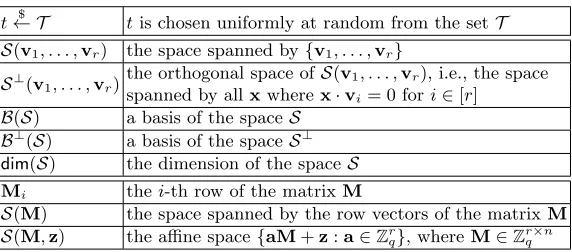
In the remainder of the paper, if not explicitly specified, we assume that all vectors are row vectors in Znq for some integer n and prime q and spaces are Euclidean spaces spanned by row vectors.
Table 1.Notation.
t← T$ tis chosen uniformly at random from the setT S(v1, . . . ,vr) the space spanned by{v1, . . . ,vr}
S⊥
(v1, . . . ,vr)
the orthogonal space ofS(v1, . . . ,vr), i.e., the space
spanned by allxwherex·vi= 0 fori∈[r]
B(S) a basis of the spaceS B⊥(S) a basis of the spaceS⊥
dim(S) the dimension of the spaceS Mi thei-th row of the matrixM
S(M) the space spanned by the row vectors of the matrixM S(M,z) the affine space{aM+z:a∈Zrq}, whereM∈Z
r×n q
Moreover, we use subscript to indicate the set type of a scheme. For example, we use KHIPE
(resp. IHIPE) to denote the key spaceK (resp. index spaceI) with regards to HIPE.
3.2 Concepts from Linear Algebra
We now derive some lemmas associated with vectors, matrices and linear spaces, and which are essential for our property-preserving transformation between HIPE and SE.
Lemma 1. Given a spaceS, then dim(S) +dim(S⊥) =n and (S⊥)⊥ =S.
The proof for the above lemma is obvious and is omitted from here.
Lemma 2. Given a space S, there exists a polynomial-time algorithm taking as input S and out-putting a basis B⊥ of S⊥.
Proof. Let the rows of a matrix Mbe formed by the row vectors which span S. Then we can use an algorithm (such as Algorithm 2.3.1 of [15]) that takes as input M and outputs a basis of the
kernel of M. This basis is also a basis ofS⊥. ut
Henceforth, we refer to the algorithm described in Lemma 2 as the BasisGenalgorithm. We will later use it to transform an element inKHIPE to an element inKSE, and vice versa.
Lemma 3. Given a spaceS, a subspaceS0 and a basis B⊥ of S⊥, there exists a polynomial-time algorithm taking as inputS,S0,B⊥ and outputting a basisB0⊥ ofS0⊥, which contains all the vectors of B⊥.
Proof. We first run the BasisGen(S0) algorithm to output a basis B00⊥ of S0⊥. We then want to
transform this basis to a basis ofS0⊥ which containsB⊥(we note that ifS0is a subspace ofS, then
S⊥is a subspace ofS0⊥). Let the rows of matricesTandT0 be formed byB⊥andB00⊥, respectively. We can then use an algorithm (such as Algorithm 2.3.7 of [15]) that takes as input T>, T0> (the transpose of matrices Tand T0, respectively) and outputs a basis for a supplement ofS⊥ inS0⊥.
We add the output basis toB⊥, which, in turn, is a basis ofS0⊥. ut
Henceforth, we refer to the algorithm described in Lemma 3 as the BasisDel algorithm. It is used during key delegation to transform a partial order associated with KSE, such asS0 S, to a
4 Property-Preserving Transformation from HIPE to SE
Our main idea of transformation from HIPE to SE is transforming the vector inclusion by space relation of SE into the hierarchical inner product relation of HIPE, meanwhile, it preserves the partial order relation in the key space of SE. Our technique involves two key steps: we first describe the transformation from HIPE to SE that works in a subset of affine spaces—Euclidean spaces; we then sketch in Section 4.3 how to derive an n-dimensional SE scheme in affine spaces from an (n+ 1)-dimensional SE scheme in Euclidean spaces.
4.1 Idea for Transforming HIPE to SE
The idea of transformation from HIPE ton-dimensional SE in Euclidean spaces is as follows. We consider an HIPE scheme with a hierarchy such that each level isndimensional and which produces ciphertexts that are associated with only hierarchical vectors of the form (x, . . . ,x) (that is all levels with the same vector x). In such a scheme, a secret key associated with a hierarchical vector (v1, . . . ,vr) ∈ KHIPE can also be viewed as being associated with the space
S⊥(v1, . . . ,vr). In other words, we can interpret the relation between a ciphertext and a secret key
asF(S⊥(v1, . . . ,vr),(x, m)) =m in the SE setting.
With the above observation and the property (S⊥)⊥=S from Lemma 1, instead of generating
a secret key for an (n −r)-dimensional space S ∈ KSE, we generate a secret key for a basis
B⊥(S) = {v1, . . . ,vr} ∈ KHIPE of S⊥ by using the KeyGen algorithm of the HIPE scheme. Here,
B⊥(S) can be generated by running the BasisGen algorithm described in Lemma 2 and we can
arrange the basis as a hierarchical vector (v1, . . . ,vr) in the HIPE setting. The initial order of the
arranged basis is arbitrary, but the order should be fixed after key generation or delegation. Furthermore, we note that when more linearly independent vectors are added in the hierarchy, the dimension of the orthogonal space gets smaller. Namely S⊥(v1, . . . ,vr,vr+1, . . . ,vr0) is a
sub-space of S⊥(v1, . . . ,vr). This property is crucial for key delegation. Given a space S, a subspace S0 of S, and a “fixed” basis B⊥ = {v
1, . . . ,vr} of S⊥, we can derive a basis in the form B0⊥ = {v1, . . . ,vr,vr+1, . . . ,vr0} of S0⊥ by running theBasisDel algorithm described in Lemma 3. Then
we can arrange the basis B⊥,B0⊥ such that B0⊥ B⊥ in the HIPE setting for key delegation.
4.2 Construction of SE from HIPE
We now describe the construction of an SE scheme from an HIPE scheme using the idea described before. From the property dim(S) + dim(S⊥) = n of Lemma 1, to construct an n-dimensional SE scheme, we require an HIPE scheme with hierarchy µ := ((n −1)n, n −1;n,2n, . . . ,(n−
1)n). Given an HIPE scheme with five algorithms:HIPE.Setup,HIPE.KeyGen,HIPE.Enc,HIPE.Dec, and HIPE.KeyDel, we construct an SE scheme with the corresponding five algorithms: SE.Setup,
SE.KeyGen,SE.Enc,SE.Dec, and SE.KeyDel, as follows:
– SE.Setup(1λ, n) runs
(pp,mk)←HIPE.Setup(1λ,µ). It outputs the public parameters pp and master keymk.
– SE.KeyGen(pp,mk,S) generates a secret key for an (n−r)-dimensional spaceS. It first runs
and then runs
skS ←HIPE.KeyGen(pp,mk,B⊥(S)). It outputs the secret keyskS with B⊥(S).
– SE.Enc(pp,x, m) runs
ctx←HIPE.Enc(pp,(x, . . . ,x), m).
It outputs the ciphertext ctx.
– SE.Dec(pp,skS,ctx) runs
m←HIPE.Dec(pp,skS,ctx).
It outputs the message m.
– SE.KeyDel(pp,S,skS,S0) delegates a secret key to an (n−r0)-dimensional subspace S0 of S, where B⊥(S) ={v
1, . . . ,vr}. It first runs
B⊥(S0) :={v1, . . . ,vr,vr+1, . . . ,vr0} ←BasisDel(S,S0,B⊥(S))
and then runs
skS0 ←HIPE.KeyDel(pp,B⊥(S),skS,B⊥(S0)).
It outputs the secret keyskS0 withB⊥(S0).
We now show that the resulting SE scheme works correctly and is indeed secure. Since our generic construction of SE scheme requires only a single instance of an HIPE scheme (along with some additional efficient algorithms), we use techniques similar to those for the Embedding Lemma of [6, 19].
Theorem 1. The SE scheme transformed from the HIPE scheme works correctly.
Proof. From our construction, the only algorithm that needs to be considered is delegation. Given a partial order pairS0 S of K
SE, we transform it into a pair (B⊥(S0),B⊥(S)) such thatB⊥(S0)
B⊥(S) in the HIPE setting. Thus, the key delegation algorithm also works.
Given a plaintext (x, m)∈ XSE and an (n−r)-dimensional space S ∈ KSE, we transform them into ((x, . . . ,x), m)∈ XHIPE and (v1, . . . ,vr)∈ KHIPE respectively, where B⊥(S) = {v1, . . . ,vr} is
a basis ofS⊥. Then we have
F(S,(x, m)) =m⇔x∈ S
⇔x·vi = 0 for allvi ∈ B⊥(S) ⇔F((v1, . . . ,vr),((x, . . . ,x), m) =m.
This implies that the resulting SE scheme inherits the decryptability (F(S,(x, m)) = m iff x∈ S
as defined in Section 2.2) from the original HIPE scheme. ut
Theorem 2. For any adversary A against the SE scheme in the same security model for the original HIPE scheme, there is an adversary D against the HIPE scheme, running in about the same time as A, such that
AdvSEA (λ)≤AdvHIPED (λ).
Proof. Given any adversary A against the SE scheme in the same security model for the original HIPE scheme (fully/selective secure, attribute/payload-hiding), we simulate an adversary D with advantageAdvSEA (λ) against the HIPE scheme as follows:
– Sim.Setup: It runs a real game RG of HIPE and forwards ppto adversaryA.
– Sim.Query: It answersA’s queries by queryingRG’s key generation and delegation oracles.
– Sim.Challenge: It forwardsA’s challenge to RG and then returns RG’s output toA.
– Sim.Guess: It answers A’s queries asSim.Query phase and forwards A’s guess to RG.
In the above security game, we can efficiently transform the elements inKSEandXSE, as required by
the HIPE setting. From Theorem 1 and its proof, all the oracles of the SE scheme can be simulated correctly. Moreover, the plaintextsx(0)= (x(0), m(0)),x(1)= (x(1), m(1)) ∈ XSE, any space S ∈ KSE
of A’s choices and those in the HIPE setting satisfy requirement (1) (and other restrictions of the security model) simultaneously. Thus, the simulation is perfect and we conclude thatAdvHIPED (λ) is
at leastAdvSEA (λ).
It is clear that properties such as full/selective security (under simple assumptions) and attribute/payload-hiding are preserved in the transformation since the model of security game we simulate for the SE scheme is identical to that for the original HIPE scheme. Moreover, should the original HIPE scheme work in prime order bilinear groups and have short ciphertexts (and other properties), the derived SE scheme would also inherit such properties since the SE scheme can be viewed as a “restricted” form or an embedding of the HIPE scheme. ut
Remark: We sometimes may require that the key space KSE to be containing all vectors in Znq.
To achieve this, we can use n extra levels each with two dimensions for the hierarchy µ in the HIPE scheme to “fix” a vector in the transformation. More precisely, we require a hierarchy µ:= ((n+ 1)n,2n−1;n,2n, . . . ,(n−1)n,(n−1)n+ 2, . . . ,(n+ 1)n) and encode z = (z1, . . . , zn) ∈ KSE as ((1, z1), . . . ,(1, zn)), x= (x1, . . . , xn) ∈ ISE as ((x1,−1), . . . ,(xn,−1)) in the last n levels.
Nevertheless, we will shortly explain why this is unnecessary for the construction of SE in affine spaces.
4.3 Construction of SE in Affine Spaces
Now, we briefly show how to construct ann-dimensional SE scheme in affine spaces from an (n+ 1)-dimensional SE scheme in Euclidean spaces.
Given an affine space S(M,z) = {aM +z : a ∈ Zr
q}, where M ∈ Zr×nq , we embed it in S((M1,0), . . . ,(Mr,0),(z,1)) ∈ XSE. Given a vector x ∈ Znq, we embed it in (x,1) ∈ ISE. Then
it is not difficult to check that x ∈ S(M,z) iff (x,1) ∈ S((M1,0), . . . ,(Mr,0),(z,1)). Moreover,
if S(M0,z0) is a subspace of S(M,z), namely there is some matrix T ∈ Zr0×r
q and vector b ∈Zrq
such that M0 = TM and z0 = z+bM, then S((M10,0), . . . ,(M0r0,0),(z0,1)) is a subspace of
S((M1,0), . . . ,(Mr,0),(z,1)), and vice versa.
5 Property-Preserving Transformation from SE to HIPE
We now turn our attention to the transformation from SE to HIPE. Here, we only require an SE scheme in Euclidean spaces.
5.1 Idea for Transforming SE to HIPE
We first give the idea of constructing an HIPE scheme with hierarchy µ:= (n, d;µ1, . . . , µd) from
an SE scheme. Given a vectorv∈Φi (resp.x∈Φi), we use
w(i):= (0, . . . ,0,v,0, . . . ,0) (respy(i):= (0, . . . ,0,x,0, . . . ,0))
to denote an n-dimensional vector, where v(resp. x) is embedded in the (µi−1+ 1)-th to theµi-th
scalars.
The key idea of our transformation is adopting some “space partition” technique. We use an n-dimensional SE scheme to embed thei-th level of µinto the (µi−1+ 1)-th up to theµi-th scalars.
Namely, given a hierarchical vector (v1, . . . ,vr)∈ KHIPE (resp. (x1, . . . ,xh)∈ IHIPE), we embedvi
(resp. xi) in w (i)
i (resp. y (i)
i ), which makes each level “independent”. More precisely, we generate
secret keys and ciphertexts as follows:
(1) A secret key generated using the KeyGen algorithm of the SE scheme for the space
S⊥(w(1)
1 , . . . ,w (r)
r )∈ KSEis set to be a secret key for a hierarchical vector (v1, . . . ,vr)∈ KHIPE;
(2) A message to be encrypted is now associated with the vectory=Ph
i=1y (i)
i ∈ ISE instead of a
hierarchical vector (x1, . . . ,xh)∈ IHIPE.
Ifr ≤h, then we have
xi·vi = 0 for i∈[r]⇔y·wi(i)= 0 for i∈[r] ⇔y∈ S⊥(w(1)1 , . . . ,w(rr)).
This indicates that the functionalityF of the resulting HIPE scheme correctly outputs the payload message (as defined in Section 2.2) if the original SE scheme does.
For a partial order pair (v1, . . . ,vr,vr+1, . . . ,vr0) (v1, . . . ,vr) of HIPE, we have
S⊥(w(1)1 , . . . ,wr(r00)) being a subspace of S⊥(w
(1)
1 , . . . ,w (r)
r ). We can then run the delegation
al-gorithm of the SE scheme for S⊥(w(1)1 , . . . ,w(r
0)
r0 ) and the resulting key is set to be the secret key
associated with (v1, . . . ,vr0).
Up to now, we have considered the case r ≤ h. However, there is an issue when h < r. If we encrypt a message associated with a vector y = Ph
i=1y (i)
i ∈ ISE and generate a secret key
associated with a space S⊥(w(1)
1 , . . . ,w (r)
r ) ∈ KSE where y·wi(i) = 0 for i ∈ [h], then we still
have y ∈ S⊥(w(1)
1 , . . . ,w (r)
r ). This does not meet the security required for HIPE. To address this
5.2 Construction of HIPE From SE
To construct an HIPE scheme with hierarchyµ:= (n, d;µ1, . . . , µd), as explained before, we require
an SE scheme with dimension n0 =n+d. Given a vector v∈Φi (resp. x∈Φi) and ˆb∈ {0,1}, we
use
w(i,ˆb):= (0, . . . ,0,(v,ˆb),0, . . . ,0) (respy(i,ˆb):= (0, . . . ,0,(x,ˆb),0, . . . ,0))
to denote ann0-dimensional vector, where (v,ˆb) (resp. (x,ˆb)) is embedded in the (µi−1+i)-th up
to the (µi+i)-th scalars. Let
1(i):= (0, . . . ,0,1,0, . . . ,0) be ann0-dimensional vector, where the (µi+i)-th scalar is 1.
Given an SE scheme with five algorithms:SE.Setup,SE.KeyGen,SE.Enc,SE.Dec, andSE.KeyDel, we construct an HIPE scheme with the corresponding five algorithms: HIPE.Setup, HIPE.KeyGen,
HIPE.Enc,HIPE.Dec, and HIPE.KeyDel, as follows:
– HIPE.Setup(1λ,µ) runs
(pp,mk)←SE.Setup(1λ, n0). It outputs the public parameters pp and master keymk.
– HIPE.KeyGen(pp,mk,(v1, . . . ,vr)) first runs
B⊥:=B⊥(S(w(11 ,1), . . . ,wr(r,1)))←BasisGen(S(w1(1,1), . . . ,w(rr,1))) and then runs
sk(v1,...,vr)←SE.KeyGen(pp,mk,S(B
⊥
)) It outputs the secret keysk(v1,...,vr) with S(B⊥).
– HIPE.Enc(pp,(x1, . . . ,xh), m) runs
ct(x1,...,xh)←SE.Enc(pp,
d
X
i=1
y(ii,0), m),
where y(ii,0)=1(i) fori∈[h+ 1, d]. It outputs the ciphertextct(x1,...,xh).
– HIPE.Dec(pp,sk(v1,...,vr),ct(x1,...,xh)) runs
m←SE.Dec(pp,sk(v1,...,vr),ct(x1,...,xh)). It outputs the message m.
– HIPE.KeyDel(pp,(v1, . . . ,vr),sk(v1,...,vr),(v1, . . . ,vr0)) where the secret key sk(v1,...,vr) is
associ-ated with a spaceS(B⊥). It first runs
B0⊥ :=B⊥(S(w(11 ,1), . . . ,w(r
0,1)
r0 ))←BasisGen(S(w
(1,1)
1 , . . . ,w (r0,1) r0 ))
and then runs
sk(v1,...,vr0)←SE.KeyDel(pp,S(B
⊥
),sk(v1,...,vr),S(B
0⊥
We show the resulting HIPE scheme works correctly and is indeed secure. The proof techniques are similar to those for Theorems 1 and 2.
Theorem 3. The HIPE scheme transformed from the SE scheme works correctly.
Proof. From our construction, the only algorithm that needs to be considered is key del-egation. Given a partial order pair (v1, . . . ,vr0) (v1, . . . ,vr) of KHIPE, we transform it
into a pair (S⊥(w(11,1), . . . ,w(r
0,1)
r0 ), S⊥(w
(1,1)
1 , . . . ,w (r,1)
r )) such that S⊥(w(11,1), . . . ,w (r0,1) r0 )
S⊥(w(11,1), . . . ,w(rr,1)) in the SE setting. Thus, the key delegation algorithm also works.
Given a plaintext ((x1, . . . ,xh), m)∈ XHIPE and a hierarchical vector (v1, . . . ,vr)∈ KHIPE, we
transform them intoy=Pd
i=1y (i,0)
i ∈ XSEand S⊥(w(11 ,1), . . . ,w (r,1)
r )∈ KSE respectively. Then we
have
– if r > h, we always let y(ii,0) = 1(i) for i∈[h+ 1, d] in our transformation, then y·w(ii,1) = 1 fori∈[h+ 1, r], implying that y6∈ S⊥(w(11 ,1), . . . ,w(rr,1));
– ifr ≤h, then
F((v1, . . . ,vr),((x1, . . . ,xh), m)) =m⇔xi·vi= 0 for i∈[r] ⇔y·w(ii,1)= 0 for i∈[r]
⇔y∈ S⊥(w1(1,1), . . . ,w(rr,1))
⇔F(S⊥(w1(1,1), . . . ,wr(r,1)),(y, m)) =m.
This shows that the resulting HIPE scheme inherits the decryptability from the original SE scheme, i.e., we haveF((v1, . . . ,vr),((x1, . . . ,xh), m)) =miff r≤h and xi·vi= 0 for alli∈[r] as defined
in Section 2.2. ut
Theorem 4. For any adversary A against the HIPE scheme in the same security model for the original SE scheme, there is an adversary D against the SE scheme, running in about the same time as A, such that
AdvHIPEA (λ)≤AdvSED (λ).
Moreover, the HIPE scheme preserves properties from the original SE scheme.
Proof. Given any adversaryAagainst the HIPE scheme in the same security model for the original SE scheme (fully/selective secure, attribute/payload-hiding), we simulate an adversary D with advantage AdvHIPEA (λ) against the SE scheme as with the proof for Theorem 2. From Theorem 3
and its proof, we can conclude that all the oracles of the HIPE scheme can be simulated correctly. Furthermore, the plaintexts x(0) = ((x1,0, . . . ,xh0,0), m(0)), x(1) = ((x1,1, . . . ,xh1,1), m(1))∈ XHIPE,
any hierarchical vector (v1, . . . ,vr) ∈ KHIPE of A’s choices and those in the SE setting satisfy
requirement (1) (and other restrictions of the security model) simultaneously.
Using the same argument, the simulation is perfect and we conclude that AdvSED (λ) is at least
6 Extensions
6.1 Working in ZN
Up to this point, we have worked in Zq, where q is prime (e.g. prime order bilinear groups). Here,
we explain how an SE or HIPE scheme is defined and why our transformation techniques also work inZN, whereN is composite and hard to factor (e.g. composite order bilinear groups).
Given a hard-factoring composite integerN and letZN =Z∗N ∪ {0}, operations inZN are then
closed (i.e., no element inZN\ZN) except for a negligible probability. In what follows, we assume
that all operations are inZN without mentioning the negligible probability, since if some elements
in ZN\ZN are involved in any operation in ZN with this negligible probability, then factoring N
becomes trivial.
We first explain how to define HIPE and SE in ZN. We note that HIPE can be defined in ZN
in a similar way as before (Section 2.2), since it does not involve any notion of field. On the other hand, to define SE, we first define an “affine space” by considering the combination of a set of vectors that is in the form {aM+z :a∈Zr
N}, where M∈Z r×n
N . We still use S(M,z) to denote
such a “space”. A “space” S(M0,z0) is called a “subspace” of S(M,z) if there is some (efficiently computable) matrix T ∈Zr
0×r
N and vector b ∈ ZrN such thatM0 =TM and z0 =z+bM. With
these in mind, we can then define SE in ZN as before.
Next, we consider transformation between HIPE and SE in ZN. Here, orthogonal spaces are
essential elements required by the transformation and they can be defined inZN in a similar way.
Definition 5. Given a set of vectors{v1, . . . ,vr}inZnN, the “orthogonal space”S ⊥(v
1, . . . ,vr) is formed by a set of vectorsx that satisfy the condition that x·vi= 0 for all i∈[r].
Let M be a matrix whose rows are formed by a set of vectors {v1, . . . ,vr}. We can use row
transformation of matrix to obtain a reduced echelon form of M, represented by EM. It is not
difficult to see that S(M,0) andS(EM,0) are identical. Here, we still useS(v1, . . . ,vr) to denote
the “space”S(M,0) and letdim(S(v1, . . . ,vr)) (“dimension” ofS(v1, . . . ,vr)) denote the number
of non-zero rows in EM. FromEM, i.e. the reduced echelon form ofM, we can compute a “basis”
of S⊥(v1, . . . ,vr), which can also form a matrix in a reduced echelon form if we only switch some
columns. Conversely if we consider the “basis” ofS⊥(v1, . . . ,vr), thenEM (or{v1, . . . ,vr}) forms
the “orthogonal space” ofS⊥(v
1, . . . ,vr). Moreover, dim(S(v1, . . . ,vr)) +dim(S⊥(v1, . . . ,vr)) =n.
From the above, it is easy to see that we obtain the similar properties as in Lemma 1. Moreover, it is also not difficult to check that algorithms 2.3.1, 2.3.7 of [15] still work in ZN and the proofs
for Lemmata 2 and 3 still hold. Therefore, our transformation techniques also work inZN.
6.2 A Fully Secure SE Scheme Supporting Negation
Similarly to HIPE, there is a structure (but non-hierarchical) in CP-FE. Let a structure of size dvector spaces have the form of n:= (d;n1, . . . , nd). In CP-FE, v∈ K is a set of labeled vectors T := {(i,vi ∈ Zni
q )|i ∈ [d]} and ind ∈ I is a non-monotone access structure A, namely, a span
program ˆM := (M ∈ Zh×`
q , ρ) along with a set of labeled vectors {(i1,x1 ∈ Zqni1), . . . ,(ih,xh ∈ Z
nih
q )} such that ρ : [h] → {(i1,x1), . . . ,(ih,xh),¬(i1,x1), . . . ,¬(ih,xh)}. Here, F(T,(A, m)) = m
holds iff {xj ·vij = 0 or not}j∈[h] is input to span program ˆM and the truth-value vector of
(%(x1·vi1 = 0), . . . , %(xh·vih= 0)) is accepted by span program ˆM.
To construct an n-dimensional SE scheme supporting negation, we require a CP-FE scheme of [26] with structuren:= (n−1;n, . . . , n). TheSetup,KeyGen, andDec algorithms are essentially in the same way as those in the transformation from HIPE to SE shown in Section 4 and the Enc
algorithm is run by setting the non-monotone access structure to be 1-out-of-(n−1) secret sharing for the non-zero inner product (i.e. x·vi 6= 0). With this and the following property:
x6∈ S ⇔x·vi 6= 0 for some vi∈ B⊥(S),
we derive a fully securen-dimensional SE scheme supporting negation in Euclidean spaces under a simple assumption. To construct the scheme in affine spaces, we use the same techniques described in Section 4.3 and require that a structure be n:= (n;n+ 1, . . . ,(n+ 1)). Note that the previous work has achieved only co-selective security [2].
7 Discussion and Open Problem
We have seen in the previous sections how the property-preserving transformation is performed between an SE and an HIPE scheme. Namely, we have shown the following relations:
SE (in affine spaces)⇐= SE (in Euclidean spaces)⇐⇒HIPE.
Since the inverse direction of the first arrow is trivial, we obtain: SE⇐⇒HIPE.
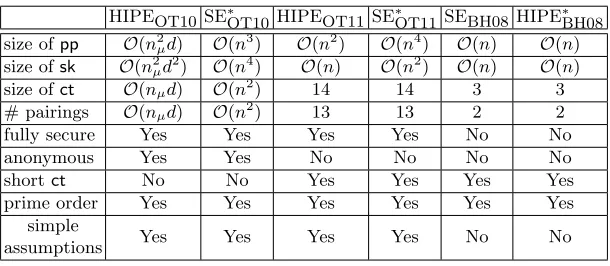
Let us now compare some selected existing HIPE and SE schemes with schemes derived using our property-preserving transformation techniques. Let HIPEOT10denote the HIPE scheme of [27],
HIPEOT11denote the HIPE scheme of [29], SEBH08denote the SE scheme of [6]. We also let SE∗OT10,
SE∗OT11, and HIPE∗BH08 be the corresponding transformed schemes, for example SE∗OT10 is derived from HIPEOT10. We compare them in terms of the size of public parameterspp, the size of secret
keyssk, the size of ciphertexts ct, the number # of pairing computation for decryption, and their properties. Here, the sizes are in the number of group elements. Moreover, all the SE schemes are n-dimensional and the HIPE schemes are with hierarchyµ:= (n, d;µ1, . . . , µd). A summary of the
comparisons is presented in Table 2, wherenµ denotes the maximal value of{µi−µi−1 :i∈[d]}.3 3We have not listed all the existing schemes such as the selective secure HIPE scheme of [25] and the SE scheme in
Table 2.Comparisons between existing and derived schemes.
HIPEOT10SE∗OT10HIPEOT11SE∗OT11SEBH08 HIPE∗BH08
size ofpp O(n2
µd) O(n3) O(n2) O(n4) O(n) O(n)
size ofsk O(n2
µd2) O(n4) O(n) O(n2) O(n) O(n)
size ofct O(nµd) O(n2) 14 14 3 3
# pairings O(nµd) O(n2) 13 13 2 2
fully secure Yes Yes Yes Yes No No
anonymous Yes Yes No No No No
shortct No No Yes Yes Yes Yes
prime order Yes Yes Yes Yes Yes Yes
simple
assumptions Yes Yes Yes Yes No No
In comparison with SEBH, as shown in Table 2, SE∗OT10, SE ∗
OT11 achieve full security at the
expense of increase in the sizes of the public parameters, secret keys and ciphertexts, and the number of pairing evaluations, approximately in the factor of betweenn2andn3. Moreover, SE∗OT10 achieves attribute-hiding and SE∗OT11 has constant-size ciphertexts. On the other hand, HIPE∗BH requires roughly about a factor of n elements less than HIPEOT10 and HIPEOT11 in terms of the
sizes of the public parameters and secret keys. It achieves significant improvement in terms of the size of ciphertexts and the number of pairing computations during decryption, with only 3 group elements and 2 pairings, respectively.
We have obtained some new instances of HIPE and SE schemes with different properties. How-ever, constructing these schemes that are fully secure, attribute-hiding, and with short ciphertexts in prime order bilinear groups (which are more efficient [16]) still remains an open problem, par-ticularly those that work under simple assumptions.
Acknowledgements The author thanks the reviewers for their helpful comments and suggestions for this paper. This work is supported in part by the National Research Foundation of Singapore under Research Grant NRF-CRP2-2007-03.
References
[1] M. Abdalla, M. Bellare, D. Catalano, E. Kiltz, T. Kohno, T. Lange, J. Malone-Lee, G. Neven, P. Paillier, and H. Shi. Searchable encryption revisited: Consistency properties, relation to anonymous IBE, and extensions. J. Cryptology, 21(3):350–391, 2008.
[2] N. Attrapadung and B. Libert. Functional encryption for inner product: Achieving constant-size ciphertexts with adaptive security or support for negation. InPublic Key Cryptography, pages 384–402, 2010.
[3] M. Bellare, B. Waters, and S. Yilek. Identity-based encryption secure against selective opening attack. InTCC, pages 235–252, 2011.
[4] J. Bethencourt, A. Sahai, and B. Waters. Ciphertext-policy attribute-based encryption. In
IEEE Symposium on Security and Privacy, pages 321–334, 2007.
[6] D. Boneh and M. Hamburg. Generalized identity based and broadcast encryption schemes. In
ASIACRYPT, pages 455–470, 2008.
[7] D. Boneh and B. Waters. A fully collusion resistant broadcast, trace, and revoke system. In
ACM Conference on Computer and Communications Security, pages 211–220, 2006.
[8] D. Boneh and B. Waters. Conjunctive, subset, and range queries on encrypted data. InTCC, pages 535–554, 2007.
[9] D. Boneh, G. Di Crescenzo, R. Ostrovsky, and G. Persiano. Public key encryption with keyword search. InEUROCRYPT, pages 506–522, 2004.
[10] D. Boneh, X. Boyen, and E.-J. Goh. Hierarchical identity based encryption with constant size ciphertext. InEUROCRYPT, pages 440–456, 2005.
[11] D. Boneh, C. Gentry, and B. Waters. Collusion resistant broadcast encryption with short ciphertexts and private keys. In CRYPTO, pages 258–275, 2005.
[12] D. Boneh, A. Sahai, and B. Waters. Fully collusion resistant traitor tracing with short cipher-texts and private keys. InEUROCRYPT, pages 573–592, 2006.
[13] D. Boneh, A. Sahai, and B. Waters. Functional encryption: Definitions and challenges. In
TCC, pages 253–273, 2011.
[14] C. Cocks. An identity based encryption scheme based on quadratic residues. In IMA Int. Conf., pages 360–363, 2001.
[15] H. Cohen, editor. A Course in Computational Algebraic Number Theory. Springer, 1996. ISBN 0387556400.
[16] D. M. Freeman. Converting pairing-based cryptosystems from composite-order groups to prime-order groups. In EUROCRYPT, pages 44–61, 2010.
[17] C. Gentry. Practical identity-based encryption without random oracles. In EUROCRYPT, pages 445–464, 2006.
[18] V. Goyal, O. Pandey, A. Sahai, and B. Waters. Attribute-based encryption for fine-grained access control of encrypted data. In ACM Conference on Computer and Communications Security, pages 89–98, 2006.
[19] M. Hamburg. Spatial encryption. IACR Cryptology ePrint Archive, 2011:389, 2011.
[20] J. Horwitz and B. Lynn. Toward hierarchical identity-based encryption. In EUROCRYPT, pages 466–481, 2002.
[21] J. Katz, A. Sahai, and B. Waters. Predicate encryption supporting disjunctions, polynomial equations, and inner products. InEUROCRYPT, pages 146–162, 2008.
[22] A. B. Lewko, T. Okamoto, A. Sahai, K. Takashima, and B. Waters. Fully secure functional encryption: Attribute-based encryption and (hierarchical) inner product encryption. In EU-ROCRYPT, pages 62–91, 2010.
[23] D. Moriyama and H. Doi. A fully secure spatial encryption scheme. IEICE Transactions, 94-A (1):28–35, 2011.
[24] T. Okamoto and K. Takashima. Homomorphic encryption and signatures from vector decom-position. InPairing, pages 57–74, 2008.
[25] T. Okamoto and K. Takashima. Hierarchical predicate encryption for inner-products. In
ASIACRYPT, pages 214–231, 2009.
[26] T. Okamoto and K. Takashima. Fully secure functional encryption with general relations from the decisional linear assumption. InCRYPTO, pages 191–208, 2010.
[28] T. Okamoto and K. Takashima. Adaptively attribute-hiding (hierarchical) inner product en-cryption. IACR Cryptology ePrint Archive, 2011:543, 2011.
[29] T. Okamoto and K. Takashima. Achieving short ciphertexts or short secret-keys for adaptively secure general inner-product encryption. InCANS, pages 138–159, 2011.
[30] R. Ostrovsky, A. Sahai, and B. Waters. Attribute-based encryption with non-monotonic access structures. In ACM Conference on Computer and Communications Security, pages 195–203, 2007.
[31] M. Pirretti, P. Traynor, P. McDaniel, and B. Waters. Secure attribute-based systems. InACM Conference on Computer and Communications Security, pages 99–112, 2006.
[32] A. Sahai and B. Waters. Fuzzy identity-based encryption. InEUROCRYPT, pages 457–473, 2005.
[33] A. Shamir. Identity-based cryptosystems and signature schemes. In CRYPTO, pages 47–53, 1984.
[34] E. Shi and B. Waters. Delegating capabilities in predicate encryption systems. InICALP (2), pages 560–578, 2008.
[35] D. X. Song, D. Wagner, and A. Perrig. Practical techniques for searches on encrypted data. InIEEE Symposium on Security and Privacy, pages 44–55, 2000.
[36] B. Waters. Efficient identity-based encryption without random oracles. In EUROCRYPT, pages 114–127, 2005.
[37] B. Waters. Dual system encryption: Realizing fully secure ibe and hibe under simple assump-tions. In CRYPTO, pages 619–636, 2009.