Fully Secure Spatial Encryption under Simple Assumptions
with Constant-Size Ciphertexts
Jie Chen Hoon Wei Lim San Ling Huaxiong Wang
Nanyang Technological University, Singapore
[email protected];{hoonwei,lingsan,hxwang}@ntu.edu.sg
December 2, 2011
Abstract
In this paper, we propose two new spatial encryption (SE) schemes based on existing inner product encryption (IPE) schemes. Both of our SE schemes are fully secure under simple assumptions and in prime order bilinear groups. Moreover, one of our SE schemes has constant-size ciphertexts. Since SE implies hierarchical identity-based encryption (HIBE), we also obtain a fully secure HIBE scheme with constant-size ciphertexts under simple assumptions. Our second SE scheme is attribute-hiding (or anonymous). It has sizes of public parameters, secret keys and ciphertexts that are quadratically smaller than the currently known SE scheme with similar properties. As a side result, we show that negated SE is equivalent to non-zero IPE. This is somewhat interesting since the latter is known to be a special case of the former.
1
Introduction
The notion of spatial encryption (SE), introduced by Boneh and Hamburg [4], is a generalized concept of identity-based encryption (IBE) [3, 6] that finds a broad range of applications. An SE scheme is defined generically in that plaintexts/ciphertexts are associated with some “poli-cies” and secret (decryption) keys are associated with some “roles”. This way, one can embed various cryptosystems, such as hierarchical IBE (HIBE), broadcast IBE, and inclusive/co-inclusive IBE into SE. Consequently, SE can be turned into many useful systems, such as broadcast HIBE, forward-secure IBE, identity-based ring signatures, encryption supporting flexible and sparse products, and encryption providing zero-handshake transport layer secu-rity. See [4, 11] for more details of the applications of SE.
1.1 Problem Statement
Informally, inn-dimensional SE, a secret key is associated with an affine space inZnq for some
integernand some primeq, while a ciphertext is associated with a vector inZnq. A ciphertext
can be decrypted by a secret key if and only if the vector for the ciphertext is an element of the affine space for the secret key. This can be represented as a functionF(S,(~x, m)) = m
in the functional encryption sense [5] for an affine space S, a vector ~x and a message m. Furthermore, one can use a secret key forS to delegate a key for a relevant subspaceS0 ofS. The first SE scheme, proposed by Boneh and Hamburg [4], has short ciphertexts—a very attractive and important property. This is so since any application of the Boneh-Hamburg SE scheme as mentioned above will inherit the same property. However, the Boneh-Hamburg SE scheme is proven to be only selective secure and under complex assumptions. Subsequently, Zhou and Cao [24] proposed a selective secure SE scheme under simple assumptions. However, their scheme no longer produces short ciphertexts but linear in the dimension n. Chen et al. [8] then gave a method of generically constructing SE from hierarchical inner product encryption (HIPE) [17, 13, 18, 20]. As expected, any SE scheme derived using their method preserves properties of the original HIPE scheme. Such a transformation technique is useful, for example, in obtaining attribute-hiding SE schemes (since most existing HIPE scheme are attribute-hiding [17, 13, 20]). Unfortunately, current HIPE schemes do not have short or even constant-size ciphertexts. Further, there are other SE constructions, such as [11, 16], that are fully secure but proven either under more complex assumptions or composite order bilinear groups [9] (which are less efficient than prime order bilinear groups). Summarizing the prior art of SE, to our knowledge, there is currently no fully secure SE scheme under simple assumptionsandin prime order bilinear groups with short or constant-size ciphertexts. The main goal of this paper is, therefore, to construct such a scheme.
We note that, on the other hand, Attrapadung and Libert [1] showed that it is possible to construct an inner product encryption (IPE) scheme with the aforementioned desired properties. IPE, introduced by Katz, Sahai and Waters [12], is another instance of functional encryption where both the secret key and ciphertext are associated with vectors in Znq for
some integer n and prime q. A ciphertext for a vector ~x can be decrypted by a secret key
sk~v for a vector ~v if and only if the inner product ~x ·~v = 0, i.e., F(~v,(~x, m)) = m. We
note that SE and IPE are somehow related in the sense that it is not difficult to convert SE to IPE. We can achieve this by simply running the key generation algorithm of the SE scheme for the spaceS⊥(~v) and setting the resulting key to be a secret key for the vector~v,
~
x·~v = 0). However, it seems that there does not exist any known generic construction of SE from IPE. This is partly because IPE has no key delegation mechanism. Without key delegation, it is even not clear how one can derive HIBE from IPE (it is, in principle, easier to derive HIBE from IPE in comparison to SE from IPE). One may naturally consider extend IPE to the hierarchical setting, namely HIPE, by adding a delegation mechanism. However, even if the IPE scheme has constant-size ciphertexts, the corresponding HIPE scheme may have ciphertexts with sizes dependent on the depth of the hierarchy. Moreover, constructing SE from HIPE is quadratically expensive as shown in [8].
1.2 Our Contributions
We take an approach along the line of extending IPE to an appropriate “intermediate” form such that constructing SE introduces only minimal cost while retaining all desired properties. Instead of extending IPE to HIPE, we extend IPE to a variant of IPE we call multi-predicate IPE, which preserves the sizes of public parameters and ciphertexts of the IPE scheme from which it is derived, while the sizes of secret keys increase by about a factor ofO(n). We then construct an SE scheme from the multi-predicate IPE scheme under linear reduction. Hence, our approach of constructing SE preserves the sizes of public parameters and ciphertexts of the original IPE.
We investigate two IPE schemes of [1, 20] and propose two fully secure SE schemes under simple assumptions and in prime order bilinear groups:
• Our first scheme achieves constant-size ciphertexts. It is based on the Attrapadung-Libert IPE scheme [1]. The corresponding multi-predicate IPE scheme is presented in Section 3.1.
Particularly, we obtain a non-anonymous HIBE (presented in Section 5.1) with all the mentioned desired properties. Note that there exist a few HIBE schemes [22, 23, 20] that are known to be fully secure under simple assumptions, but none of them has constant-size ciphertexts.
• Our second scheme is based on the Okamoto-Takashima IPE scheme [20]. The corre-sponding multi-predicate IPE scheme is shown in Section 3.2. It is proven secure under the adaptively attribute-hiding model [12, 20]. Although an SE scheme with similar properties could be derived from the techniques of [8], our construction quadratically reduces the sizes of public parameters, secret keys, and ciphertexts.
We focus on the IPE schemes of [1, 20] because they are more efficient and possess more desired properties than the others.
As explained, given an IPE scheme, one may extend it to HIPE or our proposal of multi-predicate IPE (mIPE), which in turn, is converted to an SE scheme:
IPE - HIPE or mIPE - SE
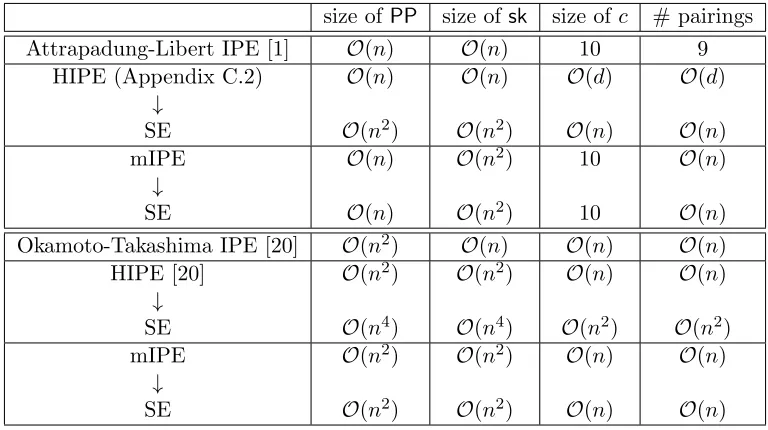
defined in Appendix C.1. Also, for comparison sake, we extend the Attrapadung-Libert IPE scheme to HIPE, which is presented in Appendix C.2. We note that the sizes of ciphertexts are not constant for the SE scheme derived from this HIPE scheme.
Table 1: Comparisons of SE schemes derived from HIPE and those from mIPE.
size of PP size of sk size ofc # pairings
Attrapadung-Libert IPE [1] O(n) O(n) 10 9
HIPE (Appendix C.2)
↓
SE
O(n)
O(n2)
O(n)
O(n2)
O(d)
O(n)
O(d)
O(n) mIPE
↓
SE
O(n)
O(n)
O(n2)
O(n2)
10
10
O(n)
O(n)
Okamoto-Takashima IPE [20] O(n2) O(n) O(n) O(n) HIPE [20]
↓
SE
O(n2)
O(n4)
O(n2)
O(n4)
O(n)
O(n2)
O(n)
O(n2) mIPE
↓
SE
O(n2)
O(n2)
O(n2)
O(n2)
O(n)
O(n)
O(n)
O(n)
Table 2 gives a summary of the comparisons of existing SE schemes against our schemes. Here, we assume all SE schemes are n-dimensional. We compare their efficiency as well as their properties. The schemes of ‘OT∗ [18]’ and ‘OT∗ [20]’ are the SE schemes derived from the Okamoto-Takashima HIPE schemes of [18] and [20], respectively, using the transformation techniques of [8].
Table 2: Comparisons between existing and our SE schemes.
Source Non-Anonymous SE Anonymous SE
BH [4] ZC [24] OT∗ [18] Our 1st scheme OT∗ [20] Our 2nd scheme
size of PP O(n) O(n) O(n3) O(n) O(n4) O(n2) size of sk O(n) O(n) O(n3) O(n2) O(n4) O(n2)
size of c 3 O(n) O(n2) 10 O(n2) O(n)
# pairings 2 O(n) O(n2) O(n) O(n2) O(n)
fully secure No No Yes Yes Yes Yes
anonymous No No No No Yes Yes
constantc Yes No No Yes No No
prime order Yes Yes Yes Yes Yes Yes
simple
assumptions No Yes Yes Yes Yes Yes
As a further contribution, we show generic construction of negated SE, i.e.,F(S,(~x, m)) =
IPE is known as a special case of negated SE, we prove that negated SE and non-zero IPE are in fact equivalent.
1.3 Our Techniques
We obtain our SE schemes from IPE schemes through some multi-predicate IPE schemes. Informally, in our multi-predicate IPE schemes, a secret key is associated with a set of vectors Γ = {~v1, . . . , ~v`} instead of a single vector in the IPE setting (hence the moniker
“multi-predicate”), while a ciphertext is still associated with a single vector ~x. Hence, we have
F(Γ,(~x, m)) = m if and only if the inner product ~x·~vi = 0 for all i ∈ [`].1 Moreover, we
allow key delegation, that is, a secret key for a set of vectors Γ can create a key for a set of vectors Γ0 where Γ ⊂ Γ0. Our definition of multi-predicate IPE is very close to that of the standard IPE. The key difference is that the former delegates secret keys by adding in more vectors while the latter does not. We summarize our multi-predicate IPE schemes, which are fully secure under simple assumptions and in prime order bilinear groups, as follows:
• The first multi-predicate IPE scheme is based on the Attrapadung-Libert IPE scheme, which has constant-size ciphertexts. In our construction, the setup, encryption al-gorithms are unchanged from the IPE scheme, which make the multi-predicate IPE preserving the size of public parameters and ciphertexts. We employ a secret-sharing technique, which is similar with the technique used in the HIBE schemes of [23, 15]. More precisely, a secret key for Γ = {~v1, . . . , ~v`} is associated with an `-out-of-` secret
sharing. When the secret key delegates a new key for Γ0 = {~v1, . . . , ~v`0}, it changes
the secret sharing to an `0-out-of-`0 by introducing fresh randomness. Our construction looks rather similar to a combination of the Attrapadung-Libert IPE scheme and the Waters HIBE scheme of [23], except that our delegation mechanism is not hierarchical.
There are new challenges in our security reduction. This is because of not only our multi-predicate IPE that allows key delegation as opposed to IPE without delegation mechanism, but also the adversary has less query restriction compared to that of HIBE.
As with the Waters HIBE scheme, our multi-predicate IPE scheme also has the “tag lineage” problem, namely, if we run the delegation algorithm to generate a new secret key, the new key will inherit the previous key’s tag values and there is no method for rerandomizing them. However, it is not adequate to adopt the proof techniques for the Waters HIBE scheme to our multi-predicate IPE setting. We introduce a new strategy based on tree structure, which helps us to overcome the tag lineage problem. We discuss this in Section 3.1.
• The second multi-predicate IPE scheme is based on the Okamoto and Takashima IPE scheme [20], which is secure under adaptively attribute-hiding model. In our construc-tion, the setup and encryption algorithms are also unchanged from the IPE scheme. We use a different way to generate a secret key since the structure of this IPE construction is different from the Attrapadung-Libert IPE scheme. To generate a secret key for a vector set Γ = {~v1, . . . , ~v`}, we first mask each vector with a random value and then
sum all elements of the masked vectors, namely, we compute a secret key for P`
i=1σi~vi, whereσ1, . . . , σ`
$
←Fq. Note that such a construction method for IPE with general
del-egation has also been mentioned in the full version of [13]. The security can be proved
1In this paper, we use [`] to denote the set{1, . . . , `}, and [`
exactly in the same way as the Okamoto-Takashima HIPE scheme due to such minor modification.
We then adopt techniques, which are similar to HIPE-to-SE transformation of [8], to con-vert the above multi-predicate IPE schemes into SE schemes. The crux of the transformation from a multi-predicate scheme to an SE scheme is to convert vector inclusion by space relation to inner product relation. This involves two major steps: (i) construct ann-dimensional SE scheme that works in a subset of affine spaces—Euclidean spaces; (ii) use encoding techniques to derive ann-dimensional SE scheme in affine spaces from an (n+ 1)-dimensional SE scheme in Euclidean spaces. We provide further details in Section 4.1.
1.4 Outline of the Paper
We organize the rest of the paper as follows. In Section 2, we provide the definitions and security models of multi-predicate IPE and SE. Moreover, we give the necessary preliminaries for our constructions. In Section 3, we give two concrete constructions of multi-predicate IPE schemes. In Section 4, we then present generic construction of SE from multi-predicate IPE. In Section 5, we discuss how to how to construct a fully secure HIBE scheme under simple assumptions with constant-size ciphertexts and how to derive negated SE from non-zero IPE. We conclude our work in Section 6.
2
Background
In what follows, we borrow the definition and the game-based security model for functional encryption (FE) from [5] which are adequate to define all encryption systems in this paper.
2.1 Functional Encryption
As in [5], we first describe a functionalityFof the syntactic definition of FE. The functionality
F describes the functions of a plaintext that can be learned from the ciphertext:
Definition 1. A functionality F defined over (K,X) is a function F : K × X → {0,1}∗
described as a (deterministic) Turing Machine. The setK is called the key space and the set
X is called the plaintext space.We require that the key spaceK contain a special key called the empty key denoted .
An FE scheme for the functionalityFenables one to evaluateF(k, x) given the encryption ofxand a secret keyskkfork. The algorithm for evaluationF(k, x) usingskkis calleddecrypt.
More precisely, an FE scheme is defined as follows:
Definition 2. A functional encryption scheme (FE) for a functionalityF defined over(K,X)
condition for all k∈ K and x∈ X:
(PP,MK)←Setup(λ) (generate a public and master secret key pair)
skk←KeyGen(PP,MK, k) (generate a secret key for k)
c←Enc(PP, x) (encrypt plaintext x)
y←Dec(PP,skk, c) (use skk to compute F(k, x) from c)
skk0 ←KeyDel(PP, k,skk, k0) (generate a secret key for k0 that satisfies a partial
order relation denoted as k0 k)
then we require thaty=F(k, x) with probability 1.
The empty key : The special key inK captures all the information about the plaintext that intentionally leaks from the ciphertext. The secret key foris empty and also denoted by . Thus, anyone can run Dec(PP, , c) on a ciphertext c← Enc(PP, x) and obtain all the information about x that intentionally leaks from c. Take IBE for example, F(,(ID, m)) outputs only |m| (the length of message m) in the attribute-hiding setting while it outputs
|m|and the identity IDin the payload-hiding setting. Henceforth, we assume that every FE scheme contains the empty key in the key spaceK and we will not explicitly mention it.
We now define the security model for FE. For the plaintext pair (x(0), x(1)) of an adversary’s choice, we need the following requirement to make the experiment non-trivial:
F(k, x(0)) =F(k, x(1)) for allk for which the adversary hasskk. (1)
Then we define a security game for an FE scheme as follows:
Definition 3. For β = 0,1 define an experiment β for an adversary A as follows:
• Setup: It runs(PP,MK)←Setup(λ) and givesPP to A.
• Query: A adaptively makes repeated key queries of one of three types:
– Generate: A submits a key generation query k ∈ K. The challenger generates a
secret key skk for k, but does not give it to A. It instead adds the key to the set S
and gives the adversary a reference to it.
– Delegate: Aspecifies a keyskk in the setS for k∈ K, then it submits a key
delega-tion query fork0∈ K, where k0k. The challenger runs theKeyDel(PP, k,skk, k0)
algorithm to get a new secret key skk0 and adds this to the set S.
– Reveal: A specifies an element of the set S for a secret key skk. The challenger
removes the item from the set S and givesA the secret key. We note at this point there is no need for the challenger to allow more delegate queries on the key since
A can run them itself.
• Challenge: A submits two plaintexts x(0), x(1) ∈ X satisfying requirement (1) and in
return, it receives Enc(PP, x(β)).
• Guess: A continues to issue key queries as before subject to requirement (1) and
Forβ = 0,1 let Wβ be the event that the adversary outputs 1 in Experiment β and define
AdvFEA (λ) :=|P r[W0]−P r[W1]|.
Definition 4. An FE scheme is secure if for all PPT adversariesA the function AdvF EA (λ)
is negligible.
2.2 Multi-Predicate Inner Product and Spatial Encryption
In both multi-predicate IPE and SE, a plaintext x∈ X is itself a pair (ind, m)∈ I × Mwhere
indis called an index andm is called the payload message.
In the multi-predicate IPE setting, a functionalityF is defined over a key space and an index space using sets of vectors. In an n-dimensional multi-predicate IPE scheme, the key space K corresponds to all sets of vectors in the form Γ = {~v1, . . . , ~v`} where~vi ∈Znq for all
i∈[`] (w.l.o.g, we require that Γ is linearly independent and ` < n) and the index space I
corresponds to all vectors~xin Znq. Hence we have
F(Γ,(~x, m)) :=
m if~x·~vi = 0 for all i∈[`]
⊥ otherwise.
Moreover, if Γ0 = {~v01, . . . , ~v`00}, then Γ0 Γ iff Γ ⊂ Γ0. Note that it is IPE when all Γ are
restricted to be only one vector.
In the SE setting, a functionalityF is defined over a key space and an index space using sets of spaces and vectors, respectively. In an n-dimensional SE scheme, the key space K
corresponds to all affine spacesS inZnq and the index space I corresponds to all vectors~xin
Znq. Hence
F(S,(~x, m)) :=
m if~x∈ S ⊥ otherwise.
Moreover, S0 S iffS0 is a subspace ofS.
Let x(0) = (ind(0), m(0)), x(1) = (ind(1), m(1)) ∈ X be the adversary’s choice of plaintext pair. The security game for both multi-predicate IPE and SE can then be defined using Definition 3 with the following variations:
• If the adversary outputs the challenge indices ind(0),ind(1) before the Setup phase, the security game is under theselective securitymodel. Otherwise it is under thefull security
model.
• If the adversary outputs the challenge indices such thatind(0)=ind(1), the security game is under thepayload-hidingsecurity model, that isF(,(ind, m)) = (ind,|m|). Otherwise it is under the attribute-hidingsecurity model, that isF(,(ind, m)) =|m|.
• In the attribute-hiding model, if the adversary is allowed key queries ki in which
F(ki,(ind(0), m(0))) = m(0) = m(1) = F(ki,(ind(1), m(1))), the security game is con-sidered adaptively or fully attribute-hiding [12, 20]. Otherwise, if F(ki,(ind(0), m(0))) (resp. F(ki,(ind(1), m(1)))) does not reveal m(0) (resp. m(1)) for all key queries ki, the
2.3 Notation
In the remainder of the paper, if not explicitly specified, we assume that all vectors are row vectors inZnq for some integernand primeq and spaces are Euclidean spaces spanned by row
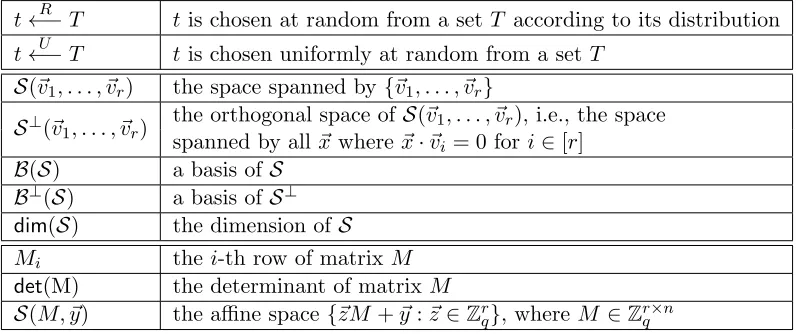
vectors. Table 3 summarizes some notation used in the remainder of the paper.
Table 3: Notation.
t←−R T tis chosen at random from a set T according to its distribution
t←−U T tis chosen uniformly at random from a set T S(~v1, . . . , ~vr) the space spanned by{~v1, . . . , ~vr}
S⊥(~v
1, . . . , ~vr)
the orthogonal space ofS(~v1, . . . , ~vr), i.e., the space
spanned by all~x where~x·~vi = 0 for i∈[r]
B(S) a basis ofS B⊥(S) a basis ofS⊥
dim(S) the dimension ofS
Mi thei-th row of matrixM det(M) the determinant of matrixM
S(M, ~y) the affine space {~zM+~y:z~∈Zrq}, where M ∈Zrq×n
Note also that we use a subscript to indicate the set type of a scheme. For example, we useKSE (resp.ISE) to denote the key spaceK (resp. index spaceI) with regards to SE.
2.4 Concepts from Linear Algebra
We require the following lemmata for our generic constructions. The proofs are simple and can be obtained from [7], for example.
Lemma 1. Given a space S, then dim(S) +dim(S⊥) =n and (S⊥)⊥=S.
Lemma 2. Given a space S, there exists a polynomial-time algorithm BasisGen taking as inputS and outputting a basis B⊥ of S⊥.
Lemma 3. Given a spaceS, a subspaceS0 and a basis B⊥ of S⊥, there exists a polynomial-time algorithm BasisDel taking as input S,S0,B⊥ and outputting a basis B0⊥ of S0⊥, which
contains all the vectors of B⊥.
2.5 Dual Pairing Vector Spaces by Direct Product of Symmetric Pairing Groups
Definition 5. “Symmetric bilinear pairing groups” (q,G,GT, g, e) are a tuple of a prime
q, cyclic (multiplicative) groups G and GT of order q, g 6= 1 ∈ G, and a polynomial-time
computable nondegenerate bilinear pairing e : G×G → GT i.e., e(gs, gt) = e(g, g)st and
e(g, g) 6= 1. Let Gbpg be an algorithm that takes as input λ and outputs a description of bilinear pairing groups(q,G,GT, g, e) with security parameter λ.
Definition 6. “Dual pairing vector spaces (DPVS)” (q,V,GT,A, e) by a direct product of
symmetric pairing groupsq,G,GT, g, eare a tuple of prime q, n-dimensional vector space
V:=
n
z }| {
G× · · · ×G
over Zq, cyclic group GT of order q, canonical basis A:= (a1, . . . ,an) of V, where
ai:= ( i−1
z }| {
1, . . . ,1, g,
n−i
z }| {
1, . . . ,1)
and pairing e:V×V→GT.
The pairing is defined by e(x,y) := Qn
i=1e(gi, hi) ∈ GT where x := (g1, . . . , gn) ∈ V
and y := (h1, . . . , hn) ∈ V. This is nondegenerate bilinear, i.e. e(sx, ty) = e(x,y)st and if
e(x,y) = 1 for all y∈V, then x=0. For all iand j, e(ai,aj) =g δi,j
T where δi,j = 1 if i=j, and 0 otherwise, and gT :=e(g, g)6= 1∈GT.
DPVS also has linear transformations φi,j on V s.t. φi,j(ai) = ai, φi,j(ak) =0 if k6=j, which can be easily achieved by
φi,j := ( i−1
z }| {
1, . . . ,1, gj, n−i
z }| {
1, . . . ,1)
where x := (g1, . . . , gn). We call φi,j “distortion maps”. DPVS generation algorithm Gdpvs
takes inputλ(λ∈N) andn∈N, and outputs a description ofparam0V:= (q,V,GT,A, e)with
security parameterλ andn-dimensional V. It can be constructed by using Gbpg.
Based on the above definitions, we now describe a random dual orthonormal bases gener-atorGob that is used as a subroutine in our proposed multi-predicate IPE schemes:
Gob(λ, n) : param0V:= (q,V,GT,A, e)←− GU dpvs(λ, n), ψ
U
←−Z∗q
X:= (χi,j) U
←−GL(n,Zq),(ϑi,j) := (X>)−1, gT :=e(g, g)ψ,paramV:= (param0V, gT)
bi := n
X
j=1
χi,jaj,B:= (b1, . . . ,bn),b∗i := n
X
j=1
ϑi,jaj,B∗ := (b∗1, . . . ,b
∗
n),
return (paramV,B,B∗).
2.6 Complexity Assumptions
Definition 7 (DLIN: Decisional Linear Assumption.). The DLIN problem is to guess β ∈ {0,1}, given(paramG, g, f, v, gθ0, fθ1, T)←− GU DLIN
β (λ), where
GDLIN(λ) : paramG := (q,G,GT, g, e) R
←− Gbpg(λ),
θ0, θ1←−U Zq, f, ν ←−U G
Y0:=νθ0+θ1, Y1←−U G
β ←− {U 0,1}, T :=Yβ
Forβ = 0,1 let Wβ be the event that the adversary outputs 1 and define
AdvDLINA (λ) :=|P r[W0]−P r[W1]|.
The DLIN assumption is: For any probabilistic polynomial-time adversary A, the advan-tage AdvDLIN is negligible inλ.
Definition 8 (DBDH: Decisional Bilinear Diffie-Hellman Assumption.). The DBDH problem
is to guess β∈ {0,1}, given(paramG, g, gθ0, gθ1, gθ2, T)←− GU DBDH
β (λ), where
GDBDH(λ) : paramG := (q,G,GT, g, e) R
←− Gbpg(λ),
θ0, θ1, θ2
U
←−Zq, Y0 :=gθ0θ1θ2, Y1
U
←−G
β←− {U 0,1}, T :=Yβ
return(paramG, g, gθ0, gθ1, gθ2, T).
Forβ = 0,1 let Wβ be the event that the adversary outputs 1 and define
AdvDBDHA (λ) :=|P r[W0]−P r[W1]|.
The DBDH assumption is: For any probabilistic polynomial-time adversaryA, the advan-tage AdvDBDH is negligible in λ.
3
Fully Secure Multi-Predicate IPE under Simple
Assump-tions
3.1 Achieving Constant-Size Ciphertexts
Our first construction of multi-predicate IPE scheme is from the IPE scheme of [1]. The latter is a variant of Waters’ dual system IBE scheme [23], which is fully secure under the DLIN and DBDH assumptions with constant-size ciphertexts. We describe our multi-predicate IPE scheme as follows:
• SetupmIP E(λ, n): It picks paramG := (q,G,GT, g, e) ←− GR bpg(λ). It then picks
α, a0, a1, b
U
←−Zq andw, w0, w1, h0, h1, . . . , hn U
←−G. The public parameters consist of
PP=
g, w, w0, w1, h0, h1, . . . , hn,
A0 =ga0, A1 =ga1B =gb, B0 =gba0, B1 =gba1,
τ0=w·w0a0, τ1=w·w1a1, T0 =τ0b, T1=τ1b, Z =e(g, g)αa0b
!
.
The master key is defined to beMK= (gα, gαa0).
• KeyGenmIP E(PP,MK,Γ): It parses Γ to be {~v1, . . . , ~v`}. It further parses each ~vi ∈ Γ
as (vi,1, . . . , vi,n) and returns ⊥ifvi,n= 0. It then runs the following steps:
– Pick r0, . . . , r`, z0, z1
U
←−Zq, set r=r0+· · ·+r`.
– Generate skΓ = (D1, . . . , D7,{Ki,0, Ki,1, . . . , Ki,n−1,tagki,1, . . . ,tagki,n−1}i∈[`]) by computing
D1 =gαa0·wr, D2=g−α·w0r·gz0, D3=B−z0, D4 =wr1·gz1,
D5 =B−z1, D6=Br0, D7=gr1+···+r`, fori∈[`] we set :
Ki,0 =gri, Ki,j = (h
−vi,j
vi,n
n ·hj·h
tagki,j
0 )ri forj∈[n−1].
• EncmIP E(PP, ~x, m): To encrypt m ∈ GT under ~x = (x1, . . . , xn) ∈ Znq, it picks
s0, s1, t,tagc
U
←−Zq and computesc= (C1, . . . , C7, C, E0, E1,tagc) where
C1=Bs0+s1, C2 =B0s0, C3 =As00, C4=B1s1,
C5=As11, C6 =τ0s0 ·τ1s1, C7 =T0s0·T1s1 ·h−0t,
C=m·Zs1, E
0 =gt, E1 = (htagc0 ·
n
Y
i=1
hxi
i )t.
• DecmIP E(PP,skΓ, c): It recovers the message in the following steps:
– Compute tagki =tagki,1x1+· · ·+tagki,n−1xn−1 fori∈[`].
– Compute W = Q5
j=1e(Cj, Dj) · (
Q7
j=6e(Cj, Dj))
−1 = e(g, g)αa0bs1 ·
e(g, h0)(r1+···+r`)t.
– Compute Wi= (e((Ki,1)
x1...(K
i,n−1)xn−1, E0)
e(E1, Ki,0) ) 1
tagki−tagc =e(g, h 0)rit.
– Recover the message as m=C/Zs1 =C/e(g, g)αa0bs1 ←C·W
2· · ·W`·W−1.
• DelmIP E(PP,Γ,skΓ,Γ0): It parses Γ as {~v1, . . . , ~v`} and Γ0 as{~v1, . . . , ~v`, ~v`+1, . . . , ~v`0}.
For all i∈[`0] it parses each~vi as (vi,1, . . . , vi,n), and returns⊥ifvi,n= 0. It then runs
the following steps:
– Parse skΓ to be
D1, . . . , D7,{Ki,0, Ki,1, . . . , Kn−1,tagki,1, . . . ,tagki,n−1}i=1,...,`.
– Pick r00, . . . , r`00, z00, z10
U
←−Zq and setr0 =r00 +· · ·+r0`0.
– For i∈[`+ 1, `0], picktagki,1, . . . ,tagki,n−1
U
←−Zq.
– Generate skΓ0 = (D0
1, . . . , D07,{Ki,00, Ki,01, . . . , Ki,n0 −1,tagki,1, . . . ,tagki,n−1}i∈[`0]) by
computing
D10 =D1·wr 0
, D02=D2·wr 0 0 ·gz
0 0, D0
3 =D3·B−z 0 0, D0
4 =D4·wr 0 1 ·gz
0 1,
D50 =D5·B−z 0 1, D0
6=D6·Br 0 0, D0
7 =D7·gr 0 1+...+r
0
`0, fori∈[`] we set :
Ki,00=Ki,0·gr 0
i, K0
i,j =Ki,j ·(h
−vi,j
vi,n
n ·hj·h
tagki,j 0 )
r0
i forj∈[n−1],
fori∈[`+ 1, `0] we set :
Ki,00=gr0i, K0
i,j = (h
−vi,j
vi,n
n ·hj·h
tagki,j 0 )
r0
Theorem 1. The multi-predicate IPE scheme is fully secure under the DLIN and DBDH assumptions.
Proof. Our proof uses the dual system methodology similar to that in [23, 1], which involves ciphertexts and secret keys that can be normal or semi-functional. The semi-functional ci-phertext and key generation algorithms (which are not used in a real system) can be described as follows:
Semi-Functional Ciphertexts: The algorithm first runs the encryption algorithm to gen-erate a normal ciphertext (C10, . . . , C70, C0, E00, E01,tagc0). It then chooses χ ←−U Zq before
replacing (C40, C50, C60, C70) by
C4 =C40 ·gba1χ, C5=C50 ·ga1χ, C6 =C60 ·w
a1χ
1 , C7 =C70 ·w
a1bχ 1 , respectively.
Semi-Functional Secret Keys: The algorithm first runs the encryption algorithm to gen-erate a normal private keyD10, . . . , D70,{Ki,00, Ki,01, . . . , Ki,n0 −1,tagk0i,1, . . . ,tagki,n0 −1}i∈[`]. The semi-functional key is obtained by choosingγ ←−U Zq and replacing (D01, D02, D04) by
D1 =D01·g−a0a1γ, D2=D20 ·ga1γ, D4 =D04·ga0γ,
respectively.
Let us assume that adversaryAmakes at mostqRkey reveal queries andqAkey generation
& delegation queries. Our proof can then proceed in a sequence of games defined as follows:
– GameReal is the actual multi-predicate IPE security game.
– Game0 is identical toGameReal except that the challenge ciphertext is semi-functional.
– Gamek (for 1≤k≤qR) is identical toGame0 except that the first kkey reveal queries are answered by returning a semi-functional key.
– GameF inal is as GameqR but the challenge ciphertext is semi-functional encryption of a random element of GT instead of the actual plaintext.
In Appendix B, we prove a set of lemmata that argue the indistinguishability between any two consecutive games under the DLIN and DBDH assumptions The game ends inGameF inal,
where any adversary’s advantage must be negligibly close to 0.
The indistinguishability ofGameReal andGame0 (see Lemma 4) as well as that ofGameqR
and GameF inal (Lemma 6) can be proved in the similar way as with [23]. It turns out that
the main challenge is to show indistinguishability between Gamek−1 and Gamek (Lemma 5).
This is mainly because multi-predicate IPE allows key delegation as opposed to IPE without delegation mechanism and the adversary’s queries have less restriction than that of HIBE.
In the HIBE scheme of [23], the challenger embeded some 2-equation trapdoors into the
k-th key reveal query’s identity (id1, . . . , id`) and the challenge identity (id∗1, . . . , id∗`∗). More
precisely, it plans to embed a 2-equation trapdoor into id` and id∗`, this is because the key
query and challenge identity always have the restriction thatid∗` 6=id` if`∗ ≥`. To do this,
before the tag values are “locked”, resulting the challenger’s guess to be correct with prob-ability 1/q0A, whereq0A is the number of key generation & delegation queries. Subsequently, Attrapadung and Libert [1] used ann-equation trapdoor as opposed to a 2-equation trapdoor for their IPE scheme to deal with the difficulties arising from the richer structure of IPE and the aggregation of ciphertexts into a constant number of elements. To embed then-equation trapdoor, it requires that the adversary’s k-th key reveal query on ~v has the restriction of
~
x∗·~v6= 0 for a challenge vector~x∗, which is clearly necessary under payload-hiding model. In our multi-predicate IPE scheme, the adversary’s query is less restricted than the previ-ous cases in the sense that, for a challenge vector~x∗ and a key reveal query Γ :={~v1, . . . , ~v`},
we only require some~vi such that~x∗·~vi6= 0. Thus, our goal is to embed an n-equation
trap-door into the challenge vector~x∗and some vector~viof thek-th reveal query Γ :={~v1, . . . , ~v`},
where~x∗·~vi 6= 0 holds. As expected, our construction also faces the “tag lineage” problem.
However, adopting Waters’s strategy described above does not work here since we may get
~
x∗·~v` = 0. Moreover, we cannot simply guess further a vector in the key reveal query that
will satisfy the restriction. This is because the k-th reveal query may be a key delegation query from a previous key for Γ :={~v1, . . . , ~v`} delegated to Γ0 :={~v1, . . . , ~v`0} while the tag
values for vectors in Γ have already been “locked”. We introduce a new strategy based on tree structure. The challenger arranges all queries and their vectors (each vector is associated with an universal counter value) in a tree. It guesses a valuek∗ for all vectors in the tree such that thek∗-th vector will appear in the k-th key reveal query and the corresponding vector
~vsatisfies the condition of~x·~v6= 0. This allows us to embed then-equation trapdoor to the correct vector of the key reveal query.
3.2 Improving Efficiency under Adaptively Attribute-Hiding Model
Our second construction of multi-predicate IPE scheme makes use of the IPE scheme of [20] as a building block. The latter is fully secure and adaptively attribute-hiding under the DLIN assumption but without constant-size ciphertexts. The main idea of our construction is that to generate a secret key, we mask each vector in Γ with a random value form Zq and then
compute the sum of all the masked vectors. We include a delegation mechanism in a similar way to the HIPE scheme of [13, 20]. We use~0 to denote the n-dimensional zero vector and
spanhb1, . . . ,bnito denote all linear combination of{b1, . . . ,bn}(i.e.,σ1b1+. . .+σnbnwhere
σ1, . . . , σn∈Zq). Our multi-predicate IPE scheme is as follows:
• SetupmIP E(λ, n): It performs the following steps:
– Pick (paramV,B,B∗)← G$ ob(λ,4n+ 2).
– Set Bb:= (b0, . . . ,bn,b4n+1),Bb∗ := (b∗0, . . . ,b∗n),Be∗ := (b∗3n+1, . . . ,b∗4n).
– Return PP:= (paramV,Bb,Be∗) and MK:=Bb∗.
• KeyGenmIP E(PP,MK,Γ): It sets Γ to be{~v1, . . . , ~v`} and does the following steps:
– Pick σdec,i, σran,1,i, . . . , σran,`,i, σdel,1,i, . . . , σdel,n,i, ψ
$
←Fq fori∈[`].
– Pick ~ηdec, ~ηran,1, . . . , ~ηran,`, ~ηdel,1, . . . , ~ηdel,n
$ ←Fn
– Compute
k∗`,dec:= (1, σdec,1~v1+. . .+σdec,`~v`, ~0, ~0, ~ηdec,0)B∗,
k∗`,ran,j:= (0, σran,j,1~v1+. . .+σran,j,`~v`, ~0, ~0, ~ηran,j,0)B∗ forj ∈[`],
k∗`,del,j:= (0, σdel,j,1~v1+. . .+σdel,j,`~v`+ψ~vj, ~0, ~0, ~ηdel,j,0)B∗ forj ∈[n].
– Return skΓ := (k∗`,dec,k∗`,ran,1, . . . ,k∗`,ran,`,k∗`,del,1, . . . ,k∗`,del,n).
• EncmIP E(PP, ~x, m): It
– Picksζ, δ, η ←$ Fq.
– Computes c0:=m·gTζ,c1:= (ζ, δ~x, ~0, ~0, ~0, η)B.
– Returns c:= (c0,c1).
• DecmuIP E(PP,skΓ, c): It recovers messagem:=c0/e(c1, ~k∗`,dec).
• DelmIP E(PP,Γ,skΓ,Γ0): It sets Γ to be {~v1, . . . , ~v`}, Γ0 to be {~v1, . . . , ~v`, ~v`+1, . . . , ~v`0},
and ~vi to be (vi,1, . . . , vi,n) for i∈[`0]. It then does the following steps:
– Pick αdec,i, αran,1,i, . . . , αran,`0,i, αdel,1,i, . . . , αdel,n,i, ψ0 ←$ Fq fori∈[`0].
– Pick r∗dec,r∗ran,1, . . . ,rran∗ ,`0,r∗del,1, . . . ,r∗del,n
$
←spanhb∗3n+1, . . . ,b∗4ni.
– Compute
k∗`0,dec:=k∗`,dec+
`
X
i=1
αdec,ik∗`,ran,i+ `0
X
i=`+1
αdec,i( n
X
t=1
vi,tk∗`,del,t) +r
∗
dec
k∗`0,ran,j :=
`
X
i=1
αran,j,ik∗`,ran,i+ `0
X
i=`+1
αran,j,i( n
X
t=1
vi,tk∗`,del,t) +r
∗
ran,j forj∈[`
0],
k∗`0,del,j :=
`
X
i=1
αdel,j,ik∗`,ran,i+ `0
X
i=`+1
αdel,j,i( n
X
t=1
vi,tk∗`,del,t) +ψ
0
k∗`,del,j+rdel∗ ,j forj∈[n].
– Return skΓ0 := (k∗
`0,dec,k∗`0,ran,1. . . ,k∗`0,ran,`0,k∗`0,del,1, . . . ,k∗`0,del,n).
Theorem 2. The multi-predicate IPE scheme is fully secure under the DLIN assumption.
The security proof of the theorem is essentially similar to that for the IPE scheme of [20]. Hence, we do not discuss any further here.
4
Generic Construction of SE from Multi-Predicate IPE
4.1 Intuition
In a multi-predicate IPE scheme, a secret key associated with a set of vectors{~v1, . . . , ~v`} ∈
KmIP E can be viewed as being associated with the space S⊥(~v1, . . . , ~v`). In other words, we
can interpret the relation between a ciphertext and a secret key asF(S⊥(~v1, . . . , ~v`),(~x, m)) =
m in the SE setting. From this observation and the property that (S⊥)⊥ =S from Lemma
1, instead of generating a secret key for an (n−`)-dimensional space S ∈ KSE, we generate
a secret key for a basisB⊥(S) ={~v1, . . . , ~v`} ∈ KmIP E ofS⊥ by using the KeyGenalgorithm
of the multi-predicate IPE scheme. Here B⊥(S) can be generated by running the BasisGen
algorithm as described in Lemma 2.
We note that when more linearly independent vectors are added into the vector set, the dimension of the orthogonal space gets smaller. Namely S⊥(~v
1, . . . , ~v`, ~v`+1, . . . , ~v`0) is a
subspace of S⊥(~v1, . . . , ~v`). This property is crucial for key delegation. Given a space S, a
subspaceS0 of S, and a “fixed” basis B⊥ = {~v1, . . . , ~v`} of S⊥, we can derive a basis in the
form B0⊥ = {~v
1, . . . , ~v`, ~v`+1, . . . , ~v`0} of S0⊥ by running the BasisDel algorithm as described
in Lemma 3.
4.2 Construction
We now describe the construction of an SE scheme from a multi-predicate IPE scheme using the above idea. To construct ann-dimensional SE scheme, we require a multi-predicate IPE scheme with the same dimension. Given a multi-predicate IPE scheme with five algorithms:
SetupmIP E,KeyGenmIP E,EncmIP E,DecmIP E, andDelmIP E, we construct an SE scheme with
the corresponding five algorithms: SetupSE,KeyGenSE,EncSE,DecSE, andDelSE, as follows:
• SetupSE(λ, n): It runsSetupmIP E(λ, n) and outputs public parametersPPand a master
key MK.
• KeyGenSE(PP,MK,S): It generates a secret key for an (n −`)-dimensional space
S. It first runs BasisGen(S) and outputs B⊥(S) = {~v
1, . . . , ~v`}. It then runs KeyGenmIP E(PP,MK,B⊥(S)) and outputs a secret key skS withB⊥(S).
• EncSE(PP, ~x, m): It runsEncmIP E(PP,(~x, m)) and outputs a ciphertextc.
• DecSE(PP,skS, c): It runs DecmIP E(PP,skS, c) and outputs a messagem.
• DelSE(PP,S,skS,S0): It delegates a secret key to an (n−`0)-dimensional subspace S0
of S, where B⊥(S) = {~v1, . . . , ~v`}. It first runs BasisDel(S,S0,B⊥(S)) and outputs
B⊥(S0) = {~v
1, . . . , ~v`, ~v`+1, . . . , ~v`0}. It then runs DelmIP E(PP,B⊥(S),skS,B⊥(S0)) and
outputs a secret key skS0 with B⊥(S0).
We now show that the resulting SE scheme works correctly and is indeed secure.
Theorem 3. The SE scheme constructed from the multi-predicate IPE scheme works cor-rectly.
Proof. From our construction, the only algorithm that needs to be considered is delegation. Given a partial order pairS0 S of K
SE, we transform it into a pair (B⊥(S0),B⊥(S)) using
theBasisDel algorithm such that B⊥(S0) B⊥(S) in the multi-predicate IPE setting. Thus,
Given a plaintext (~x, m)∈ XSE and an (n−`)-dimensional spaceS ∈ KSE, we transform them into (~x, m)∈ XmIP E andB⊥(S) ={~v1, . . . , ~vr} ∈ KmIP E respectively. Then we have
F(S,(~x, m)) =m⇔~x∈ S
⇔~x·~vi = 0 for all~vi ∈ B⊥(S)
⇔ F(B⊥(S),(~x, m)) =m.
This implies that the resulting SE scheme inherits the decryptability from the original multi-predicate IPE scheme, i.e.,F(S,(~x, m)) =miff ~x∈ S as defined in Section 2.2.
Theorem 4. For any adversaryAagainst the SE scheme in the same security model for the multi-predicate IPE scheme, there is an adversary Dagainst the multi-predicate IPE scheme, running in about the same time asA, such that
AdvSEA (λ)≤AdvmIP ED (λ).
Moreover, the SE scheme preserves properties from the multi-predicate IPE scheme.
Proof. Given any adversary A against the SE scheme in the same security model for the
multi-predicate IPE scheme (which is fully/selective secure, attribute/payload-hiding), we simulate an adversary D with advantage AdvSEA (λ) against the multi-predicate IPE scheme as follows:
• Setup: It runs a real gameRGof multi-predicate IPE and forwardsPPto adversaryA.
• Query: It answersA’s queries by queryingRG’s key generation and delegation oracles.
• Challenge: It forwardsA’s challenge to RG and then returns RG’s output to A.
• Guess: It answersA’s queries as Queryphase and Dforwards A’s guess toRG.
In the above security game, we can efficiently transform the elements in KSE and XSE, as
required by the multi-predicate IPE setting. From Theorem 3 and its proof, all the oracles of the SE scheme can be simulated correctly. Moreover, the plaintextsx(0)= (~x(0), m(0)),x(1)= (~x(1), m(1)) ∈ XSE, any spaceS ∈ KSE of A’s choices and those in the multi-predicate IPE
setting satisfy requirement (1) (and other restrictions of the security model) simultaneously. Thus, the simulation is perfect and we conclude thatAdvmIP ED (λ) is at least AdvSEA (λ).
It is clear that properties such as full/selective security (under simple assumptions) and attribute/payload-hiding are preserved in the transformation since the model of security game we simulate for the SE scheme is identical to that for the original multi-predicate IPE scheme. Moreover, should the original multi-predicate IPE scheme work in prime order bilinear groups and have constant ciphertexts (and other properties), the derived SE scheme would also inherit such properties since the SE scheme can be viewed as a “restricted” form or an embedding of the multi-predicate IPE scheme.
Remark: We note that our first multi-predicate IPE scheme described in Section 3.1 re-quires that vn 6= 0 for any vector (v1, . . . , vn). Thus, when we derive an SE scheme using
the above generic techniques, we can add one more dimension as a “dummy scalar”. That is, each vector~v= (v1, . . . , vn) in B⊥(S) ={~v1, . . . , ~v`}is replaced by a vector (v1, . . . , vn,1),
and~x= (x1, . . . , xn) is replaced by a vector (x1, . . . , xn,0) for key generation and encryption,
5
Discussion
5.1 Fully Secure HIBE Scheme under Simple Assumptions with Constant Ciphertexts
Building on our results in the previous sections, we now show how one can construct a fully secure HIBE scheme under simple DLIN and DBDH assumptions with constant-size ciphertexts. Our HIBE scheme can be regarded as an improved version the Waters HIBE scheme of [23] by having constant-size ciphertexts not achievable by the latter..
In the HIBE setting, a functionalityFis defined over a key space and an index space using sets of hierarchical identities. In an HIBE scheme with maximum depth n, the key space K
(resp. index spaceI) corresponds to all hierarchical identities in the form (id1, . . . , id`) (resp.
(id01, . . . , id0`0)), where`≤n. Here
F((id1, . . . , id`),((id01, . . . , id0`0), m)) :=
m if`≤`0 andidi0 =idi for all i∈[`]
⊥ otherwise.
Moreover, (id01, . . . , id0`0)(id1, . . . , id`) iff `≤`0 and id0i=idi for all i∈[`].
Generally, to embed an HIBE scheme with maximal depthn, we require ann-dimensional SE in affine spaces. We assume that identities are elements in Z∗q, and hence one will use a
collision resistant hash function to hash identities of arbitrary length toZ∗q. For (id1, . . . , id`)
associated with a secret key, we encode it as the affine space which begins with (id1, . . . , id`),
namely
{(id1, . . . , id`, x`+1, . . . , xn) :xi∈Zq}.
For (id1, . . . , id`) associated with a ciphertext, we encode it as the vector
(id1, . . . , id`,0, . . . ,0).
Our HIBE scheme is derived from our SE scheme, which in turn, is obtained from the multi-predicate IPE in Section 3.1. To construct ann-dimensional SE scheme, we require an (n+1)-dimensional multi-predicate IPE scheme. Here, we do not need an additional dimension as a dummy scalar as mentioned before, since we always have vn+1 6= 0 for any vector
~v = (v1, . . . , vn, vn+1) in our construction when running the key generation or delegation algorithm.
• SetupHIBE(λ, n): It chooses bilinear groups (q,G,GT, g0, e) of prime order q ≤ 2λ. It
then picksg, w, w0, w1, h0, h1, . . . , hn←−U Gand α, a0, a1, b←−U Zq. The public
parame-ters consist of
PP=
g, w, w0, w1, h0, h1, . . . , hn, hn+1
A0 =ga0, A1=ga1B =gb, B0=gb·a0, B1 =gb·a1,
τ0 =w·wa00, τ1 =w·wa11, T0=τ0b, T1 =τ1b, Z =e(g, g)α·a0·b
!
.
The master key is defined to beMK= (gα, gαa0).
• KeyGenHIBE(PP,MK,(id1, . . . , id`)): It picks r0, . . . , r`, z0, z1
U
←−Zq, setsr =P`
i=0ri.
For i ∈ [`], it picks tagki,1, . . . ,tagki,n U
(D1, . . . , D7,{Ki,0, Ki,1, . . . , Kidi,n,tagki,1, . . . ,tagki,n}i∈[`]) by computing
D1 =gαa0 ·wr, D2 =g−α·wr0·gz0, D3 =B−z0, D4=w1r·gz1,
D5 =B−z1, D6 =Br0, D7 =gr1+...+r`, fori∈[`] :
Ki,0 =gri, Ki,i = (h
1
idi
n+1·hi·h
tagki,i 0 )
ri, K
i,j = (hj ·h
tagki,j 0 )
ri forj∈[n]\{i}.
• EncHIBE(PP,(id1, . . . , id`), m): To encrypt m ∈GT, it picks s0, s1, t,tagc
U
←− Zq and computes c= (C1, . . . , C7, E0, E1, E2,tagc) where
C1=Bs0+s1, C2 =B0s0, C3 =As00, C4=B1s1,
C5=As11, C6 =τ0s0·τ
s1
1 , C7=T0s0 ·T
s1 1 ·h
−t
0 ,
C=m·Zs1, E
0=gt, E1 = (htagc0 ·hn+1·
n
Y
i=1
hidi
i ) t.
• DecHIBE(PP,sk(id1,...,id`), c): It recovers a message by performing the following steps:
– Compute tagki =tagki,1id1+· · ·+tagki,`id` fori∈[`].
– Compute W = Q5
j=1e(Cj, Dj) · (Q7j=6e(Cj, Dj))−1 = e(g, g)αa0bs1 ·
e(g, h0)(r1+···+r`)t.
– Compute Wi= (e((Ki,1)
id1...(K
i,`)id`, E0)
e(E1, Ki,0) ) 1
tagki−tagc =e(g, h0)rit.
– Recover the message as m=C/Zs1 =C/e(g, g)αa0bs1 ←C·W
1· · ·W`·W−1.
• DelHIBE(PP,(id1, . . . , id`),skΓ,(id1, . . . , id`0)): To delegate a key, it runs the following
steps:
– Set sk(id1,...,id`) to be
D1, . . . , D7,{Ki,0, Ki,1, . . . , Ki,n,tagki,1, . . . ,tagki,n}i∈[`].
– Pick r00, . . . , r`0, r0`+1, . . . , r0`0, z00, z01
U
←−Zq and set r0=r00 +. . .+r`00.
– For i∈[`+ 1, `0], picktagki,1, . . . ,tagki,n←−U Zq.
– Generate skΓ0 = (D0
1, . . . , D07,{Ki,00, Ki,01, . . . , Ki,n0 ,tagk
0
i,1, . . . ,tagk0i,n}i∈[`0]) by
computing
D01=D1·wr 0
, D20 =D2·wr 0 0 ·gz
0 0, D0
3 =D3·B−z 0 0,
D04=D4·wr 0 1 ·gz
0 1, D0
5 =D5·B−z 0 1, D0
6 =D6·Br 0 0,
D07=D7·gr 0
1+...+r`00, fori∈[`] we set :
Ki,00 =Kidi,0·g
ri0, K0
i,i =Ki,j·(h
1
idi
n+1·hi·h
tagkidi,j
0 )r 0
i,
Ki,j0 =Ki,j ·(hj·h
tagkidi,j
0 )r 0
i forj∈[n]\{i},
fori∈[`+ 1, `0] we set :
Ki,00 =gri0, K0
i,i = (h
1
idi
n+1·hi·h
tagki,i 0 )
r0
i, K0
i,j = (hi·h
tagki,j 0 )
r0
The security of our HIBE scheme can be obtained from the Embedding Lemma of [4].
Theorem 5. The HIBE scheme is fully secure under the DLIN and DBDH assumptions.
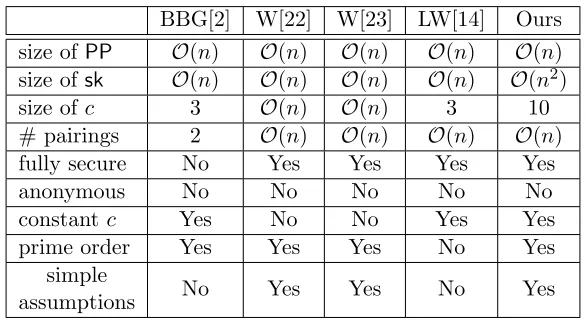
A summary of comparisons of existing HIBE schemes against ours is presented in Table 4, wherendenotes the maximal depth of HIBE.
Table 4: Comparisons between existing HIBE schemes and ours.
BBG[2] W[22] W[23] LW[14] Ours size of PP O(n) O(n) O(n) O(n) O(n) size of sk O(n) O(n) O(n) O(n) O(n2)
size of c 3 O(n) O(n) 3 10
# pairings 2 O(n) O(n) O(n) O(n)
fully secure No Yes Yes Yes Yes
anonymous No No No No No
constantc Yes No No Yes Yes
prime order Yes Yes Yes No Yes
simple
assumptions No Yes Yes No Yes
We note that the HIBE scheme of [14] has short ciphertexts, but it is under composite order bilinear group, which is less efficient.
5.2 Generic Relation between SE, HIPE and Multi-Predicate IPE
We have seen that multi-predicate IPE implies SE under some linear reduction. Although SE implies HIPE, we can also show how to construct HIPE from multi-predicate IPE directly. In fact, interestingly, multi-predicate IPE can be constructed from SE or HIPE under linear or quadratic reduction, respectively. Thus, we have the following relation:
SE
Linear
Linear mIPE
Linear
Quadratic HIPE
These results are shown in Appendix D. Particularly, we obtain a fully secure HIPE scheme under simple assumptions in prime order group with constant size of ciphertexts from the multi-predicate IPE scheme of Section 3.1. We note that if we directly extend the IPE scheme of [1] to HIPE, the size of ciphertexts may be dependent on the depth of the hierarchy.
5.3 Generic Construction of Negated SE from Non-zero IPE
In addition to the generic construction of SE from multi-predicate IPE, we describe a generic construction of a negated SE scheme that requires only a non-zero IPE scheme. This may be of independent interest.
Given a non-zero IPE scheme, denoted as nIP E, with four algorithms: SetupnIP E,
KeyGennIP E, EncnIP E, and DecnIP E, we construct a negated SE scheme, denoted as nSE
• SetupnSE(λ, n): It runsSetupnIP E(λ, n) and outputs public parametersPPand a master key MK.
• KeyGennSE(PP,MK,S): It generates a secret key for an (n −`)-dimensional space
S. It first runs BasisGen(S) and outputs B⊥(S) = {~v1, . . . , ~v`}. It then runs sk~vi =
KeyGennIP E(PP,MK, ~vi) for all i∈[`] and outputs a secret key skS :={sk~v1, . . . ,sk~v`}.
• EncnSE(PP, ~x, m): It runs EncnIP E(PP, ~x, m) and outputs a ciphertext c.
• DecnSE(PP,skS, c): For cassociated with some~x, it selects someisuch that~x·~vi 6= 0.
It runs DecnIP E(PP,sk~vi, c) and outputs a messagem.
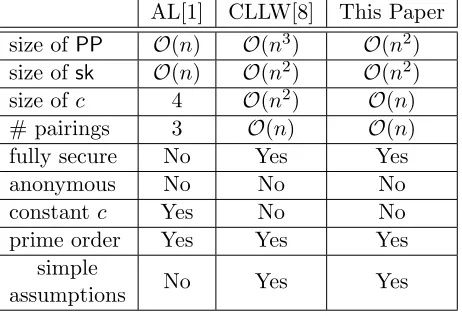
By applying our nIPE-to-nSE transformation techniques, we can obtain a fully secure negated SE scheme under DLIN assumption from the scheme of [18] which has about a factor
O(n) shorter size of public parameters and ciphertexts than the negated SE scheme presented in [8].
Table 5: Comparisons between existing negated SE schemes and ours.
AL[1] CLLW[8] This Paper
size ofPP O(n) O(n3) O(n2) size ofsk O(n) O(n2) O(n2)
size ofc 4 O(n2) O(n)
# pairings 3 O(n) O(n)
fully secure No Yes Yes
anonymous No No No
constantc Yes No No
prime order Yes Yes Yes
simple
assumptions No Yes Yes
6
Open Problem
Existing and our SE schemes are attribute-hiding or have short/constant ciphertexts, but not both. Constructing a fully secure SE, multi-predicate IPE, or HIPE scheme that is attribute-hiding and has short/constant ciphertexts in prime order bilinear groups is still an open problem, particularly one that works under simple assumptions.
References
[1] N. Attrapadung, B. Libert, Functional encryption for inner product achieving constant-size ciphertexts with adaptive security or support for negation. In: P.Q. Nguyen, D. Pointcheval (Eds.) PKC 2010, LNCS 6056, pp. 384-402. Springer, 2010.
[3] D. Boneh, M. Franklin, Identity-based encryption from the weil pairing. In: J. Kilian (Ed.) CRYPTO 2001, LNCS 2139, pp. 213-229. Springer, 2001.
[4] D. Boneh, M. Hamburg, Generalized identity based and broadcast encryption schemes. In: J. Pieprzyk (Ed.) ASIACRYPT 2008, LNCS 5350, pp. 455-470. Springer, 2008.
[5] D. Boneh, A. Sahai, B. Waters, Functional encryption: definitions and challenges. In: Y. Ishai (Ed.) TCC 2011, LNCS 6597, pp. 253-273, Springer, 2011.
[6] C. Cocks, An identity based encryption scheme based on quadratic residues. In: B. Honary (Ed.) Cryptography and Coding 2001, LNCS 2260, pp. 360-363. Springer, 2001.
[7] H. Cohen, A course in computational algebraic number theory. Springer, 1996.
[8] J. Chen, H. W. Lim, S. Ling, H. Wang, The relation and transformation between hi-erarchical inner product encryption and spatial encryption. Cryptology ePrint Archive, Report 2011/455, http://eprint.iacr.org/2011/455/.
[9] D. M. Freeman, Converting pairing-based cryptosystems from composite-order groups to prime-order groups. In: H. Gilbert (Ed.) EUROCRYPT 2010, LNCS 6110, pp. 44-61. Springer, 2010.
[10] V. Goyal, O. Pandey, A. Sahai, B. Waters, Attribute-based encryption for finegrained access control of encrypted data. In: CCS 2006, pp. 89-98. ACM, 2006.
[11] M. Hamburg, Spatial encryption. Cryptology ePrint Archive, Report 2010/389, http://eprint.iacr.org/2011/389
[12] J. Katz, A. Sahai, B. Waters, Predicate encryption supporting disjunctions, polynomial equations, and inner products. In: N. P. Smart (Ed.) EUROCRYPT 2008, LNCS 4965, pp. 146-162. Springer, 2008.
[13] A. Lewko, T. Okamoto, A. Sahai, K. Takashima, B. Waters, Fully secure functional encryption attribute-based encryption and (hierarchical) inner product encryption. In: H. Gilbert (Ed.) EUROCRYPT 2010, LNCS 6110, pp. 62-91. Springer, 2010.
[14] A. Lewko, B. Waters, New techniques for dual system encryption and fully secure IBE and HIBE with short ciphertexts. In: D. Micciancio (Ed.) TCC 2010, LNCS 5978, pp. 455-479. Springer, 2010.
[15] A. Lewko, B. Waters, Unbounded HIBE and attribute-based encryption. Cryptology ePrint Archive, Report 2011/049, http://eprint.iacr.org/2011/049
[16] D. Moriyama, H. Doi, A fully secure spatial encryption scheme. In: IEICE Transactions 94-A(1), pp. 28-35. 2011.
[17] T. Okamoto, K. Takashima, Hierarchical predicate encryption for inner-products. In: M. Matsui (Ed.) ASIACRYPT 2009, LNCS 5912, pp. 214-231. Springer, 2009.
[19] T. Okamoto, K. Takashima, Efficient attribute-based signatures for non-monotone pred-icates in the standard model.In: D. Catalano et al. (Eds.) PKC 2011, LNCS 6571, pp. 35-52. Springer, 2011.
[20] T. Okamoto, K. Takashima, Adaptively Attribute-Hiding (Hierarchical) Inner Product Encryption. Cryptology ePrint Archive, Report 2011/543, http://eprint.iacr.org/2011/543.
[21] E. Shi, B. Waters, Delegating capabilities in predicate encryption systems. In: L. Aceto et al. (Eds.) ICALP 2008, LNCS 5126, pp. 560-578. Springer, 2008.
[22] B. Waters, Efficient identity-based ecnryption without random oracles, In: R. Cramer (Ed.) EUROCRYPT 2005, LNCS 3493, pp. 114-127. Springer, 2005.
[23] B. Waters, Dual system encryption realizing fully secure IBE and HIBE under simple assumptions. In: S. Halevi (Ed.) CRYPTO 2009, LNCS 5677, pp. 619-636. Springer, 2009.
[24] M. X. Zhou, Z. F. Cao, Spatial encryption under simpler assumption. In: J. Pieprzyk, F. Zhang (Eds.) ProvSec 2009, LNCS 5848, pp. 19-31. Springer, 2009.
A
Construction of SE in Affine Spaces
Now, we briefly show how to construct ann-dimensional SE scheme in affine spaces from an (n+ 1)-dimensional SE scheme in Euclidean spaces.
Given an affine space S(M, ~y) = {~zM +~y :~z ∈ Zr
q}, where M ∈ Zrq×n, we embed it in
S((M1,0), . . . ,(Mr,0),(~y,1)) ∈ XSE. Given a vector ~x ∈ Znq, we embed it in (~x,1) ∈ ISE.
Then it is not difficult to check that ~x ∈ S(M, ~y) iff (~x,1) ∈ S((M1,0), . . . ,(Mr,0),(~y,1)).
Moreover, if S(M0, ~y0) is a subspace of S(M, ~y), namely there is some matrix T ∈Zr0×r
q and
vector~z∈Zrq such thatM0 =T M and~y0 =~y+~zM, thenS((M10,0), . . . ,(Mr00,0),(~y0,1)) is a
subspace ofS((M1,0), . . . ,(Mr,0),(~y,1)), and vice versa.
B
Lemmas for Theorem 6
We letGameRealAdvA denote an adversary A’s advantage in the real game.
Lemma 4. Suppose that there exists an adversaryAwhere GameRealAdvA−Game0AdvA=.
Then we can build an algorithmB that has advantage in the DLIN game.
Proof. Our algorithmBreceives an instance (paramG, g, f, ν, gθ0, fθ1, T) of the DLIN problem.
SetupIt picks α, b, yw, yw0, yw1
U
←−Zq,h0, h1, . . . , hn U
←−Gand sets
g=g, w=gyw, w
0 =gyw0, w1 =gyw1, h0 =h0, . . . , hn=hn,
A0=ga0 =f, A1=ga1 =ν, B=gb, B0 =gba0 =fb, B1=gba1 =νb,
τ0=w·w0a0 =w·fyw0, τ1 =w·wa11 =w·fyw1, T0 =τ0b, T1=τ1b, Z =e(g, g)αa0b =e(g, f)αb.
Here,a0, a1 are the exponents that the reduction cannot know itself. Finally,B forwards the public parameters PP to A. We also note that using α it can compute the master key MK
for itself
Key QueriesSince Bhas the actual master secret keyMKit simply runs the key generation to generate the keys in both phases. Note that theMKit has only allows for the creation of normal keys.
Challenge B receives two messages m(0), m(1) and challenge vector ~x∗. It then flips
β←− {U 0,1}. It generates the challenge ciphertext in two steps. First, it generates a normal ciphertext using the real algorithm by callingEnc(PP, ~x∗, m(β)), which outputs a ciphertext
c0 = (C10, . . . , C70, C0, E00, E10,tagc∗). Let s00, s01, t0 be the random exponents used in generating the ciphertext.
Then we modify components of the normal ciphertext as follows and returns ciphertext
c= (C1, . . . , C7, C, E0, E1,tagc∗):
C1=C10 ·(gθ0)b, C2=C20 ·(fθ1)
−b, C
3 =C30 ·(f
−θ1), C
4 =C40 ·Tb,
C5=C50 ·T, C6 =C60 ·(gθ0)
−yw·(fθ1)−yw0 ·Tyw1, C7 =C0
7·((gθ0)yw·(fθ1)
−yw0 ·Tyw1)b,
C=C0·(e(gθ0, f)·e(g, fθ1))αb, E
0 =E00, E1 =E10.
If T is a tuple, then this assignment implicitly sets s0 =−θ1+s00, s1 =s01+θ0+θ1 and
s = s0 +s1 = θ0 +s00 +s01. If T = νθ0+θ1 it will have the same distribution as a normal ciphertext; otherwise, it will be distributed identically to a semi-functional ciphertext. B
receives a bitβ0 and outputs 0 iff β=β0.
Lemma 5. Suppose that there exists an adversary A that makes at most qR queries and Gamek−1AdvA −GamekAdvA = for some k where 1 ≤ k ≤ qR. Then we can build an algorithmB that has advantage in the DLIN game.
Proof. Our algorithmBreceives an instance (paramG, g, f, ν, gθ0, fθ1, T) of the DLIN problem.
Setup B picksα, a0, a1, yw0, yw1, yh0, . . . , yhn
U
←−Zq,~ζ := (ζ1, . . . , ζn) U
←−Zn
q and sets
g=g, w=ν−a0a1, w
0 =νa1 ·gyw0, w1 =νa0·gyw1,
h0=f·gyh0, h1=fζ1·gyh1, . . . , hn=fζn·gyhn,
A0=ga0, A1 =ga1, B =gb =f, B0=gba0 =fa0, B1=gba1 =fa1,
τ0 =w·w0a0 =gyw0a0, τ1=w·w1a1 =gyw1a1,
T0 =τ0b =fyw0a0, T1 =τ1b =fyw1a1, Z =e(g, g)αa0b=e(f, g)αa0.
Next, B forwards the public parametersPP toA. Note that BknowsMK asgα, gαa0.
Key Queries Bbegins by choosing a valuek∗ uniformly at random between 1 and (n−1)qA
and creates a counter µ. Initially,µis set to 0. When either a generate or delegate request is made µis incremented as follows:
• If this is a generate query for a vector set Γ :={~v1, . . . , ~v`}, thenµis incremented by 1
for each vector in Γ one by one.
• Suppose this is a delegate query to delegate from a previous key of a vector set Γ := {~v1, . . . , ~v`} to Γ0 := {~v1, . . . , ~v`0}. Then µ is incremented by 1 for each vector
in{~v`+1, . . . , ~v`0} one by one.
Key Generation is done the same regardless of whether it is phase 1 or 2. Then,Banswers three types of queries as follows:
• Generate: Assume it is a query for Γ :={~v1, . . . , ~v`}. It generates a new child node of
root for Γ. For each vector~vi∈Γ, do
1. It sets µ=µ+ 1.
2. If µ6=k∗, it picks tag values tagki,1, . . . ,tagki,n−1. Otherwise µ=k∗, it computes tag values tagki,1, . . . ,tagki,n−1
U
←− Zq for ~vi := (v1, . . . , vn) by usingn equation
trapdoor as
tagki,1 tagki,2
.. .
tagki,n−1
= v1
vn −1
v2
vn −1
..
. . ..
vn−1
vn −1
ζ1 ζ2 .. . ζn .
3. It associates the tag valuestagki,1, . . . ,tagki,n−1,µ, and~vi to the new node.
• Delegate: Assume it is a query from a previous key of Γ := {~v1, . . . , ~v`} to Γ0 :=
{~v1, . . . , ~v`0}. It generates a new child node of Γ for Γ0. For each vector ~vi ∈
{~v`+1, . . . , ~v`0}, it sets µ = µ+ 1 and generates tag values tagki,1, . . . ,tagki,n−1
simi-lar as key generation queries, which are associated to the new node with µand ~vi.
• Reveal: Banswers the η-th reveal query as follows.
Case 1: η > k
Suppose A ask for the key of Γ to be revealed. Since B has the master key MK, it can generate a normal secret key, using the tag values stored in the node of Γ and its ancestors.
Case 2: η < k
Suppose A ask for the key of Γ to be revealed. It first generates a normal key using
MK and the tag values stored in the node of Γ and its ancestors. Then it makes it semi-functional using ga0a1 and the semi-functional key generation algorithm described
in Theorem 6.
Case 3: η =k
Suppose A ask for the key of Γ := {~v1, . . . , ~v`} to be revealed. If any of the following
events happens then the B aborts the simulation and guesses whether T is a tuple randomly.
– If k∗ is not stored in node of Γ or its ancestors
– IfA has already submitted the challenge vector~x∗, we have~x∗·~vi∗= 0, where~vi∗
has the counter value k∗.
The algorithmBfirst runs the key generation algorithm to generate a normal secret key
Assume~vi∗ := (v1, . . . , vn)∈Γ has the counter valuek∗, it then sets
D1=D10 ·T−a0·a1, D2 =D02·Ta1 ·(gθ0)yw0, D3 =D03·(fθ1)yw0,
D4=D40 ·Ta0·(gθ0)yw1, D5=D50 ·(fθ1)yw1, D6=D60 ·fθ1,
D7=D70 ·(gθ0), fori∈[`]\{i∗} we set :
Ki,0 =Ki,00, Ki,j =Ki,j0 forj∈[n−1],
fori=i∗ we set :
Ki∗,0=Ki0∗,0·(gθ0), Ki∗,j =Ki0∗,j·(gθ0)−yhn(vi/vn)+yhi+yh0tagki∗,j forj∈[n−1],
If T = νθ0+θ1, then k-th reveal query results in a normal key under randomness r 0 =
r00+θ1, ri = ri0 for i ∈ [`]\{i∗}, ri∗ =r0
i∗+θ0, z0 =z00 −yw0θ1, and z1 = z10 −yw1θ1.
Otherwise, ifT is a random group element, then we can writeT =νθ0+θ1·gγfor random
γ ∈Zq. This forms a semi-functional key where γ is the added randomness to make it
semi-functional.
ChallengeBreceives two messagesm(0), m(1)and challenge vector~x∗. Ifµ≥k∗and~x∗·~vi∗=
0 then the Baborts the simulation and guesses whetherT is a tuple randomly, where~vi∗ has
the counter value k∗. Otherwise, it picks β ←− {U 0,1} and computes the tagc∗ = −h~x∗, ~ζi
for which Bwill be able to prepare the semi-functional ciphertext. It generates the challenge ciphertext in two steps. First, it generates a normal ciphertext using the real algorithm by calling Enc(PP, ~x∗, m(β)), which outputs a ciphertext c0 = (C10, . . . , C70, E00, E01, E20,tagc∗) by using random exponents s00, s01, t0. Then B picksχ←−U Zq and computes
C1 =C1, C2 =C20 C3 =C30, C4 =C40 ·fa1χ,
C5 =C50 ·ga1χ, C6 =C60 ·w
a1χ
1 , C7 =C70 ·ν
−yh0a0a1χ·fyw1a1χ,
C=C0, E0 =E00 ·νa0a1χ, E1=E01·(νyh0tagc ∗+h~x∗,~δi
)a0a1χ.
We claim that c = (C1, . . . , C7, E0, E1, E2,tagc∗) is a semi-functional ciphertext with underlying exponents χ, s0 = s00, s1 = s01 and t = t0 + logg(ν)a0a1χ. One can check it as in Lemma 2 of [1]. Also it can show that tagc∗,tagki∗,1, . . . ,tagki∗,n−1 are still n-wise
independent. But this holds since their relations form a system
M·~ζ :=
−v1
vn 1
−v2
vn 1
..
. . ..
−vn−1
vn 1
x1 x2 x3 . . . xn
ζ1 ζ2 .. . ζn =−
tagki∗,1
tagki∗,2
.. .
tagki∗,n−1
tagc∗
which has a solution in ~ζ whenever det(M) = (−1)n+1~x∗·~vi∗/vn6= 0. Since all the other tags
of the k-th reveal key are randomly chosen, all the tags are independent in A’s view. Eventually,B receives a bitβ0 from Aand outputs 0 iffβ =β0.
The reduction will not abort 1/(n·qA) amount of the time and the abort condition will