Comments of an efficient and secure
multi-server authentication scheme with key
agreement
Yitao Chen
School of Mathematics and Statistics, Wuhan University, Wuhan, People’s Republic of China
Email: [email protected]
Abstract: Recently, Tsaur et al. proposed an authentication scheme for multi-server
environments and claimed their scheme could withstand various attacks. In this letter, we will
point out that Tsaur et al. scheme is not suitable for multi-server environments since the user has to
register for every server. Furthermore, we will show Tsaur et al. scheme is vulnerable to the
password guessing attack and the privileged insider attack.
Key words: multi-server, password authentication protocol, smart card, password
change, key agreement
1. Introduction
The authentication protocols using smart cards are widely used in the network communication. To satisfy the application in multi-server environments, the authentication scheme for multi-server environments was proposed. Recently, Tsaur et al. [1] proposed an authentication scheme for multi-server environments and claimed their scheme could withstand various attacks. In this paper we will show Tsaur et al.’s scheme is not suitable for multi-server environments. We also show Tsaur et al.’s scheme is vulnerable to the password guessing attack and the privileged insider attack.
The organization of the letter is sketched as follows. The Section 2 gives a brief review of Tsaur et al.’s scheme. The weanesses of Tsaur et al.’s scheme are shown in Section 3. Finally, we give some conclusions in Section 4.
2. Tsaur et al.’s scheme
z Ek( )⋅ : The encryption function with secret key k; z Dk( )⋅ : The decryption function with secret key k; z : The bitwise exclusive-or operator;
z ||: The concatenation operator;
z h( )⋅ : A one-way and collision-free hash function; z RC: The registration center;
z Sj: The jth server; z Ui: The ith user;
z x: The secret key of the registration center; z SIDj: The jth server’s identity;
z UIDi: The ith user’s identity;
z wj: The secret key shared between RC and Sj; z PWi: The ith user’s password;
z E T_ ij: The service period of Sj for Ui; z v ui, i: Ui’s secret information;
z vij: The secret key shared between Ui and Sj; z Aij: The authentication parameter for Ui to log in Sj; z ruk: A kth random value chosen by the smart card; z Mij: An authentication message for Ui to log in Sj; z rsk: The kth random value chosen by Sj;
z skk: The kth session key; z T: A timestamp;
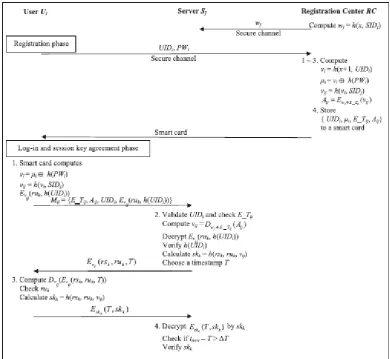
2.1. Registration phase
Suppose that user Ui want to get service granted from the server Sj. Ui first chooses his/her identity UIDi and password PWi, and then sends them to
RC via a secure channel. RC will perform the following steps:
3) RC stores UIDi, ui, E T_ ij and Aij to the memory of a smart card and issue this smart card to Ui.
2.2. Password authentication phase
Once the client A wants to login to the server S, he will perform the following login steps.
1) The user Ui inputs his identity password PWi into the terminal. The smart card generates a random number ruk , computes vi = ⊕ui h PW( i) ,
( , )
ij i j
v =h v SID and ( , ( )) ij
v k i
E ru h UID . Then Ui sends the message
1 { _ ij, ij, i, vij( k, ( i))}
M = E T A UID E ru h UID to Sj.
2) Upon receiving the message M1 , Sj computes _ ( ) i ij ij w E T ij
v =D ⊕ A ,
decrypts ( , ( )) ij
v k i
E ru h UID and verifies the correctness of (h UIDi). Then Sj generates a random number rsk, chooses a timestamp T and computes the session key skk =(rs ru vk, k, ij). At last, Sj sends 2 { ( , , )}
ij
v k k
M = E rs ru T .
3) Upon receiving the message M2 , Ui decrypts ( , , ) ij
v k k
E rs ru T and
checking the correctness of ruk. If ruk is correct, Ui computes the session key
( , , )
k k k ij
sk = rs ru v and sends 3 { ( , )} k
sk k
M = E T sk to Sj.
4) Upon receiving the message M3, Sj decrypts Eskk( ,T skk) using skk. The Sj checks whether the freshness of T by checking whether tnew− > ΔT T.
Fig. 1. Work flow of Tsaur et al.’s scheme
3. Weaknesses of Tsaur et al.’s scheme
In this section, we will show Tsaur et al.’s scheme is not suitable for the multi-server environment since the user has to register to every server. We also show Tsaur et al.’s scheme is vulnerable to the password guessing attack and the privileged Insider attack.
3.1 No single registration
3.2. Password guessing attack
Kocher et al. [2] and Messerges et al. [3] have pointed out that all existent smart cards are vulnerable in that the confidential information stored in the device could be extracted by physically monitoring its power consumption; once a card is lost, all secrets in it may be revealed. To evaluate the security of smart card based user authentication, we assume the capabilities that an adversary A may have as follows:
1) The adversary has total control over the communication channel between the users and the server in the login and authentication phases. That is, A may intercept, insert, delete, or modify any message in the channel.
2) A may (i) either steal a user's smart card and then extract the information from it, (ii) or obtain a user's password, (iii) but not both (i) and (ii).
Suppose an adversary A has stolen Ui's smart card and extracted the stored values UIDi , ui , _E Tij and Aij , where vi =h x( +1,UIDi) ,
( )
i i i
u = ⊕v h PW , ( ,vij =h v SIDi j) and _ ( ) i ij ij w E T ij
A =E ⊕ v . Then the attacker A could impersonate Ui to login in the server by performing the following procedure.
1) A collects a message 1 { _ , , , ( , ( ))} ij
ij ij i v k i
M = E T A UID E ru h UID
transmitted between Ui and Sj.
2) A guesses a password PWi′ , computes vi′= ⊕vi h PW( i′) and
( , )
ij i j
v′ =h v SID′ .
3) A gets ruk′ and (h UIDi)′ by decrypting ( , ( )) ij
v k i
E ru h UID .
4) A checks whether (h UIDi)′ and (h UIDi) are equal. If they are equal, A finds the correct password. Otherwise, A repeats 1)-4) until finding the correct password.
From the above description, we know the adversary can get the password. Therefore, Tsaur et al.’s scheme is vulnerable to the password guessing attack.
3.3. Privileged Insider attack
remembering long passwords and ease-of-use whenever required [4]. However, if the system manager or a privileged insider A of the register centre R C knows the passwords of user Ui, he may try to impersonate Ui by accessing other servers where Ui could be a registered user. In the user registration phase of Tsaur et al.’s scheme, Ui sends the password PWA to R C . Then, the privileged-insider of R C could get the password easily. Therefore, Tsaur et al.’s scheme is vulnerable to the privileged insider attack.
4. Conclusion
Recently, Tsaur et al. proposed an authentication scheme for multi-server environments and demonstrated its immunity against various attacks. However, after review of their scheme and analysis of its security, three kinds of weaknesses are presented in different scenarios. The analyses show that the scheme is insecure for practical application.
Reference
[1]. Tsaur, W.-J., et al., An efficient and secure multi-server authentication scheme with key
agreement. J. Syst. Software (2011), doi:10.1016/j.jss.2011.10.049
[2]. P. Kocher, J. Jaffe, B. Jun, Differential power analysis, Proc. Advances in Cryptology
(CRYPTO'99), (1999) 388–397.
[3]. T.S. Messerges, E.A. Dabbish, R.H. Sloan, Examining smart card security under the threat of
power analysis attacks, IEEE Transactions on Computers 51 (5) (2002) 541–552.
[4]. H.C.Hsiang, W.K. Shiha, Improvement of the secure dynamic ID based remote user
authentication next term scheme for multi-server environment, Computer Standards &