Available Online at www.ijcsmc.com
International Journal of Computer Science and Mobile Computing
A Monthly Journal of Computer Science and Information Technology
ISSN 2320–088X
IJCSMC, Vol. 4, Issue. 9, September 2015, pg.192 – 198
RESEARCH ARTICLE
FRACTAL TEXTURE BASED
IMAGE CLASSIFICATION
R.Ilackiya
1, Dr. K.Perumal
2¹Scholar, Department of Computer Center, Madurai Kamraj University, Madurai, India
²Associate Professor, Department of Computer Center, Madurai Kamraj University,Madurai, India
1 [email protected]; 2 [email protected]
Abstract— In recent years, Fractal Geometry is used or applied in image processing. Fractal geometry is accurate to displaying a modelling of nature texture in a digital image. This paper presents texture feature extraction method ie) Segmentation Based Fractal Texture Analysis or SFTA.A SFTA analysis is used to extracting or classify different textures images. The Extraction algorithm is mainly used to decompose the input image into set of binary images since fractal dimensions resulting regions are computed to describe segmented texture patterns. The classification is performed by agglomerative hierarchical cluster tree with Inner squared distance method.
Keywords: Fractal Geometry,Texture, Texture extraction, Segmentation Based Fractal Texture Analysis or SFTA, Agglomerative hierarchical cluster.
I. INTRODUCTION
Segmentation plays a vital role in all kinds of image analysis. Segmentation means splitting
the images into meaningful regions .Texture segmentation[1] is a process to segregate an
image into homogenous regions and to identify interested regions of object .There are two
types, supervised or unsupervised. Supervised texture segmentation is the system has models
of textures to be encountered in the images to be segmented. Unsupervised texture
segmentation is dividing an image into regions of similar texture without a priori information
Mainly Texture characterization is used for fractal dimension. There are two separate
methods. First it is estimated based on the average intensity difference of the pixels within the
region of interest. In second method, the fractal dimension is determined from the Fourier
power spectrum of the image data. Fractal dimension looks as good in describing many
natural textures.
Texture plays an important role such as surface inspection, scene classification, and surface
orientation and shape determination.
Texture classification can be divided into 3 phases
Extracting texture features
Training a classifier
Classification of an unlabelled texture image
Texture analysis is important in many applications of computer image analysis for
classification or segmentation of images. Segmentation needed an efficient description of
image texture. Industrial and biomedical surface inspection is a applications of texture
analysis.
For example for defects and disease, ground classification and segmentation of textured
regions in document analysis segmentation of satellite or aerial imagery, and content-based
access to image databases.
There are main four issues in texture
Analysis[2]:
Feature Extraction
Texture Discrimination
Texture Classification
Shape From Texture
The first stage of image texture analysis is Feature Extraction. Next stage is results obtained
II. LITERATURE SURVEY
AzmiTawfik Alrawi, Ali makki Sagheer and Dheyaa Ahmed Ibrahim,[1]has proposed
multitexture segmentation. The author describes to implement a novel supervised algorithm
for multitexture segmentation and this algorithm based on blocking procedure where each
image divide into block (16×16 pixels) and extract vector feature for each block to
classification these block based on these feature. These feature extract using Box Counting
Method (BCM). BCM generate single feature for each block and this feature not enough to
characterize each block ,therefore, must be implement algorithm provide more than one slide
for the image based on new method produce multithresolding, after this use BCM to generate
single feature for each slide.
Alceu Ferraz Costa, Gabriel Humpire-Mamani, Agma Juci Machado Traina[3] has proposed
we propose a Segmentation-based Fractal Texture Analysis, or SFTA.
The author describes Segmentation-based Fractal Texture Analysis, or SFTA.The extraction
algorithm consists in decomposing the input image into a set of binary images from which the
fractal dimensions of the resulting regions are computed in order to describe segmented
texture patterns. The decomposition of the input image is achieved by the Two- Threshold
Binary Decomposition (TTBD) algorithm. We evaluated SFTA for the tasks of content-based
image retrieval (CBIR) and image classification, comparing its performance to that of other
widely employed feature extraction methods such as Haralick and Gabor filter banks. SFTA
achieved higher precision and accuracy for CBIR and image classification. Additionally,
SFTA was at least 3.7 times faster than Gabor and 1.6 times faster than Haralick with respect
to feature extraction time.
III.TEXTURE ANALYSIS METHODS
It can be categorised into four types
Structural Method
It represents texture by well-defined primitives and a hierarchy of spatial arrangements of
those primitives. It provides a good symbolic description of the image but this feature is
more useful for synthesis than analysis tasks. This is the advantage of structural approach. A
powerful tool is provided by mathematical morphology. It also useful for bone image analysis,
Statistical Method
Statistical approaches[2] is contrast to structural methods, do not attempt to understand
explicitly the hierarchical structure of the texture. It is mostly used in bio medical images
Model-Based Method
Model based texture analysis using stochastic and fractal models. The parameters of the
model are estimated and then used for image analysis. The fractal model is useful for
modelling some natural textures. And also used for texture analysis and discrimination.
Transform Method
Fourier , Gabor and wavelet transforms are the transform methods .It represents an image in
a space whose co-ordinate system has an interpretation that is closely related to the
characteristics of a texture (such as frequency or size).
IV.RELATED WORKS
A segmentation-based fractal texture analysis is used to classify different image textures[3].
The Extraction algorithm is mainly used to decompose the input image into set of binary
images since fractal dimensions resulting regions are computed to describe segmented texture
patterns. The classification is performed by agglomerative hierarchical cluster tree with Inner
squared distance method.
Symbol Definition
I Grayscale image.
Ib Binary image.
Δ Border image.
nl Grey level range.
T Set of threshold values.
Nt Number of thresholds.
D Fractal dimension.
D0 Haussdorf fractal dimension.
_ Box size in the box counting
Algorithm.
TABLE OF SYMBOLS
Table 1
SFTA Extraction Algorithm
Needed: Grayscale image I and number of thresholds nt.
Ensure: Feature vector VSFTA.
1: T ← MultiLevelOtsu(I,nt)
2: TA ← {{ti, ti+1} : ti, ti+1 ∈ T, i ∈[1..|T| − 1]}
3: TB ← {{ti, nl} : ti ∈ T, i ∈[1..|T|]}
4: i ← 0
5: for {{t_, tu} : {t_, tu} ∈ TA ∪ TB} do
6: Ib ← TwoThresholdSegmentation(I, t_, tu)
7: Δ(x, y) ← FindBorders(Ib)
8: VSFTA[i] ← BoxCounting(Δ)
9: VSFTA[i + 1] ← MeanGrayLevel(I, Ib)
10: VSFTA[i + 2] ← PixelCount(Ib)
11: i ← i + 3
12: end for
13: return VSFTA
V. RESULTSANDDISCUSSION
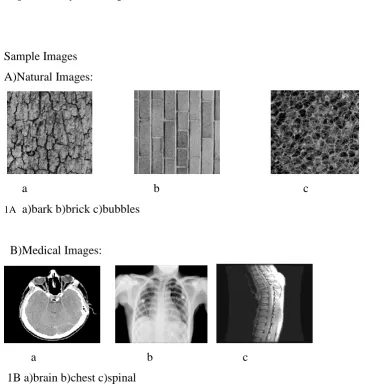
Step: 1 First we create a database with any images (Both natural and medical images). It is
collection of 13 different images. These were 512×512 pixels images with 256 grey levels per
pixel, followed by a histogram equalization process[4]. The image is a 512×512 image with
8-bits (256 grey levels) per pixel.
Step: 2 Next it is implementing in matlab.
Step: 3 The process is extracting the images one by one. They take seconds for extracting the
images.
Step:4 Then clustering will be done. The Agglomerative hierarchical cluster tree with Inner
squared distance method are used in the research
Xn - Feature Matrix
C - Maximum number of Clusters
Step :5 Finally, the image is classified.
Sample Images
A)Natural Images:
a b c
1A a)bark b)brick c)bubbles
B)Medical Images:
a b c
1B a)brain b)chest c)spinal
Figure 1 (A) (B)Sample images from the SFTAdataset.
The segmentation-based fractal texture analysis is used to classify different image textures.
Conclusion
In this paper, we proposed a feature extraction algorithm; the Segmentation based Fractal
Texture Analysis (SFTA).In these algorithms there are 13 textures are used. First we can
clustering 13 textures. So it can reduce the processing time. The SFTA is used both at
References:
1. “Texture Segmentation Based on Multifractal Dimension”, AzmiTawfik Alrawi, Ali makki Sagheer and Dheyaa Ahmed Ibrahim, International Journal on Soft Computing ( IJSC ) Vol.3, No.1, February 2012.
2. “Texture Analysis Methods – A Review” Andrzej Materka and Michal Strzelecki ,Technical University
of Lodz, Institute of Electronics, COST B11 report, Brussels 1998.
3. “An Efficient Algorithm for Fractal Analysis of Textures”Alceu Ferraz Costa, Gabriel Humpire-Mamani, Agma Juci Machado Traina , Patterns and Images, 2012 25th SIBGRAPI Conference on Graphics.
4. “The USC Texture Mosaic Images “ ,Allan G. Weber Signal and Image Processing Institute,
USC-SIPI web site (http://sipi.usc.edu).
5. “Texture classification”,T Ojala and M Pietikäinen Machine Vision and Media Processing
Unit,Finland.
6. R. M. Haralick, K. Shanmugam, and I. H. Dinstein, “Textural Features for Image Classification,” IEEE
Transactions on Systems, Man and Cybernetics, vol. 3, no. 6, pp. 610–621, 1973.
7. P. Liao, T. Chen, and P. Chung, “A Fast Algorithm for Multilevel Thresholding,” Journal of Information Science and Engineering, vol. 17,no. 5, pp. 713–727, 200
8. Y. Q. Chen and M. S. Nixon, “Statistical geometrical features for texture classification,” Pattern Recognition, vol. 28, no. 4, pp. 537–552, 1995.
9. X. Wang, X. Ding, and C. Liu, “Gabor filters-based feature extraction for character recognition,” Pattern Recognition, vol. 38, no. 3, pp. 369–379, 2005.
10. R. M. Rangayyan and T. M. Nguyen, “Fractal analysis of contours of breast masses in mammograms,”
Journal of Digital Imaging, vol. 20, no. 3, pp. 223–37, Sep. 2007.
11.K. I. Laws, Textured Image Segmentation. PhD thesis, University of Southern California, 1980. USCIPI Report 940.