AN EFFICIENT PARALLEL ALGORITHM FOR SKEIN HASH FUNCTIONS
K´evin Atighehchi, Adriana Enache, Traian Muntean, Gabriel RisterucciERISCS Research Group Universit´e de la M´editerran´ee
Parc Scientifique de Luminy-Marseille, France email: [email protected]
ABSTRACT
Recently, cryptanalysts have found collisions on the MD4, MD5, and SHA-0 algorithms; moreover, a method for find-ing SHA1 collisions with less than the expected calculus complexity has been published. The NIST [1] has thus de-cided to develop a new hash algorithm, so called SHA-3, which will be developed through a public competition [3]. From the set of accepted proposals for the further steps of the competition, we have decided to explore the design of an efficient parallel algorithm for the Skein [12] hash func-tion family. The main reason for designing such an algo-rithm is to obtain optimal performances when dealing with critical applications which require efficiently tuned imple-mentations on multi-core target processors. This prelimi-nary work presents one of the first parallel implementation and associated performance evaluation of Skein available in the literature. To parallelize Skein we have used the tree hash mode in which we create one virtual thread for each node of the tree.
KEY WORDS
Skein, SHA-3, parallel cryptographic algorithms, secure communicating systems.
1
Introduction
Skein [12] is a new family of cryptographic hash functions which is one of the candidates in the SHA-3 competition [15]. Its design combines speed, security, simplicity, and a great deal of flexibility in a modular package.
In 2005, security flaws were identified in SHA-1 [16][2], indicating that a stronger hash function is highly desirable. The NIST [1] then published four additional hash functions in the SHA family, named after their digest length (in bits): SHA-224, SHA-256, SHA-384, SHA-512. These are known as the SHA-2 family which does not share the weakness of SHA-1.
The SHA-3 project was announced in November 2007 and was motivated by the collision attacks on com-monly used hash algorithms (MD5 and SHA-1). The new hash function is not linked to its predecessor, so that an attack on SHA-2 is unlikely to be applicable to SHA-3.
Since the new proposals are intended to be a drop-in replacement for the SHA-2 family of algorithms, some properties of the SHA-2 family must be preserved. How-ever, some new properties and features shall be provided
by SHA-3: it may be parallelizable, more suitable for cer-tain classes of applications, more efficient to implement on actual platforms, or may avoid some of the incidental generic properties (such as length extension) of the Merkle-Damgard construct ([10] [9]) that often results in insecure applications.
This paper describes sequential and parallel algo-rithms for Skein cryptographic hash functions, and the analysis, testing and optimization thereof. Our approach for parallelizing Skein uses the tree hash mode which cre-ates one virtual thread for each node of the tree, thus providing a generic method for fine-grain maximal paral-lelism.
The paper is structured as following: Section 2 and 3 give a brief description of Skein and a detailed descrip-tion of the associated Tree Mode, the Secdescrip-tion 4 presents the potential approaches for parallelism. Then we present the work done for parallelizing the hash algorithm: speedup, implementation description, testing and first elements of performance evaluation for basic platforms parallel im-plementations. Finally, some recommendations for future work are given in the last chapter.
2
Brief description of Skein
The structure of the Skein algorithm (Unique Block Itera-tion, UBI chaining) has its origin in the Sponge hash func-tions [7][8].
Definition [8]: LetAbe an alphabet group which rep-resents both input and output characters and letCbe a finite set whose elements represent the inner part of the state of a sponge. A sponge function takes as input a variable-length stringpof characters ofAthat does not end with0and pro-duces an infinite output stringzof characters ofA. It is determined by a transformationfofA×C.
Skein acts like a sponge function: it takes a variable length string of characters as its input and produces an infi-nite output string (it can generate long output by using the threefish block cipher in counter mode). The capacity of the sponge function is replaced in Skein by a tweak which is unique for each block.
chaining value for the UBIs of the output function is the same, while in the sponge function it depends on the previ-ous state.
Skein also has a configuration block that is processed before any other blocks.
The hash functions in the Skein family use three dif-ferent sizes for internal state : 256, 512 and 1024 bits:
• Skein-512: the primary proposal; it should remain se-cure for the foreseeable future.
• Skein-1024: the ultra-conservative variant. If some future attack managed to break Skein-512, it should remain secure. Also, with dedicated hardware it can run twice as fast as Skein-512.
• Skein-256: the low memory variant. It can be imple-mented using about 100 bytes of memory.
Skein uses Threefish as a tweakable block cipher, with the UBI chaining mode to build a compression func-tion that maps an arbitrary input size to a fixed output size. For instance, Figure 6 shows a UBI computation for Skein-512 on a 166-byte (three blocks) input, which makes three calls to Threefish-512.
The core of Threefish is a non-linear mixing func-tion called MIX that operates on two 64-bit words. This cipher repeats operations on a block a certain number of rounds (72 for Threefish-256 and Threefish-512, 80 for Threefish-1024), each of these rounds being composed of a certain number of MIX functions (2 for Threefish-256, 4 for Threefish-512 and 8 for Threefish-1024) followed by a permutation. A subkey is injected every four rounds. For a parallel implementation, each mix operation could be assigned to one thread since, for a given round, they operate on different 128-bit blocks. In theory, we could achieve a maximum speedup of 2 with Threefish-256, 4 with Threefish-512 and 8 with Threefish-1024 provided that, at each round, waiting times (for instance for schedul-ing) between threads are negligible, a permutation being performed at the end of each round.
Skein is built with three basic elements: the block ci-pher (Threefish), the UBI, and an argument (containing a configuration block and optional arguments). The config-uration block is mainly used for tree hash, while optional arguments make it possible to create different hash func-tions for different purposes, all based on Skein.
Skein can work in two modes of operation, which are built on chaining the UBI operations:
• Simple hash: Takes a variable sized input and returns the corresponding hash. It is a simple and reduced version of the full Skein mode. For instance, with a hash process where the desired output size is equal to the internal state size it consists of three chained UBI functions, the first processes the configuration string, the second the message and the last is used to supply the output.
• Full Skein: The general form of Skein admits key pro-cessing, tree hashing and optional arguments (for ex-ample, personalization string, public key, key identi-fier, nonce, and so on). The tree mode replaces the single UBI call which processes the message by a tree of UBI calls.
The result of the last UBI call (the root UBI call in the case of tree processing) is an input to the Output function which generates a hash of desired size.
The followings sections recall the two modes of Skein intended to be widely used, the Simple Hash mode and the Hash Tree mode, a mode specifically designed for parallel implementations (see [12] for more information).
3
Simple Hash Mode
3.1 Specification
A simple Skein hash computation has the following inputs: Nb The internal state size, in bytes (32,64or128).
No The output size, in bits.
M The message to be hashed, a string of up to299−8 bits (296−1bytes).
LetC be the configuration string for whichYl = Yf =
Ym= 0. We define:
K′ := 0Nb a string ofN
bzero bytes (1)
G0 := U BI(K′, C, T
cf g2120) (2)
G1 := U BI(G0, M, Tmsg2120) (3)
H := Output(G1, No) (4)
whereH is the result of the hash.
If the three parametersYl,Yf andYmare not all 0,
then the straight UBI operation of the equation (3) is re-placed by a tree of UBI operations as defined in the Section 4.1.
3.2 Remarks
4
Hash Tree Mode
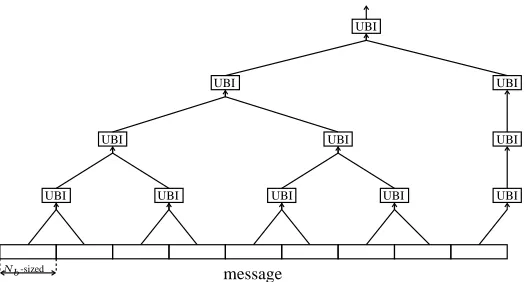
4.1 SpecificationTree processing varies according to the following input pa-rameters:
Yl The leaf size encoding. The size of each leaf of the
tree isNl =Nb2Yl bytes withYl ≥ 1(whereNb is
the size of the internal state of Skein).
Yf The fan-out encoding. The fan-out of a tree node is
2Yf withY
f ≥ 1. The size of each node is Nn =
Nb2Yf.
Ym The maximum tree height;Ym ≥2. If the hieght of
the tree is not limited this parameter is set to255. G0 The input chaining value and the output of the
previ-ous UBI function. M The message data.
UBI UBI UBI UBI UBI
UBI UBI UBI
UBI UBI
UBI
message
Nb-sized
Figure 1: Tree hashing withYl=Yf = 1
We define the leaf sizeNl=Nb2Yland the node size
Nn=Nb2Yf.
We first split the messageM into one or more mes-sage blocksM0,0, M0,1, ..., M0,k−1, each of sizeNlbytes
except the last, which may be smaller. We now define the first level of tree hashing by:
M1=
k−n1
i=0
UBI(G0, M0,i, iNl+ 1·2112+Tmsg·2120)
The rest of the tree is defined iteratively. For any levell= 1,2, ...we use the following rules:
1. IfMlhas lengthNb, then the resultG0is defined by
G1=Ml.
2. IfMlis longer thanNbbytes andl=Ym−1, then we
have almost reached the maximum tree height. The result is then defined by:
G1= UBI(G0, Ml, Ym·2112+Tmsg·2120)
3. If neither of these conditions holds, we create the next tree level. We split Ml into blocks
Ml,0, Ml,1, ..., Ml,k−1, where all blocks are of size
Nn, except the last which may be smaller. We then
define: Ml+1=
k−n1
i=0
UBI(G0, Ml,i, iNn+(l+1)·2112+Tmsg·2120)
and apply the above rules toMl+1again.
The resultG1is then the chaining input to the output transformation.
4.2 Sequential implementation
The straightforward method would consist of implement-ing this algorithm as it is described in its specifications. This implementation constitutes a scheduling method for the node processing that we call Lower level and leftmost
node first (or Lower level node first for short). Such an
implementation has the disadvantage of consuming a lot of memory. For instance if we takeYl = 1, we need an
amount of avalaible memory space of up to half of the message size, which may be impossible for long messages. There is an effective algorithm (see [13]) which computes a value of a node of heighth, while storing only up toh+ 1
hash values. The idea is to compute a new parent hash value as soon as possible before continuing to compute the lower level node hash values; we call this method
heigher level node first. The interest of this method, which maintains a stack in which the intermediate values are stored, is to rapidly discard those that are no longer needed. This stack, which is initially empty, is used as follows: we use (push) leaf values one by one from left to right and we check at each step whether or not the last two values on the stack are of the same height. If such is the case, these last two values are popped and the parent hash value is computed and pushed onto the stack, otherwise we continue to push a leaf value and so on. Note that we could use a two hash-sized buffer at each level (from 1 to h) instead of a unique stack, even though it is useless in such a sequential implementation. This algorithm can be applyed to Skein trees, in which case the memory consumption does not exceed(h−1)(2Yf −1) + 2Ylblocks of sizeN
b
for the computation of a node of heighth, on the condition that we include a special termination round since they are not necessarily full trees (as we can see in Figure 1).
We assume the existence of the following elements: • oracles:
– S(n)which returns the node value.
– LEAF CALC(l) which returns a pair of ele-ments(S(nl), t)where S(nl)is the leaf value
(aNb-sized block of the message) andta binary
– T OP N U M BER(s)which returns the number of top nodes on the stack of equal height. – SIZE(s)which returns the number of staked
nodes. • variables:
– l: a counter which starts from 0, the leftmost leaf.
– np: the number of nodes processed. – cl: the current level.
– t: the termination variable
– Dl: the internal node degree at level1.
– Dn: the internal node degree at level>1.
– s: the stack.
• other notation: nl,np,nr,nidenote respectively a
leaf node, a parent node, a root node and thei-th child of a parent node.
Then the Algorithm 1 describes the message process-ing stage with Skein tree hashprocess-ing.
5
Approaches for parallelism
In the following sections, we denote n the number of blocks1 of the message and N
t the number of threads.
These threads are then indexed0,1, ..., Nt−1.
We assume thatk1 = k = n
2Yl
is the number of Nb-sized blocks of level 1. We define a recursive sequence
starting at an initial valuek2by
k2=
k
2Yf
andki=
ki−1
2Yf
.
There exists an indexvfor whichkv = 1. The tree height
is thenp= min(v, Ym). The bytes string produced at level
iof the tree (except the base leveli= 0) can be split into kiblocksMi,0, Mi,1, Mi,2, ..., Mi,kiof sizeNb.
5.1 Addressing parallelism
Two possible ways to address parallelism can be applied: (i) a deterministic way, in which a thread with index j must take into account, at the current step, the predictable behavior of the threads 0,1,2, ..., j −1; and (ii) a non-deterministic way, in which the first node whose child val-ues are available is assigned to the first ready thread. The meaning of the term first depends on the strategy adopted to parallelize this algorithm as described bellow. The fol-lowing sections illustrate several methods.
Algorithm 1 Skein tree hashing using a stack
1: Setl= 1,np= 0,cl= 1,t= 0,Dl= 2Yl,Dn= 2Yf
ands= [ ].
2: ifcl < Ym−1and(t6= 0or(T OP N U M BER(s) =
Dl and cl = 1) or (T OP N U M BER(s) =
Dnandcl >1))then
3: ComputeN =T OP N U M BER(s)
4: fori=N−1to0do
5: PopS(ni)froms
6: end for
7: ConcatenateS=fN−1
i=0 S(ni)
8: ComputeS(np) = UBI(G, S,(np−N)·Nb+cl·
2112+T
msg·2120)
9: PushS(np)ontos
10: ifcl= 1then
11: Computenp=lnpDlm
12: else
13: Computenp=lDnpnm
14: end if
15: Incrementcl
16: else
17: Compute(S(nl), t) =LEAF CALC(l)
18: PushS(nl)ontos
19: Setnp=l
20: Setcl= 1
21: Incrementl
22: end if
23: ComputeR=T OP N U M BER(s)
24: ift6= 0andR=SIZE(s)andcl >1then
25: fori=R−1to0do
26: PopS(ni)froms
27: end for
28: ConcatenateS=fRi=0−1S(ni)
29: ComputeS(nr) = UBI(G, S, cl·2112+Tmsg·2120)
30: ReturnS(nr)
31: else
32: Loop to line 2
33: end if
5.2 Lower level node priority
This method consists in processing the tree levels succes-sively. It should, in theory, offer the best performances due to the (almost) absence of synchronization between threads, apart from synchronization due to dependencies between worker threads and main thread which provides the input data. An example is shown in Figure 2, in which a job is indexed asijwhereidenotes the iteration step and
j the index of the assigned thread. If one counts the jobs on each level from left to right, then we can assign a job j to a thread indexedj modNt. This method, although
intended to get the best performances, has the drawback of requiring huge amount of memory as explained above.
1When it is not specified, the blocks are of sizeNbbytes and we
7
3
11 12 13
52 51 71 81 91 82 73 4 53
2 2 2
1 6
74
4 2
1 2 3
6 6 6
2 1
2
4
5
24 31 3 33 34 4 4 43 4
1
2 4
Figure 2: Lower level node first (Yf =Yl= 1, Ym= 255, Nt= 4)
For an implementation, worker threads could wait for themselves when the end of the tree level is reached. This does not minimize the number of steps. Indeed, at the same iteration it is possible to assign the last nodes of levelito the first threads and the first nodes of level i+ 1to the last threads2, when the number of nodes of leveli is not
a multiple ofNt. Note that the other methods described
hereafter do not seem to offer the opportunity to gain a few steps in order to optimize speed.
5.3 Higher level node priority
3 5
1 1
1 12
2 22 1
1
1
3
23
13 14
3
4
2 3 3 4 4 44 1 6 1 7 1 1 53
7 81 6 11 10 9 2 2 6 2 5 41 2
4 2 3 54 63 4 73
Figure 3: Higher level node first (Yf =Yl= 1, Ym= 255, Nt= 4)
This method consists in assigning3 to a thread the
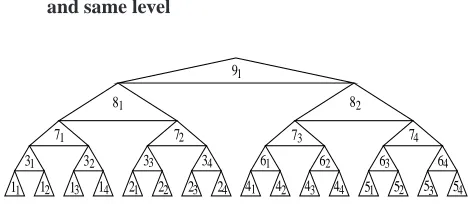
higher level node among all those that may be assigned to it. Apply this method in a deterministic way need that each thread maintains a vector describing, at each step, the number of nodes that can be processed on each level tak-ing into account the tasks performed by all threads. Thus, knowing the state of the tree, a thead indexed0will choose the higher level node, a thread indexed1 will choose the second higher level node, and so on (an example is shown in Figure 3). Apply this method in a non-deterministic way means that the higher level node whose child values are avalaible is assigned to the first ready thread.
The advantage of this approach is to conserve at best the memory usage during the hash process. Indeed, if we denote byNtthe number of threads, and bypthe height of
the produced tree, we define a recursive sequence by n1=Nt, np−1=kp−1and
2A step in between two successive levels is possible if the child values
of the first nodes of leveli+ 1do not belong to the same iteration step.
3An assignment of a node to a thread means that the thread is
respon-sible for producing the hash value of this node using the hash values of its children.
ni= max(
jni
−1
2Yf
k
,2Yf)fori∈J1, p−1J.
Thus, at each level of the tree, we can use buffers of size n1Nbbytes for the first one,n2Nbbytes for the second, and
so on. If theYmparameter does not constrain this tree, then
a memory space of only NbPpi=1−1ni bytes seems
suffi-cient for a deterministic implementation (the memory con-sumption for the non-deterministic case should approach the deterministic case with high probability). Note that this estimate does not represent the maximum memory used at every moment because not all buffers will be entirely filled. In fact the real memory usage is much lower, the worst case occurring when all the buffers are not empty and not necessarily filled. Furthermore, we cannot be sure that the lengths of the first level buffers at the bottom of the tree are multiples of 2Yf (take an example with 5 or
6 threads), so we have to consider them as cyclic buffers. Note also that this is only the recommended memory for the produced/consumed digests at the nodes; we must add the data input buffer cost and some other data such as mu-texes, semaphores or eventual conditional variables needed for synchronization. Also, if we look at Figure 3, we must be careful that thread32 does not produce a digest before thread31 has finished consuming digest produced by21, forcing these threads to perform a data recopy in order not to lose too much parallelism.
This scheduling method, which must be further stud-ied, seems not easy to implement and it is not clear if it offers good performance in practice because of the large number of synchronization mechanisms required. There-fore a deterministic case implementation should be avoided since the threads might wait for themselves uselessly. Fi-nally, note that the total number of steps increases com-pared to the first scheduling method because of the number of purely sequential steps, which can approach the height of the tree (see, for example, the right side of the tree in Fig-ure 3). This number of additional steps depends on the con-figuration of the tree and the number of threads generated. Thus the inherent unbalanced loading between threads of this scheduling approach can induce a performance penalty,
a priori negligible.
5.4 Priority to a fixed number of nodes of higher level and same level
7
2 3 4
11 12 13
32 31 71 81 91 82 73 4 33
2 2 2 2 41
3 1 4 6 74 4 5 53 52 5 4 43
1 2 3 4
6 6 6
2 4 1
2
4
1
Figure 4: Fixed number and same level nodes first (Yf =Yl= 1, Ym= 255, Nt= 4)
threads. ForNtthreads, at each level we use buffers which
can receiveNt2Yf blocks of sizeNb, except the base level
where the leaves are the input data buffer blocks. For the same level these threads have to computeNt2Yf node
val-ues in order to move up and computeNtnode values at the
next level. Once theseNtnodes values are computed, the
Nt2Yf child values are removed. If the current level
occu-pied by threads is greater than1and the lack of resources on the level below prevents them from finishing the com-pution of theNt2Yf blocks, then they return down to level
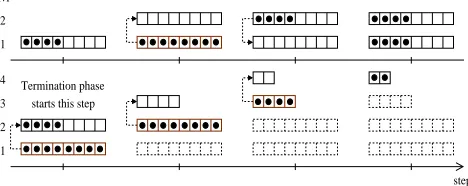
1, otherwise they continue, and so on (see Figure 5). In the termination phase for the end of the message, buffers’ con-tents of less thanNt2Yf blocks have to be processed.
Fur-thermore, top levels may need narrower buffers (see Figure 4) and when the Ym = pparameter constrains the tree,
the penultimate level buffer must always have a capacity ofkp−1blocks. When a levellis reached, buffers are not all filled, except one, and the effective consumption does not exceed(l(2Yf −1) + 1)N
tblocks of sizeNb. Such an
algorithm requires aboutNttimes more memory for
stor-ing internal node values than the sequential algorithm usstor-ing level buffers instead of a stack.
We may think that this fixed number and same level
nodes first scheduling is as efficient as the lower level node first version described above in Section 5.2. Just like the higher level node first scheduling, any recurrent waiting
be-tween threads should reduce performance, though it has the advantage of being simpler to implement.
Termination phase
step 1
3
2
1 4
starts this step 2
lvl
Figure 5: level buffer utilization for a message of32Nbbytes
(Yf =Yl= 1, Ym= 255, Nt= 4)
5.5 Assigning subtrees
If we consider the case where a thread is processing a sub-tree, the user could control an additional parameter, the heighthsof the subtree. Threads should be able to process
full subtrees, not necessarilly full subtrees at the right side of the original tree and finally a last top subtree of height less than or equal tohs.
Although the use of sub-trees may slightly unbalance loading between threads, it would have the advantage of reducing the total number of dependencies during the exe-cution and thus improve performance. Note that the effect of this parameter could be similar to theYfandYleffect but
the user might have an interest in treating a tree of a partic-ular configuration, for example to check a hash issued from
a tree of a particular configuration.
The scheduling policies outlined above can always be applied.
6
From Simple hash to Tree hash
The Tree mode allows the calculation of a hash in an in-cremental way; that is to say, it allows updating the hash whenever a new data field is concatenated after the actual data. It also offers the possibility of authentication and up-dating the hash when the data to be authenticated is never truncated or concatenated with additional fields (e.g: mem-ory authentication [11], or a static dictionary).
Note that computing a hash with the Hash Tree mode requires more basic operations than Simple Hash mode (be-sides, there are more sophisticated mechanisms for these types of application, such as incremental hash and mem-ory authentication). So if these features are absent, be-cause of the overhead that represents the tree structure, it would not be worth providing this functionality in a non-multithreaded implementation.
The object of this section is to confront the Simple Hash Mode to the Tree Hash Mode. Then, we estimate the following speedups:
• Parallel tree processing compared to the sequential UBI operation of the equation (3).
• Parallel tree processing compared to the sequential tree processing.
In each case, we give the potential speedup for which the number of hardware processing units is large enough to not be a limiting factor.
6.1 Elementary operations and time complexity The time complexity of a function UBI for the evaluation
UBI(G, M, Ts)can be described by
T(l) =a·(
l
8Nb
·1l>0+1l=0) +b
wherelis the message length in bits, the constantais the time complexity for a block ciphering operation and the constantbcorresponds to the time complexity for the ini-tialization operations such as padding operation and argu-ment evaluation.
We can assume that b is much lower thana, so we parametrizebbyαa withα ∈ [0,1]and define this time complexity by
T(n, α) =a·(n+α) (5) wheren=l8Nl
b
m
is not zero.
iteration of the UBI chaining mode, framed in Figure 6, which gives an example of three-block message hashing using UBI.
Figure 6: Processing a message of 166 bytes
6.2 Comparing the two algorithms
The number of basic operations of a single UBI application isn+α. Let’s consider the Tree hash mode in the best case where there is ak ∈ Nsuch thatn = 2
Ylkand also
anh ∈ Nsuch thatk = 2
Yfh. The associated tree is a
complete tree of2Yf nodes and of depthh. Ifh≤Y
m−1,
the number of basic operations without the contributions in αis given by
Nsnc(n) =n·
1 + 2
Yf−Yl 2Yf −1
− 2
Yf 2Yf−1.
Forh > Ym−1, this becomes
Nsc(n) =n·
1 + 2
Yf(Ym−1)−1
2Yl+Yf(Ym−2)(2Yf −1)
.
The associated contributions inαare Msnc(n, α) =
n·2Yf−Yl−1 2Yf −1 ·α,
Msc(n, α) = (n·
2Yf(Ym−1)−1
2Yl+Yf(Ym−2)(2Yf −1)+ 1)·α.
Following the model of equation (5), the time complexity Tt(n, α)of a calls tree UBI fornof the form2Yl+Yfh is
given by
Tt(n, α) =
(
a·(Nsnc(n) +Msnc(n, α)) ifh≤Ym−1
a·(Nsc(n) +Msc(n, α)) otherwise. FromNnc
s (n)and Nsc(n), for a fixed message size
and not taking into account the contributions inα, one can observe the following:
• IfYl=Yf = 1andh≤Ym−1, then the maximum
number of basic operation is reached. Such parame-ters can be of interest if we can usen2parallel process-ing units.
• IfYm = 2andh > Ym−1, thenYf is not used,
the number of operations is function only ofYland is
maximized forYl= 1.
• IncreasingYlwill minimize the overhead of the
num-ber of operations but requires the use of larger buffers, mainly in a multi-threaded implementation.
• IncreasingYf tends to decrease the number of
opera-tions as well, but it is much less significant compared toYl.
• The choice of the two parametersYl and Yf
influ-ences the deep of the tree and therefore the memory usage overhead. Increasing these two parameters will decrease the overhead. A constraintYmon the tree
depth does not affect the amount of memory required for a hash computation (though when using mecha-nisms for memory authentication one needs to store the intermediary levels of the tree).
The choice of parametersYf,Yl andYmdepends on the
degree of parallelism for a particular implementation, the synchronization primitives of a specific implementation, and the constraints associated with the memory require-ments.
Now we consider the optimal configuration with k processing units. Ifh≤Ym−1, the number of operations
by processing unit, without the contribution inα, shall be Npnc(n) = 2Yl+h·2Yf.
Forh > Ym−1, this becomes
Npc(n) = 2Yl+ (Ym−2)·2Yf + 2Yf(h−Ym+2).
The associated contributions inαare Mpnc(n, α) = (h+ 1)·α,
Mpc(n, α) = Ym·α.
Following always the model of equation (5), the time com-plexity Ttp(n, α)of a calls tree UBI performed by a sys-tem with at leastkprocessing units and fornof the form
2Yl+Yfhis given by
Ttp(n, α) =
(
a·(Npnc(n) +Mpnc(n, α)) ifh≤Ym−1
a·(Npc(n) +Mpc(n, α)) otherwise.
We define P Spt/u(n) to be the potential speedup of the
Tree mode in an optimal configuration system, for n of the form2Yl+Yfh, when compared to the Simple hash (a
straight UBI operation).P Spt/u(n)is given by
P Spt/u(n) =
T(n, α)
Ttp(n, α).
For any n, there exists two full trees, one with a lower valueh1 =
ln(j n
2Yl k
)
ln(2Yf)
and the other with an up-per valueh2 =
ln(l n 2Yl
m
)
ln(2Yf)
constrained tree generated over then-block-sized message (h2−h1≤1). Then, for allnand a not constrained tree,
P Spt/u(n)≥
T(n,0)
Ttp(2Yl+Yfh2,1)
and we can deduce the following result.
Lemma 1. In the general case, for all nbut a not con-strained tree in height,P Spt/u(n)∈Ω(lognn).
Note that if we takeα= 0, fornof the form2Yl+Yfh
andh≤Ym−1, we have
P Spt/u(n) =
n Nnc
p (n)
= n·log(2
Yf)
(log(n)−log(2Yl))·2Yf + log(2Yl)·2Yl.
Similarly, in this case and ifh > Ym−1, the speed-up is
thenP Spt/u(n) =Ncn p(n).
6.3 Speed-up of the Tree hash
We define P Spt/st(n)the potential speedup of the Tree
mode in an optimal configuration system, fornof the form
2Yl+Yfhand when compared to a one processor
implemen-tation, by
P Spt/st(n) =
Tt(n, α)
Ttp(n, α)
.
In the general case, for all n and a not constrained tree, we can give a following lower bound
P Spt/st(n)≥
Tt(2Yl+Yfh1,0)
Ttp(2Yl+Yfh2,1)
.
Then, adequate lower bound and upper bound for Tt(2Yl+Yfh1,0) and Ttp(2Yl+Yfh2,1) respectively allow
to express exclusively in terms of n a lower bound for P Spt/st(n).
Note that if we take α = 0, fornof the formn = 2Yl+Yfhandh≤ Y
m−1, then the potential speed-up of
Hash Tree when compared to a single processor implemen-tation isP Spt/st(n) = N
nc s (n)
Nnc
p (n)and in case of a constrained
tree withh > Ym−1we haveP Spt/st(n) = Nc
s(n)
Nc p(n).
6.4 Numerical estimates
In order to compare implementation speedup to a not pes-simistic speedup reference, a user must estimate time com-plexityTN.E.
st (n)of the sequential version of the tree for
allnby
TstN.E.(n, α) =n+ p−1 X
i=1 ki+
p
X
i=1 kiα.
In a same way, an upper bound for the time complexity TN.E.
Nt (n, α) of the parallel version executed by Nt
pro-cessing units is given by
TNN.E.t (n, α) =
k1 Nt
(2Yl+α) +
p
X
i=2
ki
Nt
(2Yf +α).
Then a good lower bound for the performance improve-mentSN.E.
Nt/st, when an implementation dedicated toNt
pro-cessing units is used, is given by SNN.E.t/st=T
N.E. st (n,0)
TNN.E.t (n,1).
7
Java implementation
This section provides some details on a Java implementa-tion of Skein based on an approach like the first one in Sec-tion 5, which offers maximum parallelism in theory and is independent of the algorithm parameters (in particular the parameters influencing the node sizes and tree structure in Skein Hash Tree mode). Details of the performance given here are for illustrative purposes, only. We have not at-tempted to optimize the method for practical use; we are aiming solely to demonstrate the performance improve-ments that can be obtained on a lambda system configu-ration.
Thread scheduling in Java. There are two kinds of schedulers : green and native. A green scheduler is pro-vided by the Java Virtual Machine (JVM), and a native scheduler is provided by the underlying OS. In this work, tests were performed on a Linux operating system with a JVM using the native thread scheduler. This provides a standard round-robin strategy.
Threads can have different states : initial state (when not started), runnable state (when the thread can be exe-cuted), blocked state and terminating state. The main issue is when a thread is in the blocked state, i.e. waiting for some event (for example, a specific I/O operation or wait-ing for a signal notification), in which case the thread is not consuming CPU resources at all, meaning that having a large number of blocked threads does not impact much on the efficiency of the system.
7.1 Class organization
Our implementation of Skein is composed of several classes, splitting the core functionality and special code of the algorithm:
• Main algorithm: The Skein core is implemented as three classes, Skein256, Skein512 and Skein1024. They all provide the same interface, and support Sim-ple Hash as well as Full Skein. Tree and thread man-agement is done in other support classes.
we can have in the hash tree. All of these classes have a similar interface:
- TreeNode: used when hashing a file with a hash tree
- NodeThread: used in a hash tree with one thread per node
- NodeJob: used in a hash tree with one job per node, and processes those jobs with a thread pool - ThreadPool: manage the pool of thread used
with NodeJob instance.
- Other classes are needed for the pipeline im-plementation of Skein: SimplePipeFile and TreePipeFile are used, the first one for Simple Hash and the second one for Full Skein with tree. In addition to these classes, two main classes were written. The Speed class is used to test the speed-up of the algorithm, and the Test class implements direct calls to the different hash methods on different inputs, as well as running tests provided in the Skein reference paper. 7.2 Sequential Skein implementation
To do a Simple Hash, one simply calls the update() and digest() methods on a Skein class. There are also meth-ods available to perform the Tree hash computation sequen-tially.
7.3 Parallel Skein implementation 1. One thread per node
We create one thread per node, and let the scheduler handle how they are executed.
2. One thread per node with a thread pool
To optimize the first implementation we create a thread pool that has a fixed number of threads. These threads accept jobs in a FIFO manner and then exe-cutes them (Figure 7).
3. Pipe input file
Because most of the time people hash many files at the same time, we have decided to implement a pipe that applies the hash function in parallel for each input file. This implementation uses the thread pool with a thread count equal to the number of files to be hashed. It is implemented using both the Simple hash and the Tree hash methods.
8
Testing and performances
The tests were done using a basic platform for illustrative purpose only: a Dell Latitude D830, Intel(R) Core(TM)2 Duo CPU T7500 @ 2.20Ghz, 2GB RAM, L2 cache size 4MB with a Ubuntu 9.10 operating system. For evaluating
Job Job
Job Job Job
Job Job Job
Job Job Job
Job Job Job Job Job
CPU Job
Thread scheduler Working
threads
queue
Figure 7: Parallel Skein using one thread per node and a thread pool
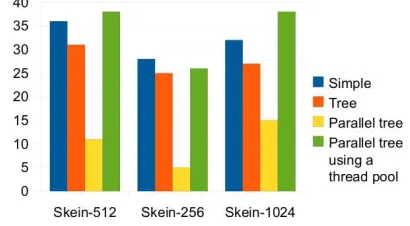
the performance of the various implementations we wrote the Speed class, used in conjunction with the YourKit pro-filing tool [4], which allows monitoring the CPU and mem-ory usage. In order to determine the efficiency of the im-plementation, we have performed tests using a fixed file of 700MB. The performance results are illustrated in the chart below:
Figure 8: Processing speed (in MB/s) comparison between the Skein versions
Although the fastest version should theoretically be Skein-1024, from this chart we can see that the version us-ing a block size of 512 bits is faster. That is because the computer used for these tests has a 64 bit processor. Fur-thermore, the slowest for our test is Skein-256, but this one would be the fastest on a 32 bit CPU.
The tests using the YourKit profiler showed that the parallel versions use more heap memory, but the CPU load stay close to 100%, meaning both processors available on the platform are used at their full capacity.
In terms of execution time the One Thread per Node implementation is the slowest. This is mainly due to the overhead of the thread scheduler and poor memory man-agement. Creating a lot of threads, although highly scal-able, for single use is quite costly: it triples the heap mem-ory usage in comparison to the sequential version, but is not very effective. It is also slower when compared to the se-quential version, due to excessive synchronization required between threads.
time for this implementation is less than half of the sequen-tial version.
The last parallel implementation uses the thread pool class with as many threads as input files. This is an efficient implementation as the execution time is half of the sequen-tial version, and the difference for the used heap memory is quite small for the simple mode hash it is less than 0.2MB. Also an important factor is that when running the tests on a computer with two CPUs, having two input files means that both threads stay in the runnable state, which allows us to maximize CPU utilization.
Comparing the three versions of Skein implementa-tions, we noticed that for the simple sequential implemen-tation the amount of heap memory used is almost the same. A small difference was noted for Skein-1024, which uses 0.1MB more heap memory and 0.1MB more non-heap memory. This is because this last version uses blocks of 1024 bits. In terms of execution time the results reflected the ones in the chart above.
For the tree implementations, we used the same pa-rameters for all three versions of Skein. The results showed that for the sequential version Skein-256 uses less memory, and for the parallel implementations Skein-1024 uses less heap memory. The reason is that the number of nodes is smaller for Skein versions with bigger block sizes, and the size of each node does not vary much between the three versions.
9
Comparing with other implementations
Our implementations were also tested and compared to other Skein implementations, one in Java, from sphlib-2.0, and the second in C from the NIST submission of Skein.
In Java, using our Speed class to test both our imple-mentation and sphlib-2.0 impleimple-mentation, we obtained the results in Table 1. As we can see the Skein
implementa-Implementation Processings speed Skein-512 our implementation 36MB/s
Skein-512 sphlib-2.0 34MB/s SHA-512 sphlib-2.0 27MB/s
Table 1: Speed results - sphlib-2.0
tion from the sphlib-2.0 is slower. Also it is important to notice that this Skein implementation is much faster when compared to the SHA-512 one (Skein is therefore a good candidate for replacing the current SHA-2).
For the second comparison in terms of execution time we used a 700MB file and hashed it using both our im-plementation in Java and the C reference imim-plementation of Skein. The execution times are the followings: 27 sec-onds with the Java sequential version, 20 secsec-onds with the Java parallel version and 24 seconds with the C reference (sequential) version. The Java implementation of the tree mode was of course slower than the C version, but not sig-nificantly; therefore some Java applications can use Java
implementation of Skein with no very significant loss of performances. On the other hand, the parallel tion using the thread pool is faster than the C implementa-tion.
10
Conclusion and further work
Hash functions are the most commonly used cryptographic primitives. These functions can be found in almost any application and they secure the fundamental levels of our information infrastructures. Currently the SHA family of functions is the most popular, but because the SHA-1 ver-sion was broken a new SHA family is needed.
Skein is one of the candidates to the second round of the SHA-3 competition and, judging by the results ob-tained, it is one of the promising candidates.
Skein is appropriate for hardware implementation, both for devices with little memory and high speed needs. Furthermore, software implementations of this family of hash functions in C or Java can be used immediately, in-creasing its accessibility. The C version is the fastest, but the availability of a pure Java implementation with accept-able performance is interesting for a large class of Java ap-plications.
Further work is in progress for testing the parallel im-plementation on a highly multi-core/multi-processor sys-tem. Moreover, further research should be done to imple-ment a more specific thread scheduling policy that would increase performances by minimizing the scheduling over-head.
References
[1] Nist.http://www.nist.gov/index.html. [2] Schneier on security (web site). http:
//www.schneier.com/blog/archives/ 2005/02/cryptanalysis_o.html.
[3] Sha-3 competition. http://www.nist.gov/ itl/csd/ct/hash_competition.cfm. [4] Yourkit profiler (web site). http://www.
yourkit.com.
[5] G. S. Almasi and A. Gottlieb. Highly parallel
comput-ing. Benjamin-Cummings Publishing Co., Inc.,
Red-wood City, CA, USA, 1989.
[6] M. Bellare, T. Kohno, S. Lucks, N. Ferguson, B. Schneier, D. Whiting, J. Callas, and J. Walker. Provable security support for the skein hash family, 2009. http://www.skein-hash.info/ sites/default/files/skein-proofs. pdf.
sponge construction. In EUROCRYPT, pages 181– 197, 2008.
[8] Guido Bertoni, Joan Daemen, Michael Peeters, Gilles Van Assche, Guido Bertoni, Joan Daemen, Michal Peeters, and Gilles Van Assche. Sponge func-tions, 2007.
[9] Jean-Sbastien Coron, Yevgeniy Dodis, Ccile Malin-aud, and Prashant Puniya. Merkledamgrd revisited: How to construct a hash function. pages 430–448. Springer-Verlag, 2005.
[10] Ivan Damg˚ard. A design principle for hash func-tions. In CRYPTO ’89: Proceedings of the 9th
Annual International Cryptology Conference on Ad-vances in Cryptology, pages 416–427, London, UK,
1990. Springer-Verlag.
[11] Reouven Elbaz, David Champagne, Catherine H. Gebotys, Ruby B. Lee, Nachiketh R. Potlapally, and Lionel Torres. Hardware mechanisms for memory au-thentication: A survey of existing techniques and en-gines. volume 4, pages 1–22, 2009.
[12] Niels Ferguson, Stefan Lucks Bauhaus, Bruce Schneier, Doug Whiting, Mihir Bellare, Tadayoshi Kohno, Jon Callas, and Jesse Walker. The skein hash function family (version 1.2), 2009.
[13] Markus Jakobsson, Tom Leighton, Silvio Micali, and Michael Szydlo. Fractal merkle tree representation and traversal, 2003.
[14] Alfred J. Menezes, Paul C. Van Oorschot, Scott A. Vanstone, and R. L. Rivest. Handbook of applied cryptography, 1997.
[15] Andrew Regenscheid, Ray Perlner, Shu jen Chang, John Kelsey, Mridul Nandi, Souradyuti Paul Nistir, Andrew Regenscheid, Ray Perlner, Shu jen Chang, John Kelsey, Mridul Nandi, and Souradyuti Paul. The sha-3 cryptographic hash algorithm competition, 2009.
[16] Xiaoyun Wang, Yiqun Lisa Yin, and Hongbo Yu. Finding collisions in the full sha-1. In In Proceedings