Volume 5, No. 4, 2011, 609–621
ON THE NUMBER OF BENT FUNCTIONS FROM ITERATIVE CONSTRUCTIONS: LOWER BOUNDS AND HYPOTHESES
Natalia Tokareva Sobolev Institute of Mathematics
Siberian Branch of the Russian Academy of Sciences pr. Koptyuga 4, 630090, Novosibirsk, Russian Federation
and
Novosibirsk State University
st. Pirogova 2, 630090, Novosibirsk, Russian Federation
(Communicated by Joan-Josep Climent)
Abstract. In the paper we study lower bounds on the number of bent func-tions that can be obtained by iterative construcfunc-tions, namely by the construc-tion proposed by A. Canteaut and P. Charpin in 2003. The number of bent iterative functions is expressed in terms of sizes of finite sets and it is shown that evaluation of this number is closely connected to the problem of decom-posing Boolean function into sum of two bent functions. A new lower bound for the number of bent iterative functions that is supposed to be asymptotical-ly tight is given. Appasymptotical-lying Monte–Carlo methods the number of bent iterative functions in 8 variables is counted. Based on the performed calculations sever-al hypotheses on the asymptotic vsever-alue of the number of sever-all bent functions are formulated.
1. Introduction
Boolean functions with even number of variables that have extremal nonlinear properties are called bent functions. They were introduced by O. Rothaus [11, 12] in sixties of XX century. Till now bent functions are intensively studied since they have a lot of applications in coding theory and cryptography, see for example surveys [15,14].
Precisely, Boolean function in n variables (n is even) is called bent if it is at the maximal possible Hamming distance 2n−1−2(n/2)−1from the class of all affine Boolean functions. In other terms all Walsh–Hadamard coefficients of a bent tion are the same in absolute values. There are many open problems in bent func-tions. The number of bent functions innvariables is still unknown ifn >8. More-over, there is a large gap between lower 22(n/2)+log2(n−2)−1 and upper 22
n−1+1 2
n n/2
bounds for this number. There are several improvements of these bounds, see [1], [5] and [16], but not too significant. To find the asymptotic value for the number of all bent functions is a long-standing hard problem closely connected to the problem of enumeration of Hadamard matrices (unsolved since 1893).
2000Mathematics Subject Classification: Primary: 06E30; Secondary: 94A60.
Key words and phrases: Bent function, iterative construction, asymptotic value, bent sum decomposition, Monte–Carlo methods.
The author is supported by the Russian Foundation for Basic Research (grants 09-01-00528, 10-01-00424, 11-01-00997) and Federal Target Grant for 2009-2013 (contract No. 02.740.11.0429).
c
In this paper we study lower bounds on the number of bent functions that can be obtained by iterative constructions, namely by the construction proposed by A. Canteaut and P. Charpin [2]. Bent functions obtained via this construction we callbent iterative functions. The number of such functions is expressed in terms of sizes of special finite sets. Then it is shown that evaluation of the number of bent iterative functions is closely connected to the problem of decomposing Boolean function into sum of two bent functions. A new lower bound for the number of bent iterative functions that is supposed to be asymptotically tight is given. The numbers of bent iterative functions in 4, 6 and 8 variables are determined. For the last case probabilistic approaches such as Monte–Carlo methods are applied. Based on the performed calculations we formulate several hypotheses on the asymptotic value of the number of all bent iterative functions and on the number of all bent functions.
The structure of the paper is the following. In section 2 we give some preliminar-ies: necessary definitions (subsection 2.1), a brief overview of the known iterative constructions for bent functions (subsection 2.2), a simplified variant of A. Can-teaut’s and P. Charpin’s iterative construction (subsection 2.3). In section 3 the number of bent iterative functions is expressed in terms of sizes of finite sets. In section 4 bent sum decomposition problem and its connection to the evaluation of the number of bent iterative functions is considered. In section 5 applying proba-bilistic methods we study bent iterative functions in small number of variables. In section 6 several hypotheses on the number of bent functions are introduced.
2. Preliminaries
2.1. Necessary definitions. Let + mean sum modulo 2. Denote by hx, yithe standard inner product of two binary vectorsxandy of lengthn,
hx, yi=x1y1+. . .+xnyn.
It is well known that a Boolean functionf innvariables can be uniquely represented by itsalgebraic normal form(brieflyANF)
f(x) =
n X
k=1
X
i1,...,ik
ai1,...,ikxi1·. . .·xik
+a0,
where for eachk indicesi1, . . . , ik are pairwise distinct and all together run trough allk-element subsets of the set{1, . . . , n}. The coefficientsai1,...,ik,a0belong toZ2.
Algebraic degree(brieflydegree) of a Boolean function f is the number of variables in the longest item of its ANF. Denote it bydeg(f). Anaffine functionis a function of degree 1. It has the formf(x) =hx, yi+afor some vectory and constanta.
Recall that Walsh–Hadamard transform of a Boolean function f in n variables is the integer-valued function
Wf(y) = X x∈Zn2
(−1)hx,yi+f(x).
For a bent functionf it is possible to define thedual functionfe. It is a Boolean function innvariables given by 2n/2(−1)fe(y)=Wf(y). It is well known that
e f is a bent function too ande
e f =f.
2.2. Iterative constructions and lower bounds. Iterative constructions for bent functions have been investigated by many authors. Let us recall only some of them.
The first iterative construction was given by O. Rothaus [11,12]. It tells that a Boolean functionf(x0, x00) =g(x0) +h(x00) is bent if and only if functionsg andh are bent. From here one can get a bound |Bn| ≥maxm+k=n|Bm||Bk|, where |M| means the size of a setM.
The next construction was obtained by O. Rothaus [11] and J. Dillon [7]. Let f0, f00 and f000 be bent functions inn variables such that their sum is bent again. Theng(a1, a2, x) =f0(x)f00(x) +f0(x)f000(x) +f00(x)f000(x) +a1f0(x) +a1f00(x) +
a2f0(x) +a2f000(x) +a1a2 is a bent function inn+ 2 variables. But to obtain the lower bound on|Bn|from this construction seems to be rather difficult. In general, it is not clear when for distinct collections {f10, f100, f1000} and {f20, f200, f2000} one can obtain distinct bent functionsg.
Another construction was introduced by C. Carlet [4]. Suppose that f0, f00
and f000 are bent functions in n variables such that their sum (denote it by s) is bent. Moreover, let es = fe0 +ff00+ff000. Then function g(x) = f0(x)f00(x) + f0(x)f000(x) +f00(x)f000(x) is bent innvariables. In this case one can try to find an equality containing|Bn|and a certain function of|Bn|3. But we guess that checking conditions (whensis bent and when it holdses=fe0+ff00+ff000) is difficult enough. J.-J. Climent, F. Garc´ıa and V. Requena [6] suggested the construction of bent functions inn+ 2 variables from bent functions innvariables using minterms. Here we are not going to consider details of this construction. Let us give only the lower bound on the number of bent functions obtained via this construction. As usual this bound can be taken as the lower bound for the number of all bent functions:
|Bn+2| ≥6|Bn|2−8|Bn|.
An extensive study of the restrictions of bent functions to affine subspaces was proposed by A. Canteaut and P. Charpin [2]. In particular, they have established that restrictions of a bent functionf to a subspaceV of codimension 2 and to its cosets are bent if and only if the derivative of fewith respect to V⊥ is constant equal to 1. This last result can be interpreted as an iterative construction for bent functions. It is studied in the next section with respect to the lower bound on the number of all bent functions.
2.3. Bent Iterative functions. Let us present the iterative construction of A. Canteaut and P. Charpin [2] in the following simplified form and equip it with a new proof.
Let Boolean functiongin n+ 2 variables be defined as
Theorem 1. Let functionsf0, f1, f2be bent functions innvariables. Then function
gdefined by (1) is a bent function inn+2variables if and only iff3is a bent function
inn variables andfe0+fe1+fe2+fe3= 1.
Proof. (⇐=) Letf0, f1, f2 andf3be bent functions andfe0+fe1+fe2+fe3= 1 hold. Show thatgis bent. We have
Wg(a1, a2, x) = Wf0(x) + (−1)a2Wf1(x) + (−1)a1Wf2(x) + (−1)a1+a2Wf3(x). Using dual functions we obtain
Wg(a1, a2, x) = 2n/2
(−1)fe0(x)+ (−1)a2+fe1(x)+ (−1)a1+fe2(x)+
(−1)a1+a2+1+fe0(x)+fe1(x)+fe2(x)
.
The possible values for the expression between parentheses are±4,±2 and 0. In fact this expression is always equal to±2. Indeed, in the casefe0(x) =fe1(x) =fe2(x) = 0 we obtain the expression
R(a1, a2) = 1 + (−1)a2+ (−1)a1+ (−1)a1+a2+1
that for anya1, a2 equals±2. It is easy to prove that in all other (seven) cases for
e
f0(x), fe1(x),fe2(x) the expression between parentheses differs from R(a1, a2) only by changing the signs for even number of items. And hence it can be equal to±2 or ±2±4 only. Since it is not more than 4, only one possible value±2 remains. Thus, for any a1, a2, x it is true Wg(a1, a2, x) = ±2(n+2)/2, and therefore g is a bent function.
(=⇒) Letg be a bent function. Then its Walsh–Hadamard coefficient
Wg(a1, a2, x) = 2n/2
(−1)f0e(x)+ (−1)a2+f1e(x)+ (−1)a1+f2e(x)+
(−1)a1+a2Wf3(x) 2n/2
is equal to ±2(n+2)/2 for all a
1, a2, x. It is obvious that the expression between parentheses should be equal to ±2. The necessary condition for it is that the fourth item between parentheses has to be a natural number. But according to the Parseval’s equality for Wf3 it is true if and only ifWf3(x) =±2n/2 for all x, i. e. f3 is a bent function. Thus, the fourth item has the form (−1)x1+x2+f3e(x).
It is easy to see now that the valuefe3(x) has to be defined by the valuesfe0(x),
e
f1(x) andfe2(x) in the unique way. It is true since the sum in parentheses is equal to±2. It remains to note that we have already found this appropriate way forfe3(x) to be defined. Namely,fe3=fe0+fe1+fe2+ 1.
Let us give some concrete examples. Here Boolean functions are presented by their vector of values.
• bent iterative function g = (0001 0001 0001 1110) is obtained by taking f0 = f1 = f2 = (0001). Note that fe0 = f0. Function f3 can be found from the equalityfe3=fe0+fe1+fe2+ 1 = (1110). Note also that herefe3=f3.
• bent iterative function g = (0001 0010 0001 1101) is constructed by taking f0 = (0001), f1 = (0010), f2 = (0001). Note that again fe0 = f0 = f2, but
e
f1= (0100). The functionf3is derived fromfe3=fe0+fe1+fe2+ 1 = (1011). Then
• bent iterative function g = (0010 0001 0001 1101) is constructed by taking f0 = (0010), f1 = (0001), f2 = (0001). Here fe0 = (0100), fe1 = f1 = f2. The functionf3 is obtained fromfe3=fe0+fe1+fe2+ 1 = (1011). Thenf3= (1101).
Note that three distinct bent functions innvariables can produce up to 6 distinct bent functions inn+ 2 variables, since it is possible to order them in 3! ways.
Bent functions that can be obtained by Theorem1we callbent iterative functions. LetBIn+2(it means “Bent Iterative”) denote the class of all such functions inn+ 2 variables.
Note that according to [2] there exist bent functions from Maiorana–McFarland class [10] and from the classPS (Partial Spreads) [7] that can not be represented as bent iterative functions. Also as it follows from investigation [3] of nonnormal functions there exist bent functions in BIn that are nonequivalent to Maiorana– McFarland bent functions.
3. The number of bent iterative functions
Here it is shown how it is possible to calculate the number of bent iterative functions. This task is reformulated in terms of finite sets and then several open problems are given.
Theorem 2. For any evenn≥4
|BIn|= P f0∈B
n−2 P
f00∈B n−2
|(Bn−2+f0)∩(Bn−2+f00)|.
Proof. Let us study in how many ways one can construct a bent iterative function gin nvariables. It is possible to do it as follows. First, take arbitrary ordered pair of two bent functionsf0,f1inn−2 variables. These functions may coincide or may not. The number of all distinct such pairs is|Bn−2|2. Then take a suitable bent functionf2inn−2 variables. Bent functionf2we callsuitableforf0,f1if function
e
f0+fe1+fe2 is bent. It is clear that according to Theorem1for any suitable bent functionf2 one can construct a bent iterative function g by determining f3 from the equality fe3 =fe0+fe1+fe2+ 1. So, if k(f0, f1) is the number of suitable bent functionsf2for given bent functions f0,f1, then
(2) |BIn|= P
f0∈Bn−2 P
f1∈Bn−2
k(f0, f1).
Indeed, any bent iterative functiong can be obtained in the way presented. Note thatg is uniquely determined by the ordered triplef0,f1,f2.
Now let us study numbersk(f0, f1). LetB(f0, f1) be the set of all suitable bent functions inn−2 variables forf0, f1. So,|B(f0, f1)|=k(f0, f1). Show that the set B(f0, f1) is in 1–to–1 correspondence with (Bn−2+fe0)∩(Bn−2+fe1).
Define a map
φ:B(f0, f1)→(Bn−2+fe0)∩(Bn−2+fe1) by the rule
φ(f2) =fe0+fe2, for allf2∈ B(f0, f1).
Prove that φ is a bijective mapping. It is easy to see that if f2 6= f20 then
φ(f2)6=φ(f20). Letsbe a function from (Bn−2+fe0)∩(Bn−2+fe1). Then bent function
f2 defined byfe2=s+fe0is suitable forf0,f1(since functionfe0+fe1+fe2=fe1+s is bent) and it holdsφ(f2) =s. Thus,φis bijective.
So, it is proven that
k(f0, f1) =|(Bn−2+fe0)∩(Bn−2+fe1)|.
Now replacek(f0, f1) by this expression in formula (2) and change variablesf0,f1 to variablesf0 =fe0,f00=fe1. In such a way we get the statement of theorem.
Consider an example. Let us construct all bent iterative functions for n = 4. The total number of them is |BI4| = P
f0∈B
2 P
f00∈B
2
| (B2+f0)∩(B2+f00)|. Recall that B2 consists of all functions with odd number of nonzero values, |B2|= 8. Let us present their vectors of values: (0001), (0010), (0100), (1000), (1110), (1101), (1011), (0111). Note that any setB2+f0 is the set of all Boolean functions with even number of ones. So,|(B2+f0)∩(B2+f00)|= 8 for any bent functionsf0,f00. It means that any bent function in 2 variables is suitable for all fixed bent functions f0, f1. Then by Theorem2 we get |BI4|= 8·8·8 = 512. Recall thatB4 consists of 896 functions.
It is known that if functionf0 is bent then functionf0+`is bent too for every affine Boolean function`. That is why any set (Bn−2+f0)∩(Bn−2+f00) contains at least all affine functions inn−2 variables:
`= (f0+`) +f0 = (f00+`) +f00. The number of these affine functions is 2n−1 and hence we get Proposition 1. For any bent functionsf0, f00 inn−2 variables (3) 2n−1≤ |(Bn−2+f0)∩(Bn−2+f00)| ≤ |Bn−2|.
In [13] it is proven
Proposition 2. For bent functionsf0, f00 inn−2variables the equality
|(Bn−2+f0)∩(Bn−2+f00)|=|Bn−2|
holds if and only if f0+f00 is an affine function.
From Theorem2 and Propositions1,2it follows
Corollary 1. 2n−1|B
n−2|2<|BIn|<|Bn−2|3 for any evenn≥4.
Indeed, it is enough to note that there exist bent functionsf0,f00for which upper
bound in (3) holds. And there existf0,f00 for which it does not hold.
Corollary 2. |BIn|>22
(n/2)+2−n−3
for any evenn≥4.
Proof. From Corollary1it follows|BIn|>2n−1|Bn−2|2.SinceBIn−2is a subset of Bn−2, we have|Bn−2|>|BIn−2| and hence
|BIn|>2n−1|BIn−2|2.
Applying Corollary1and inequality |Bn−4|>|BIn−4|, we obtain |BIn|>2n−1·2(n−3)·2· |BIn−4|2
Continue in this way,
|BIn|>2n−1·2(n−3)·2·2(n−5)·2 2
·. . .·23·2(n/2)−2|B2|2
(n/2)−1 .
Then by substitution|B2|= 23 we obtain |BIn|>23·2
(n/2)−1
·2d, where
d= (n−1) + (n−3)·2 + (n−5)·22+. . .+ (n−(n−3))·2(n/2)−2. One can see that
d=n
(n/2)−2
X
i=0 2i
−
(n/2)−2
X
i=0
(2i+ 1)2i= (n−1)(2(n/2)−1−1)−2 (n/2)−2
X
i=0
i·2i.
Using combinatorial formula k X
i=0
i·2i= (k−1)2k+1+ 2,
we getd= 5·2(n/2)−1−n−3. And hence,|BI
n|>22
(n/2)+2−n−3 .
It is interesting to find better bounds on|BIn|and clarify is this number more close to|Bn−2|2 or rather to|Bn−2|3. Note that answer to this question has direct applications to the problem of lower bound for|Bn|.
In the next section several techniques helpful to this question are presented.
4. Bent sum decomposition problem Define the following set
Xn ={f+h : f, h∈ Bn}
and consider the system{Cf :f ∈ Bn} of its subsets defined asCf =Bn+f.So,
Xn= [ f∈Bn
Cf.
One can prove
Proposition 3. |Bn|> p
2|Xn| for any evenn≥2.
Let ψ be an element of Xn. The number of subsets Cf that cover ψ we call multiplicity ofψand denote it bym(ψ). Note that ifψis covered by Cf then it is covered by any setCf0, where f0 is obtained fromf by adding an affine function.
It is clear that
(4) X
ψ∈Xn
m(ψ) =|Bn|2.
Theorem 3. For any evenn≥2
|BIn+2|=
X
ψ∈Xn
Proof. The statement follows from Theorem 2. Indeed, let us fix any function ψ from Xn. It is covered exactly by m(ψ) sets, say Cf1, Cf2, . . . , Cfm(ψ). Now let pair (f0, f00) run trough all the ordered pairs of bent functions innvariables. Then functionψis covered by set (Bn+f0)∩(Bn+f00) if and only if both functionsf0,f00 belong to the set{f1, f2, . . . , fm(ψ)}. The number of such ordered pairs ism(ψ)2.
Thus, by Theorem2we get the formula |BIn+2|=Pψ∈Xnm(ψ)
2.
So, in order to evaluate|BIn+2|(and then|Bn+2|) we have to study the setXn and the distribution of multiplicities for its elements.
Theorem 4. For any evenn≥2
|Bn+2| ≥ |BIn+2| ≥ |Bn|4
|Xn|.
Proof. By (4) we have
X
ψ∈Xn
m(ψ) =|Bn|2.
Note that the minimal value of the sum X
ψ∈Xn
m(ψ)2
is reachable if and only if all the multiplicities are the same, i. e. if and only if m(ψ) =|Bn|2/|Xn|for allψ∈Xn. Then by Theorem3we have
|Bn+2| ≥ |BIn+2|=
X
ψ∈Xn
m(ψ)2≥ |Xn| · |Bn|2
|Xn| 2
= |Bn| 4
|Xn| .
Corollary 3. The average value of square of multiplicity inXn is not less than
|Bn|4/|Xn|2.
It is well known [12] that for a bent function in n variables, n ≥ 4, it holds deg(f)≤n/2. Then the setXn can include only functions of degree less or equal ton/2. Therefore, it holds
Corollary 4. For any evenn≥4
|Bn+2| ≥ |BIn+2| ≥
|Bn|4
21+n+
n 2
+...+
n n/2
=
|Bn|4
22
n−1+1 2
n n/2
.
In order to find the exact number of bent iterative functions one has to find the distribution of multiplicities inXn. Thus, we come to a new problem statement.
Open problem: bent sum decomposition. What Boolean functions can be represented as the sum of two bent functions inn variables? How many such rep-resentations does a Boolean function admit?
5. Monte–Carlo methods for enumeration of bent iterative functions if nis small
Here we study bent sum decomposition problem for small dimensions. Sizes of Xn andBIn+2are determined forn= 2,4,6. In the last case probabilistic methods are applied.
For n = 2 the set X2 consists of all Boolean functions with even number of nonzero values,|X2|= 8. Multiplicities of all functions from X2 are maximal and equal to 8. Thus, by Theorem 3 we have |BI4| = 8·82 = 512. Recall that B4 consists of 896 functions.
Forn= 4 the set X4 consists of all Boolean functions of degree not more than 2, |X4| = 211 = 2048. All affine functions in X4 (number of them is 25) have maximal multiplicities equal to 896. All the others have multiplicities equal to 384. Thus, |BI6| = 32·8962+ 2016·3842 = 77·222 = 322 961 408 ≈228,3. Note that via Maiorana–McFarland construction [10] (with a fixed division of variables into halves) it is possible to obtain only 28(23)! = 315·215 = 10 321 920 ≈223,3 bent functions. It remains to add that total number of bent functions in 6 variables is about 232,3, see the survey [15] for detail.
Proposition 4. |BI4|= 512,|BI6|= 322 961 408≈228,3.
If n = 6 the set X6 again is the set of all Boolean functions of degree less or equal to 3,|X6|= 242. It is checked via exhaustive search.
Now let us do the following probabilistic investigation. We apply Monte–Carlo methods for enumerating the sumP
ψ∈X6m(ψ)
2that is equal to|BI
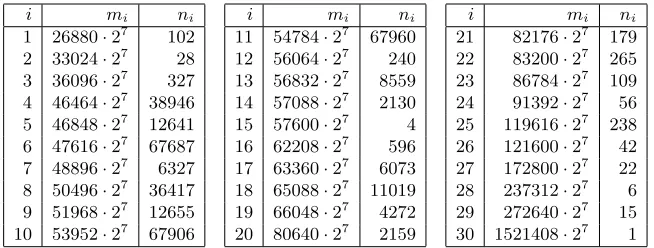
8|by Theorem 3. We have taken at random N = 346 981≈218,4Boolean functions in 6 variables of degree not more than 3 without linear parts in ANFs (by linear part we mean all ANF items of degree less or equal to 1). While checking multiplicities for these N functions it is obtained that there are only 30 distinct values of them. In Table 1 one can see the distribution of multiplicities for the taken functions. By ni the number of Boolean functions with multiplicitymi is denoted.
i mi ni
1 26880·27 102 2 33024·27 28 3 36096·27 327
4 46464·27 38946 5 46848·27 12641
6 47616·27 67687 7 48896·27 6327
8 50496·27 36417 9 51968·27 12655 10 53952·27 67906
i mi ni
11 54784·27 67960 12 56064·27 240 13 56832·27 8559
14 57088·27 2130 15 57600·27 4
16 62208·27 596 17 63360·27 6073
18 65088·27 11019 19 66048·27 4272 20 80640·27 2159
i mi ni
21 82176·27 179 22 83200·27 265 23 86784·27 109
24 91392·27 56 25 119616·27 238
26 121600·27 42 27 172800·27 22
28 237312·27 6 29 272640·27 15 30 1521408·27 1
Table 1. Distribution of multiplicities in a sample ofN = 346 981 Boolean functions in 6 variables.
Then count thesample average valueQfor the square of multiplicity,
Q= 30
X
i=1
ni·m2i !
Since|X6|= 242, we obtain the estimation
|BI8| ≈Q· |X6|= 200 150 615 856 476 000 000 000 000≈287,37.
Now evaluate the mistake of our approximation of|BI8|. In Monte–Carlo methods one has to choose thereliabilityν of approximation, 0< ν <1. The closer to 1 is ν, the higher is reliability. Then the approximate upper bound for the mistake of estimation can be obtained by the known formula
δ=tνS/
√
N
(see for example [8]), whereS is the corrected standard deviationfor our approxi-mation andtν is the standard parameter determined byν. We get the valueS by the known formula
S= v u u t
30
X
i=1
ni(m2
i −Q)2 !
/(N−1).
So, S = 65 975 029 301 812,10. Now let ν = 0,999. The corresponding standard parameter istν = 3,291 (see [8] for detail). Then the approximate upper bound for the mistake is
δ= 368 599 402 514,14.
It means that with probability 0.999 the average value of square of multiplicity in the setX6 is in the interval (Q−δ;Q+δ).And hence it is proven
Proposition 5. With probability0.999 it holds287,36<|BI8|<287,38.
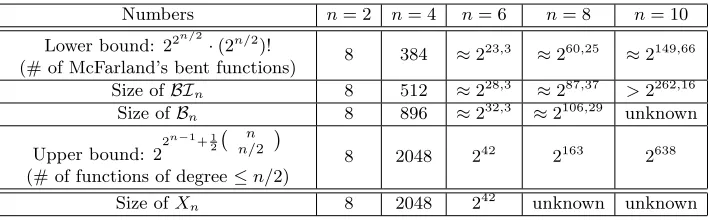
Note that according to P. Langevin and G. Leander, see [9], the total number of bent functions in 8 variables is 29×193 887 869 660 028 067 003 488 010 240'2106,29. Note also that number of Maiorana–McFarland’s bent functions in 8 variables is just about 260,25.
We see that Q is close to the lower bound |Bn|4/|Xn|2 from Corollary3. For
n = 6 this lower bound is 44 793 743 175 843,84 ≈245,348. So, from Theorem 4 it follows
Proposition 6. |BI8|>197 004 891 331 091 000 000 000 000≈287,35. Since|B8| '2106,29[9], by Theorem4 we have
Proposition 7. |B10|>|BI10|>830 602 255 559 379·1064>2262,16.
Let us summarize in Table 2 what is known now about sizes ofBIn,Bn andXn ifnis small. We put here also the corresponding values of lower and upper bounds for the number of all bent functions innvariables.
Numbers n= 2 n= 4 n= 6 n= 8 n= 10
Lower bound: 22n/2·(2n/2)!
(# of McFarland’s bent functions) 8 384 ≈2
23,3 ≈260,25 ≈2149,66
Size ofBIn 8 512 ≈228,3 ≈287,37 >2262,16
Size ofBn 8 896 ≈232,3 ≈2106,29 unknown
Upper bound: 22
n−1+1 2
n n/2
(# of functions of degree≤n/2)
8 2048 242 2163 2638
Size ofXn 8 2048 242 unknown unknown
6. Problem of asymptotic value of the number of all bent functions. Hypotheses.
One of the main open problem in bent functions is to find the asymptotic value of the number of them. It is very difficult to do any step in this area. Indeed, for n ≥ 10 the number of bent functions in n variables is unknown. And there is a large gap between lower 22(n/2)+log(n−2)−1 and upper 22
n−1+1 2
n n/2
bounds for this number. There are several improvements of these bounds, see [1], [5] and [16], but not too significant with respect to log log|Bn|. Here by log we mean log2. In this section several hypotheses based on the obtained results and performed calculations are formulated.
In the previous section we have seen that for n = 2,4,6 the set Xn contains all Boolean functions of degree not more than n/2. The case n = 6 was checked via exhaustive search. We have used processor Intel Core i7 3.0 Ghz 256 Gb. The program has worked 14 days with full loading of RAM. Note that casen= 8 is too hard for the exhaustive search now. In this case one has to find bent decompositions for about 2163 Boolean functions in 8 variables. Recall that the number of all bent functions in 8 variables has been found only a few years ago [9] and is about 2106,29. Casen= 10 can not be checked even theoretically since the number of bent functions in 10 variables is unknown.
Results onX2, X4,X6 lead us to the following strong hypothesis.
Hypothesis 1. Any Boolean function inn variables of degree not more than n/2 can be represented as the sum of two bent functions innvariables (nis even,n≥2).
So, we suppose thatXn is as large as possible, i. e. |Xn|= 22
n−1+1 2
n n/2
. In other words we conjecture that for any Boolean functionf innvariables there exists a bent functiong in nvariables such thatf+g is bent. Note that this hypothesis has a similarity to the previously obtained fact, see [13]: for any non affine Boolean functionf innvariables there exists a bent functionginnvariables such thatf+g is not bent.
If Hypothesis 1 is right then by Proposition3one can prove
Hypothesis 2. For the number of bent functions in nvariables it is true
22
n−2+1 4
n n/2
≤ |Bn| ≤2
2n−1+1 2
n n/2
.
Thus, we suppose that the number of all bent functions is very close to the existing upper bound.
Hypothesis 3. The number of all bent functions innvariables (n is even,n≥2)
is asymptotically equal to22
n−c+d
n n/2
, wherec,dare constants and1≤c≤2. If Hypothesis 1 is right then using Theorem4one can prove
Hypothesis 4. The class BIn is thebasic classin Bn, i. e.
lim n→∞
log log|BIn| log log|Bn|
= 1.
Numbers n= 2 n= 4 n= 6 n= 8 a= log log|BIn| ≈1.584962501 ≈3.169925001 ≈4.821035977 ≈6.449066085
b= log log|Bn| ≈1.584962501 ≈3.293864089 ≈5.015117973 ≈6.731862061 a/b 1 0.962372738 0.961300612 0.957991419
Table 3. Relations between log log|BIn|and log log|Bn|ifnis small. Ifn is small the dynamics of the corresponding relations is not still impressive. But it can be explained by aneffect of small values.
We have seen in Propositions5,6that lower bound for|BIn|from Theorem4is very close to the tight value ifnis small. We do the following assumption.
Hypothesis 5. The bound of Theorem 4is asymptotically tight, i. e.
lim n→∞
log log(|Bn−2|4/|Xn−2|) log log|BIn|
= 1.
In order to confirm this hypothesis one can see the values log log(|Bn−2|4/|Xn−2|) and log log|BIn| for smallnin Table 4. They are indeed very close to each other.
Numbers n= 4 n= 6 n= 8 a= log log(|Bn−2|4/|Xn−2|) ≈3.169925001 ≈4.819127567 ≈6.448708743
b= log log|BIn| ≈3.169925001 ≈4.822730148 ≈6.449066085 a/b 1 0.999604149 0.99994459
Table 4. Relations between log log(|Bn−2|4/|Xn−2|) and log log|BIn|ifnis small.
7. Conclusion
In this paper a simplified variant of the A. Canteaut’s and P. Charpin’s con-struction was presented (Theorem 1). The number of bent iterative functions is expressed in terms of sizes of finite sets (Theorem2) and it is shown how evaluation of it is connected to the bent sum decomposition problem (Theorem 3). A new lower bound for the number of bent iterative functions is given (Theorem4). Ob-tained results lead us to a new vision of the enumeration problem for bent functions. Hypotheses 1, 4 and 5 give the following directions in the future studying of the problem. First, to study the size of Xn. If it is big enough it is possible to get a good lower bound for the number of bent functions. Second, to study distributions of multiplicities inXn in order to find the number of bent iterative functions. This number by Hypothesis 5 is asymptotically equal to the number of all bent functions. It is interesting also to study several weakened variants of the given hypotheses.
References
[1] S. V. Agievich, On the representation of bent functions by bent rectangles, in “Proc. of the Int. Petrozavodsk Conf. on Probabilistic Methods in Discrete Mathematics,” (2000), 121–135; preprint,arXiv:math/0502087v1
[2] A. Canteaut and P. Charpin,Decomposing bent functions, IEEE Trans. Inform. Theory,49 (2003), 2004–2019.
[3] A. Canteaut, M. Daum, H. Dobbertin and G. Leander, Finding nonnormal bent functions, Discrete Appl. Math.,154(2006), 202–218.
[5] C. Carlet and A. Klapper,Upper bounds on the numbers of resilient functions and of bent functions, in “Proc. of 23rd Symposium on Information Theory,” (2002), 307–314.
[6] J.-J. Climent, F. Garc´ıa and V. Requena, On the construction of bent functions of n+ 2
variables from bent functions ofnvariables, Adv. Math. Commun.,2(2008), 421–431.
[7] J. F. Dillon, “Elementary Hadamard Difference Sets,” Ph.D Thesis, University of Maryland, 1974.
[8] V. E. Gmurman, “Probability Theory and Mathematical Statistics,” Higher Educ., Moscow, 2006.
[9] P. Langevin, G. Leander Counting all bent functions in dimension eight 99270589265934370305785861242880, Des. Codes Crypt.,59(2011), 193–205.
[10] R. L. McFarland,A family of difference sets in non-cyclic groups, J. Combin. Theory Ser. A,15(1973), 1–10.
[11] O. Rothaus,On bent functions, IDA CRD W. P. No. 169, 1966.
[12] O. Rothaus,On bent functions, J. Combin. Theory Ser. A,20(1976), 300–305.
[13] N. N. Tokareva,Automorphism group of the set of all bent functions, Discrete Math. Appl., 20(2010), 655–664.
[14] N. N. Tokareva,Generalizations of bent functions. A survey, Discrete Anal. Oper. Res.,17 (2010), 34–64.
[15] N. Tokareva, “Nonlinear Boolean Functions: Bent Functions and Their Generalizations,” LAP LAMBERT Academic Publishing, Saarbrucken, Germany, 2011.
[16] L. Wang and J. Zhang, A best possible computable upper bound on bent functions, J. West China,33(2004), 113–115.