IMPLEMENTATION PRACTICES OF CONSTITUENCY DEVELOPMENT FUND PROJECTS IN KENYA: A CASE OF WAJIR EAST CONSTITUENCY
BY
HASSAN MOHAMED HUSSEIN D53/CTY/PT/25673/2013
A RESEARCH PROJECT SUBMITTED TO THE SCHOOL OF BUSINESS IN PARTIAL FULFILLMENT OF THE REQUIREMENTS FOR THE AWARD OF
MASTER OF BUSINESS ADMINISTRATION DEGREE (STRATEGIC MANAGEMENT) OF KENYATTA UNIVERSITY
DECLARATION
I declare that this research project is my original work and that it has not been presented in any university for academic credit.
Signed: ……… Date: ………
Name: Hassan Mohamed Hussein Reg No: D53/CTY/PT/25673/2013
This research project has been submitted for examination with my approval as the University supervisor.
Signed: ……… Date: ………
ACKNOWLEDGEMENT
ABBREVIATIONS AND ACRONYMS CDF-Constituency Development Fund
CDFC-Constituency Development Fund Committee MP- Member of Parliament
TABLE OF CONTENTS
DECLARATION... ii
DEDICATION... iii
ACKNOWLEDGEMENT ... iv
ABBREVIATIONS AND ACRONYMS ... v
LIST OF FIGURES ... ix
LIST OF TABLES ... x
OPERATIONAL DEFINITION OF TERMS ... xi
ABSTRACT ... xii
CHAPTER ONE ... 1
INTRODUCTION... 1
1.1 Background of the study ... 1
1.1.1 Successful Implementation of CDF Projects ... 2
1.1.2 CDF Projects... 3
1.2 Statement of the Problem ... 3
1.3 General Objective ... 5
1.3.1 Specific Objectives ... 5
1.4 Research Questions ... 5
1.5 Significance of the Study ... 5
1.6 Scope of the Study... 6
1.7 Limitation of the Study ... 6
1.8 Assumptions of the Study ... 6
1.9 Organization of the Study ... 6
CHAPTER TWO ... 8
LITERATURE REVIEW ... 8
2.1 Introduction ... 8
2.2 Theoretical Review ... 8
2.2.1 Theories of projects implementation ... 8
2.2.2 Success and sustainable theories ... 9
2.3 Empirical Review ... 10
2.3.2 Skills of management teams and committees ... 12
2.3.3 Funding and Resources ... 14
2.3.4 Governance ... 15
2.4 Summary and Gaps to be filled by the study ... 17
2.5 Conceptual Framework ... 17
CHAPTER THREE ... 19
RESEARCH METHODOLOGY ... 19
3.1. Introduction ... 19
3.2 Study Design ... 19
3.3 Target Population ... 19
3.4 Sample design and sample size ... 20
3.5 Data Collection instruments and procedure ... 20
3.6 Pilot Test ... 21
3.6.1 Reliability ... 21
3.6.2 Validity ... 22
3.7 Data Analysis ... 22
3.8 Ethical Considerations... 22
CHAPTER FOUR ... 23
RESEARCH FINDINGS AND DISCUSSIONS ... 23
4.1 Introduction ... 23
4.2 Questionnaire response rate ... 23
4.3 General Information ... 23
4.3.1 Gender ... 23
4.3.2 Respondents role in the project ... 24
4.3.3 Work experience ... 25
4.4 Stakeholders Participation ... 25
4.6 Funding and Resources ... 28
4.7 Governance... 29
4.8 Successful Implementation of CDF Projects ... 31
CHAPTER FIVE ... 32
5.1 Introduction ... 32
5.2 Summary of Findings ... 32
5.3 Conclusions ... 34
5.4 Recommendations of the study ... 35
5.5 Suggestion for Further Research ... 36
APPENDIX ONE: QUESTIONNAIRE ... 39
SECTION A: GENERAL INFORMATION ... 39
APPENDIX TWO: TIME FRAME ... 44
LIST OF FIGURES
Figure 2.1: Conceptual framework ... 18
Figure 4.1: Gender ... 24
Figure 4.2: Role of the respondents in the project ... 24
Figure 4.3: Work experience... 25
Figure 4.4: Sources of funding... 28
LIST OF TABLES
Table 3.1 Target population ... 20
Table 3.2 Sample distribution ... 20
Table 4.1: Response Rate ... 23
Table 4.2: Stakeholders Participation ... 25
... 26
Table 4.3: Effect of stakeholder involvement on successful implementation of CDF projects Table 4.4: Skills of the project teams... 27
Table 4.5: Effects of skills of project teams on success of CDF projects ... 27
Table 4.6: Completion of projects within budget ... 29
Table 4.7: Governance ... 29
Table 4.8: Election method ... 31
OPERATIONAL DEFINITION OF TERMS
Constituency Development Fund (CDF): a fund established in 2003 to spur grass root development managed at the constituency level
Funding resources: Refers to funds that are invested in a CDF development initiative.
Governance: The act of providing leadership to a project team as well as managing activities and project resources.
Implementation: is the carrying out, execution, or practice of a plan, a method, or any design, idea, model, specification, standard or policy for doing something. As such, implementation is the action that must follow any preliminary thinking in order for something to actually happen (Basik, 2010). Project: A project is defined as a temporary endeavour undertaken to create a unique product or
service.
Project success: The ability of a project to be completed within its budget, due date and within the intended design.
Project management is the process of making decisions and operationalizing certain strategies and tactics to bring the project to success.
Stakeholder involvement: the active engagement of all individuals or groups who have an active stake in the project.
ABSTRACT
CHAPTER ONE INTRODUCTION 1.1 Background of the study
Globally, parliamentary involvement in grassroots projects and in community development has been growing in a diverse set of countries, including Kenya, Pakistan, India, Uganda, Bhutan, Jamaica and Papua New Guinea. One tool for this involvement is Constituency Development Funds (CDFs), which dedicate public money to benefit specific political subdivisions through allocations and/or spending decisions influenced by their representatives in the national parliament. Several projects have been funded through CDF which resemble the USA congressional allocation called member item (Basik, 2010).
Successful implementation of a project is usually difficult and complex and appears to be one of the most difficult aspects of a manager‟s job (Bolles, 2002). It is a stage in project management that involves putting funds into real work. A project has been defined as the investment of money or otherwise in a time bound intervention to create productive deliverables while implementation is defined as a specified set of activities designed to put into practice an activity or program of known dimensions. According to this definition, implementation processes are purposeful and are described in sufficient detail such that independent observers can detect the presence and strength of the "specific set of activities" related to implementation (Cleland, 2006). In addition, the activity or program being implemented is described in sufficient detail so that independent observers can detect its presence and strength (Harold, 2004). In other words implementation simply means carrying out the activities described in a work plan, therefore making Project implementation or project execution the phase where visions and plans become reality (Young, 2013).
systematically and quantitatively assess these critical variables, anticipating possible effects, and then choose appropriate methods of dealing with factors that affect project success (Mobey& Parker, 2002). The chances of a project succeeding according to Dennis and Jeffrey (2010) can be increased if firms have an understanding of what the critical success factors are which may include understanding of organizational culture, planning, communication and adequate finances and community involvement in project identification. Community involvement in project identification and implementation ensures that projects implemented through decentralized funds respond to the needs of the community. It also contributes towards community ownership of projects.
The Kenyan Constituency Development Fund (CDF) was introduced in 2003. The fund was designed to support constituency-level grass-root development projects. It is aimed at achieving equitable distribution of development resources across regions and to control imbalances in regional development brought about by partisan politics. It targeted all constituency-level development projects, particularly those aiming to combat poverty at the grassroots (Nyaguthii & Oyugi 2013). The CDF program has facilitated the putting up of new water, health and education facilities in all parts of the country, including remote areas that, until then, often received inadequate attention during funds allocation in national budgets (Ochanda, 2010).
1.1.1 Successful Implementation of CDF Projects
Project management is the process of making decisions and operationalizing certain strategies and tactics to bring the project to success. According to Mobey and Parker (2002), to increase the chances of a project succeeding it is necessary for the organization to have an understanding of what are the critical success factors, to systematically and quantitatively assess these critical factors, anticipating possible effects, and then choose appropriate methods of dealing with them. Project success means different things to different people. According to Pinto (2007),it means achieving deadlines or delivering within the budget and making the customer happy.
were not met. Kezner (1987) notes that project success involves both meeting customer expectations and getting the job done within the commonly acceptable constrains of time, cost and quality. He suggests that project management can be defined as successful when it has achieved the project objectives; within time, within cost and at the defined performance level while utilizing the assigned resources effectively and efficiently. Project failure is when the final results are not what were expected.
1.1.2 CDF Projects
The Kenyan Constituency Development Fund (CDF) was introduced in 2003 during the Kibaki presidency. The fund was designed to support constituency-level, grass-root development projects. It was aimed to achieve equitable distribution of development resources across regions and to control imbalances in regional development brought about by partisan politics. It targeted all constituency-level development projects, particularly those aiming to combat poverty at the grassroots. The CDF program has facilitated the putting up of new water, health and education facilities in all parts of the country, including remote areas that were usually overlooked during funds allocation in national budgets.
CDF is helping provide services to communities that for many years did not benefit substantially from government services (Mwagwabi, 2008). In particular, basic services like health care, good roads and schooling are now being made available through CDF. In this regard, if the CDF initiative is properly implemented, it can play a significant role in the achievement of the Vision 2030 objectives, which are overly geared towards enhancing economic growth and poverty reduction. Given the importance of this Fund in local development, it is critical to strengthen its institutional, design and implementation aspects. This will be instrumental in enhancing the efficiency in the utilization of funds and reinforcing CDF implementation by promoting citizens participation in CDF processes and activities (Kimani, Nekesa & Ndungu, 2009).
1.2 Statement of the Problem
accountabilities. On the other hand, project failure would entail lateness, cost ineffectiveness dissatisfied stakeholders and lack of accountabilities. The implementation of project effectively and within budget would be influenced by the execution of project activities, accuracy of project financial forecasts and the subsequent forces of demand and supply on the project inputs. Stakeholders' satisfaction entails meeting their expectations in the implementation of the projects. Financial accountabilities entail prudence and transparency in the utilization of projects for the purposes they are intended for.
There has been a lot of criticism, from various quarters, on the way the CDF is managed and implemented. According to Transparency International (2014), doubts have been raised as to whether the constituency development fund has met its stated objectives. For instance there is reported lack of transparency in allocation of funds for development projects; it is not clear how decisions are arrived at on what development projects to be implemented and the formation of the Constituency development committees that are the centre of decision making are characterized by political patronage. A report by the Kenya Tax Payers Association for 2013/14 indicated that 40% of the CDF could not be accounted for, 20% of the projects had not been successfully completed and only 5% had been completed successfully.
1.3 General Objective
The general objective of this study was to investigate implementation practices of constituency development fund projects in Wajir East Constituency, Kenya.
1.3.1 Specific Objectives
i. To find out the effect of stakeholder involvement on successful implementation of CDF projects in Wajir East Constituency, Kenya
ii. To examine how skills of management teams and committees influence successful implementation of CDF projects in Wajir East Constituency, Kenya.
iii. To establish how funding affects successful implementation of CDF projects in Wajir East Constituency, Kenya.
iv. To determine the effect of governance on successful implementation of CDF projects in Wajir East Constituency, Kenya.
1.4 Research Questions
i. How does stakeholder involvement affect successful implementation of CDF projects in Wajir East Constituency, Kenya?
ii. What is the effect of skills of management teams and committees on successful implementation of CDF projects in Wajir East Constituency, Kenya?
iii. What are the effects of funding on successful implementation of CDF projects in Wajir East Constituency, Kenya?
iv. How does governance affect successful implementation of CDF projects in Wajir East Constituency, Kenya?
1.5 Significance of the Study
influencing project implementation process. The government might also benefit from the study findings and recommendations by formulating policies that enable efficient implementation of CDF projects. Scholars and researchers might also benefit from the study as it might inform them on the successful implementation practices of CDF projects thus, acting as a point of reference to other studies.
1.6 Scope of the Study
The study focused on the successful implementation practices of CDF projects in Wajir East Constituency in Wajir County. The study was confined to the CDF managers, project teams and beneficiaries in the constituency. The study considered four variables which influence successful implementation of CDF projects, namely: stakeholder involvement, skills of management teams and committees, funding and governance. The study was carried out in 2018 where the data was collected in September for a period of one month.
1.7 Limitation of the Study
Due to the time and financial resources constraint, the study concentrated on a relatively small portion of the accessible population. This might limit the generalization of the findings to the whole country since other factors not considered in the study might be at play in other constituencies. Besides, some respondents were also unwilling to give information due to suspicion of some nature. Inadequate resources were addressed by a trade- off between sample size and available funds in such a manner that the sample size was not too small to lack representativeness of the target population and not too large to constrain the resources. The respondents were informed on the purpose of the study which was purely academic and that the information given would be treated with the greatest confidentiality.
1.8 Assumptions of the Study
In the proposed study, the following assumptions were made:
i. All the respondents were cooperative and provided reliable information.
ii. That there were no extraneous intervening variable with the process of data collection such as biased responses. If it arose, the variable was assumed insignificant.
1.9 Organization of the Study
CHAPTER TWO LITERATURE REVIEW 2.1 Introduction
This chapter covers the review of the available literature related to the study. It gives a brief review of the theoretical review, stakeholder involvement, skills of management teams and committees, funding and resources, governance, critical review of literature, summary and research gaps. The chapter concludes with a conceptual framework.
2.2 Theoretical Review
2.2.1 Theories of projects implementation
Project implementation theory as Nutt, (1986) puts it is a series of steps taken by responsible organizational agents to plan change process to elicit compliance needed to install changes'. Managers use implementation to make planned changes in organizations by creating environments in which changes can survive and be rooted. Implementation is a procedure directed by a manager to install planned changes in an organization. There is widespread agreement that managers are the key process actors and that the intent of implementation is to install planned changes, whether they be novel or routine. However, procedural steps in implementation have been difficult to specify because implementation is ubiquitous. Amachree, (1988) made several important distinctions pertinent to these processes of planned change, identifying four procedures called the entrepreneurial, exploration, control and implementation sub processes. From this perspective, implementation can be viewed as a procedure used in planning change process that lays out steps taken by the entire stakeholders to support change.
within the promised timescale and without using more money and other resources that were originally set aside or budgeted.
2.2.2 Success and sustainable theories
According to (Goldratt, 1984), organizational performance is dictated by constraints. These are restrictions that prevent an organization from maximizing its performance and reaching its goals. Constraints can involve people, supplies, information, equipment, or even policies, and can be internal or external to an organization. Types of (internal) constraints include equipment; the way equipment is currently used limits the ability of the system to produce more salable goods/services, people: lack of skilled people limits the system. Mental models held by people can cause behaviour that becomes a constraint, policy: a written or unwritten policy prevents the system from making more. The theory says that every system, no matter how well it performs, has at least one constraint that limits its performance this is the system's weakest link. The theory also says that a system can have only one constraint at a time, and that other areas of weakness are non-constraints until they become the weakest link. The theory is used by identifying the constraint and changing the way of working so as to overcome it. The researcher will use this theory evaluate how the constraints of the manager, stakeholder involvement and project team training influence success of CDF projects in Wajir East Constituency.
suggested that a synthesis of the measures of success in the fields has the potential to present a more accurate, comprehensive, and useful model of project success.
Sustainable development is a pattern of resource use that aims at meeting human needs while preserving the environment so that these needs can be met not only in the present, but also for future generations. The term was used by the Brundtland Commission which coined what has become the most often-quoted definition of sustainable development as development that „meets the needs of the present generation without compromising the ability of future generations to meet their own needs (Reclift, 1997).‟
Sustainability describes a form of economy and society that is lasting and can be lived on a global scale. Sustainable development ties together concerns for carrying out capacity of natural systems with the social challenges facing humanity. The society-changing potential of the claim: „More justice between generations, more global justice at the same time‟ faces the peril of getting out sight. Sustainability is just not the trivial general claim to take social, economic and environmental policy serious independent of any relationship in time and space and to strike a sound balance between these aspects. In its literal rudiments, sustainability means a capacity to maintain some entity, outcome, or process over time. According to the economist Amartya Sen‟s “development as freedom” dictum (1999), we create options for the future by creating options for today‟s poor because more options will drive greater development. The study was based on this theory due to its relevance in addressing global and local sustainability issues especially development projects aimed at alleviating poverty at grass root level.
2.3 Empirical Review
2.3.1 Stakeholder involvement
Implementation of projects should start once stakeholders are identified, characterized and structured, participation level attributed and participation techniques decided. Adherence to the principles in Section1, such as the early involvement of the stakeholders and the establishment of clear rules, is essential for a successful participation process. This implies that the project management clearly understands each step of the proposed participatory process, especially the participatory techniques. In order to motivate the stakeholders to remain active in the process until the end, an adequate information and publicity about the techniques is useful. An inappropriate implementation can lead to stakeholder‟s mistrust and frustration, and as consequence, a failure of the project (Karlsen, 2002).
In his interview with the officials of the CDC, Mapesa (2006) confirmed that the CDC has tried to encourage community participation in PNI and project implementation to ensure transparency, process ownership and viability. Poor community participation has led to poor choice of projects some of which are not supported by the CDF Act. To enhance community participation in tendering and supplies, several measures are put in place to facilitate smooth and transparent implementation of projects. These measures include: registration of contractors/suppliers and artisans, provision of information on tendering and supplies guidelines, and formation of a subcommittee for vetting and recommending suppliers. This is also to ensure that the CDF money remains in the constituency.
important to identify all the stakeholders and manage them as they can have a negative and positive influence on the project.
2.3.2 Skills of management teams and committees
The skills required for project management are now often divided 50/50 into traditional „hard‟ skills, such as risk management and scheduling, and „soft‟, people oriented skills, such as interpersonal communication. Leadership skills are on the same level as any other technical activity with which the project manager is faced and project success is based on planning, establishing an effective team, feedback through team meetings, and commitment to the task at hand. A balance between the technical and leadership aspects of project management and the project manager's goals are to build team morale and foster good working relations so everyone is eager to work toward a common goal--project completion.
Toor, and Ofori (2008) suggested that successful project managers are in high demand as organizations strive to deliver successful projects at a faster pace in increasingly complex environments. One of prerequisite requirement of project manager is subject matter knowledge. Effective project managers understand the inner workings of their organizations and know enough about their products/services to hold intelligent conversations with customers, stakeholders, suppliers, and functional leaders within the organization. The best project managers are excellent listeners, and view exchanges with the above groups as learning opportunities.
together. Quite simply, effective project managers tend to be as “likeable” as they are assertive (Lloyd, et al 2011).
Some of the overriding factors leading to successful project management included technical credibility and the ability to use a systems approach for completing tasks that met performance standards on time and within planned costs. Project manager best suited for project management ventures based on their training, experience, and educational background. The focus of project-management training has been on the technical skills deemed essential to the position, from mastering planning or budgeting processes to cost containment and evaluating risk, however, posits that because managers who are pressed into the role of project manager often focus on technical issues while giving management aspects less credence, they fall short of relating their game plans to the overarching strategy of the organization.
Project implementation is not a top-down-approach. Consequently, the success of any implementation effort depends on the level of involvement of middle managers. To generate the required acceptance for the implementation as a whole, the affected middle managers‟ knowledge (which is often underestimated) must already be accounted for in the formulation of the strategy. Then, by making sure that these managers are a part of the strategy process, their motivation towards the project will increase and they will see themselves as an important part in the process (Rapa & Kauffman, 2005).
2.3.3 Funding and Resources
According to Chandra (2008), availability of adequate funds also has a direct connection with expeditious implementation of projects. Firms with adequate funds have successful completion of their projects. There is always a budget for the project and this presents with serious project constraints. While the overall resource available may in theory be sufficient to complete the project, there might be difficulties arising from the way in which the project is scheduled. There might be a number of activities scheduled to take place at the same time and this may not be possible given the amount of resources available.
Projects usually compete for resources. These resources include manpower, money and time. These projects compete against each other putting the project manager in the position of being in competition. Portfolio management is a solution to this whereby the project manager asks the top level management to define and set project priority across all projects. Also some projects seemingly are more important only due to importance' and political clout of the project manager, these may not be aligned with the organization's goals and objectives.
Running a project initiative heavily depends on availability of varied resources to facilitate execution of tasks to accomplish organizational goals, Jean (2002). A project intervention is established on the platform of availability of resources invested with the sole purpose of gaining interest; hence resource mobilization is a fundamental requirement for project success, Prusona (2003). According to Jared Ogari (2001), no project venture can operationalize any superior competitive project idea at a resource disadvantage, for ideas may just remain so, if there are no resources to set them in a motion.
substandard and implemented selectively. He continued to state that only constructors reap heavily from the shoddy jobs that they did. This study clearly captured the belief of most Kenyans that CDF was meant to benefit a few people. It is true that the media and it was in public domain that most Kenyans were not happy with the quality of projects done by CDF.
Baskin (2010) reinforced the above conclusion on new MPs abandoning projects initiated by their predecessors by stating that it was necessary to address the politicized nature of CDF funds, so that projects begun in one mandate would be completed regardless of electoral results. Indeed this was a major challenge with CDF projects as many times than not, whenever we had a new MP; projects started by previous MPs were abandoned for political reasons. This resulted in the objectives of the initial project being left unattained and hence leaving a big gap unfilled. The management of CDF funds should have found ways to promote continuity and ensure that all started projects were funded to completion before new ones were started.
Although project delivery process does not have a stage called funding, budgetary constraints affect each stage of the process (Sullivan & Mayer, 2010). The Right of Way to a project is not identified by a project that only fulfills the environmental process, only for the policy makers to disagree with the chosen source of funding. Mansfield et al (1994) reviewed the correlation between cost overruns and project delays and realized that a good agreement exists between the two factors.
2.3.4 Governance
Leadership is an important issue that can best be analyzed within a governance framework. In general, governance refers to the system (i.e., traditions, institutions and processes) by which power is exercised in making decisions on issues of public concern including giving citizens are a voice in the process. Good governance is based on the exercise of fairness, transparency, accountability, responsibility, discipline, equity, efficiency and effectiveness among other values in discharging ones duties. Hitherto, the CDF lacks an effective mechanism for good governance (Kimutai, 2006).
departments have often been accused of inefficiency and ineffectiveness. This is worsened by the near complete absence of civic participation in the use of the fund (Mayo, 2005). This notwithstanding, the introduction of CDF was not accompanied by additional human resources hence it can be expected that the capability of accounting officers is far much stretched to be effective. Without such effectiveness, unethical practices are likely to pass unnoticed in as far as the utilization of the fund is concerned.
There seems a relationship between the nature of project team and the implementation of CDF Funded development projects. In the light of this possibility, it might be tempting to believe that the extent, to which a project output are obtained, is largely determined by the degree to which adequate governance is provided. Governance entails a display of vision and integrity, perseverance and courage, hunger for innovation and willingness to take risks. Effective leaders have the ability to read the forces that shaped their times and seize on the resulting opportunities, Mayo (2005).
In the views of Bwisa (2009), good governance must be a priority as it is the single most important factor which will determine the rate at which the country will eradicate poverty. There is need to identify and remove institutions and regulatory obstacles that hamper the participation of citizens in the process of formulation and implementation of economic policies. Governance, as enshrined by the guiding principles of leadership and integrity in the new Kenyan Constitution (2010, 2c) entails selfless service based solely on the public interest demonstrated by: honesty in the execution of public duties; accountability to the public for decisions and actions; and discipline and commitment in service to the people. On account of such leadership perceptions, it is apparent that adequate community leadership is pivotal to the sustainability of community based development projects. According to Paulo Freire, the founder of psycho-social analysis, development means a balanced growth in the economic and social fields, and that development should be much more quality of life as seen by an individual, a community or a country at large.
sensitized to set own goals and initiate sound actions that address such needs according to their experiences and local resources. In the words of Kimutai (2006) a good leader listens and takes into consideration team member‟s views. The leader should be able to allow people to contribute, never overbearing and always motivating. For community based development projects to be sustained, it is incumbent upon the leaders to steer the process of setting the community goals. These goals must be agreed on by the majority and should be congruent with the aspirations, desires and expectations of the people. This can only be attained by involving the community members in decision making, planning, and design of the projects, implementation, monitoring and evaluation in addition to future sustainability of the projects.
2.4 Summary and Gaps to be filled by the study
The studies reviewed concentrate on the findings carried out in business oriented projects. The findings may therefore not sufficiently address the unique characteristics of projects carried out in other settings. Studies on CDF projects are lacking to the best knowledge of the researcher. Further, the studies reviewed are largely descriptive in that they describe the status of projects as it is. It is important to not only report the status but also evaluate the methods of remedying the state of affairs. The current study went further and analyzed the determinants of project success or failure, measure their respective contribution to project success or failure and finally assess ways of surmounting the impediments to the success of CDF projects in Wajir East Constituency.
2.5 Conceptual Framework
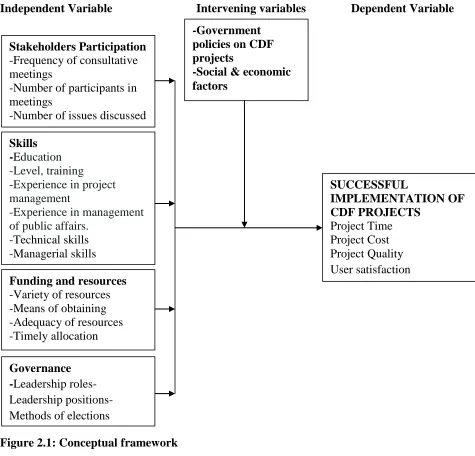
Independent Variable Intervening variables Dependent Variable
Figure 2.1: Conceptual framework Source: Researcher, (2017)
As shown in figure 2.1, the independent variables were; stakeholders participation, skills, funding and resources and governance while the dependent variable was successful implementation of CDF projects.
Stakeholders Participation -Frequency of consultative meetings
-Number of participants in meetings
-Number of issues discussed Skills
-Education -Level, training -Experience in project
management -Experience in management
of public affairs. -Technical skills -Managerial skills Funding and resources -Variety of resources -Means of obtaining -Adequacy of resources -Timely allocation Governance -Leadership roles-Leadership positions-Methods of elections
SUCCESSFUL IMPLEMENTATION OF CDF PROJECTS Project Time Project Cost Project Quality User satisfaction -Government
policies on CDF projects
CHAPTER THREE RESEARCH METHODOLOGY 3.1. Introduction
This chapter deals with the research methodology was used in the study. It outlines the research design, target population, sample size and sample selection. It also features data collection instruments, instruments pre-testing (piloting), instrument validity and instrument reliability. This chapter also presents data collection techniques and methods of data analysis.
3.2 Study Design
Descriptive research design was adopted for the study. The design was appropriate for the study because it provides quantitative and numerical description. Descriptive research design has the ability to produce information about aspects of education that interests policy makers and researchers. The descriptive survey design helped to ensure minimization of bias and maximization of reliability because of its rigidity and it focuses on the objectives of the study. The research design is appropriate for field survey studies where respondents are observed in their natural set ups without manipulating the environment. Previous studies have used descriptive research design conclusively giving accurate results.
3.3 Target Population
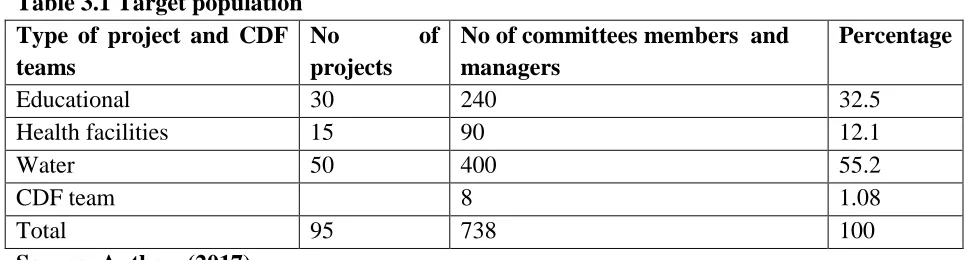
Table 3.1 Target population Type of project and CDF teams
No of
projects
No of committees members and managers
Percentage
Educational 30 240 32.5
Health facilities 15 90 12.1
Water 50 400 55.2
CDF team 8 1.08
Total 95 738 100
Source: Author, (2017)
3.4 Sample design and sample size
Sampling is the process of selecting a sufficient number of individuals or objects that the selected group contains elements representative of the characteristics found in the entire group (Orodho & Kombo, 2002). The sampling technique that was used in this study was stratified random sampling which according to (Kombo & Tromp, 2006) involves dividing the population into homogenous subgroups and then taking a simple random sample in each subgroup. The projects were stratified into: educational, health care and water strata. The purpose of the stratification was to have a good representation of the population of the study and to cater for all the categories of projects in the constituency. From the population of 738 shown in table 3.1 the researcher took a sample of 10% from the sector committees and CDF officials as shown in table 3.2. Therefore the sample size was 81 respondents which forms 11% of the target population. Table 3.2 Sample distribution
Stratum Population/Frequency Sample ratio Sample size
Educational 240 0.1 24
Health facilities 90 0.1 9
Water 400 0.1 40
CDF team 8 1.0 8
Total 738 0.1 81
Source: Author, (2017)
3.5 Data Collection instruments and procedure
questionnaires as the data collection instrument. Secondary data for the research study was collected from journals, articles written by accredited researchers and scholars on the underlying issue of the study as well as documents obtained from the organization.
The respondents of the study were required to fill in questionnaires. The questionnaire that was used for the study was semi-structured and thus comprised of open and closed ended questions. The open ended questions in the questionnaire gave respondents a chance to express their opinion on the underlying questions. The questionnaire that was used in the study can be viewed on Appendix I.
3.6 Pilot Test
Before actual data collection, a pilot study was conducted. The pilot data was not included in the actual study and allowed for pre-testing of the research instrument. Pre-testing of the questionnaire provides the opportunity to refine the questionnaire by revealing errors in the questions, sequence and design and see how the questionnaire performs under actual conditions (Churchill & Iacobucci, 2002). Piloting enhanced the instrument‟s validity and reliability as well as ensured familiarity with the administrative procedures in data collection. The results helped the researcher to correct inconsistencies arising from the instruments, which ensured that they measure what it ought to measure.
3.6.1 Reliability
Reliability of an instrument is the measure of the degree to which a research instrument yields consistent results or data after repeated trials. In order to test the reliability of the instrument to be used in the study, a pilot study was carried out and a reliability coefficient computed. This established the extent to which the questionnaires elicited the same responses every time it was administered.
calculating this; the researcher made the relevant changes in order to make the questionnaire reliable and bring the Cronbach‟s alpha to minimum .70.
3.6.2 Validity
According to Paton (2001) validity is quality attributed to proposition or measures of the degree to which they conform to establish knowledge or truth. It refers to the extent to which an instrument asks the right questions in terms of accuracy. The content validity of the instrument was determined through piloting, where the responses of the subjects were checked against the research objectives. A correlation coefficient of 0.5 arrived at was considered reliable for the study (Paton, 2002). The results obtained from the pilot study assisted the researcher in revising the questionnaire to make sure that it covered the objectives of the study.
3.7 Data Analysis
The researcher mainly used descriptive statistics which included frequency distribution, tables, percentages, measures of central tendency such as mean, mode and median and measures of dispersion. All qualitative data gathered during the study were analyzed through content analysis and presented descriptively. An attempt was also made to analyse data through inferential statistics especially correlation and regression. The research sought assistance through computer application especially SPSS and Excel to help to communicate and analyse the data.
3.8 Ethical Considerations
CHAPTER FOUR
RESEARCH FINDINGS AND DISCUSSIONS 4.1 Introduction
This chapter presents data analysis, interpretations and discussions. In this chapter data is presented and discussed to address the research questions and objectives.
4.2 Questionnaire response rate
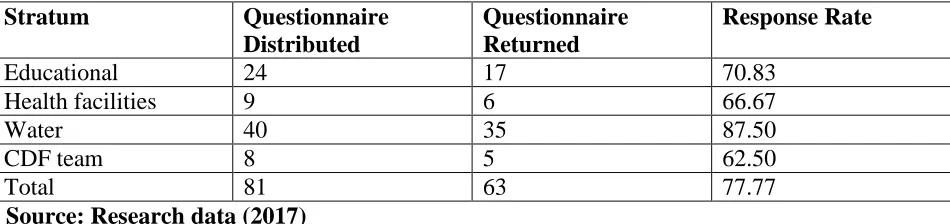
Detailed questionnaires were designed and distributed to establish the implementation practices of constituency development fund projects in Wajir east constituency. To make the analysis more comprehensive a total of 81 questionnaires were distributed out of which 63 were filled and returned which is a response rate of 77.77%. The response rate is considered satisfactory for the study. This response rate was good and representative and conforms to Mugenda and Mugenda (2003) stipulation that a response rate of 50% is adequate for analysis and reporting; a rate of 60% is good and a response rate of 70% and over is excellent. Table 4.1 below shows the response rate.
Table 4.1: Response Rate
Stratum Questionnaire
Distributed
Questionnaire Returned
Response Rate
Educational 24 17 70.83
Health facilities 9 6 66.67
Water 40 35 87.50
CDF team 8 5 62.50
Total 81 63 77.77
Source: Research data (2017) 4.3 General Information
The results on general characteristics of the respondents were investigated in the first section of the questionnaire. The general information of the respondents included name, project name and location, gender, respondents‟ role in the project, work experience.
4.3.1 Gender
Figure 4.1: Gender
Source: Research data (2017)
4.3.2 Respondents role in the project
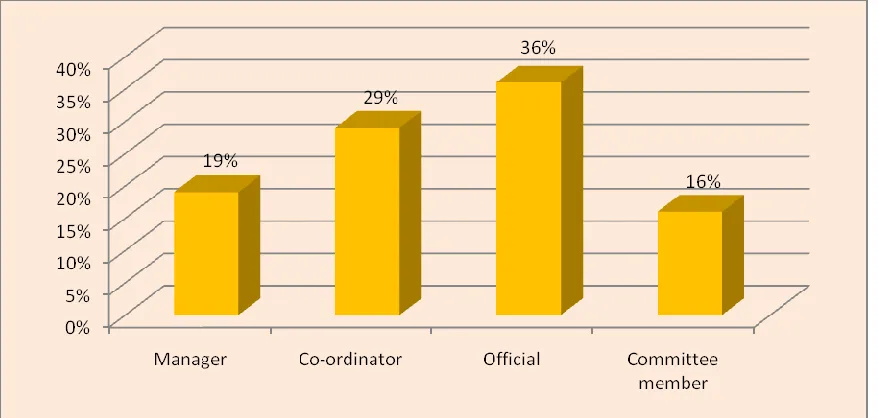
The study sought to find out the role of the respondents in the various projects across the county. Based on the findings, majority (36%) of the respondents were officials while 29% were project co-coordinators. It was also established that 19% of the respondents were managers while 16% were committee members as shown in figure 4.2.
4.3.3 Work experience
The study found it necessary to find out the respondents work experience. Based on the findings, majority (44%) of the respondents had between 5 and 10 years experience while 29% had over 10 years of work experience. It was also revealed that 27% of the respondents had an experience not `exceeding 5 years. From the findings therefore majority of the respondents were experienced and hence can be highly informative on issues that relate to implementation practices of constituency development fund projects in Wajir east constituency.
Figure 4.3: Work experience Source: Research data (2017) 4.4 Stakeholders Participation
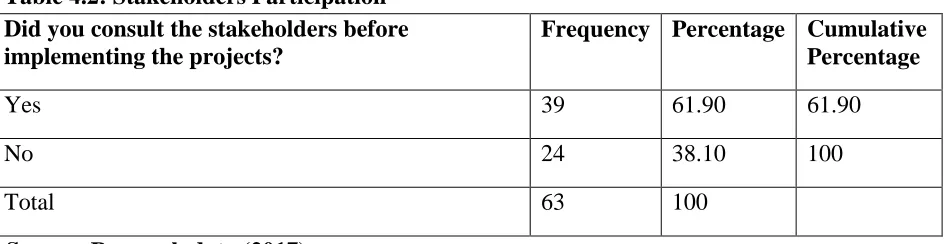
The study sought to find out whether they consulted the stakeholders before implementing the projects where the majority (61.90%) answered in the affirmative. It was also noted that 38.10% indicated that stakeholders were not involved as shown in table 4.2.
Table 4.2: Stakeholders Participation Did you consult the stakeholders before implementing the projects?
Frequency Percentage Cumulative Percentage
Yes 39 61.90 61.90
No 24 38.10 100
Total 63 100
The respondents unanimously agreed that stakeholder involvement had helped in implementation of the CDF projects in Wajir East constituency. This implies that stakeholder involvement is an important factor that influences success of CDF projects.
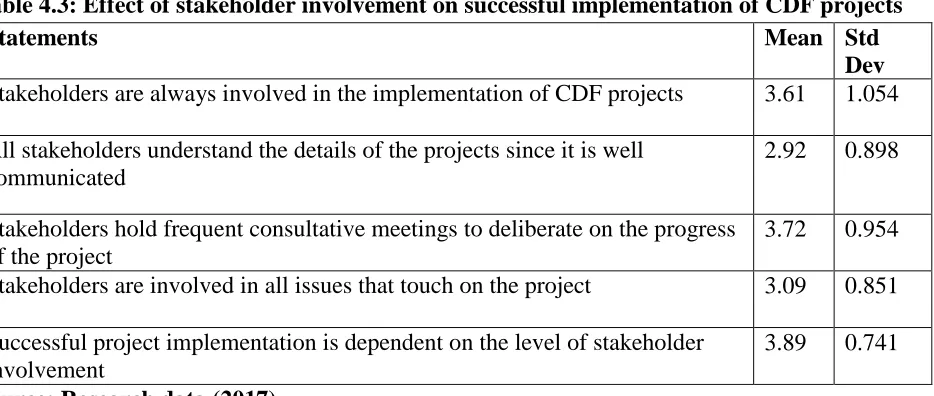
The respondents were also presented with statements to rate on a 5 point scale seeking to establish the influence of stakeholder involvement on implementation of CDF projects. The respondents agreed that successful project implementation is dependent on the level of stakeholder involvement (mean=3.89, SD=0.741). The respondents also agreed that to a great extent stakeholders hold frequent consultative meetings to deliberate on the progress of the project (M=3.72, SD=0.954) and are always involved in the implementation of CDF projects (M=3.61, SD=1.054). The respondents agreed though to a moderate extent that stakeholders are involved in all issues that touch on the project (M=3.09, SD=0.851). Further, the respondents indicated that to a small extent, all stakeholders understand the details of the projects since it is well communicated (M=2.92, SD=0.898).
Table 4.3: Effect of stakeholder involvement on successful implementation of CDF projects
Source: Research data (2017) 4.5 Skills
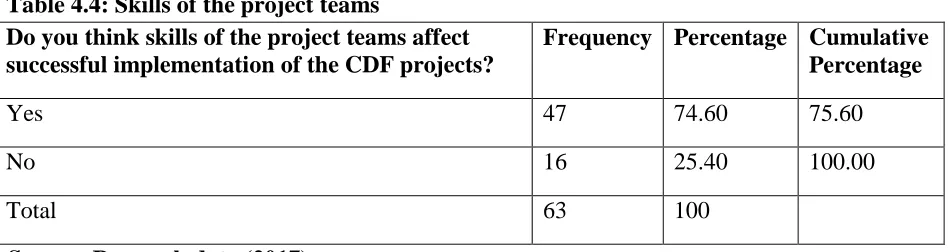
The study sought to find out whether skills of the project teams affected successful implementation of CDF projects where the findings indicated that 74.6% of the respondents agreed while only 25.4% disagreed. The respondents also indicated that the effect was to a great extent.
Statements Mean Std
Dev Stakeholders are always involved in the implementation of CDF projects 3.61 1.054 All stakeholders understand the details of the projects since it is well
communicated
2.92 0.898
Stakeholders hold frequent consultative meetings to deliberate on the progress of the project
3.72 0.954 Stakeholders are involved in all issues that touch on the project 3.09 0.851 Successful project implementation is dependent on the level of stakeholder
involvement
Table 4.4: Skills of the project teams
Do you think skills of the project teams affect successful implementation of the CDF projects?
Frequency Percentage Cumulative Percentage
Yes 47 74.60 75.60
No 16 25.40 100.00
Total 63 100
Source: Research data (2017)
The respondents were further presented with statements to rate on 5 point likert scale seeking to establish whether skills of the project teams affected the success of the projects. The findings indicated that project team selection has an impact to the success of CDF projects as shown by a mean of 3.79 and a standard deviation of 0.990. Further findings indicated that Education level of project team members contribute to success of CDF projects (M=4.02, SD=0.793) and that project team skills contribute to the success of projects (M=4.00, SD=0.871). The respondents also agreed to a large extent that project team members frequently take short courses on project implementation as shown by a mean of 3.84 and a standard deviation of 0.868. According to the respondents, project team training is carried out to ensure that the project is of the desired quality (M=3.80, SD=0.849) therefore Carrying out project team training reduces the risks that the project might encounter (M=4.00, SD=0.712). To a moderate extent, the respondents indicated that the expenses on training hinders frequent training of team members as shown by a considerably low mean of 2.72 and a standard deviation of 1.003 summarized in table 4.5. Table 4.5: Effects of skills of project teams on success of CDF projects
Statements Mean Std
Dev Project team selection has an impact to the success of CDF projects 3.79 0.990 Education level of project team members contribute to success of CDF
projects
4.02 0.793
Project team skills contribute to the success of projects 4.00 0.871 Project team members frequently take short courses on project
implementation
3.84 0.868
Project team training is carried out to ensure that the project is of the desired quality
Source: Research data (2017) 4.6 Funding and Resources
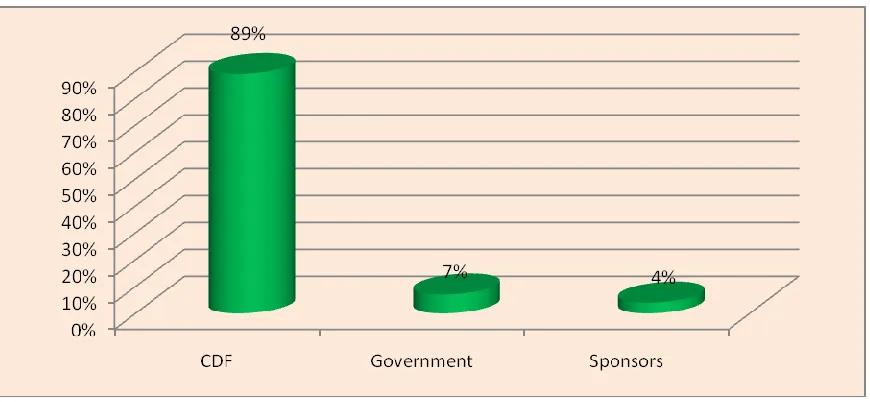
The respondents were asked to indicate the sources of funds for the projects. Majority (89%) of the respondents indicated that CDF was the main source of funding for the projects. Only 7% of the respondents indicated that government was a source of funding while 4% indicated that sponsors/well-wishers were also a source of funding. Figure 4.4 shows the sources of funding. Figure 4.4: Sources of funding
Source: Research data (2017)
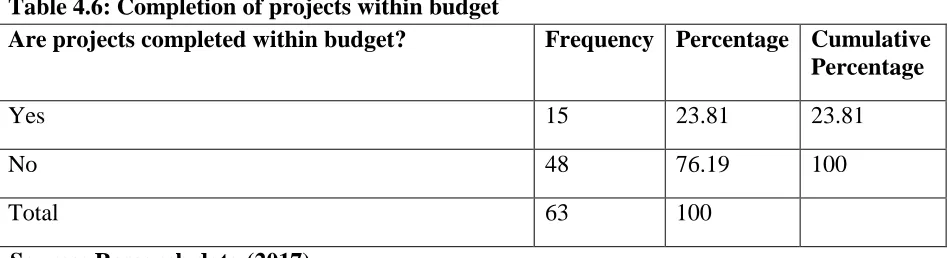
Results in table 4.6 below show that 76.19% of the projects had insufficient budget while only 23.81% found their budgeted cost enough. This implies that the funding from the CDF is usually insufficient. This is a major reason as to why most of the projects did not complete in the allocated time.
Carrying out project team training reduces the risks that the project might encounter
4.00 0.712
Table 4.6: Completion of projects within budget
Are projects completed within budget? Frequency Percentage Cumulative Percentage
Yes 15 23.81 23.81
No 48 76.19 100
Total 63 100
Source: Research data (2017)
From the foregoing, it was notable that in the respondents‟ opinion, there was need to broadly provide funds for the CDF projects at the right time for proper implementation and timely completion of the project. The study established some of the key issues in the project funding were delayed and untimely funding. Other resources that are supposed to be mobilized include human resources as well as harnessing local materials.
4.7 Governance
The study sought to establish the effect of governance on successful implementation of CDF projects in Wajir East Constituency. Governance is a leadership function for influencing Project Committee Members efforts the ends of a project initiative. Project Committee Members governance was therefore regarded crucial to implementation of development projects. The study measures of PMC governance included the number of leadership positions available, methods of conducting elections and the frequency of conducting elections. Results indicated that 82% of the respondents agreed that governance affected implementation of CDF projects while 18% disagreed.
Table 4.7: Governance
Do you think governance affect implementation of CDF projects?
Frequency Percentage Cumulative Percentage
Yes 52 82 82
No 11 18 100
Total 63 100
The respondents indicated that CDF lacks its own structure for disclosure and accountability, since these are handled by central government officials. The Kenyan Public Service and especially procurement and supplies departments have often been accused of inefficiency and ineffectiveness.
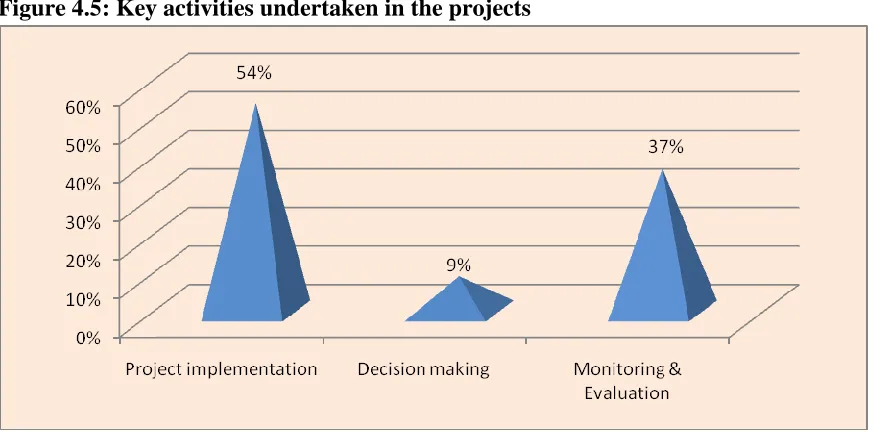
The study sought to find out the key activities they undertake in their respective projects. The findings indicated that 54% of the respondents were involved in project implementation while 37% were involved in monitoring and evaluation. It was also established that only 9% were involved in decision making as shown in figure 4.5.
Figure 4.5: Key activities undertaken in the projects
Source: Research data (2017)
Table 4.8: Election method
Election method Frequency Percentage Cumulative
Percentage
Secret method 21 34 34
Queuing method 8 13 47
Consensus 19 30 77
Acclamation 15 23 100
Total 63 100
Source: Research data (2017)
Based on the findings 21(34%) of the respondents indicated that elections were carried out through secret ballot while 19(30%) indicated that elections were conducted through consensus. It was also established that 15(23%) of the respondents mentioned acclamation while 8(13) indicated queuing as a voting method. The respondents indicated that the elections were being held yearly but not regularly.
4.8 Successful Implementation of CDF Projects
The respondents were asked to give scores to the project where project completion ahead of schedule had a low score of 2.69 as well as project being completed within budget. Other project scores included project implemented according to the original design (3.54), project serving the intended community‟s needs (3.61) and project meets stakeholder‟s expectations (3.92).
Table 4.9: Successful Implementation of CDF Projects
Source: Research data (2017)
Project success Mean Standard
Deviation
Project on or ahead of schedule 2.69 0.820
Project within budget 2.50 0.932
Project implemented according to the original design 3.54 0.614 Project serving the intended community‟s needs 3.61 0.752
CHAPTER FIVE
SUMMARY OF FINDINGS, CONCLUSIONS AND RECOMMENDATIONS 5.1 Introduction
This chapter summarizes the study and makes conclusion based on the findings. The recommendations of the study and areas for further research are also presented.
5.2 Summary of Findings
The study sought to find out whether they consulted the stakeholders before implementing the projects where the majority answered in the affirmative. It was also noted that some indicated that stakeholders were not involved. The respondents unanimously agreed that stakeholder involvement had helped in implementation of the CDF projects in Wajir East constituency. This implies that stakeholder involvement is an important factor that influences success of CDF projects. The respondents were also presented with statements to rate on a 5 point scale seeking to establish the influence of stakeholder involvement on implementation of CDF projects. The respondents agreed that successful project implementation is dependent on the level of stakeholder involvement. The respondents also agreed that to a great extent stakeholders hold frequent consultative meetings to deliberate on the progress of the project and are always involved in the implementation of CDF projects. The respondents agreed though to a moderate extent those stakeholders are involved in all issues that touch on the project. Further, the respondents indicated that to a small extent, all stakeholders understand the details of the projects since it is well communicated.
the project is of the desired quality therefore Carrying out project team training reduces the risks that the project might encounter. To a moderate extent, the respondents indicated that the expenses on training hinder frequent training of team members.
The respondents were asked to indicate the sources of funds for the projects. Majority of the respondents indicated that CDF was the main source of funding for the projects. Other sources of fund mentioned include government and sponsors/well-wishers. Results show that many projects had insufficient budget. This implies that the funding from the CDF is usually insufficient. This is a major reason as to why most of the projects did not complete in the allocated time.
The study sought to establish the effect of governance on successful implementation of CDF projects in Wajir East Constituency. Governance is a leadership function for influencing Project Committee Members efforts the ends of a project initiative. Project Committee Members governance was therefore regarded crucial to implementation of development projects. The study measures of PMC governance included the number of leadership positions available, methods of conducting elections and the frequency of conducting elections. Results indicated that majority of the respondents agreed that governance affected implementation of CDF projects. The respondents indicated that CDF lacks its own structure for disclosure and accountability, since these are handled by central government officials. The Kenyan Public Service and especially procurement and supplies departments have often been accused of inefficiency and ineffectiveness.
5.3 Conclusions
Based on the findings it was determined that the community played an effective role in planning, implementation and monitoring and evaluation of the project. Thus the study found out that effective community participation was crucial in enhancing timely completion of projects. The study concluded thus that stakeholder participation played a positive role in enhancing the timely completion of the CDF financed projects.
The study established that skills influences success of implementation of CDF funded projects. The staff did not have adequate skills to ensure that there is efficiency and effectiveness in the implementation of CDF funded project. Moreover, the employees are not adequately trained to effectively participate in developing initiatives that will lead to improved implementation practices of CDF funded project. The management training is not frequent and therefore more courses should be trained. The managerial skills of the project management committee members affected their outlook to projects being undertaken. The sustainability of the projects was hinged on the ability of the project management committee members to effectively discharge their mandates. Capacity to understand the accounting procedures for constituency development projects was affected by the competence and managerial skills of the project management committee members.
The data analysis for CDF Projects in Wajir East constituency shows that failure in timely completion of these facilities is occasioned by challenges associated with project funding. All elements of project financing i.e. fund allocation process, budgetary utilization and funds were substantially affected. The study concludes that funds allocation and utilization influence implementation of CDF projects. The factors necessary for successful implementation of CDF projects include; timely disbursement, adequate budgeting, adequate budgetary allocation, expenditure variability and availability of facilities.
political ambitions; funding for projects is also thinly done leading majority of projects being in perpetual state of „ongoing‟ for over six years which implies that the purpose for which projects are started for is not met. It was concluded that legislators are not free to employ CDF funds to woo their political cronies. Members of the National Assembly are not accorded too many powers in the CDF governance structure. In addition, the study concluded that, interference of CDF projects by the members of the National Assembly is likely to negate the intended benefits of these projects. It was deduced that though political interest are significant in CDF projects, their impact on successful completion of those projects is quite marginal.
5.4 Recommendations of the study
This study recommended that the various institutions involved in decision making on CDF funding at both national and constituency level should endeavor to put in place more efficient mechanisms geared towards improving its performance. These should be aimed at not only ensuring better cost estimates for infrastructural projects but at developing a more robust and effective funding system that would ensure prompt, adequate and sufficient disbursement of funds to earmarked projects.
The study recommends that improvement on skills will facilitate performance of CDF funded project. There is need to have skilled project managers to ensure that there is efficiency on the performance of CDF funded project. The project managers should be engaged on planning and implementation of CDF projects. There employee training should be frequent to enable project managers to acquire additional knowledge.
CDFC members need to be individuals who have the interest of the public at hand so as to involve them in all CDF funded projects stages to realize ownership of CDF funded projects. The CDFC and by extension PMC need not be „recruited‟ basing on political cronyism so as to have some standards of professionalism in CDF management. Various government ministries need to be fully involved to give the much required technical input throughout CDF project cycle and not at convenient stages as is the current case.
5.5 Suggestion for Further Research
REFERENCES
Amachree, S. M. O. (1988). Investment Appraisal in Developing Countries. Avebury Gower Publishing Company Ltd.
Baker, P.K. (1998). "Implementation to Management Plans Through Project Management". In D. I. Cleland and W. R King (EdsProiect Management Handbook; New York; Van Nostrand Reinhold Co Best practices and lessons learned by IFAD in Asia; Tango International, The eighth in a series of discussion papers produced by the Asia and the Pacific Division, IFAD
Baskin (2010). Constituency Development Funds as a Tool of Decentralized Development: Nairobi: Institute for Policy Analysis and Research
Baskin, M. (2010). Constituency Development Funds (CDFs) as a Tool of Decentralized Development, overview paper presented the 56th Commonwealth Parliamentary Conference, 10-19 September.
Bolles, D. (2002). Building Project Management Centre of Excellence. U.S.A.: University Press of America.
Bourne, L. (2009). Advising Upwards: A framework for understanding and Engaging Senior Management Stakeholders. Aldershot, UK: Gower Publishing Ltd.
Chandra P, (2008). PROJECTS: Planning. Analysis, Selection, Financing, Implementation, and Review, (6th Edition), Pashupati Printers Pvt. Ltd., Naveen Shahdara, Delhi, India. Chikati, J. (2009). Project Cycle Management:An Intergrated Approach and Logical
Framework. Nairobi: Signal Printers.
Churchill, G.A. and Iacobucci, D. (2002). Marketing research: Methodological foundations, 8th ed. Orlando: Harcourt College Publishers.
Harold, K.(2004). Advanced project management: Best practices on implementation. USA :Willy & sons.
Kerzner, H., & Kerzner, H. R. (2017). Project management: a systems approach to planning, scheduling, and controlling. John Wiley & Sons.
Kimani, F., Nekesa, P., Ndungu, B., (2009). Best Practices in Constituency Development Fund (CDF). A Research Publication.
Kombo, D. K., & Tromp, D. L. (2006). Proposal and thesis writing: An introduction. Nairobi: Paulines Publications Africa, 10-45.
Llewellyn, R. (2009, May 28). Stakeholder Management Overview. Retrieved from www.pmhut.com.
Mapesa, B. M., & Kibua, T. N. (2006). An assessment of the management and utilisation of the constituency development fund in Kenya (No. 76-2006). Institute of Policy Analysis and Research.
Monitoring, Qualitative Impact Assessment and People Friendly Evaluation Methods
Mulwa F. W (2007). Participatory Monitoring and Evaluation of Community Projects Community Based Project
Mwagwabi, L., (2008). Enhancing Constituency Development Accountability; the Case of Bahari Constituency Development Fund. The Governance Link, issue 5, September 2008.
Nutt, P. C. (1986). Tactics of Implementation. Academy of Management Journal 1986, Vol. 29, No. 2,
Odhiambo P.S.O (2007). Impact of Kenya Education Staff Institute Training on Secondary School Management in Kenya (Case Study of Siaya District). A Research Proposal for the Degree of Doctor of Philosophy in Evaluation of Educational Programs. Department of Education Comm.-Tech and Curriculum Studies, Maseno University. Ofori, G. (2008). Leadership for future construction industry: Agenda for authentic leadership.
International Journal of Project Management, 26(6), 620-630.
Orodho, A., & Kombo, D. (2002). Research methods. Nairobi: Kenyatta University, Institute of Open Learning.
Otieno G.O (2007). Measuring effectiveness of Constituency Development Fund on Poverty Paton, M.Q. (2002). Qualitative Research and Evaluation Methods (3rd Edition). London: Sage
Publications.
Pedro, S. (2014). Project planning and project success: the 25% solution. CRC Press.
Pinto, J.K. (2007). Project Management: Achieving Competitive advantage. Pearson: NewBaskerville.
Rapa, A. and Kauffman, D. (2005). Strategy implementation – an insurmountable obstacle, Handbook of Business Strategy, 6 (1): 141-146.
Turner, R., Ledwith, A., & Kelly, J. (2010). Project management in small to mediumsized enterprises: Matching processes to the nature of the firm. International Journal of Project Management, 28(8), 744–755.
APPENDIX ONE: QUESTIONNAIRE SECTION A: GENERAL INFORMATION
1. Name
2. Project name………..Project Location……… 3. Gender
Male Female
4. What is your role in the project?
Manager Coordinator Official Committee member 5. Years in service
Less than 5 years 5-10 years above10 years SECTION B: STAKEHOLDERS PARTICIPATION
6. Did you consult the stakeholders before implementing the projects? Yes No
7. Do you think this involvement has helped in the implementation of the project? Yes No
8. If yes to question 7, to what extent?
Very great great moderate low very low 9. Stakeholder involvement is a factor that influences success of projects. In your own opinion, rate using the scale below Not at all = 1, Low Extent = 2, Moderate Extent = 3, Great Extent = 4, Very Great Extent = 5
1 2 3 4 5
Stakeholders are always involved in the implementation of CDF projects
All stakeholders understand the details of the projects since it is well communicated
10. What do you recommend on stakeholder involvement to help facilitate implementation of CDF projects?
……… ……… ……… SECTION C: SKILLS
11. Do you think skills of the project teams affect successful implementation of the CDF projects?
Yes No
12. If yes to question 11, to what extent?
Very great great moderate low very low 13. Was the skills of the project teams a determinant of success in your project? In your own opinion, rate using the scale below Not at all = 1, Low Extent = 2, Moderate Extent = 3, Great Extent = 4, Very Great Extent = 5
Stakeholders are involved in all issues that touch on the project
Successful project implementation is dependent on the level of stakeholder involvement
Skills 1 2 3 4 5
Project team selection has an impact to the success of CDF projects
Education level of project team members contribute to success of CDF projects
Project team skills contribute to the success of projects Project team members frequently take short courses on project implementation
Project team training is carried out to ensure that the project is of the desired quality
Carrying out project team training reduces the risks that the project might encounter