ADELAIDE & FLINDERS UNIVERSITIES
Impact of Mining and Resource Development:
A Case Study for Eyre Peninsula Councils
Report commissioned by:
Local Government Association of South Australia
Report prepared by:
The South Australian Centre for Economic Studies
Contents
Executive Summary (i)
1. Introduction 1
1.1 Background 1
1.2 Objective 2
2. Literature Review 5
2.1 Future of mining in South Australia 5
2.2 Mining on the Eyre Peninsula 5
2.3 General impacts of mining on regional communities 8
2.4 General impacts of mining on local government 14
3. Profile of Local Councils: The Baseline 17
3.1 Population growth 17
3.2 Employment in various industries 19
3.3 Post-school qualifications 25
3.4 Age distribution 26
3.5 Council finances 27
3.6 Number of rateable properties 29
3.7 Student enrolment in Eyre Peninsula schools 29
3.8 Gross Regional Product, unemployment and the labour market 29
4. Mining on the Eyre Peninsula 33
4.1 Mines on the Eyre Peninsula 33
4.2 Travel of residents for work 37
5. Assessing the Impact of Mining on Local Governments 39
5.1 Responses from councils 39
5.2 Demand for infrastructure 45
6. Methodology 47
7. Case Study of Tumby Bay 72
7.1 Why Tumby Bay 72
7.2 What will result for Tumby Bay from mining? 73
7.3 What has Tumby Bay done to prepare for mining? 75
References 77
Appendix A: Projections for Local Government Areas 81
Appendix B: Statistical Subdivision & Statistical Local Areas 92
This report was prepared by the following SACES researchers:
Assoc Professor Michael O’Neil, Executive Director Lauren Kaye, Research Economist
Mark Trevithick, Research Economist
Disclaimer: This study, while embodying the best efforts of the investigators is but an expression of the issues considered most relevant, and neither the Centre, the investigators, nor the Universities can be held responsible for any consequences that ensue from the use of the information in this report. Neither the Centre, the investigators, nor the Universities make any warranty or guarantee regarding the contents of the report, and any warranty or guarantee is disavowed except to the extent that statute makes it unavoidable.
Executive Summary
This is an investigative report concerned with future mining developments on the Eyre Peninsula, about which there are many unknowns and considerable uncertainties. The principal objective of the report was to provide information to councils to “help them determine future population patterns” and settlement patterns and the report addresses this objective.
There are 33 developing minerals projects in South Australia (excluding those already approved) and of these some 15 projects are located in, or proximate to, the Eyre Peninsula.1
To the extent that uncertainties can be resolved in regard to the timing of construction and mine site operations then councils, mining companies, State and Commonwealth governments can proceed with longer-term strategic planning. This report provides information to assist with the planning process. It is difficult to plan and commit resources including funding – whether you are a mining company or local council – in an environment of uncertainty. Judgements about the future (i.e., commodity prices, demand), population impacts, sourcing of skilled labour and various other “unknowns” impact future planning and elevate risks.
Leaving aside the two largest councils in the Eyre Region the other nine councils are relatively small. They will be required to deal with individual mine operators, with local impacts and with regional impacts. There are likewise service and infrastructure requirements that the State government will need to address. And, further there is no single, one mine operator or mine site as with Olympic Dam and potentially multiple start dates.
R1: The State government together with the Local Government Association of SA (LGA) should consider establishing an “Eyre Peninsula Mining and Community Development Taskforce” to:
provide a single and strengthened forum for information sharing as to the development of
mine sites, infrastructure demand and community impacts;
to assist councils in preparatory planning for housing and support services;
to provide a focus to all State agencies activity (e.g., education, health, police) as a result of mining proceeding and thereby provide support to the Eyre Peninsula Local Government Association (EPLGA) and Regional Development Australia (RDA) as they address local issues.
R2: The “Eyre Peninsula Mining and Community Development Taskforce” would thereby play a similar role as the Olympic Dam Taskforce, enabling a single body to take a regional perspective in developing industry, on environmental matters and regional infrastructure and emerging issues that require joint local council/State government decision (i.e., “user pays” principle for road access; maintenance of local roads, etc). Such a body could also draw in planning assistance from State agencies where land use planning, re-zoning is necessary at a council level.
R3: Representation is a matter for the State government but could include membership of the LGA
(1), membership from the EPLGA (3), membership of the Whyalla and Eyre RDA (1) consideration be given to a representative from the South Australian Chamber of Mines and Energy (SACOME) (1).
1 DMITRE: various publications.
An important distinguishing feature for the mine operators, councils and communities on the Eyre Peninsula (relative to other mine sites in Western Australia, Northern Territory and Far North Queensland) is the proximity of local townships to the mine sites. The most important implication is the beneficial prospect of a more stable, residential population, a drive-in/drive-out workforce and flow-on demand for household investment and consumption.
Potential impacts include:
short term boost in population numbers during the infrastructure and construction phase, pressure on housing, rents, existing accommodation, potential need for demountable, short-term accommodation;
attract and retain new residents for on-going operations, single persons and married workers with
families, with flow-on benefits to housing construction, personal consumption, school enrolments and access to services;
job opportunities for local residents although unemployment is low and current full-time employment is high;
increase in local incomes (increase in expenditure) and wealth;
preference for local employees, unemployment is low in some regional towns, transition of some
workers from agricultural sector to mining particularly transport/road drivers and even skilled workers from councils and related employment;
potential training and employment for local Indigenous communities that will require specialised
(i.e., culturally specific) approaches to training and work placement;
trades workers comprise approximately 18 per cent of a mining company’s workforce; stationary
and mobile plant operators, road and rail drivers and mining labourers represent some 54 per cent of the workforce so that many of these skills already exist in the workforce of the region. That is to say, there will be movement within the currently employed workforce; and
there will be opportunities in clerical and administration sectors. Much of the demand for professionals, surveyors, engineering, specialist managers and environmental health professionals could be met from migration into the region.
As mining on the Eyre Peninsula grows and the population of towns increase the responsibilities and expectations of local government increase beyond its traditional scope. Pressure is likely on councils to provide new infrastructure such as land use for housing, accommodation, libraries, community centres etc and services such as rubbish disposal. Councils face resource constraints when trying to meet these expectations.
The construction of new mines is certain to have an impact on councils across the region. Employment will be created not only at mine sites, but also in support industries such as housing construction, transport, and shopping and personal services. First round impacts will be direct employment in mining, a shift of labour from existing industries and an even lower unemployment rate. Second round impacts will flow from investment in housing, household consumption expenditure and a potential boost to the population.
What is needed is a collaborative approach where local and state governments cooperate and plan with mining companies to assist councils to provide some of the required infrastructure.
maximising productivity and at the same time providing a high quality of life, low cost housing and social and community services will provide substantial benefits to the region.
In this report, the South Australian Centre for Economic Studies (SACES) estimates the following:
to the year 2020 the number of new jobs in the mining industry to reach 2,180;
the number of new mine workers who move into the region to be 1,530 to 1,660;
the resulting residential, longer-term population increase to be in the order of 4,450 to 4.820 persons;
demand for housing (to 2026) to increase above the baseline due to mining under scenario 1 (most likely scenario) by 1,200 houses;
the student population to increase by between 950 to 1,050 students, demand for teachers from
between 42 to 70;
require four additional bulk-billing General Practitioners (GPs) and up to 14 additional police staff;
the four townships/council areas of Tumby Bay, Wudinna, Franklin Harbour and Kimba will experience most increases in population; and
depending upon the density of dwellings per hectare up to 108.5 hectares of land needed to accommodate population growth (12.5 dwellings per hectare) rising to 169 hectares (eight dwellings per hectare).
1. Introduction
1.1 Background
Australia’s mining sector has expanded rapidly over the past decade. An expansion in foreign demand for Australian commodities particularly those used in steel and energy generation has been lead by China and a number of periphery countries in Asia.
South Australia’s mining output and mineral exploration expenditure has grown rapidly as new mineral deposits are discovered and developed to meet expected demand. The State now has 20 major operating mines compared to five in 2006 (DMITRE, 2012); there are also 33 developing projects and more than 107 prospective mine sites. Most mining activity in the State is concentrated in the Far North and increasingly on the Eyre Peninsula. Consequently local councils on the Eyre Peninsula face increasing pressure to meet community demands and expectations for local infrastructure and services. To meet the challenges Eyre Peninsula councils need to better understand how their region will be affected in terms of: population growth, housing demand and allotment of residential land as well as the impact on all other community infrastructure and services.
The Eyre Peninsula is unique compared with other long established mining areas in Central Queensland and northern Western Australia which typically use Fly-in-fly-out (FIFO) workers. Most newly developing mines on the Eyre Peninsula are within commuting distance for local townships making the preferred method of travelling to work drive-in-drive-out (DIDO). The implication of DIDO is that existing town residents employed in mines will commute to the mine site while maintaining a permanent residence on the Eyre Peninsula. As new residents take up employment over the next five to ten years they are also likely to adopt a DIDO arrangement. Unlike with FIFO, the burden of supporting these residents rests with local councils that are required to identify future population patterns so they can plan for town development.
Traditionally, council responsibilities have been referred to in simplest terms as “roads, rates and rubbish” although we consider this to be an outdated view of the functions, services and activities that councils are responsible for. It is not the function of this report to review council activities (a detailed list of local government responsibilities can be found at the Local Government Association website), except to note that Councils spend over $0.5 billion annually on, inter alia, economic development, community amenity and services, industry programs, environmental management, water catchment, recreation facilities and broad range of community services.
Councils levy rates on local residents to generate the financial resources necessary to deliver these services and infrastructure. The expected increase in populations of towns on the Eyre Peninsula can only be supported if councils have the human and financial resources to meet the growth. Councils have limited ability to raise revenue quickly to respond to the increasing demand for new infrastructure and services. Long-term strategic planning is needed along with collaboration between councils, mining companies, State Government and Federal Government.
1.2 Objective
The single objective of this project was the following:
to assist Councils to plan properly for the future by providing information that will help them to determine future population patterns.
To meet this objective the report will outline the following:
population growth and settlement patterns;
community profile and trends; and
community facilities catchment.
It was suggested that the report will also assist councils and the Local Government Association of SA (LGA) with regards to:
the development, timing, design and location of community infrastructure over the next ten years
and beyond and the relationship between mining company’s and councils;
identifying services and facilities required for their Council district’s emerging population based upon supply and demand analysis and identification of service catchments;
identifying capital costs (where possible) associated with proposed community infrastructure to be included in their long term financial and asset management plans; and
allowing the LGA of SA to provide input of a statistical nature to future iterations of the South
Australian Government’s regional planning strategy for the Eyre Peninsula. However, it is important to consider the following caveats:
that there is a high degree of uncertainty with respect to mining companies as to their future labour requirements and exactly when they will be required;
there is a high degree of uncertainty as to the start date of mining operations, dependent upon a
number of variables (e.g., $A, international circumstances, commodity prices, availability of supportive infrastructure such as ports, water, electricity, rail/road);
several companies are only at the very preliminary, pre-feasibility stage and future timing of operations is unknown;
there is a list of “developing mines” which have no start date well into the future; and
relationships between mining companies and councils appear to be positive, but it is not possible
to determine with real certainty community infrastructure requirements, specific services or capital costs for any specific physical infrastructure.2
The future impact on councils is dependent, in part, on all of the above but most critically the preference (and then actual reality) of mining companies to hire and maintain a local labour force, the extent of unemployment in the region to take-up employment, the number of people who leave existing employment to take up a mining job, the ability of the farming community to contribute to employment in mining and the take-up of those who are underemployed or not in the labour force. Each of these factors will determine the extent of in-migration to the region; the life of a mine will influence settlement/ residence decisions; family structures and the location of mines will influence where individuals/families chose to locate. The profile of a “mining workforce” – by age, gender, family structure – will exert influence on community infrastructure and demand for services. The extent of an under-utilised stock of
and while this may service the fly-in/fly-out (FIFO) workforce it will act to reduce demand for new housing.
The final determination of a mining company as to how it intends to transport mining products will impact on decisions about ports, pipelines, the use of roads and rail. It is not yet determined what these impacts will be, but if, for example, local roads are intended to be used then councils will need to explore user-pay charges, perhaps transfer “local roads” to State government or explore alternative financing options so that ratepayers do not bear the cost of maintenance.
The genesis of this project is that the Local Government Association of South Australia commissioned the South Australian Centre for Economic Studies (SACES) to profile and characterise local government areas on the Eyre Peninsula to assist Eyre Peninsula councils to undertake strategic planning for the future. The LGA asked SACES to consider the following Local Government Areas as part of the analysis.
Ceduna Lower Eyre Peninsula
Cleve Streaky Bay*
Elliston Tumby Bay*
Kimba* Wudinna*
Franklin Harbour*
Note: Those asterisked denotes towns that are expected to be most impacted by residential expansion over the next 5 years, depending on continued demand for iron ore and development of mining sector across the region.
When the Local Government Areas of Whyalla and Port Lincoln are included, this list covers all of the Local Government Areas in the Regional Development Australia Whyalla and Eyre Peninsula region. For these LGAs, this report provides inter alia, a profile of each region using a variety of sources including the ABS Census to map aggregate population, population change and growth between Census years, population by age cohort, employment by industry, education qualifications and council rates and taxes revenue. General commentary is also provided on the levels of associated State-based services such as education, health and police that will be required with the expansion of mining. This report also provides profiles of each mine on the Eyre Peninsula including size, location, development status, minerals extracted, expected length of operations once fully operational and whether they currently use or intend to use FIFO workers to support operations.
Input from mining companies was sought to develop a better description of each mine on the Eyre Peninsula. Companies surveyed were asked to describe the location of their mines and the nearest towns to each mine site, stage of development, life of mine, infrastructure requirements, investment, workforce, preference for sourcing workers and any requirements between miners, local and state government in relation to maximising regional benefit.
Input from Local Council was sought to assess the local impacts from mining, planning currently undertaken and assistance required. Councils were asked to describe their relationship with the mining sector, how well informed they are and the nature of cooperation between the mining and exploration companies. Information was sought regarding council’s capacity to adapt to increased demands from mining due to population growth and increased demand for infrastructure and services. Responses from councils are summarised into a single response and provided in the main body of the report.
A case study of Tumby Bay is provided highlighting the expected impact of mining on a selected community on the Eyre Peninsula, i.e., growth in population, need for accommodation, community infrastructure, services and the role local government and mining companies need to play in assisting the development.
The report is organised as follows, Section 2 contains a literature review of the current state of mining in South Australia, what the future holds for the industry, mining on the Eyre Peninsula and a description of the general impacts of mining on communities and local government. Section 3 contains a summary profile of each local government area, Section 4 provides a description of mines on the Eyre Peninsula, Section 5 provides a discussion of the responses to the survey received from the nine participating councils and considers the potential impact on local governments in terms of services and infrastructure provision. Section 6 considers the methodology to estimate population impacts and other impacts relevant to local councils and Section 7 provides a case study of the impacts of mining on the District Council of Tumby Bay.
2. Literature Review
2.1 Future of mining in South Australia
Investment in mining exploration and the development of new mines in South Australia, supported by the Plan for Accelerating Exploration (PACE) began in April 2004. Global demand primarily from China and a number of developing countries in Asia provided strong stimulus to mining exploration. Minerals mined in South Australia include, inter alia, copper, iron ore, gold, silver, cobalt, heavy minerals, lead, zinc, graphite, molybdenum and uranium.
With respect to uranium, South Australia has three mines, Olympic Dam the world’s largest uranium deposit at Roxby Downs owned by BHP Billiton, the Beverley mine owned by Heathgate Resources and the Honeymoon mine owned by Uranium One. The State has 78 per cent of Australia’s known uranium resources and one third of the world’s known uranium reserves which offer potential for further exports to countries for use in electricity generation (Earth Resources, Information Sheet).
Although mining is still a small sector of the South Australian economy in terms of its proportion of gross state product in comparison with traditional industries of manufacturing and services, the mining industry has grown considerably. Mineral exploration in South Australia reached $313 million in 2011 (ABS, 2011) or 8.8 per cent of Australian mineral exploration expenditure, a significant increase over the last ten years. Mining real gross value added for South Australia reached $4.4 billion in 2010/11, an increase of 46 per cent over ten years (SACES Economic Briefing report, June 2012).
The future of mining in South Australia is dependent on a number of external considerations including overseas economic conditions as the majority of output is exported overseas, commodity prices, international demand and supply, the availability of processing facilities and internal considerations including associated infrastructure such as roads, rail, water, power etc.
2.2 Mining on the Eyre Peninsula
The Whyalla and Eyre Peninsula region consists of a population of 58,707 (2010) and covers an area of 170,448 square kilometres3 (SACES, Regional factsheet, RDA Whyalla and Eyre Peninsula). If the
local government areas of the Provincial Cities of Port Lincoln and Whyalla are excluded and Unincorporated West Coast and Aboriginal communities are excluded, then the population of just the Eyre Peninsula is 19,929 (ABS, 2011) covering an area of 42,967 square kilometres.4
The Eyre Peninsula contains the mineral rich regions of the Gawler Craton and Eucla Basin. Existing mining operations are largely centred on iron ore extraction and a heavy mineral sands mining operation at Jacinth-Ambrosia. New opportunities also exist for the development of mining for gold, nickel, silver
and uranium. In 2010 the Eyre Peninsula Mining Alliance (EPMA)5 was formed to promote minerals
development on the Eyre Peninsula and address issues in relation to infrastructure development and sustainable growth of the mining industry.
Major industries of the Eyre Peninsula region are agriculture and fisheries, manufacturing, building and construction, retail trade and service industries. Mining currently comprises a small share of activity but has potential for growth in the medium term. Eyre Peninsula is rich in iron ore with high grade deposits of hematite and magnetite; mineral exploration has identified up to one billion tonnes or iron ore product
3 This includes the unincorporated area of Unincorporated West Coast and the Aboriginal communities of Maralinga Tjarutja Lands and Yalata
Aboriginal Reserve.
4 This represents the local government areas of Tumby Bay, Wudinna, Elliston, Streaky Bay, Kimba, Cleve, Franklin Harbour, Lower Eyre Peninsula
and Ceduna.
with an estimated value of between $100 billion and $140 billion (Regional Development Australia, Whyalla and Eyre Peninsula). Exploration companies believe the total unexploited iron ore resource on the Eyre Peninsula to be well in excess of the already discovered one billion tonnes. Annual export production is expected to reach 15 to 20 million tonnes within five years, but development of the region’s iron ore mining industry is dependent on the construction of a deep sea port capable of handling panamax size ships (Regional Development Australia, Whyalla and Eyre Peninsula).
The Eyre Peninsula has major sea ports located at Port Lincoln, Port Bonython, Thevenard (Ceduna) and Whyalla. Mining companies active on the Eyre Peninsula have proposed a number of new deepwater ports for which they will provide the capital funding. Some proposals include:
Deep sea-water port at Sheep Hill (Port Spencer) funded by Centrex Metals; and
Deep sea-water port at Cape Hardy near Tumby Bay and Port Neill funded by Iron Road.
The District Council of Franklin Harbour was recently awarded $2.2 million in Regional Development Australian Funding (RDAF) for the Lucky Bay Harbour extension in Round Two of the RDAF funding grants program. The project will involve construction of a new port facility capable of loading iron ore and is estimated to have a total cost of $12.2 million with funding leveraged from additional sources (Regional Development Australia Fund, Project fact sheet). The new facility will assist emerging iron ore companies in the Whyalla and Eyre Peninsula region facilitating the transfer of ore from mines and shipment to export markets.
The South Australian Government’s Major Developments Directory 2012/13 lists nine new developments in the Eyre Peninsula region valued at $5.8 billion. These projects are listed as at the feasibility study stage, under consideration, at field trials stage, in progress or approved. By way of comparison the capital value of major mineral projects listed in the Directory on the Eyre Peninsula is approximately the same as the capital value of mineral projects listed for the Far North region. New development projects on the Eyre Peninsula in order of highest capital cost to least capital cost include:
Iron Road’s Central Eyre Iron project (Warramboo) – 175km north of Port Lincoln;
Eyre Iron and WISCO’s Fusion project – 35 km north of Port Lincoln;
Centrex Metals and Baogang’s Bungalow Joint Venture – 10km north west of Cowell;
Arrium’s Hematite extension project – near Whyalla;
Centrex Metals Wilgerup deposit– 30km South East of Lock;
Ironclad’s Wilcherry Hill iron ore project – 40km north of Kimba;
Lincoln Mineral’s Gum Flat mine – 20km West of Port Lincoln;
Minotaur Exploration’s Poochera deposit – near Streaky Bay;
Samphire’s Uranium Project – 20km South of Whyalla
Source: South Australian Major Developments Directory, 2012/13
PIRSA Minerals indicates South Australia has 20 major approved mines in operation. Five of these approved mines are located on the Eyre Peninsula and include:
Approved mines on the Eyre Peninsula
Mine Resources Company Location
Iron Chieftain Iron ore Arrium Limited Middleback Ranges, north western Eyre Peninsula Jacinth-Ambrosia Mineral
Sand Project
Heavy mineral sands
Iluka Pty Ltd Approximately 200km NW of Ceduna Middleback Range: Project
Magnet
Iron ore Arrium Limited Middleback Ranges, north western Eyre Peninsula Wilcherry Hill project Iron ore Ironclad Mining
Limited
30km north of Kimba, northern Eyre Peninsula Wilgerup Iron ore Centrex Metals Ltd 30km SE of Lock, central Eyre Peninsula Source: PIRSA Minerals, list of approved mines.
PIRSA Minerals also indicates there are 31 developing projects in South Australia. Eleven of these developing projects are located on the Eyre Peninsula and include;
Developing mines on the Eyre Peninsula
Mine Resources Company Location
Atacama Heavy minerals Iluka Resources Ltd 200km NW of Ceduna Bungalow Iron ore Centrex Metals Ltd
(joint venture with Baogang)
9km N of Cowell
Fusion Iron Magnetite Project Iron ore Centrex Metals Ltd (joint venture with WISCO)
South Eastern Eyre Peninsula
Gum Flat Iron ore Lincoln Minerals Ltd Southern Eyre Peninsula, within 20km of Port Lincoln Hematite Extension Project Iron ore Arrium Limited Middleback Ranges, north western Eyre Peninsula Menninnie Dam Lead, Zinc and
Silver Terramin Australia Ltd Northern Eyre Peninsula, 160km WNW of the Port Pirie lead smelter
Paris Silver Investigator
Resources Ltd Northern Eyre Peninsula, approximately 500km NW of Adelaide Poochera Kaolin Minotaur Exploration
Ltd 100km SE of Ceduna on Eyre Peninsula
Samphire Project Uranium Uranium SA Approximately 20km south-west of Whyalla on Eyre Peninsula
Sonoran Heavy minerals Iluka Resources Ltd 200km NW of Ceduna
Tripitaka Heavy minerals Iluka Resources Ltd Approximately 100km NW of Ceduna Typhoon Heavy minerals Iluka Resources Ltd 200km NW of Ceduna
Uley Graphite Project Graphite Mega Graphite Inc South Eyre Peninsula, approximately 23km W and SW from Port Lincoln
Warramboo Iron ore Iron Road Ltd Central Eyre Peninsula Source: PIRSA Minerals, list of developing mines.
Iron Road’s Central Eyre Iron project (see developing mines list) at Warramboo located 26km from Wudinna in Central Eyre Peninsula is an example of a developing project which is expected to have a positive impact on the local community; requiring strategic planning by the local council because of the close proximity of the mine to regional towns. As potentially the biggest project in the State after Olympic Dam, the development is expected to reverse the exodus of people from Wudinna and attract new families to the town.
Nigel Austin from The Advertiser notes in a recent article “The mine that could change our future”, (February 12th, 2013),
“that once the mine is operational it is expected to earn more than $2 billion a year, a return far greater than that produced by the farms on which the mine is situated. In terms of infrastructure it is estimated the mine will require $4.5 billion dollars in new infrastructure expenditure on power, roads, water, 150km of rail and a new port proposed at Cape Hardy capable of handling panamax size ships.
During construction 1,600 workers will be required and upon completion the mine will require 500 workers to operate. Given the proximity of the mine to Wudinna many of the workers will be based at
Wudinna township.6 Iron Road was quoted as saying “we want the workforce to be as residential as
possible i.e., drive-in-drive-out” such that the town will not be bypassed as in FIFO arrangements. The final plan is for 30 per cent of new workers to be based in Wudinna doubling the town’s size. Hundreds of new homes are expected to be built providing a boost for school services and health services, the rail and power system will be improved, local businesses will have increased turnover and community infrastructure such as sporting clubs will be upgraded. The life of the mine is expected to be 12 years but Iron Road would like to increase that to 20 or 30 years with further drilling and testing.”
The numbers referred to in the article appear to be on the high side given that it is difficult to develop robust workforce forecasts for especially construction phases of mines and related infrastructure. RESA in an earlier workforce study estimated total new construction jobs for the 10 projects they surveyed at 1,400 (2013) and this included Iron Road activities at Warramboo. Total new jobs were estimated to increase by 691 (from 2,769 in 2011 to 3,338 in 2020) for the 10 projects assuming probability weighting for mines going ahead and no staff turnover. If all seven mines proceeded to the operation stage then 2,070 on-going direct jobs could be created.
So there needs to be a degree of caution in estimating impacts and planning for growth. Notwithstanding, what we do know is that the population of Wudinna is approximately 560 persons (Census 2011) with an unemployment rate at 1.6 per cent and that the location and life of the mine would support an increase in the local population, a local residential workforce and drive-in/drive-out situation.
2.3 General impacts of mining on regional communities
The following literature review examines the general impacts of mining on regional communities from an Australia wide perspective, with reference to the situation of the Eyre Peninsula. Impacts can be, economic, environmental or social in nature and can be both positive and negative.
Economic
Two speed economy with uneven wealth distribution
The most frequently mentioned impacts of mining on communities were economic in nature − the wealth generated for Australia’s communities and the new jobs created across a broad spectrum of occupations. Data from the Australian Taxation Office shows that postcodes in the Pilbara region of Western Australia and the Central Outback region of Queensland which are at the centre of the mining industry are now amongst the wealthiest in their respective states and Australia. Mining has also made a significant contribution to boosting whole of state incomes. For example, an examination of mean taxable income for taxable individuals in Australia for 2009/10 reveals a mean income of $59,951 while in the mining state of Western Australia mean income for taxable individuals was $65,829 almost 10 per cent higher than other mainland States.7
While the mining industry has increased mean incomes, resulted in a boom in exports and contributed to strong economic growth, the benefits of mining are not spread evenly across Australian communities. States which are not naturally endowed with resources argue that the gains from the boom and the benefits of mining investment accrue largely to mining-related sectors and the states where these are concentrated, while the rest of the country is impacted by a higher exchange rate. Other export oriented industries are said to be impacted by the value of the $A, notably manufactured exporters, services exports such as tourism and education services, processed food and some agricultural exports. There is a “flip-side” in that consumer goods and capital goods are cheaper given the value of the Australian dollar and this acts to moderate inflation.
For example in 2011/12 private new capital investment in minerals and energy in Western Australia (Australia’s largest mining state) was 55 per cent of the Australian total (Government of Western Australia Department of Mines and Petroleum). The stimulus from this investment means that output growth in a mining state such as Western Australia will grow faster than non-mining states while the mining industry is expanding. As a result resource rich states of Western Australia and to lesser extent Queensland have benefited disproportionately in comparison to New South Wales and Victoria leading to what economists describe as a two speed economy.
Although mining output from South Australia accounts for a small proportion of total mining output nationally there is strong growth predicted for the Far North and Whyalla and Eyre Peninsula. Over the next ten years as new mines are opened on Eyre Peninsula incomes and wealth in local towns will grow and the population will increase as mine workers shift to the region permanently. This is one way in which regional communities will benefit through their ability to attract, settle and retain mine workers and their families.
Potential Impacts
short term boost in population numbers during the infrastructure and construction phase, pressure on housing,
rents, existing accommodation, potential need for demountable, short-term accommodation;
attract and retain new residents for on-going operations, single persons and married workers with families, with
flow-on benefits to housing construction, personal consumption, school enrolments and access to services;
job opportunities for local residents although unemployment is low and current full-time employment is high;
and
increase in local incomes (increase in expenditure) and wealth.
Job creation
The mining industry has the potential to create additional jobs for local communities across a broad range of occupations. Occupations most in demand are engineering, especially mechanical and mining, surveyors, scientists, geologists, metallurgists, technicians, truck drivers, plant operators and tradesmen. Clearly, persons in some of these occupations and with these qualifications are not currently residing in the region and represent a temporary or transient, mobile workforce.
The Workforce Study for the Resources Sector in the Eyre Peninsula noted that 2,070 ongoing direct jobs will be created in mining and processing operations on the Eyre Peninsula between 2011 and 2020 if all the proposed mines listed in the study become operational. That study further estimated that 4,500 “man years of effort” over the period 2011-16 will be created on the Eyre Peninsula in the construction phase of new mines and through infrastructure development.
Companies expressed a strong desire to create jobs for local residents with the preference for jobs going to those within local townships. It is also important to note that Eyre Peninsula mining companies have strong commitments to education, training and employment opportunities for the Aboriginal community. Iluka and Ironclad have Native Title Agreements with Indigenous communities which outline a range of obligations and initiatives to create jobs for remote Aboriginal communities. Iluka has set a 20 per cent indigenous employment target at its Jacinth-Ambrosia heavy mineral sands mine near Ceduna (Iluka Resources, 2013).
Potential Impacts
preference for local employees, unemployment is low in some regional towns, transition of some workers from
agricultural sector to mining particularly transport/road drivers and even skilled workers from councils and related employment; and
potential training and employment for local Indigenous communities that will require specialised (i.e., culturally
specific) approaches to training and work placement.
Skills shortages
Mining companies face various challenges to find skilled labour for the construction of mines and operation. This leads to the recruitment of workers from local government agencies and the private sector in small regional communities creating acute shortages of skilled workers. One local government in Queensland notes,
The mining boom has leached many of the skilled workers and much of the support and people needed for the survival of the infrastructure of the town. Whether it is grader drivers abandoning their machines to drive at the mines or nurses, also needed by the mining companies, or plumbers or carpenters. (Local government QLD, quoted in Local government, mining companies and resource development: Meeting the governance challenge, 2012)
On the Eyre Peninsula growth in the mining sector will place increasing demands on the existing workforce as the demand for skilled labour escalates. Over the next five years demand for skilled tradespersons is expected to increase by 8.9 per cent annually followed by production and transport workers increasing by 7.9 per cent annually and labourers and related workers increasing by 7.3 per cent annually (RDA Roadmap Whyalla and Eyre Peninsula, 2011). Mining companies offer higher wages and may entice workers from other industries operating in the town creating shortages of workers needed for the survival and function of local towns.
Successive rounds of job cuts at BHP Billiton are favourable for other mining regions in South Australia. The most recent round of job cuts at BHP Billiton’s Olympic Dam of 100 contract staff will provide skilled labour to other operating mines on Eyre Peninsula which will help to alleviate skills shortages. Likewise the cancellation of the expansion of the Olympic Dam mine which would have needed 6,000 workers during construction phase and 4,000 workers during operation (Olympic Dam Project: Draft EIS), reduces still further the demand for skilled and semi-skilled labour in the short to medium term.
Potential Impacts
trades workers comprise approximately 18 per cent of a mining company’s workforce; stationary and mobile
plant operators, road and rail drivers and mining labourers represent some 54 per cent of the workforce so that many of these skills already exist in the workforce of the region. That is to say, there will be movement within
Social
Housing availability/affordability
Development of mines in regional areas can have a significant impact on the availability and affordability of accommodation. Two general examples taken from the “Local government, mining companies and resource development: Meeting the governance challenge”, (Centre for Social Responsibility in Mining, 2012) report cites the Pilbara region in Western Australia and the Bowen Basin in Queensland as examples of areas which have become unaffordable due to high demand for houses. Pilbara residents in Karratha and Port Hedland pay amongst the highest real estate prices and rental in the country caused by strong demand for accommodation and a slow supply response. Median house prices are well in excess of those paid in metropolitan Perth and other regional areas. In the Bowen Basin median rent is the highest in the State of Queensland at around $2,000 per week.
On the Eyre Peninsula the expanding mining industry and associated population growth implies demand for housing will outstrip supply in some local government areas. Population growth and demand for housing is currently strongest in the towns of Whyalla, Ceduna and Cowell where the positive impact of the mining industry is already being felt following the development of new mines nearby. The availability of housing and land for housing is a critical issue for both local councils and mining companies where the benefits of pre-planning and joint discussions will be of immeasurable importance.
Pressure on social and community infrastructure
Community infrastructure includes a wide range of built facilities, services and network of organisations which cater to the community’s needs. The influx of new mining workers increases demand for community infrastructure and services sometimes placing a strain on local councils. On the other hand, increased population makes health centres, schools, child care centres and other personal services more viable and avoids the pattern of the withdrawal of services which has been experienced across much of the regional landscape. Service organisations sometimes struggle to find skilled and experienced workers to fill the growing number of key positions and vacancies which open up in response to increased demand on services.
Expansion of mining on the Eyre Peninsula and the anticipated growth in population of local communities will increase pressure on councils to provide the necessary social and community infrastructure that a growing population will require.
Residents in the Whyalla and Eyre Peninsula region have access to a wide range of health services in a number of locations, including access to eleven hospitals. The Whyalla, Port Lincoln and Ceduna Hospitals are regional facilities attracting priority status and all have either undergone or are earmarked for major redevelopment – i.e., Ceduna Hospital had a $36 million redevelopment during 2009/10, Whyalla Hospital is undergoing a $69 million redevelopment scheduled for completion in May 2013, and the $39 million redevelopment of the Port Lincoln Hospital is currently at the planning stage. Eight smaller hospitals at Cummins, Elliston, Streaky Bay, Tumby Bay, Wudinna, Cleve, Cowell and Kimba provide a range of primary health services, including residential aged care.
There are additional Community Health Centres located at Port Lincoln, Tumby Bay, Cleve, Whyalla, Lock, Wudinna and Ceduna. Dedicated Indigenous Health Centres are located in Port Lincoln (Port Lincoln Aboriginal Health Service); Ceduna (Ceduna Koonibba Aboriginal Health Service); Whyalla (Nunyara Wellbeing Centre) and Yalata (Yalata/Maralinga Health Service).
Depending upon the final measure of population growth some of these facilities may require upgrading or expansion, particularly for schools in coastal districts, child care centres and recreational facilities for young people especially.
Managing a fly-in/fly-out (FIFO) workforce
FIFO mining operations result from having mines located in remote regional areas which do not have the infrastructure to support a large workforce. Workers fly to remote locations where food and lodging accommodation is provided for employees at the mine site but not for their families. Schedules are established whereby each employee spends a fixed number of days working on-site and then a fixed number of days at home. In the construction phase of a new mine FIFO is the best way of managing the construction workforce which by its nature is short term and itinerant.
Employees benefit from FIFO by providing the flexibility of working on the mine site and still being able to live in another destination of their choosing. Mining companies benefit through cheaper on-costs associated with housing workers. The higher costs of town construction and maintenance, costs and difficulties of providing social overhead capital, industrial relations, worker preferences for the opportunities offered by larger metropolitan areas, structural changes within the mining industry and changing taxation arrangements have contributed to making FIFO attractive and the preferred workforce arrangement for mining companies8 (Storey, 2010).
FIFO has implications for future infrastructure development in local communities with discussions and planning underway to upgrade Port Lincoln, Whyalla, Ceduna and Wudinna airports to cater for growth of FIFO mine workers and increased passenger numbers (see RDA Roadmap Whyalla and Eyre Peninsula, 2011). These are significant projects the development of which will provide long-term benefits to each community and have spill-over effects for tourism and trade.
In an earlier study of the mining industry, a survey was undertaken by the South Australian Centre for Economic Studies where mining companies were asked about the advantages and disadvantages that flow from fly-in/fly-out operations. The responses were wide ranging and show that the decision to operate this system is quite complex. From the perspective of mining companies, the advantages and disadvantages of the fly-in/fly-out system are listed below:
Advantages: 50 per cent of respondents stated that the lower capital cost incurred was a major advantage of the system,
better home and family life rather than a one company town, domestic issues
are kept separate from work,
minimisation of impact on the area,
more flexibility with rosters,
the pain of closing down a community is avoided,
lower relocation costs for employees,
less absenteeism, lower turnover and a larger reservoir of employees,
fewer fringe benefit tax implications,
captive workforce so weekends can be treated as weekdays,
more stable workforce,
the difficulty of attracting qualified personnel to outback locations is avoided.
Disadvantages: high travel costs,
higher operating costs and a less social environment,
lower productivity on-site,(one and a half people are required to do one full time person's work),
safety (many hours spent in light aircraft),
high social cost (if one marriage partner is on the system, experience has shown a very high separation rate after a few months of fly-in/fly-out operations),
lack of overlap between employees,
difficulties can arise in maintaining effective continuity in key positions at the site while the regular incumbent is absent.
The responses show that the advantages and disadvantages are dependent upon location as some respondents advantages are others disadvantages, such as the quality of home life. The answers also show that not only economic factors need to be considered in any mining development but social factors that affect the workforce are important to the efficient operations of a mining enterprise.
From the perspective of local councils, FIFO has drawbacks which can adversely affect local communities. Some local community members feel their community does not benefit from FIFO workers. There are concerns that FIFO workers use community services but spend their income elsewhere rather than on local businesses. In addition mining companies are keen to achieve economies of scale and bypass local businesses in their supply chains which perpetuates what is known as the “flyover effect” (Local government, mining companies and resource development: Meeting the governance challenge, 2012). One private sector representative in Queensland noted in relation to FIFO employment arrangements,
It will be the death of us. When people reside here, they add to the community. They buy products from town and they support other industries. If BHP do 100 per cent FIFO there will be no more people coming to town, but they’ll be taking out resources (Non-mining private sector QLD, quoted in Local government, mining companies and resource development: Meeting the governance challenge, 2012)
There were also concerns that non-resident mining workers were excluded from statistical counts and therefore assumed to place no extra demands on councils feeding into local government funding formulas. This exacerbates the significant deficit in available council revenue to fund the infrastructure and services required to service resource industry activity (Local government, mining companies and resource development: Meeting the governance challenge, 2012).
However, the Eyre Peninsula faces a different set of circumstances to remote mines located in Queensland and Western Australia which are only accessible by plane. Eyre Peninsula mines are located close to townships, i.e., a commuting distance of 50km, which makes drive-in/drive-out (DIDO) arrangements more feasible. Mines potentially could be staffed almost exclusively of local workers who commute to work but reside in the local area and this would minimise the impact of FIFO and the flyover effect.
An additional consideration is the research, development and planned exploration of drilling for oil and gas in the Great Australia Bight (GAB) by British Petroleum (BP) and partners. Already there are helicopter flights from Port Lincoln out to the drilling sites and this will expand in 2013/14. There are potential benefits to Port Lincoln in particular if they are able “to capture” both employment at the drilling sites and capture on-land expenditure, including if workforce members reside at places such as Coffin Bay and the Boston Marina.
Environmental
Land use conflict
Land use conflicts can arise between local communities and mining companies. Conflict is most likely to arise when resource-rich land in question lies close to urban areas and in cases where resources are located on prime agricultural land such as the lower Eyre Peninsula. Interstate governments have countered the issue of land use by enacting legislation banning the development of mining operations within a 2 km radius of towns with at least 1,000 people (e.g., Queensland). The New South Wales Government has responded by developing regional strategic land use plans to ensure that conflict between agricultural producers and mining companies is minimised.
As new mining operations are developed on the Eyre Peninsula the potential for land use conflict arises. For example Iron Road’s Central Eyre Iron project near Wudinna/Warramboo is located on fertile agricultural land running across several Eyre Peninsula farms. Although there are community benefits associated with the mine, land owners have expressed some reservations with the proposal as their farming operations could be negatively impacted. For example, trucks carrying mined product are likely to pass through their region during seeding and harvest periods.
Cumulative environmental impacts of multiple mining operations
Cumulative impacts are defined as the aggregated positive and negative outcomes of an activity on society, the economy and the environment. Each individual effect may be minor on its own, but collectively the total impact may be greater than the sum of the individual parts. In relation to mining cumulative effects can arise from,
the compounding effects of a single mining or processing operation;
interference effects between multiple mining and processing operations; and
interaction between mining and non-mining activities.
The central idea behind cumulative impacts is that it is insufficient to consider the impact of only one project or action. For sustainable development in the mining industry the full range of human generated stressors need to be examined and put into their environmental, social and economic context.
Some of the general environmental impacts on the local community relate to threats to native plant and animal species, vegetation clearing and loss of biodiversity, reduced surface water quality in lakes and rivers, reduced groundwater quality, reduced quality of prime farming and grazing land, reduced air quality and greenhouse gas emissions.
Mining development on the Eyre Peninsula is likely to have some of these types of impacts on the natural environment. For example the Jacinth-Ambrosia mine disturbs an area of 610 hectares near Ceduna involving removal of vegetation, top soil and sub soil while remaining overburden is removed with a truck and excavator (Iluka Resources, 2013). Seeds, vegetation, top soil and sub-soil is stockpiled separately for revegetation at the end of the mine’s life. Other environmental concerns centre around the impact of drilling on underground water aquifers which can become contaminated.
2.4 General impacts of mining on local government
Challenges faced by local government on the Eyre Peninsula
Increased community expectations
The function of local government as set out in the Local Government Act 1999:
Plan at the local and regional level for the development and future requirements of their area;
Provide services and facilities that benefit their area, ratepayers and residents, and to visitors to
that area;
Provide for the welfare, well being and interests of individuals and groups within their
communities;
Take measures to protect their area from natural and other hazards and to mitigate the effects of
such hazards;
Manage, develop, protect, restore, enhance and conserve the environment in an ecologically
sustainable manner, and to improve amenity;
Provide infrastructure for their communities and for development within their area;
Promote their areas and to provide an attractive climate and locations for the development of
business, commerce, industry and tourism;
Establish or support organisations or programs that benefit people in their areas or Local
Government generally;
Manage and, if appropriate, develop public areas vested in or occupied by a Council;
Manage, improve and develop resources available to a council; and
Undertake other functions and activities conferred by or under an Act.
As mining on the Eyre Peninsula grows and the population of towns increase the responsibilities and expectations of local government increase beyond its traditional scope. Pressure is likely on councils to provide new infrastructure such as land use for housing, accommodation, libraries, community centres etc and services such as rubbish disposal. Councils face resource constraints when trying to meet these expectations.
Financial resources of councils are narrow in comparison to state and federal governments making it more difficult to fund and provide an acceptable level of services. Mining companies have generally been reluctant to make up the shortfall in local government; instead mining companies believe that state and federal governments should play a greater role in addressing shortfalls in funding.
What is needed is a collaborative approach where local and state governments cooperate and plan with mining companies to assist councils to provide some of the required infrastructure. Given that mining companies have been provided access to resources in local areas they owe a duty of care to the local residents to invest in town infrastructure that will have a lasting benefit to the community such as roads, power utilities, hospitals and schools.
In a research paper on “The Economics of Government Provision of Mining Infrastructure: A Case Study Approach” (SACES, 2011) the researchers examined the experience of small to medium sized mines in the Eyre Peninsula to consider principles and rationale for government investment in infrastructure, how best to achieve both economic and social dividends and provide an objective basis to determine future investment that maximises economic benefit. The principles and rationale were:
1. The provision of infrastructure by government for mining developments needs to be considered
on a case-by-case basis. Infrastructure should not be provided prior to a full financial review of the expected returns from the development. If a development is submarginal in the absence of funding, other things being equal, then it should not be pursued. Sensitivity analysis needs to be undertaken on the likely benefits under a range of price scenarios.
2. If it can be demonstrated that the mining development would act as a catalyst to substantial further development of a region or allow other proven mining deposits to be developed that are economic as a group (in the absence of infrastructure) but not individually then government might wish to become involved in the provision of infrastructure for mining developments. The evidence in support of this is not convincing.
3. The user-pays principle is appropriate in the case of developments in isolated areas where virtually all infrastructure (physical and social) is project specific. Non-refundable grants should be required of the developer to partially cover the cost of the social infrastructure if the development is not likely to operate for one cycle of infrastructure.
4. If intergovernmental bidding for investment attraction purposes (or other reasons) lead the State government to provide incentives through infrastructure provision or otherwise to ensure specific mining projects go ahead, such incentives should be provided only to projects which in all other respects are economic; should be project-specific and tailored to minimise the cost to government; and should be available only where, net of the cost of other opportunities foregone by this use of funds, they increase the present value of the South Australian community's wealth.
5. If the cost minimising approach to mining development, in the absence of government provision
of infrastructure, is for a fly-in/fly-out operation then government should not be involved in the provision of social infrastructure. Both economic and social costs are involved in this costing exercise.
6. The government may need to become involved in the provision of infrastructure for mining developments to ensure equity between generations.
7. There is an argument for government providing infrastructure to mining developments as a form
of equity investment to overcome the distortion to private sector discount rates caused by sovereign risk. Government equity investment needs to recoup a return to the South Australian government commensurate with the level of equity provided. Part ownership of the infrastructure is a means by which the government can obtain a share of the rents of the mineral resource.
8. The South Australian government should aim to charge the appropriate user charge for physical
infrastructure provided for mining developments. Government should expect to earn a rate of return on assets equal to the marginal pre-tax rate of return on assets in the private sector. 9. The provision of transport infrastructure to mining developments would provide the South
Australian government with the opportunity to raise revenue through infrastructure pricing policies. Transport infrastructure charges need to be set that do not significantly distort production decisions.
3. Profile of Local Councils: The Baseline
Mining on the Eyre Peninsula has the potential to be a major new industry. The list of different resources in the region is extensive as noted previously. As well as containing different resources, a number are high quality (e.g., the kaolin deposit at Poochera is claimed to contain the “brightest deposits of kaolin known in the world”).9
The construction of new mines is certain to have an impact on councils across the region. Employment will be created not only at mine sites, but also in support industries such as housing construction, transport, and shopping and personal services. First round impacts will be direct employment in mining, a shift of labour from existing industries and an even lower unemployment rate. Second round impacts will flow from investment in housing, household consumption expenditure and a potential boost to the population.
3.1 Population growth
Councils on the Eyre Peninsula by population size (not by area) are small with the exception of Whyalla and Port Lincoln ranging from 1,048 persons (Elliston) to 4,916 persons (Lower Eyre Peninsula)10.
Population growth in the Eyre Peninsula has not been as significant as state wide population growth over the period 2001 to 2011. Whilst the majority of Councils show an increase in population there are a few that experienced a decline in population. Those that experienced a decline in population are fairly small communities with population numbers of less than 2,000. Figures 3.1a and 3.1b show the changes in the ABS estimates11 of population in these regional communities over the decade to 2011. It
can be seen that communities that are growing are doing so very slowly. Figure 3.1c shows the population trends for Port Lincoln and Whyalla. Overall, the regional communities under study have been growing at a slower rate than the State average.
Figure 3.1a: Population trends, Eyre Councils: Elliston, Franklin Harbor, Kimba and Wudinna, 2001 to 2011
Source: ABS, Regional Population Growth, Australia, 2011, Table 4 (Cat No. 3218.0).
9 Andrews, 2012.
10 ABS 2011, 2011 Census of Population and Housing, using ABS Table builder.
11 The ABS Cat 3218.0, Regional Population Growth, Australia, provides estimates of population levels by State and local government area for each
year based on census data collected. The estimates for 2001 to 2006 are final, however the estimates for 2007 to 2011 are preliminary based on the 2011 census and as such may change as a result of future census outcomes.
1,000 1,100 1,200 1,300 1,400 1,500 1,600 1,700 1,800 1,900 2,000 2001 2002 2003 2004 2005 2006 2007pr 2008pr 2009pr 2010pr 2011pr Es tim ate d po pu lati on (A BS ) Elliston (DC) Franklin Harbour (DC) Kimba (DC) Wudinna (DC) Cleve (DC)
Figure 3.1b: Population trends, Eyre Councils: Ceduna, Cleve, Lower Eyre Peninsula, Streaky Bay and Tumby Bay, 2001 to 2011
Source: ABS, Regional Population Growth, Australia, 2011, Table 4 (Cat No. 3218.0).
Figure 3.1c: Population trends, Port Lincoln and Whyalla, 2001 to 2011
Source: ABS, Regional Population Growth, Australia, 2011, Table 4 (Cat No. 3218.0).
1,000 1,500 2,000 2,500 3,000 3,500 4,000 4,500 5,000 5,500 2001 2002 2003 2004 2005 2006 2007pr 2008pr 2009pr 2010pr 2011pr Es tim ate d p op ula tio n ( AB S) Ceduna (DC)
Lower Eyre Peninsula (DC) Streaky Bay (DC) Tumby Bay (DC) 13,000 14,000 15,000 16,000 17,000 18,000 19,000 20,000 21,000 22,000 23,000 24,000 2001 2002 2003 2004 2005 2006 2007pr 2008pr 2009pr 2010pr 2011pr Es tim ate d po pu lat ion (A BS ) Port Lincoln (C) Whyalla (C)
3.2 Employment in various industries
Figure 3.2 shows the growth in mining employment in South Australia from February 1994 to November
2012.12 The peak of mining employment in South Australia occurred in May 2012 with an estimated
14,400 individuals employed in mining. The growth of the mining sector over the last decade with the majority of this growth occurring since 2003 is evidenced by an increase of almost 10,000 employees in the decade to November 2012.
Figure 3.2: Persons employed, mining South Australia, by quarter, 1994 to 2012, (‘000)
Source: ABS, Labour Force, Australia, Detailed, Quarterly, November 2012, Table 5 (Cat No. 6291.0.55.003).
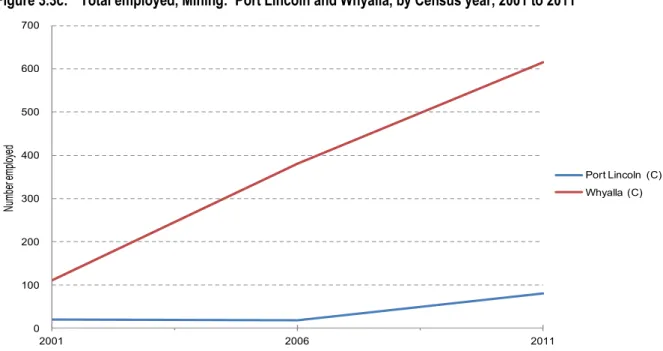
In the five years between 2006 and 2011 the majority of Eyre Peninsula councils experienced an increase in levels of employment in the mining industry with the exception being Cleve District Council.13
Figures 3.3a to 3.3c illustrate the growth in mining in each council district separately. Whyalla experienced the largest increase in mining employment in the region over the preceding decade with Ceduna (due to Iluka) and Franklin Harbour due to the Iron Duke mine also experiencing significant employment growth. The increase in mining employment in Whyalla is as a result of the development of the Iron Chieftain mine and the expansion of the Middleback Range project. These results are indicative that a similar expansion is likely to be experienced in years to come in other communities as a result of planned and developing mines such as the Menninie Dam and Wilcherry Hill projects which are both near the town of Kimba and the Iron Road Warramboo mine site. These community expansions will of course be dependent on the size of operations. Whilst these population expansions are likely to result in more revenue for councils they will also result in the need for more services provision.
12 The ABS Cat 6291.0.55.003, Labour Force Australia, Detailed Quarterly provides estimates of labour force by industry and state based on
population data from the 2006 census.
13 The ABS Cat 2003.0 provides time series profiles for each Local Government area compiled from data from the previous three censuses. These
are accessible through the ABS’s Census page.
0.0 2.0 4.0 6.0 8.0 10.0 12.0 14.0 16.0 Fe b-1994 Oc t-1994 Ju n-1995 Fe b-1996 Oc t-1996 Ju n-1997 Fe b-1998 Oc t-1998 Ju n-1999 Fe b-2000 Oc t-2000 Ju n-2001 Fe b-2002 Oc t-2002 Ju n-2003 Fe b-2004 Oc t-2004 Ju n-2005 Fe b-2006 Oc t-2006 Ju n-2007 Fe b-2008 Oc t-2008 Ju n-2009 Fe b-2010 Oc t-2010 Ju n-2011 Fe b-2012 Oc t-2012 Pe rso ns '0 00
Figure 3.3a: Total employed, Mining: Elliston, Franklin Harbor, Kimba and Wudinna, by Census year, 2001 to 2011
Source: ABS, 2011 Census of Population and Housing, Time Series Profile, Ceduna (DC), Cleve (DC), Elliston (DC), Franklin Harbour (DC), Kimba (DC), Lower Eyre Peninsula (DC), Port Lincoln (C), Streaky Bay (DC), Tumby Bay (DC), Whyalla (C), Wudinna (DC), October 2012, Table 33 (Cat No. 2003.0).
Figure 3.3b: Total employed, Mining: Ceduna, Cleve, Lower Eyre Peninsula, Streaky Bay and Tumby Bay, by Census year, 2001 to 2011
Source: ABS, 2011 Census of Population and Housing, Time Series Profile, Ceduna (DC), Cleve (DC), Elliston (DC), Franklin Harbour (DC), Kimba (DC), Lower Eyre Peninsula (DC), Port Lincoln (C), Streaky Bay (DC), Tumby Bay (DC), Whyalla (C), Wudinna (DC), October 2012, Table 33 (Cat No. 2003.0). 0 10 20 30 40 50 60 70 80 90 2001 2006 2011 Nu m be r E m plo ye d Wudinna (DC) Elliston (DC) Kimba (DC) Cleve (DC) Franklin Harbour (DC) 0 10 20 30 40 50 60 2001 2006 2011 Nu mb er Em plo ye d Tumby Bay (DC) Streaky Bay (DC) Lower Eyre Peninsula (DC) Ceduna (DC)