Introduction
The explosion in published medical material has become a bewildering environment for today’s clinician. The MEDLINE database provides access to the abstracts of nine million published articles from 3900 current medical journals. The problem is not how to find information but how to sift through the mass of data to find the important concepts. Our project is a prag-matic solution to the problem of information overload, developed over a decade by a group of clinicians.
Personalised Medical Reference
In 1992, a group of medical students and a general practitioner (GP) were awarded the John Perry Prize
by the British Computer Society Primary Health Care Specialist Group.1The prize was awarded for a
com-puterised medical reference resource called Personalised Medical Reference (PMR). This reference resource had been constructed over the previous 18 months by the medical student and GP authors and was based on the content and structure of the Oxford University Medical School clinical course.
The PMR database was designed based on a complex web structure of interlinking index terms. Each disease/condition had a tree-like structure of related information, with files containing text and/ or diagrams at the leaves of the tree structure. Also an information file was attached to the top of the disease/condition tree. An example of a disease tree is presented in Box 1.
Also the links between each disease/condition were explicitly classified with the meaning (semantic links) illustrated (see Box 2).
Articles
Personalised Medical Reference to General
Practice Notebook (GPnotebook) –
an evolutionary tale
James McMorran BM BCh PhD DCH DRCOG MRCGP
General Practitioner, Coventry, and Visiting Senior Clinical Lecturer, Centre for Primary Health Care Studies, Warwick University, Warwickshire, UK
Damian Crowther MA BM BCh PhD MRCP
Honorary Registrar in Neurology, Addenbrooke’s NHS Trust, and Wellcome Advanced Training Fellow, Cambridge Institute for Medical Research, Cambridge, UK
This article describes GPnotebook, the winner of the 2002 John Perry Prize, awarded annually by the PHCSG in memory of Dr John Perry, for outstanding innovation in primary care informatics.
ABSTRACT
In 1992, a group of medical students and a UK general practitioner were awarded the John Perry Prize for an MS-DOS-based flexible, dynamic, updateable and structured computerised medical reference system. At the time of the award the refer-ence system contained over 4000 index terms and was designed to provide an easy-to-retrieve synopsis of the whole of clinical medicine.
What has happened to this resource now? This brief paper outlines how the developers of the reference resource have improved on the design and
content of the medical database. Now the reference resource is an Internet-based resource called Gen-eral Practice Notebook (www.gpnotebook.co.uk) and is currently attracting 5000 to 9000 page views per day and containing over 30 000 index terms in a complex web structure of over 60 000 links. This paper describes the evolutionary process that has occurred over the last decade.
J McMorran and D Crowther 174
These design features facilitated the concomitant authoring of the PMR database by a group of authors. Each author worked on his own version of the PMR database and these were integrated into a ‘master’ version of the database that was then redistributed to the authoring team. During the integration process, information was peer reviewed by the authoring team. Also the information was periodically reviewed by senior medical practitioners who were mainly based at Oxford and Cambridge medical schools.
A major design feature that discriminated PMR from any based (or computerised former paper-based) resource was the use of ‘referential integrity’.1
This design feature meant that information should only be stored in one physical and logical location. Therefore, if any changes to particular items of know-ledge occurred then the database design meant that the whole knowledge resource was consistent. This contrasts with a paper-based textbook, where multiple authors, in effect, create the resource in series (i.e. working on their own individual parts of the text), and there is no constraint within the medium (i.e. writing the book) to prevent one author from contradicting another.
As the development of PMR continued, the database became first a resource at the Cairns Library for other medical students, and then progressed to be used by GPs within the primary care consultation.
First changes
PMR was an MS-DOS-based system; the first evolution was transference of the system from an MS-DOS plat-form to a Windows platplat-form. A Windows-based version of the database was developed in 1994. This system continued the design strategies utilised in the original MS-DOS version of PMR. Again authors worked on their own versions of the database that were then integrated into a ‘master’ version. There was again a process of peer review and external review of information as in the production of PMR.
During this period, the medical student authors had progressed to practising doctors. The aims of the author-ing team were formalised in providauthor-ing a clinical synopsis of the whole of clinical medicine. The authors (see Appendix 1) have chosen a variety of clinical areas to specialise in but the common goal was to maintain the medical database as a common source of aide-memoire level information for the whole of medicine.
The Internet
In the late 1990s the Internet had become a rapidly expanding resource for dissemination of information. International publishing houses began to set up web-based information resources for a variety of professional audiences including clinicians. One such venture was Epulse – this was perceived as the elec-tronic version of the popular GP newspaper, Pulse. The PMR database became the core resource on the then-popular Epulse site, and was called ‘Clinical Reference Guidelines’.
In the years since its conception the database con-tinued to be developed and updated by the authoring team. The structure of the system had become a web of over 40 000 links and more than 25 000 index terms. An example of the structure of the hyperthyroidism linking in the Clinical Reference Guidelines is illus-trated in Figure 1.
Epulse became a casualty of the dotcom collapse, a crisis that provided the team with the opportunity to develop its own independent web resource.
Development of General
Practice Notebook
(GPnotebook)
In October 2001, General Practice Notebook (GPnote-book) became available as a resource on the worldwide
Box 1 Disease tree
Disease X – epidemiology – aetiology – clinical features – investigations – treatment – prognosis – reference
Box 2 The links between each disease/condition
Parent page Semantic link Child page
Atherosclerosis frequently Myocardial causes infarction
Hepatitis C type Hepatitis
Fi
g
u
re
1
H
yp
er
th
yr
o
id
is
m
l
in
ki
n
g
i
n
t
h
e
C
lin
ic
al
R
ef
er
en
ce
G
u
id
el
in
es
o
n
E
p
u
ls
web. The GPnotebook site (www.gpnotebook.co.uk) maintains the original database design but adds the convenience and power of a database-driven website.
GPnotebook was designed and implemented under the lead of one of the authoring team (DC). An import-ant new step was the development of online authoring of GPnotebook. Now instead of authoring individual copies of the clinical database, all authors update and develop the clinical database that users see as GPnote-book. Information is again peer reviewed before being made available to the users of the worldwide web re-source but this means that, in principle, fundamental changes to the perceived clinical knowledge base can be announced in the morning, such as a new inter-action of a drug, and the database will be up to date in the afternoon. Also because of ‘referential integrity’, the database will be logically consistent throughout the now 27 000 HTML pages of information.
GPnotebook today
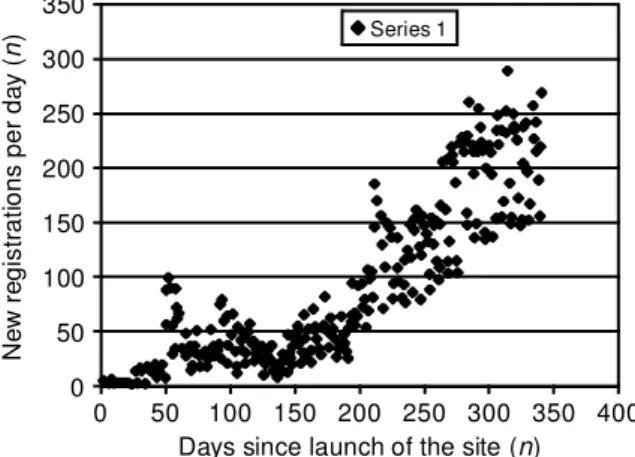
In June 2002, GPnotebook had over 24 000 registered users. Over 11 000 users are medical doctors, with more than 50% of these doctors being UK based. Each day there are between 5000 and 9000 page views and the limits of this range are increasing month on month. The number of new users visiting the site is currently rising exponentially with a doubling time of 38 days (see Figure 2).
Feedback from users has been positive, for example:
GPnotebook contains relevant, useful information presented in a way that is most appropriate for GP users;
it is the only desktop reference that gives information quickly enough to use during consultations. (Peter O’Brien, PCG Chairman)
. . . I like it a lot. Very clean and simple, professional uncluttered layout, snappy data – like the ‘lecture notes’ from university days. (Ken Holton, GP)
Also, users come back to use the site again and again, with about 14% or more of any cohort of users who registered in a particular month reusing the site each month as a source of clinical information.
GPnotebook is now a resource on the National electronic Library for Health virtual branch libraries in primary care and emergency care. The site has a Google ranking of above seven (higher than other UK resources such as the BNF) and will soon enter the Google medical website top 20.
Conclusion
GPnotebook represents a project to build and main-tain a computerised clinical reference resource over more than a decade. The project has produced a resource that has grown in size and complexity. The elegant simplicity of the original PMR design of over a decade ago remains and has been built upon. However, the principle of creating an aide-memoire type resource that will continue to be useful to a clinician as a clinical synopsis of the whole of medicine, whichever specialty he/she is in, remains.
REFERENCE
1 McMorran S and Prince P (1993) Personalised Medical Reference.Journal of Informatics in Primary Care, 13–15.
ADDRESS FOR CORRESPONDENCE
Dr Jim McMorran
Visiting Senior Clinical Lecturer Centre for Primary Healthcare Studies University of Warwick
Coventry CV4 7AL UK
Tel: +44 (0)24 7645 3634 Fax: +44 (0)24 7663 6886
Email: [email protected]
Accepted June 2002 J McMorran and D Crowther
176
Figure 2 New registrations per day since the launch of the site
N ew r eg is tr at io ns p er d ay ( n )
0 50 100 150 200 250 350 400
0 150 50 100 200 250 300 350 300 Days since launch of the site (n)
Appendix 1
Other GPnotebook authors
Dr Stewart McMorran, MA MB BCh MSc MPhil MRCS, A&E Specialist Registrar, Oxford Region.
Dr Steven Young-Min, Specialist Registrar in Rheumatology/General Medicine, and Arthritis Research Campaign Clinical Research Fellow in Rheumatology, University of Newcastle-upon-Tyne Medical School.
Dr Jon Pleat, Duke of Kent Research Fellow in Burns and Reconstructive Surgery, Stoke Mandeville Hospital, Aylesbury and the University of Oxford.
Dr Ian Wacogne, Specialist Registrar in Paediatrics in the West Midlands Region and currently Chief Resident, Royal Children’s Hospital, Brisbane, Australia.
Dr Clive Prince, General Practitioner and GP Trainer at an advanced training practice in Bewdley, Worcestershire.