https://itms-journals.rtu.lv
©2019 Vipin K. Agrawal, Vijay K. Agrawal, A. Ross Taylor, Ngan N. Chau.
An Exploratory Study of Factors Driving Decision
Maker Intensions to Adopt Cloud Computing
Vipin K. Agrawal
1, Vijay K. Agrawal
2, A. Ross Taylor
3, Ngan N. Chau
4 1University of Texas at San Antonio, San Antonio, USA
2,3,4
University of Nebraska at Kearney, Kearney, USA
Abstract – United States based companies have invested more
heavily in cloud services than companies in other nations. Despite numerous benefits claimed by cloud service providers, many organisations are still uncertain about the implementation of cloud computing. The aim of this study is to gain a better understanding of the factors that are important to the usage adoption decision of this information technology delivery model and the implications for organisations in the United States. Decision makers were surveyed to discover which attributes were important in their determination of cloud computing utilisation. Using a sample of executives from manufacturing and service sectors in the United States, multiple factors contributing to the recent growth in cloud computing have been identified using a factor analysis. Four factors emerged from the data analysis include extrinsic motivation, intrinsic motivation, perceived risks, and resource constraint.
Keywords – Cloud computing, cloud services, information
technology, outsourcing.
I.INTRODUCTION
International Data Corporation (IDC) has predicted that total annual spending on public cloud services and infrastructure will grow 23.8 percent in 2019 to reach $210 billion based on their study of 20 industries across 49 countries [1]. Further, the United States has been forecasted to be the largest spender in 2019, expected to reach $124.6 billion [2]. Relatively speaking, cloud computing was ranked as the fourth largest information technology (IT) investment for organisations [1]. The 2016 SIM IT issues and trends study also showed that cloud computing was ranked third in the “get-more-investment” and fifth in the “most-worrisome” lists [3]. These rankings reflect not only the potential of cloud computing to affect the IT delivery practices but the need to obtain a better understanding of drivers influencing the adoption and usage of cloud services in organisations.
Cloud computing has emerged as an alternative technology-delivery model that has altered the rules around technology acquisition, deployment, and support [4]. Unlike the traditional organisational governance model utilised for buying/installing or leasing software and/or hardware, cloud computing calls for a different governance model that requires a core competency in vendor and service-level agreement management. Further, many executives predicted that because of cloud computing potential to free businesses from corporate IT (such as building and maintaining huge server farms) the cloud could be an engine for small businesses and job creation [5].
Given the challenges associated with fulfilling the potential organisational benefits of cloud computing, this study addresses the following research question: “What factors do decision makers use when deciding whether or not they should move an IT operation to the cloud?” To address this question, a review of related literature is used to develop a set of survey questions to measure possible contributors to cloud computing adoption. Next, data collection and data analysis are performed; results obtained are explained. The paper concludes with practical implications and suggestions for future research.
II.LITERATURE REVIEW
This review seeks to examine previous research to identify possible drivers of cloud computing adoption. A brief overview of cloud computing is provided, followed by a discussion of numerous previously identified benefits as well as obstacles that could influence decision makers in choosing whether to migrate toward cloud solutions.
A.An Overview of Cloud Computing
Cloud computing is a model of using a networked IT environment and/or the Internet to provide IT services to a client location [6]. More specifically, the definition from the National Institute of Standards and Technology (NIST) considers cloud computing to be a three-part model of service provisioning composed of essential characteristics, service models, and deployment models. A brief summary is provided here (see [7] for a detailed explanation).
B.An Inventory of Benefits Derived from Cloud Services
Previous research [9], [10] revealed several benefits that favour a transition to cloud computing. The most cited benefit is cost advantages, including (1) cost reduction due to reduced investment in hardware and information and communications technology (ICT) staffing [11], [12], [13], [14], [15]; (2) low cost of implementation and management [16] and (3) the ability to predict cost and outcome [17] due to the fact that companies are able to estimate the costs, requirements, and functionality before committing to an established cloud solution.
Second, cloud services help to improve business focus by keeping a leaner business model. Specifically, cloud computing frees up employees from maintenance and non-core activities; thus, they could focus on core skills and competencies [4], [18], [19], [20], [21].
Third, the “pay-as-you-use” cloud services transform a large amount of fixed costs into variable costs [22]. In other words, organisations can convert capital expenditures (CAPEX) to operating expenses (OPEX) and pay-per-use basis [23], [24], [20], [21], [25], increasing their operational flexibility.
Fourth, a cloud environment also allows easy change in IT solution whenever there are changes in the business environment. The increased agility/adaptability [23], [26], [27], [28], [29], [30], [25]and flexibility/scalability [11], [12], [13], [14] further create an illusion of availability of infinite resources in the users’ mind [18], [23], [26], [31], [32], [21], [33] while creating a greener computing environment [25]. This flexibility also improves business continuity, mobility, and productivity [34].
Fifth, broad network access nurtures a growing generation of teleworkers and project teams across geographic locations, allowing increased interconnection and collaboration [35], [36], [20].
Sixth, with on-demand services and streamlined systems/processes provided in the cloud environment, organisations have seen increased efficiency in their operations and stronger customer relationships [32].
Seventh, to reduce training costs and improve user satisfaction, organisations demand an easy-to-use computing environment. Previous study [37], [28] has shown a relatively high perceived ease of use among users of cloud services. For example, a simpler user interface is among major factors leading many commercial off-the-shelf (COTS) ERP systems in cloud environment to be usable with little or no training.
Eighth, the high backlog of projects dampened the performance of the IT department, causing management to
replace in-house development with
COTS/outsourcing/offshoring and now with cloud computing [38]. This shifting is considered necessary to organisational survival in an increasingly competitive environment. In fact, extant research demonstrated that through cloud computing, organisations are able to access advanced technology and skilled labour that could provide them with new capabilities through numerous value-added services [39], [40], [41],which in turn further enhance their competitive advantage [42], [43], [44].
Ninth, cloud computing is often a by-product of business process reengineering; it allows an organisation to immediately realise the benefit of accelerated reengineering by having a world-class outsider, i.e., the cloud computing vendor taking over the process [45].
Tenth, the risk of adopting a new and advanced technology can be shared with the cloud service provider.
Eleventh, cloud services are available 24/7 with worldwide access to IT application developers; more importantly, high redundancies [27] provide developers with fast and easy resources for testing and development [29]. Easy access also increases mobility, allowing employees to obtain information at every moment from any location [12], [14].
Twelfth, because IT plays the role of a strategic necessity [46], [47], firms prefer to minimise spending on IT applications; this can be achieved in cloud environments where IT resources can be utilised at significantly lower costs. For example, numerous off-the-shelf/ERP solutions with minimum customisations are available in the cloud [26].
Thirteenth, the standardisation of IT functions will lead to simplification and reduction of efforts by the management in handling the problematic and complex IT function [8], [48]. Cloud users are able to concentrate on aspects of innovation without concerns on constant server updates and other computing issues. The ability to deploy new applications quickly shortens the time to market for IT application development [4], [26], [32]. It follows that cloud services allow organisations to cope with the rapid changes in business process as well as to shorten IT system life cycle.
Finally, as the technology behind cloud computing is approaching maturity and standards have been developed, the risk of adopting cloud services is significantly reduced.
C. An Inventory of Obstacles (Risks or Disadvantages) to Cloud Services Adoption
Being a new and growing technology-delivery model, cloud computing offers companies several benefits but exposes them to various kinds of risk in such an environment. Organisations that deploy cloud computing may be exposed to four categories of risk: organisational, operational, technical, and legal risks [49]. Organisational risks cover those related to potential changes in areas such as IT governance, compliances to individual regulations, in-house IT specialists, business continuity and resilience, and IS risk planning and management. Operational risks relate to those influencing daily business and IT operation such as service level agreement, financial issues, data and application movability – interoperability, system users, and service reliability. Technical risks are realised through the lack of IT expertise in companies that adopt cloud computing; potential issues include data quality and maintenance, system performance, system integration, and data security. Finally, legal risks pertain to data privacy, intellectual property, and contracts.
security issues [7], [51], [52]. Neumann [53] provided many real cases of risky exposure such as Dropbox’s sharing services, and Amazon Web services. These incidents call for the need to consider several newly appeared security and privacy risks in cloud environment [23], [26], [11], [7], [29]. Juels and Oprea [30], for instance, proposed an auditing framework to increase security as well as cloud-service operation visibility to enterprise adopters. Another framework [55] to assess risk was suggested based on two dimensions: the criticality of the business process being supported by the cloud computing solution, and the sensitivity of the data that will be stored in the cloud; the overall risk level should be equated with the highest risk realised for either dimension. By realising their risk exposure, companies could effectively manage and substantially reduce risks associated with cloud computing [56].
III.METHODOLOGY
To explore the important attributes of cloud computing that may contribute to the adoption decision, an exploratory study was conducted in the United States using a sample of senior managerial IT professionals (directors, chief information officers, IT managers, etc.) from manufacturing and service sector firms who had some responsibility for making IT management decisions for U.S. based organisations. Survey administration followed the guidelines in [57], [58]; the sampling frame of a fee-based online panel offered by Qualtrics, a leading online survey research platform, was used. As indicated in [59], such online panels were of lower cost, provided faster responses, and had the ability to obtain a targeted sample of people who were scarce in the general population.
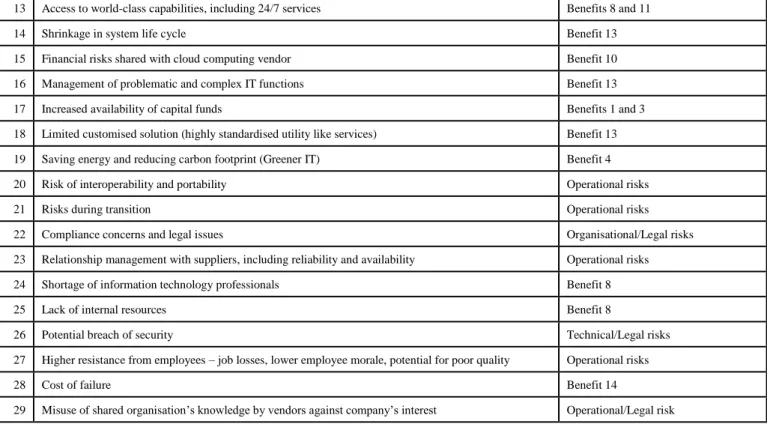
Following [60], the analysis was performed in three stages. First, based on the literature and expert feedback, we generated a pool of 29 items (or attributes) that decision makers perceive to be important for the adoption of cloud computing (see
Table I). In the second stage, we further ranked these items based on their average scores. Finally, we used exploratory factor analysis to classify different groups of measured items that contribute to the adoption decision.
A.Stage 1: Item Generation
A list of items found in the literature was generated for usage in the survey. To establish face validity (i.e., a subjective assessment of whether an item or question measures what it claims to measure), a three-step approach was used. First, a pool of measured items was initiated by the authors with expertise in the Management, MIS, and IT disciplines; a preliminary consensus was reached among them on the question-phrasings that evoked acceptable face-validity. Next, each judge independently again assessed the face validity of each item; these independent assessments were then compared with each other for inter-rater concordance and the questions were rephrased as required. Finally, four IT executives from different firms were asked to comment on the question phrasing and the time required to respond.
A Delphi-like technique was used to finalise the phrasing of measured items. The Delphi technique is designed to solve problems in domains that are not suitable for more structured models or in areas of limited research where a generally accepted standard does not exist [61]. In the Delphi method, experts are consulted across multiple rounds to anonymously answer the question under consideration. After each round, the results are presented and the experts perform the analysis again based on the new information gained. The process continues across multiple rounds until either consensus is achieved or no additional perspectives are obtained. For this study, the classification of the questions into variables was conducted using a panel of seven industry experts from various backgrounds using the above approach. The face validity of the twenty-nine items was established by revising questions until consensus was reached.
TABLE I
LINKAGES BETWEEN MEASURED ITEMS AND THE LITERATURE REVIEW
Item Links to …
1 Ease of use Benefit 7
2 Rapid change in business process cycle Benefit 4
3 Firms to become more flexible, dynamic, adaptable, agile, and having scalability Benefits 3 and 4
4 Maturity and standardisation of technology Benefit 14
5 Simplifying overall IT environment and data centre or IT consolidation Benefit 13
6 Increasing IT innovation, moving at the speed of change, and time to market Benefits 4 and 13
7 Improving business focus by keeping a leaner business model Benefit 2
8 Improving customer satisfaction Benefit 6
9 Improving mobility, collaboration, and productivity Benefit 5, 11
10 Accelerated reengineering benefits Benefit 9
11 Redirection of resources Benefits 2, 3, and 12
13 Access to world-class capabilities, including 24/7 services Benefits 8 and 11
14 Shrinkage in system life cycle Benefit 13
15 Financial risks shared with cloud computing vendor Benefit 10
16 Management of problematic and complex IT functions Benefit 13
17 Increased availability of capital funds Benefits 1 and 3
18 Limited customised solution (highly standardised utility like services) Benefit 13
19 Saving energy and reducing carbon footprint (Greener IT) Benefit 4
20 Risk of interoperability and portability Operational risks
21 Risks during transition Operational risks
22 Compliance concerns and legal issues Organisational/Legal risks
23 Relationship management with suppliers, including reliability and availability Operational risks
24 Shortage of information technology professionals Benefit 8
25 Lack of internal resources Benefit 8
26 Potential breach of security Technical/Legal risks
27 Higher resistance from employees – job losses, lower employee morale, potential for poor quality Operational risks
28 Cost of failure Benefit 14
29 Misuse of shared organisation’s knowledge by vendors against company’s interest Operational/Legal risk
B.Stage 2: Ranking of Measured Items
Respondents’ profile: A web-based survey was conducted. IT professionals who had agreements with Qualtrics to participate in online surveys and polls in return for compensation were contacted via emails. An opt-out option was also provided to all subjects. Non-responses were minimised through only using close-ended questions. Participants were first asked to indicate the industry they were employed in; this information was used to ensure adequate representation of industry type. The target
quotas consisted of 80 service sector responses (with 40 respondents in the Computer Software industry sector and 40 respondents in other service industry sectors) and 70 manufacturing sector responses. Once a quota was reached, Qualtrics deactivated the links given to participants in that sector. Respondents who began a survey before the link was deactivated were allowed to finish the survey. One hundred and forty-eight usable responses were received from the initial sample of 153, resulting in a 97 % response rate.
TABLE II
LEVEL OF RESPONDENTS IN THEIR ORGANISATIONS AND THEIR FUNCTIONAL DEPARTMENTS
What is your level at the organisation? No. of responses
% Which functional department do you work?
No. of responses
%
Executive 53 36 % Accounting 4 3 %
Directors 35 23 % Administration 9 6 %
First Line Management 28 19 % Engineering 12 8 %
Middle Management 32 22 % Information Systems 116 79 %
Production 1 1 %
Sales/Marketing 4 3 %
Other 0 0 %
Purchasing 1 1 %
Development/Support 1 1 %
148 100 % 148 100 %
TABLE III
NUMBER OF FULL-TIME EMPLOYEES AND IT BUDGET
Full-time information systems’ employee at your organisation
No. of responses % Budget of organisation’s IT Department
No. of responses %
1 to 25 16 11 % Up to 10 million 57 39 %
26 to 100 19 13 % 10 million to 25 million 35 23 %
101 to 500 38 26 % 25 million to 50 million 40 27 %
501 to 1,000 34 23 % More than 50 million 16 11 %
1,000 to 2,000 26 17 %
More than 2,000 15 10 %
Tables II and III show a fair representation of the intended population in the sample. Seventy-nine percent of the respondents were from IT departments, as intended. The remaining respondents were directly associated with the IT department. The senior level management was represented to a higher degree than mid-level managers were. In most of the respondents’ organisations, the full-time IT employees were 100 or higher and having an IT department budget of more than $10 million.
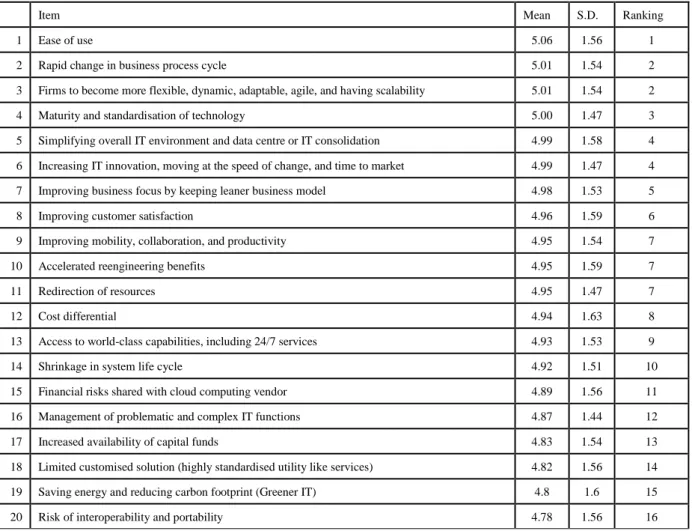
Ranking of attributes: Responses to the questionnaire were analysed using the R programming language. Respondents ranked the contribution of each item to their overall decision from 1 (None) to 7 (Very High). The mean and standard deviation of each item was calculated. Since higher numbers are associated with a stronger preference; we ranked items based on means and counting occurrences of data. Table IV shows the mean and standard deviation of each item sorted in descending order of preference. Column 3 of Table IV shows a very high perceived importance for all items; in particular, the mean varies from 4.51 to 5.06. Surprisingly, the median of all items was 5. On the one hand, this result confirms the validity of stage 1 that these items were indeed considered contributors to the adoption decision; on the other hand, their low variability in terms of central tendency prevents us from focusing on a
smaller set of items (say, the top 10 contributors). Interestingly, items describing benefits of cloud services tended to have higher rankings than obstacles. To some extent, this result confirms the recent growth of cloud computing adoption. Further examination of item description did not provide unambiguous groupings of closely ranked items. As a result, we focus more on the item correlation via exploratory factor analysis to better classify items.
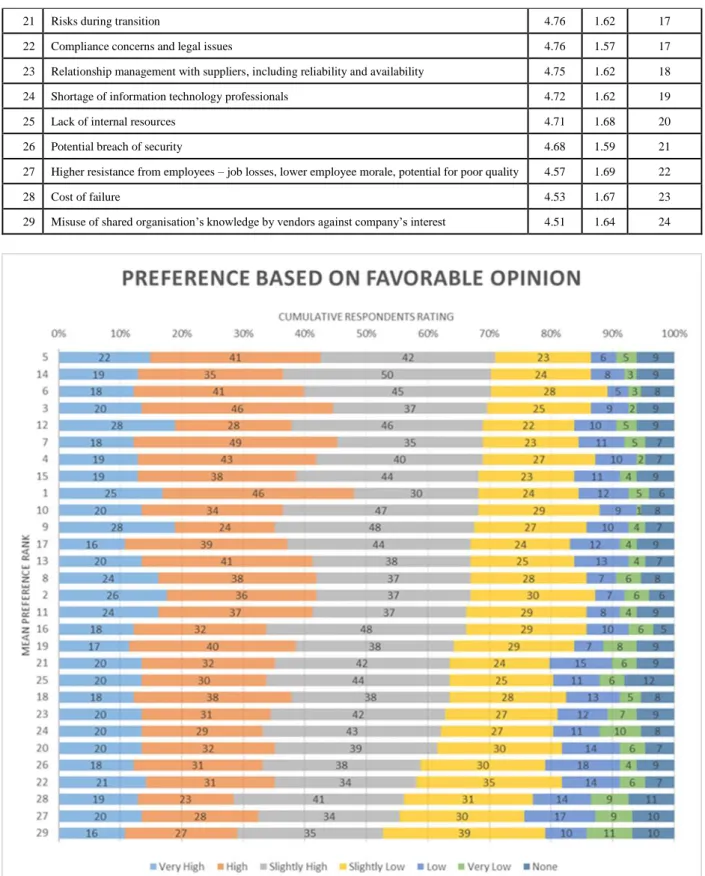
In an effort to understand the distribution of the responses, the authors counted occurrences of data; items were ranked by a process that consisted of summarising the count of each importance response for each item. Responses of 5, 6, and 7 were considered to be favourable responses so the counts of those responses were summed at the item level for a favourability count. For items that were tied, the sum of the counts for items 7 and 6 was used as the next sorting item. If there were still ties, the count for item 7 was used to break the tie. At that point there were no more ties. The results are shown in descending order of preference and can be found in a bar chart, see Fig. 1. The bar chart shows the cumulative percentage for each item’s responses along the x-axis. The count for each response type is contained within the item’s bar and is out of 128 total responses.
TABLE IV
DESCRIPTIVE STATISTICS AND RANKING OF CONTRIBUTING FACTORS TO THE USAGE OF CLOUD COMPUTING
Item Mean S.D. Ranking
1 Ease of use 5.06 1.56 1
2 Rapid change in business process cycle 5.01 1.54 2
3 Firms to become more flexible, dynamic, adaptable, agile, and having scalability 5.01 1.54 2
4 Maturity and standardisation of technology 5.00 1.47 3
5 Simplifying overall IT environment and data centre or IT consolidation 4.99 1.58 4
6 Increasing IT innovation, moving at the speed of change, and time to market 4.99 1.47 4
7 Improving business focus by keeping leaner business model 4.98 1.53 5
8 Improving customer satisfaction 4.96 1.59 6
9 Improving mobility, collaboration, and productivity 4.95 1.54 7
10 Accelerated reengineering benefits 4.95 1.59 7
11 Redirection of resources 4.95 1.47 7
12 Cost differential 4.94 1.63 8
13 Access to world-class capabilities, including 24/7 services 4.93 1.53 9
14 Shrinkage in system life cycle 4.92 1.51 10
15 Financial risks shared with cloud computing vendor 4.89 1.56 11
16 Management of problematic and complex IT functions 4.87 1.44 12
17 Increased availability of capital funds 4.83 1.54 13
18 Limited customised solution (highly standardised utility like services) 4.82 1.56 14
19 Saving energy and reducing carbon footprint (Greener IT) 4.8 1.6 15
21 Risks during transition 4.76 1.62 17
22 Compliance concerns and legal issues 4.76 1.57 17
23 Relationship management with suppliers, including reliability and availability 4.75 1.62 18
24 Shortage of information technology professionals 4.72 1.62 19
25 Lack of internal resources 4.71 1.68 20
26 Potential breach of security 4.68 1.59 21
27 Higher resistance from employees – job losses, lower employee morale, potential for poor quality 4.57 1.69 22
28 Cost of failure 4.53 1.67 23
29 Misuse of shared organisation’s knowledge by vendors against company’s interest 4.51 1.64 24
Fig. 1. Preference based on favourable response.
C.Stage 3: Construct Validation
Exploratory factor analysis was used to classify the items into constructs (or factors) and to eliminate items with low factor loadings. This allowed us to explore new relationships among ranked items. A confirmatory factor analysis (CFA) was later conducted to evaluate the identified constructs; we used CFA
for classification purposes only, not to extensively validate the scales for the construct or to develop a survey instrument [60].
IV.RESULTS AND DISCUSSION
method with varimax rotation, we first considered the number of factors that would exceed sixty percent of variance explained and dropped items whose loadings were less than 0.6 [60]. The more factors were considered, the higher number of items was dropped, except the four-factor and five-factor models where the twelve dropped items were almost identical (only one item was different). With this outcome, we run subsequent factor analyses on the remaining items with both four-factor and five-factor models. The five-five-factor model was abandoned because
of the high cross-factor loadings and a single-item factor. Hence, we selected the four-factor model; the initial model accounted for 73.4 % of the total variation among items. Table V shows the factor loadings of 13 measured items. The four-factor model indicates that there are four main constructs that are most salient to executives considering cloud computing; the first two contain items that have higher rankings in Table I, while the last two consist of items with lower rankings.
TABLE V
DESCRIPTIVE STATISTICS AND RANKING OF CONTRIBUTING FACTORS TO THE USAGE OF CLOUD COMPUTING
Description F1 F2 F3 F4
C1 Maturity and standardisation of technology 0.69
C2 Simplifying overall IT environment and data centre or IT consolidation 0.75
C3 Rapid change in business process cycle 0.81
C4 Shrinkage in system life cycle 0.68
C5 Access to world-class capabilities, including 24/7 services 0.69
C6 Saving energy and reducing carbon footprint (Greener IT) 0.76
C7 Improving mobility, collaboration, and productivity 0.68
C8 Firms to become more flexible, dynamic, adaptable, agile, and having scalability 0.69
C9 Higher resistance from employees – job losses, lower employee morale, potential for
poor quality 0.73
C10 Potential breach of security 0.85
C11 Risks during transition 0.72
C12 Lack of internal resources 0.85
C13 Cost of failure 0.74
The first construct, named “Extrinsic Motivation,” was measured using five items: “Simplifying overall IT environment and data centre or IT consolidation”; “Rapid change in business process cycle”; “Shrinkage in system life cycle”; “Access to world-class capabilities, including 24/7 services”; and “Maturity and standardisation of technology”. These items reflect the fact that executives were more likely to move to cloud-based services when they believed that doing so would allow them to better cope with a rapidly changing business environment.
The second construct, named “Intrinsic Motivation,” was measured by three items: “Saving energy and reducing carbon footprint (Greener IT)”; “Improving mobility, collaboration, and productivity”; and “Firms to become more flexible, dynamic, adaptable, agile, and having scalability”. These items reflect that executives were more likely to move to cloud computing when they perceived that it would strengthen the company, assisting them to gain a competitive advantage in implementing their business strategy.
The third construct, named “Perceived Risks,” was measured using three items: “Higher resistance from employees – job losses, lower employee morale, potential for poor quality”; “Potential breach of security”; and “Risks during transition”. This construct echoes many aspects of risks and the salience of
security, privacy, and availability mentioned in our literature review. The organisational risks represent that executives are concerned about the risks that are presented by the dependence on IT. If they perceive that there is less risk associated with using cloud computing instead of their owned resources, they are more likely to switch to cloud-based systems. Finally, the fourth construct, named “Resource Constraint” was measured by two items: “Lack of internal resources”; and “Cost of failure.” These items taken together would seem to indicate the degree to which executives saw cloud computing as an inexpensive and supplementary solution to acquiring and managing IT resources.
Finally, we used a confirmatory factor analysis (CFA) to validate the four factors contributing to cloud computing adoption/usage; we used the lavaan package in R to fit the model. The CFA supported the model overall. In particular, a value above 0.90 for the Comparative Fit Index (CFI = 0.935) and the Tucker-Lewis Index (TLI = 0.914) indicates that the model is a good fit [63].
V.CONCLUSION
21st century has been experiencing a transition to federated and then to participatory governance models. As an alternative technology-delivery model, cloud computing has been evolving since the past decade to increasingly respond to cost cutting and business demand.
In addition to being a tool for streamlining internal operations, cloud computing has recently evolved to provide companies with a competitive advantage, i.e., operational flexibility. According to [64], a company’s real value relies on creating competency and the ability to continuously restructure its value chain, i.e., a network of competence [65]. Nowadays, the business environment constantly changes, making any core competences only temporary; thus, companies need to refine their core competences while modifying the existing pool of knowledge, skills, and resources. Increasingly critical and knowledge-intensive business components are outsourced and often developed in close cooperation with the vendor. This demands a flexible organisation, in which key value creating competences are kept in-house while procuring the rest of the value to outside specialists.
As with any research study, the present research has limitations that need to be discussed. First, there were several items on the questionnaire that were eliminated using an exploratory factor analysis. Although the literature was thoroughly reviewed and additional perspectives were obtained from IS academicians and managers, the description of these items should be improved to prevent ambiguity and high cross-loadings. Second, the sample was obtained from the manufacturing sector (automobile, computer hardware, pharmaceutical, telecommunication – hardware, and other) and the service sector (banking, retail, hotels, computer software, construction, government, healthcare, insurance, technology, transportation, utilities, and other). Other types of organisations such as airlines manufacturing, railway, chemicals, airlines operations, etc. were not included in the sample. Hence, any inferences based on the results might be restricted to the companies listed in the directory.
There are several opportunities for future research from this study. First, further refinement of the measuring items is warranted; while the current survey items were able to help advance this exploratory research, the number of items that are cross-loaded is a concern. Last but not least, a longitudinal study (if possible) would improve the robustness of the result.
REFERENCES
[1] M. Ali, S. U. Khan, A. V. Vasilakos, “Security in cloud computing: Opportunities and challenges”, Information Sciences, vol. 305, pp. 357–383, 2015. https://doi.org/10.1016/j.ins.2015.01.025
[2] A. Aljabre, “Cloud computing for increased business value”, International Journal of Business and Social Science, vol. 3, no. 1, pp. 234–239, 2012.
[3] S. A. Almulla and C. Y. Yeun, “Cloud computing security management”, in Engineering Systems Management and Its Applications (ICESMA), IEEE Second International Conference, pp. 1–7, 2010.
[4] S. J. Andriole, “Ready technology”, Communications of the ACM, vol. 57, no. 2, pp. 40–42, 2014. https://doi.org/10.1145/2556941 [5] S. J. Andriole, “Who owns IT?”, Communications of the ACM, vol. 58,
no. 3, pp. 50–57, 2015. https://doi.org/10.1145/2660765
[6] Y. L. Antonucci and J. J. Tucker III, “IT outsourcing: Current trends, benefits, and risks”, Information Strategy: The Executive’s Journal, vol. 14, no. 2, pp. 16–26, 1998.
https://doi.org/10.1080/07438613.1998.10744580
[7] C. A. Ardagna et al., “Scalability patterns for platform-as-a-service”, in Cloud Computing (CLOUD), IEEE 5th International Conference, 2012, pp. 718–725. https://doi.org/10.1109/CLOUD.2012.41
[8] C. A. Ardagna et al., “From security to assurance in the cloud: A survey”, in ACM Computing Surveys, vol. 48, no. 1, 2015.
https://doi.org/10.1145/2767005
[9] M. Armbrust et al., “A view of cloud computing”, Communications of the ACM, vol. 53, no. 4, pp. 50–58, 2010.
https://doi.org/10.1145/1721654.1721672
[10] M. Bayramusta and V. A. Nasir, “A fad or future of IT? A comprehensive literature review on the cloud computing research”, International Journal of Information Management, vol. 36, no. 4, pp. 635–644, 2016. https://doi.org/10.1016/j.ijinfomgt.2016.04.006
[11] A. B. Blankenship, G. Breen, and A. Dutka, State of the Art Marketing Research. Chicago, IL: American Marketing Association, 1998. [12] R. Buyya, C. S. Yeo, and S. Venugopal, “Market-oriented cloud
computing: Vision, hype, and reality for delivering it services as computing utilities”, in High Performance Computing and Communications, 10th IEEE International Conference, 2008, pp. 5–13. https://doi.org/10.1109/HPCC.2008.172
[13] A. Caldarelli, L. Ferri, and M. Maffei, “Expected benefits and perceived risks of cloud computing: an investigation within an Italian setting”, Technology Analysis & Strategic Management, vol. 29, no. 2, 2017, pp. 167–180. https://doi.org/10.1080/09537325.2016.1210786
[14] N. G. Carr, “IT doesn’t matter”, in Harvard Business Review, vol. 38, 2003, pp. 24–38.
[15] N. G. Carr, The big switch: Rewiring the world, from Edison to Google. New York: WW Norton & Company, 2008.
[16] K. Dahbur, B. Mohammad, and A. B. Tarakji, “A survey of risks, threats and vulnerabilities in cloud computing”, Proceedings of the International conference on intelligent semantic Web-services and applications, p. 12, April, 2011. https://doi.org/10.1145/1980822.1980834
[17] C. De Meijer, and A. Brown, “Transaction banking in the cloud: Towards a new business model”, Journal of Payments Strategy & Systems, vol. 8, no. 2, pp. 206–223, 2014.
[18] S. Dhar, “From outsourcing to Cloud computing: evolution of IT services”, Management Research Review, vol. 35, no. 8, pp. 664–675, 2012. https://doi.org/10.1108/01409171211247677
[19] D. A. Dillman, Mail and telephone surveys: The total design method (Vol. 19). New York: Wiley Intersciences, 1978.
[20] D. A. Dillman, Mail and internet surveys: The tailored design method. New York: John Wiley Co, 2000.
[21] S. Domberger, The contracting organisation: A strategic guide to outsourcing. Oxford, UK: Oxford University Press, 1998. https://doi.org/10.1093/0198774575.001.0001
[22] A. Dutta, G. C A. Peng, and A. Choudhary, “Risks in enterprise cloud computing: the perspective of IT experts”, Journal of Computer Information Systems, vol. 53, no. 4, pp. 39–48, 2013. https://doi.org/10.1080/08874417.2013.11645649
[23] D. A. Fernandes et.al., “Security issues in cloud environments: a survey”, International Journal of Information Security, vol. 13, no. 2, pp. 113– 170, 2014. https://doi.org/10.1007/s10207-013-0208-7
[24] C. H. Fine, R. Vardan, R. Pethick, and J. El-Hout, “Rapid-response capability in value-chain design”, MIT Sloan Management Review, vol. 43, no. 2, 2002.
[25] A. Goscinski, and M. Brock, “Toward dynamic and attribute based publication, discovery and selection for cloud computing”, Future Generation Computer Systems, vol. 26, no. 7, pp. 947–970, 2010. https://doi.org/10.1016/j.future.2010.03.009
[26] J. F. Hair, W. C. Black, B. J., Babin, & R. E. Anderson, Multivariate Data Analysis 7th Edition. Harlow: Pearson Education Limited, UK, 2014. [27] M. A. Himmel, and F. Grossman, “Security on distributed systems: Cloud
security versus traditional IT”, IBM Journal of Research and Development, vol. 58, no. 1, pp. 1–3, 2014.
[28] B. N. Hwang, C. Y. Huang, and C. L. Yang, “Determinants and their causal relationships affecting the adoption of cloud computing in science and technology institutions”, Innovation, vol. 18, no. 2, pp. 164–190, 2016. https://doi.org/10.1080/14479338.2016.1203729
[29] S. Ibrahim, B. He, and H. Jin, “Towards pay-as-you-consume cloud computing”, in Services Computing (SCC), 2011 IEEE International Conference on Services Computing, 2011, pp. 370–377. https://doi.org/10.1109/SCC.2011.38
[30] A. Juels, and A. Oprea, “New approaches to security and availability for cloud data”, Communications of the ACM, vol. 56, no. 2, pp. 64–73, 2013. https://doi.org/10.1145/2408776.2408793
[31] A. Kakabadse, and N. Kakabadse, “Trends in outsourcing: Contrasting USA and Europe”, European Management Journal, vol. 20, no. 2, pp. 189–198, 2002. https://doi.org/10.1016/S0263-2373(02)00029-4 [32] J. R. Kalyvas, M. R. Overly, and M. A. Karlyn, “Cloud computing: a
practical framework for managing cloud computing risk – part I”, Intellectual Property & Technology Law Journal, vol. 25, no. 3, pp. 7–18, 2013.
[33] J. R. Kalyvas, M. R. Overly, and M. A. Karlyn, “Cloud computing: A practical framework for managing cloud computing risk – part II”, Intellectual Property & Technology Law Journal, vol. 25, no. 4, pp. 19–27, 2013.
[34] L. Kappelman, et.al., “The 2016 SIM IT issues and trends study”, MIS Quarterly Executive, vol. (1), Article 6, 2017. Available: https://aisel.aisnet.org/misqe/vol16/iss1/6. [Accessed September 2019]. [35] D. A. Kenny, B. Kaniskan, and D. B. McCoach, “The performance of
RMSEA in models with small degrees of freedom”, Sociological Methods & Research, vol. 44, no. 3, pp. 486–507, 2015. https://doi.org/10.1177/0049124114543236
[36] N. Kshetri, “Privacy and security issues in cloud computing: The role of institutions and institutional evolution”, Telecommunications Policy, vol. 37, no. 4–5, pp. 372–386, 2013.
https://doi.org/10.1016/j.telpol.2012.04.011
[37] Kynetix Technology Group, “Cloud computing – a strategic guide for board level executives”, 2009. [Online]. Available:
https://www.scribd.com/document/50992268/Kyne-Tix-Cloud-Computing-Strategy-Guide. [Accessed: June 12, 2012].
[38] P. Lal, and S. S. Bharadwaj, “Understanding the impact of cloud-based services adoption on organisational flexibility: An exploratory study”, Journal of Enterprise Information Management, vol. 29, no. 4, pp. 566–588, 2016. https://doi.org/10.1108/JEIM-04-2015-0028 [39] J. Lawler, et al., “A case study of determinants of an effective cloud
computing strategy”, The Review of Business Information Systems, vol. 16, no. 3, pp. 145–156, 2012.
https://doi.org/10.19030/rbis.v16i3.7132
[40] L. S. Lee, and Jr, R. D. Mautz, “Using cloud computing to manage costs”, Journal of Corporate Accounting & Finance, vol. 23, no. 3, pp. 11–15, 2012. https://doi.org/10.1002/jcaf.21748
[41] A. Y. Lewin, and C. Peeters, “Offshoring work: business hype or the onset of fundamental transformation?”, Long Range Planning, vol. 39, no. 3, pp. 221–239, 2006. https://doi.org/10.1016/j.lrp.2006.07.009 [42] A. Lin, and N. C. Chen, “Cloud computing as an innovation: Perception,
attitude, and adoption”, International Journal of Information Management, vol. 32, no. 6, pp. 533–540, 2012.
https://doi.org/10.1016/j.ijinfomgt.2012.04.001
[43] S. Liu, et al., “The business value of cloud computing: the partnering agility perspective”, Industrial Management & Data Systems, vol. 116, no. 6, pp. 1160–1177, 2016. https://doi.org/10.1108/IMDS-09-2015-0376 [44] P. Mahatanankoon, H. J. Wen, and B. Lim, “Consumer-based m-commerce: exploring consumer perception of mobile applications”, Computer standards & interfaces, vol. 27, no. 4, pp. 347–357, 2005. https://doi.org/10.1016/j.csi.2004.10.003
[45] P. Maresova, V. Sobeslav, and O. Krejcar, “Cost–benefit analysis– evaluation model of cloud computing deployment for use in companies”, Applied Economics, vol. 49, no. 6, pp. 521–533, 2017. https://doi.org/10.1080/00036846.2016.1200188
[46] S. Marston, et al., “Cloud computing—The business perspective”, Decision Support Systems, vol. 51, no. 1, pp. 176–189, 2011. https://doi.org/10.1016/j.dss.2010.12.006
[47] P. Mell, and T. Grance, “The NIST definition of cloud computing – recommendations of the National Institute of Standards and Technology”, 2011. [Online]. Available: http://csrc.nist.gov/publications/nistpubs/800-145/SP800-145.pdf. [Accessed: March, 2019].
[48] D. Naukam, “Finance must adapt to cloud-based subscription models”, Financial Executive, vol. 30, no. 2, pp. 100–104, 2014.
[49] P. G. Neumann, “Risks and myths of cloud computing and cloud storage”, Communications of the ACM, vol. 57, no. 10, pp. 25–27, 2014. https://doi.org/10.1145/2661049
[50] F. T. Neves, F. C. Marta, A. M. R. Correia, and M. D. C. Neto, “The adoption of cloud computing by SMEs: identifying and coping with external factors”, in Proceedings of the 11th Conference of Portuguese Association of Information Systems, 2011, October 19–21, Lisbon,
Portugal. [Online]. Available:
http://run.unl.pt/bitstream/10362/6166/1/Neves_Marta_Correia_Neto_20 11.pdf. [Accessed: Feb. 3, 2012].
[51] Z. Perunović, M. Christoffersen, and R. N. Mefford, “Deployment of vendor capabilities and competences throughout the outsourcing process”, International Journal of Operations & Production Management, vol. 32, no. 3, pp. 351–374, 2012. https://doi.org/10.1108/01443571211212619 [52] C. K. Prahalad, and M. S. Krishnan, The new age of innovation-driving
co-created value through global networks. New York: McGraw-Hill, 2008.
[53] J. Pyke, “Now is the time to take the cloud seriously. White Paper”, 2009.
[Online]. Available:
www.cordys.com/cordyscms_sites/objects/bb1a0bd7f47b1c9ddf36ba7db 88241d/time_to_take_the_cloud_seriously_online_1_.pdf. [Accessed: Jan. 16, 2012].
[54] D. Reisinger, “Cloud spending will soar as enterprise reliance on SaaS grows: IDC”. Jan. 24, 2018. [Online]. Available: http://www.eweek.com/cloud/cloud-spending-will-soar-as-enterprise-reliance-on-saas-grows-idc. [Accessed: Feb. 25, 2018).
[55] V. Sambamurthy, A. Bharadwaj, and V. Grover, “Shaping agility through digital options: Reconceptualizing the role of information technology in contemporary firms”, in MIS quarterly, vol. 27, no. 2, 2003, pp. 237–263. https://doi.org/10.2307/30036530
[56] P. B. Seddon, S. Cullen, and L. P. Willcocks, “Does Domberger’s theory of ‘The Contracting Organisation’ explain why organisations outsource IT and the levels of satisfaction achieved?” European Journal of Information Systems, vol. 16, no. 3, pp. 237–253, 2007. https://doi.org/10.1057/palgrave.ejis.3000664
[57] E. Smith, and M. Shirer, “Worldwide Public Cloud Services Spending Forecast to Reach $210 Billion This Year, According to IDC”. [Online]. Available: https://www.idc.com/getdoc.jsp?containerId=prUS44891519 [Accessed: Feb. 28, 2019].
[58] I. Son, D. Lee, J. N. Lee, and Y. B. Chang, “Market perception on cloud computing initiatives in organisations: An extended resource-based view”, Information & Management, vol. 51, no. 6, pp. 653–669, 2014. https://doi.org/10.1016/j.im.2014.05.006
[59] N. Su, “Emergence of cloud computing: An institutional innovation perspective”, in Proceedings of the 32nd International Conference on Information Systems, Shanghai, China, 2011.
[60] N. Sultan, “Cloud computing: A democratizing force?” International Journal of Information Management, vol. 33, no. 5, pp. 810–815, 2013. https://doi.org/10.1016/j.ijinfomgt.2013.05.010
[61] P. P. Tallon, K. L. Kraemer, and V. Gurbaxani, “Executives’ perceptions of the business value of information technology: a process-oriented approach”, Journal of Management Information Systems, vol. 16, no. 4, pp. 145–173, 2000.
https://doi.org/10.1080/07421222.2000.11518269
[62] A. N. Toosi, R. N. Calheiros, and R. Buyya, “Interconnected cloud computing environments: Challenges, taxonomy, and survey”, ACM Computing Surveys, vol. 47, no. 1, p. 7, 2014.
https://doi.org/10.1145/2593512
[64] W. Voorsluys, J. Broberg, and R. Buyya, “Introduction to cloud computing”, in Cloud computing: Principles and paradigms, R. Buyya, J. Broberg, and A. Goscinski (Eds.). New Jersey: John Wiley & Sons Inc., 2011, pp. 1–41. https://doi.org/10.1002/9780470940105.ch1
[65] S. Iqbal, and L. Pipon-Young, “Methods-The Delphi method--A guide from Susanne Iqbal and Laura Pipon-Young”, Psychologist, vol. 22, no. 7, p. 598, 2009.
Vipin K. Agrawal, after receiving his PhD in finance from the University of Texas at Austin was an Assistant Professor at California State University (Fullerton) and a Visiting Professor at Texas Christian University and the University of Texas at Austin. He is currently an Associate Professor in Practice at the University of Texas at San Antonio (UTSA). His research has been published in journals such as the Quarterly Review of Economics and Finance, Production and Operations Management. In addition, he has also published a peer-review monograph titled “Corporate Policies in a World with Information Asymmetry”.
E-mail: [email protected]
Vijay K. Agrawal is a Professor of Management Information Systems of the College of Business and Technology at the University of Nebraska at Kearney. His areas of interest are management information systems, operations management, and accounting. He received his B.S. in mechanical engineering from the University of Indore, MBA from the University of Toledo, and M.S. in computer science from Bowling Green State University. He received his PhD from Jamia Millia Islamia (University of Millia Islamia), New Delhi, India. He worked for 20 years in various industries and approximately 20 years in academia. He has published in Production and Operations Management, National Social Science Journal, Global Journal of Flexible Systems Management, Encyclopaedia of Operations Research and Management Science, and others.
E-mail: [email protected]
ORCID iD: https://orcid.org/0000-0002-7012-1321
A. Ross Taylor graduated from the University of Arkansas Sam M. Walton College of Business in 2006 with a PhD in information systems. He is an Associate Professor of Management Information Systems of the College of Business and Technology at the University of Nebraska at Kearney. His research has been published in journals such as the European Journal of Operations Research and Journal of Behavioral Studies in Business. His areas of interest are computer-aided decision making, rural economic development, and social media.
E-mail: [email protected]
ORCID iD: https://orcid.org/0000-0002-9763-2009
Ngan N. Chau is an Associate Professor of Marketing of the College of Business and Technology at the University of Nebraska at Kearney. Her areas of interest are supply chain management, durable goods marketing, and digital marketing channels. She received her PhD from the University of Central Florida. Her research has been published in journals such as Production and Operations Management, Journal of Internet Commerce, and Journal of Marketing Channels.
E-mail: [email protected]