Conference papers
Integrating data for learning disabilities
service providers: are the barriers and
solutions technical or organisational?
Udo Kruschwitz PhD
Lecturer, Department of Computer Science, University of Essex, Colchester, UK
Simon Musgrave MA (Econ)
Manager, KPMG Advisory, London, UKDan O’Neill BA BSc
Teaching Fellow, Department of Human and Health Sciences
John Gekas MSc
Research Officer, Department of Computer Science
Hershbinder Mann MA
Research Officer, Department of Human and Health Sciences
University of Essex, Colchester, UK
Note: The views and opinions expressed herein are those of the authors and do not necessarily represent the views and opinions of KPMG LLP.
ABSTRACT
Since the publication of the Government White Paper ‘Valuing People: a new strategy for learning disability for the 21st century’, the responsibility for providing health care for people with learning disabilities has shifted rapidly to primary care.1 However, people with learning disabilities are sup-ported by a disparate group of providers, from health care through local authorities to the volun-tary sector, with resultant difficulties in providing seamless care. There would seem to be considerable potential for ‘joined-up’ data and information ser-vices to improve this situation, and Semantic Web technologies offer many enticing possibilities in this regard. However, to be effective, many organisa-tional and policy issues have to be addressed; not
least among these is the concern of patient con-fidentiality. This is particularly pertinent given that people with learning disabilities might be less able to make informed decisions.
The approach that this paper takes is to review the policy and service scenarios that would benefit from ‘joined-up’ data, and then, based on user feedback from a series of seminars with stake-holders on these issues, explore what works well, what works less well, and to offer suggestions for future developments.
Context
In order to appreciate the objectives of the research, it is important to understand the wider context of learning disabilities (LD) which has been something of a Cinderella in terms of IT investment. For that reason it is a particularly interesting area to explore, as the complexities are greater than in other health areas and the opportunities for improvements more extensive.
Characteristics of learning disabilities
A diagnosis of learning disability is contingent on evidence of early developmental delay, difficulties in performing everyday activities and intellectual im-pairment. The label of ‘learning disability’ is value-laden. On one hand, labelling can lead to unhelpful stigmatisation, on the other a failure in diagnosis or rejection of the label can lead to ineligibility to access support services.
As well as the technical and ethical difficulties with diagnosis, wider issues arise in this domain. For example, there is evidence that people with LD experience high levels of physical and mental health comorbidity, high service demand,2–4and over-representation in prison5–7 and the homeless populations.8
Given the difficulties of successfully supporting people whose problems can arise from genetic disorders, physical trauma or disease, social and environmental conditions, or any mix of these, the more robust and usable the evidence base, the better the potential service environment.
However, the domain of learning disabilities is a particular case where relevant data sources are dis-tributed among government agencies (health and local authority), voluntary sector organisations and academia, greatly complicating data sharing.
Stakeholders
People with LD will often require lifelong support from different statutory and voluntary sector agencies. An immediate consequence of this is that many individuals and organisations have a stake in the care, policy and research for people with LD. These include:
. health service trusts, typically the primary care
trusts (PCTs) which might currently be operating as a provider or a purchaser of LD services
. local authorities via the social services department . voluntary agencies
. national support groups (for instance, the Down’s
Syndrome Association)
. local support groups (that might or might not be
affiliated to a national organisation)
. private sector providers of housing, care or
pro-fessional staff
. individual carers.
All of these have an interest in the development of LD services or the care of specific individuals. As such they have a concern in the use and potential abuse of data and information.
Data developments
Across this wide landscape of interested parties, both the data and the technological environment are chang-ing rapidly. The NHS Connectchang-ing for Health pro-gramme (NHS CfH)9promises to deliver an integrated patient care record which should make the provision of service much more straightforward. This will gen-erate the Secondary Uses Service (SUS), which will provide an anonymised subset of the full database.9 This subset has been designed to be used for perform-ance management, but also offers a very promising source of information for policy research and public health surveillance.
On the technological level, the emergence of Sem-antic Web and GRID technologies10,11enhances the possibility of creating virtual data environments in which data are held by all the stakeholders but made available to trusted third parties. This contrasts with the current situation, exemplified by a service in Essex that relies on the delivery of data via CD-ROM to a central database.12The availability is best achieved by enabling intelligent access to the distributed servers, assuming that the data are understandable. For this to happen, developments in ontologies and metadata are necessary.13There are well-developed clinical coding languages, such as SNOMED-CT,14and they might be developed for LD as there are LD database structures being shared.15Whether full ontologies can be devel-oped or even need to be develdevel-oped specifically for LD is an ongoing issue.
Data sharing challenges
focusing on in this paper). The first is the policy scenario in which the user is concerned with exam-ining the overall picture. The second is the service scenario in which an individual care programme is being managed.
Policy scenario
On the one hand are users who want to access population-level data to plan services, understand trends or research particular topics. These users are unlikely to be interested in individual cases, even if they wish to access individual-level data for detailed statistical analysis and hypothesis testing. Their main concern is to have as much data access as possible so that the population can be served most effectively by well-researched, well-managed and well-monitored policy interventions. In other words, the better the information, the better the service can be.
Service scenario
The other use case is centred on the individual record. In this scenario, the user is the care provider and, ideally, they will want access to data in such a way that efficient, individual care strategies can be pursued. For example, a person with LD might need residential care and the care worker will want to identify available care provision, liaise with other agencies with an interest in the individual, liaise with parents or other guardians, and possibly link to support groups or other informal care networks. For this to happen, an integrated care record, probably based on the NHS number or other identifier, is required. This is not unproblematic. In practice there are many organisational as well as technical and legal barriers. Whilst at the practitioner level there might be good interagency co-operation, at the organisational level there can be many obstacles. In some cases these obstacles result from misinterpret-ation, or overenthusiastic application of legislation. For example, data exchange between health and social services personnel who are working with the same clients has been severely held back in some areas by a perception that data sharing would be illegal under the provisions of the Caldicott Report.17
Methods and feedback
The authors, as part of an Economic and Social Research Council project, ran a series of workshops
with stakeholders to obtain their views on the issues outlined above. The workshops utilised the University of Essex ‘i-lab’ (a computer lab with specific group-ware enabling all participants to express their views anonymously and then work in small groups to process and group responses) to facilitate this feedback. The first workshop focused on issues of confidentiality in data sharing.18A second workshop focused on ex-ploring solutions and barriers for integrating data for learning disability service providers. The workshops included two groups of participants. The first group comprised representatives of stakeholder groups that might want access to the information, whether for research, service planning or to help support individ-uals who have learning disabilities (among others representatives from Essex County Council, Colchester Primary Care Trust, The Northeast Essex Inclusive Communication Project, local clinicians and practi-tioners). The second consisted of computer scientists and informatics specialists, who addressed the issues from a purely technical perspective (this group in-cluded technical experts who have been involved in large-scale projects that employ Semantic Web tech-nologies such as MIAKT,19CancerGrid,20DIP21and CLEF22).
The local context
Participants provided a valuable insight into the local context, including an illustration of the difficulties inherent in collecting and maintaining reliable data about people with LD who are receiving services from health or social care providers.
The publication of the Government Green Paper ‘Independence, Well-being, and Choice’23places the responsibility on local authorities to develop preven-tive services, so that people do not need to access statutory specialist services. Therefore, one major con-cern is that of trying to identify people with learning disability who are not currently known to the statu-tory services so that the demand for preventive ser-vices can be quantified.
Data landscape
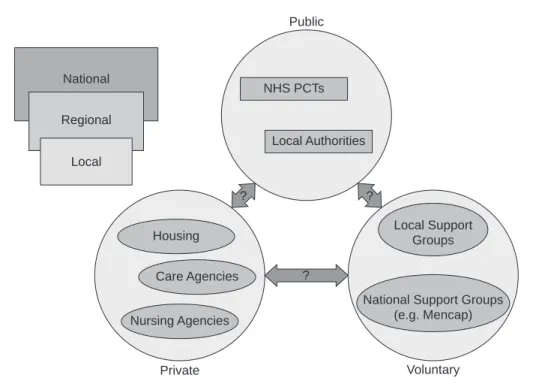
At each level these data can be generated and held by actors from different sectors – statutory, voluntary and private. It is generally thought that there is little or no sharing of data across sectors. One exception to this would be where statutory bodies commission services from providers in the private sector, when they are able to insist on certain data being made available for audit and management purposes.
Within each sector there are then a number of agencies and organisations with variable degrees of data compatibility and exchange.
The discussion in the workshops generated a far more detailed picture of the complexity and the issues raised for the field of learning disabilities. In particu-lar, contributors from both health and social services highlighted the fragmented and partial nature of data held within organisations as a source of continuing difficulty. Essex County Council Learning Disability Service (ECCLDS), which provides the lead for LD services in the area, currently interfaces with a mini-mum of nine other organisations. While there is a degree of data sharing between ECCLDS and Colchester PCT, these two major users (and providers) of LD data do not use compatible systems; it is thought unlikely that this situation will change in the foreseeable future. In addition, the County Council would like to use data from a wider range of sources. The most notable case is the Employment Service, where data sharing could be extremely beneficial, for example in ensuring that individuals are receiving the correct levels of benefit.
Data sharing experiences
That there are many potential benefits from joining up data is unquestionable. Nevertheless, this fact on its own does not help us in assessinghowdata should best be shared. The discussions with stakeholders and users that addressed this question highlighted important issues, both positive and negative, that fell into four broad categories: technical aspects, communication, organisational issues and LD-specific issues. These are summarised below.
Technical aspects
Common standards in data files and explicit protocols for data sharing are important. However, equally im-portant are security measures to prevent confiden-tiality breaches and promote confidence in the security arrangements. A well-defined access control policy is desirable, for example a single point of access to an array of data sources (or services) that would allow access to data through something as simple as a Web browser with a minimal amount of registration. Sem-antic Web technologies are seen to offer a considerable potential in this context.
Data sharing is hampered by inconsistencies in data coding or in basic definitions, incomplete data sources, difficulties with linkage of data (matching data from different sources), data format integration problems, and uncertainty about the validity or reliability of the National
Regional
Local
Private Nursing Agencies
Care Agencies Housing
Public
NHS PCTs
Local Authorities
Voluntary Local Support
Groups
National Support Groups (e.g. Mencap)
? ?
?
data from the different sources. Another technical concern is data duplication, for instance where differ-ent departmdiffer-ents duplicate the same data and do the same work twice. To add another difficulty, different organisations use different terminology to describe similar concepts, and similar terminology to describe different concepts.
Communication
An important experience is that good communication between all parties allows for better information sharing. This is facilitated by personal relationships and access to data curators. Part of a successful communication process is to explain what the data will be used for because an understanding of the potential benefits motivates sharing. This includes communicating with the actual clients or patients who could clearly see what data were being gathered, why, and with whom they would be shared (this also leads to a straightforward and efficient consent pro-cess). Sharing data is seen to be easier if it is done for a specific purpose, such as direct care of the patient or developing a commissioning strategy for services.
Examples of poor communication leading to prob-lems included those of agency leaders or directors who do not communicate ideas/requirements effectively, and the lack of agreed procedures. Service- or policy-led approaches that do not work in partnership with the data providers are also more likely to founder.
Organisational issues
Strong project leadership is key to success. However, complex problems may also be resolved at the indi-vidual level. Examples of successful projects were reported between NHS trusts/clinicians; salient fea-tures of these projects were that collaborators shared a similar organisational culture, and there was a prag-matic approach in that the focus was on ‘getting the job done’. Greater difficulties arise when this degree of communality and focus is absent.
Cultural mismatches and complex bureaucracy were seen as significant obstacles. Agreeing protocols or procedures between (culturally) dissimilar organ-isations, for example health and social services, is also seen as a problem.
Furthermore, where legislative barriers exist that effectively prohibit data sharing, informal, practical information-sharing arrangements between profes-sionals are seen to be in the best interest of the patient or client. Critical factors in these lower-level arrange-ments are that the professionals concerned have a degree of mutual trust, and that they have the com-mon goal of providing the best quality service for the patient or client.
LD-specific issues
The discussion also brought up a number of aspects that are particularly relevant in the context of LD data. Complex LD needs or issues might require several types of information to be shared. In relation to vulnerable adults, procedures for sharing information are critical to effectively protect adults with LD (for instance, for supporting someone in court). Sharing data seems to work well if there is consent from the patients or ‘data subjects’, or if the person with LD is in fact the one sharing his or her own information, that is, when targeting specific individuals for improved care. Suc-cessful information sharing between professionals and other agencies has been evidenced in work concerning the protection of vulnerable adults from abuse.
Summary of stakeholder experiences
The major barriers to data sharing appear to be more ‘social’ than ‘technical’. Sharing information works best if there are clear objectives about why infor-mation is to be shared and with whom, because this helps decide what information needs to be shared and this will determine how it should happen.Apart from the above mentioned problems, there are varying information sharing and confidentiality policies between different organisations. The reluctance officially to authorise data sharing between agencies is also considered to be a problem. The same applies to defensive working practices that focus almost exclus-ively on avoiding risk (rather than potential benefit). Data restrictions can be frustrating, more so if one has to enter into complex agreements and registration processes. Finally, it is important to find a balance between individual rights and public good.
Outcomes
The overriding themes emerging from the discussion wereintegration,efficiency,searching and access, and
security.
Integration
health and social care data. The application of new Web technologies to this area could be of huge value to all stakeholders.
Efficiency
Data relating to individual persons/cases may be held on multiple databases within the same agencies as well as between them. Users pointed up the fact that if communication between these databases is not per-mitted, time is lost to data entry and the use of those data may itself become inefficient as data replication arises. Moreover, information can quickly become outdated if the various sources are not updated concurrently as changes occur. For example, a change to an individual’s address might be applied in one database, but if this is not known to another agency any associated sources will also become inaccurate.
Customised searching and access
Information must allow for the planning of services and inform the targeting of resources in accordance with need. Data sources must provide users, such as health practitioners, with the ability to access infor-mation in such a way that it enables analyses of diverse cases within different time frames, places and con-texts. The level of specificity of any particular query would need to be established by the user in relation to particular criteria.
Security
It is necessary for all sharing data to observe whatever data protection and confidentiality protocols apply. Locally this means conforming to the Essex Trust Charter as well as wider data protection concerns.24,25 Consequently, any proposed system of data sharing must incorporate access control.
Conclusions
Experiences with NHS Connecting for Health suggest that the major barrier to the successful implemen-tation of effective information systems is the fear of change (and related social and organisational issues). In this context, we might ask whether patient confidentiality issues have become a useful scapegoat issue, blocking change and preserving established work patterns and positions of influence. The case of integrating LD data is all the more complicated as it
crosses organisations. However, the fact that the data are located across organisations could lead to LD being an early innovator of Semantic Web technologies, as local control of interoperable data sources could well be the best way forward for delivering safe access to data for aggregate and individual purposes.
The key issue is how to provide up-to-date and timely information for service development and de-livery without compromising patient confidentiality. The benefits of patient confidentiality have to be weighed against the costs of creating barriers to the sharing of data and information for the delivery of care.
The principal technical barrier to data sharing in the LD domain is the lack of interoperability. Given this, Semantic Web services have great potential in pro-ducing ‘joined-up’ data, which in turn could deliver improvements in services. However, stakeholders still have serious concerns regarding consent to data sharing, data protection and access control.
Greater consistency of language and terminology between agencies would facilitate data sharing at a local level. Even if issues of interoperability are tackled, there remains the paradoxical situation that while data sharing is widely regarded as desirable, progress might continue to be hampered more by social factors than by technical issues.
ACKNOWLEDGEMENTS
This project is supported by the Economic and Social Research Council (ESRC) under grant RES-149-25-0038. We would like to thank all who participated in the workshops or contributed to the project in any other way. We also want to thank the delegates at HC 2006 for the lively discussion and hope that some of the questions raised have been answered by this paper.
REFERENCES
1 Department of Health.Valuing People: a new strategy for learning disability for the 21st century. Government White Paper, London, 2001.
2 Beange H, McElduff A and Baker W. Medical disorders of adults with mental retardation: a population study. American Journal on Mental Retardation1995;99:595– 604.
3 Kapell D, Nightingale B, Rodriguez A, Lee JH, Zigman WB and Schupf N. Prevalence of chronic medical conditions in adults with mental retardation: compari-son with the general population. Mental Retardation 1998;36:269–79.
4 Cooper S-A and Bailey NM. Psychiatric disorders amongst adults with learning disabilities: prevalence and relation-ship to ability level.Irish Journal of Psychological Medi-cine2001;18:45–53.
International Literature on the Epidemiology of Mentally Disordered Offenders. NHS Centre for Reviews and Dissemination, University of York, 1999.
6 Hayes SC. Prevalence of intellectual disability in local courts. Journal of Intellectual and Developmental Dis-ability1997;22:71–85.
7 Mason J and Murphy GH. People with intellectual disabilities on probation in the UK: an initial study. Journal of Community and Applied Social Psychology 2002;12:44–55.
8 Reeve K and Coward S.Life on the Margins: the experi-ences of homeless people living in squats. London: Crisis and the Countryside Agency, 2004.
9 NHS Connecting for Health. Secondary Uses Service (SUS). www.connectingforhealth.nhs.uk/programmes/ sus
10 Berners-Lee T, Hendler J and Lassila O. The Semantic Web.Scientific American2001;5:34–43.
11 Rector A, Taweel A, Rogers Jet al. Joining up Health and BioInformatics: e-Science meets e-Health. In: Proceed-ings of the UK e-Science All Hands Meeting, Nottingham, 2004.
12 Essex County Council.TABBS Annual Report. 2004. 13 Pisanelli DM, Gangemi A, Battaglia M and Catenacci C.
Coping with medical polysemy in the semantic web: the role of ontologies. In:Proceedings of MEDINFO 2004, San Francisco, 2004.
14 SNOMED Clinical Terms. www.snomed.org/snomedct/ index.html
15 Dickman E. Learning Disabilities: a nosology. 2003. www.emersondickman.org
16 Elliot MJ, Purdam K and Smith D. Confidentiality and the grid. In: Proceedings of the 1st National e-Social Science Centre All Hands Meeting, Manchester, 2004. 17 Department of Health.Report on the Review of Patient
Identifiable Information (Caldicott Report). London, 1997.
18 ESRC National Centre for e-Social Science. Agenda Setting Workshops: Confidentiality. www.ncess.ac.uk/ events/ASW/confidentiality
19 Medical Imaging and Advanced Knowledge Technol-ogies Project. www.aktors.org/miakt
20 CancerGrid Project. www.cancergrid.org
21 Data, Information and Process Integration with Sem-antic Web Services. dip.semSem-anticweb.org
22 Clinical e-Science Framework Project. www.clinical-escience.org
23 Department of Health. Independence, Well-being and Choice: our vision for the future of social care for adults in England. Government Green Paper, London, 2005. 24 Essex Trust Charter. www.essexinformationsharing.
gov.uk
25 Data Protection Act. www.opsi.gov.uk/acts/acts1998/ 19980029.htm
CONFLICTS OF INTEREST
None.
ADDRESS FOR CORRESPONDENCE
Udo Kruschwitz
Department of Computer Science University of Essex
Wivenhoe Park Colchester Essex CO4 3SQ UK
Tel: +44 (0)1206 872669 Fax: +44 (0)1206 872788 Email: [email protected]
Accepted September 2006