Volume||06||Issue||07||July-2018||Pages-7994-8002||ISSN(e):2321-7545 Website: http://jsae.in
Index Copernicus Value- 76.10 DOI: http://dx.doi.org/10.18535/ijsre/v6i7.03
Diagnosing Technological Pedagogical Content Knowledge Landscape: The Case
of the Mathematics Teachers in Government-Funded University
Authors
Patrick G. Galleto1, Ninfa B. Pangilinan2
College of Education, Jose Rizal Memorial State University, Main Campus, Dapitan City ABSTRACT
Technology-pedagogy-content-based instruction in Mathematics teaching remained the forefront of educational discussion in many higher education institutions in the Philippines today. The study diagnosed the landscape of the teachers’ technological content knowledge (TCK), technological pedagogical knowledge (TPK), and technological pedagogical content knowledge (TPCK) to commence in a government-funded university in the Philippines utilizing survey method of quantitative research with questionnaire checklist. The study revealed that Mathematics teachers intensified and recognized their developing skills in online digital resources and Mathematics softwares applications. The result suggests that Mathematics teachers should be continuously equipped with the technological pedagogical content knowledge to suit the students’ needs of the current times.
Keywords: Digital education, mathematical software application
INTRODUCTION
The educational change brought about by technology, economic, and cultural forces in the early twenty-first century were speedily transforming the educational system globally. The developed nations substantially pronounced these changes, but their effect was also apparent in the developing countries like the Philippines. Higher education across the world is rapidly changing in many ways especially the accessibility of online digital information and communication technologies. However, the study claims that, in the country today, there are Mathematics teachers and their effective classroom practices somewhat remained traditional in this era of rapid change which seamlessly remained content focused, teachers’ directed, didactic instruction focused on content delivery, and rule-centered of the pedagogy.
Hans and Akhter (2013) asserted that teachers, entering the educational workforce, consistently reported minimal preparatory experiences without technologically integrated lessons or formal digital literacy development in the educational setting. They further pointed out that, since teachers tend to teach as they were taught, the instructional workforces are reasonably not prepared to meet the increasingly digital demands of the twenty-first-century knowledge landscape. The current workforces are not able to attend the digital skill expectations of basic education institutions and students as well. In principle, diagnosing teachers' integration of technological skills into teaching and learning is a necessity.
but internet instant messaging, video games, video conferencing and networking formed a substantial part of the native language of digital natives or net generation. However, the traditional higher education system which barely engages the minds and aptitude of digital natives in the classrooms in some government-funded colleges and universities in the Philippines has not been studied at length.
In this study, it is seen as critical to assist Mathematics teachers in higher education institutions, policymakers, and other concerned agencies. This study diagnosed the landscape of technological pedagogical content knowledge (TPCK) of Mathematics teachers to commence in Jose Rizal Memorial State University System during the second semester of the academic year 2017-2018 to establish research-based output and validate hearsay speculations against the Mathematics teachers. Goos and Bennison (2008) supported that investigating teachers’ skills concerning the use of technology for learning and teaching are crucial. Importantly, the study expected to formulate teachers’ development program geared towards acquiring relevant technological pedagogical content knowledge and skills.
THE CONCEPTUAL FRAMEWORK OF THE STUDY
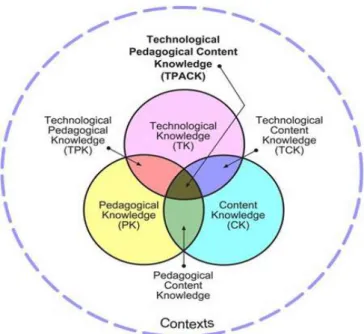
This study is anchored on Koehler’s “Technological Pedagogical Content Knowledge or (TPCK or TPACK) Framework” which asserts that a teacher possesses three fundamental types of knowledge, namely: technological knowledge, pedagogical knowledge, and content knowledge (Handal et al., 2013). Accordingly, pedagogical knowledge refers to the teachers’ know-how instructional expertise which includes an understanding of teaching-led research literature along with practical professional experience. The content knowledge, on the other hand, is the know-what aspect of the subject-matter, more specifically, the body of professional expertise that skilled practitioners typically must master to qualify in their field. Further, technological knowledge refers to a broad range of general technical skills that are required to operate software and hardware or to work with online environments (e.g., downloading a mathematical document like worksheets from the Internet).
The model illustrates further the overlapping of the three elements, namely: pedagogical content knowledge (PCK), technological pedagogical knowledge (TPK), and technological content knowledge (TCK). Shulman (1986) defined PCK as the capability of the teachers to deliver specific content through appropriate teaching processes leading to successful student learning. Handal et al. (2013), on the other hand, underscored that TCK highlights those technical skills specific to a particular discipline (e.g., using mathematical softwares). Furthermore, TPK focuses on instructional competencies that allow teachers to enhance learning while incorporating technology in the enactment of the curriculum (Handal et al., 2013). Interestingly, however, the intersection of the three elements, highlighting technology utilization, represents the specific skills as the primary focus of the study, namely: TPK, TCK, and TPCK or TPACK. Looking at the TPCK model of Koehler (2011), the concept of TPCK lies at the center of the interface of the three fields indicating the top point of skill deployment.
The proponent of the framework explained further that TK is about deploying general skills. The study is contemplated to diagnosed Mathematics teachers’ TCK since, according to Koehler (2011), TCK is about the deployment of teachers’ professional ICT skills. Likewise, TPK revolves about various other teaching capabilities needed to work with technology and in specific situations, such as teaching using an interactive whiteboard, educating students on cybersafety issues, or demonstrating classroom management skills at the school computer laboratory (Handal et al., 2013). Finally, TPCK represents the set of competences standing at the highest level of the model, blending subject-matter content, pedagogy, and technology seamlessly and serving effective teaching and learning through technology (Mishra & Koehler, 2006).
learning. Similarly, Archambault and Barnett (2009) identified online distance education as a TPCK-related activity while Graham et al. (2009) pointed out the importance of TPCK in Science education.
In higher education, the TPCK model has been used for exploring how teachers articulate content, pedagogy, and technology and for enriching the discourse on using ICTs within the subject area (Polly & Barbour as cited by Handal et al., 2013). As such, this study was the first attempt to conduct empirical research to diagnose how the TPCK framework is applied in a government-funded Jose Rizal Memorial State University in the Shrine City of the Philippines Dapitan City through a questionnaire to survey the teachers’ self-reported perceptions.
Figure 1. The Koehler’s TPCK Framework
RESEACH DESIGN AND METHOD
This study employed the survey method of quantitative research with the aid of a questionnaire checklist to diagnose the magnitude of the teachers’ technological content knowledge (TCK), technological pedagogical knowledge (TPK), and technological pedagogical content knowledge (TPCK). The study involved 28 Mathematics teachers and 648 students of Jose Rizal Memorial State University System during the second semester, 2017-2018. The complete enumeration was used in the selection of the Mathematics teacher-respondents while proportionate simple random sampling utilizing the lottery method was employed in the selection of student-respondents of the study. The questionnaire of the study consisted of TCK, TPK, and TPCK scales with ten items per scale for a total of 30 items adapted from Handal et al. (2013) to generate the necessary data in the study. Frequency count and percent were used to quantify the teachers’ technological content knowledge, technological pedagogical knowledge, and technological pedagogical content knowledge. Moreover, Mann-Whitney test was used to validate the claim between the Mathematics teachers and the students on the magnitude of the teachers' technological content knowledge, technological pedagogical knowledge, and technological pedagogical content knowledge.
RESULTS AND DISCUSSIONS
Mathematics Teachers’ Technological Content Knowledge
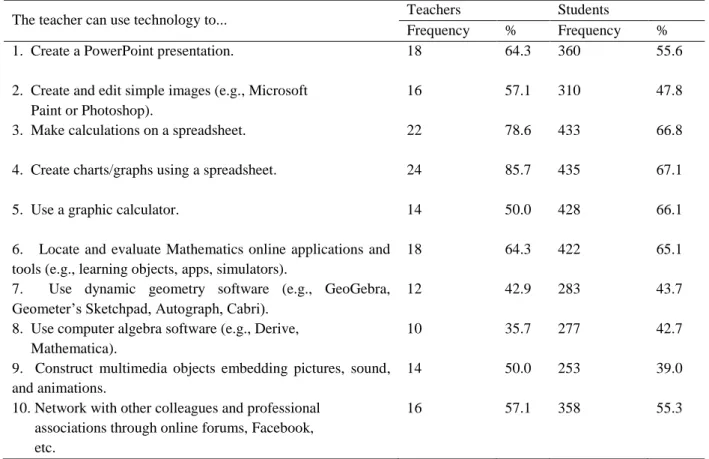
Excel spreadsheet (TCK3, TCK4). Excel is a Microsoft tool used by teachers to record and compute grades of the students, create graphs or tables, and the like. It implies that Mathematics teachers are now using software services such as the Microsoft Excel in recording and computing grades over the traditional ones. Jacinto (2017) corroborated the present finding when she revealed that spreadsheet was the second most frequent computer application employed by the secondary school teachers of Angadanan, Isabela, Philippines.
Further, the percentage on the use of PowerPoint (TCK1) and Paint/Photoshop (TCK2) of teachers (64.3%, 57.1%) was also high and was being supported by the student - respondents (55.6%, 47.8%). The finding indicates that teachers today have found new innovative ways of presenting lessons and creating representations of objects/images. Cox et al. as cited by AlAmmary (2012) asserted that many educators perceived technology as a tool for enhancing the presentation of material for making lessons more fun for the students and for making administration more efficient.
Similar results were revealed for locating online applications (TCK6) and using networking websites (TCK10). The finding signifies that Mathematics teachers are becoming knowledgeable about the teaching resources that can be found on the Internet and are now using networking websites such as Facebook in teaching. Cruz and Cruz (2013) asserted that many universities in the Philippines and abroad are now subscribing digital networking applications where students and faculty can interact and share resources. However, the percentage on the use of graphics calculator (TCK5) and Mathematics software (TCK7, TCK8) and constructing multimedia objects (TCK9) was low. It might be due to the unawareness of the teachers to these educational tools which are difficult to obtain in the market, or they are uncommon in the educational arena here in the Philippines. Handal et al. (2013) corroborated the present finding when they revealed that some tools that have been in the educational field for a while, such as graphics calculators had not been widely adopted.
Table 1 Technological Content Knowledge of the Mathematics Teachers
The teacher can use technology to... Teachers Students
Frequency % Frequency % 1. Create a PowerPoint presentation. 18 64.3 360 55.6
2. Create and edit simple images (e.g., Microsoft Paint or Photoshop).
16 57.1 310 47.8
3. Make calculations on a spreadsheet. 22 78.6 433 66.8
4. Create charts/graphs using a spreadsheet. 24 85.7 435 67.1
5. Use a graphic calculator. 14 50.0 428 66.1
6. Locate and evaluate Mathematics online applications and tools (e.g., learning objects, apps, simulators).
18 64.3 422 65.1
7. Use dynamic geometry software (e.g., GeoGebra, Geometer’s Sketchpad, Autograph, Cabri).
12 42.9 283 43.7
8. Use computer algebra software (e.g., Derive, Mathematica).
10 35.7 277 42.7
9. Construct multimedia objects embedding pictures, sound, and animations.
14 50.0 253 39.0
10. Network with other colleagues and professional associations through online forums, Facebook, etc.
16 57.1 358 55.3
Mathematics Teachers’ Technological Pedagogical Knowledge
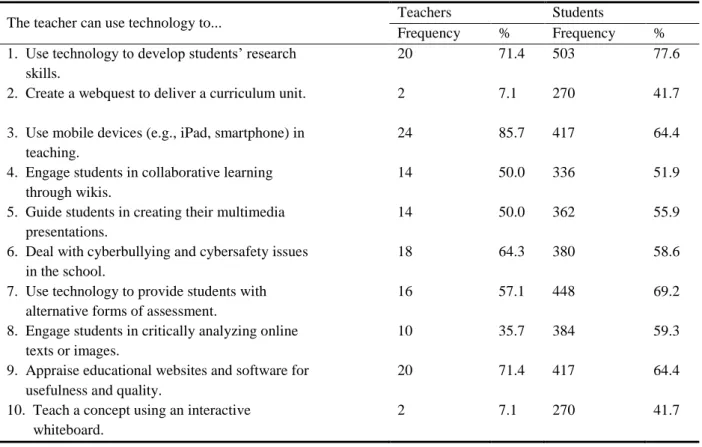
discloses that 85.7% of the teachers used mobile devices in teaching (TPK3) and 64.4% of the students supported their claim. It means that the teachers apply mobile devices in their classroom activities. It denotes further that the teachers get knowledgeable on the use of mobile technologies in facilitating novel educational methods. Thomas et al. (2013) supported the present finding when they revealed that the majority of teachers supported the use of cell phones in the classroom and presently used them for school-related work. Pettit and Kukulska-Hulme (2007) also explained that mobile devices had engaged the imagination of some educators, not least because such devices are a significant part of the grain of daily life. Moreover, the percentage of teachers who use technology to develop students’ research skills (TPK1), to deal with cyberbullying (TPK6), for alternative assessment tasks (TPK7), and appraise educational websites and software (TPK9) was high and the student - respondents agreed on it. Teachers are presumed to do these as part of their class tasks. Nevertheless, the remaining items relating to wikis (TPK4), multimedia presentations (TPK5), and online texts or images (TPK8) obtained low responses from both the teachers and the students. Result suggests that the teachers are not familiar to work with those ICT tools which might result for the teachers the inability to use them inside the classroom. The use of webquest and interactive whiteboard (TPK2, TPK10) also registered 7.1% of the teacher- and student-respondents. It probably signifies that these pedagogical approaches are not known to the teachers. Lau and Sim (2008) confirmed that the learning potential of ICT is deprived as many teachers are still not fully ICT literate and do not use it in their teaching.
Pelgrum (2001) asserted that one of the obstacles to the integration of ICT in education is the problem that teachers did not have sufficient knowledge and skills regarding ICT. Bingimlas (2009) also found out in his study that lack of access to resources was one of the barriers to the integration of ICT in teaching and learning environment. The limitations on access to hardware and software resources influenced teachers' motivation to use ICT in the classroom (Osborne and Hennessy as cited by Bingimlas, 2009).
Table 2 Technological Pedagogical Knowledge of the Mathematics Teachers
The teacher can use technology to... Teachers Students
Frequency % Frequency % 1. Use technology to develop students’ research
skills.
20 71.4 503 77.6
2. Create a webquest to deliver a curriculum unit. 2 7.1 270 41.7
3. Use mobile devices (e.g., iPad, smartphone) in teaching.
24 85.7 417 64.4
4. Engage students in collaborative learning through wikis.
14 50.0 336 51.9
5. Guide students in creating their multimedia presentations.
14 50.0 362 55.9
6. Deal with cyberbullying and cybersafety issues in the school.
18 64.3 380 58.6
7. Use technology to provide students with alternative forms of assessment.
16 57.1 448 69.2
8. Engage students in critically analyzing online texts or images.
10 35.7 384 59.3
9. Appraise educational websites and software for usefulness and quality.
20 71.4 417 64.4
10. Teach a concept using an interactive whiteboard.
2 7.1 270 41.7
Mathematics Teachers’ Technological Pedagogical Content Knowledge
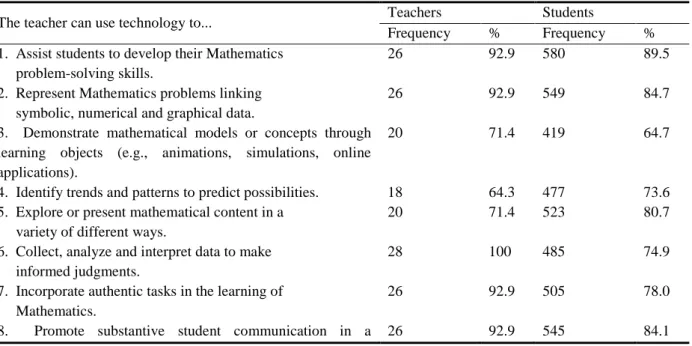
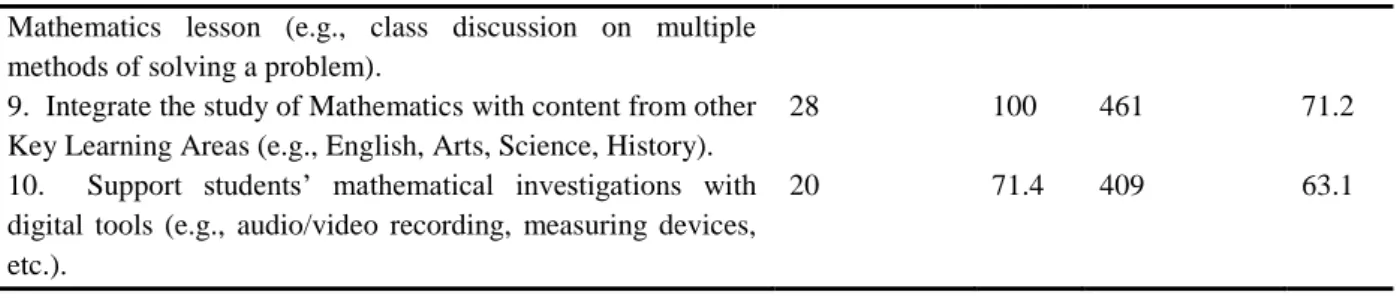
teachers. Table 3 manifests the technological pedagogical content knowledge of Mathematics teachers as perceived by the Mathematics teachers themselves and their students in their respective classes. The table exhibits the high percentages of both the teachers and students responses on each indicator of the technological pedagogical and content knowledge. The highest rate related to the items for data analysis and judgment (TPCK6) and integration of the study of Mathematics with other key learning areas (TPCK9). The result suggests that Mathematics teachers are becoming more creative and innovative in teaching with the aid of technology.
Likewise, the items which relate to developing students' Mathematics problem-solving skills (TPCK1), linking symbolic, numerical, and graphical data (TPCK2), authentic tasks in Mathematics (TPCK7), and substantive student communication in a Mathematics lesson (TPCK8) constituted the same high percentage (92.9%) on teacher - respondents and varying yet very close to high percentages on student – respondents. Finding signifies that problem-solving, providing an authentic task, and the teachers were emphasizing student-teacher communication and collaboration. Ottenbreit-Leftwich et al. (2010) asserted that teachers used technology as a tool to engage and motivate students, improved student comprehension and promote higher-level thinking, as well as a means to facilitate technology skill development that could transfer to future applications.
Similar results were revealed in items related to digital learning objects (TPCK3), predicting possibilities (TPCK4), exploring Mathematical content in different ways (TPCK5), and students' Mathematical investigations with digital tools (TPCK10). Findings again denote that teachers are becoming knowledgeable on some teaching resources available on the Internet such as online Mathematics application and tools.
The Department of Education (DOE) of the United States as cited by Ertmer (2005) confirmed that technology is currently considered by most educators and parents to be an integral part of providing a high-quality education. National Council of Teachers of Mathematics (2008) supported that technology is an essential component in Mathematics teaching, and it influences the way Mathematics is taught and learned. Likewise, Hollebrands (2007) substantiated that new learning opportunities are provided in technological environments, potentially engaging students of different mathematical skills and levels of understanding with mathematical tasks and activities. Moreover, the visualization of mathematical concepts and exploring Mathematics in technological environments can foster Mathematics teachers and students understanding in a new way.
Table 3 Technological Pedagogical Content Knowledge of the Mathematics Teachers
The teacher can use technology to... Teachers Students
Frequency % Frequency % 1. Assist students to develop their Mathematics
problem-solving skills.
26 92.9 580 89.5
2. Represent Mathematics problems linking symbolic, numerical and graphical data.
26 92.9 549 84.7
3. Demonstrate mathematical models or concepts through learning objects (e.g., animations, simulations, online applications).
20 71.4 419 64.7
4. Identify trends and patterns to predict possibilities. 18 64.3 477 73.6 5. Explore or present mathematical content in a
variety of different ways.
20 71.4 523 80.7
6. Collect, analyze and interpret data to make informed judgments.
28 100 485 74.9
7. Incorporate authentic tasks in the learning of Mathematics.
26 92.9 505 78.0
Mathematics lesson (e.g., class discussion on multiple methods of solving a problem).
9. Integrate the study of Mathematics with content from other Key Learning Areas (e.g., English, Arts, Science, History).
28 100 461 71.2
10. Support students’ mathematical investigations with digital tools (e.g., audio/video recording, measuring devices, etc.).
20 71.4 409 63.1
The Diagnostic Difference of the Mathematics Teachers’ Technological Pedagogical Content Knowledge Shown in Table 4 is the diagnostic difference of the TPCK of the Mathematics teachers as perceived by the students and the teachers. Results indicated no significant difference in the TPCK of the Mathematics teachers based on the diagnostic magnitude made by the Mathematics teachers themselves and their students. It means that, in general, students supported the claim of the teachers. It further suggests that the Mathematics teachers can use educational technologies in the classroom setting where the application of these technologies is evident and at the eyesight of their students.
However, Malubay and Daguplo (2018) posited that, despite the effort to integrate technology in the classroom, Mathematics teachers are still behind compared to other more advanced institutions in and outside the country.
Table 4-Diagnostic Difference of the TPACK of the Mathematics Teachers as Perceived by the Students and the Teachers
Respondents N Mean Rank Sum of
Ranks U-value p-value
Teachers 28 163.18 2284.50
1950.50ns
0.725
Students 648 154.61 45610.50
* = significant @ .05 level of confidence ns = not significant @ .05 level of confidence Conclusions and Recommendations
Mathematics teachers intensify the application of their technological pedagogical content knowledge. They also begin to practice in applying educational resources such as mathematical softwares that they can find on the Internet for their classroom activities. It suggests that Mathematics teachers should be regularly sent to seminars/training about the current mathematical tools especially those educational technologies for learning to keep them abreast the current changes in Mathematics education.
Likewise, Mathematics teachers recognize further the applicability and benefits of digital resources in the teaching-learning process in almost all of the Mathematics courses where the representation of concepts and ideas is needed. It necessitates that the administration should provide with educational technologies or mathematical softwares especially those that are difficult to access on the Internet to teachers.
However, teachers' use of some online applications (e.g., webquest, wikis) is still developing due to some factors which affect and hinder the teachers from using them. It supports the claim of the study that some teachers remained traditional in today's era of rapid change. It recommends that Mathematics teachers should use educational technologies in some particular areas where they are needed.
REFERENCES
1. Hans, A. & Akhter, S. (2013). Emerging Trends in Teacher’s Education. https://www.google.com.ph/url?sa=t&rct=j&q=&esrc=s&source=web&cd=3&cad=rja&uact=8&ved
=0ahUKEwiEr4-bidLRAhULWbwKHVtvDjUQFggpMAI&url=http%3A%2F%2Fmacrotheme.com%2Fyahoo_site_a dmin%2Fassets%2Fdocs%2F3HansMR22SI.40131741.pdf&usg=AFQjCNFU84bdMp8QfeLuAj9ff SQnvWostg&bvm=bv.144224172,d.dGc
2. Handal, B., Campbell, C., Cavanagh, M., Petocz, P., & Kelly, N. (2013). Technological pedagogical content knowledge of secondary mathematics teachers. Contemporary Issues in Technology and
Teacher Education, 13(1).
http://www.citejournal.org/volume-13/issue-1-13/mathematics/technological-pedagogical-content-knowledge-of-secondary-mathematics-teachers 3. Goos, M., & Bennison, A. (2008). Surveying the technology landscape: Teachers’ use of technology
in secondary mathematics classrooms. Mathematics Education Research Journal, 20(3), 102-130. https://webcache.googleusercontent.com/search?q=cache:IWVtYISxGQYJ:https://www.learntechlib. org/p/57927+&cd=2&hl=en&ct=clnk&gl=ph
4. Shulman, L. S. (1986). Those Who Understand: Knowledge Growth in Teaching. Educational
Researcher, 15(2), 4–14. www.wcu.edu/WebFiles/PDFs/Shulman.pdf
5. Koehler, M. J. (2011). TPCK – Technological pedagogical and content knowledge. http://www.tpck.org/
6. Mishra, P., & Koehler, M. J. (2006). Technological pedagogical content knowledge: A framework for teacher knowledge. Teachers College Record, 108(6), 1017-1054. DOI: 10.1111/j.1467-9620.2006.00684.x
7. Angeli, C., & Valanides, N. (2009). Epistemological and methodological issues for the conceptualization, development, and assessment of ICT-TPCK: Advances in technological pedagogical content knowledge (TPCK). Computers & Education, 52(1), 154-168. https://pdfs.semanticscholar.org/0c75/949827bb5258a8c9cc1fa408db18e2c9f849.pdf
8. Lee, M-H., & Tsai, C-C. (2010). Exploring teachers’ perceived self-efficacy and technological pedagogical content knowledge with respect to educational use of the World Wide Web.
Instructional Science, 38, 1-21. http://link.springer.com/article/10.1007/s11251-008-9075-4
9. Archambault, L. M., & Barnett, J. H. (2010). Revisiting technological pedagogical content knowledge: Exploring the TPCK framework. Computers & Education, 55, 1656-1662. http://www.academia.edu/4916143/Revisiting_technological_pedagogical_content_knowledge_Expl oring_the_TPACK_framework
10.Graham, C. R., Burgoyne, N., Cantrell, P., Smith, L., St Clair, L., & Harris, R. (2009). Measuring the TPACK confidence of in-service science teachers. Tech Trends, 53(5), 70-79. https://www.google.com.ph/url?sa=t&rct=j&q=&esrc=s&source=web&cd=&cad=rja&uact=8&ved= 0ahUKEwjx8OLdxtTRAhUFEpQKHblYBHUQFggnMAA&url=http%3A%2F%2Fgalleries.lakehea du.ca%2Fuploads%2F4%2F0%2F5%2F9%2F4059357%2Fmeasureing_tpack_confidence.pdf&usg= AFQjCNGICX8c5g7G0lVW7YeZgn_C7xPrLw&bvm=bv.144686652,d.dGo
11.Jacinto, M.A.T. (2017). Anxiety and efficacy in computer technology integration among secondary school teachers of Angadanan, Isabela, Philippines. 6th International Conference on Advances in Science, Engineering, and Technology (ICASET-17) Dec. 17-18, 2017. http://fze.uconferencealerts.com/siteadmin/upload/AE12171006.pdf
13.Cruz, M.B. & Cruz, S.B.B. (2013). The use of internet-based social media as a tool in enhancing student’s learning experiences in biological sciences.” High. Learn. Res. Commun. Vol. 3, Num. 4. https://files.eric.ed.gov/fulltext/EJ1133759.pdf
14.Thomas, K.M., O’Bannon, B.W. & Bolton, N. (2013). Cell phones in the classroom: Teachers’ perspectives of inclusion, benefits, and barriers. Interdisciplinary Journal of Practice, Theory, and
Applied Research Volume 30, Issue 4, 295-308.
https://www.tandfonline.com/doi/full/10.1080/07380569.2013.844637?scroll=top&needAccess=true 15.Pettit, J. & Kukulska-Hulme, A. (2007). Going with the grain: Mobile devices in practice.
Australasian Journal of Educational Technology, 23(1), 17-33.
http://oro.open.ac.uk/7118/1/Pettit_and_Kukulska-Hulme_ajet-p17-33.pdf.
16.Lau, B.T. & Sim, C.H. (2008). Exploring the extent of ICT adoption among secondary school teachers in Malaysia. Journal of Computing and ICT Research, Vol. 2(2), 19-36. http://citeseerx.ist.psu.edu/viewdoc/download?doi=10.1.1.372.7344&rep=rep1&type=pdf#page=19 17.Pelgrum, W.J. (2001). Obstacles to the integration of ICT in education: results from a worldwide
educational assessment. Computers and Education, 37(3), 163-178. https://www.sciencedirect.com/science/article/pii/S0360131501000458
18.Bingimlas, K.A. (2009). Barriers to the successful integration of ICT in teaching and learning environments: A review of the literature. Eurasia Journal of Mathematics, Science and Technology
Education, 5(3), 235-245. https://eric.ed.gov/?id=EJ905676
19.Ottenbreit-Leftwich, A.T., Glazewski, K.D., Newby, T.J., & Ertmer, P.A. (2010). Teacher value beliefs associated with using technology: Addressing professional and student needs. Computers &
Education 55(3), 1321–1335. https://www.sciencedirect.com/science/article/pii/S0360131510001612
20.Ertmer, P.A. (2005). Teacher pedagogical beliefs: The final frontier in our quest for technology integration? Educational Technology Research and Development, 53(4), 25–39. https://link.springer.com/article/10.1007/BF02504683
21.National Council of Teachers in Mathematics-NCTM (2008). The Role of Technology in the Teaching and Learning of Mathematics. http://www.nctm.org/about/content.aspx?id=14233
22.Hollebrands, K. F. (2007). The role of a dynamic software program for geometry in the strategies high school Mathematics students employ. Journal for Research in Mathematics Education, 38(2), 164-192. https://eric.ed.gov/?id=EJ757035