TECHNICAL UNIVERSITY OF CLUJ-NAPOCA
ACTA TEHNICA NAPOCENSIS
Series: Applied Mathematics, Mechanics, and Engineering
Vol. 60, Issue III, September, 2017
THE USE OF COMPETITIVE ENGINEERING IN THE
INFORMATION TECHNOLOGY AND MANAGEMENT OF THE
REGIONAL DEVELOPMENT PROJECTS
Nicolae Traian JOLDEȘ, Csaba GYENGE, Gheorghe ACHIMAȘ
ABSTRACT: Regardless of what we are referring to, today, more than ever, we can identify elements of
project management or project management. Thus, project management has emerged as a way of planning, organizing, implementing, coordinating and controlling more or less complex activities in different areas of activity: political, social, commercial, cultural, etc. Project management has begun to become a business standard in both the private and public sectors, increasing the range of application areas as well as the complexity of developmental shapes and models. The current period is described by more and more specialists as the "project management era" in all areas. The paper presents the methods applied by the authors whose main objective is the computerization of the activities related to the problem of solving, according to the European norms, the collection, sorting and storage of household waste in the areas related to Sălaj County. In order to achieve the proposed objectives, the competing engineering methodologies have been used, through appropriate customizations.
Key words :Competitive engineering, project management, sustainable development, project lifecycle
INTRODUCTION
There are at least two components within managerial theory and practice. One component refers to the "core" managerial activities that are identical and can be highlighted in any geographical point of the world, and a second, more subtle, component that is fueled by the specificity of the local community on which management is acting [1].
Management can be successful if it manages to order the two components so that they align with a quality gradient. In other words, management has to find, in its operating environment, "real positive" measures, that is, measures that, by overcoming the universally valid level, can determine the expected effects in a specific cultural space.
However, it is necessary to distinguish between the managerial knowledge of a universal character that is associated with the first component and the specific knowledge that targets the second component.
By the late 1980s and early 1990s, the new concept of sustainable development emerged, which changed and clarified many aspects that were not highlighted in the past. Increasing environmental pollution can be stopped by a policy in line with the concept of sustainable development.
PROJECT MANAGEMENT
Project management is a specialized field of management initiated in the 1950s to coordinate and control the increasingly complex activities of economic and social activity [1], [4].
The emergence and development of project management were mainly driven by NASA’s launching and running space programs, by the competition between developed countries for military supremacy, by the requirement of the clients from social-economic field that projects must be executed in the shortest time with fastest possible recovery [3].
The following trends are considered in the project management issues approach:
• Organizations tend to globalize their activities;
• Accelerated growth of information and knowledge;
• Increasing demand for complex and increasingly complex and personalized goods and services;
• increasing competition on the market. The project management issue can be differentiated according to the field in which it is carried out:
• in the field of commercial companies, especially those in infrastructure, informatics, telecommunications, construction;
• in the field of non-profit organizations of education, health, environment protection.
The project represents a set of temporary efforts to create a product or provide a service.
The triangular model of a project (Figure 1) [5] highlights the interdependence of the three basic elements of a project:
- objective - costs - time.
The objective of a Structural Funds project can be defined as a group of interrelated activities grouped in a logical succession to achieve the priorities set out in the sustainable development strategy.
The cost of the project is the cumulative of the investment costs and the
operating costs as well as the expenses recorded before the actual start of the project implementation.
The time horizon represents the period of time in which the implementation of the takes place having the final result the integral fulfilment of all result indicators.
Fig. 1 Triangular model of a project
From another prospective [4], the project is an ensemble of time-bound activities with a start and an end to which limited resources are allocated to achieve the predetermined goal (Figure 2).
Fig. 2 Defining a project as a set of activities
The initial moment is considered the moment when the decision is made to proceed to the design of a project and the final moment is the one in which the last activity foreseen in the project ends.
Using project management involves a number of advantages, such as:
- the possibility of solving complex problems in very limited timeframes and with superior economic results; - promoting a matrix organizational
structure that favors organizational change and efficiency;
- facilitating specialist contacts between project team members and other organization specialists;
- creating premises favorable for the training of professional managers.
Classification of projects can be structured into three large groups:
historical monument, retrofitting of a bank, etc.);
2. research and development projects (development of a new product, new technology, development of a new software, etc.);
3. organizational projects (introducing a new marketing concept, introducing project management as an alternative form of leadership, widening the market segment, etc.).
The direct costs of the project are obtained by adding up the direct costs of all activities [3], [5]:
( )
(
)
( )∑
∑
∈ ∈ ⋅ − = = network ji ij ij ij network
j i ij
Y a W C costs direct Total , , , , ,
, (1)
The direct cost curve - duration for activity (i, j) is presented in figure 3. For complex networks a formal approach to the problem can be used to model it as a linear program. To do this we approximate the Direct cost – duration diagram with the broken line (figure 3). This linear approximation shows an increase in the direct cost with "ai, j" for each reduction in activity duration by one unit of time. The duration Yi, j of the activity (i, j) corresponds to a direct cost Ci, j (figure 3).
As a result, time optimization problem can be stated as follows: A “D” duration of the project (figure 3) and unlimited resources, to find the duration of the activities and their programming which ensures the execution of the project with minimum direct costs.
Fig. 3 The direct – costs diagram for activities (i,j) Since all Wi, j are constants, minimize total direct costs, is equivalent to maximizing:
( ) j i retea j i j i y a , , , ⋅
∑
∈ (2) ( ) j i retea j i j i Y a Z Max , , , ⋅ =∑
∈ (3)Therefore, formulating the time - cost problem is:
0
, − ≤
+ i j j
i Y T
T (4)
j i j
i D
Y, ≤ , (5)
j i j
i D
Y, ≤− ,
− (6)
D T
Tn− i ≤ (7)
where: Ti is the advanced beginning in knot „i”
n – the terminal knot of the network D – duration of the project
Yi,j – activity duration (i,j).
The condition in relation (4) shapes the precedent relationships - succession of activities. Conditions (5) - (6) require that the duration Yi, j be between the two extreme points, and the relationship (7) expresses the condition that this duration does not exceed the maximum imposed "D".
Using COMPETITIVE ENGINEERING methods
In the traditional methods of product development and the realization of various major development programs, constructive and technological aspects are two distinct entities. New methodologies tend to integrate the two functions of product development and the realization of different structural programs in a unique cooperative process, applying the competing engineering methods accordingly.
Competitive Engineering (Concurrent Engineering - EC) and other slightly older concepts, such as CIM, supposes the application to all levels of activity involved in the projects to be carried out.
The issues to be considered are: • information system;
• the circulation of materials;
• integrating the different stages of program implementation.
• Integrating the construction design cycle, promoting teamwork;
• Improvement of the communication with the equipment and material suppliers, with the subcontractors of different special parts of the complex program;
• hiring multidisciplinary specialists;
• the involvement of modern
technologies in the different phases of the project;
• development in due time of 3D models of the whole complex that is planned to be realized;
• CAD/CAM integration;
• simulation of the operation of the various subunits and of the whole complex;
• analysis of provision with energy, access ways, materials, utilities.
Of course, effective implementation of competing engineering methods requires continuous communication between the realizers of different phases and subprograms. Physical models of the entire complex need to be developed, on the basis of which it is possible to thoroughly analyze all the aspects related to the preparation, execution and verification of the works and even for the tests and approvals.
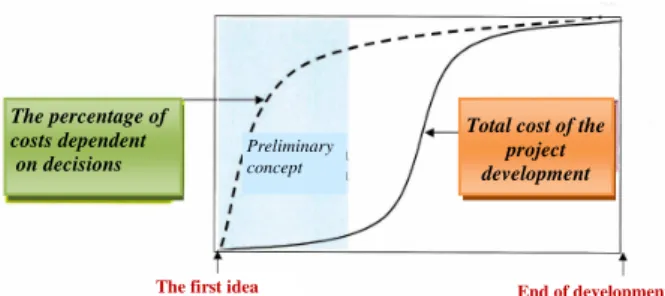
Under the global name of competitive engineering applied in the particular case of regional development projects, the use of those methods of organization, marketing, construction and assembly is ensured to provide the quality of the works and the costs appropriate to the program and of course the rhythmical and timely achievement of the different phases of the works (Figure 4).
Fig. 4 The total cost of achieving a functional integrated complex
Applying the results of competing engineering principles leads to:
• Decreasing development times;
• reducing the number of changes to the project;
• Decreasing the delays in completing the different phases;
• increasing global quality; • Increasing productivity;
• Increased return on assets invested. Thus, it can be argued that the concurrent engineering applied in the case of the development of complex development projects provides a logical and structured framework that allows the achievement in time and at the imposed performances of the whole ensemble..
SUSTAINABLE DEVELOPMENT
The concept of sustainable development, with approaches that have their roots in biology and ecology, is explicitly linked to economic activity.
Hence the term of sustainable economic development that is used by some authors.
From the perspective of sustainable development, in the context of the European Union, economic growth must be made in such a way that the negative impact on the environment is limited. The concept of sustainable development is a paradigm shift in this area - sustainability is no longer seen only in relation to environmental protection but is discussed in the context of links with other areas, especially those involving economic activity.
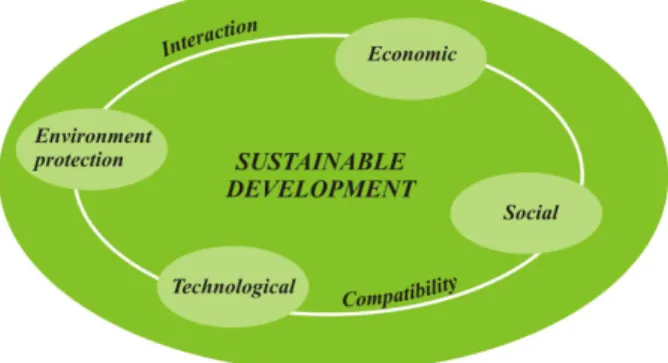
The definition set forth by the European Commission and then well-known, says that sustainable development is "that development that meets the needs of the present without compromising the ability of future generations to meet their own needs".
This definition implies a reorientation of public policies to determine "a process of change in which resource exploitation, investment direction, technological development orientation, and institutional change are all in harmony, increasing both
Total cost of the project development The percentage of
costs dependent
on decisions Preliminary concept
current and future potential to meet needs and human aspirations "(Figure 5).
Fig. 5 Definition of sustainable development
The definition of durable development contains two key concepts, namely:
• The concept of needs, meaning here mainly the needs of the poor, to whom priority must be given;
• The concept of limits or thresholds imposed by the technological level and the social organization in terms of the ability of the environment to meet present and future needs.
The objective of sustainable development include:
• Reviving economic
development/growth;
• Quality reorientation of the development;
• meeting essential needs for food, energy, water and sanitation;
• ensuring a sustainable level of the population;
• technological reorientation and risk management;
• Correlation of economic and environmental dimensions in the decision-making process.
Sustainable development is trying to respond to the following imperatives: 1. Integration of nature conservation and
development;
2. Meeting the basics human needs; 3. Social equity and justice;
4. Opportunity for social self-determination and cultural diversity;
5. Maintaining ecological integrity. The three "E" of sustainable development - Economics - Ecology - Equity, is a relatively condensed set of values that should guide the process of change. This set of values should be expanded to include also other sectors, such as education and health.
The simplest way to establish a relationship between the economy and the natural environment can be based on the balance of materials or energy. (Figure 6).
Fig.6 Sorting - Storage - Recycling Station
CONCLUSIONS
Project management is a new management method, which is an expression of management professionalization.
The problem of solving the complex of problems and the activity related to the European level of the processing, storage and recycling of domestic waste, (Figure 6) implies an appropriate management and the high-level computerization of the set of related issues.
solutions are in line with the regional development program in Sălaj County.
BIBLIOGRAPHY
[1].Abrudan, I. Premises and landmarks of Romanian managerial culture. Publishing House DACIA, Cluj-Napoca, 1993.
[2].Bâlc, N., ș.a. Design for competitive manufacturing. Alma Mater
Publishing House, Cluj-Napoca, 2006.
[3]. Ciobanu, R.M. Project Management. Asache Publishing House , Iași, 2002. [4]. Curaj, A., ș.a. Practice of project
management. Economic Publishing House, București, 2003.
[5]. Lungu, Fl., ș.a. Management and engineering in business. Publisher UTPRESS, Cluj-Napoca, 2010. [6]. Tureac, I., ș.a. Ecologic Design and
sustainable development. Publishing House of Transilvania University from Brașov, Brașov, 2003.
UTILIZAREA INGINERIEI CONCURENTE LA INFORMATIZAREA ACTIVITĂȚILOR TEHNICE ȘI DE MANAGEMENT AL PROIECTELOR DE DEZVOLTARE REGIONALĂ
ABSTRACT: Indiferent de domeniul în care facem referire, astăzi, mai mult ca oricând, putem identifica elemente de managementul de proiect sau managementul proiectelor. Astfel managementul de proiect a apărut ca o modalitate de planificare, organizare, implementare, coordonare și control al activităților mai mult sau mai puțin complexe din diferite arii de activitate: politice, sociale, comerciale, culturale, etc. Managementul proiectelor a început să se constituie într-un standard de afaceri atât în sectorul privat cât și în cel public, crescând tot mai mult diversificarea domeniilor de aplicabilitate precum și complexitatea formelor și modelelor de dezvoltare. Perioada actuală este descrisă de tot mai mulți specialiști ca „era managementului de proiect” în toate domeniile. În cadrul lucrării se prezintă metodele aplicate de către autori având ca obiectiv principal informatizarea activităților legate de problematica soluționării, conform normelor europene, a activităților de colectare, sortare și depozitare a deșeurilor menajere în zonele aferente Județului Sălaj. În scopul realizării obiectivelor propuse, s-au folosit metodologiile ingineriei concurente, prin particularizări adecvate.
Nicolae Traian JOLDEȘ, PhD Student, Eng.Ec., Technical University of Cluj-Napoca, Department of Manufacturing Engineering, 103 – 195 Muncii Bvd, 400641 Cluj-Napoca, Phone: 0754 424298.
Csaba GYENGE, Prof. Dr. Eng., Technical University of Cluj-Napoca, Department of Manufacturing Engineering, 103 – 195 Muncii Bvd, 400641 Cluj-Napoca, Phone:
(+)40.264.401.721.
Gheorghe ACHIMAȘ, Prof. Dr. Eng., Technical University of Cluj-Napoca, Department of Manufacturing Engineering, 103 – 195 Muncii Bvd, 400641 Cluj-Napoca, Phone: