Shany Thomas et al IJSRE Volume 05 Issue 6 May 2018 Page 7933
Volume||6||Issue||05||May-2018||Pages-7933-7937||ISSN(e):2321-7545 Website: http://jsae.in Index Copernicus Value- 76.10 DOI: http://dx.doi.org/10.18535/ijsre/v6i5.03
Original Article-
A study to assess effectiveness of planned teaching programme on knowledge regarding
palliative care among staff nurses
Authors
Shany Thomas1, Patel Avruti2, Patel Janki3, Patel Nishi4, Shah Riddhi5, Christy Shiney6, Chauhan Yamini7
1
Asst. Professor, Shri G H Patel College of Nursing, Karamsad, Anand, Gujarat
2,3,4,5,6,7
B.Sc Nursing Shri G H Patel College of Nursing Corresponding Author:
Shany Thomas
Asst. Professor, Shri G H Patel College of Nursing, Karamsad, Anand, Gujarat
ABSTRACT
The study was carried out to assess effectiveness of planned teaching programme on knowledge regarding palliative care among staff nurses. Convenient sampling was used to select 150 staff nurses from selected hospitals, Anand. The questionnaire consisted of demographic data of the participants and knowledge questionnaire on palliative care. Lesson plan was developed with the help of subject experts. Pre-test was administered on the first day and planned teaching programme was executed on the same day. The post-test had been taken after 7 days of pre-test. Results: Data was analyzed using IBM SPSS Statistics 20. The findings of the study revealed that there was a significant difference found between pre and post test knowledge score t-29.5(p 0.00), hence the planned teaching programme was effective in improving nurse’s knowledge. Conclusions: As palliative care is an important aspect of nursing care, nurses need to be educated on palliative care and informed about changes that are happening in this area.
Key-words: Planned teaching programme, Palliative care
INTRODUCTION
Palliative care is a health care specialty that is both a philosophy of care and an organized, highly structured system for delivering care to persons with life-threatening or debilitating illness from diagnosis till death and then into bereavement care for the family1. Palliative care improves health care quality in three domains: the relief of physical and emotional suffering, improvement and strengthening of the process of patient– physician communication and decision-making, and assurance of coordinated continuity of care across multiple healthcare settings such as hospital, home, hospice, and long-term care5.
Palliative care focuses primarily on anticipating, preventing, diagnosing and treating symptoms experienced by patients with a serious or life threatening illness & helping patients & their families make medically important decisions5.
Shany Thomas et al IJSRE Volume 05 Issue 6 May 2018 Page 7934 According to Worldwide Palliative Care Alliance (WBPC) although more that 100 million people across the world benefited from hospice and palliative care, annually less than 8% of those in need access it6. Although India ranks at the bottom of the quality of the death index in overall score, it is estimated that in India around 7 million people are diagnosed with cancer every year, around 80% of all cancer are diagnosed in the advanced stage when treatment is less effective and palliative care become absolutely essential. Every hour more than 60 patients die in India from cancer and in pain. In India the total number who needs palliative care is likely to be 6 million people, but less than 1% has access to it1,2.
Nurses play a significant role in the care of the dying, critically ill as well as the terminally ill clients. Lack of knowledge about palliative care is an obstacle to nurses as conventional training in nursing does not provide specialized and unique training in palliative care as it is not part of their curriculum. Sorifa B et all (2015) conducted a descriptive study to assess the knowledge & practice of staff nurses on palliative care in selected hospital of Guwahati city, Assam. Self administered structured questionnaire was used to collect data from100 staff nurse. It was found that maximum 79% had inadequate knowledge, 21% had moderately adequate knowledge & no one had adequate knowledge on palliative care. According to the levels of practice maximum 48% practice adequately where as 43% practice moderately adequate and only 9% practice inadequately. The correlation (r= 0.30) indicates that there is a positive correlation between knowledge and practice scores of palliative care by the staff nurses. The study concluded that the nurses had poor knowledge & practice regarding palliative care7.
Palliative care is important for patients who are suffering from life threatening condition and nurses play vital role in giving care to that patient so, it is necessary to assess knowledge of nurses regarding palliative care and improve their knowledge regarding palliative care. Nurses will be able to render effective palliative care when they are knowledgeable about the concept of palliative care, able to identify the symptoms and the needs of the patient.
SUBJECTS AND METHODS
A pre experimental, one group pre test- post test design adopted for the study. 150 staff nurses were selected using convenient sampling using the inclusion criteria. Questionnaire consisted of demographic data of the participants and knowledge questionnaire on palliative care. Lesson plan on palliative care was developed with the help of subject experts. The participant information sheet containing details of purpose, participant selection, voluntary participation, procedure and protocol, risk, benefits, confidentiality was distributed to the participants and informed consent was obtained. Pre-test on 1st day and then planned teaching programme was executed on the same day. The post-test had been taken after 7 days of pre-test.
RESULTS
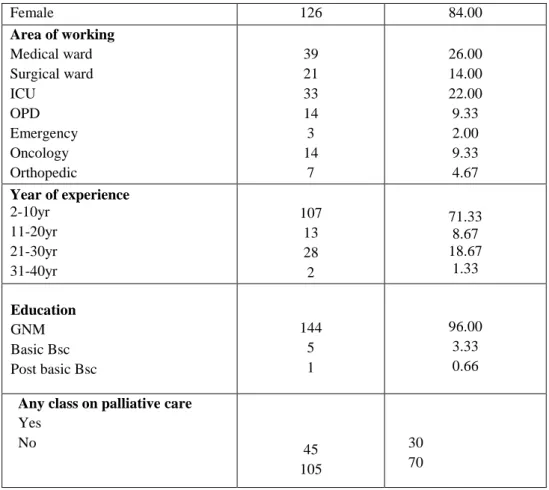
The demographic characteristics shows that majority (66.67%) of the staff nurses were in the age group 20 to 30 years and 84% were females. Majority (96.0%) of them were GNM. (71.33%) of participants had experience of 2 to 10 years. Majority (70%) of participants had not attended any palliative class and (26%) of participants were working in medical ward.
Table 1: Frequency and percentage distribution of staff nurses according to their demographic variables
Background variables Frequency Percentage
Age
20-30 31-40 41-50 51-60
94 20 24 12
62.67 13.33 16.00 8.00
Gender
Shany Thomas et al IJSRE Volume 05 Issue 6 May 2018 Page 7935
Female 126 84.00
Area of working
Medical ward Surgical ward ICU OPD Emergency Oncology Orthopedic 39 21 33 14 3 14 7 26.00 14.00 22.00 9.33 2.00 9.33 4.67
Year of experience
2-10yr 11-20yr 21-30yr 31-40yr 107 13 28 2 71.33 8.67 18.67 1.33 Education GNM Basic Bsc Post basic Bsc
96.00 3.33 0.66 144 5 1 96.00 3.33 0.66
Any class on palliative care
Yes
No 30
70 45
105
In pre test only two participants had good knowledge where as in post test 141 participants had good knowledge.
Table 2 : Pre and post test knowledge of staff nurses regarding palliative care.
Sr.No. Category Pre test Post test
Frequency Percentage Frequency Percentage
1 Adequate 2 1.33% 141 94%
2 Moderate 70 46.66% 9 6%
3 Poor 78 52% 0 0%
The obtained pre-test mean score (Table-2) was 13.193 (SD- 3.2017) and obtained post-test mean score was 22.240 (SD- 1.8123). The findings of the study revealed that there was a significant difference found between pre and post test knowledge score (Table-3) t-29.5(p = 0.00), hence the planned teaching programme was effective in improving nurse’s knowledge.
Table 3: comparison between pre and post test knowledge score of nurses regarding palliative care.
Variables Number Mean SD SE Mean T value P value
Pre-test 150 13.193 32017 0.26142 29.579 0.000
Post-test 150 22.240 1.8123 0.14797
DISCUSSION
Shany Thomas et al IJSRE Volume 05 Issue 6 May 2018 Page 7936 The mean post test knowledge score (22.24) of the present study was higher than mean pre test knowledge score( 13.19) with the mean difference of( 9.047). Difference between pre test and post test knowledge was statistically tested and it was found significant. The results were consistent with the findings of the study conducted by David A (2010) to assess the effectiveness of information booklet regarding palliative care among the nurses. The Mean pre test score was 12.71, and mean post test score was 21.78, which showed that the information booklet was effective in improving the nurses’ knowledge regarding palliative care4
.
CONCLUSION
The planned teaching Programme was found to be effective in enhancing nurses’ knowledge. Participants gained significant knowledge after exposed to the Planned Teaching Programme. There should be regular in-service training for the nurses so they can be up-to-date with the changing trends which in turn improve the patient outcome. As palliative care is an emerging concept in India, Nurses need to be trained and educated on the various dimensions of palliative care and the concept need to be incorporated in the nursing curriculum so that the nurses can be molded according to the changing trends.
Ethical clearance - Taken from Institutional ethical committee, HM Patel Centre for Medical Care and Education, Karamsad
Source of funding - Self
Conflict of Interest - Nil
REFERENCES
1. M.R.Rajagopal. (2015). An Indian Primer of Palliative care for medical students and doctors. kerela: Trivandrum Institute of palliative science publication.
2. Sadasivan, S. M. (2014). Palliative care A Handbook for nurses . kerela: Kerela state resource center in palliative care publication.
3. Cancer [Internet].WHO Definition of Palliative Care, {cited 2017 Dec 12]. Available from: http://www.who.int/cancer/palliative/definition/en .
4. David, A., & Banerjee, S. (2010). Effectiveness of “Palliative Care Information Booklet” in Enhancing Nurses’ Knowledge. Indian Journal of Palliative Care, 16(3), 164–167. Available from: http://doi.org/10.4103/0973-1075.73647.
5. Rome, R. B., Luminais, H. H., Bourgeois, D. A., & Blais, C. M. (2011). The Role of Palliative Care at the End of Life. The Ochsner Journal, 11(4), 348–352.
6. Worldwide Hospice Palliative Care Alliance General Fact sheet [ Updated 2015; cited 2017 Nov 7]. Available from http://www.thewhpca.org/about-us-3.
7. Sorifa b(2015) , a study to assess the knowledge & practice on palliative care in Assam. International Journal of Human Resource management,(cited 2017 July 10)1:41-45
8. Das A (2013),a study to assess the level of knowledge &attitude of staff nurses regarding palliative care in venjaramoodu.International Journal of science and research,(cited 2017 July 8)5:611
9. Ellershaw, J., & Ward, C. (2003). Care of the dying patient: the last hours or days of life. BMJ : British Medical Journal, 326(7379), 30–34.
10.Murugan rajalakshmi(2012) ,a study to assess knowledge, attitude, practice and associated factors towards palliative care in Ethiopia.BMC palliative care, (cited 2017 July 9)13:6
Shany Thomas et al IJSRE Volume 05 Issue 6 May 2018 Page 7937 12.Mohammad Al (2014),a study to assess knowledge on palliative care among staff nurses in
Jordan.Journal of hospice and palliaitve nursing,(cited 2017 July 9)16:7
13.Youssef w (2014),a study to assess nurses knowledge &practice regarding palliative care in egupt.Advances in life and technology,(cited 2017 July 9)2:90-101