Neha Agarwal, PriyankaIJSRE Volume 06 Issue 1 January 2018 Page 7792 Volume||6||Issue||01||January-2018||Pages-7792-7798||ISSN(e):2321-7545
Website: http://jsae.in
Index Copernicus Value- 76.10 DOI: http://dx.doi.org/10.18535/ijsre/v6i1.04
Study of Different Type Security to Client / Server Network: A Review
Authors
Neha Agarwal1, Priyanka2 1
Dept-Computer Science Application Chaudhary Devi Lal University
2
Assistant Professor, Dept-Computer Science Application Chaudhary Devi Lal University
ABSTRACT:
Networking is considered as a process which is fostering exchange of data. security to client server network is must. In this paper we have discussed challenges to network security along with peer to peer & client server networking technology. Objective of this paper is study different security mechanisms used in different type of network. security against hacking & security to data is usually provided using access control mechanism. Here in this paper we have discussed security of data from loss, email security, application layer security. Moreover discussion has been made on Firewall based security as well as virtual private network. In this paper we have discussed lot of existing researches related to image based network security.
Keywords: Network Security, Access Control, Firewalls, Virtual private network, Image Processing, Encryption & Decryption.
1.INTRODUCTION
Networking is considered as a process which is fostering exchange of data & ideas with in group of individuals or groups which is sharing common interests. Networking is two kinds of business. Period networking knows setting up & operation of a physical computer network.
Fig 1 Networking
The two common types of networks are peer-to-peer & client/server. They allow users to share information or resources.
Peer-to-Peer Networks
It consists of basic methods that allow multiple users to share resources such as printers & fax machinery. These resources are connected to multiple computers in a peer-to-peer network. Method for setting up a peer-to-peer network is to connect computers running client software such as Windows to a hub or to use a wireless access point. Peer-to-peer networks are imperfect in what they could do because this is easy
low-Networki ng Opportuniti
es
Communitie s
Speed Boosting Business
Neha Agarwal, PriyankaIJSRE Volume 06 Issue 1 January 2018 Page 7793 cost process. For example, peer-to-peer networks have no centralized security safeguards. Information are communal from every computer & if one computer shuts down, loses power, , it is impossible to access information on that computer Peer to Peer networks all tend to sluggish down when extra than five PC are connected
Client/Server Networks
Computer network where central & strong computer called server is a hub. Several less powerful personal computers or workstations called clients are connected to it. Clients run programs & get information that is stored on server.
Client
Client is known as computer hardware or software which is accessing a service made available by a server. Server is often on another computer system where client accesses service by way of a network.
HTTP client transfers a request to server in form of a request method, URI, & protocol version. It is generally followed by a MIME-like message. It is containing request modifiers, client data & body content over a TCP/IP connection. Distribution module is consisting of normal web servers.
They are dependable for accepting client & server requests & delivering ready media & associated resources to client. For large-scale distribution, edge networks or other content delivery networks could also be used. Server
Server has been program of a computer & device that is giving functionality for other programs or devices called clients. Such type of architecture is known as client–server model. A general computation is dispersed across manifold processes or devices. Servers could provide different functionalities that are called services like sharing data or resources between multiple clients.
2. NETWORK SECURITY
Network security is any activity designed to protect usability & integrity of your network & data. It includes both hardware & software technologies. Effective network security manages access to network. It targets a variety of threats & stops them from entering or spreading on your network. Network security combines multiple layers of defenses at edge & in network. Every security pf network layer equipment controls & policies. The Authorized client profit access to network, but malicious actors is blocked from carrying out exploits & threats. Digitization has transformed our world.
Business Networking
In terms of business networking, one of implicit objectives is to form professional relationships that might boost one's future business & employment prospects. Networking events, such as conferences & meetings, are common practice within professional organizations, which might also link up within other bodies to stage a joint event.
Online Networking
Business networking has received a tremendous boost in participation thanks to burgeoning popularity of business networking websites. LinkedIn provides an online meeting place for business professionals to engage within other professionals, join groups, post blogs & create online profiles within goal of catching attention of others within similar interests.
Computer Networking
Neha Agarwal, PriyankaIJSRE Volume 06 Issue 1 January 2018 Page 7794
3. TYPES OF NETWORK SECURITY
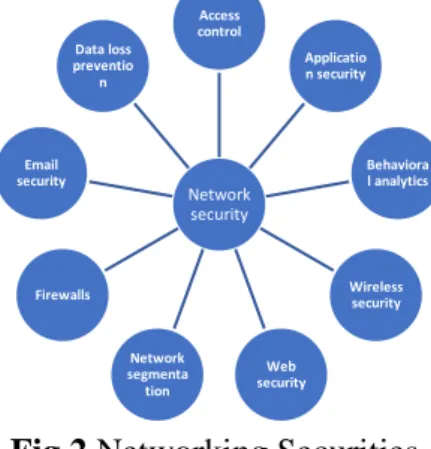
The different types of network security as discussed in this section. Access control
Not every user should have access to your network. To keep out potential attackers, you need to recognize each user & each device. Then you could enforce your security policies. They could chunk disobedient endpoint devices or provide them only incomplete access. This process is network access control.
Fig 2 Networking Securities
Application security
Some software them use to run their firm require to be protected but IT staff made it or whether him buy it. Some application might contain holes, or weakness of security, those attackers could use to infiltrate your network. This security include both software & processes their use to close those black holes.
Behavioral analytics
Behavioral analytics must know what usual behavior looks like. This tools mechanically discern activities that deviate from norm. Your security team could then better identify indicators of compromise that pose a potential problem & quickly remediate threats.
Data loss prevention
Association must made sure that their employees not mail sensitive data outside network. The Data loss prevention technologies could stop people from uploading, forwarding, or even printing critical information in an unsafe manner.
Email security
Email gateways are number one threat vector for a security breach. Attackers use personal information & social engineering tactics to build sophisticated phishing campaigns to deceive recipients & send them to sites serving up malware. The security of mail application jams attacks & controls outbound messages to thwart defeat of sensitive information.
Firewalls
Firewalls put up a barrier between your trusted internal network & untreated outside networks, such as Internet. They use a set of defined rules to allow or block traffic. Hardware or software are both a firewall. The Cisco present united attacks devices & threat focused next-generation firewalls.
Intrusion prevention systems
An intrusion prevention system scans network traffic to actively block attacks. IPS Cisco Generation to application do associate large amounts of global attacks deverness to not only jam hateful activity but also track progression of suspect files & malware across network to prevent spread of outbreaks & reinjection.
Mobile device security
Cybercriminals are increasingly targeting mobile devices & apps. Within next 3 years, 90 percent of IT organizations might support corporate applications on personal mobile devices. You need to control which
Network security
Access control
Applicatio n security
Behaviora l analytics
Wireless security
Web security Network
segmenta tion Firewalls Email security
Data loss preventio
Neha Agarwal, PriyankaIJSRE Volume 06 Issue 1 January 2018 Page 7795 devices could access your network. You would also need to configure their connections to keep network traffic private.
Network segmentation
Software-defined segmentation puts network traffic into different classifications & makes enforcing security policies easier. Ideally, classifications are based on endpoint identity, not mere IP addresses. You could assign access rights based on role, location, & more so that right level of access is given to right people & suspicious devices are contained & remediated.
Security information & event management
Security information & event management secure pull together data that their security of employees require to recognize & respond to threats. These products come in various forms, including physical & virtual appliances & server software.
VPN
A virtual private network encrypts connection from an endpoint to a network, often over Internet. Typically, a remote-access VPN uses IPsec or Secure Sockets Layer to authenticate communication between device & network.
Web security
The security of we, its key would control their employees web use, jam web-based attacks & deny access to malicious websites. There secure their web gateway on web site or in cloud server. The security of web server to take step protect your own website.
Wireless security
Wireless networks are not as secure as wired ones. Without stringent security measures, installing a wireless LAN could be like putting Ethernet ports everywhere, including parking lot. The stop an use from given grasp their required products important designed to protect a wireless network.
4. RELATED RESEARCHES
There are several researches related to network security. Some of them have been discussed here.
Shobha Pati et al (2008) A Secure Approach to Image Encryption of color image without using key. [1]
The advent of internet introduced to its users a new dimension as to how data could be shared from one part of world to other in near real time. These opportunities came problem, how to argue discretion of data being transmitted. This gave a fillip to already vibrant research area of cryptography. Encryption of images is made with traditional encryption algorithms such as RSA, DES etc. But drawback of this approach is that key management is difficult & keys for encryption are limited. They have explain encrypting images that is dividing an image at pixel system into multiple parts, such that individually parts convey no information about image, but a qualified set of these shares would help to regenerate original image.
Chi Chang-Yanab, et al., (2008) have done a study on methods of noise reduction within a stripped image.[2]
Through their analysis they have found out by image spectrum that its difference could help us to choose different methods to do noise reduction while information of image is reduced to be least. They have also illustrated some methods of noise reduction & taken one test image as an example. Since this image is affected by notable striping, noise reduction methods of this stripped image are being mainly studied. Gray price replacement & Wavelet technique is acceptable within stripped noise reduction. Then, MSR & PSNR are calculated to evaluate processed image. Results suggest that methods required are suitable within processing this noise”.
Neha Agarwal, PriyankaIJSRE Volume 06 Issue 1 January 2018 Page 7796 Authors has been compared fourteen & respectable algorithms based on histogram normalization, illumination properties & human perception theory using 3 verification methods. The implementation to gain from research shows that enlightenment preprocessing methods significantly improve verification rate & it is a very important step within face verification system.
Dr.Ch. Srinivasa Rao et al (2010) Analysis on Keyless Approach of Image Encryption. [4]
Some limitations of key oriented techniques to maintain key records & increase high computational cost to overcome limitation of image size & key records, brute force attacks .This paper proposes an better keyless methods for image encryption in lossless red green & blue images .There are some various approaches being followed an image encryption ,first approach is image splitting & second approach is multiple shares .The objective of this work is to increase security level by randomly distributing pixel bit over entire image .
Gamil R.S. Qaid et al (2012) Encryption & Decryption of Digital picture Using Color Signal. [5]
Level of security & secrecy provided by digital color signal-based picture encryption. Picture encryption & decryption algorithm is planned to security in transmission of picture based data as well as in storage. This new proposed encryption algorithm could ensure lossless of transmissions of images. Proposed encryption algorithm in this study has been tested on some images & showed good results. Many techniques for picture encryption were employed in past. They included selective bit plane encryption, fuzzy PN codes based on color picture encryption, polarization encryption, data encryption, standard DES etc. with varying degrees of success to attack resistance & other features.
P. Radhadevi1, P. Kalpana (2012) Secure Picture encryption using AES [6]
Security in transmission of digital images has its importance in today’s picture communications, due to increasing use of images in industrial process, it is essential to protect confidential picture data from unauthorized access, picture security has become a critical issue. Difficulties in ensuring individuals privacy become increasingly challenging. Various methods have been investigated & developed to protect data & personal privacy. Encryption is probably most obvious one. In order to protect valuable information from undesirable readers, picture encryption is essential. This paper presents an application of AES operations in picture encryption & decryption. Encrypted cipher images always display uniformly distributed RGB pixels
Payal Sharma et al (2012) Image Encryption Techniques.[7]
As use digital techniques for transmitting & storing images are increasing, it becomes an important issue that how to protect confidentiality, integrity & authenticity of images. There are various techniques which are discovered from time to time to encrypt images to make images more secure. Image encryption techniques scrambled pixels of image & decrease correlation among pixels, so that we would get lower correlation among pixel & get encrypted image. In this paper review of various encryption techniques that are existing is given. It also focuses on functionality of techniques. Keywords: Chaotic key, Cryptography, AES, Huffman Table. There are so many technique to make an image secure.
Subhajit DasAn (2013) Innovative Approach in Image Encryption[8]
Neha Agarwal, PriyankaIJSRE Volume 06 Issue 1 January 2018 Page 7797 different decryption result that proved sensitivity of algorithm. It is very difficult for an attacker to extract pixels from encrypted image pixels as distributions of pixels of encrypted images are uniform.
Rinki Peshawar et al (2013) Survey on Different picture Encryption & Decryption Techniques. [9]
This research focuses mainly on different kinds of picture encryption & decryption techniques. In research they have focuses on picture encryption techniques it becomes an important issue that how to protect confidentiality, integrity & authenticity of images. There are various techniques which are discovered from time to time to encrypt images to make images more secure. In this paper a Survey of Different picture Encryption & encryption techniques that are existing is given. It additionally focuses on functionality of picture encryption & decryption techniques.
Jyotika Kapur et al (2013) Security using picture processing.[10]
Using picture stitching & picture steganography security could be provided to any picture which has to be sent over network or transferred using any electronic mode. There is a message & a secret picture that has to be sent. Secret picture is divided into parts. In second phase which is Embedding Phase, cipher text is embedded into any part of secret picture that is to be sent. Third phase is Hiding Phase, where steganography is performed on output picture of Embedding Phase & other parts of picture where parts are camouflaged by another picture using least significant bit replacement. These individual parts are sent to concerned receiver. At receivers end decryption of Hiding phase & Embedding Phase takes place respectively. Parts obtained are stitched together using k nearest method. Using SIFT features quality of picture is improved.
5. SCOPE OF RESEARCH
This paper discusses security of computing systems & shows how to protect computer-related assets & resources at end, different firewalls like Packet Filtering, Application Gateways & Personal Firewall are summarized & compared according to different network scenarios. As use digital techniques for transmitting & storing images are increasing, it becomes an important issue that how to protect confidentiality, integrity & authenticity of images.
REFERENCES
1. Shobha Pati (2008) A Secure Approach to Image Encryption of color image without using key International Journal of Current Engineering & Technology
2. Chi Chang-Yanab, et al., (2008) have done a study on methods of noise reduction within a stripped
image
3. Mariusz Leszczyński (2010) has worked on image preprocessing for illumination invariant face verification
4. Dr.Ch. Srinivasa Rao (2010) Analysis on Keyless Approach of Image Encryption International Journal of Research & Computational Technology, Vol.7
5. Gamil R.S. Qaid , Sanjay N. Talbar(2012) Encryption & Decryption of Digital picture Using Color Signal” IJCSI International Journal of Computer Science Issues, Vol. 9, Issue 2, No 2, March 2012 6. P. Radhadevi1, P. Kalpana (2012) Secure Picture encryption using aes” International Journal of
Research In Engineering & Technology Volume: 01 Issue: 02 Oct-2012
7. Payal SharmaDigita(2012) Image Encryption Techniques: A Review International Journal of
Computing & Business Research
Neha Agarwal, PriyankaIJSRE Volume 06 Issue 1 January 2018 Page 7798 9. Rinki Pakshwar, Vijay Kumar (2013) A Survey On Different picture Encryption & Decryption
Techniques” International Journal of Computer Science & Information Technologies, Vol. 4
10.Jyotika Kapur(2013) Security using picture processing” International Journal of Managing
Information Technology (IJMIT) Vol.5, No.2, might 2013
11.Umashankar Pandey (2013) Literature Survey & Performance Analysis of Image Encryption Technique Based on Chaotic Schemes International Journal of Computer Technology & Electronics Engineering (IJCTEE) Volume 3, Issue 6, December 2013
12.Nur Amalina (2013) Enhanced Network Security System Using Firewalls ARPN
13.Manish Kumar (2014) A first approach on an RGB image encryption Optics & Lasers in Engineering
52 (2014)
14.Archit Uprit (2014) Network Security Using Linux/Unix Firewall
15.Assistant Professor (2014) Unique Key Using Encryption & Decryption of Image International Journal of Advanced Research in Computer & Communication Engineering Vol. 3, Issue 10, October 2014
16.Mohammad Sajid Qamruddin Khizrai(2014) Image Encryption using Different Techniques for High
Security Transmission over a Network International Journal of Engineering Research & General Science Volume 2, Issue 4, June-July, 2014
17.Ravi Prakash Dewangan(2015) Image Encryption using Random Permutation by Different Key Size
International Journal of Science, Engineering & Technology Research (IJSETR), Volume 4, Issue 10, October 2015
18.Samreen Sekhon Brar(2016) Double Layer picture Security System using Encryption &
Steganography”J. Computer Network & Information Security, 2016
19.Dipak Aher(2016) Novel Framework of Hyper Image Encryption Algorithm International Journal of
Emerging Technologies in Engineering Research (IJETER) Volume 4, Issue 5, might (2016)
20.Shahriar Mohammadi, Reza Ebrahimi Atani, Hossein Jadidoleslamy (2011) A Comparison of Link
Layer Attacks on Wireless Sensor Networks Journal of Information Security, 2011
21.Wajeb Gharibi & Maha Shaabi (2012) Cyber threats in social networking websites, International Journal of Distributed & Parallel Systems (IJDPS) Vol.3, No.1, January 2012
22.Tongguang Ni, Xiaoqing Gu, Hongyuan Wang, & Yu Li (2013) Real-Time Detection of