TECHNICAL UNIVERSITY OF CLUJ-NAPOCA
ACTA TECHNICA NAPOCENSIS
Series: Applied Mathematics, Mechanics, and Engineering Vol. 62, Issue I, March, 2019
INFLUENCING OF THE VIBRATIONS EFFECTS TO THE
HAND-ARM SYSTEM
Aurora Felicia CRISTEA
Abstract: The aim of the paper presents an experimental way to reduce mechanical vibrations that are transmitted to the operator’s arm at workplace. This can be done using an innovative device [4], a damper mounted parallel to the forearm, between the wrist and the elbow.The innovative idea of this paper is the creation (design and realization of the practice) of a vibration attenuator device, which will be mounted along of the forearm; this could minimize the transmitted vibration, by the hand up the arm and the paper is based on this study.
Key words:Hand-arm system, Vibration attenuator, Professional affections. 1. INTRODUCTION
The subject of this paper has as starting point the analysis of the measurements of mechanical vibrations transmitted from a machine-tool to the human operator. It was observed that, transmitting vibrations at low frequencies, in this paper, around 20Hz at the cause’s negative effects on the individual’s health, respectively professionally diseases:
for example Vibration White Finger, joint disorders etc. I was found that, these disorders are especially associated to the intensity of the vibrations the individual is subjected to, i.e. the duration of the exposure and their frequency. Apart from the exposure and their frequency, there are other factors that influence the occurrence of these disorders, such as: the environment, the health status, stature, weight and sex [1], [2].
When talking about transmitting mechanical vibrations to the hand-arm system, the literature mentions protective equipment against the transmission of mechanical vibrations to the hand, namely gloves manufactured from various materials (rubber, linen, combinations of these, etc.), there are of course, other protection measures against the transmission of mechanical vibrations to the hand-arm system.
In our country, in the period 1992-2018, the professional diseases due to work increased [1]. From this perspective, the most affected from the occupational point of view were: locksmiths, miners, smelters, foundry-workers, welders, medical assistants, carpenters and mechanics workers.
This study wants the demonstrated that used or wearing such an attenuator device can reduce the vibrations transmitted to the arm along the arm and to the shoulder and thus reducing the risk of occupational illnesses on this segment.
Another positive aspect about wearing such a protection device is the fact that the tactile sense is restored in the fingers and palm in connection to grabbing tools and devices.
2. EXPERIMENTAL MODEL OF THE MOVEMENTS OF THE HAND-ARM SYSTEM
In the order of simulation of movements defining the anatomical elements (hand, forearm, arm) of the hand-arm system, using the same simplifying conditions used as in the mechanical model, as the same mechanical parameters (viscous-elastic coefficients), masses, lengths, etc.
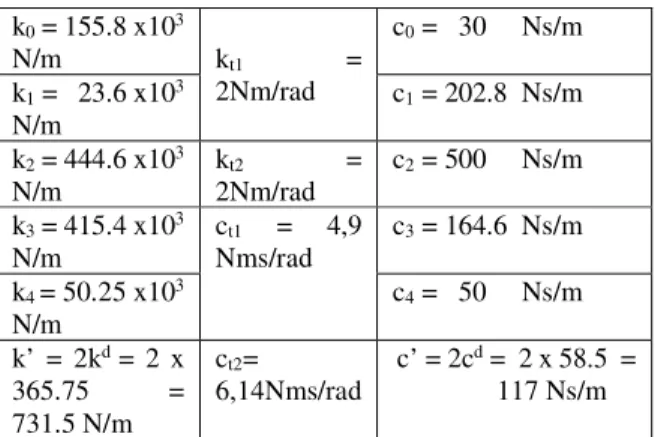
The mechanical characteristics of the anthropometry, rigidity and elasticity of the mechanical system are shown in Tables 1 and 2. The anthropometric characteristics were determined, and the elasticity and damping characteristics were taken from the specialized literature.
Tabel 1
Anthropometrical parameters.
Table 2
Visco-elastic coefficients of hand-arm system [2], under the conditions imposed by table 1
2. EXPERIMENTAL RESEARCHES
The researches regarding the transmissibility of mechanical vibrations to the arm-hand system have been performed by measuring the mechanical vibrations using a drilling machine. The machine drilled through a chemically treated MDF board using a 10cm drill. The experiment measured the vibrations transmitted by the machine when operating with percussion and without percussion (Fig.2-9). Another positive aspect about wearing such a protection device is the fact that the tactile sense is restored in the fingers and palm in connection to grabbing tools and devices.
The innovative idea of this paper is the creation (design and realization of the practice for measurements) of a vibration attenuator
device, which will be mounted along of the forearm; this could minimize the transmitted vibration, by the hand up the arm. The damper was fixed such as:
In study, we evaluated a person of 40-year-old male, weighing 85kg and 1.85m tall, used and handled the drilling machine. The measurements used an inductive transducer (accelerometer type K3), being able to
simultaneously measure vibrations on axis: Ozh.
This was connected to a vibration measuring device type SVAN 958. The study was done only for the vibration transmission on the Ozh,
axis, respectively alongside the forearm of the hand-arm system.
Fig. 1 Fastening the attenuator device on the forearm.
a. Technical characteristics of mini-attenuator FA 1008 VB ([1]-damper1,2, [2]-connecting device between dampers, [3]-support, [4]-bracelet, [5]-fastening system);
b. Interior padding with sponge;
c. Interior padding with felt.
The accelerometer was mounted on the anatomic locations: wrist and elbow, being fastened directly under the metallic bracelet by tightening it, and directly on the arm (taped).
The figure 1a) and 1b) presents the way the dampers (element 1) are fixed in the structure. They are connected to each other in the back side of the forearm with a linear and metallic clamping element which has two metallic caps welded at the ends with jaws (element 2). One of the damper ends (the mobile one) is attached to these jaws and the other one (the fixed one) has an external thread and is introduced in the holes of the bracelet (Φ11) (element 3). This fastens the two semicircles on and under the articulation with an M10 nut. The metal bracelets are fixed at the other end of the forearm (above the wrist) with an M5 screw and nut (element 4). The vibration attenuator device (containing 2 dampers) was mounted along the
Anthropometrical parameters
m1 = 0.45 kg
= ' 3
l 0,298 m Jc3 = 0.0149 kgm2
m2 = 1.15
kg 3
l = 0.178 m
m3 = 1.9 kg
6 , 0 l / l3 '3=
k0 = 155.8 x10³
N/m kt1 =
2Nm/rad
c0 = 30 Ns/m
k1 = 23.6 x10³ N/m
c1 = 202.8 Ns/m
k2 = 444.6 x10³ N/m
kt2 = 2Nm/rad
c2 = 500 Ns/m
k3 = 415.4 x10³ N/m
ct1 = 4,9 Nms/rad
c3 = 164.6 Ns/m
k4 = 50.25 x10³ N/m
c4 = 50 Ns/m
k’ = 2kd= 2 x 365.75 = 731.5 N/m
ct2= 6,14Nms/rad
forearm and fixed with a complex shank (bracelets). The damper device was mounted between the wrist and the elbow, parallel to the forearm (Fig.1b), in accordance to the simulating model, in terms of the placement, and technical characteristics (rigid and dampers). Also, the weight of the device is 0,5kg, just like the theoretical model [1-3].
Next, it explicit the way in which the dampers were chosen (two elements marked with 1, in figure 1a), which is mounted in series, parallel to the forearm, in the attenuator device in figure 1b) according to the technical characteristics in table 1.
The two dampers are similar from the construction and technical characteristics point of view. This is why, we present both as element 1 (Fig.1b). They are sold based on their elastic and damping characteristics, given by the damper from the mechanical model, that is seeking technical characteristics and masses that are identical or almost identical to the theoretical model. When choosing these mini-dampers it had to consider the fact that the entire device (including the two mini-dampers mounted in series) had not be heavier than 0.5 kg.
The results are analyzed in the figures 2-9 for all the cases considered by the experiment and taking into consideration the anatomic location (wrist, elbow and shoulder), the way in which the bracelets were fastened on the skin (sponge – Fig. 2a) and felt – Fig. 2b), and whether the drilling machine worked with or without percussion. The interior padding of the metallic bracelets has been done to prevent skin lesions and to prevent blocking the worker’s forearm movements.
Table 3
Mini-attenuator of vibration named FA 1008 VB, technical characteristics.
Technical characteristics
Adequate values
Type Adjustable
Displacement 8 mm Functional
temperature scale
-5 by 65° C
Mass
0,026 g
Field 0,6-10 Kg Energy capacity 3,6 kNm/h Exterior screw
dimension
M 10x1
Exterior attenuator diameter
10 mm
External dimensions 65,5 mm Transmitted force 3-6 N
The measured results have been analyzed and an average was calculated. They have been recorded directly by the machine, and then downloaded on the computer using a special program.
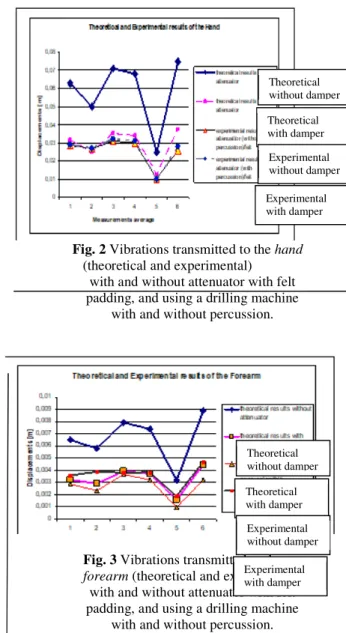
Fig. 2 Vibrations transmitted to the hand (theoretical and experimental)
with and without attenuator with felt padding, and using a drilling machine
with and without percussion.
Fig. 3 Vibrations transmitted to the forearm (theoretical and experimental)
with and without attenuator with felt padding, and using a drilling machine
with and without percussion.
Theoretical without damper Theoretical with damper
Experimental without damper
Experimental with damper
Theoretical without damper Theoretical with damper
Experimental without damper
Fig. 4 Vibrations transmitted to the Arm (theoretical and experimental) with and without attenuator with felt padding, and using a drilling machine
with and without percussion.
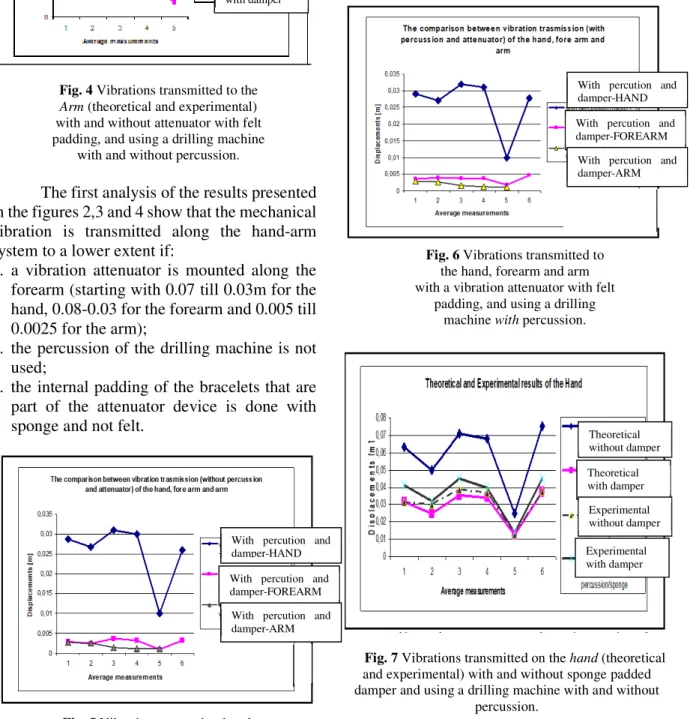
The first analysis of the results presented in the figures 2,3 and 4 show that the mechanical vibration is transmitted along the hand-arm system to a lower extent if:
1. a vibration attenuator is mounted along the forearm (starting with 0.07 till 0.03m for the hand, 0.08-0.03 for the forearm and 0.005 till 0.0025 for the arm);
2. the percussion of the drilling machine is not used;
3. the internal padding of the bracelets that are part of the attenuator device is done with sponge and not felt.
Fig. 5 Vibrations transmitted to the hand, forearm and arm with a vibration attenuator, with felt padding,
and using a drilling machine without percussion.
The results in figures 5 and 6 show that, by using the drilling machine without and with percussion and a damper with felt padded bracelets, in both cases the vibrations in the three anatomic locations (hand, forearm and arm) are reduced (starting with 0.03 till 0.005m) in the first case (without percussion) in comparison the other case.
Fig. 6 Vibrations transmitted to the hand, forearm and arm with a vibration attenuator with felt
padding, and using a drilling machine with percussion.
Fig. 7 Vibrations transmitted on the hand (theoretical and experimental) with and without sponge padded damper and using a drilling machine with and without
percussion.
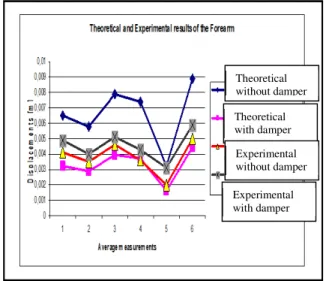
The results presented in figures 7, 9 and 9 [3], [4] have shown that, the vibrations transmitted
With percution and damper-HAND With percution and damper-FOREARM
With percution and damper-ARM Theoretical without damper Theoretical with damper Experimental without damper
Experimental with damper
With percution and damper-HAND With percution and damper-FOREARM
With percution and damper-ARM
Theoretical without damper Theoretical with damper Experimental without damper
to the hand-arm system are reduced from the hand up arm, by using the vibration attenuator device (starting from 0.005 till 0.002m) and especially when using the drilling machine without percussion. This analysis was also performed comparing the theoretical model with an attenuator device included in the model.
Fig. 8 Vibrations transmitted on the forearm (theoretical and experimental) with and without sponge
padded damper and using a drilling machine with and without percussion.
Fig. 9 Vibrations transmitted on the arm (theoretical and experimental), with and without sponge padded damper, and using a drilling machine with and without
percussion.
4.CONCLUSIONS
The innovative idea of this paper was the experimental creation (design and realization of the practice) of a vibration attenuator device, which will be mounted along of the forearm; this could minimize the transmitted vibration, by the hand up the arm. Also, the purpose of the paper was to demonstrate that, the mechanical vibrations transmitted from an excitation source (ex. Machine-Tool) to the human operator (hand-arm system) are reduced from the hand to the elbow joint by mounting an attenuator device along the forearm [1], [3]. All these studies were done in order to avoid or reduce the action of the vibrations on the human body (in this case the hand-arm system) at the workplace, and respectively, the reduction of their effect and the prevention of occupational illnesses. The introduction of this paper mentions that occupational illnesses occur after years of vibration exposure, at the workplace [1].
The conclusions of the experiment performed validated the theoretical results generated by the simulation and have shown that, by using an attenuator device mounted parallel to the forearm (between the wrist and the elbow), we can reduce vibrations along the arm to the shoulder by 50%.
Performing experiments (vibration measurements) on the hand-arm system (Fig.1b, and Fig. 2-9), which lead to the validation of the theoretical model and the results of the simulation.
The mini-dampers were purchased and mounted on the device and it tried to maintain the same technical characteristics as the theoretical model. The experiment, presented in this paper, was done using a drilling machine that functioned alternatively with and without percussion. The results were analyzed and were presented in figures 2, 3 and 4. They show that the mechanical vibrations generated by the machine-tool or device are reduced along the hand-arm system if:
An attenuator device is mounted along the forearm; The operator uses a drilling machine without percussion; The inner lining of the bracelets that are part of the attenuator device is made of sponge and not felt.
Irrespective of the fact, whether the drilling machine will work with or without percussion
Theoretical without damper Theoretical with damper Experimental without damper
Experimental with damper
Theoretical without damper Theoretical with damper
Experimental without damper
(Fig. 2-9). In this way, the vibrations are a reduced a lot from the hand (entry point of vibrations) to the arm with up to 50% [1-4].
At the same time, the vibrations along the forearm to the shoulder are reduced more, if the inner lining of the bracelets of the damper (element 2 in figure 1a) is made of a medium density sponge, than if the lining is made from other materials (felt in this case).
At this stage, since the ergonomic part of the device has not been established yet, these lining materials (sponge and/or felt) are necessary, otherwise, the metallic bracelets placed on the wrist and under the elbow might injure the skin. In addition, they prevent the device from slipping, allowing the operator to work with the machine - tool or to handle the device properly. Wearing an attenuator device, like the one, presented in the paper, it has proven that (by simulation and experimental research):
1. It reduces the vibrations transmitted to the arm along the arm to the shoulder and could reduce the risk of occupational illnesses; 2. It restores the tactile comfort of the fingers and extra comfort when gripping tools and devices.
5. REFERENCES
[1] Detesan, Ovidiu-Aurelian, Cad model of the
RTTRR modular small-sized serial robot,
Acta Technica Napocensis series-Applied Mathematics Mechanics and Engineering, volume: 60 issue: 1 pages: 69-74 published:, issn: 1221-5872, 2017.
[2] Detesan, Ovidiu-Aurelian, The path planning of RTTRR small-sized industrial robot in a process of microprocessor
packing, Acta Technica Napocensis
Series-Applied Mathematics Mechanics And
Engineering volume: 60 issue: 4 pages: 551-556 published: nov 2017, accession number: wos:000428901100016, issn: 1221-5872.
[3] SREN 5349-2:2003: Mechanical Vibrations. Measurements and evaluation of human exposure at vibrations transmitted of hand. [4] Pop (CRISTEA) Aurora Felicia, Arghir
Mariana, Patent no. 128900/2018; Dispozitiv de atenuare a vibraţiilor atasat pe sistemul mână-braţ al operatorului uman (Device of attenuation mechanical vibration).
INFLUENȚA EFECTELOR VIBRAȚIILOR LA SISTEMUL MÂNA-BRAȚ
Rezumat. Scopul lucrării este de a prezenta o modalitate experimentală de reducere a vibrațiilor mecanice transmise la brațul operatorului, la locul de muncă. Acest lucru se poate face folosind un dispozitiv inovator, un amortizor montat paralel cu antebrațul, între încheietura mâinii și cot. Ideea inovatoare a acestei lucrări este proiectarea și realizarea atenuatorului de vibrații, care va fi montat de-a lungul antebrațului; acest lucru ar putea minimiza vibrația transmisă prin mâna brațului și lucrarea se bazează pe acest studiu.
Aurora Felicia CRISTEA, Assistant Proffesor PhD Engineer, Technical University of Cluj-Napoca,