Continuous Rating (W)
Voltage (V) Cycle (Hz)
Input Output Max. Output (W)
740
Models No.
Description
NEW TOOL
Current (A)
T
ECHNICAL INFORMATION
C
ONCEPT AND MAIN APPLICATIONS
S
pecification
S
tandard equipment
O
ptional accessories
Note: The standard equipment for the tool shown above may differ by country.
P 1 / 20
DCS230T/ PS-220TH
DCS231T/ PS-221TH
Engine Chain Saw 250mm
Primarily targeted at professionals who frequently prune fruit trees or street trees, these new models have been developed as "the lightest-in-the world*" top handle engine chain saws. (*Note: according to our investigation, in the category of engine chain saw and at the date of August, 2004)
Other benefits are: Inertia chain brake
Automatic adjustable chain oiling Easy start system
Idling start
DCS230T and PS-220TH feature no load speed of 11,500rpm whilst DCS231T and PS-221TH feature 10,500rpm.
DCS230T and DCS231T are Makita brand models. PS-220TH and PS-221TH are Dolmar brand models.
Chain blade 250mm (25AP-60E for carving bar or 91VG-40E for sprocket nose bar) Guide bar (Carving bar or Sprocket nose bar)
Chain oil Engine oil
Chain blade 250mm ... 1 (25AP-60E for Carving bar or 91VG-40E for Sprocket nose bar) Guide bar ... 1 (Carving bar or Sprocket nose bar)
Guide bar scabbard ... 1 Wrench 13-16 ... 1
250 (9-7/8)
22.2 Standard guide bar: mm (")
DCS230T PS-220TH DCS231T PS-221TH Specification Model Displacement: ml 11,500 10,500
No load speed: min-1=rpm
1/4 0.050 Gauge (")
Chain blade
0.2 Fuel tank capacity: l
0.74 Max output: kw
2.5 (5.5) Power head weight: kg (lbs)
Pitch (") Carving bar
Sprocket nose bar bar 3/8 0.050 Gauge (")
Pitch (")
0.19 Chain oil tank capacity: l
Dimensions: mm (") Width (W) Height (H) Length (L) 215 (8-1/2) 202 (8) 242 (9-1/2) L H W
[II] Disassembly/Assembly/Adjustment
1. Necessary Repairing Tools
2. Lubrication/Sealing
After you have disassembled the following parts, do lubrication or sealing as instructed below.
Needle bearing on clutch drum: Apply Makita grease N No. 2. Spiral spring of recoil starter: Apply Makita grease N No. 2.
Engine: Apply Three bond 1215 to the contact surface between Crankcase and Cylinder.
Description Use for
Tool No.
Bearing Setting Tool 20-12.2 1R028
Retaining Ring Pliers ST-2N Disassembling/assembling kickback brake (inertia chain brake) system
1R003
Bearing Setting Plate 12.2 Press-fitting Bearing to Crankshaft 1R034
Drill Chuck Remover 11 1R048
Copper Round Bar 20-100 Removing Flywheel
1R091
Air Tightness Tester Testing Carburetor
1R127
T-type Hex Wrench 3-127 Removing/installing M4 Hex socket head bolt 1R170
T-type Hex Wrench 4-130 Removing/installing M5 Hex socket head bolt 1R171
1/4" Hex Shank Bit for M5 Removing Engine 1R229
Bearing Extractor Removing Bearing from Crankshaft
1R269
13mm Hex Socket Bit
Removing/installing Clutch and Flywheel Impact Driver (6990D, 6916D or the like)
Iron Hammer Removing Flywheel
0.3mm Thickness Gauge Fixing and adjusting Ignition coil complete 0.7mm Spark Plug Gauge Adjusting spark gap of Spark plug
1) Clutch can be easily removed using Impact driver without locking Spindle.
2) Do not remove Spark plug because Clutch is removed using compression resistance.
CAUTION: Be sure to turn off Engine stop switch to avoid injury from accidental engine startup.
3) Attach 13mm hex socket bit to Impact driver. Clutch is left-handed. Therefore, remove Clutch by turning the hexagonal portion in the center of Clutch clockwise with the Impact driver. (Fig. 1)
3-1. Clutch Section
3-2. Inspection of Clutch Drum
Fig. 1 Fig. 2
Fig. 3 Fig. 4
Fig. 6
1) Apply Makita grease N No. 2 to the Needle bearing on Clutch drum, and insert Clutch drum in Crankshaft. 2) Set Flat washer 8 in place so that the chamfered side of the washer faces the engine side. (Fig. 2)
3) Assemble Clutch to Crankshaft first by turning it
counterclockwise by hand, then turning counterclockwise for one second with Impact driver. (Fig. 1)
1) If the sprockets are dirty or worn down, clean them or replace Clutch drum by new one. (Fig. 3)
2) At the same time, check the drive links of saw chain for damage or wear. And if necessary, replace them by new ones. (Fig. 4)
3-3. Oil Pump Section
DISASSEMBLY
DISASSEMBLY ASSEMBLY
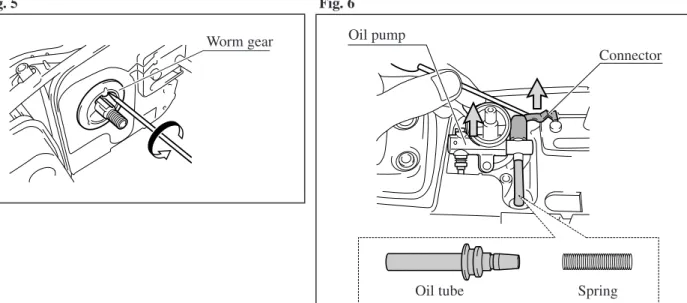
1) Remove Worm gear by turning counterclockwise with thin screwdriver. (Fig. 5) 2) Unscrew 4x18 Tapping screw, and remove Oil pump cover and Chain slider (L). 3) Remove two M4x12 Pan head screws. While levering up Connector a little bit, pull off Connector and Oil tube from Oil pump. Now Oil pump can removed. (Fig. 6)
Note: Be sure to replace Oil pump entirely by new one.
4) Check if Connector and Oil tube is cracked or clogged and if Spring (oil filter) is clogged. (Fig. 6) loosen
tighten
Flat washer 8
Fig. 5
Worm gear
Connector Oil pump
Oil tube Spring
3. Disassembly/Assembly
CAUTION: Be sure to remove gasoline and saw chain from the machine for safety before repair/ maintenance!
Refer to the instruction manual for detailed information on how to remove or adjust saw chain.
3-3. Oil Pump Section (cont.)
3-4. Adjusting the Flow of Chain Oil
Fig. 10
Fig. 11
The flow of chain oil can be adjusted by turning the adjusting screw on the bottom of the machine using the slotted screwdriver portion of Wrench 13-16 supplied.
Turn clockwise to increase the flow, and counterclockwise to decrease. (Fig. 8)
3-5. Ignition System
1) Fasten two M4x12 Pan head screws, first A then B so that Worm gear does not touch Oil pump. (Fig. 7) 2) Do not forget to set Flat washer 10 in place. (Fig. 7)
3) Install Oil pump cover and Worm gear, first Oil pump cover, then Worm gear.
4) After installation of Worm gear, make sure that Worm gear can be turned easily by hand.
1) Remove Plug cap from Spark plug. Then using circuit tester, check the electrical conduction between Plug cap spring and the ground (earth) terminal of Ignition coil complete. If the value of electrical resistance is about 7k ohms, the conduction is normal. (Fig. 9)
2) If there is no or unstable electrical resistance, check if Plug cap spring is properly connected with the ignition cable of Ignition coil complete. Lubricate the inside of Plug cap using aerosol spray lubricant, and then pull the ignition cable and Plug cap together spring out of Plug cap using pliers. (Fig. 10)
3) Check if Plug cap spring is properly connected with the ignition cable. If not, connect in the correct way as described below in 4).
Also check if Plug cap is cracked. If cracked, replace it by new one. 4) Install Plug cap spring on the ignition cable of Ignition coil complete by piercing the needle portion of the spring in the center of the cable. While taking care not to let Plug cap spring fall off the cable, grab the cable with pliers and pull the spring back into Plug cap. (Fig. 11) 5) Check if Plug cap spring is properly connected with the ignition cable of Ignition coil complete using circuit tester as described above in 1). Defective connection can cause weak or no spark at Spark plug.
INSPECTION OF PLUG CAP
Fig. 8 Fig. 7
Flat washer 10
Pan head screw M4x12
Decrease Increase
Fig. 9
Plug cap Ignition coil
complete
Ignition cable Aerosol spray
lubricant
Plug cap
Plug cap spring
Plug cap Pull with pliers. Pierce in the center
of ignition cable.
ASSEMBLY
Ground (earth) terminal
3-5. Ignition System (cont.)
3-7. Inspection/Replacement of Stop Switch
1) Remove Plug cap, and remove Spark plug with supplied Wrench 13-16. Note: If Spark plug is wet with fuel, wipe it off with a clean cloth and dry Spark plug with power blower.
2) Remove carbon deposits on the center electrode and the ground electrode of Spark plug using wire brush.
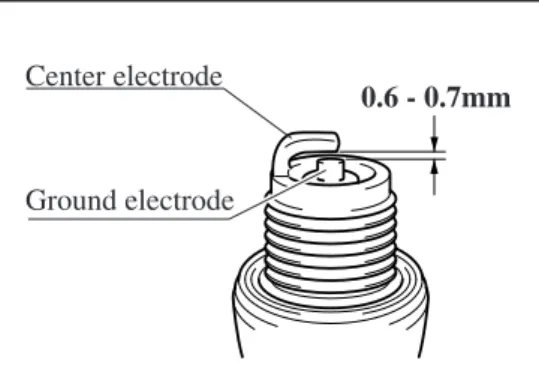
3) Adjust the spark gap to 0.6-0.7mm by inserting a 0.7mm Spark plug gauge in the spark gap. (Fig. 12)
4) Check if the spark occurs in the spark gap as described below: Install Plug cap on Spark plug, touch the threaded portion of the plug to the engine block, and then pull Recoil starter rope.
5) If no spark occurs, check the electrical conduction as described above in 1) of CHECKING PLUG CAP.
And if the conduction is normal, replace Spark plug by new one and re-check for a spark in the spark gap.
INSPECTION OF SPARK PLUG
1) Remove Top handle cover by removing four 4x18 Tapping screws. 2) Using circuit tester, check the electrical conduction between the terminals. Stop switch is normal if the terminals are not conducted with the engine turnded on and conducted with the engine turned off. (Fig. 10)
INSPECTION Fig. 15
Spark gap = the distance between the center electrode and the ground electrode
Fig. 12
0.6 - 0.7mm
Center electrode
Ground electrode
3-6. Removal/Installation of Ignition Coil Complete
1) Before removing Ignition coil complete, remove Starter case, pull Plug cap off from Spark plug and pull the ground (earth) wire off from the terminal on Ignition coil complete. (Fig. 13)
2) Remove two M4x20 Hex socket head bolts. Now Ignition coil complete can be removed. (Fig. 14)
Note: Be careful not to lose two Spacers through which the Hex socket bolts are inserted. REMOVAL
1) Put Spacers and Ignition coil complete in place, and pretighten M4x20 Hex socket head bolts. Do not tighten the bolts securely in this step. Insert a 0.3mm thickness gauge between Ignition coil complete and the magnet portion of Flywheel. Ignition coil complete will stick to the magnet portion of Flywheel. Then tighten the bolts securely.
2) Remove the thickness gauge, then turn Flywheel to make sure that Ignition coil complete does not touch Flywheel.
INSTALLATION
Fig. 14 Fig. 13
Ground (earth) wire
Ground (earth) terminal M4x20 Hex socket head bolt (2pcs)
Spacer (2pcs) Flywheel
3-7. Inspection/Replacement of Stop Switch (cont.)
3) Using circuit tester, also check the conduction between the engine block and the terminal connector of the ground (earth) wire of Ignition coil complete. (Fig. 16) At the same time, check wrong wiring, loose screws, loose connections or broken wires.1) Disconnect lead wires from Switch. Now Switch can be removed by pushing from the inside of Top handle cover. 2) Route the two lead wires (black and red) under the two fuel tube. (Fig. 17)
REPLACEMENT Fig. 17 Fig. 16
Terminal connector of the ground (earth) wire of Ignition coil
3-8. Disassembling/Assembling Flywheel
1) Flywheel can be removed easily with Impact driver without locking Piston as well as Clutch. (Fig. 18) 2) Do not remove Spark plug because Clutch is removed using compression resistance.
CAUTION: Be sure to turn off Engine stop switch
to avoid injury from accidental engine startup.
3) Attach 13mm hex socket bit to Impact driver.
Then remove Hex nut M8 by turning counterclockwise with the Impact driver. (Fig. 19)
Note: Be sure that Hex nut M8 is right-handed.
4) Remove Flywheel by hitting Crankshaft hard with Copper round bar 20-100 (1R091) and iron hammer. (Fig. 19) 5) Two Ratchets on Flywheel can be removed by removing M5x12 Hex socket button bolts with T-type hex wrench 3-127 (1R170).
DISASSEMBLING
1) Install two Torsion spring 15 on Flywheel as illustrated on Flywheel, then fasten two Ratchets to Flywheel with Hex socket button bolts. (Fig. 20)
2) Fitting the protrusion (key) on the center hole of
Flywheel to the groove in Crankshaft, assemble Flywheel to Crankshaft.
3) Set Spring washer 8 in place, then fasten Hex nut M8 to Crankshaft by turning clockwise for one second using 13mm hex socket bit and Impact driver.
ASSEMBLING
Fig. 18
Fig. 19
Fig. 20
Fuel tubes Lead wires
Turn Hex nut M8 counterclockwise.
Flywheel
3-9. Replacement of Recoil Starter Rope
Fig. 22
Fig. 23
Fig. 25 Fig. 24
1) Remove Side handle, and separate Recoil starter assembly from the machine.
2) If Recoil starter rope is connected with both Starter knob and Reel, pull Starter knob to draw the rope out of Starter case and cut it. If the rope cannot be cut, pull Starter knob to draw out the rope till Reel rotates one turn. Then hook the rope on the U-shaped notch in Reel as illustrated in Fig. 21, and turn Reel counterclockwise till Spiral spring is unwound enough.
CATION: Reel rotates very fast if you release Recoil starter rope
being pulled. Be very careful not to cut your hands.
3) Unscrew Set screw, and remove Cam and Torsion spring.
4) Remove Reel while pushing Spring case so that it does not get out of place. (Fig. 22)
5) Untie the knots at Starter knob and Reel, then remove worn rope.
DISASSEMBLING
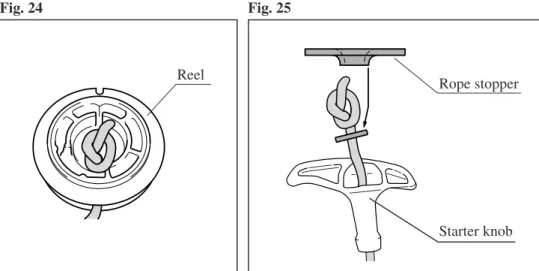
1) If Spiral spring has been removed, first put it in place. 2) Put new Recoil starter rope through Starter case. (Fig. 23) Note: When using a commercial rope, cut it to 750mm. 3) Tie knots at Reel and Starter knob as illustrated in Fig. 24, 25. Do not forget to install Rope stopper as illustrated in Fig. 25 before tying a knot at Starter knob.
Important: Rope stopper is not reversible when assembled to
Starter knob. Be sure to put it through Recoil starter rope as illustrated in Fig. 25. Failure to follow this instruction can result in broken rope.
ASSEMBLING
Fig. 21
U-shaped notch Recoil starter rope
Spring case Reel
Reel Push Spring case.
Rope stopper
Starter knob Reel
3-9. Replacement of Recoil Starter Rope (cont.)
4) Connect Reel with Spiral spring byturning clockwise while tilting it as illustrated in Fig. 26.
By rotating Reel clockwise about half a turn, Reel will move down to touch Spring case completely, indicating that it has been correctly connected with Spiral spring. Remember the point at which Reel moved down.
CATION: No force is required to connect Reel with Spiral spring. Take care not to deform Spiral spring by forcing Reel against Spiral spring.
5) Put Torsion spring and Cam in place, and fasten them securely with Set screw. (Fig. 27)
Important: Reel is not correctly connected with Spiral spring
if it does not turn smoothly after secure tightening of Set screw. Reassemble Reel to Spiral spring as described above in 4).
6) Turn Reel counterclockwise to wind up Recoil starter rope. (Fig. 28)
7) The loose portion can be eliminated from the rope by hooking the rope on the U-shaped notch in Reel, turning Reel clockwise two times, then removing the rope from the U-shaped notch. (Fig. 29)
Remark: There are two points at which Reel hooks on Spiral spring. Therefore, turn Reel so that it moves down to touch Spring case at the same position as it did at first in 4).
Fig. 26
Spiral spring
[Start of connecting]
[Correctly connected]
Take care not to hook this portion on Spiral spring.
Tilt down Reel so that this portion can be hooked on Spiral spring.
Put in place without being caught by Spiral spring
Lift up this portion so that it cannot touch Spiral spring.
Hooked on Spiral spring
Fig. 27
Fig. 28
Fig. 29
3-9. Replacement of Recoil Starter Rope (cont.)
1) Fix the straight end of Spiral spring in the small hole on Spring case as illustrated in Fig. 30.
Then set Spiral spring in Spring case by winding up clockwise. (Fig. 31) 2) Spiral spring is factory-lubricated with red grease. However, you may use Makita grease N No. 2 when repairing. Apply a little amount.
Fig. 30
Fig. 31
Spring case
If Spiral Spring Gets Out of Spring Case
Spiral spring
small hole
3-10. Disassembling/Assembling Carburetor
1) Remove Cleaner case cover.
2) Remove Choke lever by unscrewing PT3x10 Tapping screw using slotted screwdriver. (Fig. 32)
3) Remove two M5x45 Pan head screws that fasten Cleaner case and Carburetor. Then remove Cleaner case. (Fig. 33)
Note: If the pan head screws are left on Cleaner case, Cleaner case cannot be removed. Be sure to remove the pan head screws from Cleaner case before separating Cleaner case from the engine block.
4) Remove two tubes, then while tilting Carburetor so that it does not touch Throttle wire, separate Carburetor from the engine block. (Fig. 34)
REMOVING FROM ENGINE BLOCK Fig. 32
Fig. 33
Fig. 34
Choke lever slotted screwdriver
M5x45 Pan head screw
Throttle wire
3-10. Disassembling/Assembling Carburetor (cont.)
1) Remove Diaphragm cover and Diaphragm gasket set by unscrewing four Pan head screws.
Note: If Gasket is sticking, carefully remove it because it is easily broken.
2) Replace Metering diaphragm if it shows any sign of wear, wrinkles, curling or tears.
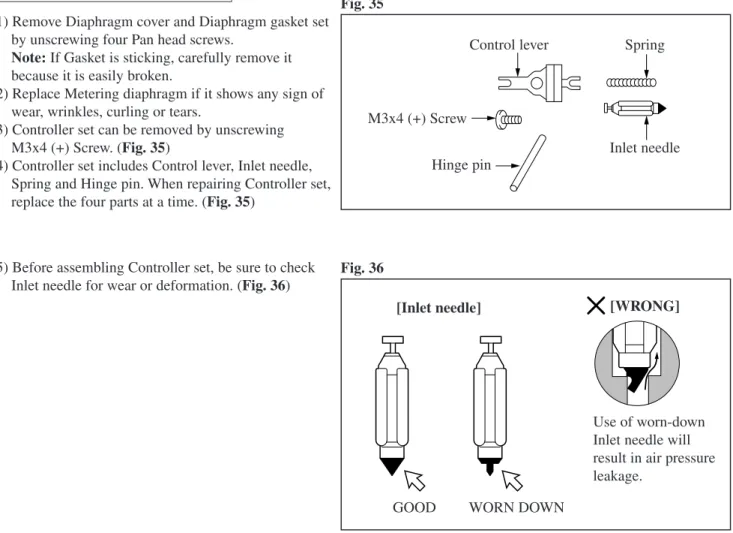
3) Controller set can be removed by unscrewing M3x4 (+) Screw. (Fig. 35)
4) Controller set includes Control lever, Inlet needle, Spring and Hinge pin. When repairing Controller set, replace the four parts at a time. (Fig. 35)
Fig. 35 DISASSEMBLING & CLEANING
Control lever Spring
Inlet needle M3x4 (+) Screw
5) Before assembling Controller set, be sure to check Inlet needle for wear or deformation. (Fig. 36)
Hinge pin
Fig. 36
6) When installing Control lever, make sure that the upper end of Spring is correctly placed over the protrusion of Control lever. (Fig. 37)
[Inlet needle]
GOOD WORN DOWN
Use of worn-down Inlet needle will result in air pressure leakage.
Fig. 37
Control lever
[WRONG]
Metering diaphragm
Inlet needle Control lever
[CORRECT]
[WRONG] [WRONG]
Dust or debris on the valve seat will result in air pressure leakage.
The upper end of Spring is not placed over the protrusion of Control lever.
3-10. Disassembling/Assembling Carburetor (cont.)
7) Before removing two Pan head screws, tighten the idling screw on (A) to the full. (Fig. 38) 8) Before installing Strainer, ensure that it is not clogged with dust, dirt or debris. (Fig. 38)
9) Clean up the drainages in Carburetor first by spraying commercial carburetor cleaner and then, several minutes after, by washing with gasoline.
3-11. Testing Air Tightness of Carburetor
Connect Air tightness tester (No.1R127) to the nipple (the fuel suction port), and increase the pressure of the tester up to 0.05Mpa.Air tightness is normal if the tester keeps on indicating 0.05Mpa about ten seconds. (Fig. 40)
1) Referring to Fig. 38, assemble Carburetor. 2) Install (A) so that the choke adjuster is placed on the opposite side to the tube ports. (Fig. 39)
Fig. 38
Throttle holder
[Exploded View of Carburetor]
Pan head screw (2pcs)
(A)
Pan head screw (4pcs)
Strainer
O ring 15 Controller set
Gasket
Gasket Metering
diaphragm Pump
diaphragm
Diaphragm cover
ASSEMBLING Fig. 39
Choke adjuster
Tube ports
Fig. 40
Air tightness tester (1R127)
3-12. Assembling Parts in Handle
1) Hook the longer leg of Torsion spring 11 in the three protrusions on Lock-off lever. (Fig. 41) 2) Hook the other end of Torsion spring 11 on Throttle lever. (Fig. 42)
3) Insert Rod into Throttle lever as illustrated in Fig. 43.
Fig. 43 Fig. 42
Fig. 41
Torsion spring 11
Torsion spring 11 Lock-off lever
Throttle lever
Rod
3-13. Routing Tubes
1) Route Tubes as illustrated in Fig. 44. 2) Install Gasoline filter on the end of the fuel suction tube, which will be placed in the fuel tank.
Connect Tube 3-140 with the fuel suction tube using Tube joint. (Fig. 44) 3) On the top of Housing, route Tubes as illustrated in Fig. 45, 46.
3-14. Removing/Disassembling/Assembling Engine Block
Fig. 46 Fig. 45
Fig. 50 Fig. 48 Fig. 49
Fig. 44
Gasoline filter Fuel suction tube Tube 3-140
Tube joint Primer
pump
Top handle
[Around the fuel tank]
Fuel suction tube
Fuel suction tube Place the two tubes
parallel to one another. Ensure that the fuel suction tube is placed inside.
Then insert the tubes into the fuel tank.
[On the top of Housing]
Be sure to place the fuel suction tube inside so that it does not touch the hex socket head bolt which will be very hot from the heat of the engine.
1) Proceed to disassemble the machine until the following parts are removed; Spark plug, Clutch complete, two M4x12 Pan head screws (used for fastening Oil pump), Exhaust muffler complete, Starter case complete, Ignition coil complete, Flywheel, Carburetor
2) Insert T-type Hex Wrench 3-127 (No. 1R170) from the through hole near the hole for the Carburetor fastening screw. And then loosen two M4x14 Hex socket head bolts that fasten Insulator. (Fig. 47)
3) Remove Damper spring and 4x18 Tapping screw that fastens Top handle to Housing complete. (Fig. 48)
4) Release Top handle from Housing by pulling Air duct from the Ignition coil installation side. (Fig. 49)
5) Raise the rear end of Top handle by pivoting on the front end, and remove two M4x14 Hex socket head bolts that fasten Insulator.
Be careful not to lose the two bolts. (Fig. 50)
6) Using Impact driver and 1R229 (or 1R171), remove four M5x20 Hex socket head bolts from the top and the bottom of the Engine block. Now Engine block can be removed from the left side of Housing.
REMOVAL
Fig. 47
1R170
Damper spring
Fig. 52 Fig. 53
3-14. Removing/Disassembling/Assembling Engine Block (cont.)
1) Separate Crank case from Cylinder by removing four M5x20 Hex socket head bolts.
If cannot be separated because of the adhesive, remove by hitting the both ends of Crankshaft alternately with plastic or wooden hammer. Be careful not to let Crankshaft tilt too much at this time. Cylinder can be damaged. (Fig. 51)
Now you can replace Oil seals on the ends of Crankshaft and two Piston rings on Piston.
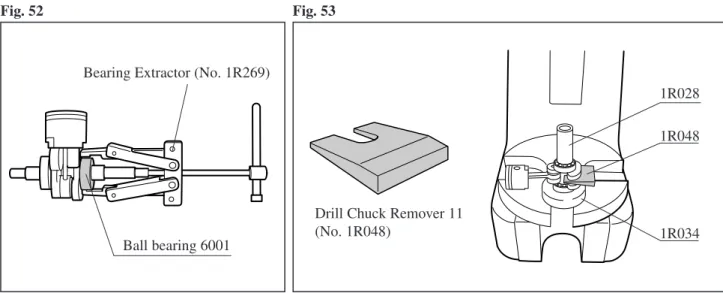
2) Remove Ball bearing 6001 using Bearing Extractor (No. 1R269). (Fig. 52)
Note: When press-fitting Ball bearing 6001, insert Drill Chuck Remover 11 (No. 1R048) between Crankshaft (R) and (L) in order not to deform the bearing. (Fig. 53)
3) Pull off Piston clip from Piston pin while turning in the loosening direction using pliers. (Fig. 54)
DISASSEMBLING
Fig. 51
Crankshaft
Bearing Extractor (No. 1R269)
Drill Chuck Remover 11 (No. 1R048)
Ball bearing 6001
1R028 1R048
1R034
Fig. 53
4) Push Piston pin out of Piston by pushing from the opposite side using T-type Hex Wrench 4-130 (No. 1R171) or the like. (Fig. 55) 5) Now Needle gauge 8 can be extracted from Connecting rod for replacement. When replacing Piston, replace two Piston clip at a time.
Fig. 55
Piston clip
Piston clip
1R171
3-14. Removing/Disassembling/Assembling Engine Block (cont.)
1) Assemble Piston so that the triangular marking on its top is placed on the exhaust muffler installation side (the longer Crankshaft side). (Fig. 56)
2) Piston ring is not reversible when assembled to Piston. Adjusting the end-gap of Piston ring fit in the groove of Piston; first the lower Piston ring, then the upper one. (Fig. 57)
Caution:
1) Because Piston ring is easily broken, take care
not to expand excessively when installing new one.
2) When inserting Piston into Cylinder, be very careful with the position of the end-gap of Piston ring, never placing Piston ring over the knock pin. It will result in broken Piston ring to force Piston into Cylinder with the ring placed over the knock pin.
3) Crankshaft is not reversible when assembled to Cylinder. Place it so that the longer shaft faces the Exhaust muffler installation side. (Fig. 58) 4) Apply "Three bond 1215" to the matching surface between Crankcase and Cylinder; it is enough to apply the adhesive only to the shaded portion of Crankcase.
And then aligning the protrusion on Crankcase with one on Cylinder as illustrated in Fig. 59, assemble them together.
ASSEMBLING
Fig. 56
Fig. 57
Fig. 58
Fig. 59
triangular marking
Crankshaft, longer
Knock pin Piston ring
[WRONG]
[WRONG] [CORRECT]
Crankshaft, longer
Crankcase Cylinder Exhaust muffler installation side matching surface
to apply "Three bond 1215"
Crankcase Cylinder
3-15. Disassembling/Assembling Kickback Brake System
1) Release Brake band (Hand guard cover) by pulling Front hand guard as illustrated in Fig. 60. 2) If Sprocket cover is assembled to the machine, separate by loosening Collared hex nut M8 with supplied Wrench 13-16.
3) Remove Spring cover and Chain slider (R) from Sprocket cover Fig. 61.
4) Grasp the rear end of Compression spring 9 with Retaining ring pliers ST-2N (No. 1R003), and pull it off from Link plate complete. (Fig. 62)
Note: Use Retaining ring pliers ST-2N (No. 1R003) when grasping or tightening parts in the following disassembling/assembling steps. 5) Remove Compression spring 6.
DISASSEMBLING
1) Set all parts except Compression spring 9 in place of Sprocket cover by doing the reverse of the assembling steps. 2) Grasp the rear end of Compression spring 9 with Retaining ring pliers ST-2N (No. 1R003), and then it put through Link plate complete while levering up Link plate complete as illustrated in Fig. 64.
3) Put Compression spring 9 in Sprocket cover as follows; First, compress one end of the spring with one jaw of the pliers put in the first through hole in Link plate complete other put around the fourth winding of the spring. Then push down the other end of the spring. (Fig. 65) 4) Install Spring cover, and fasten Brake band (Hand guard cover) with 4x12 Tapping screws.
Then move Front hand guard to make sure that it works properly.
ASSEMBLING
Fig. 62
6) Grasp the Front hand guard section together with Compression spring 9, and pull them off from the machine. (Fig. 63)
7) When removing Brake band (Hand guard cover), unscrew two 4x12 Tapping screws.
Fig. 63
Fig. 61 Fig. 60
Front hand guard
Chain slider (R)
1R003
Compression spring 9 Link plate
complete
Link plate complete Front guard
section
Fig. 64
Fig. 65
Push down this end. Compress this end.
3-16. Miscellaneous Remarks
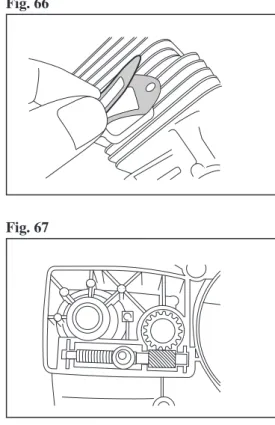
[1] Do not reuse Gaskets between Exhaust muffler and Cylinder. Always use new one for replacement. (Fig. 66)
4. Adjustment
See Instruction manual for adjustment of idling settings and saw chain tension. [2] If any sawdust or debris in the saw chain tensioner in Sprocket cover, blow it out using power blower or the like. (Fig. 67)
Fig. 67 Fig. 66
C
ircuit diagram
Switch
Ignition coil complete
Insulated connector
Body earth
Receptacle
Color index of lead wires' sheathBlack Red
Switch
Receptacle
Lead wire (black)
Lead wire (red)
W
iring diagram
Top handle cover
Connect the lead wires (red, black)
with the terminals of switch before
assembling the switch to the top
handle cover.
Switch
Top handle cover
Assemble the switch to the top handle cover
so that the rib on the top handle cover is
positioned between the terminals of the switch.
Fix the lead wires with
this lead wire holder.
Lead wires
W
iring diagram
Top handle cover Route the lead wires through
the space (the shaded portion) between the main housing and the top cover.
Top cover Main housing
Lead wires
Tubes
Pins
Body earth
Inside wall
Route the lead wires under the tubes.
Route the lead wires and the tubes between the pins and the inside wall.
Fix the tubes with the lead wire holders. Fix the lead wires with
Lead wire
W
iring diagram
Baffle plate Route the lead wire through
the space (the shaded portion) between the main housing and the baffle plate.
Main housing
Inside wall Pin
Route the lead wire under the tubes. Route the lead wire
between the pin and the inside wall.
Assemble the insulated receptacle to the ignition coil complete as illustrated here.
Fix the lead wire with the lead wire holder.
Tube Lead wire