English grammar,
punctuation and spelling
Mark schemes
Key stage 1
SAMPLE BOOKLET
Published July 2015
This sample test indicates how the national curriculum will be assessed from 2016.
Further information is available on GOV.UK at
www.gov.uk/sta
.
[BLANK PAGE]
Contents
1. Introduction
4
2. Structure of the key stage 1 English grammar, punctuation and spelling test 4
3. Content domain coverage
4
4. Internal moderation procedures
5
5. Paper 1: spelling
5
5.1 Content domain coverage for Paper 1: spelling
5
5.2 General guidance on marking Paper 1: spelling
5
5.3 Pupil version of Paper 1: spelling
6
6. Mark schemes for Paper 1: spelling
7
7. Paper 2: questions
8
7.1 Content domain coverage for Paper 2: questions
8
7.2 General guidance on marking for Paper 2: questions
9
7.3 Explanation of the mark schemes for Paper 2: questions
11
1. Introduction
The Standards and Testing Agency (STA) is responsible for the development and delivery of statutory tests and assessments. STA is an executive agency of the Department for Education. The 2014 national curriculum will be assessed for the first time in May 2016. The sample test and mark schemes set out how the new national curriculum will be assessed from 2016 onwards. This test has been developed to meet the specification set out in the test framework for English grammar, punctuation and spelling at key stage 1. The test frameworks are on the GOV.UK website at www.gov.uk/sta.
A new test and mark scheme will be developed each year.
The key stage 1 tests will be marked internally by teachers to inform teacher assessment. Scaled score conversion tables are not included in this document. Conversion tables are produced as part of the standard-setting process. As the sample tests are not subject to standard setting, they are not available for these tests. Scaled score conversion tables for the 2016 tests will be published at www.gov.uk/sta in June 2016.
A variety of questions has been included in this sample test to demonstrate the formats and curriculum content that pupils may encounter in a live test. A commentary is provided in the mark scheme that accompanies each question.
This sample test mark scheme is provided to give teachers an indication of how to mark the tests. The mark schemes for the sample tests have been subject to a shorter process than the full, rigorous development process that is used for live mark schemes. The pupil examples are based on responses gathered from the test trialling process.
The sample test and mark schemes have been reviewed by teachers and other expert reviewers.
2. Structure of the key stage 1 English
grammar, punctuation and spelling test
The key stage 1 English grammar, punctuation and spelling test materials comprise: • Paper 1: spelling (20 marks)
• Paper 2: questions (20 marks)
3. Content domain coverage
The sample test meets the specification set out in the test framework. Tables 1 and 2 set out the areas of the content domain that are assessed in sample test papers 1 and 2.
4. Internal moderation procedures
We recommend teachers involved in marking the key stage 1 tests undertake moderation activity to ensure marking is consistent across their school. Guidance is published on the GOV.UK website at www.gov.uk/sta.
5. Paper 1: spelling
5.1 Content domain coverage for Paper 1: spelling
This information is provided in the mark scheme in Table 1.
5.2 General guidance on marking Paper 1: spelling
The following guidance applies to all questions in Paper 1. Please read this carefully before applying the individual mark schemes.
• If the pupil makes more than one attempt, it must be clear which answer the pupil wishes to be marked. If the pupil makes two or more attempts and it is not clear which is to be considered, you must not award the mark.
• The pupil can answer in upper or lower case, or a mixture of the two. The exception to this is for days of the week and months of the year, which must be written in lower-case letters with an initial capital letter for the award of the mark.
• If the pupil has answered with the correct sequence of letters but has incorrectly inserted an apostrophe or hyphen, you must not award the mark.
• If the pupil has answered with the correct sequence of letters but these have been separated into clearly divided components, with or without a dash, you must not award the mark.
5.3 Pupil version of Paper 1: spelling
Page 02 of 04Spelling
P. There was a big
in the gar
den. 1. Hannah r an than Lee. 2. Yester
day it was v
ery
.
3.
I had a big smile on my
.
4.
Ther
e was a large
of childr
en at the par
ty.
5.
You pick things up with your
.
6.
The
in the box ar
e dif
fer
ent colours.
7.
Our new
is black with white paws.
8.
I
my friend for her help.
9.
W
e ar
e going on holiday on
.
10.
I am not allowed to eat too many
. Page 03 of 04 END OF SPELLING TEST 11. My gr andad was a cake. 12. The childr en
all of the wor
ds.
13.
Our class built a
fr
om clay.
14.
A
can hold its br
eath for two hours.
15.
The musician gav
e concer
ts all ov
er the
.
16.
Dad
to meet the childr
en.
17.
A r
ose
fell to the gr
ound.
18.
I saw a beautiful
.
19.
The school gar
den is a
place to sit.
20.
Susan had a large collection of
6. Mark schemes for Paper 1: spelling
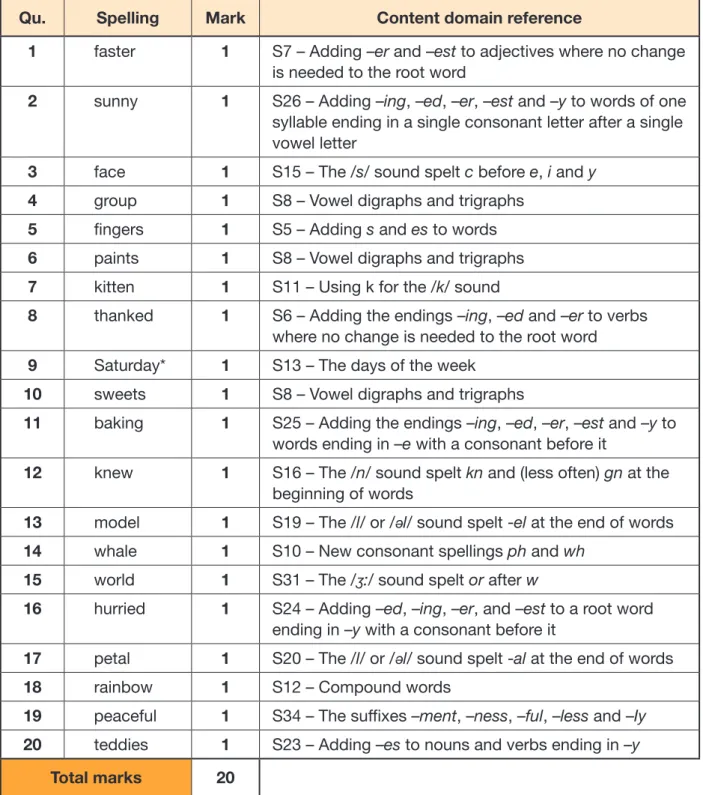
Information relating to the content domain reference codes can be found in the key stage 1 English grammar, punctuation and spelling test framework.Table 1: mark schemes and content domain references for Paper 1
Qu. Spelling Mark Content domain reference
1 faster 1 S7 – Adding –er and –est to adjectives where no change is needed to the root word
2 sunny 1 S26 – Adding –ing, –ed, –er, –est and –y to words of one syllable ending in a single consonant letter after a single vowel letter
3 face 1 S15 – The /s/ sound spelt c before e, i and y
4 group 1 S8 – Vowel digraphs and trigraphs
5 fingers 1 S5 – Adding s and es to words
6 paints 1 S8 – Vowel digraphs and trigraphs
7 kitten 1 S11 – Using k for the /k/ sound
8 thanked 1 S6 – Adding the endings –ing, –ed and –er to verbs where no change is needed to the root word
9 Saturday* 1 S13 – The days of the week
10 sweets 1 S8 – Vowel digraphs and trigraphs
11 baking 1 S25 – Adding the endings –ing, –ed, –er, –est and –y to words ending in –e with a consonant before it
12 knew 1 S16 – The /n/ sound spelt kn and (less often) gn at the beginning of words
13 model 1 S19 – The /l/ or /əl/ sound spelt -el at the end of words
14 whale 1 S10 – New consonant spellings ph and wh
15 world 1 S31 – The /ʒ:/ sound spelt or after w
16 hurried 1 S24 – Adding –ed, –ing, –er, and –est to a root word ending in –y with a consonant before it
17 petal 1 S20 – The /l/ or /əl/ sound spelt -al at the end of words
18 rainbow 1 S12 – Compound words
19 peaceful 1 S34 – The suffixes –ment, –ness, –ful, –less and –Iy
20 teddies 1 S23 – Adding –es to nouns and verbs ending in –y
Total marks 20
*Days of the week and months of the year must be written with an initial capital letter. See guidance in section 5.2.
7. Paper 2: questions
7.1 Content domain coverage for Paper 2: questions
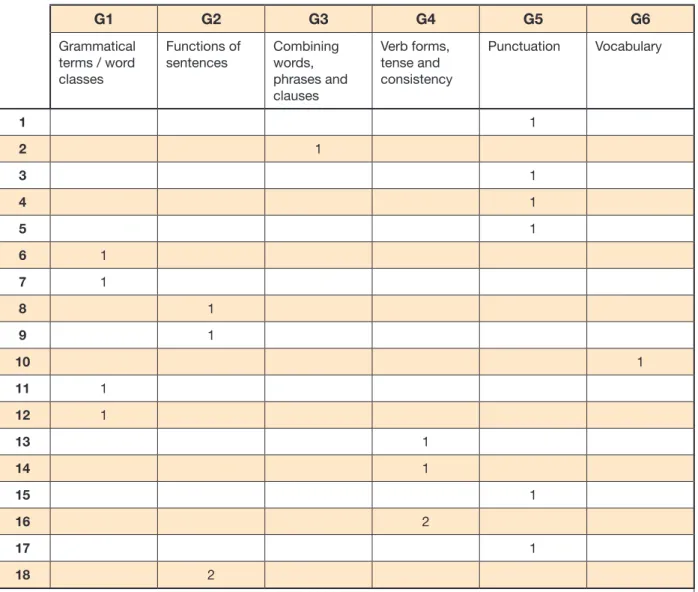
Table 2 sets out the content domain coverage for Paper 2. Information relating to these codes can be found in the key stage 1 English grammar, punctuation and spelling test framework.
Table 2: Content domain coverage for Paper 2
G1 G2 G3 G4 G5 G6
Grammatical terms / word classes
Functions of
sentences Combining words, phrases and clauses
Verb forms, tense and consistency
Punctuation Vocabulary
1 1
2 1
3 1
4 1
5 1
6 1
7 1
8 1
9 1
10 1
11 1
12 1
13 1
14 1
15 1
16 2
17 1
7.2 General guidance on marking for Paper 2: questions
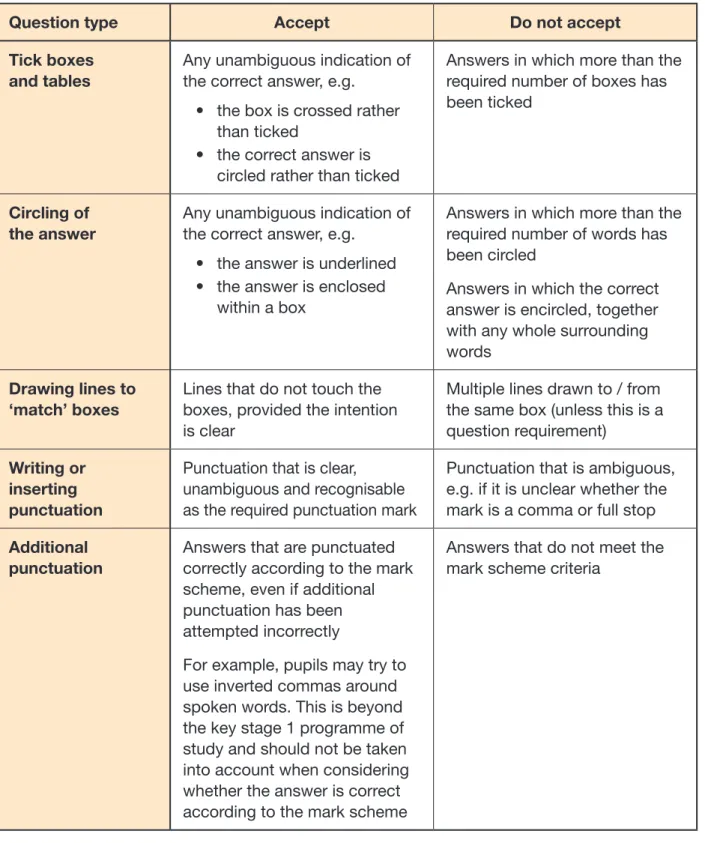
The following guidance applies to all questions in Paper 2. Please read this carefully before applying the individual mark scheme entries.
Table 3: General guidance for Paper 2
Question type Accept Do not accept Tick boxes
and tables
Any unambiguous indication of the correct answer, e.g.
• the box is crossed rather than ticked
• the correct answer is circled rather than ticked
Answers in which more than the required number of boxes has been ticked
Circling of the answer
Any unambiguous indication of the correct answer, e.g.
• the answer is underlined • the answer is enclosed
within a box
Answers in which more than the required number of words has been circled
Answers in which the correct answer is encircled, together with any whole surrounding words
Drawing lines to ‘match’ boxes
Lines that do not touch the boxes, provided the intention is clear
Multiple lines drawn to / from the same box (unless this is a question requirement)
Writing or inserting punctuation
Punctuation that is clear, unambiguous and recognisable as the required punctuation mark
Punctuation that is ambiguous, e.g. if it is unclear whether the mark is a comma or full stop
Additional punctuation
Answers that are punctuated correctly according to the mark scheme, even if additional punctuation has been attempted incorrectly
For example, pupils may try to use inverted commas around spoken words. This is beyond the key stage 1 programme of study and should not be taken into account when considering whether the answer is correct according to the mark scheme
Answers that do not meet the mark scheme criteria
Question type Accept Do not accept Spelling (in Paper
2 only)
Where no specific mark scheme guidance is given, incorrect spellings of the correct answer should be accepted
Incorrect spellings of answers for which the mark scheme requires correct spelling Correct spelling is generally required for questions assessing contracted forms, plurals, verb tenses, prefixes and suffixes
Answers outside the expected space
A correct answer given somewhere other than the answer space, providing it is not contradicted by another answer written elsewhere
Correct answers that are written in the ‘blank’ within a question, rather than in the expected space below it
Correct answers in which the pupil has written out a word or sentence that is already provided
Answers that are given outside the expected space and
contradicted by another answer written elsewhere
More than one answer given
Multiple answers that are all correct according to the mark scheme
Both correct and incorrect responses given
Handwriting Answers that are clear,
unambiguous and recognisable
Answers that are unclear or ambiguous
Crossed-out answers
Correct answers that have not been crossed out
Correct answers that replace a crossed-out attempt
Crossed-out answers, whether or not these have been replaced by a further attempt
7.3 Explanation of the mark schemes for Paper 2: questions
Teachers should familiarise themselves with the marking guidance in section 7.2 of this document before applying the mark schemes that follow.
The mark schemes contain the following information for each question: • a question number
• the question from the test paper
• what is required to answer each question – either a correct answer or examples of different types of creditworthy response
• how many marks are available for this question • any additional guidance that may be relevant • the content domain reference.
The commentary has been added to the sample test mark scheme to provide an explanation of how the new national curriculum is assessed through the key stage 1 English grammar, punctuation and spelling test.
Qu Requirement Mark
1 Write the missing punctuation mark to complete the sentence below.
Award 1 mark for the correct insertion of a question mark.
Can you play my favourite tune?
1m
Content domain: G5.3 – question marks
2 Tick the correct word to complete the sentence below.
I hope __________ we will play musical chairs at the party.
Award 1 mark for the correct box ticked. when
if
that ✓
because
1m
Content domain: G3.4 – subordinating conjunctions
Commentary: This is an example of a typical multiple-choice question, in which the pupil is asked to tick one of the options. Answers marked in alternative ways, e.g. with a cross, or written into the sentence, can also be marked as correct.
3 Tick one box to show where a comma should go in the sentence below.
Award 1 mark for the correct box ticked.
Aisha found some red blue and purple beads in the box.
1m
Content domain: G5.5 – commas in lists
Commentary: This question format, with tick boxes below the target sentence, is sometimes used for questions that ask where a punctuation mark should be inserted.
One has been done for you.
Award 1 mark for all three matched correctly.
I will it’s
you have I’ll
it is didn’t
did not you’ve
Content domain: G5.8 – apostrophes to mark contracted forms
Commentary: This is an example of a matching question. In this representation, one has been completed as an example for pupils. This may not always be the case.
5 Look at where the arrow is pointing.
The children went home Josh had enjoyed his party.
Which punctuation mark is missing?
Award 1 mark for the correct box ticked. comma
question mark apostrophe
full stop ✓
1m
Content domain: G5.2 – full stops
Commentary: Although pupils are asked to tick the box to show their answer, the mark should also be awarded if a full stop is inserted in the correct place in the sentence.
6 What type of word is underlined in the sentence below?
Poppy held the baby rabbit gently in her arms.
Award 1 mark for the correct box ticked. an adjective
an adverb ✓
a noun a verb
1m
The brave mouse marched up to the lion.
Award 1 mark for the correct box ticked. an adverb
an adjective ✓
a verb a noun
Content domain: G1.3 – adjectives
Commentary: The wording of this question is different from question 6, which has a similar format. The test uses a variety of ways to phrase similar questions.
8 Read the sentences below.
Growing Beans
Place some damp cotton wool in a jar.
Push a bean seed down against the side of the jar. Wait for the bean seed to sprout.
Tick the word that best describes these sentences.
Award 1 mark for the correct box ticked. statements
questions
commands ✓
exclamations
1m
Content domain: G2.3 – commands
9 Tick the sentence that is a statement.
Award 1 mark for the correct box ticked. What an interesting painting!
Can you collect the crayons, please? James washed the paintbrushes. ✓
Check that your tables are clean.
1m
Content domain: G2.1 – statements
Commentary: Questions 8 and 9 appear in this sample test in order to show the variety of question formats that might be used.
Award 1 mark for three correct suffixes added. foxes
cards
matches
Do not accept responses that are misspelt or that contain apostrophes.
Content domain: G6.3 – Regular plural noun suffixes –s or –es
Commentary: Responses must be spelt correctly for the award of the mark in questions assessing suffixes. Although pupils are asked to write their answers in the spaces provided, the mark should also be awarded if the word is written out again, with the correct plural ending added.
11 Circle the three nouns in the sentence below.
Award 1 mark for all three identified.
A whale has an enormous heart that can weigh as much as a small car.
1m
Content domain: G1.1 – nouns
Commentary: The word ‘three’ is emboldened in this question, whereas ‘verbs’ is emboldened in question 12. Emboldening of the terminology usually takes precedence, except in cases such as this where pupils are asked to identify more than one of something.
12 Circle the verbs in the sentence below.
Award 1 mark for both verbs identified.
Yesterday was the school sports day and Jo wore her new running shoes.
1m
Content domain: G1.2 – verbs
Commentary: This question requires pupils to circle their answers. The response should be marked as incorrect if any additional words are circled. Do not accept responses in which running is circled, since it acts as an adjective in this sentence.
13 Tick the sentence that is correct.
Award 1 mark for the correct box ticked. Adam saw his friend in the park and wave. Adam saw his friend in the park and waved. ✓
Adam sees his friend in the park and wave. Adam sees his friend in the park and waved.
1m
Award 1 mark for all three correct.
Sentence Past tense Present tense
Becky was thinking. ✓
I am reading my book. ✓
Jo is going for a walk. ✓
Content domain: G4.1d – present and past progressive
Commentary: Table completion questions are one of the formats that will be used in the test. Usually, pupils will be asked to put one tick in each row.
15 Why do the underlined words start with a capital letter?
King Fred had a party at Greystone Palace on Sunday afternoon.
Award 1 mark for responses that explain that the words start with a capital letter because they are names, e.g.
• they are names
• because they are names
• every name starts with a capital letter
• King Fred / Greystone Palace / Sunday is a name
Also award 1 mark for responses that refer to the words being proper nouns, e.g.
• they are proper nouns
Do not accept general responses or those referring to other uses of capital letters, e.g.
• because they are important
• king is the first word in the sentence
1m
Content domain: G5.1 – capital letters
Commentary: Examples of pupils’ responses are written in italics and preceded with a bullet point. Responses that meet the criteria but use different phrasing should also be marked as correct.
Use of the term ‘proper noun’ is not an expectation at the end of key stage 1, but if pupils give it as their answer, the mark should be awarded.
Pupils are not expected to write full sentences or with correct spelling and punctuation for questions that ask for an explanation.
Write these verbs in the past tense. One has been done for you.
When my family visited the zoo,
I photos with my new camera.
Award 1 mark for: • took
Also accept:
• had taken
• was taking
My brother for his picture.
Award 1 mark for:
• smiled
Also accept:
• had smiled
• was smiling
Do not accept responses that are spelt incorrectly.
2m
Content domain: G4.1a – simple past and simple present
Commentary: This question has been included as an example of an open response format. Pupils are expected to write their answers on the lines. Correct spelling is required for questions assessing verb tenses. Past perfect verb forms are not in the key stage 1 programme of study, but examples are included here as the mark should be awarded if pupils give them as their answer.
visits
take
____________ going to the shops soon.
Award 1 mark for: • I’m
Do not accept: i’m
Do not accept responses that are spelt incorrectly.
Content domain: G5.8 – apostrophes (contraction)
Commentary: Correct spelling and correct placement of the apostrophe are required in questions
assessing contracted forms. The pronoun ‘I’ must be written with a capital letter. The apostrophe must be clear and unambiguous for the award of the mark; this is the case with all punctuation marks required in a pupil’s response.
18 Joe wanted to buy a present. He asked his mum if Gran would like flowers.
Write Joe’s question to his mum in the speech bubble. Remember to use correct punctuation.
Award 2 marks for an appropriate question that starts with a capital letter and ends with a question mark, e.g.
• Would Gran like some flowers?
• Can I buy my granny some flowers?
• Would she like flowers?
• Mum, can I get some flowers?
Also accept responses that use capital letters incorrectly for Gran / my gran or have incorrect internal punctuation.
Award 1 mark for an appropriate question that does not start with a capital letter and / or that does not end with a question mark, e.g.
• would Gran like some flowers?
• Can I buy Gran some flowers.
• should I buy flowers for my gran
Up to 2m
Content domain: G2.2 – questions
Commentary: This is an example of a multi-mark open response question, in which pupils are expected to meet multiple criteria in order to gain maximum marks. It is expected that there will be only one or two of this type of question in each test. Examples of pupils’ responses are written in italics and preceded with a bullet point. Responses that meet the criteria but use different phrasing should also be marked as correct. Correct spelling is not required for the award of the mark. Although correct sentence punctuation is required for the award of both marks, pupils are not required to use capital letters correctly for Gran / my gran or correct internal punctuation, as this is beyond the programme of study. Answers that use inverted commas should also be accepted according to the mark scheme criteria, whether or not these are used correctly.
[BLANK PAGE]
© Crown copyright and Crown information 2015
Re-use of Crown copyright and Crown information in test materials
Subject to the exceptions listed below, the test materials on this website are Crown copyright or Crown information and you may re-use them (not including logos) free of charge in any format or medium in
accordance with the terms of the Open Government Licence v3.0 which can be found on the National Archives website and accessed via the following link: www.nationalarchives.gov.uk/doc/open-government-licence. When you use this information under the Open Government Licence v3.0, you should include the following
attribution: ‘Contains public sector information licensed under the Open Government Licence v3.0’ and where possible provide a link to the licence.
Exceptions – third-party copyright content in test materials
You must obtain permission from the relevant copyright owners, as listed in the ‘2016 sample tests copyright report’, for re-use of any third-party copyright content which we have identified in the test materials, as listed below. Alternatively you should remove the unlicensed third-party copyright content and/or replace it with appropriately licensed material.
Third-party content
These materials contain no third-party copyright content.
If you have any queries regarding these test materials contact the national curriculum assessments helpline on 0300 303 3013 or email [email protected].