Factorial and Construct
Validity of the Sibling
Relationship Questionnaire
Marleen M. S. Derkman, Ron H. J. Scholte, William M. Van der Veld,
and Rutger C. M. E. Engels
Radboud University Nijmegen, The Netherlands
Abstract.The psychometric properties of the shortened version of the Sibling Relationship Questionnaire (SRQ; Furman & Buhrmester, 1985) were examined in a sample of 428 Dutch adolescents, aged 13 to 16. In order to examine the dimensions Warmth/Closeness and Conflict, as proposed by Furman and Buhrmester, we first conducted confirmatory factor analyses. Second, we investigated the construct validity by correlating Warmth/Closeness and Conflict with internalizing and externalizing behaviors and the quality of relationship with parents. Third, we determined the internal reliability of Warmth/Closeness and Conflict and the underlying qualities by computing Cronbach’sαs. The results confirmed the dimensions Warmth/Closeness and Conflict as major aspects of sibling relationships. Moreover, the construct validity of the instrument and internal consistency for these dimensions and the underlying qualities proved to be good. Our findings underscore the psychometric properties of the SRQ, in that it appears to be a valid and reliable measure to assess Warmth/Close-ness and Conflict in sibling relationships.
Keywords:SRQ, CFA, validity, internalizing and externalizing behaviors
In adolescents’ daily lives, siblings play important roles. In fact, sibling relationships are often among an individual’s longest lasting relationships. According to Blyth, Hill, and Smith Thiel (1982), more than two-thirds of adolescents with siblings listed their siblings as significant persons in their lives and, on average, 77% of adolescents’ siblings were listed as important persons. Moreover, siblings rated each other as important sources of companionship, intima-cy, and nurturance (Lempers & Clark-Lempers, 1992). So, by being an influential role model, and a source of help, emotional support, and companionship, siblings might have major and unique effects on each other’s development (Furman & Buhrmester, 1985). Therefore, sibling relation-ships might be significant in predicting adolescents’ emo-tional and behavioral adjustment (Noller, 2005).
To assess aspects of the sibling relationship, Furman and Buhrmester (1985) developed the Sibling Relationship Questionnaire (SRQ), which has been applied in a number of studies (e.g., Richmond, Stocker, & Rienks, 2005; Stocker, Burwell, & Briggs, 2002; Van der Vorst, Engels, Meeus, Dekovi2, & Van Leeuwe, 2007). However, there is
little research on the factorial and construct validity of the SRQ. Therefore, in this study, we aimed to test the theoret-ical model underlying the SRQ by conducting confirmatory factor analyses (CFA) and examining its construct validity and internal reliability.
Warmth and Conflict
Warmth and conflict are basic aspects to describe sibling relationships (e.g., Kim, McHale, Osgood, & Crouter, 2006; Scharf, Shulman, & Avigad-Spitz, 2005) or to pre-dict adjustment in adolescence (e.g., Kim, McHale, Crou-ter, & Osgood, 2007; Stocker, 1994; Stocker et al., 2002). Warmth and conflict were also used to investigate sibling relationship trajectories in adolescence (e.g., Feinberg, Mc-Hale, Crouter, & Cumsille, 2003) and to assess the quality of sibling relationships (e.g., Richmond et al., 2005). These studies indicate that warmth and conflict represent impor-tant aspects of the quality of sibling relationships and, giv-en their importance, we focused on these two aspects in the present study.
Furman and Buhrmester’s study (1985) indicates that the dimension Warmth/Closeness consists of seven underlying qualities (i.e., Intimacy, Prosocial Behavior, Companion-ship, Affection, Similarity, Admiration of the sibling, and Admiration by the sibling) and that the dimension Conflict can be divided into three underlying qualities (i.e., Quar-reling, Antagonism, and Competition). So, according to Furman and Buhrmester (1985), underlying the SRQ is a second-order factor model. The first-order factors are the qualities and the second-order factors are the overarching dimensions (i.e., Warmth/Closeness and Conflict). To our
knowledge, CFA that test the theoretical model of the SRQ have not yet been reported. Therefore, the first aim of this study was to investigate the structures of the dimensions Warmth/Closeness and Conflict and the underlying quali-ties, by conducting CFA in a sample of Dutch adolescents.
Construct Validity
The second aim of our study was to investigate the con-struct validity of the dimensions Warmth/Closeness and Conflict. Moser and Jacob (2002) investigated the con-struct validity by correlating the scores on the SRQ with the scores on the Family Environment Scale. They con-cluded that the construct validity of the SRQ was adequate. We aimed to test to what extent Warmth/Closeness and Conflict were associated with internalizing and externaliz-ing behaviors. Previous studies have found associations be-tween sibling relationships and internalizing and external-izing behaviors. For example, Stocker (1994) found that warmth in sibling relationships was associated with higher self-worth and with fewer conduct problems and feelings of loneliness. Also, more conflicts in sibling relationships have been related to adolescents depressed moods and ex-ternalizing behavior (Kim, Hetherington, & Reis, 1999; Stocker et al., 2002). Therefore, we expected that in sibling relationships Warmth/Closeness would be negatively relat-ed and Conflict would be positively relatrelat-ed to internalizing and externalizing behaviors.
To investigate the construct validity further, we exam-ined whether Warmth/Closeness and Conflict were associ-ated with the quality of relationship with parents. In the literature, the congruence hypothesis is commonly men-tioned to describe possible links between family relation-ships (e.g., Noller, 2005). This hypothesis proposes that qualities of different family relationships are positively as-sociated with each other, so that a high quality parent-child relationship is related to a high quality sibling relationship. Following the congruence hypothesis, we, thus, expected more Warmth/Closeness and less Conflict in sibling rela-tionships to be associated with high quality relarela-tionships with parents.
Internal Reliability
Our third aim was to investigate the internal reliability of the dimensions Warmth/Closeness and Conflict and their underlying qualities. Several studies have reported on the internal reliability of the SRQ (e.g., Richmond et al., 2005; Stocker et al., 2002). For example, the original study of Furman and Buhrmester (1985) reported Cronbach’s αs that exceeded .70 for all 10 underlying qualities, with the exception of the quality Competition. Moser and Jacob (2002) reported Cronbach’s αs of .90 and .68 for the di-mensions Warmth/Closeness and Conflict, respectively. Cronbach’s αs of the dimensions Warmth/Closeness and
Conflict are frequently reported. However, detailed infor-mation about the internal reliabilities of the 10 underlying qualities is currently lacking. The third aim of our study was, therefore, to examine the internal reliability of the two dimensions Warmth/Closeness and Conflict and of the 10 underlying qualities.
In sum, the SRQ was administered to a large sample of Dutch siblings in order to (1) test the factor structure, (2) test the construct validity, and (3) test the internal consis-tency of the two dimensions Warmth/Closeness and Con-flict and the 10 underlying qualities. To examine whether Warmth/Closeness and Conflict are universal aspects of sibling relationships, these aims were also tested over time.
Method
Participants and Procedure
For the present study, data were collected as part of a broad-er longitudinal study called “Family and Health”, in which different socialization processes underlying various health behaviors in adolescence were examined (for details of the sample selection, see Van der Vorst et al., 2007). The ad-dresses of families with at least two children aged between 13 to 16 were selected from 22 municipalities in the Neth-erlands. Of the approximately 5000 families that received a letter, 885 families agreed to participate by returning the response forms. The remaining families were contacted by phone to establish whether they fulfilled the inclusion cri-teria: They had to be full families with two biologically related adolescent children who were neither twins nor mentally or physically disabled. Families who did not ful-fill these criteria were excluded from the study; as a result 765 families remained. Because of financial constraints we were only able to select a maximum of 428 families, with an equal number of adolescents from lower education, in-termediate general education, and preparatory college and university education. All participants gave their written in-formed consent.
Trained interviewers visited the families at their homes for the first time between November 2002 and April 2003 (T1) and for the second time 1 year later (T2). In the second wave, 416 families were still included in the study. During these home visits each family member filled in the exten-sive questionnaire without discussing its questions or an-swers with each other. When all four family members had completed the questionnaires, each family received 30 Euros for their participation. At the end of the study five travel-cheques of 1000 Euros each were raffled between the families that took part in the entire “Family and Health” study.
At the beginning of the project, the mean age of the mothers and fathers was 43.82 (SD= 3.57) and 46.18 (SD= 4.00), respectively. The mean age of the older and younger siblings was 15.22 (SD= .60; range 14 to 17 years) and
13.36 (SD= .50; range 13 to 15 years), respectively. Of the older adolescents, 98.1% were of Dutch origin and of the younger adolescents 96.3% were of Dutch origin. Further, 53% of the older and 47.7% of the younger siblings were male.
Measures
Sibling Relationship Questionnaire (SRQ)
The SRQ is a self-report questionnaire to assess dimensions of sibling relationships (Furman & Buhrmester, 1985). To create a Dutch version of the original English question-naire, the SRQ was first translated into Dutch and then back into English by two researchers of the Radboud University Nijmegen. They discussed the translation with a language consultant and with that feedback the final translation of the SRQ was established (see Van der Vorst et al., 2007). The Dutch items of the SRQ are available from the authors. The first dimension of the SRQ is Warmth/Closeness (15 items). An example of a Warmth/Closeness item is, “How much do you and this sibling do nice things for each other?” The second dimension is Conflict (6 items). An example of a Conflict item is, “How much do you and this sibling dis-agree and quarrel with each other?” The siblings responded to each item on a 5-point scale, ranging from 1 (hardly at all) to 5 (extremely much), assessing the extent to which certain features were characteristic of their sibling relation-ship. A higher score on Warmth/Closeness and Conflict in-dicated respectively more warmth/closeness and conflict in the sibling relationship.
Internalizing Behavior
Internalizing behavior was used to test the construct valid-ity of the SRQ. To measure internalizing behavior, a sum score was computed of self-esteem and depression. Both siblings answered 10 items about their self-esteem (Rosen-berg Self-esteem Scale; Rosen(Rosen-berg, 1965) and 6 items about their depressive feelings (Kandel & Davies, 1982). An example of a self-esteem item is “Overall, I am satisfied with myself.” Siblings answered these items on a 4-point scale that ranged from 1 (does not fit me at all) to 4 (fits me well). Five items were recoded; higher scores indicated lower self-esteem. The scale is internally reliable, with a Cronbach’s αof .86. To measure depression, the partici-pants answered on a 5-point scale ranging from 1 (never) to 5 (always) whether certain feelings, such as feeling ner-vous and tensed, occupied them during the last 12 months. Higher scores on this scale indicated more depressive feel-ings. Internal reliability for the depression scale was good, with a Cronbach’sαof .78. We computed mean scores of self-esteem and depression in order to get a score on inter-nalizing behavior (Pearson correlation between self-esteem
and depression was .51,p< .01). Higher scores on inter-nalizing behavior indicated more interinter-nalizing problems.
Externalizing Behavior
To test the construct validity, we measured externalizing behavior. Siblings filled in 13 items about whether they had been involved in various delinquent activities, such as stealing and vandalism, in the past 12 months (Scholte, En-gels, De Kemp, Harakeh, & Overbeek, 2007). The possible answers included 0 times, 1–3 times, 4–6 times, 7–12 times, and more than 12 times. Cronbach’sαfor this scale was .77. Higher scores on this scale indicated more exter-nalizing behavior.
Quality of Relationship with Parents
To assess the quality of relationship with parents, the par-ticipants filled in 12 items of the Inventory of Parent and Peer Attachment for both their fathers and mothers (IPPA; Armsden & Greenberg, 1987). The participants answered items such as “My mother/father accepts me the way I am,” on a 6-point scale, ranging from 1 (never) to 6 (always). Internal reliability for the quality of the relationship with father and mother was good, with Cronbach’sαs of .85 and .82, respectively. In order to create a score of the quality of the relationship with parents, 8 items had to be recoded and a mean score of the quality of relationship with father and relationship with mother was computed (Pearson correla-tion of relacorrela-tionship with father and mother was .60,p< .01). Higher scores on the quality of relationship with ents indicated higher quality of relationships between par-ticipants and their parents. This scale was used to test the construct validity of the SRQ.
Strategy for Analyses
The factorial validity was tested in two steps. In the first step we evaluated the factor structure underlying the SRQ. To avoid dependency in the data, we selected one sibling from each family using a randomization procedure result-ing in a sample of N = 401. In the second step, we tested whether the factorial structure found in the first step had measurement invariance over time (T1 vs. T2). This was accomplished with multigroup factor analysis. It is impor-tant to establish measurement invariance when the same group is compared across time (Kuhn & Holling, 2009; Meredith, 1993). We tested both the metric invariance and scalar invariance, by putting across-group constraints on the factor model. Since the factorial structure underlying the SRQ is a second-order factor model, scalar invariance cannot be tested in a straightforward way as is the case for first-order factor models. We followed the suggestions of
Byrne and Stewart (2006) and, thus, assumed that the first-order factors had means of zero.
Current practice to evaluate model fit is by the use of fit indices, specifically the RMSEA. Recent studies have, how-ever, shown that fit indices with fixed critical values (e.g., RMSEA, GFI) cannot control for type I and type II errors (Barret, 2006; Marsh, Hau, & Wen, 2004; Saris, Satorra, Van der Veld, 2009). As a consequence, correct theories are reject-ed and incorrect theories are acceptreject-ed in unknown rates. An alternative procedure,the detection of misspecifications, has recently been suggested by Saris and colleagues (2009). Since the procedure of Saris et al. (2009) is a relatively new approach we will also report theχ² test and other fit measures. To examine the second aim – the construct validity of Warmth/Closeness and Conflict – we added internalizing and externalizing behaviors and the quality of relationship with parents to the model in Lisrel 8.8 (Jöreskog & Sörbom, 1996a) and computed correlations between these variables and Warmth/Closeness and Conflict. To investigate the third aim of our study – the internal reliability of the two dimensions Warmth/Closeness and Conflict and the under-lying qualities – we computed Cronbach’sαs.
Data Preparation
Listwise deletion was used to deal with missing data. We analyzed the covariance matrix, estimated with Prelis2 (Jöreskog & Sörbom, 1996b) under the assumption that the data were continuous. Estimation of the factor models was done with the maximum likelihood procedure in Lisrel 8.8 (Jöreskog & Sörbom, 1996a), even though some variables were not normally distributed. However, robustness studies indicated that the so-called “quasi-maximum likelihood” estimator was robust under quite general conditions (e.g., Satorra, 1992).
Results
Factorial Validity
The measurement model we tested is depicted in Figure 1. The output indicated that there were three serious misspec-ifications, that is, two correlated errors (between Items 14 and 15, and between Items 30 and 31; to be consistent with
Figure 1.Standardized estimates* belonging to the first- and second-order factor loadings of the SRQ.Note.*All estimates are significant (p< .05).
Furman and Burhmester’s study, we used the original num-bering for the items) and one correlated disturbance term (between the first-order factors Admiration of Sibling and Admiration by Sibling). After introducing these parame-ters, no other relevant misspecifications were found in the model. The global fit measures for this model were:
NT-χ² = 436 (df= 177), RMSEA = 0.061, sRMR = 0.054, NNFI = 0.98, GFI = .91, and CFI = .98.
The first step was to establish the factor structure under-lying the SRQ. The completely standardized estimates of the first- and second-order factor loadings of the SRQ are presented in Figure 1. Most of the first-order factor ings were high, with loadings above .70. The factor load-ings on Items 9 (Companionship), 17 (Prosocial Behavior), and 30 (Admiration of sibling) were satisfactory, with fac-tor loadings above .60, however, with a relatively poor (.38) loading on Item 29 (Competition). The second-order factor loadings were all above .70, except for the factor loadings of Warmth/Closeness on Similarity (.60) and of Conflict on Competition (.63). All factor loadings were sig-nificant (p< .05).
In the second step, we conducted tests for measurement invariance to see whether the factorial structure was invari-ant over time (T1 vs. T2). We first tested the most restricted model (i.e., scalar invariance). The global fit measures for this model were: NT-χ² = 770 (df= 392), RMSEA = 0.053, NNFI = 0.98, and CFI = .98. Overall, the estimates indicate that the indicators measured the constructs quite reliably and, therefore, the SRQ is a good instrument to measure Warmth/Closeness and Conflict across time.
Construct Validity and Internal Reliability
The output of the analyses for the construct validity of the dimensions Warmth/Closeness and Conflict revealed no misspecifications. The correlations between the constructs are presented in Table 1. All correlations in Table 1 support our hypothesis, promoting the construct validity of the
SRQ. Finally, Table 1 also presents the correlation between Warmth/Closeness and Conflict. As expected, this was a negative correlation that was stronger than any other cor-relation in the table, which also supports construct validity. The global fit measures for this model were: NT-χ² = 565 (df= 234), RMSEA = 0.060, sRMR = 0.057, NNFI = 0.97, GFI = .89, and CFI = .97.
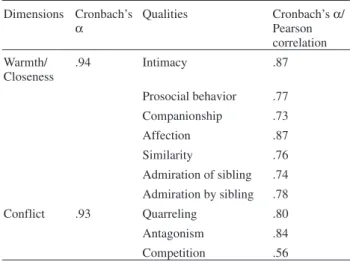
The third aim of this study was to assess the internal consistency (Cronbach’sα) of the 10 qualities and the two overarching dimensions of the SRQ. Internal consistency proved to be good, with all Cronbach’sαs for the qualities – except for Competition – ranging from 0.73 to 0.87 (see Table 2). Note that most of the qualities were measured by two items; therefore, Cronbach’sαequals the Pearson cor-relation between the items. Cronbach’sαs for the overarch-ing dimensions Warmth/Closeness and Conflict were 0.94 and 0.93, respectively. The internal consistency for these dimensions was estimated using the correlations between the factors representing the qualities; that is, we treated the first-order factors as indicators. The estimates indicate that the dimensions Warmth/Closeness and Conflict and the 10 qualities are measured rather reliably with the SRQ.
Discussion
In this study, we tested the theoretical model underlying the SRQ (Furman & Buhrmester, 1985) and its construct validity and internal reliability. The first aim of this study was to examine the dimensions Warmth/Closeness and Conflict in a sample of Dutch adolescent siblings. We, therefore, first conducted a CFA, which indicated that most items loaded on the subsequent qualities, and that the qualities measured the dimensions Warmth/Closeness and Conflict reliably. To make sure we measured the same concept in a similar way over time, we conducted tests for
Table 1. Relationship of warmth/closeness and conflict with internalizing behavior, externalizing behav-ior, and the quality of relationship with parents
Correlation between r
Warmth/closeness and
Internalizing behavior –.16* Externalizing behavior –.23* Relationship with parents .38* Conflict and
Internalizing behavior .13*
Externalizing behavior .16*
Relationship with parents –.26* Warmth/closeness and conflict –.40* Internalizing and externalizing behavior .15* Note.*p< .05.
Table 2. Internal consistency for the dimensions warmth/ closeness and conflict and the 10 underlying qual-ities
Dimensions Cronbach’s
α Qualities Cronbach’sPearson α/ correlation Warmth/
Closeness
.94 Intimacy .87
Prosocial behavior .77 Companionship .73
Affection .87
Similarity .76
Admiration of sibling .74 Admiration by sibling .78
Conflict .93 Quarreling .80
Antagonism .84
measurement invariance. From these tests we can con-clude that the factor structure of Warmth/Closeness and Conflict, as stated by Furman and Buhrmester (1985), holds across time. Therefore, we can confirm the theoret-ical model of the SRQ and conclude that the SRQ mea-sures Warmth/Closeness and Conflict in sibling relation-ships in the same way over time. We found a significant negative relationship between the two dimensions, which indicates that a warmer/closer sibling relationship is asso-ciated with less conflict in the relationship.
Concerning the construct validity of the SRQ, more warmth/closeness and less conflict in sibling relation-ships are associated with less internalizing and external-izing behaviors. Consequently, the links between the SRQ and problem behaviors conform to our expectations. Also, the results of this study support the congruence hy-pothesis (e.g., Noller, 2005), in that, more warmth/close-ness and less conflict in sibling relationships are associ-ated with higher quality of relationship with parents. As a consequence, we can conclude that the construct valid-ity of the SRQ is adequate.
The third aim of our study was to examine the reliabil-ity of the SRQ. For both the 2 dimensions and the 10 underlying qualities, with the exception of Competition, the internal reliability scores were high. The quality Competition was reliable to a lesser extent; this is in line with the results of Furman and Buhrmester (1985) who also found that the internal consistency coefficients for all qualities were high, except for the quality Competi-tion. Competition was measured by two items, namely “How much do you and this sibling try to out-do each other at things?” and “How much do you and this sibling compete with each other?” The reason for the low reli-ability might be that these items measured different as-pects of competition.
Strengths and Limitations
Although the construct and factorial validity of the SRQ have never been investigated in a sample of Dutch adoles-cents before, further research will be needed to examine whether our findings hold in other cultures. A limitation of this study may be that the variation of internalizing and externalizing behaviors was rather limited. Associations between Warmth/Closeness and Conflict in sibling rela-tionships, on the one hand, and internalizing and external-izing behaviors, on the other, may be stronger in a sample of adolescents that display more internalizing or external-izing behaviors.
We would like to stress that in this study we used CFA, which is a more thorough and stringent way of testing a theoretical model than principal factor analysis. Our find-ings underscore the psychometric properties of the SRQ, which appeared to be a reliable and valid measurement to assess Warmth/Closeness and Conflict in sibling rela-tionships.
References
Armsden, G. C., & Greenberg, M. T. (1987). The inventory of par-ent and peer attachmpar-ent: Individual differences and their rela-tionship to psychological well-being in adolescence.Journal of Youth and Adolescence, 16, 427–454.
Barret, P. (2006). Structural equation modeling: Adjudging model fit.Personality and Individual Differences, 42,815–824. Blyth, D. A., Hill, J. P., & Smith Thiel, K. (1982). Early
adoles-cents’ significant others: Grade and gender differences in per-ceived relationships with familial and nonfamilial adults and young people.Journal of Youth and Adolescence, 11,425–450. Byrne, B. M., & Stewart, S. M. (2006). The MACS approach to testing for multigroup invariance of a second-order structure: A walk through the process. Structural Equation Modeling, 13,287–321.
Feinberg, M. E., McHale, S. M., Crouter, A. C., & Cumsille, P. (2003). Sibling differentiation: Sibling and parent relationship trajectories in adolescence.Child Development, 74,1261–1274. Furman, W., & Buhrmester, D. (1985). Children’s perceptions of the qualities of sibling relationships.Child Development, 56,
448–461.
Jöreskog, K. G., & Sörbom, D. (1996a).LISREL®8 User’s
refer-ence guide. Chicago, IL: Scientific Software International. Jöreskog, K. G., & Sörbom, D. (1996b).PRELIS®2 User’s
refer-ence guide. Chicago, IL: Scientific Software International. Kandel, D. & Davies, M. (1982). Epidemiology of adolescent
de-pressive mood.Archives of General Psychiatry, 39,1205–1212. Kim, J., McHale, S. M., Crouter, A. C., & Osgood, D. W. (2007). Longitudinal linkages between sibling relationships and ad-justment from middle childhood through adolescence. Devel-opmental Psychology, 43,960–973.
Kim, J., McHale, S. M., Osgood, D. W., & Crouter, A. C. (2006). Longitudinal course and family correlates of sibling relation-ships from childhood through adolescence.Child Develop-ment, 77,1746–1761.
Kim, J. E., Hetherington, E. M., & Reis, D. (1999). Associations among family relationships, antisocial peers, and adolescents’ externalizing behaviors: Gender and family type differences.
Child Development, 70,1209–1230.
Kuhn, J. T. & Holling, H. (2009). Measurement invariance of di-vergent thinking across gender, age, and school forms. Euro-pean Journal of psychological assessment, 25,1–7.
Lempers, J. D., & Clark-Lempers, D. S. (1992). Young, middle, and late adolescents’ comparison of the functional importance of five significant relationships.Journal of Youth and Adoles-cence, 21,53–96.
Marsh, H. W., Hau, K. T., & Wen, Z. (2004). In search of golden rules: Comment on hypothesis testing approaches to setting cut-off values for fit indices and dangers in overgeneralizing Hu and Bentler’s (1999) findings.Structural Equation Model-ling, 11,320–341.
Meredith, W. (1993). Measurement invariance, factor analysis, and factorial invariance.Psychometrika, 58,525–543. Moser, R. P., & Jacob, T. (2002). Parental and sibling effects in
adolescent outcomes.Psychological Reports, 91,463–479. Noller, P. (2005). Sibling relationships in adolescence: Learning
and growing together.Personal Relationships, 12,1–12. Richmond, M. K., Stocker, C. M., & Rienks, S. L. (2005).
pa-rental differential treatment, and children’s adjustment. Jour-nal of Family Psychology, 19,550–559.
Rosenberg, M. (1965).Society and the adolescent self-image.
Princeton, NJ: Princeton University Press.
Saris, W. E., Satorra, A., & Van der Veld, W. M. (2009). Testing structural equation models, or detection of misspecifications.
Structural Equation Modeling: A Multidisciplinary Journal, 16,561–582.
Satorra, A. (1992). Asymptotic robust inferences in the analysis of mean and covariance structures.Sociological Methodology, 22,249–278.
Scharf, M., Shulman, S., & Avigad-Spitz, L. (2005). Sibling re-lationships in emerging adulthood and in adolescence.Journal of Adolescent Research, 20,64–90.
Scholte, R. H. J, Engels, R. C. M. E., de Kemp, R. A. T., Harakeh, Z., & Overbeek, G. (2007). Differential parental treatment, sib-ling relationships, and delinquency in adolescence.Journal of Youth and Adolescence, 36,661–671.
Stocker, C. M. (1994). Children’s perceptions of relationships with siblings, friends, and mothers: Compensatory processes and links with adjustment.Journal of Child Psychology, 35,
1447–1459.
Stocker, C. M., Burwell, R. A., & Briggs, M. L. (2002). Sibling conflict in middle childhood predicts children’s adjustment in early adolescence.Journal of Family Psychology, 16,50–57. Van der Vorst, H., Engels, R. C. M. E., Meeus, W., Dekovi2, M.,
& Van Leeuwe, J. (2007). Similarities and bidirectional influ-ences regarding alcohol consumption in adolescent sibling pairs.Addictive Behaviors, 32,1814–1825.
Marleen M. S. Derkman Behavioral Science Institute Radboud University Nijmegen PO Box 9104
6500 HE Nijmegen The Netherlands Tel. +31 24 361-2980 Fax +31 24 361-2776 E-mail [email protected]