Ready for College and Ready for Work:
Same or Different?
Results of a new ACT study provide empirical evidence that, whether planning to enter college or workforce training programs after graduation, high school students need to be educated to a comparable level of readiness in reading and mathematics. Graduates need this level of readiness if they are to succeed in college-level courses without remediation and to enter workforce training programs ready to learn job-specific skills.
We reached this conclusion by:
• Identifying the level of reading and mathematics skills students need to be ready for entry-level jobs that require less than a bachelor’s degree, pay a wage sufficient to support a family, and offer the potential for career advancement
• Comparing student performance on ACT tests that measure workforce readiness with those that measure college readiness
• Determining if the levels of performance needed for college and workforce readiness are the same or different
The study results convey an important message to U.S. high school educators and high school students: We should be educating all high school students according to a common academic expectation, one that prepares them for both postsecondary education and the workforce. Only then—whether they are among the two-thirds who enter college directly after graduation or those who enter workforce training programs—will they be ready for life after high school. Although the contexts within which these expectations are taught and assessed may differ, the level of expectation for all students must be the same. Anything less will not give high school graduates the foundation of academic skills they will need to learn additional skills as their jobs change or as they change jobs throughout their careers. The results of this study provide ample evidence that we must move the agenda for high school redesign in a direction that will prepare all students for success no matter which path they choose after graduation.
Introduction
For decades it has been a commonly held belief that high school students
planning to go to college need to take more rigorous coursework than those going directly into the workforce. Today, however, many employers are convinced that in an expanding global economy, entry-level workers need much the same knowledge and skills as college-going students. But such claims have been based mostly on anecdotal rather than empirical evidence. This research brief examines the relationship between college readiness and workforce readiness by asking the question: Are readiness for college and readiness for work the same, or different? The primary mission of our public education system is to give every student the opportunity to live a meaningful and productive life, which includes earning a wage sufficient to support a small family. All students need to develop the knowledge and skills that will give them real options after high school. No student’s choices should be limited by a system that can sometimes appear to have different goals for different groups. Educating some students to a lesser standard than others narrows their options to jobs that, in today’s economy, no longer pay well enough to support a family of four. Widening access to the American dream through public education has always been one of the foundations of our society, and it is more critical than ever to our ability to remain competitive in today’s global economy.
Our new finding has important implications for U.S. high school education. It suggests that all high school students should be educated according to a common academic expectation that prepares them for both postsecondary education and the workforce. This means that all students should be ready and have the opportunity to take a rigorous core preparatory program in high school, one that is designed to promote readiness for both college and workforce training programs.
What Is the Expectation for Workforce Training
Readiness?
Our first step was to define workforce readiness. We began by referring to the Occupational Information Network (O*NET), a comprehensive national database of job and worker attributes developed for the Employment and Training
Administration of the U.S. Department of Labor. O*NET classifies jobs using five zones, each defined by particular education, training, and experiential requirements.
We focused on Job Zone 3 because the occupations in this zone are likely to offer a wage sufficient to support a small family1, provide the potential for career
advancement, and are projected to increase in the future (U.S. Department of Labor, 2004). Zone 3 is the highest O*NET level that includes jobs that do not require a bachelor’s degree, but which likely require some combination of vocational training and/or on-the-job experience, or an associate’s or higher degree (O*NET OnLine Help, n.d.). Examples include electricians, construction workers, upholsterers, and plumbers.
By selecting O*NET Zone 3, we are essentially defining workforce readiness as workforce training readiness, since Zone 3 jobs require high school graduates to The WorkKeys® System
WorkKeys is ACT’s job skills assessment system measuring the “real-world” skills that employers believe are critical to job success. The skills are valuable for any occupation—skilled or
professional—and at any level of education. WorkKeys is used by businesses, workforce development groups, and schools to find, hire, train, and retain qualified employees. Components include:
Job Analysis (Profiling)
Identify the skill requirements and WorkKeys skill levels an individual must have to perform successfully. The WorkKeys job profile database currently includes profiles for more than 12,000 jobs across all industry verticals.
WorkKeys Assessments
Measure the current skills of individuals in nine key areas. WorkKeys tests in Reading for Information and Applied Mathematics were used for the present study.
Training
Improve skills that make individuals more employable and business more competitive through a better trained workforce.
have the foundational skills necessary to learn additional job-specific skills throughout their careers.
What are the minimum skill standards that high school graduates need to enter Zone 3 occupations? We used job profiles from ACT’s WorkKeys program (see sidebar, previous page), O*NET occupational data that identify the minimum level of knowledge and skills needed to enter each of these profiled jobs, and expert ratings to derive a profile that identifies the reading and mathematics skills needed for students to be ready to enter the vast majority—90 percent—of the profiled Zone 3 occupations after high school.2 On a WorkKeys scale that reports
scores for Reading for Information and Applied Mathematics ranging from Level 3 to Level 7 (see sidebar, this page),this level of knowledge and skills was profiled at a Level 5 for both readingandmathematics.
Do College Readiness and Workforce Training Readiness
Represent a Common Expectation?
After defining workforce training readiness for 90 percent of the profiled Zone 3 occupations that require training after high school, we examined whether the level of readiness for workforce training programs is the same as or different than the level of readiness needed for success in college.
Commonalities: Readiness Levels
Because WorkKeys and the ACT® test are measures of workforce and college
readiness, respectively, we based our analysis on WorkKeys and ACT scores from a statewide sample of high school eleventh-grade students over a four–year period. We conducted a statistical concordance between the respective college and workforce training readiness levels in reading and mathematics from both programs.3 The concordance between the ACT College Readiness Benchmarks
(see sidebar, next page) and WorkKeys Level 5 shows that the levels of readiness in reading and mathematics are comparable. Therefore, it is reasonable to
conclude that the expectations of students who choose to enter workforce training programs for jobs that are likely to offer both a wage sufficient to support a small family and potential career advancement should be no different from the
expectations of students who choose to enter college after high school graduation.Table 1 summarizes the comparability analysis.
Table 1
Comparability between WorkKeys Job Profile Level 5 and ACT College Readiness Benchmarks in Reading and Mathematics4
WorkKeys Test WorkKeys Readiness Level
Comparable ACT Score Range and
College Readiness Benchmark
Reading for Information 5 19–23
Benchmark = 21
Applied Mathematics 5 18–21
Benchmark = 22
WorkKeys Level Scores
Developed with input from employers, labor organizations, educators, and policymakers, ACT’s WorkKeys tests are criterion-referenced tests anchored to the skills needed for workforce readiness in nine areas.
Jobs are profiled using the same levels to assess individuals’ workforce readiness skills. An individual’s readiness for a particular job can be compared to the
requirements of the job, as defined through the job profiling process. In this study, the level of knowledge and skills considered to represent work readiness was profiled at a Level 5 for both reading and mathematics.
Level 5 WorkKeys Applied Mathematics and Reading for Information scores are often used in state and community workforce readiness certificate programs across the nation. These programs are used to qualify prospective worker readiness for a majority of jobs in a particular locale.
The results of this analysis address the comparability of the levels of expectation
represented by college and workforce training readiness. Because each test measures only one of the two kinds of readiness and is not perfectly correlated with the other test, a given individual’s ACT test score cannot be substituted for a WorkKeys test score or vice versa.
Commonalities: Skills
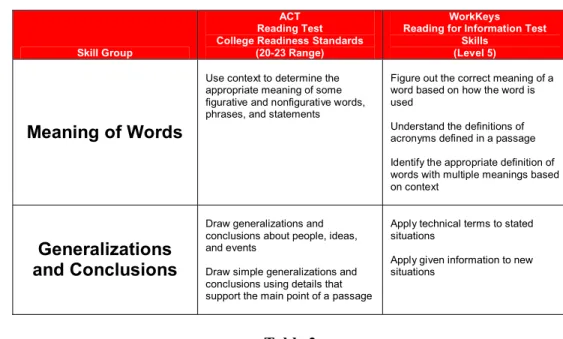
This analysis provides empirical evidence supporting the contention that the expectations for college readiness and for workforce training readiness are comparable. This empirical comparability is further supported by similarities in the skills defined for college and workforce training readiness shown in Tables 2 and 3.
For reading and mathematics, respectively, the two tables contain all of the ACT College Readiness Standards in the 20–23 range (the score range that contains the corresponding College Readiness Benchmark) and all of the WorkKeys skills at Level 5. Because WorkKeys is designed expressly to reflect what businesses expect of entering workers and the ACT is designed expressly to reflect what colleges expect of entering students, the two assessment programs have uniquenesses in what they measure and in the scores they report. But there are also commonalities in the expectations for readiness in the two tests, as shown by the skill groupings in these tables.
Table 2
Reading Skills for College and Workforce Training Readiness
Skill Group
ACT Reading Test College Readiness Standards
(20-23 Range)
WorkKeys Reading for Information Test
Skills (Level 5)
Main Ideas and
Supporting Details
Infer the main idea or purpose of straightforward paragraphs Understand the overall approach taken in a passage (e.g., point of view, kinds of evidence used) Locate important details Make simple inferences about how details are used in a passage
Understand main ideas, topic sentences, and the relationships among sentences in a paragraph Correctly use technical terms when describing the main idea and supporting details in a passage Recognize organizational structures of passages to identify pertinent details and recognize appropriate applications
Select important details to clarify meaning
Sequential,
Comparative, and
Cause-Effect
Relationships
Order simple sequences of events Identify clear relationships between people, ideas, and events Identify clear cause-effect relationships
Apply straightforward instructions to new situations
Apply complex instructions that include conditionals to situations described in a passage
ACT College Readiness Benchmarks
The ACT, the most widely accepted and used test by postsecondary institutions across the U.S. for college admission and course placement, measures students’ academic readiness to make successful transitions to college and work after high school. ACT has defined college readiness empirically by establishing College Readiness Benchmarks representing the minimum ACT test scores required for students to have a high probability of success in
corresponding credit-bearing first-year college courses. The ACT Benchmarks are based on course placement data from a nationally representative sample of postsecondary institutions. The Benchmarks reflect the ACT scores students need to earn to have at least a 75 percent or greater chance of obtaining a course grade of C or better. The College Readiness Benchmarks for Reading and Mathematics are:
Reading: 21 Mathematics: 22
Skill Group
ACT Reading Test College Readiness Standards
(20-23 Range)
WorkKeys Reading for Information Test
Skills (Level 5)
Meaning of Words
Use context to determine the appropriate meaning of some figurative and nonfigurative words, phrases, and statements
Figure out the correct meaning of a word based on how the word is used
Understand the definitions of acronyms defined in a passage Identify the appropriate definition of words with multiple meanings based on context
Generalizations
and Conclusions
Draw generalizations and conclusions about people, ideas, and events
Draw simple generalizations and conclusions using details that support the main point of a passage
Apply technical terms to stated situations
Apply given information to new situations
Table 3
Mathematics Skills for College and Workforce Training Readiness
Skill Group
ACT Mathematics Test College Readiness Standards
(20-23 Range)
WorkKeys Applied Mathematics Test
Skills (Level 5)
Algebra and
Algebraic
Thinking
Solve routine two-step or three-step arithmetic problems involving concepts such as rate and proportion, tax added, percentage off, and computing with a given average
Exhibit knowledge of elementary number concepts including rounding, the ordering of decimals, pattern identification, absolute value, primes, and greatest common factor
Evaluate algebraic expressions by substituting integers for unknown quantities
Add and subtract simple algebraic expressions
Solve routine first-degree equations Perform straightforward word-to-symbol translations
Multiply two binomials Evaluate quadratic functions, expressed in function notation, at integer values
Solve problems that include a considerable amount of extraneous information
Calculate using several steps of logic
Perform single-step conversions within or between systems of measurement
Look up and use a single formula Calculate using mixed units (e.g., 3.5 hours and 4 hours 30 minutes) Find the best deal using one- and two-step calculations and then comparing results
Calculate percentages, percentage discounts, or percentage markups Divide negative numbers Decide what information, calculations, or unit conversions to use to solve the problem
Use exponents, including exponents in fractions and formulas
Geometry and
Geometric
Thinking
Compute the area and perimeter of triangles and rectangles in simple problems
Use geometric formulas when all necessary information is given Locate points in the coordinate plane
Comprehend the concept of length on the number line
Solve geometric problems that include a considerable amount of extraneous information Calculate using several steps of logic
Calculate perimeters and areas of basic shapes (rectangles and circles)
Skill Group
ACT Mathematics Test College Readiness Standards
(20-23 Range)
WorkKeys Applied Mathematics Test
Skills (Level 5)
Exhibit knowledge of slope Find the measure of an angle using properties of parallel lines Exhibit knowledge of basic angle properties and special sums of angle measures (e.g., 90°, 180°, and 360°)
Decide what information, calculations, or unit conversions to use to solve the problem
Data
Representation and
Statistical Thinking
Calculate the missing data value, given the average and all data values but one
Translate from one representation of data to another (e.g., a bar graph to a circle graph)
Determine the probability of a simple event
Exhibit knowledge of simple counting techniques
Average hours and minutes or other mixed units in one system Solve problems that include a considerable amount of extraneous information
Calculate using several steps of logic sometimes involving graphs, charts, or tables
Commonalities: Sample Test Questions
Further parallels in the levels of readiness for college and workforce training programs can be seen in the test questions used to assess the skills measured in the two tests. Table 4 contains examples from the ACT Reading Test and the WorkKeys Reading for Information Test. Although the contexts of the passages are unique—the ACT passage is a prose selection and the WorkKeys passage is a workplace communication—the underlying reading skills being measured are similar.
Table 4
Comparison of College and Workforce Training Readiness: Reading Test Questions
ACT Reading 20-23 Range
[Order simple sequences of events]
WorkKeys Reading for Information Level 5
[Apply straightforward instructions to new situations]
Excerpt from passage*:
Mr. Brook had come home early and lighted a fire in the little grate in his sitting room. He felt comfortable and at peace that evening. He sat before the fire in his stocking feet, with a volume of William Blake on the table by his side, and he had poured himself a halfglass of apricot brandy. At ten o’clock he was drowsing cozily before the fire, his mind full of cloudy phrases of Mahler and floating half-thoughts. . . . He had been walking across the campus that afternoon when Madame Zilensky stopped him and began some preposterous rigmarole, to which he had only halflistened: he was thinking about the stack of canons turned in by his counterpoint class. Now the words, the inflections of her voice, came back to him with insidious exactitude. Madame Zilensky had started off with the following remark: “One day, when I was standing in front of a
pâtisserie (pastry shop), the King of Finland came by in a sled.”
Mr. Brook jerked himself up straight in his chair and put down his glass of brandy. The woman was a
Passage: MEMO
TO: Publications Department Assistants
FROM: Publications Department Manager
Thank you in advance for helping the editors proof the Valve Adjustment manual and documents associated with the new line of valves. The following instructions are for proofing the manuscript copy of the manual scheduled for the beginning of next week. Additional instructions will be provided when the preliminary copy with typefaces, graphics, copy placement, and headings is proofed.
Team Proofing Stage
You will be paired with another proofer, the reader, and you will be issued two versions of the same section. One version is the marked-up copy, which contains modifications in handwritten red ink. The reader will read aloud each word, punctuation mark, and number on the marked-up section.
Geometry and
Geometric
Thinking
(continued)
ACT Reading 20-23 Range
[Order simple sequences of events]
WorkKeys Reading for Information Level 5
[Apply straightforward instructions to new situations]
pathological liar. Almost every word she uttered outside of class was an untruth. . . .
Mr. Brook finished off the rest of his brandy. And slowly, when it was almost midnight, a further understanding came to him. The reason for the lies of Madame Zilensky was painful and plain. All her life long Madame Zilensky had worked—at the piano, teaching, and writing those beautiful and immense twelve symphonies. Day and night she had drudged and struggled and thrown her soul into her work, and there was not much of her left over for anything else. Being human, she suffered from this lack and did what she could to make up for it. . . . Through the lies, she lived vicariously. The lies doubled the little of her existence that was left over from work and augmented the little rag end of her personal life.
∗ Adapted from Carson McCullers, “Madame Zilensky and the King of Finland.” ©1955 by Carson McCullers.
The other copy is the new version, and it should incorporate all edits from the marked-up version. The proofer must mark in red ink any missed edits and any additional modifications. Most likely further corrections will be needed.
Single Proofing Stage
After the corrections have been made and checked from the team proofing stage, you should do a single proof on the new copy. Mark corrections in red ink. Continue to repeat this process until the materials are error free. During your single proof, read every word aloud. In this way you will both see and hear the copy, which will enable you to better detect a missing word or number. Reminder:
Spell-check programs have reduced misspellings considerably, but you should be aware of specialized terms that the computer’s dictionary does not know. Once the manual is ready to print, I will need you to follow the same instructions to proof the technical specification sheets for each valve type. If you have any questions, please speak to me or to one of the editors.
Question:
The first insight about Madame Zilensky that came to Mr. Brook during his cozy evening was that she was a great:
A. composer.
B. teacher.
C. performer.
D. liar.
Question:
You are an assistant. According to the memo shown, during the team proofing stage, what is the next step after you mark any needed modifications?
A. Further clerical corrections will be made.
B. The proofing stages will reveal no further corrections.
C. The proofing time on the project will be reduced.
D. The editors will meet the printer deadline.
The commonalities in mathematics skills are illustrated by the sample questions in Table 5. While the questions present problems in different contexts, the underlying mathematics skills each pair requires for their solutions are similar.
Table 5
Comparison of College and Workforce Training Readiness: Mathematics Test Questions
ACT Mathematics
20-23 Range WorkKeys Applied Mathematics Level 5 [Evaluate algebraic expressions by substituting
integers for unknown quantities; solve routine first-degree equations]
[Look up and use a single formula; perform single-step conversions within or between systems of
measurement]
The number of bricks, B, needed to build a wall of uniform length L feet and uniform height H feet can be found by the equation B = 7LH. A wall of uniform height that is 20 feet long is constructed using 350 bricks. What is the height, in feet, of the wall?
A. 1.75
B. 2.5
C. 17.5
D. 50
A refrigeration system at your company uses temperature sensors fixed to read Celsius (°C) values, but the system operators in your control room understand only the Fahrenheit scale. You have been asked to make a Fahrenheit (°F) label for the high temperature alarm, which is set to ring whenever the system temperature rises above -10°C. What Fahrenheit value should you write on the label?
A. -23°F
B. -18°F
C. 14°F
ACT Mathematics
20-23 Range WorkKeys Applied Mathematics Level 5 [Solve routine two-step or three-step arithmetic
problems involving concepts such as rate and proportion, tax added, percentage off, and
computing with a given average]
[Calculate percentages, percentage discounts, or percentage markups]
The Sunrise Preschool held its annual book fair for 3 days. The total profit for the 3 days was $2,525. The profit, in dollars, is shown for each of the 3 days in the bar graph below.
$0 $300 $600 $900 $1,200 $1,500
1 2 3
Day
pr
of
it
Approximately what percent of the book fair’s profit over the 3 days did the preschool make on Day 1 ?
A. 25%
B. 33%
C. 50%
D. 60%
As a dietitian, you help clients manage their sugar intake. A popular fruit drink contains a total of 28 grams of carbohydrates. Of that total, 19 grams are sugar. About what percent of the total carbohydrates is the sugar?
A. 7%
B. 9%
C. 15%
D. 68%
Summary
This study provides empirical evidence that the levels of readiness that high school graduates need to be prepared for college and for workforce training programs are comparable. These empirical results are also supported by commonalities seen in the types of knowledge and skills students need to be ready for college and workforce training programs, even though these skills are often taught and assessed in different contexts. All of these skills can be acquired through rigorous high school courses, regardless of the context (academic or career focused) within which they are taught. The results of this study underscore the importance of having a common expectation for all students when they graduate from high school: one that prepares all high school graduates for both credit-bearing entry-level college courses and workforce training programs associated with jobs that are likely to offer both a wage sufficient to support a small family and the potential for career advancement.
If we are to be competitive in today’s global economy, it is critical for us as a nation to give every high school graduate the opportunity to live a meaningful and productive life and earn a decent wage. All high school graduates should have a sound foundation of knowledge and skills so that they can enter college or workforce training programs ready to learn.
Action Steps for Policymakers
Following are recommended action steps that state policymakers can take toward achieving a common expectation that all high school graduates will be ready for college and for workforce training programs:
• Use the common expectation to establish a statewide commitment that all students will be prepared for college and workforce training programs when they graduate from high school.
• Require that all students take a rigorous core preparatory course program in high school.
• Hold schools and states accountable for preparing all students for college and workforce training programs through rigorous core courses.
• Ensure that state standards reflect the skills needed for college and workforce training readiness for all students.
• Provide funding for measures of college and workforce training readiness skills to be used as statewide high school assessments.
• Begin measuring student progress with aligned assessments as early as the eighth grade to monitor progress, make appropriate interventions, and maximize the number of high school graduates who are ready for college and workforce training programs.
• Use the common expectation of college and workforce training readiness as a prerequisite for entry into funded training or development programs (e.g., incumbent worker training) and offer remediation for those who do not meet this expectation.
• Communicate the common expectation of college and workplace training readiness to all stakeholders, including businesses, workforce and economic development associations, and educational institutions.
Notes
1 Comparison of median wagesfor O*NET job zones was based on the following chart (O*NET Consortium - Production Database, n.d.):
Median Annual Salary by O*NET Job Zone
$0 $10,000 $20,000 $30,000 $40,000 $50,000 $60,000 $70,000
1 2 3 4 5
O*NET Job Zone
S
a
la
ry
($
)
Self-sufficient wage based on median recommended budget for a family of 4 (two parents two children) averaged across 2600 U.S. communities (EPI). Poverty level provided by U.S. Dept of Heath and Human Services (2006)
Self-Sufficient Wage ($39,066)
Poverty Level ($20,000)
A “self-sufficient” wage is typically defined as the money needed to meet basic needs such as food, housing, utilities, clothing, child care, and health care plus a small allowance for personal expenses and savings.
2 ACT’s WorkKeys is a standardized job skills and assessment system that businesses commonly use for employee selection and training. WorkKeys includes a job
profiling/job analysis component used to identify the critical skills required to enter a job and perform it effectively. There are 120 O*NET Zone 3 jobs for which ACT has a WorkKeys profile estimate based on either the WorkKeys job profile database or expert
ratings. The WorkKeys profile estimates for these jobs were used to identify the reading and mathematics skills needed for a majority of the profiled Zone 3 occupations. 3 To determine how workforce training readiness compares to college readiness, we analyzed data from 476,847 high school juniors in Illinois who took the ACT, the WorkKeys Reading for Information Test, and the WorkKeys Applied Mathematics Test between 2001 and 2004. These tests are administered as part of the Illinois Prairie State Achievement Examination program, a statewide assessment administered annually to all eleventh-grade students. We statistically aligned the scores on the two WorkKeys Tests (which represent workforce training readiness) to the scores on the ACT Reading and Mathematics Tests (which represent college readiness).
4 The statistical concordance reveals that the Level 5 score on the Reading for Information test corresponds to an ACT score range that includes the ACT College Readiness Benchmark for Reading as its midpoint; the Level 5 score on the Applied Mathematics test corresponds to an ACT score range that is just one score point below the ACT College Readiness Benchmark for Mathematics. However, because WorkKeys and the ACT do not measure the same things and are not perfectly correlated, scores on the two tests are not interchangeable.
References
Economic Policy Institute. (2005). Basic family budget calculator spreadsheets. Retrieved February 22, 2006, from
http://www.epinet.org/datazone/fambud/xls/basic_family_budgets_20050901.xls
O*NET Consortium - Production Database. (n.d.). Retrieved February 22, 2006, from http://www.onetcenter.org/database.html#download
O*NET OnLine Help. (n.d.). Retrieved February 22, 2006, from http://online.onetcenter.org/help/online/zones#zone3
U.S. Department of Health and Human Services. (2006). The 2006 HHS poverty guidelines. Federal Register, 71(15), 3848–3849.
U.S. Department of Labor. (2004). Employment Projections Home Page. Retrieved February 22, 2006, from http://www.bls.gov/emp/home.htm