ON
LIN
E V
ER
SIO
N
ON
LIN
E V
ER
SIO
N
ON
LIN
E V
ER
SIO
N
Electrical safety – dwellings
The Building Regulations 2000
P
P1
Design and installation of electrical installations
APPROVED DOCUMENT
Building Regulations 2000
APPROVED
DOCUMENT
P
Electrical safety – dwellings
Coming into effect 6 April 2006
Published by NBS, part of RIBA Enterprises Ltd, and available from:RIBA Bookshops Mail Order
15 Bonhill Street London EC2P 2EA
Telephone orders/General enquiries: 020 7256 7222 Fax orders: 020 7374 2737
Email orders: [email protected] Or order online at:
www.thebuildingregs.com
www.thenbs.com
2006 edition
© Crown copyright 2006
The Approved Documents are published by NBS for the Office of the Deputy Prime Minister. This publication has been approved by Ministers and has official status. Copyright in the contents, the cover, the design and the typographical arrangement of this publication rests with the Crown unless otherwise stated. The contents of this publication may be reproduced free of charge in any format or medium for the purposes of private research and study or for internal circulation within an organisation. This is subject to the contents being reproduced accurately and not in a way that implies official status. Any publisher wishing to reproduce the content of this publication must not use or replicate the ODPM crest or replicate the official version’s style and appearance, including the cover design, and must not present their publication as being an official publication as this may confuse the public. The reproduced material must be acknowledged as Crown Copyright and the title of the publication specified. The Office of the Deputy Prime Minister does not accept any responsibility for the accuracy and comprehensiveness of any other versions.
Any other use of the contents of this publication would require a copyright licence. Please apply for a licence by writing to the Office of Public Sector Information, Information Policy Team, St Clements House, 2-16 Colegate, Norwich NR3 1BQ. Fax 01603 723000 or email [email protected]. Further information can be obtained from www.opsi.gov.uk.
ISBN-10 1 85946 223 5 ISBN-13 978 1 85946 223 2 Stock code 57648
RIBA Bookshops
66 Portland Place, London W1B 1AD. Telephone 020 7256 7222.
113-115 Portland Street, Manchester M1 6DW. Telephone 0161 236 7691.
Birmingham & Midland Institute, Margaret Street, Birmingham B3 3SP. Telephone 0121 233 2321. RSUA, 2 Mount Charles, Belfast BT7 1NZ. Telephone 028 9032 3760.
Renew Rooms, 82 Wood Street, Liverpool L1 4DQ. Telephone 0151 707 4380.
ONLINE
VERSION
ONLINE
VERSION
ONLINE
1 Approved Document G Sanitation, hot water safety and water efficiency
All references to the Building Regulations 2000 (as amended) should be read as references to the Building Regulations 2010.
All references to the Building (Approved Inspectors etc.) Regulations 2000 should be read as references to the Building (Approved Inspectors etc.) Regulations 2010.
There have been no substantive requirements amendments to either set of regulations, but please note the simplification of the definition of ‘room for residential purposes’ in regulation 2 of the Building Regulations 2010. Please also note that L1(c) has now become regulation 40.
The following tables will help you to find the new regulation number for regulations which have been re-numbered in the 2010 Regulations. For any regulation number not included in the tables below, the number of the regulation has not changed.
Amendments to Approved Documents and
Compliance Guides 2010
ONLINE
VERSION
ONLINE
VERSION
ONLINE
Building Regulations
Regulation number in Building Regulations 2000
Regulation number in Building Regulations 2010
Regulation number in Building Regulations 2000
Regulation number in Building Regulations 2010
Regulation number in Building Regulations 2000
Regulation number in Building Regulations 2010
2(2A) 2(3) 12(7) 12(8) 20AA 42
2(2B) 2(4) 13(2)(c)(iii) 13(2)(ii) 20B 43
2(2C) 2(5) 13(3) deleted 20C(A1) 44(1)
2(3) deleted 13(5) 13(3) 20C(1) 44(2)
3(1)(g) 3(1)(h) 13(6) 13(4) 20C(2) 44(3)
3(1)(h) 3(1)(g) 13(7) 13(5) 20C(3) 44(4)
4(1A) 4(2) 14(3)(aa) 14(3)(b) 20D 27
4(2) 4(3) 14(3)(b) 14(3)(c) 20E 37
4A 23 14A 15 21(1) 18(1)
4B(1) 22 15 16 21(2) 18(8)
4B(2) deleted 16A 20 21(3) 18(2)
6(1)(cc) 6(1)(d) 16B 38 21(4) 18(3)
6(1)(d) 6(1)(e) 16C 39 21(5) 18(4)
6(1)(e) 6(1)(f) 17A 24 21(6) 18(5)
6(1)(f) 6(1)(g) 17B 25 21(7) 18(6)
6(1)(ff) 6(1)(h) 17C 26 21(8) 18(7)
6(1)(g) 6(1)(i) 17D 28 22 47
9(1A) 9(2) 17E(4) 29(5) 22B(1)(a) 48(1)(a)
9(2) 9(3) 17E(5) 29(4) 22B(1)(b) 48(1)(b)
9(3) 21(1) 17F 30 22B(1)(c) 48(1)(c)
9(4) 21(2) 17G 31 22B(1)(d) 48(1)(g)
9(5) 21(3) 17H 32 22B(1)(e) 48(1)(d)
9(5A) 21(4) 17I 33 22B(1)(f) 48(1)(i)
9(6) 21(5) 17J 35 22B(1)(g) 48(1)(j)
12(2) 12(1) 17K 36 22B(1)(h) 48(1)(l)
12(2A) 12(2) 18 45 22B(1)(ha) 48(1)(m)
12(4A) 12(5) 19 46 22B(1)(i) 48(1)(n)
12(5) 12(6) 20 19 22B(1)(j) 48(1)(o)
12(6) 12(7) 20A 41 22B(1)(k) 48(1)(h)
22B(1)(ka) 48(1)(k) J2A J3 J6 J7
22B(1)(l) 48(1)(e) J3 J4 L1(c) Regulation 40
22B(1)(m) 48(1)(f) J4 J5 Schedule 2A Schedule 3
22B(2) 48(2) J5 J6 Schedule 2B Schedule 4
ONLINE
VERSION
ONLINE
VERSION
ONLINE
Building (Approved Inspectors etc.) Regulations
Regulation number in Building (Approved Inspectors etc.) Regulations 2000
Regulation number in Building (Approved Inspectors etc.) Regulations 2010
Regulation number in Building (Approved Inspectors etc.) Regulations 2000
Regulation number in Building (Approved Inspectors etc.) Regulations 2010
Regulation number in Building (Approved Inspectors etc.) Regulations 2000
Regulation number in Building (Approved Inspectors etc.) Regulations 2010
1 1 and 38 13(1)(d) 12(6)(c) 25(2) 25(3)
3 4 13(2) 12(1) 25(3) 25(4)
4 3 13(3) 12(2) 31A(a) 32(c)
8 10 13(4) 12(3) 31A(b) 32(c)
9 11 13(5) 12(4) 31A(c) 32(e)
10(1) 9(5) 13(6) 12(5) 31A(d) 32(f)
10(2) 9(1) 13A 13 31A(e) 32(h)
10(3) 9(2) 14 14(1) 31A(ea) 32(i)
10(4) 9(3) 15(1) 14(2) 31A(f) 32(j)
10(5) 9(4) 15(2) 14(3) 31A(g) 32(k)
11(1)(a) 8(1)(a) 15(3) 14(4) 31A(h) 32(d)
11(1)(c) 8(1)(b) 16 15 31A(ha) 32(g)
11(2) 8(2) 17 16 31A(i) 32(a)
11A 20(1) 18(1) 17(1) 31A(j) 32(b)
12 20(1) and (3) 18(2) 17(2) and (3) *Sch 3 7A Sch 2 8
12A 20(1) and (5) 18(3) 17(4) Sch 3 8 Sch 2 9
12AA 20(1) 18(4) 17(5) Sch 3 9 Sch 2 10
12B 20(1) 18(5) 17(6) Sch 4 7A Sch 3 8
12C 20(1) and (6) 18(6) 17(7) Sch 4 8 Sch 3 9
12D 20(1) and (2) 19 18 Sch 6 5A Sch 5 6
12E 20(1) and (4) 20 19 Sch 6 6 Sch 6 7
13(1) 12(6) 23A 24
13(1)(b) 12(6)(a) 24 25(1)
13(1)(c) 12(6)(b) 25(1) 25(2)
Please note that some of the numbering and cross referencing in the forms in Schedule 1 has changed slightly. *Sch =Schedule
ONLINE
VERSION
ONLINE
VERSION
ONLINE
ON
LIN
E V
ER
SIO
N
ON
LIN
E V
ER
SIO
N
ON
LIN
E V
ER
SIO
N
1
Approved Document P Electrical safety – dwellings
Contents
PAGE
Use of guidance 3
The Approved Documents 3 Limitation on requirements 3 Materials and workmanship 3 Mixed use development 4 The Workplace (Health, Safety and Welfare)
Regulations 1992 4
The Requirements 5
Section 0: General guidance 7
Performance 7
General 7
Definitions 7
Other regulations 7 Notification of work 7
Section 1: Design, installation,
inspection and testing, and provision
of information 10
General 10
Design and construction 10
General 10
Protection against flooding 10 Accessibility 10 Inspection and testing before taking
into service 10
General 10
BS 7671 certificates for all
electrical work 10 Building Regulations compliance
certificates/final notices for
notifiable work 11 Certification of notifiable work 11
a. Where the installer is registered with a Part P competent person
self-certification scheme 11 b. Where the installer is not registered with a Part P competent person scheme but qualified to complete
BS 7671 certificates 11 c. Where installers are not qualified
to complete BS 7671 certificates 11 Third party certification 12 Inspection and testing of
non-notifiable work 12 Provision of information 12
PAGE
Section 2: Material alterations and
material changes of use 13
Section 3: Information about
other legislation 14
Electricity at Work Regulations 1989 14 Electricity Safety, Quality and Continuity
Regulations 2002 14
Functionality requirements 14
Appendix A: Examples of electrical
installation diagrams 15
Appendix B: Copies of BS 7671
and IEE model forms 20
Appendix C: Older practice that can be
encountered in alteration work 35
Appendix D: New harmonised cable
identification colours 40
Appendix E: Competent person
self-certification schemes 41
Standards referred to 42
Other publications referred to 43
P
App Doc P_new.indd 1
App Doc P_new.indd 1 14/3/06 19:16:5514/3/06 19:16:55
ONLINE
VERSION
ONLINE
VERSION
ONLINE
ON
LIN
E V
ER
SIO
N
ON
LIN
E V
ER
SIO
N
ON
LIN
E V
ER
SIO
N
App Doc P_new.indd 2
App Doc P_new.indd 2 14/3/06 19:16:5714/3/06 19:16:57
ONLINE
VERSION
ONLINE
VERSION
ONLINE
ON
LIN
E V
ER
SIO
N
ON
LIN
E V
ER
SIO
N
ON
LIN
E V
ER
SIO
N
3
Approved Document P Electrical safety – dwellings
THE APPROVED DOCUMENTS
This document is one of a series that has been approved and issued by the Secretary of State for the purpose of providing practical guidance with respect to the requirements of Schedule 1 to and regulation 7 of the Building Regulations 2000 (SI 2000/2531) for England and Wales. SI 2000/2531 has been amended by the Building (Amendment) Regulations 2001 (SI 2001/3335), the Building (Amendment) Regulations 2002 (SI 2002/440), the Building (Amendment) (No 2) Regulations 2002 (SI 2002/2871), the Building (Amendment) Regulations 2003 (SI 2003/2692), the Building (Amendment) Regulations 2004 (SI 2004/1465) and the Building (Amendment) (No 3) Regulations 2004 (SI 2004/3210) and the Building and Approved Inspectors (Amendment)
Regulations 2006 (SI 2006/652).
At the back of this document is a list of all the documents that have been approved and issued by the Secretary of State for this purpose.
Approved Documents are intended to provide guidance for some of the more common building situations. However, there may well be alternative ways of achieving compliance with the
requirements. Thus there is no obligation to adopt any particular solution contained in an Approved Document if you prefer to meet the relevant requirement in some other way.
Supplementary guidance
The Office of the Deputy Prime Minister occasionally issues additional material to aid interpretation of the guidance contained in Approved Documents. This material may be conveyed in official letters to Chief Executives of Local Authorities and Approved Inspectors and/ or posted on the websites accessed through: http://www.odpm.gov.uk/building-regulations.
Other requirements
The guidance contained in an Approved Document relates only to the particular requirements of the Regulations which the document addresses. The building work will also have to comply with any other relevant requirements in Schedule 1 to the Regulations.
There are Approved Documents which give guidance on each of the Parts of Schedule 1 and on Regulation 7.
LIMITATION ON REQUIREMENTS
In accordance with regulation 8, the requirements in Parts A to D, F to K, N and P (except for paragraphs H2 and J6) of Schedule 1 to the Building Regulations do not require anything to be done except for the purpose of securing reasonable standards of health and safety for persons in or about buildings (and any others who may be affected by buildings or matters connected with buildings). This is one of the categories of purpose for which Building Regulations may be made.
Paragraphs H2 and J6 are excluded from regulation 8 because they deal directly with prevention of the contamination of water. Parts E and M (which deal, respectively, with resistance to the passage of sound, and access to and use of buildings) are excluded from regulation 8 because they address the welfare and convenience of building users. Part L is excluded from
regulation 8 because it addresses the conservation of fuel and power. All these matters are amongst the purposes, other than health and safety, that may be addressed by Building Regulations.
MATERIALS AND WORKMANSHIP
Any building work which is subject to the requirements imposed by Schedule 1 to the Building Regulations should, in accordance with regulation 7, be carried out with proper materials and in a workmanlike manner.
You may show that you have complied with regulation 7 in a number of ways. These include the appropriate use of a product bearing CE marking in accordance with the Construction Products Directive (89/106/EEC)1, the Low Voltage Directive (73/23/EEC and amendment 93/68/EEC)2 and the EMC Directive (89/336/ EEC)3, as amended by the CE marking Directive (93/68/EEC)4, or a product complying with an appropriate technical specification (as defined in those Directives), a British Standard, or an alternative national technical specification of any state which is a contracting party to the European Economic Area which, in use, is equivalent, or a product covered by a national or European certificate issued by a European Technical Approval issuing body, and the conditions of use are in accordance with the terms of the certificate. You will find further guidance in the Approved Document supporting regulation 7 on materials and workmanship.
Use of guidance
1 As implemented by the Construction Products Regulations 1991
(SI 1620/1991).
2 As implemented by the Electrical Equipment (Safety) Regulations 1994
(SI 3260/1994).
3 As implemented by the Electromagnetic Compatibility Regulations 1992
(SI 2372/1992).
4 As implemented by the Construction Products (Amendment) Regulations
1994 (SI 3051/1994) and the Electromagnetic Compatibility (Amendment) Regulations 1994 (SI 3080/1994).
P
App Doc P_new.indd 3
App Doc P_new.indd 3 14/3/06 19:16:5714/3/06 19:16:57
ONLINE
VERSION
ONLINE
VERSION
ONLINE
VERSION
ON
LIN
E V
ER
SIO
N
ON
LIN
E V
ER
SIO
N
ON
LIN
E V
ER
SIO
N
4
Electrical safety – dwellings Approved Document P
Independent certification schemes
There are many UK product certification schemes. Such schemes certify compliance with the requirements of a recognised document which is appropriate to the purpose for which the material is to be used. Materials which are not so certified may still conform to a relevant standard.
Many certification bodies which approve such schemes are accredited by UKAS.
Technical specifications
Under section 1(1) of the Building Act 1984, Building Regulations may be made for various purposes including health, safety, welfare,
convenience, conservation of fuel and power and prevention of waste or contamination of water, furthering the protection or enhancement of the environment, facilitating sustainable development or the prevention and detection of crime. Standards and technical approvals are relevant guidance to the extent that they relate to these considerations. However, they may also address other aspects of performance such as serviceability, or aspects which, although they relate to the purposes listed above, are not covered by the current Regulations. When an Approved Document makes reference to a named standard, the relevant version of the standard is the one listed at the end of the publication. However, if this version has been revised or updated by the issuing standards body, the new version may be used as a source of guidance provided it continues to address the relevant requirements of the Regulations.
The appropriate use of a product which complies with a European Technical Approval as defined in the Construction Products Directive will meet the relevant requirements.
The Office intends to issue periodic amendments to its Approved Documents to reflect emerging harmonised European Standards. Where a national standard is to be replaced by a European harmonised standard, there will be a co-existence period during which either standard may be referred to. At the end of the co-existence period the national standard will be withdrawn.
MIXED USE DEVELOPMENT
In mixed use developments part of a building may be used as a dwelling while another part has a non-domestic use. In such cases, if the requirements of the Regulations for dwellings and non-domestic use differ, the requirements for non-domestic use should apply in any shared parts of the building.
THE WORKPLACE (HEALTH,
SAFETY AND WELFARE)
REGULATIONS 1992
The Workplace (Health, Safety and Welfare) Regulations 1992 as amended contain some requirements which affect building design. The main requirements are now covered by the Building Regulations, but for further information see: Workplace health, safety and welfare: Workplace (Health, Safety and Welfare) Regulations
1992, Approved Code of Practice, L24, HMSO,
1992 (ISBN 0 7176 0413 6).
The Workplace (Health, Safety and Welfare) Regulations 1992 apply to the common parts of flats and similar buildings if people such as cleaners and caretakers are employed to work in these common parts. Where the requirements of the Building Regulations that are covered by this Part do not apply to buildings other than dwellings, the provisions may still be required in the situations described above in order to satisfy the Workplace Regulations.
P
USE OF GUIDANCE
App Doc P_new.indd 4
App Doc P_new.indd 4 14/3/06 19:16:5714/3/06 19:16:57
ONLINE
VERSION
ONLINE
VERSION
ONLINE
VERSION
ON
LIN
E V
ER
SIO
N
ON
LIN
E V
ER
SIO
N
ON
LIN
E V
ER
SIO
N
5
Approved Document P Electrical safety – dwellings
This Approved Document, which takes effect on 6 April 2006, deals with the requirements of Part P of Schedule 1 to the Building Regulations 2000 (as amended by SI 2004/3210 and SI 2006/652).
Requirement Limits on application
PART P ELECTRICAL SAFETY
Design and installation
P1. Reasonable provision shall be made in the design and installation of electrical installations in order to protect persons operating, maintaining or altering the installations from fire or injury.
The requirements of this part apply only to electrical installations that are intended to operate at low or extra-low voltage and are: (a) in or attached to a dwelling;
(b) in the common parts of a building serving one or more dwellings, but excluding power supplies to lifts;
(c) in a building that receives its electricity from a source located within or shared with a dwelling; and
(d) in a garden or in or on land associated with a building where the electricity is from a source located within or shared with a dwelling.
The Requirements
NOTES
Examples of application of Part P
Part P applies to electrical installations in or attached to buildings or parts of buildings comprising:
• dwelling houses and flats;
• dwellings and business premises that have a common supply – for example shops and public houses with a flat above;
• common access areas in blocks of flats such as corridors and staircases;
• shared amenities of blocks of flats such as laundries and gymnasiums.
Part P applies also to parts of the above electrical installations:
• in or on land associated with the buildings – for example Part P applies to fixed lighting and pond pumps in gardens;
• in outbuildings such as sheds, detached garages and greenhouses.
Interaction with other Parts of the
Building Regulations
Other Parts of Schedule 1 to the Building Regulations contain requirements affecting electrical installations. Examples include, but are not limited to:
• Part A (Structure): depth of chases in walls, and size of holes and notches in floor and roof joists;
• Part B (Fire safety): fire safety of certain electrical installations; provision of fire alarm and fire detection systems; fire resistance of penetrations through floors and walls; • Part C (Site preparation and resistance to
moisture): moisture resistance of cable penetrations through external walls;
• Part E (Resistance to the passage of sound): penetrations through floors and walls;
• Part L (Conservation of fuel and power): energy efficient lighting; reduced current-carrying capacity of cables in insulation;
ELECTRICAL SAFETY
P
App Doc P_new.indd 5
App Doc P_new.indd 5 14/3/06 19:16:5814/3/06 19:16:58
ONLINE
VERSION
ONLINE
VERSION
ONLINE
ON
LIN
E V
ER
SIO
N
ON
LIN
E V
ER
SIO
N
ON
LIN
E V
ER
SIO
N
6
Electrical safety – dwellings Approved Document P
• Part M (Access to and use of buildings): height of socket outlets, switches and consumer units.
Further guidance is available in:
• the Electrician’s guide to the Building
Regulations, published by the IEE (Institution
of Electrical Engineers), available from www.iee.org
• the Electrical Installers’ Guide to the Building
Regulations published by the NICEIC Group
Limited and the ECA (Electrical Contractors’ Association), available from www.niceic.org.uk or www.eca.co.uk.
Regulation 4(2) states that, on completion of electrical installation work, the building (and parts of the electrical installations in the building that were not the subject of work) should be no worse in terms of the level of compliance with the other applicable Parts of Schedule 1 to the Building Regulations than before the work was undertaken. For example, one or more perforations of a ceiling lining beneath a floor – made to accommodate recessed lighting or similar fittings – may have an adverse effect on that floor’s performance in terms of its resistance to fire and sound penetration. Due regard should therefore be paid to the guidance in Approved Documents B and E on the performance of compartment floors.
Regulation 4(2) also means that, when extending or altering an installation, only the new work must meet current requirements and there is no obligation to upgrade the existing installation unless the new work would adversely affect the safety of the existing installation, or the state of the existing installation was such that the new work could not be operated safely, or where there is a requirement to upgrade imposed by the energy efficiency requirements of the Building Regulations.
.
P
ELECTRICAL
SAFETY
App Doc P_new.indd 6
App Doc P_new.indd 6 14/3/06 19:16:5814/3/06 19:16:58
ONLINE
VERSION
ONLINE
VERSION
ONLINE
ON
LIN
E V
ER
SIO
N
ON
LIN
E V
ER
SIO
N
ON
LIN
E V
ER
SIO
N
7
Approved Document P Electrical safety – dwellings
Performance
0.1 In the Secretary of State’s view, the requirements will be met by adherence to the ‘Fundamental Principles’ for achieving safety given in BS 7671:2001 Chapter 13. To achieve these requirements electrical installations must be: a. designed and installed to afford appropriate
protection against mechanical and thermal damage, and so that they do not present electric shock and fire hazards to people; b. suitably inspected and tested to verify that
they meet the relevant equipment and installation standards.
General
0.2 A way of satisfying the fundamental principles would be to follow:
a. the technical rules described in the body of BS 7671:2001 as amended or in an equivalent standard approved by a member of the EEA; and
b. guidance given in installation manuals that are consistent with BS 7671:2001, such as: i. the IEE (Institution of Electrical Engineers)
On-Site Guide;
ii. the series of IEE Publications, Guidance Notes Nos 1 to 7.
0.3 The diagrams in Appendix A give an indication of the sorts of electrical services encountered in dwellings, some of the ways they can be connected and the complexity of the wiring and protective systems necessary to supply them. They are not an indication of the scope of Part P and must not be used for installation purposes.
Definitions
0.4 The following meanings apply throughout this document:
Electrical installation is defined in the Building Regulations as fixed electrical cables or fixed electrical equipment located on the consumer’s side of the electricity supply meter.
Extra-low voltage is defined in the Building Regulations as voltage not exceeding 50 volts between conductors and earth for alternating current or 120 volts between conductors for direct current.
Low voltage which normally exceeds extra-low voltage is defined in the Building Regulations as not exceeding 1000 volts between conductors or 600 volts between conductors and earth for alternating current; or 1500 volts between
conductors or 900 volts between conductors and earth for direct current.
Kitchen is defined in the Building Regulations as ‘a room or part of a room which contains a sink and food preparation facilities’.
As a guide only, in open plan areas the zone of a kitchen may be considered to extend from the edge of the sink to a distance of 3m or to a nearer dividing wall.
Other Regulations
0.5 Electrical work is also affected by the Electricity at Work Regulations 1989 as amended and the Electricity Safety, Quality and Continuity Regulations 2002 as amended, as described in paragraphs 3.1 to 3.13.
Notification of work
When necessary to involve building control bodies
0.6 Except in the circumstances outlined in paragraph 0.7 below, notification of proposals to carry out electrical installation work must be given to a building control body (the local authority or an approved inspector) before work begins.
When not necessary to involve building control bodies
0.7 It is not necessary to give prior notification of proposals to carry out electrical installation work to building control bodies in the following circumstances:
a. The proposed installation work is undertaken by a person registered with an electrical self-certification scheme prescribed in regulations (see schedule 2A of the Regulations). In these cases the person is responsible for ensuring compliance with BS 7671:2001 or an equivalent standard and all relevant building regulations requirements. A full list of schemes with contact details is given in Appendix E. OR
b. The proposed electrical installation work is non-notifiable work of the type described in Table 1 and does not include the provision of a new circuit (see schedule 2B of the
Regulations).
Section 0: General guidance
P
App Doc P_new.indd 7
App Doc P_new.indd 7 14/3/06 19:16:5914/3/06 19:16:59
ONLINE
VERSION
ONLINE
VERSION
ONLINE
VERSION
ON
LIN
E V
ER
SIO
N
ON
LIN
E V
ER
SIO
N
ON
LIN
E V
ER
SIO
N
8
Electrical safety – dwellings Approved Document P
Additional notes
Tables 1 and 2 above give the general rules for determining whether or not electrical installation work is notifiable. The rules are based on the risk of fire and injury and what is practicable. The following notes provide additional guidance and specific examples:
a. Notifiable jobs include new circuits back to the consumer unit, and extensions to circuits in kitchens and special locations (bathrooms, etc) and associated with special installations (garden lighting and power installations, etc). b. Replacement, repair and maintenance jobs
are generally not notifiable, even if carried out in a kitchen or special location or associated with a special installation.
c. Consumer unit replacements are, however, notifiable.
d. In large bathrooms, the location containing a bath or shower is defined by the walls of the bathroom.
e. Conservatories and attached garages are not special locations. Work in them is therefore not notifiable unless it involves the installation of a new circuit or the extension of a circuit in a kitchen or special location or associated with a special installation.
f. Detached garages and sheds are not special locations. Work within them is notifiable only if it involves new outdoor wiring.
Table 1
Work that need not be notified to building control bodies
Work consisting of:
Replacing any fixed electrical equipment (for example, socket-outlets, control switches and ceiling roses) which does not include the provision of any new fixed cabling
Replacing the cable for a single circuit only, where damaged, for example, by fire, rodent or impact (a) Re-fixing or replacing the enclosures of existing installation components (b)
Providing mechanical protection to existing fixed installations (c) Installing or upgrading main or supplementary equipotential bonding (d)
Work that is not in a kitchen or special location and does not involve a special installation (e) and consists of:
Adding lighting points (light fittings and switches) to an existing circuit (f) Adding socket-outlets and fused spurs to an existing ring or radial circuit (f)
Work not in a special location, on:
Telephone or extra-low voltage wiring and equipment for the purposes of communications, information technology, signalling, control and similar purposes
Prefabricated equipment sets and associated flexible leads with integral plug and socket connections
Notes:
(a) On condition that the replacement cable has the same current-carrying capacity and follows the same route. (b) If the circuit’s protective measures are unaffected.
(c) If the circuit’s protective measures and current-carrying capacity of conductors are unaffected by increased thermal insulation. (d) Such work will need to comply with other applicable legislation, such as the Gas Safety (Installation and Use) Regulations. (e) Special locations and installations are listed in Table 2.
(f) Only if the existing circuit protective device is suitable and provides protection for the modified circuit, and other relevant safety provisions are satisfactory.
Table 2
Special locations and installations
(a)Special locations
Locations containing a bath tub or shower basin Swimming pools or paddling pools
Hot air saunas
Special installations
Electric floor or ceiling heating systems Garden lighting or power installations Solar photovoltaic (PV) power supply systems Small scale generators such as microCHP units
Extra-low voltage lighting installations, other than pre-assembled, CE-marked lighting sets
Note:
(a) See IEE Guidance Note 7 which gives more guidance on achieving safe installations where risks to people are greater.
P
GENERAL
GUIDANCE
App Doc P_new.indd 8
App Doc P_new.indd 8 14/3/06 19:16:5914/3/06 19:16:59
ONLINE
VERSION
ONLINE
VERSION
ONLINE
ON
LIN
E V
ER
SIO
N
ON
LIN
E V
ER
SIO
N
ON
LIN
E V
ER
SIO
N
9
Approved Document P Electrical safety – dwellings
g. Outdoor lighting and power installations are special installations. Any new work in, for example, the garden or that involves crossing the garden is notifiable.
h. The installation of fixed equipment is within the scope of Part P, even where the final connection is by a 13A plug and socket. However, work is notifiable only if it involves fixed wiring and the installation of a new circuit or the extension of a circuit in a kitchen or special location or associated with a special installation.
i. The installation of equipment attached to the outside wall of a house (for example security lighting, air conditioning equipment and radon fans) is not notifiable provided that there are no exposed outdoor connections and the work does not involve the installation of a new circuit or the extension of a circuit in a kitchen or special location or associated with a special installation.
j. The installation of a socket outlet on an external wall is notifiable, since the socket-outlet is an outdoor connector that could be connected to cables that cross the garden and requires RCD protection.
k. The installation of prefabricated, “modular” systems (for example kitchen lighting systems and armoured garden cabling) linked by plug and socket connectors is not notifiable, provided that products are CE-marked and that any final connections in kitchens and special locations are made to existing connection units or points (possibly a 13A socket outlet).
l. Work to connect an electric gate or garage door to an existing isolator is not notifiable, but installation of the circuit up to the isolator is notifiable.
m. The fitting and replacement of cookers and electric showers is not notifiable unless a new circuit is needed.
n. New central heating control wiring installations are notifiable even where work in kitchens and bathrooms is avoided.
GENERAL GUIDANCE
P
App Doc P_new.indd 9
App Doc P_new.indd 9 14/3/06 19:17:0014/3/06 19:17:00
ONLINE
VERSION
ONLINE
VERSION
ONLINE
ON
LIN
E V
ER
SIO
N
ON
LIN
E V
ER
SIO
N
ON
LIN
E V
ER
SIO
N
P
10
Electrical safety – dwellings Approved Document P
General
1.1 Where electrical installation work is to be carried out professionally, compliance is necessary with the Electricity at Work Regulations 1989 as amended.
1.2 In accordance with the Electricity Safety, Quality and Continuity Regulations 2002 and the contract for a mains supply, proposals for new installations of a mains supply or significant alterations to an existing mains supply must be agreed with the electricity distributor.
Design and installation
General
1.3 Electrical installations should be designed and constructed, suitably enclosed and separated by appropriate distances to provide mechanical and thermal protection, so that they afford appropriate protection for persons against the risks of electric shock, burn or fire injuries.
1.4 A way of complying is to follow the technical rules in BS 7671:2001 as amended or an equivalent standard.
Protection against flooding
1.5 The Electricity Safety, Quality and Continuity Regulations 2002 require the electricity distributor to install the cut-out and meter in a safe location, where they are mechanically protected and can be safely maintained. In compliance with this requirement, the electricity distributor and installer may be required to take into account the risk of flooding. Some guidance is given in the ODPM publication Preparing for flooding, available from www.odpm.gov.uk.
Accessibility
1.6 Wall-mounted socket-outlets, switches and consumer units should be located so that they are easily reachable where this is necessary to comply with Part M of the Building Regulations. Approved Document M shows ways of complying. Accessible consumer units should comply with BS EN 60439-3.
Inspection and testing before
taking into service
General
1.7 Electrical installations should be inspected and tested as necessary and appropriate during and at the end of installation, before they are taken into service, to verify that they are safe to use, maintain and alter and comply with Part P of the Building Regulations and with any other relevant Parts of the Building Regulations.
BS 7671 installation certificates
1.8 In general, compliance with Part P can be demonstrated by the issue of the appropriate BS 7671 electrical installation certificate.
1.9 Inspection and testing should be carried out to follow the procedures in Chapters 71 and 74 of BS 7671:2001, and a copy of the appropriate installation certificate should be supplied to the person ordering the work. The electrical installation certificate must be made out and signed only by someone “qualified” to do so. Where this is the case, a safety certificate should be issued for all but the simplest of like-for-like replacements.
1.10 “Qualified” in this context means having the appropriate qualifications, knowledge and experience to carry out the inspection and testing procedures and complete the relevant electrical installation certificate.
1.11 The certificate should show that the electrical installation work has been:
a. Inspected appropriately during erection as well as on completion to verify that the components are:
i. made in compliance with appropriate British Standards or harmonised European Standards;
ii. selected and installed in accordance with BS 7671:2001 (including consideration of external influences such as the presence of moisture);
iii. not visibly damaged or defective so as to be unsafe.
b. Tested appropriately to check satisfactory performance in relation to continuity of conductors, insulation resistance, separation of circuits, polarity, earthing and bonding arrangements, earth fault loop impedance and functionality of all protective devices including residual current devices. It is not necessary to carry out all these tests for each and every installation, only those which are needed to establish whether the installation is safe.
1.12 Appendix 6 of BS 7671 and Appendix B of this Approved Document contain models of the various BS 7671 certificates. Qualified installers should use the one appropriate to the work they have carried out.
1.13 BS 7671 does not insist on a Minor Works Certificate being issued for the replacement of equipment such as accessories or luminaires, but advises that this should be done where appropriate inspection and testing has been carried out, irrespective of the extent of the work undertaken. The Minor Works Certificate is not appropriate for the replacement of consumer units or similar items, for which the full Electrical Installation Certificate should be used.
Section 1: Design, installation, inspection
and testing, and provision of information
App Doc P_new.indd 10
App Doc P_new.indd 10 14/3/06 19:17:0014/3/06 19:17:00
ONLINE
VERSION
ONLINE
VERSION
ONLINE
VERSION
ON
LIN
E V
ER
SIO
N
ON
LIN
E V
ER
SIO
N
ON
LIN
E V
ER
SIO
N
11
Approved Document P Electrical safety – dwellings
DESIGN, INSTALLATION, INSPECTION AND TESTING
P
1.14 Section 712 of BS 7671:2001 provides a list of all the inspections that may be necessary although in particular cases only some elements will be relevant. A schedule of inspections forms part of the Electrical Installation Certificate in Appendix 6 of BS 7671 and in this Approved Document at Appendix B.
1.15 Section 713 of BS 7671:2001 provides a list of all the tests that may be necessary although, again, in particular cases only some elements may be relevant. A blank schedule for recording test results also forms part of the Electrical Installation Certificate. Tests should be carried out using appropriate and accurate instruments under the conditions given in BS 7671, and the results compared with the relevant performance criteria to confirm compliance.
1.16 The Minor Works Certificate lists six essential tests for additions and alterations that do not include the provision of a new circuit. Appropriate tests should be carried out depending on the nature of the work.
Building Regulations compliance certificates/ notices for notifiable work
1.17 A Building Regulations compliance certificate (issued by Part P competent person scheme installers), completion certificates (issued by local authorities) and final notices (issued by approved inspectors) are evidence that compliance with the Building Regulations has been achieved, and are issued on completion of notifiable works only. They are different documents than a BS 7671 installation certificate and attest compliance with all relevant requirements of the Building Regulations, not just Part P.
Certification of notifiable work
a. Where the installer is registered with a Part P competent person self-certification scheme
1.18 Installers registered with a Part P competent person self-certification scheme are qualified to complete BS 7671 installation certificates and should do so in respect of every job they undertake. A copy of the certificate should always be given to the person ordering the electrical installation work.
1.19 Where Installers registered with Part P competent person self-certification scheme, a Building Regulations compliance certificate must be issued to the occupant either by the installer or the installer’s registration body within 30 days of the work being completed. The relevant building control body should also receive a copy of the information on the certificate within 30 days.
1.20 The Regulations call for the Building Regulations compliance certificate to be issued to the occupier. However, in the case of rented properties, the certificate may be sent to the person ordering the work with a copy sent also to the occupant.
b. Where the installer is not registered with a Part P competent person self-certification scheme but qualified to complete BS 7671 installation certificates
1.21 Where notifiable electrical installer work is carried out by a person not registered with a Part P competent person self-certification the work should be notified to a building control body (the local authority or an approved
inspector) before work starts. Where the work is necessary because of an emergency the building control body should be notified as soon as possible. The building control body becomes responsible for making sure the work is safe and complies with all relevant requirements of the Building Regulations.
1.22 Where installers are qualified to carry out inspection and testing and completing the appropriate BS 7671 installation certificate, they should do so. A copy of the certificate should then be given to the building control body. The building control body will take this certificate into account in deciding what further action (if any) needs to be taken to make sure that the work is safe and complies fully with all relevant requirements. Building control bodies may ask for evidence that installers are qualified in this case.
1.23 Where the building control body decides that the work is safe and meets all building regulation requirements it will issue a building regulation completion certificate (the local authority) on request or a final certificate (an approved inspector).
c. Where installers are not qualified to complete BS 7671 completion certificates
1.24 Where such installers (who may be
contractors or DIYers) carry out notifiable electrical work, the building control body must be notified before the work starts. Where the work is
necessary because of an emergency the building control body should be notified as soon as possible. The building control body then becomes
responsible for making sure that the work is safe and complies with all relevant requirements in the Building Regulations.
1.25 The amount of inspection and testing needed is for the building control body to decide, based on the nature and extent of the electrical work. For relatively simple notifiable jobs, such as adding a socket-outlet to a kitchen circuit, the inspection and testing requirements will be minimal. For a house re-wire, a full set of inspections and tests may need to be carried out.
1.26 The building control body may choose to carry out the inspection and testing itself, or to contract out some or all of the work to a specialist body which will then carry out the work on its behalf. Building control bodies will carry out the necessary inspection and testing at their expense, not at the householders’ expense.
App Doc P_new.indd 11
App Doc P_new.indd 11 14/3/06 19:17:0114/3/06 19:17:01
ONLINE
VERSION
ONLINE
VERSION
ONLINE
VERSION
ON
LIN
E V
ER
SIO
N
ON
LIN
E V
ER
SIO
N
ON
LIN
E V
ER
SIO
N
12
Electrical safety – dwellings Approved Document P
P
DESIGN, INSTALLATION, INSPECTION AND TESTING
1.27 A building control body will not issue a BS 7671 installation certificate (as these can be issued only by those carrying out the work), but only a Building Regulations completion certificate (the local authority) or a final certificate (an approved inspector).
Third party certification
1.28 Unregistered installers should not themselves arrange for a third party to carry out final inspection and testing. The third party – not having supervised the work from the
outset – would not be in a position to verify that the installation work complied fully with BS 7671:2001 requirements. An electrical installation certificate can be issued only by the installer responsible for the installation work.
1.29 A third party could only sign a BS 7671:2001 Periodic Inspection Report or similar. The Report would indicate that electrical safety tests had been carried out on the installation which met BS 7671:2001 criteria, but it could not verify that the installation complied fully with BS 7671:2001 requirements – for example with regard to routing of hidden cables.
Inspection and testing of
non-notifiable work
1.30 Non-notifiable electrical installation work must also be carried out in accordance with the requirements of BS 7671:2001 or an equivalent standard. However, it is not necessary for the work to be checked by a building control body or alternatively carried out by an installer registered with a Part P competent person self-certification scheme.
1.31 Local authorities, however, can take enforcement action if non-notifiable work – for example electrical work which is part of a wider project – is found to be unsafe and non-compliant.
1.32 Those qualified to complete BS 7671 installation certificates who carry out non-notifiable work should issue the appropriate electrical installation certificate for all but the simplest of like-for-like replacements. DIYers may wish to employ a qualified third party to carry out inspection and testing of non-notifiable work to make sure it is safe. The qualified person need not necessarily be registered with a Part P competent person scheme self-certification scheme but, as required by BS 7671, must be qualified in respect of the inspection and testing of an installation.
Provision of information
1.33 Sufficient information should be left with the occupant to ensure that persons wishing to operate, maintain or alter an electrical installation can do so with reasonable safety.
1.34 The information should comprise items called for by BS 7671:2001 or an equivalent standard and other appropriate information including:
a. electrical installation certificates describing the installation and giving details of work carried out;
b. permanent labels, for example on earth connections and bonds, and on items of electrical equipment such as consumer units and RCDs;
c. operating instructions and log books; d. for unusually large or complex installations
only, detailed plans.
App Doc P_new.indd 12
App Doc P_new.indd 12 14/3/06 19:17:0114/3/06 19:17:01
ONLINE
VERSION
ONLINE
VERSION
ONLINE
ON
LIN
E V
ER
SIO
N
ON
LIN
E V
ER
SIO
N
ON
LIN
E V
ER
SIO
N
P
13
Approved Document P Electrical safety – dwellings
2.1 Where any electrical installation work is classified as an extension, a material alteration or a material change of use, the addition and alteration work must include:
a. such works on the existing fixed electrical installation in the building as are necessary to enable the additions and alterations, the circuits which feed them, the protective measures and the relevant earthing and bonding systems to meet the requirements; and
b. establishing that the mains supply equipment is suitable.
2.2 A way of complying would be to follow for the new work the guidance given above in Section 1 in relation to design, construction and inspection and testing and to show that for the altered circumstances:
a. the rating and the condition of the existing equipment belonging to both the consumer and to the electricity distributor:
i. can carry the additional loads being allowed for, or
ii. are improved so that they can carry the additional loads being allowed for; and b. the correct protective measures are used; and c. the earthing and equipotential bonding
arrangements are satisfactory.
2.3 In accordance with Regulation 4(2), the whole of the existing installation does not need to be upgraded to current standards, but only to the extent necessary for the new work to meet current standards except where upgrading is required by the energy efficiency requirements of the Building Regulations.
2.4 Appendix C offers guidance on some of the types of older installations that might be encountered in alteration work.
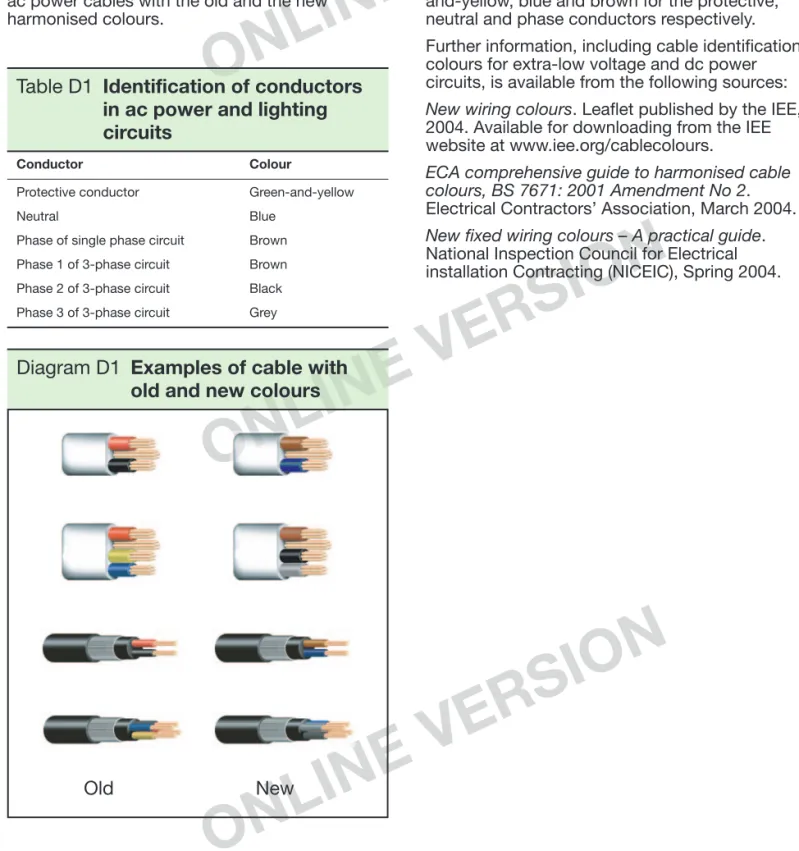
2.5 Appendix D offers guidance on applying the harmonised European cable identification system when making additions and alterations to existing installations.
Section 2: Extensions, material alterations
and material changes of use
App Doc P_new.indd 13
App Doc P_new.indd 13 14/3/06 19:17:0214/3/06 19:17:02
ONLINE
VERSION
ONLINE
VERSION
ONLINE
ON
LIN
E V
ER
SIO
N
ON
LIN
E V
ER
SIO
N
ON
LIN
E V
ER
SIO
N
P
14
Electrical safety – dwellings Approved Document P
Electricity at Work Regulations 1989
3.1 All electrical installations must be
accommodated in ways that meet the requirements of the Building Regulations. However electrical installations carried out by persons on whom duties are imposed by the Electricity at Work Regulations 1989 must meet the requirements of those Regulations.
3.2 The advice given below reflects the present state of the Electricity at Work Regulations 1989 following amendments by Statutory Instruments 1996/192, 1997/1993 and 1999/2024.
3.3 Regulation 3 imposes duties on employers, employees and the self-employed. Regulation 3(2)(b) places duties on employees equivalent to those placed on employers and self-employed persons where there are matters within their control.
3.4 The text of the Electricity at Work Regulations and guidance on how to comply with them are contained in the Health and Safety guidance document ‘ Memorandum of Guidance on the Electricity at Work Regulations 1989 – HSR25 ’. Important elements of the Regulations include: a. The Electricity at Work Regulations require
that electrical work is only carried out by persons that are competent to prevent danger and injury while doing it, or who are appropriately supervised (Regulation 16). b. The Electricity at Work Regulations set general
requirements for the design, construction and suitability of equipment for its intended use (Regulations 4(1), 5, 6, 7, 8, 9, 10, 11, 12).
Electricity Safety, Quality and
Continuity Regulations 2002
3.5 The Electricity Safety, Quality and Continuity Regulations 2002 (SI 2002/2665) came into force on 31 January 2003. These Regulations replaced the Electricity Supply Regulations 1988 (as amended).
3.6 The Regulations specify safety standards which are aimed at protecting the general public from danger. In addition, the Regulations specify power quality and supply continuity requirements to ensure an efficient and economic electricity supply service for consumers.The Regulations were introduced to improve standards in public safety and to align requirements to modern electricity markets.
3.7 The duty holders are generators, distributors, suppliers, meter operators, consumers and specified persons. Most of the duties apply to distributors who own or operate networks used to supply consumers’ installations, street furniture or other networks.
3.8 Amongst other duties, distributors are required to provide an earthing facility for new connections (unless this would be inappropriate
for safety reasons), to maintain the supply within defined tolerance limits and to provide certain technical and safety information to consumers to enable them to design their installations.
3.9 Distributors and meter operators must ensure that their equipment on consumers’ premises is suitable for its purpose and safe in its particular environment and that the polarity of conductors is clearly indicated.
3.10 The Regulations allow the Secretary of State to issue safety enforcement notices to consumers in circumstances where consumers’ installations outside buildings present a danger to the public.
3.11 In relation to ‘embedded’ generation5, the Regulations require persons operating ‘switched alternative’ sources of energy in their installations to prevent a parallel connection occurring with the distributor’s network and to comply with BS 7671 . Sources of energy that operate in parallel with the distributor’s network must meet certain additional safety standards: for example the equipment must not be a source of danger or cause interference with the distributor’s network. Persons installing domestic combined heat and power equipment must advise the local distributor of their intentions before or at the time of
commissioning the source.
3.12 Distributors are prevented by the Regulations from connecting installations to their networks which do not comply with BS 7671. Other persons may connect installations to distributors’ networks provided they obtain the prior consent of the distributor, who may require evidence that the installation complies with BS 7671 and that the connection itself will meet safety and operational requirements. Distributors may disconnect consumers’ installations which are a source of danger or cause interference with their networks or other installations.
3.13 Detailed Guidance on the Regulations is available at www.dti.gov.uk/electricity-regulations.
Functionality requirements
3.14 Part P of the Building Regulations makes requirements covering the safety of fixed electrical installations , but does not cover system functionality. The functionality of electrically powered systems such as fire alarm systems, fans and pumps is covered in other Parts of the Building Regulations and other legislation.
Section 3: Information about other legislation
5 ‘Embedded’ generators are those connected to the distribution networks
of public electricity suppliers rather than directly to the National Grid. Most CHP and renewable generating stations are embedded.
App Doc P_new.indd 14
App Doc P_new.indd 14 14/3/06 19:17:0214/3/06 19:17:02
ONLINE
VERSION
ONLINE
VERSION
ONLINE
VERSION
ON
LIN
E V
ER
SIO
N
ON
LIN
E V
ER
SIO
N
ON
LIN
E V
ER
SIO
N
P
15
Approved Document P Electrical safety – dwellings
Notes
1. The diagrams do not give all the information needed to achieve compliance with BS 7671 , nor do they cover all the electrical services found in dwellings, some of which (e.g. swimming pools and saunas) are subject to special requirements specified in Part 6 of BS 7671:2001. The diagrams must not be used for installation purposes.
2. The diagrams are simplified examples of what may be encountered. They are not a substitute for the proper consideration of for instance:
a. Cross-sectional areas (csa) of the phase and neutral conductors of circuits. The minimum csa required by BS 7671 depends on a number of variables, including: type of cable, number of cores, type and nominal current of overcurrent protective device, grouping with other circuits, ambient temperature, contact with thermally insulating materials and circuit length. b. Cross-sectional areas of protective
conductors. BS 7671 contains different rules, involving a number of variables, for determining the minimum csa for each type of protective conductor, including the earthing conductor, circuit protective conductors, main equipotential bonding conductors and supplementary bonding conductors.
c. Types and nominal current ratings of fuses or circuit breakers. These particulars depend on the circuit design current and load characteristics, and need to be co-ordinated with the circuit conductors and with the earth fault loop impedance of the circuit.
d. Types of wiring or wiring system. While PVC insulated and sheathed cables are likely to be suitable for much of the wiring in a typical dwelling, other types of cable may also be necessary. For example, heat-resisting flexible cables are required for the final connections to certain equipment; the cable to the garage or shed, if run underground, is subject to certain requirements; and cables concealed in floors and walls in certain circumstances are required to have an earthed metal covering, be enclosed in steel conduit or have additional mechanical protection. e. Principles of cable routing. BS 7671 contains criteria for the routing and positioning of cables, so as to give protection against electric shock and fire as a result of mechanical damage to a cable. For example, such criteria are given for cables concealed in walls or buried in the ground.
f. Current ratings of circuits to fixed current-using equipment such as a shower or cooker.
In the above context, diagrams are given as follows:
Diagram 1(a) indicates the many electrical appliances that can be found in the home and how they might be supplied.
Diagram 1(b) indicates earthing and bonding arrangements that can be necessary.
Diagram 2(a) indicates earthing arrangements as might be provided by electricity distributors.
Diagram 2(b) indicates the earthing arrangement as might need to be provided by the consumer.
Appendix A: Examples of electrical
installation diagrams
Key to diagrams
App Doc P_new.indd 15
App Doc P_new.indd 15 14/3/06 19:17:0314/3/06 19:17:03
ONLINE
VERSION
ONLINE
VERSION
ONLINE
VERSION
ON
LIN
E V
ER
SIO
N
ON
LIN
E V
ER
SIO
N
ON
LIN
E V
ER
SIO
N
16
Electrical safety – dwellings Approved Document P
Diagram 1(a)
Illustration of the fi xed electrical installation that might be commonly
encountered in new or upgraded existing dwellings
Notes:
1. See the general rules in BS 7671:2001.
2. The RCD component in the main switch is required for TT systems (see Diagram 2(b)). Individual circuit 30mA RCDs may be required to avoid unnecessary tripping.
3. The notices include advice on periodic testing and regular test operation of the RCDs.
4. The zone shown around the bath or shower corresponds to zone 3 in Section 601 of BS 7671:2001. The socket-outlet shown in the bedroom with the shower cubicle must be outside zone 3.
P
EXAMPLES OF ELECTRICAL INSTALLATION DIAGRAMS
App Doc P_new.indd 16
App Doc P_new.indd 16 14/3/06 19:17:0314/3/06 19:17:03
ONLINE
VERSION
ONLINE
VERSION
ONLINE
ON
LIN
E V
ER
SIO
N
ON
LIN
E V
ER
SIO
N
ON
LIN
E V
ER
SIO
N
17
Approved Document P Electrical safety – dwellings
Diagram 1(b)
Illustration of earthing and bonding conductors that might be part
of the electrical installation shown in Diagram 1(a)
Notes:
1. See the general rules in BS 7671:2001.
2. Circuit protective conductors are taken to all items of fixed electrical equipment and local isolation and switching devices which appear in Diagram 1(a). 3. In the case of a protective multiple earthing (PME) supply (see Diagram 2(a)), consult the electricity distributor.
4. Supplementary bonding is required in bathrooms to an extent dependent upon the presence of metallic fixtures, fittings and pipework: see Section 601 of BS 7671:2001.
EXAMPLES OF ELECTRICAL INSTALLATION DIAGRAMS
P
App Doc P_new.indd 17
App Doc P_new.indd 17 14/3/06 19:17:0414/3/06 19:17:04
ONLINE
VERSION
ONLINE
VERSION
ONLINE
ON
LIN
E V
ER
SIO
N
ON
LIN
E V
ER
SIO
N
ON
LIN
E V
ER
SIO
N
18
Electrical safety – dwellings Approved Document P
Diagram 2(a)
Example earthing arrangement where the electricity distributor
provides the earth connection (referred to as TN-C-S where the
connection is made to A, or TN-S where the connection is made
to B – the most common systems in urban areas)
Notes:
1. Connection A shows the arrangement where an electricity distributor provides a combined protective earthing and neutral conductor as part of a protective multiple earthing system (referred to as TN-C-S).
Connection B shows the arrangement where an electricity distributor provides a protective earthing conductor (usually the metallic covering of the supply cable) that is separate from the neutral conductor (as part of a system referred to as TN-S).
2. Connection A or B can only be made by the electricity distributor or its appointed agent.
P
EXAMPLES OF ELECTRICAL INSTALLATION DIAGRAMS
App Doc P_new.indd 18
App Doc P_new.indd 18 14/3/06 19:17:0514/3/06 19:17:05