e
Joined Up W
elf
ar
e
Joined Up Welfare
The next steps for personalisation
Guy Miscampbell
Edited by Ruth Porter
Joined Up Welfare
The next steps for personalisation
Guy Miscampbell
Edited by Ruth Porter
Policy Exchange is the UK’s leading think tank. We are an educational charity whose mission is to develop and promote new policy ideas
that will deliver better public services, a stronger society and a more dynamic economy. Registered charity no: 1096300.
Policy Exchange is committed to an evidence-based approach to policy development. We work in partnership with academics and other experts and commission major studies involving thorough empirical research of alternative policy outcomes. We believe that the policy experience of other countries offers important lessons for government in the UK. We also believe that government has much to learn from business and the voluntary sector.
Trustees
Daniel Finkelstein (Chairman of the Board), David Meller (Deputy Chair), Theodore Agnew, Richard Briance, Simon Brocklebank-Fowler, Robin Edwards, Richard Ehrman, Virginia Fraser, David Frum, Edward Heathcoat Amory, Krishna Rao, George Robinson, Robert Rosenkranz, Charles Stewart-Smith and Simon Wolfson.
Guy Miscampbell is a Research Fellow in Policy Exchange’s Economics and Social Policy unit. Prior to joining Policy Exchange he read Economics and Politics at Durham University. Whilst there he interned in the office of United States Congressman Don Young, as well as winning the inaugural Global Debate and Public Policy Championship.
Ruth Porter joined Policy Exchange in January 2014 as Head of Economics & Social Policy. Ruth has more than a decade of experience working in public policy with leading think tanks, in both the UK and New Zealand. Most recently she worked as the Communications Director at the Institute of Economic Affairs. In previous roles, she co-authored a series of reports on education that won the Innovative Projects category of the Sir Antony Fisher International Memorial Awards, as well as editing the book Pursuing Social Justice in New Zealand, which was launched by New Zealand’s Governor-General.
She is a frequent commentator in the media, regularly taking part in programmes such as Radio 5’s Paper Review and BBC 2’s Newsnight. She is also an Adviser to Million Jobs, a campaign focused on helping more young people find work.
© Policy Exchange 2014 Published by
Policy Exchange, Clutha House, 10 Storey’s Gate, London SW1P 3AY
www.policyexchange.org.uk
ISBN: 978-1-907689-78-9
Printed by Heron, Dawson and Sawyer Designed by Soapbox, www.soapbox.co.uk
Contents
About the Economics and Social Policy Unit 4
Acknowledgements 5
The Research Process 6
Executive summary 7
1 Multiple disadvantage 13
2 Progress and remaining challenges 19
3 Principles for reform 25
4 A Central Hub 30
5 Diverse Services 34
6 Effective Diagnosis 39
7 Summary of Recommendations 47
Appendix A: Roundtable discussions: A summary 50
and Social Policy Unit
Policy Exchange wants to see a high growth, enterprise led economy in the UK with freer markets driving growth and opportunity. Where individuals, families and communities are encouraged to take responsibility and are able to flourish. We are optimistic about the country’s future and the power of freedom and responsibility to improve people’s lives.
Email:
[email protected] [email protected] [email protected] [email protected] Twitter:
@ruthoporter @sc_hughes
@guymiscampbell @jondupont
Acknowledgements
We are grateful to the Hadley Trust for their continued support of this programme of work.
We are also thankful to all those who contributed to our research through submissions to the call for evidence, attending roundtables, or contributing through meetings and informal discussions. Specific thanks go to Matthew Oakley, Ed Holmes, Chris Goulden, Jonty Olliff-Cooper and Richard Wellings for their thoughts, inspiration and reviews.
We would also like to thank a number of officials at the Department for Work and Pensions and other Civil Service departments who have been helpful in providing information and responding to requests. Any errors remain the authors.
As part of the research process we held several roundtable discussions to discuss how groups with multiple issues experience the current provision of services. The main purpose of these roundtables was to assess how uncoordinated services affected service users and providers at the local level, and to guide our policy recommendations.
We also launched a call for evidence, as well as consulting with multiple stakeholders and officials. This report has formed from a synthesis of the information we collected, and supporting research we undertook. Finally, we passed the report on to several expert reviewers in order to gain their feedback and views. More detail on the roundtables and the call for evidence can be found in the appendices.
Executive Summary
Mental health problems, low skills, family disruption, criminal history, social networks that don’t encourage work, substance abuse, physical health issues, disabilities, unstable housing, lack of resources - more than one in ten adults in Britain suffer from multiple disadvantages of these kind at any one time, including many of the most vulnerable people in our society.
Finding a way to improve the quality of life for these people is essential. This requires a system that is as flexible as possible. Successive governments have attempted to create a more joined up and citizen-centred service and some progress has been achieved, but much remains to be done.
This is not an academic question. There are, for example, 11.5 million working-age people in Great Britain with a long-term health condition, and 18% of the working age population has a mental health problem. An estimated 10,000 16-18 year olds leave care each year. The welfare reforms have improved matters, but there is still too much duplication and inefficiency in the system for it to help many who deserve support.
A jobseeker might suffer from a range of issues which prevent them finding and sustaining work, but the current welfare system often does not deal with these overlapping problems from the beginning of the process.People can be referred to a variety of different services that operate independently of each other. For example, someone suffering from a lack of training, mental health issues and who has been out of work for a long period of time might receive support from six different providers including the jobcentre, a work programme provider, an external charity, the local authority, and health services.
The extent to which these services would then work together is limited, meaning cross-cutting issues are sometimes not addressed effectively. This is confusing for the user, and expensive for the government. Attempts to overcome this issue have been made with schemes such as the Troubled Families programme, but they only apply to specific groups or areas rather than fundamentally joining up the services most people receive.
Jobcentre Plus is not particularly successful at returning people sustainably to work. We have previously estimated that only 36% of JSA claimants would find a job within six months of claiming benefits and keep it over the whole of a 7-8 month period. Others do not find employment, or cycle in and out of work. Much of this can be attributed to them having barriers to work which are not fully dealt with.
Why does this happen?
The roots of this problem come from the way that services are traditionally designed and commissioned. There are two issues:
z Signposting for services does not occur from one identifiable point.
z Delivery of services is not as specialised as it needs to be.
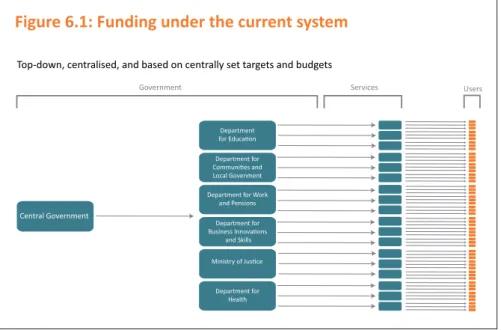
In general, even for those with multiple issues, services are funded and provided separately. The only thing which unifies them is the end user. This means that they do not take account of each other, and may not provide services in the most appropriate manner.
Our current welfare system has made great strides in recent years, and is aiming to reduce complexity, a goal best demonstrated by the objective of Universal Credit to streamline a number of separate benefits into a single payment. It has also made progress towards becoming more joined up and more personalised, but more is left to do. Currently a separated system persists because:
1. There is no single, clear, and central point of contact for users.
2. The dominance of Jobcentre Plus on employment support services prevents the development of more specialist providers and personalised welfare services.
3. Government departments and budgets are frequently ‘siloed’, hindering the development of cross-cutting policy, and preventing funding from effectively flowing to joined up approaches.
4. Commissioning generally occurs across diverse and overlapping commissioning zones, hindering effective design.
5. A lack of local information stymies coordination on the ground and hinders joinup.
6. There are huge barriers to the effective use of data, making it difficult to track the effectiveness of any single intervention and assess the needs of service users.
7. There is a need to adapt to the changing nature of the welfare system. Universal Credit, in-work conditionality, renegotiation of the JCP estate, and an increase in contracted out support all mean that over the next decade there will be significant questions as to how the welfare state should evolve.
Recommendations:
Creating a central hub that comprehensively assesses people’s specific needs
In general, Jobcentre Plus performs well at the administration of benefits, and bringing certain groups closer to the labour market. However, there are legitimate concerns about how effective the organisation is at moving those with more significant barriers to work into the labour market. One way to join up services would be provide a single portal through which they are accessed, as is the case in Canada.
Executive Summary
We believe this approach of having a single portal to access services should be replicated. Ideally users would have a single journey where advisers can identify an individual’s specific barriers to work and refer them to the appropriate provider as soon as possible. To achieve this type of experience we recommend a number of reforms to the existing employment support framework:
z Jobcentre Plus as it currently exists should be split into two constituent parts. The first would be the ‘Citizen Support’ centre which would act as the primary and central hub for accessing government services.
z Citizen Support centres would encompass referral for a much wider range of services than just employment support, including skills support and other services which tackle barriers to work, such as mental health or substance abuse.
z The employment support element of JCP should be established as a separate body and transformed into a mutual.
This would mean that from first contact the whole of the user’s barriers would be addressed together rather than by a series of separate services. Transferring to this sort of system would entail a number of logistical changes. Therefore we suggest that:
z In the shorter-term, the referral aspect of services should move to co-locating where possible in order to begin adjusting user expectations. This could occur either in existing JCP facilities, or in other community spaces.
z In the longer-term decisions regarding the estates of government services should be made with a view to rolling referral and administrative services into Citizen Support centres.
Creating a more diverse range of employment services
Having specialist services tackle different combinations of needs necessarily means involving a more diverse set of providers than currently exists, and an ability for individuals to receive services from them much earlier in their journey than is currently the case. As such, we recommend that
z The default settings for employment support services should be that they are contracted out to private, third sector or local bodies.
Since being created in 2005, Service Canada has been the place where Canadians access programs, services and benefits from the Canadian Government. It functions as a single point of access which provides administrative services and other functions at around 600 points throughout the country
Where Service Canada does not directly provide services, it helps Canadians access other programmes. In this sense it brings together access to a vast number of services and reflects citizens’ expectations of government, referring them on to others where necessary. It achieved this through establishing a ‘one-client’ view of services in order to avoid duplication such as having to provide personal information multiple times over each interaction.
z The employment support element of Jobcentre Plus should be spun out into a mutual or social enterprise which is then subject to competition with other providers.
Individuals would then be referred to the most appropriate provider through a combination of user preference and the provider’s history of success. If a provider is more effective then it will survive. If it is not then there is no reason individuals should be using that service before other forms of support. Our priority should be finding the most effective support possible rather than supporting one particular provider. Mutualising the employment support element of JCP would be an appropriate way of transferring responsibility and funding to more of a private-sector structure without compromising its identity.
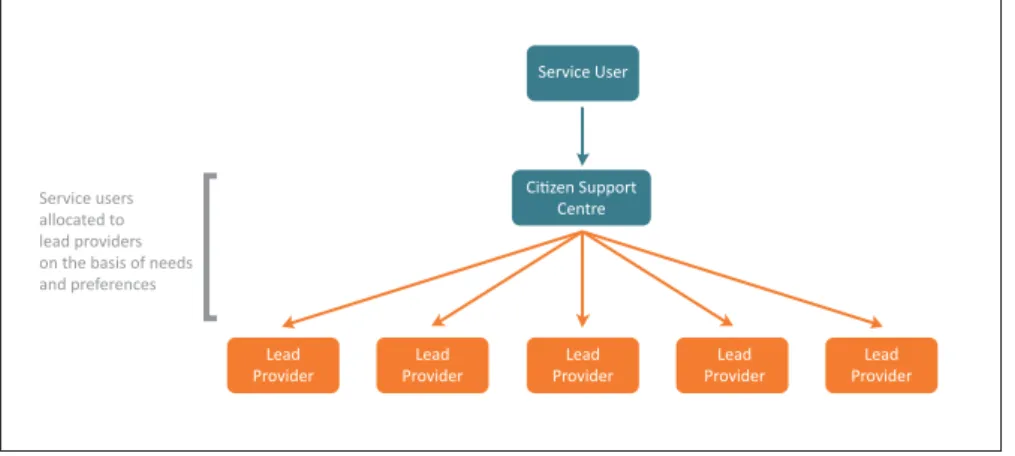
The provider an individual was referred to would act as a ‘lead provider’ who would then coordinate specialist support suited to that person’s needs, and operate as a specific point of contact for other services the individual was using.
In order to ensure the market for providing these services is competitive, referral will have to occur on the basis of the most suitable provider rather than pre-existing relationships. This means selecting programs on their merit rather than who is providing them. As a consequence we suggest:
z A ‘purchaser-provider’ split should exist between Citizen Support centres and those providing employment support services. Allocation to services should depend on two criteria:
z The performance of the provider when dealing with similar individuals. z The preferences of the individual receiving services.
This also means that instead of creating new government run or directly commissioned services, government should instead commit to a system targeted purely at need and demand. As such, if it wants to take action on specific issues such as youth unemployment, we recommend that:
z Government should instead control the overall budget, rather than creating micromanaged or targeted schemes.
z Where discrete government schemes are created, they should compete for funding on a level playing field with other providers.
There would also be important implications for how government commissions services. Currently this is undertaken on the basis of geographical boundaries, an arrangement which would have to be rethought. One way that this could be done is by investigating a system of licence-based commissioning similar to that used by General Practitioners. To assess how feasible this is, we recommend that:
z DWP and other relevant departments should consult on how a licence-based system would operate, and whether or not it is an appropriate way of expanding access to the market.
Executive Summary
Shift funding so it follows the individual to the provider they select, rather than funding providers directly.
Joining up services around the citizen necessitates that funding is accurate, responsive, and citizen-centred. We suggest that instead of funding services directly:
z The Citizen Support centre should attach a bespoke payment to the individual on the basis of their barriers to employment. This should then be the sum available to the provider if they help the individual sustainably find employment.
This would mean that services would have to be centred on the individual and their needs, rather than allocated through eligibility criteria. Providers would become subject to competition for customers and resources, rather than lobbying policymakers for resources to be allocated to specific services. This approach would create a system which focuses on solving the issues an individual faces, putting sustainable goals first and foremost in the minds of providers.
In order to ensure that claimants were provided with the right treatment, and that the correct incentives were created for providers, it would be necessary to ensure this payment varies depending on how severe the user’s barriers to work are. We recommend that to achieve this:
z The Department for Work and Pensions should develop a diagnostic tool that assesses the barriers faced by claimants and the intensity of those barriers.
There have been several attempts to develop these tools so far. It is unclear at this time which approaches may yield the most useful results. Therefore we recommend that a number of different tools are developed and trialled:
z The Department for Work and Pensions should continue with its attempts to develop diagnostic tools which segment on the basis of how likely claimants are to respond to specific interventions.
z Alongside predictive tools the Department should develop one based on an accumulation of claimant data and an assessment of how severe those barriers to work are, rather than an attempt to predict the likelihood of long-term employment.
One way this type of assessment could be facilitated is the collection and use of more relevant data at an individual’s first interaction with the Citizen Support centre. We suggest that this could be facilitated by:
z The Citizen Support centre undertaking a full assessment of each individual’s needs at initial contact, in order to gather all of the data that would previously have been collected by a plethora of referral bodies and organisations.
z Wherever possible, Citizen Support centres should utilise existing data to help assess the barriers service users will face. This should be achieved by
data sharing agreements between the Department and other central and local government bodies.
This information could then be used to communicate the correct information and outcome payment to providers. This would allow them to correctly gauge the individual’s distance from the labour market, and incentivise them to carry out the appropriate interventions. We suggest that this could be achieved by:
z The collected data being incorporated into a model which provides a summary of the individual’s service needs, their intensity, and the corresponding outcome payment.
z This system then producing a digestible summary which can be included with the referral that follows the individual.
z The model focusing on existing barriers to work and service needs rather than attempting to predict more variable long-term outcomes.
A path forward
Over the next decade a number of choices will have to made on the future of the welfare state and how welfare to work services can be best provided. We believe that a system which focuses on the individual and puts their needs at the centre of consideration is the most appropriate approach.
Through increased personalisation, and a structure which emphasises making services simple and accessible, we believe that a more joined up and cohesive service could be created. This is the next logical step in the direction of the welfare reforms. It would mean less waste, and more individuals who can tackle their barriers to work and fulfil their potential. As such, this report lays out a direction of reform we believe should be pursued, and which should shape the welfare to work system over the next decade and beyond.
1
Multiple Disadvantage
Mental health problems, low skills, family disruption, criminal history, social networks that don’t encourage work, substance abuse, physical health issues, disabilities, unstable housing, lack of resources - more than one in ten adults in Britain suffer from multiple disadvantages of these kind at any one time, including many of the most vulnerable people in our society.12
Finding a way to improve the quality of life for these people by providing exactly the right help is essential to promoting employment and addressing social exclusion.3 This requires a system that is as flexible as possible.4 Successive governments have attempted to create more joined up and citizen-centred services and some progress has been achieved but much still remains to be done. The recent Department for Work and Pensions’ social justice strategy identified this as a priority, commenting that:
“It is clear that the number of people facing multiple disadvantages which damage their life chances and those of their children, is unacceptably high.”5
These issues are often analysed and measured separately, making it very hard to gain an exact sense of the problem.6 However, the figures below provide some insight into how many people may be affected:
z There are 11.5 million working-age people in Great Britain with a long-term health condition and more than half are classified as disabled. Compared to a rate of 77% for those without health issues, the employment rate for working-age people with long-term health issues is 58% and for disabled people it is 45%.7
z Up to 18% of the working age population has a mental health problem, and there is an increasing prevalence of sickness benefit claimants claiming mental or behavioural disorder as their primary condition.8
z The UK government estimates that there are some 120,000 ‘troubled families’,9 defined as having at least five out of seven10 of the possible problems they consider.11 However, the accuracy of this figure has been disputed.1213
z An estimated 10,000 16-18 year olds leave care each year. In 2013, 34% of all care leavers were not in education, employment or training by the age of 19 – more than double the number in the general population.14
These examples may overlap in some areas, but they demonstrate how many people rely on multiple state services at any one time. The current way public
1. Defined as suffering from three or more of six areas of disadvantage: Education, health, employment, income, social support, housing and local environment.
2. Department for Work and Pensions, Social Justice:
Trans-forming Lives, HM Government,
2012
3.A working definition of social exclusion provided by Levitas et al., The Multi-Dimensional
Analysis of Social Exclusion,
Department of Sociology and School for Social Policy Townsend Centre for the International Study of Poverty, 2007 stipulates that:
“Social exclusion is a complex and multi-dimensional process. It involves the lack or denial of resources, rights, goods and services, and the inability to participate in the normal relation-ships and activities, available to the majority of people in a society, whether in economic, social, cultural or political arenas. It affects both the quality of life of individuals and the equity and cohesion of society as a whole.”
From this, and the range of risk factors the article identifies, it is reasonable to assume that social exclusion is wide and varied, requiring different interventions in different circumstances. 4. See McNeil. C, Now it’s
personal, Personal advisers and the new public service work-force, IPPR, 2009: “Personalised employment programmes are the most effective, including cost effective, way of providing active employment support.” And Gregg
P, ‘Realising Potential: A Vision for Personalised Conditionality and Support’, DWP, 2008: “[A]
combi-nation of personalised support and conditionality will ensure that claimants undertake activity that both they and their personal adviser agree will support an eventual return to work.”
5. Department for Work and Pensions, Social Justice:
Transforming Lives, HM
Government, 2012 6. For example, the English Indicies of Deprivation can be used to identify the relative deprivation of an area, but not to identify deprived people themselves. See: Department for Communities and Local Government, The English Indices
of Deprivation 2010 – Neighbour-hoods Statistical Release, 2011 &
Department for Communities and Local Government, English Indices
of Deprivation 2010 – Guidance document, 2011
7. Department for Work and Pensions, The disability and
health employment strategy: the discussion so far, DWP, 2013
8. van Stolk. Et al. Psychological
Wellbeing and Work, DWP &
DH, 2014
9. Pickles. E, Written
state-ment to Parliastate-ment – Troubled Families programme,
Depart-ment for Communities and Local Government, 2013 – Accessed at: (https://www.gov.uk/govern- ment/speeches/troubled-families-programme--2)
10. No parent in work, poor quality housing, no parent with qualifications, mother with mental health problems, one parent with a longstanding disability/illness, low family income, family unable to afford some food/clothing items. 11. Department for Communities and Local Government, Troubled Family Estimates Explanatory Note, 2013 – Accessed at: (http:// webarchive.nationalarchives. gov.uk/20120919132719/www. communities.gov.uk/documents/ newsroom/pdf/2053538.pdf) 12. Portes. J, “Neighbours from
hell”: who is the Prime Minister talking about?, National Institute
for Economic and Social Research, 2012
13. Portes. J, “The Government
continues to abuse the data on “troubled families”, National
Institute for Economic and Social Research, 2012
14. HM Government, Care Leaver Strategy – A cross-departmental strategy for young people leaving care, 2013
15. Dunleavy. P, The Future of
Joined-up Public Services, 2020
Public Services Trust at the RSA, 2010
16. See Gardiner. L & Wilson. T,
Hidden Talents – Analysis of frag-mentation of services to young people, CESI, 2012 - which notes
confusion in the case of services for young people.
17. For example one charity responding to our call for evidence stated that: “There is
no real coordination and people often find themselves on a tread-mill repeating the same courses and programmes and never getting a job.”
services are structured and provided is simply not adequate to deal with many of these scenarios.15 This causes multiple problems:
z In some cases, services don’t help the end client sufficiently:
z They are confusing making it hard for a user to know which services are
available, and what they are entitled to.16
z They can be ineffective, not addressing problems properly, or in an
appropriate order.17
z They can cause clients to miss out on help due to strict eligibility
criteria.18
z They can be expensive
z Ineffective interventions and services can waste resources put into the
system if they do not achieve their desired outcomes.
z There is too much duplication, with the same functions being carried out
multiple times by multiple agencies.19
z They don’t achieve their goals, causing higher costs down the line.20
Combined, the resources allocated to tackle barriers to work are not as effective as they should be. Frequently, people cannot or do not access the most appropriate forms of support.21 When they do, it often does not take account of other forms of assistance they may be receiving. In some cases this is because providers are unaware of the other services. In others there may be institutional barriers to cooperation, or insufficient resources and incentives to encourage providers to work together.22
For example, currently if an unemployed individual has little work history, a poor education, and undiagnosed mental health issues, they could receive varying levels of support from Jobcentre Plus, Work Programme providers, social work departments, local authority employment schemes, the National Careers Service, skills training from an FE college, and potentially several charities. This is before underlying mental health issues have been treated.
In short, they may be dealing with a wide array of different programmes and schemes in what can be a convoluted experience. If that is not the case, they may have ‘slipped through’ the net and would not be receiving services they would need to overcome their barriers to work.23
This is best highlighted by comments from an attendee at one of the roundtables hosted by Policy Exchange. He described his experience with a child he had known for a decade. The child’s family was involved with selling drugs and in the period of time that he had known him, the boy had been expelled from school, involved in a local gang and eventually went to jail. The entrenched family, drugs and skills issues he had would have required a comprehensive approach to tackle, whereas instead a piecemeal approach was used and failed to resolve the problems:
“Every now and again, we’d bring him over to our offices and we’d talk about the potential for getting him work and every now and then he’d say yes I want to get work, I want to stop doing the drugs, but he has no skills ... He came to us a couple of weeks ago and said “you know what, it’s finally clicked he wants to go back to college to do an access course.
Multiple disadvantage
18. For example one Housing Association responding to our call for evidence stated that: “There
is often duplication and job seekers are often hampered by a range of specific criteria to access them [services].”
19. For example a group of councils responding to our call for evidence stated that in their experience: “Multiple
programmes mean a variety of different referral routes … This can lead to overpayment for outcomes, high levels of deadweight, double funding and duplication of provision.”
20. See Allen. G, Early
Interven-tion: The Next Steps, HM
Govern-ment, 2011 for a discussion of early intervention and how savings may be attained by effec-tive intervention.
21. For example see Lane. K,
Fair welfare: supporting claim-ants into work, Citizens Advice
Bureau, 2010 - Surveys found that many were not happy with the support offered and that it was not tailored. See Ginger-bread, Submission of evidence
to the Work and Pensions Select Committee, 2013 – Over half
the single parents interviewed felt under-served by the JCP offer. See Work and Pensions Select Committee, Can the Work
Programme work for all user groups? 2013 –
For specific issues relating to currently Work Programme policy meeting the hardest to help claimants’ needs. See Finn. D,
Delivering income support and employment services – the service user perspective (presentation),
Centre for Economic and Social Inclusion, 2014 – Issues listed include not enough individualised support, allocation to ineffective activities, and difficulties with take-up.
22. For an exploration of these issues see Holmes. E & Oakley. M, Route2Work – Employment
Support for the very-hardest-to-help, Policy Exchange, 2013,
pp. 28-29
23. Froy. F & Giguère. S, Breaking
out of policy silos – doing more with less, Local Economics and
Employment Development (LEED), OECD Publishing, 2010 24. Quote from an attendee at our ‘Families with multiple
depen-dencies’ roundtable. It should be
noted that the views of advisers and other observers do not necessarily reflect a full under-standing of all underlying factors affecting an individual, or how the individual perceives them-selves and their service needs. “We’re looking out the window a few days later and he was there with all his friends, all his
family. Still selling drugs. The likelihood that he ends up, at this stage in his life he will go to college, to read law, or read anything, is very very small. And he is inherently a nice boy, it’s all about the family he happened to be with.”24
No service will ever be perfect, but trying to solve each issue in isolation would not be sufficient to tackle the type of entrenched issue this family faced. Solving cross-cutting issues requires a bolder approach than simply tinkering around the edges or relying on excellent local practice to patch over the flaws in service design.
Why does this happen?
The roots of this problem come from the way that services are traditionally designed and commissioned. There are two issues:
z Signposting to services does not occur from one identifiable point.
z Delivery of services is not as specialised as it needs to be.
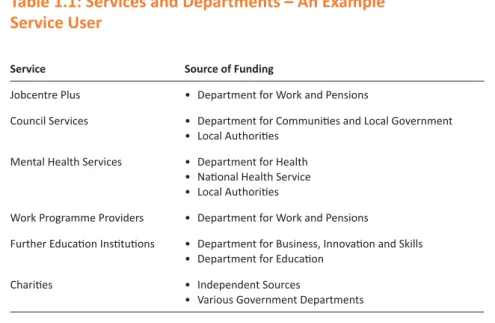
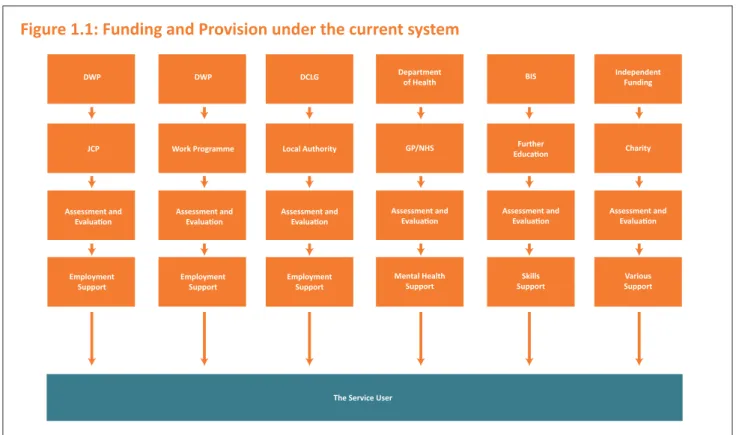
As an illustration, someone suffering from skills needs, mental health issues and long-term unemployment is likely to be receiving some of the various services depicted below:
In general these would be funded and provided separately. They will often be accessed independently and will not be coordinated. An example of how a hypothetical citizen with these types of needs might interact with those services is given below. Funding flows from departments to bodies which then assess eligibility and deliver support.
Table 1.1: Services and Departments – An Example
Service User
Service Source of Funding
Jobcentre Plus • Department for Work and Pensions
Council Services • Department for Communities and Local Government
• Local Authorities
Mental Health Services • Department for Health
• National Health Service • Local Authorities
Work Programme Providers • Department for Work and Pensions
Further Education Institutions • Department for Business, Innovation and Skills • Department for Education
Charities • Independent Sources
25. Department for Work and Pensions Benefit Reform Division,
Universal Credit: welfare that works, Department for Work and
Pensions , 2010
All of these programmes have the same goal: To help the client overcome the issues they face. Despite this, each service is provided separately. The only thing which unifies them is the end user. This approach is broadly replicated across different services, with a few notable exceptions. The result is that services can be disjointed, confusing, and unstructured.
There is a clear government commitment to simplifying the welfare system, best demonstrated by the goal of Universal Credit to streamline a number of separate benefits into a single payment.25 However, there are still several reasons this structure persists:
1. There is no one clear central point of contact for users, i.e. a key signposting service with overarching responsibility for coordination is missing.
2. The dominance of Job Centre Plus on employment services prevents the development of more specialist providers and personalised welfare services. 3. Government departments and budgets are frequently ‘siloed’, hindering the
development of cross-cutting policy, and preventing funding from effectively flowing to joined up approaches.
4. Commissioning generally occurs across diverse and overlapping commissioning zones, hindering effective design.
5. A lack of local information stymies coordination on the ground and hinders joinup.
6. There are huge barriers to the effective use of data, making it difficult to track the effectiveness of any single intervention and assess the needs of service users. An example from Essex of the resulting service landscape throughout the local authority is displayed in box 1.2 overleaf:
Figure 1.1: Funding and Provision under the current system
DWP DWP DCLG Departmentof Health BIS IndependentFunding
JCP Work Programme Local Authority GP/NHS EducationFurther Charity
Assessment and
Evaluation Assessment andEvaluation Assessment andEvaluation Assessment andEvaluation Assessment andEvaluation Assessment andEvaluation
Employment
Support EmploymentSupport EmploymentSupport
The Service User
Mental Health
Multiple disadvantage
Figure 1.2: Landscape in Essex pre-Community Budgets
Source: Whole Essex Community Budgets/Wilson. T, & Gallagher. P, Community Works – Putting work, skills and enterprise at the heart of
Community Budgets, Centre for Economic & Social Inclusion, 2013
policyexchange.org.uk | 9
Mini
str
y of Jus
tic e Na tional Off en der Ser vice Community Learning Adult Community Learni ng Specialis t Schools & Pr ovi der s Appr en ticesh ip Tr aini ng Ag ency NEET S In ter ven tion Team Raisi ng Participa tion Ag e Team Tr ansition P ath w ay Ser vice Esse x Coun ty Council Thurr ock Counci l (Un itar y) Sou th
end Council (Unitar
y) Educ ationa l Funding Authority (EF A)
Schools to ag
e 16
6
th F
orm
to 18
6
th F
orm Col leg es 16-18 Sup ply Chai
n including ITP
s Col leg es 16-18 Appr en ticesh ip s 16-18
Adult Skills budg
ets inc Appr en ticeship s 19+ FE HE Depa rtmen t f or Ed uc
ation & Skills (DfE)
You
th Co
ntr
act
NEET - RP
A Independen t T raining Pr ovider ( ITP) Appr en ticesh ip s 16-18
Adult Skills budg
ets inc Appr en ticeship s 19+ Fr esh St art Independen t T raini ng Pr ovider W ork Pr ogr
amme - 2 x Prime Pr
ovider s inc Y outh Co ntr act W ag e Incen tiv e Supply Chai n includes Righ t t o Con tr ol ( pil ot) Supply Chai n includes Supply Chai n includes Famil
ies with Multiple Pr
ob
lems - Prime Pr
ovider W ork T rials W ork Experience W
ork & En
terp rise Cl ub s W ork T og eth er Fle xible Su pport (F SF) Partner ship Gr an ts Depa rtmen t f or W
ork & P
ensions (D WP) Ne w En terprise Allo w an ce, Men
tor & Loan
(2 x Primes, JCP Admin)
Pr e-empl oymen t tr ainin g sect
or based w
or
k ac
ademies
UK Commission f
or Emplo ymen t & Ski lls (UK CE S)
21 x Sect
or Skil ls Council s Emp lo yer s Jobcen tr e Plus Sup ply Chai
n including ITP
s Na tional App ren ticeship Ser vi ce Gr ow
th & I
nno
va
tion Fund
W
ork Place Learning
Independen t T raini ng Pr ovider Learn Dir ect (R egio nal Con tr
act with Sup
ply Chai
n ITP
s)
Adv
anced Learning Loans ag
e 24+ Univ er sities Higher E duc ation Fundin g Coun ci l
for England (HEF
CE)
Ac
ademies to age 16
CEIAG CEIAG
CEIAG
CEIAG
6
th F
orm
to 18
HMR
C
Business Link W
eb sit e Depa rtmen t f or Busi ness, Inno va tion
& Skills (B
IS) Skills Fund
ing Ag ency (S FA) Off ender s Learning
& Skills Ser
vice OFSTED
Emplo
yer Owner
ship of Skill
s ( pi lot) Independen t T raini ng Pr ovider s Appr en ticesh ip s 16-18
Adult Skills budg
ets inc Appr en ticeship s 19+ Ski lls S upport f or Unempl oy ed & Appr en ticeship Gr an ts f or Emp lo yer s (A
GE) Skills S
upport f
or R
edu
ndancy
3 x ITP
s CEI AG W eb sit e CEI AG Phone Ser vice 13-adul t CEI AG 19+ Face t o F ace
(18+ JCP r
ef err als) Ac cess t o W ork JCP Suppo rt Co ntr
act - Pri
me Pr ovider Respo nse t o Redundancy Ski lls T rai
ning & Licen
ces not fu nded b y SF A Other Co mm er cial T raining Pr ovider s FSF Lo w V alue Pr ocur emen t Na tional Ca reer s Ser vice Independen t Pr ovider s Vo lun tar
y & Co
mmunity Sect or inc Y outh Co ntr act W ag e Incen tiv e W
ork Choice - Prime Pr
ovider
Figur
e X: Skills and Emplo
yability as-is in Esse
x Di rectl y Funded KEY ES F Fun ded Partner ship Deli ver y
Why does this matter?
There has been a consistent case put forward by a series of Employment Ministers: that Jobcentre Plus is working and high levels of off-flow from JSA demonstrate it is returning people to work.26 This view was reflected by recent comments from the Secretary of State for Work and Pensions that:
“The number of people stuck on Jobseeker’s Allowance for a year or more is down by almost a fifth.”27
This measure is important and other labour market indicators are generally positive. However, there is a strong possibility that results are less good for a subset of JSA leavers. An individual leaving Job Seekers Allowance (JSA) can indicate desirable outcomes such as finding sustained employment, mixed outcomes such as finding short-term employment, or negative outcomes such as simply dropping out of the system or returning to JSA.28 There is, for example, evidence of individuals in a ‘low-pay, no-pay’ cycle,29 and whilst individuals leaving JSA is generally a good thing, they may leave for insecure work and require support again sooner rather than later.
It is hard to judge the scale of this problem as figures on sustained job outcomes are not publicly available, though it has been suggested by the Work and Pensions Select Committee that they should be for the purposes of measurement.30 However, using a statistical release on the destinations of 2011 jobseekers, Policy Exchange has previously estimated that only 36% of JSA claimants would find a job within six months of claiming benefits and keep it over the whole of a 7-8 month period.3132
The salient point is that the number of people leaving JSA is one important measure, but does not capture a whole range of outcomes.3334 For example, the same report estimates that only 68% of those leaving JSA enter paid employment, and that only 71% of those entering employment sustained it continuously for 7-8 months. Simply focusing on how many people left JSA masks groups who either cannot sustain work, or have not found it. More current data collected on sustainable job outcomes is patchy, though the Department has noted that once the transition to Universal Credit has occurred the use of real-time information will allow greater sophistication in measurement.35
One explanation as to why ‘cycling’ between JSA and short-term employment would be occurring is that at least some individuals are likely to have multiple dependencies which prevent them from sustaining work or progressing within the employment they have.36 For example, somebody with a chaotic family situation may not be able to sustain working full-time due to the disruption going on in their household. As such, they would ‘cycle’ off JSA, only to become unemployed again later. An appropriate intervention would target the main barrier to work – their chaotic family situation, allowing them to enter employment more sustainably at a later date.
There is a need to act and ensure interventions are effective, sustainably solving the issues they target rather than kicking the can down the road. This happens already in areas of excellent practice, or for certain groups, but we need to hardwire this focus into the system and make more coordinated and joined up working the principle goal of any intervention.
26. For instance see: Esther Mcvey: (http://www.grimsby- telegraph.co.uk/Government- work-pay-mantra-paying/story-21253879-detail/story.html); Chris Grayling: (http://www.dwp. gov.uk/newsroom/ministers-speeches/2012/24-01-12.shtml); Mark Hoban: (http://www.dwp. gov.uk/newsroom/ministers-speeches/2012/19-09-12. shtml); James Purnell: (http:// webarchive.nationalarchives.gov. uk/20091107151134/http://www. dwp.gov.uk/newsroom/ministers-speeches/2008/09-10-08.shtml) 27. The Rt Hon Iain Duncan Smith, Speech – Jobs and Welfare
reform: getting Britain working,
DWP, 2014
28. See: Adams et al.
Destina-tions of Jobseeker’s Allowance, Income Support and Employment and Support Allowance Leavers 2011, Department for Work
and Pensions, 2012. A survey of around 3,400 JSA claimants indi-cated that 7-8 months later only 55% of leavers were in paid work, with 30% claiming an out-of-work benefit and 15% doing neither. 29. Shildrick. T, et al. The low-pay,
no-pay cycle – Understanding recurrent poverty, Joseph
Rowntree Foundation, 2010 30. Work and Pensions Select Committee, The role of Jobcentre
Plus in the reformed welfare system, House of Commons, 2014
31. Oakley. M, Welfare Reform
2.0 – Long-term solutions, not short-term savings, Policy
Exchange, 2012
32. A freedom of information request seeking to update these figures was rejected on the grounds of cost to collect and analyse the information. 33. A detailed criticism of the current performance metrics which focus on off-flow can be found in: Walker. B et al., Up to
the job? How reforming Jobcentre Plus will help tackle worklessness,
Centre for Social Justice, 2013, pp. 11-17
34. Alternative measures suggested during the research process included ‘out of poverty’ or ‘off Universal Credit and in work’ measures. Policy Exchange has consistently advocated that performance should be assessed on the basis of sustainable employment.
35. Work and Pensions Committee, Role of Jobcentre
Plus in the reformed welfare system: Government Response to the Committee’s Second Report of Session 2013-2014, House of
36. E.g. for Homelessness see Singh. P, ‘No Home, No Job –
Moving on from transitional spaces,’ Off the streets and Into
Work, 2005.
For Health and employment see Shildrick. T et al. ‘The low-pay,
no-pay cycle – Understanding recurrent poverty’, Joseph
Rowntree Foundation, 2010. For Debt see Fuertes. B, ‘Barriers
to escaping the low-pay no-pay cycle for disadvantaged parents’
Employment Research Institute, 2010.
For General linkages see Hendra. R et al., ‘Breaking the low-pay,
no-pay cycle: Final evidence from the UK Employment Retention and Advancement (ERA) demon-stration’, DWP, 2011.
It is however worth noting that several of these studies identify that there are also labour market reasons (such as low paid insecure work) which means that instability within work will exist to some extent. This cannot easily be disentangled from the effects of multiple dependencies. 37. Mulgan. G, Joined-Up
Govern-ment: Past, Present, and Future,
British Academy, 2005 38. HM Government,
Modernising government, 1999
39. Bourn. J, Joining Up to
Improve Public Services, National
Audit Office, 2001
40. HM Treasury & Department for Communities and Local Government, Total place: a whole
area approach to public services,
HM Treasury, 2010
41. HM Government, Open Public
Services White Paper, 2011
42. See for example: Depart-ment for Communities and Local Government, Anti-social
Behav-iour Intensive Family Support Projects – Housing Research Summary, DCLG, 2006
43. Department for Communi-ties and Local Government, The
Troubled Families programme – Financial framework for the Troubled Families programme’s payment-by-results scheme for local authorities, DCLG, 2012
44. Department for Work and Pensions, ESF Support for Families
with Multiple Problems – statis-tics to January 2014, DWP, 2014
45. National Audit Office,
Department for Communities and Local Government and the Department for Work and Pensions, Programmes to help
families facing multiple chal-lenges, NAO, 2013
2
Progress and Remaining
Challenges
There have been a number of attempts to integrate services. Tony Blair originally articulated this as a goal in 1997,37 which was followed by the publication of the Modernising Government white paper38 and the Joining Up to Improve Public Services report by the National Audit Office.39
More recently attempts to rethink how public services are delivered took place through the 2009 Total Place pilots,40 which aimed to create incentives for local cooperation as well as an increased responsibility over different policy areas. In addition, there has been the Open Public Services white paper41 and a number of other pilots and policies. Generally, these attempts can be described as one of three approaches:
1. Joining up around specific service needs by identifying areas where there is duplication or several needs are likely to coincide, and then combining funding or programs which deal with them.
2. Joining up around a ‘place’ by devolving power, responsibility, and funding to a more local level with the intention of creating a greater join-up of services. 3. Personalising services by giving individuals control of budgets and allowing
them to purchase the most appropriate services.
The Government has launched or piloted a number of programmes which embody these approaches. Examples of a couple of projects in the first category are detailed below:
Box 2.1: Joining up around specific service needs: Two policies
Troubled Families
Emphasis on family intervention is not a new priority,42 but the most recent step have
been the Troubled Families programme launched by the Department for Communities and Local Government in 201243 and the Families with Multiple Problems programme
launched by the Department for Work and Pensions in 2011.44
There is a unifying approach to both of these initiatives, namely that “the design of both programmes recognises that addressing the intractable problems encountered by families facing multiple issues can lead to social improvements and fiscal benefits.”45
To achieve this, the Troubled Families programme articulated five principles that are designed to make interventions more effective:
46. Department for Communities and Local Government, Working
with Troubled Families – A guide to the evidence and good practice, DCLG, 2012
47. National Audit Office,
Depart-ment for Communities and Local Government and the Depart-ment for Work and Pensions – Programmes to help families facing multiple challenges, NAO,
2013
48. Department for Communities and Local Government, The Cost
of Troubled Families, DCLG, 2013
49. Department for Work and Pensions & Jobcentre Plus, Access
to Work – Factsheet, DWP, 2014
50. Thompson. A, et al. Work
Choice Evaluation: Commissioning and Transition of Clients to the Programme, DWP, 2011
51. Gheera.M, & Long. R,
Inde-pendent Living Fund, House of
Commons Library, 2014 52. Department for Communities and Local Government, Disabled
facilities grant, DCLG, 2009
53. Jarrett. T, The Supporting
People programme, House of
Commons Library, 2012 54. Tu. T, et al. Evaluation of the
Right to Control Trailblazers: Synthesis Report, Ipsos MORI
Social Research Institute & Office for Disability Issues, 2013
z A dedicated worker, dedicated to a specific family; z Practical ‘hands on’ support;
z A persistent, assertive and challenging approach;
z Considering the family as a whole – gathering the intelligence; z Common purpose and agreed action.46
While it is still too early to reach a conclusion on the scheme, DCLG reported that outcomes claimed for by local authorities exceeded targets by 3 percent.47 However,
there are wider issues with accurately quantifying the financial savings that might be achieved.48
Right to Control
The Right to Control trailblazers were an approach to giving choice and control over public funding to disabled adults. They achieved this by bringing together funding from a wide range of services including:
z Access to Work (DWP) – A scheme to provide practical or financial support to help
them overcome barriers to starting or keeping a job.49
z Work Choice (DWP) – A disability employment programme which supports those
who cannot be supported through mainstream employment services.50
z Independent Living Fund (DWP) – A programme which delivers financial
assistance to support disabled people living in their communities rather than residential care.51
z Disabled Facilities Grant (DCLG) – A grant for providing adaptions and facilities to
ensure a disabled person can continue to live in their property.52
z Supporting People (DCLG) – A grant to local authorities to help vulnerable people
live independently.53
The initiative aims to give a greater amount of control and choice to users of these services, and was piloted in seven areas. However, no significant positive impact was found. The evaluation primarily attributed this to customers not following the intended journey and the lack of a sufficiently developed provider market.54
Why would we need wider reform?
These schemes have had varying degrees of success. However, they are all based around identifying a specific set of needs and solving them with a specific package of services. This approach could be rolled out to some extent, but it would mean that individuals who did not fit into these specific groups would be excluded from the joined up services.
This means, for example, that an individual meeting four rather than five of the seven ‘troubled families’ metrics would not receive assistance from the more cohesive service. Similarly, if they had other issues that fell outside of the programme’s remit they would still not receive coordinated attention to address these other problems.
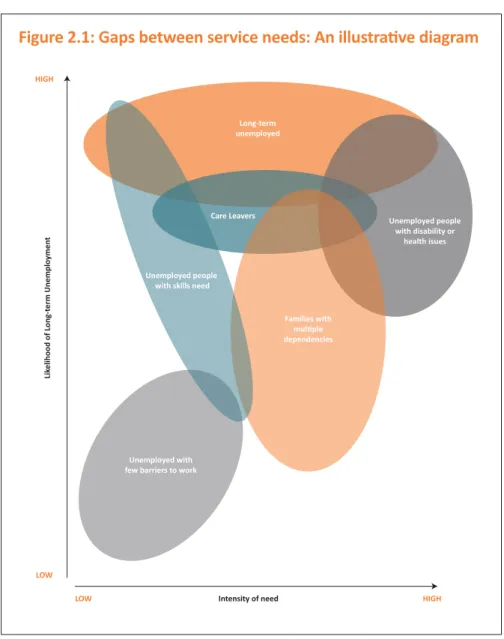
The diagram below provides an illustration of this issue. While simplified, it demonstrates that a combination of needs could fall anywhere along the scale. Designing schemes with certain combinations in mind will exclude those who
Progress and remaining challenges
fall out of those ‘groups’, or fall into several of them. These individuals are represented by overlaps, or the space outside the ‘groups’ in the diagram.
Instead of focusing on specific programs and combinations of needs, there should be a focus on how services can respond to individual needs, providing a better service for all, rather than only for select groups.
Without this approach, the system will continue to rely on strict eligibility, siloed design and fragmented delivery. Some acknowledgement of this issue can be gleaned from alternative forms of coordination where experiments have occurred. Increasingly, the focus should therefore not be on putting support packages together, but looking at how to resolve the deeper flaws of the current arrangements.
One attempt to achieve this has come from the second approach, trying to join up around services within a ‘place’. Notably, community budgets and city deals both take a ‘place-based’ approach, aiming to provide a more effective route for funding to provide coordinated services within a certain area. They are summarised below:
Figure 2.1: Gaps between service needs: An illustrative diagram
Intensity of need
Lik
elihood of Long-t
erm Unemplo
ymen
t
HIGH
HIGH LOW
LOW
Long-term unemployed
Unemployed people with skills need
Families with
multiple
dependencies
Unemployed with few barriers to work
Care Leavers Unemployed people
with disability or health isues
55. Department for Communities and Local Government, 16 areas
get ‘community budgets’ to help the vulnerable, DCLG, 2010
56. Q228 - House of Commons Communities and Local Government Committee,
Communiy Budgets, House of
Commons, 2013
57. For example, see: House of Commons Committee of Public Accounts, Integration across
government and Whole-Place Community Budgets, House of
Commons, 2013
58. National Audit Office, Case
study on integration: Measuring the costs and benefits of Whole-Place Community Budgets,
National Audit Office, 2013 59. HM Government, Unlocking
growth in cities: city deals – wave 1, HM Government, 2012
60. Tinsley. M, Cultures of
Depen-dency – Fact, fiction, solutions,
Policy Exchange, 2013 61. Department of Health,
Personalised budgets for all and more breaks for carers, DH, 2010
Box 2.2: Joining up around a ‘place’ : Community Budgets and
City Deals
Community Budgets
Community Budgets are intended to establish joint budgets by bringing together all funding for local public services. In simple terms, they pool resources for tackling an issue at a local level.55 Their primary aim is to improve services, though they are also
expected to deliver savings.56
Sixteen ‘first-phase’ pilots were announced in April 2011 for Community Budgets for families with multiple problems and two more types of pilots (for local public services and local issues) were announced in December 2011. They are subject to ongoing evaluation and discussion57 and were analysed in a 2013 report by the National Audit
Office58 who indicated that early signs are positive.
City Deals
The City Deals process has had two waves. The first consisted of the eight largest cities outside of London being given new powers over spending and economic policy. This was followed up by a second wave of the next fourteen largest cities outside of London and the six cities with the highest rates of population growth in recent times.
The deals themselves provide cities with new responsibilities and corresponding powers over areas such as infrastructure investment, skills funding, or development funding. The first wave has been agreed and their details were laid out in the 2012 publication ‘Unlocking growth in cities: city deals – wave 1’.59 Submissions were made
in January 2013 from each city participating in wave 2 and were being approved towards the end of 2013 and the beginning of 2014.
The National Audit Office’s initial reviews were positive. The first wave of city deals are predicted to create 175,000 jobs and 37,000 new apprenticeships in the next 20 years.
There is certainly a role for these types of approaches and Policy Exchange has consistently advocated greater devolution of welfare powers to areas well placed to exercise them.60 However, this cannot be relied upon as a complete solution. Some local areas may lack the governance and resource to commission and organise such a large cross-cutting budget effectively, or services may be split across arbitrary geographical boundaries. Furthermore, they may not be the most effective providers or may prevent other more effective groups from accessing funding and providing services. These are not issues present in the third approach; personalising services.
Personalisation of services
The theory underpinning personal budgets and direct payments is that those who know their circumstances and barriers are best placed to make decisions over what type of support they should receive. The Coalition clearly sympathises with this view, and has made a commitment that everyone eligible would receive a personal budget by 2013.61
Progress and remaining challenges
Box 2.3: Personalising Services: Personalised Budgets and
Direct Payments
Direct payments have existed in some form since 1996-1997.62 They are made in lieu of
services and are provided to those who have needs which would be fulfilled by social care services. These include:
z Disabled people aged 16 or over with short or long-term needs. z Disabled parents for children’s services.
z Carers aged 16 or over, including those with parental responsibility for disabled children.
z Elderly people who rely on community care services.63
The amount received depends on the council’s estimate of the reasonable cost of the service. They can be used to provide flexibility and choice for the user, allowing them to make decisions over their care and equipment.
Since 2013, personal budgets have been established for all publicly funded adult social care other than when emergency access is required.64 There is, however, an
acknowledgement that they may not be suitable for everyone.
In principle a model resembling personal budgeting may be appropriate for several of the services in question. However, it is not suitable for all services and especially those where the user may be required to undertake tasks they may not do voluntarily, such as certain elements of employment support.
What can be taken from them is the general sentiment that budgets should correlate to needs, and that wherever possible “the right to self-determination will be at the heart of a reformed system.”65
Next Steps
In conclusion, there are many different types of public service reform that have been pioneered. Each has attempted to chip away at the existing situation through moving funding and responsibility closer to the individual, and pooling resources at a more local level. In these schemes, there is much to be emulated.
The first two approaches discussed here, joining up around a set of needs, and joining up around a place, are both fairly prescriptive. They would fail to improve the system for all groups regardless of their location or issues, and may have issues with scale which mean certain groups will not benefit. Therefore, emulating elements of the third, more personalised approach, would be the most appropriate way of ensuring that services are better coordinated for all groups.
The question is how to create a system that permits this type of flexibility and means that services wrap around the needs of individuals and communities. As the Open Public Services White Paper outlined in 2011:
“The job of government is not to specify which service to which people; rather it is to create an open framework within which people have the power to make the choices that are best for them, and where all good, innovative idea for improving the quality of services are welcomed and encouraged.”66
62. Gheera. M, Direct payments
and personal budgets for social care, House of Commons Library,
2013
63. UK Government, Apply for
Direct Payments – Accessed here:
(https://www.gov.uk/apply-direct-payments), 2014
64. Local Government Asso-ciation, Adass & NHS, Putting
People First – A shared vision and commitment to the transforma-tion of Adult Social Care, HM
Government, 2007 65. ibid.
66. HM Government, Open
Public Services White Paper, HM
The third approach, moving towards a more personalised system, is a step in the right direction. Whilst direct payments and personalised budgeting would not necessarily be appropriate and workable for all needs, a system which embraces tailored and individual support would. Ultimately provision should be built around individuals and their preferences wherever possible.
67. Holmes. E, Work Programme
2.0, Policy Exchange, 2014
(forth-coming)
3
Principles for Reform
Principle for reform 1: Create a central hub that comprehensively assesses people’s specific needs (this would be done by expanding the role of JCP).
Principle for reform 2: Create a more diverse range of employment services (through mutualising the employment services aspect of JCP).
Principle for reform 3: Shift funding so it follows the individual to the provider they select, rather than funding providers directly.
Our current welfare to work system has made great strides in recent years. It has made progress towards becoming more joined up and more personalised, as demonstrated by the Work Programme bringing in private providers and charities to assist the long-term unemployed. This has been a positive step and Policy Exchange will be proposing ways that the second iteration of the Work Programme could evolve and improve.67
Given these improvements, it is time to think about the next steps. With advances in technology, a developed network of service providers, and more sophisticated payment mechanisms, it is time to consider how employment support and other related services should evolve and what system we want to move towards over the next decade.
Specifically, this report supports a system that is driven by user demand rather than suppliers; that gives users greater control over the services they receive; and that combines the series of disparate services and referrals into a more cohesive system.
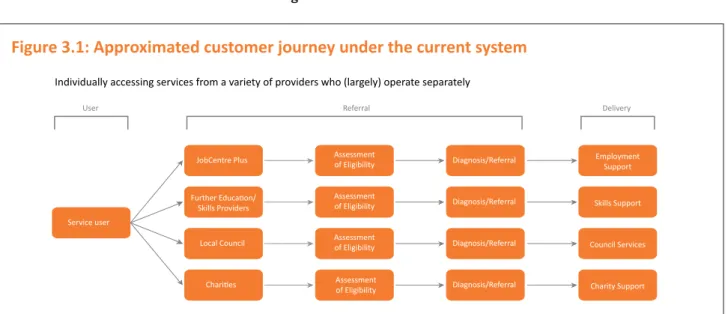
As discussed already, currently people are often assessed by and receive services separately. To understand how this works in practice, an example is demonstrated below (Diagram 3.1 overleaf).
The first step of rethinking this system would involve establishing a redesigned hub for accessing the majority of government services, rather than just employment support.
This organisation would act as a single point that would assess the barriers people face and the scale of their needs. It would then provide the individual with information about the support available to them and the comparative performance of providers who can deliver it.
Accounting for customer preferences, they would then be referred to a provider who would act as a caseholder, being the main point of contact for the customer, and responsible for planning and coordinating other support services they were receiving. This would resolve several of the issues which prevent coordination by ensuring that: