Experimental Characterization of Shape Memory Alloy Cables
for Applications in Civil Structures
Sherif Daghash1, Muhammad M. Sherif1, and Osman E. Ozbulut1
1 University of Virginia, Charlottesville, VA
ABSTRACT: Shape memory alloys (SMAs) have attracted a great deal of attention as a smart material that can be used in various civil engineering applications. In contrast to the use of SMAs in the biomedical, mechanical and aerospace applications, which requires mostly small diameter of material, the larger size bars are usually needed in a civil engineering application. It is well known that properties of large-section SMA bars are generally poorer than those of wires due to difficulties in material processing. Furthermore, large diameter SMA bars are more expensive than thin SMA wires. This study explores the performance of NiTi SMA cables and their potential use in civil engineering. In particular, superelastic properties of an SMA cable, which is composed of 7 strands and each strand has 7 wires with a diameter of 0.885 mm, are characterized through uniaxial tensile tests.
1 INTRODUCTION
The concept of using smart materials in engineering has received significant interest with the growing demand for high performance, adaptive, reliable and cost-effective structural systems. The use of smart materials that can serve multiple functions enables simplified designs, reduced material use, and less manufacturing complexity. A particularly appealing and interesting class of smart materials is shape memory alloys (SMAs). SMAs are a class of metallic alloys that possess several unique characteristics. The two most prominent properties of SMAs are the shape memory effect, which is the ability of the material to return to its original shape after heating; and superelastic effect, which is the ability of the material to recover its large inelastic deformations upon the removal of the load. Both of these peculiar capabilities depend largely on a diffusionless solid-to-solid phase change, i.e. martensitic transformations. As a result of these phase transformations, SMAs can produce very high actuation strain, stress, and work output. In addition, SMAs have excellent self-centering ability, good energy dissipation capacity, high corrosion resistance, and high fatigue life. Consequently, there have been a wide variety of applications of SMAs in various disciplines including biomedical, aerospace, automotive and other industries.
Due to their excellent biocompatibility and corrosion resistance, unique properties of SMAs were first exploited in medical applications. SMA staples are used to accelerate the healing process of broken and fractured bones by exerting a compressive force on the bone at the fracture point. Applications of shape memory alloys in heart surgery include artificial heart muscles, vane cave filters that stop blood clots, and arterial stents that have a self-expanding ability to counteract a disease-induced localized flow constriction (Morgan 2004). Spinal vertebra spacers that permits relative motions of two vertebrae, SMA gloves that help regain the
activity of hand muscles, eyeglasses frames that can be bent back and forth, and orthodontic arch wires that are used in dentistry are among other applications in the medical field (Gil and Planell 1998). In aerospace industry, SMA adaptive wings are studied to adjust the shape of an airfoil to the present flight conditions by exploiting temperature-induced transformations. An adaptive winglet that keeps the wing in an optimal shape that is appropriate to incoming flow is another aerospace application. Other industrial applications of SMAs include temperature control systems with memory alloys that immediately shut down the system in the presence of a temperature increase, heat-activated fasteners, attitude control systems of stationary satellites, and cellular telephone antennas (Mertmann 2004). While this brief review of SMAs in industrial applications is not intended to be exhaustive, it points out to the fact that SMAs have been employed in the form of small diameter wires or thin plates in a large majority of the applications.
As civil infrastructure systems are subjected to extreme events such as earthquakes, hurricanes, and tropical storms more frequently, structural engineers explore innovative strategies to avoid, minimize or mitigate potential consequences. Many researchers have explored the use of SMAs in various civil infrastructures and performed a large number of numerical and experimental studies. SMA bracing systems have been studied by a large number of researchers for vibration control of building structures (Kari et al. 2011, Miller et al. 2012, and Ozbulut and Roschke 2010). A number of researchers have explored the potential application of superelastic SMAs in a seismic isolation system (Attanasi et al. 2009, Ozbulut and Hurlebaus 2010, 2011a-b, 2012, Dezfuli and Alam 2013). Several studies have considered the use of SMAs to reduce the oscillations in stayed cables of bridges under strong winds and traffic loads (Faravelli et al. 2011). The use of SMAs in concrete as short fiber (Moser et al. 2005), main reinforcement (Czaderski et al. 2006), or as strengthening reinforcement (Czaderski et al. 2014) has also been investigated.
Although it has been recognized that SMAs have significant potential for civil engineering applications, the widespread use of SMAs in civil infrastructures has been hindered by several factors such as the need for larger capacity SMAs and high material cost. Since the SMA wires are more readily available and have lower cost, most researchers considered the use of SMA wires, which lead to laboratory-scale investigations. Previous studies showed that good superelastic properties could be obtained in large diameter SMA bars (DesRoches et al. 2004). However, it is known that the SMAs in the wire form exhibit higher strength and damping properties. Furthermore, careful consideration of other factors such as higher cost and required particular processing of the SMA bars must be taken into account when determining whether to use the wire or bar for SMAs (DesRoches et al. 2004).
Shape memory alloy cables are relatively new structural elements that leverage the excellent mechanical properties of thin SMA wires into large force tension elements. The SMAs in the cable form may have potential performance and cost advantages over wires or bars and may expedite the implementation of SMAs in real-world applications. This study evaluates the performance of a large diameter SMA cable, which has a 7×7×0.885mm design, for civil engineering applications. In particular, a large number of tensile tests are conducted to examine the mechanical response of the SMA cable under various cyclic amplitudes and loading frequencies.
2 EXPERIMENTAL PROCEDURE
2.1 Material and Specimen
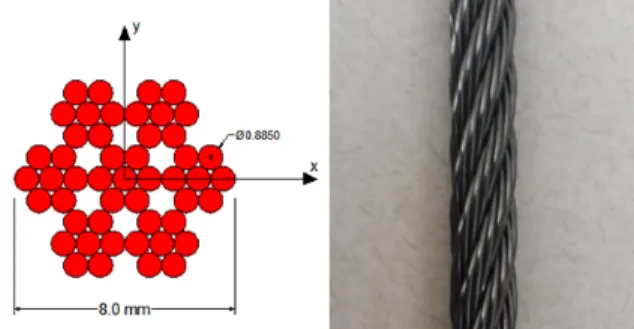
The material used in this research is SMA cable made of Nickel Titanium (NiTi) and obtained from Fort Wayne Metals, Research Products Corp. The SMA cable, which was produced in a helix configuration, composed of 7 strands and each strand had 7 wires. Each wire had a diameter of 0.885 mm providing outer cable diameter of 8 mm and total cross sectional area of 30.14 mm2. Figure 1 presents schematic drawing of the cable cross-section, and longitudinal
section of the cable. The test samples are obtained by cutting the cable into pieces with a length of 150 mm.
Figure 1. Schematic drawing of cable cross section and longitudinal section of the cable.
2.2 Experimental Test Setup
All the uniaxial tensile tests on SMA cable specimens were performed using MTS servo hydraulic system with mechanical grips. The displacement and force data was recorded using MTS data acquisition system. The specimens had a gauge length of 75 mm. In order to obtain more reliable strain data, the displacement or strain data were also measured using MTS laser extensometer and Digital Image Correlation (DIC) system which was provided by Correlated Solution, Inc. The DIC system first captures a series of pictures recording the deformation history of the specimen with a fast-rate camera and then analyzes the data using commercial software. The DIC measurements depend mainly on quality of the pattern of specimen surface. The surface pattern should be non-periodic, isotropic, and of high contract to guarantee accurate measurements of the DIC system with the lowest possible noise. This can be achieved by applying black dots on a white background painted on the specimen surface. Therefore, a speckle surface pattern was applied to one side of the test specimen. Finally, the variation of temperature in the cable was captured during the testing program. The temperature fields across the entire specimen length were measured using an infrared FLIR® A615 camera.
2.3 Testing Procedure
Before formal tests, a training test procedure that consists of 20 load cycles to obtain 5% strain at 0.01 Hz was applied on all specimens. Then, one specimen was cycled in a displacement-controlled mode in loading and force-displacement-controlled mode in unloading for 3 cycles at a frequency of 0.05 Hz and at 4% strain to calibrate the strain measurements of MTS system. The displacement data were recorded using both the MTS data acquisition system and the laser extensometer with a rate of 10 Hz. The strain data calculated from the extensometer were then used as a basis to calibrate the strain measurements of the MTS system. Afterwards, a thorough experimental testing program is followed. All the tests except the fatigue test were
displacement-controlled in loading and force-controlled in unloading to avoid applying any compression force on the cable during unloading.
In order to investigate the mechanical response of the cable under different strain amplitudes, the first SMA cable specimen was cycled at target strain amplitudes of 2, 3, 4, 5, 6, 7, 8 and 9% at a loading frequency of 0.05 Hz. All the tests lasted for 3 cycles. Data sampling rate of those tests for the MTS data acquisition, extensometer and DIC system was 10 Hz. Tests matrix was then extended to include the behavior of the cable under higher frequency cyclic loads. The tensile loads were applied to a second specimen to obtain about 6% strain at loading frequencies of 0.05, 0.1, 0.5, 1.0, and 2.0 Hz. Due to the limited capability of the DIC system at higher test frequencies, tests data were recorded using the MTS data acquisition system and the extensometer only with data sampling rate of 200 Hz. The third specimen was used to study the behavior of the cable under low-cycle fatigue loads. The specimen was subjected to cyclic loads in a force-controlled procedure for 100 cycles between stresses of 560 MPa (corresponds to a target strain amplitude of 6%) and near zero stress at a frequency of 0.05 Hz. The MTS data acquisition system, the laser extensometer and the DIC system were used to record the data with sampling rate of 10 Hz.
3 EXPERIMENTAL RESULTS
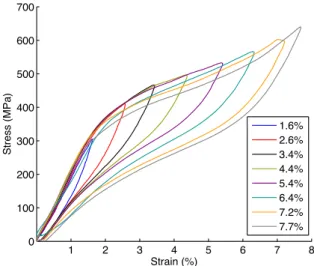
Figure 2 represents stress-strain curves for experimental tests at measured strain amplitudes varying from 1.6% to 7.7%. It can be observed that the material exhibits well-known flag-shaped cycles, which is a common behavior of SMAs. The SMA cable recovers almost all of its deformations upon unloading when it is loaded up to 6.4% strain. On the other hand, recorded residual strains at higher strain amplitudes are about only 0.2%. It can be also seen that the strength of the cable decreased at those strain amplitudes possibly due to the failure of individual wires at the gripping region.
Figure 2. Stress-strain curves of SMA cable tested under various strain amplitudes.
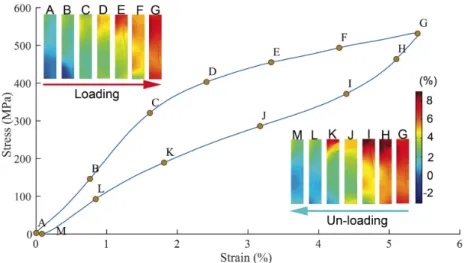
Figure 3 illustrates the stress-strain curve with strain field maps obtained at different load levels using DIC. The strain rate was equal to 0.005% s-1 during the loading phase and the maximum global strain was 5.4%. The specimen was unloaded back to zero stress with a rate of -0.50 MPa s-1. The maximum global strain can be correlated to strain field maps at different levels of load. However, the higher strains at the gripping regions can be observed from strain field maps. The
1 2 3 4 5 6 7 8 0 100 200 300 400 500 600 700 Strain (%) Stress (MPa) 1.6% 2.6% 3.4% 4.4% 5.4% 6.4% 7.2% 7.7%
increase in local strain along the gage length is mostly uniform, which indicate the growth of martensitic phase proceeds homogenously. Figure 4 shows the variation of temperature along the length of SMA cable during loading and unloading. Since the exothermic responses are generated during loading and the endothermic responses are generated during unloading by the stress-induced phase transformations, the temperature of the SMA cable increases during forward phase transformations and decreases during reverse phase transformations. The uniform temperature distributions on the surface of the SMA cable prove out the homogeneity of martensite development. In addition, the heat emission and absorption are observed to be symmetric during forward and reverse phase transformations.
Figure 3. Stress-strain curve of SMA cable at 5.4% strain with corresponding DIC axial strain field maps.
Figure 4. Temperature variations of SMA cable during loading and unloading.
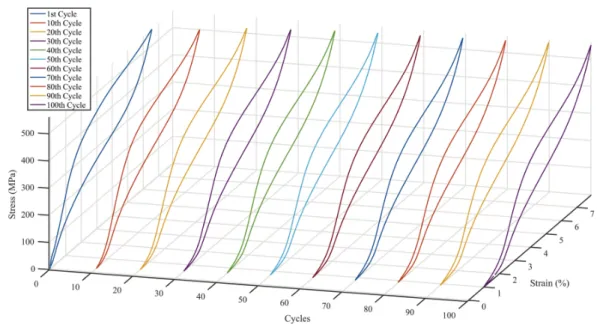
Knowledge of material behavior under repeated loading conditions is important for civil engineering applications of SMAs. Figure 5 shows the evolution of stress-strain curves for 100 cycles to a maximum strain of about 6%. It can be seen that the response of the SMA cable specimen up to 100 cycles is the typical flag-shaped hysteresis. However, the stress level for the
forward transformation decreases, while for the reverse transformation the stress remain constant or decreases slightly at higher number of cycles. Therefore, the area of the hysteresis loop becomes smaller with the increasing cycles. However, the change in hysteresis loops is more significant in the early cycles. This can be seen more clearly in Figure 6, which shows the stress-strain curves for first ten cycles as well as the cycles 41 to 50.
Figure 5. Stress-strain curves of SMA cable for every 10th cycle
Figure 6. Stress-strain curves of SMA cable for cycles 1-10 and 41-50.
Due to the accumulated residual strains, the hysteresis loops of SMA cable shift to the right with increasing number of cycles in Figure 7. The evolution of residual strain versus number of cycles is given in Figure 8. The maximum residual strain of the SMA cable subjected to 100 loading-unloading cycles is about 1.1%. It can be observed that the increment of the residual strain progressively reduces during cyclical loading. This can be explained as the permanent localized deformations accumulate in the early cycles and start to disappear in later cycles.
0 2 4 6 8 0 100 200 300 400 500 600 Strain (%) Stress (MPa) N=1 N=10 0 2 4 6 8 0 100 200 300 400 500 600 Strain (%) Stress (MPa) N=41 N=50
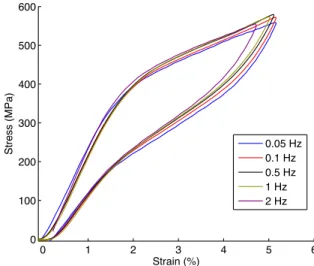
Figure 7. Evolution of residual strain as a function of number of cycles during cyclic tensile tests. In order to explore strain rate effects on the mechanical response of SMA cables, the tensile tests were conducted at a target strain of 6% for loading frequencies of 0.05, 0.1, 0.5, 1.0, and 2.0 Hz. Figure 8 shows the hysteresis loop at each loading frequency. It can be observed that the forward transformation stresses are about equal for all frequencies, while the reverse transformation stresses increase at higher test frequencies. High loading frequencies do not allow the material to transfer latent heat to the environment. As a result, the temperature of the material changes and this, in turn, alters the transformation stresses.
Figure 8. Stress-strain curves of SMA cable tested under various loading frequencies.
4 CONCLUSIONS
Shape memory alloys can be used in civil structures to enable more resilient and sustainable designs. However, for civil engineering applications, SMAs with large capacities are needed rather than thin wires. In this study, uniaxial tensile behavior of a large diameter SMA cable is studied. Experimental tests on an SMA cable, which has an outer diameter of 8 mm and
7×7×0.885mm design, conducted at various strain amplitudes and loading frequencies. The
test results indicate that the SMA cable can undergo deformations up to 6% strain with no residual deformations. It is also observed that the hysteresis loops narrows and residual strains
0 20 40 60 80 100 0 0.2 0.4 0.6 0.8 1 1.2 1.4 Cycles Residual Strain (%) 0 1 2 3 4 5 6 0 100 200 300 400 500 600 Strain (%) Stress (MPa) 0.05 Hz 0.1 Hz 0.5 Hz 1 Hz 2 Hz
are accumulated with the increasing number of loading cycles. The influence of number of loading cycles on the behavior of the SMA cable is more apparent in early cycles and tends to diminish, especially after the first 40 cycles. It is also noted that the increasing loading rates result in an upward shift in the reverse transformation stress levels while do not considerably alter the forward transformation levels.
As the SMA cables exhibit similar superelastic behavior to thin SMA wires and have lower costs than large diameter SMA bars, it can potentially accelerate the implementation of SMAs in real world applications. Shape memory alloy cables can be used as a component of seismic control devices such as dampers or base isolation systems to provide both re-centering ability and energy dissipation capacity or as bridge restrainers to mitigate pounding and unseating of bridges.
REFERENCES
Attanasi, G., Auricchio, F., and Fenves, GL. 2009. Feasibility investigation of superelastic effect devices for seismic isolation applications, Journal of Materials Engineering and Performance, 18, 5-6, 729-737.
Czaderski, C., Shahverdi, M., Brönnimann, R., Leinenbach, C., and Motavalli, M. 2014. Feasibility of iron-based shape memory alloy strips for prestressed strengthening of concrete structures. Construction and Building Materials, 56, 94-105.
Czaderski, C., Hahnebach, B., and Motavalli, M. 2006. RC beam with variable stiffness and strength.
Construction and Building Materials, 20(9), 824-833.
DesRoches, R., McCormick, C. and Delemont, M. 2004. Cyclic Properties of Superelastic Shape Memory Alloy Wires and Bars, Journal of Structural Engineering, 130(1), 38-46.
Dezfuli, FH., and Alam, MS. 2013. Shape memory alloy wire-based smart natural rubber bearing. Smart Materials and Structures, 22(4), 045013.
Faravelli, L., Fuggini, C., and Ubertini, F. 2011. Experimental study on hybrid control of multimodal cable vibrations. Meccanica, 46(5), 1073-1084.
Gil, FJ., and Planell, JA. 1998. Shape memory alloys for medical applications. Proc Inst Mech Eng, 212(6), 473-88.
Kari, A., Ghassemieh, M., and Abolmaali, SA. 2011. A new dual bracing system for improving the seismic behavior of steel structures. Smart Materials and Structures, 20(12), 125020.
Mertmann M., 2004. Non-Medical Applications of NITI- NOL, Minimally Invasive Therapy & Allied Technologies. 13(4), 254-260.
Miller, D. J., Fahnestock, LA., and Eatherton, MR. 2012. Development and experimental validation of a nickel–titanium shape memory alloy self-centering buckling-restrained brace. Engineering Structures,
40, 288-298.Morgan, NB. 2004. Medical shape memory alloy applications—the market and its products. Material Science and Engineering, A 378, 16-23.
Moser, K., Bergamini, A., Christen, R., and Czaderski, C. 2005. Feasibility of concrete prestressed by shape memory alloy short fibers. Materials and structures, 38(5), 593-600.
Ozbulut, OE., and Hurlebaus, S. 2010. Evaluation of the performance of a sliding-type base isolation system with a NiTi shape memory alloy device considering temperature effects. Engineering Structures, 32, 238-249.
Ozbulut, OE., Roschke, PN., 2010. GA-based optimum design of a shape memory alloy device for seismic response mitigation, Smart Materials and Structures, v 19, n 6, p 065004 (14 pp.).
Ozbulut, OE., and Hurlebaus, S. 2011a. Seismic assessment of bridge structures isolated by a shape memory alloy/rubber-based isolation system. Smart Materials and Structures, 20, 015003.
Ozbulut, OE., and Hurlebaus, S. 2011b. Energy-balance assessment of shape memory alloy-based seismic isolation devices. Smart Structures and Systems, 8, 399-412.
Ozbulut, OE., and Hurlebaus, S. 2012. A comparative study on seismic performance of superelastic-friction base isolators against near-field earthquakes. Earthquake Spectra, 28, 1147-1163.