Gatekeeper Compliance Audit Program
Gatekeeper Compliance Audit Program
Gatekeeper Compliance Audit Program| 2
Contents
Contents
2
1.
Guide Management
4
1.1.Change Log 5 1.2.Review Date 5 1.3.Conventions 51.4.Terms and Definitions 5
1.5.Advice on this Guide 5
1.6.Document Structure 6
2.
Introduction
7
2.1.Purpose 7
2.2.Terminology 7
3.
Gatekeeper PKI Framework
8
3.1.Gatekeeper PKI Framework 8
4.
Gatekeeper Audit Process
9
4.1.GCAP Audit Engagement 9
4.2.Prior Audit Work 9
4.3.Considering Audit work conducted on another Service ProviderError! Bookmark not
defined.
4.4.Audit Assessment 11
4.5.GCAP Audit Reporting 11
4.6.Audit Report Review 12
5.
Gatekeeper Audit Criteria
13
5.1 Summary of Audit Criteria 13
5.2 Gatekeeper Approved Documents 14
5.3 Personnel security 18
5.4 Physical and environmental security 20
5.5 Media and ICT equipment management 21
5.6 Access control management 23
5.7 Operations security 25
5.8 CA key lifecycle management controls 27
5.9 Subscriber key lifecycle management controls 30
Gatekeeper Compliance Audit Program| 3
5.11Business continuity management 32
5.12Outsourced arrangements 33
ANNEX A: Non-compliance ratings
34
ANNEX B: Control Mappings – WebTrust to GCAP
35
Gatekeeper Compliance Audit Program| 4
Figures
Figure 1: Framework Structure 8
Gatekeeper Compliance Audit Program| 5
1. Guide Management
1.1.
Change Log
This is the second published edition of the Gatekeeper Compliance Audit Program (GCAP). This release aligns with the compliance requirements of the current edition of the Australian Government Protective Security Policy Framework (PSPF) and
Australian Government Information Security Manual (ISM).
1.2.
Review Date
This document will be reviewed annually to remain consistent with the PSPF and ISM.
1.3.
Conventions
The GCAP adopts the following conventions:
MUST indicates a mandatory requirement that is required to be met in order to satisfy a control test.
SHOULD indicates something that is not mandatory but is recommended which supports either a mandatory control test or is considered best practice.
MUST NOT indicates something that if practiced, exercised or implemented will breach a GCAP control test.
NON COMPLIANCE will result if an Authorised Auditor determines a Service Provider does not meet a requirement listed in this guide. Non-compliance severity ratings are listed at Annex A.
1.4.
Terms and Definitions
The terms and definitions used in this document are defined in the Identity and Access Management Glossary.
1.5.
Advice on this Guide
Advice on the IRAP Guide or suggestions for amendment can be forwarded to: Gatekeeper Competent Authority
C/O Director, Authentication and Identity Management Efficiency, Assurance and Digital Government Cluster Governance and Resource Management Group Department of Finance
John Gorton Building King Edward Terrace PARKES ACT 2600
Gatekeeper Compliance Audit Program| 6
1.6.
Document Structure
This document is structured in the following manner: Section 2 provides an introduction to the GCAP Guide. Section 3 describes the Gatekeeper PKI Framework. Section 4 defines the Gatekeeper audit process.
Section 5 lists the compliance criteria and suggested audit guidance. Annex A list non-compliance severity ratings
Annex B and C map WebTrust and the European Telecommunications Standards Institute (ETSI)controls to GCAP to determine the suitability of using prior audit work as part of an annual Gatekeeper compliance audit.
Gatekeeper Compliance Audit Program| 7
2. Introduction
2.1.
Purpose
Under the Gatekeeper Public Key Infrastructure (PKI) Framework (the Framework), annual compliance audits remain a condition of Gatekeeper accreditation. In accordance with Clause 11 of the Gatekeeper Head Agreement/Memorandum of Agreement, the Department of Finance (Finance) requires that Authorised Auditors conduct an audit of Service Providers’ compliance with the Framework on the anniversary of their initial accreditation date.
Failure to conduct an annual Gatekeeper compliance audit represents a breach of the Gatekeeper Head Agreement/ Memorandum of Agreement and may result in termination of accreditation.
The primary objective of the GCAP is to provide a work program to assist Service Providers in meeting the compliance audit requirements stipulated in the
Gatekeeper Head Agreement/Memorandum of Agreement. The GCAP provides guidance to Authorised Auditors on the scope and conduct of the assessment required under Gatekeeper. The GCAP applies to all Gatekeeper Certification Authorities (CA), Registration Authorities (RA) and Validation Authorities (VA) across all Levels of Assurance (LOA).
Service Providers and Authorised Auditors are encouraged to seek further guidance from the documentation listed in the Framework at Section 5.8 (Mandatory
Requirements), Section 5.9 (Recommended Standards and Guides) and References (Section 13).
The complete suite of Gatekeeper documents is available at www.gatekeeper.gov.au
2.2.
Terminology
In conducting a compliance audit, the Authorised Auditor MUST have a degree of competence in Public Key Infrastructure (PKI) and general knowledge of Gatekeeper Policies and Criteria.
Note the following terms: Compliance
Audit
Means an engagement with an Authorised Auditor who conducts an independent audit to determine whether or not a Service Provider remains compliant with an accreditation regime.
Authorised Auditor
Refers solely to an individual who is listed on the Australian Signals Directorate Information Security Registered Assessors Program (IRAP) website.
Prior audit
work Refers to WebTrust
1 or ETSI2 audit work successfully completed in the period since the previous Gatekeeper compliance audit (or since accreditation if undertaking the first Gatekeeper compliance audit). Service
Provider Refers solely to a Gatekeeper Accredited RA, CA or VA, unless Explicitly stated otherwise.
1 For further information see [WebTrust] 2 For further information see [ETSI]
Gatekeeper Compliance Audit Program| 8
3. Gatekeeper PKI Framework
3.1.
Gatekeeper PKI Framework
The Framework is a whole-of-government suite of policies, standards and procedures that governs the use of PKI in Government for the authentication of individuals, organisations and non person entities.
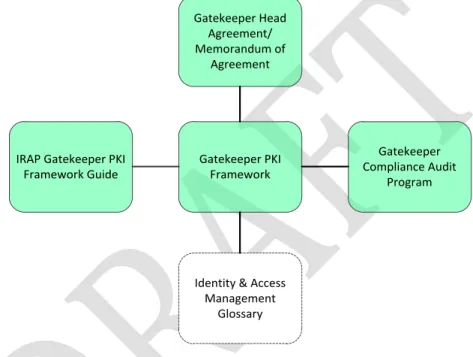
The Framework is built around five core documents as shown below.
Gatekeeper PKI Framework IRAP Gatekeeper PKI
Framework Guide Gatekeeper Compliance Audit Program Gatekeeper Head Agreement/ Memorandum of Agreement
Identity & Access Management
Glossary
Figure 1: Framework Structure
The Gatekeeper Compliance Audit Program (this document) provides guidance to Authorised Auditors and Service Providers on the scope and conduct of the compliance assessment required under the Framework.
The Gatekeeper PKI Framework defines the minimum requirements for Service Providers to obtain and maintain Gatekeeper accreditation.
The IRAP Gatekeeper PKI Framework Guide provides IRAP Assessors with a guide to assess the implementation of security practices and controls by Service Providers.
The Gatekeeper Head Agreement/Memorandum of Agreement is the ‘contract’ between Finance (on behalf of the Commonwealth) and the Service Provider. This provides a legal framework which establishes the conditions under which the Service Provider is accredited and what is required in order for the Service Provider to maintain its Gatekeeper Accreditation.
The Identity and Access Management Glossary contains a list of definitions, acronyms and associated terms related to the Framework. The Glossary also contains all related terms associated with the National e-Authentication Framework and the Third Party Identity Services Assurance Framework.
Gatekeeper Compliance Audit Program| 9
4. Gatekeeper Audit Process
4.1.
GCAP Audit Engagement
Service Providers SHOULD consider the following activities before engaging an Authorised Auditor:
Develop a GCAP Statement of Work (SOW) which describes the audit work to be undertaken. Include any information relating to changes that have occurred in the Service Provider’s PKI environment in the period since the previous GCAP, including:
o Outcomes of prior audit work;
o Changes to PKI environment or Gatekeeper Approved Documents; o Changes in the ownership or management of the Service Provider or PKI
environment;
o Compromises or security incidents; o Frequency of internal reviews; and
o Outcomes from testing Disaster Recovery and Business Continuity plans or Incident Response procedures.
Release the GCAP SOW with a Request for Tender (RFT);
o Authorised Auditors may use information within the GCAP SOW to assist in drafting their response to the RFT.
Review the responses to the RFT.
Once an Authorised Auditor has been selected the successful respondent and Gatekeeper Competent Authority should be informed.
Upon appointment, the chosen Authorised Auditor:
o formalises a contract with the Service Provider to conduct the Audit; o performs the GCAP as required; and
o reports its findings to the Gatekeeper Competent Authority, the Service Provider and any other parties agreed between the Authorised Auditor and the Service Provider.
4.2.
Prior Audit Work
The GCAP provides a set of procedures for Authorised Auditors to follow when they conduct an Audit of a Service Provider’s PKI operations. The GCAP provides
guidance on how an Authorised Auditor can use previously conducted audit work to reduce the possibility of unnecessary re-work.
An Authorised Auditor has the discretion in deciding whether to leverage WebTrust or ETSI audit work that has been completed in the period since the previous
Gatekeeper compliance audit.
WebTrust and ETSI are regarded as the most common programs for external CA Audits. Accordingly, Finance has decided that the GCAP does not warrant the
Gatekeeper Compliance Audit Program| 10
inclusion of additional Audit programs at this time. This decision will be reviewed annually to ensure consistency with international best practice for CA Audits.
Service Providers that have completed, or are considering either a WebTrust or ETSI audit program are required to provide status reports to the Authorised Auditor. Incorporating prior audit work by the Authorised Auditor provides two benefits to Service Providers:
Reduces expenditure on external Audit requirements; and
Reduces the extent of interruptions to operations when Audits occur.
The GCAP does not unequivocally accept prior audit work as sufficient to meet the compliance requirements for Gatekeeper. Rather, the modular structure of GCAP allows, where possible, work programs conducted under WebTrust or ETSI to be used as a substitute for parts of the GCAP work program. This is conditional on the Authorised Auditor being satisfied that the prior audit work provides adequate assurance within the constraints of the GCAP.
The following conditions apply when considering prior audit work:
The Authorised Auditor is required to review the relevant annex (i.e. Annex B or C), which specifies:
o the control mappings between GCAP and WebTrust and ETSI; and o the suitability of using these control mappings for GCAP.
The Authorised Auditor may choose not to consider previous work done and therefore conduct a full GCAP. The Authorised Auditor and the Service Provider will discuss and agree the factors contributing to this assessment.
o The Authorised Auditor may decide to conduct a full GCAP if prior work is deemed to be insufficient or there is a lack of evidence of the nature of the work undertaken.
The ‘actual’ WebTrust or ETSI audit work being considered MUST have been undertaken in the period since the previous Gatekeeper compliance audit (or since accreditation if undertaking the first Gatekeeper compliance audit), not the date on which the final Audit report was issued.
o The GCAP requires the work being considered to have been conducted to a satisfactory outcome.
The Authorised Auditor has the final responsibility in deciding whether prior audit work will be considered as part of the GCAP.
When a decision has been made to use work from a WebTrust or ETSI audit program, the Authorised Auditor MUST ensure that the decision is adequately supported.
Figure 2 shows the key decision points that an Authorised Auditor SHOULD consider when planning the Audit of a Service Provider’s PKI operations. This will help Authorised Auditors to consider prior work performed.
A full GCAP is required if the Authorised Auditor chooses not to rely on any audit work performed since the previous GCAP.
Gatekeeper Compliance Audit Program| 11
Figure 2: Authorised Auditor – GCAP Planning Procedure
4.3.
Audit Assessment
The GCAP consists of 108 controls. The Gatekeeper audit criteria include the list of controls to be evaluated and assessment guidance that can assist the Authorised Auditor in determining the adequacy of a Service Provider’s controls. Authorised Auditor’s are free to use alternative methods and criteria to evaluate the adequacy of controls.
Below is an example of GCAP control and assessment guidance.
Control Assessment Guidance
1. Unevaluated products are not used unless the risks have been
appropriately documented and accepted.
Seek evidence that the Service Provider is not using unevaluated products unless the risks have been appropriately documented and accepted.
4.4.
GCAP Audit Reporting
Upon completion of the GCAP, the Authorised Auditor will issue a final Gatekeeper Audit Report to the Gatekeeper Competent Authority, the Service Provider and any other entities agreed to in the GCAP contract. Unless otherwise specified in the GCAP contract, a Gatekeeper Audit Report is considered to be sensitive commercial
information and should be treated with the required level of security controls for their protection.
As part of the Gatekeeper Audit Report, the Authorised Auditor MUST detail: The work conducted including the outcomes of control tests that were
conducted;
Any adverse issues identified, including potential control or procedural weaknesses;
Gatekeeper Compliance Audit Program| 12
Areas of non-compliance and their associated severity ratings3; and Recommendations to remediate identified issues and non-compliances. Completed Gatekeeper Audit Reports are to be sent to the Gatekeeper Competent Authority at the following address:
Gatekeeper Competent Authority
C/O: Director, Authentication and Identity Management Efficiency, Assurance and Digital Government Cluster Governance and Resource Management Group Department of Finance
John Gorton Building King Edward Terrace PARKES ACT 2600
4.5.
Audit Report Review
The specific process for dealing with the final Gatekeeper Audit Report findings is contained within each Service Provider’s Gatekeeper Head
Agreement/Memorandum of Agreement.
Finance will review the Gatekeeper Audit Report findings and will subsequently issue either a:
Statement to the Service Provider advising that its Gatekeeper Accreditation will be maintained; or
Notice to the Service Provider specifying any adverse compliance audit findings and the required remedial actions (including timeframes to implement the remedial action) that will enable the Service Provider to maintain its Gatekeeper accreditation. Depending on the nature of the non-compliance, remedial action may include an additional compliance audit.
Gatekeeper Compliance Audit Program| 13
5. Gatekeeper Audit Criteria
5.1 Summary of Audit Criteria
The following table lists the controls to be evaluated.
Section Audit Criteria Controls
Total Controls 108
5.2 Gatekeeper Approved Documents 19
5.3 Personnel Security 5
5.4 Physical and Environmental Security 5 5.5 Media and ICT Equipment Management 16
5.6 Access Control Management 12
5.7 Operations Security 12
5.8 CA Key Lifecycle Management Controls 19 5.9 Subscriber Key Lifecycle Management Controls 10
5.10 Incident Management 5
5.11 Business Continuity Management 4
Gatekeeper Compliance Audit Program| 14
5.2 Gatekeeper Approved Documents
Documentation supports the accurate and consistent application of policy and procedures within a Service Provider’s environment. Documentation also provides increased accountability and a standard against which compliance can be measured.
Control Assessment Guidance
5.2.1 Management, Publication and Communication 1. Gatekeeper Approved Documents are approved by
management..
Obtain the latest copy of the Gatekeeper Approved Documents from the Service Provider and the date and approved version of the Gatekeeper Approved Documents from Finance.
Review the Gatekeeper Approved Documents to check if the version number and date are the same as those provided by Finance.
If the Gatekeeper Approved Documents have changed in the period since the previous Gatekeeper compliance audit (or since accreditation if undertaking the first Gatekeeper compliance audit), obtain evidence of the Service Provider’s submission to Finance for re-evaluation and the subsequent approval.
If an amended Gatekeeper Approved Document has been submitted to Finance for re-evaluation and has not yet been approved, detail the submission and any reason why it has not been approved.
5.2.2 Security Risk Management Plan (SRMP)
2. Security risks are identified, evaluated and managed by the Service Provider.
3. All PKI-related systems are covered by a SRMP. 4. Assets to be protected are identified.
Verify that the Service Provider has a defined risk management process which includes responsibilities, assets to be protected, risk tolerance levels and approved treatment options for unacceptable risks. Determine when the last threat and risk assessment was undertaken. Was this completed in the timeframe prescribed in the SRMP?
Gatekeeper Compliance Audit Program| 15
5. Risk owners are identified for every security risk. 6. Security risk tolerances are specified.
7. Security risks deemed unacceptable are treated.
8. Unevaluated products are not used unless the risks have been appropriately documented and accepted.
Were there any adverse findings?
Have all remediation actions been authorised and implemented? If any remediation actions do not appear to have been
implemented and the reasons are not given are they addressed as residual risks?
Have they been officially approved and signed off by risk owners or management?
Verify that if the Service Provider is using unevaluated products, the risks have been appropriately documented and accepted. 5.2.3 Cryptographic Key Management Plan (CKMP)
9. A policy on the use and lifetime protection of cryptographic controls is developed, implemented and maintained through their whole lifecycle.
10. The level of detail in the CKMP is consistent with the criticality and classification of the information to be protected.
Review each of the processes within the CKMP and test to determine if they are implemented as prescribed.
Consider in particular the outcomes of the following procedures that relate to both Certification Authority (CA) and Subscriber keys: generating, distributing and activating keys;
storing, accessing, changing and updating keys, including rules governing key changes and how this will be done;
dealing with compromised keys;
revoking keys including how keys should be withdrawn or deactivated;
recovering keys that are lost or corrupted as part of business continuity;
backing up and archiving keys;
logging and auditing of key management related activities; and escrowing keys (if service is provided).
Gatekeeper Compliance Audit Program| 16
11. Australian Signals Directorate (ASD) evaluated cryptographic
products, algorithms and protocols are used. Check product evaluation documentation to determine if any product specific requirements apply. Check the ISM to determine if ASD Approved Cryptographic Algorithms (AACAs) and ASD Approved Cryptographic Protocols (AACPs) are used. 12. An annual inventory of cryptographic material is undertaken. Verify that the Service Provider has conducted an inventory of
cryptographic material in the period since the previous Gatekeeper compliance audit (or since accreditation if undertaking the first Gatekeeper compliance audit).
5.2.4 Certification Practice Statement & Certificate Policy 13. The Certification Practices Statement (CPS) and Certificate
Policy(s) are formally approved.
Verify that the PKI has a management group (e.g. Policy Approval Authority, Policy Management Authority or equivalent group) which final authority and responsibility for specifying and approving the CPS and CP(s).
Verify that the responsibilities for maintaining the CPS have been formally assigned.
14. The CPS and CP(s) conform to the document structure defined in RFC3647
15. PKI services are provided in accordance with disclosed practices in the CPS and CP(s).
16. All certificates issued by the PKI are compliant with a published CP.
17. The CA makes the Subscriber aware of applicable certificate and key management obligations.
18. Terms and conditions are made available to Relying Parties.
Check RFC3647 to determine if the CPS and CP(s) include the headings listed in section 4 of the standard.
The CA provides its certification services in accordance with the CPS and CA CP.
Review the controls listed in the CPS and cross reference them against the policies contained within each CP to determine if they reflect and achieve the objectives set forth in each CP.
Check if the CPS and CP(s) contain sections for Subscribers relating to: The protection of personal information;
Gatekeeper Compliance Audit Program| 17
Any reliance or financial limits for certificate usage; Liability arrangements;
Accuracy of representations in certificate application;
Information on the protection of the subscribers private key; Restrictions on private key and certificate use;
The associated LOA for a certificate; and
Notification procedures for private key compromise.
In addition to the above, check if the CPS and CP(s) contain sections for Relying Parties relating to:
The purposes for which a certificate is used Digital signature verification responsibilities Revocation and suspension (if supported) checking
responsibilities
Acknowledgement of liability caps and warranties
Examine the previous three months of statistical data relating to certificates that have been issued, renewed, rekeyed, revoked and suspended (if supported) and:
Determine using event logging or other means if the certificates have been processed as described and report any anomalies, and Determine over the same period that certificate distribution to
subscribers and CRL and OCSP processing (if supported) was also conducted as prescribed.
Gatekeeper Compliance Audit Program| 18
19. Every CP under which digital certificates are issued clearly
specifies the LOA associated with the digital certificates. Verify that digital certificates specify an assurance level as an OID. Note: The Gatekeeper OID is in the form 1.2.36.1.333.5.n, where n represents the certificate LOA.
5.3 Personnel security
Control Assessment Guidance
20. Employees hold a Security Clearance appropriate for their job requirements.
21. Employees and contractors (where relevant) receive
appropriate annual security awareness education and training as relevant for their job function.
22. Training records for every PKI-specific position are maintained. 23. A Trusted Persons Register is maintained.
Verify that all staff hold an appropriate security clearance for their position.
Verify that the Service Provider provides aftercare arrangements which enable staff to advise the Australian Government Security Vetting Agency (AGSVA) of any significant change in their personal circumstances.
Verify that information security awareness, education and training programs have been established for employees and contractors (where relevant).
Are the programmes in line with the Service Provider’s Gatekeeper Approved Documents?
Do they include training requirements and training procedures for each role?
Do they include re-training requirements and re-training procedures for each role?
Review training records to verify personnel maintain a skill level which enables them to perform their duties satisfactorily.
Gatekeeper Compliance Audit Program| 19
Control Assessment Guidance
Review the Trusted Persons Register and verify the details are correct. Are all employees in Positions of Trust or users with privileged
access listed?
Is a manager appointed?
Is the Trusted Persons Register reviewed and updated in accordance with the Gatekeeper Approved Documents?
24. All information security responsibilities are defined and
allocated. Verify that the authorisations and security clearance requirements necessary for system access are specified in the System Security Plan (SSP).
Verify that the Service Provider has appointed a security expert, as an Information Technology Security Advisor (ITSA) or
equivalent position.
Verify that the Service Provider has appointed an Information Technology Security Manager (ITSM) or equivalent position. Verify that each PKI system has a system owner.
Verify that standard procedures for all personnel with access to PKI systems include:
Requirements to notify the ITSM of any Cyber Security Incident as soon as possible after the Cyber Security Incident is discovered Requirements to notify the ITSM of access to any data or systems
they are not authorised to access.
Gatekeeper Compliance Audit Program| 20
Control Assessment Guidance
specific security processes are clearly defined.
o Have staff been made aware of these obligations? o Have the procedures been tested so that they can be
followed during an emergency, Cyber Security Incident or other adverse event?
5.4 Physical and environmental security
Control Assessment Guidance
25. Security perimeters are used to protect areas that contain either sensitive or critical information or information processing facilities.
26. Secure areas are protected by appropriate entry controls to ensure that only authorised personnel are allowed access. 27. Physical protection against natural disasters, malicious attacks
or accidents are designed and applied.
28. PKI services are not directly accessible from the Internet. 29. Networks are managed and controlled to protect information
processing facilities and information in systems and applications.
Confirm the Security Profile contains a Site Security Plan. Review the Security Profile to verify that each physical and
environmental security control detailed in the document is still in place and operating as intended.
Verify that any instances of compromise or suspected compromise have been managed in accordance with the Security Profile
Obtain evidence that a review of physical and environmental security arrangements has been conducted in the period since the last
Gatekeeper compliance audit (or since accreditation if undertaking the first Gatekeeper compliance audit)?
Examine the results of the last security review Were there any adverse findings?
Gatekeeper Compliance Audit Program| 21
Verify that all physical control tests and maintenance checks were conducted in the period since the last Gatekeeper compliance audit (or since accreditation if undertaking the first Gatekeeper compliance audit). Consider:
Alarm and physical security control systems. Emergency response processes.
Intrusion detection and prevention systems. Firewall rules.
Environmental and fire control systems. UPS and power generators.
The number of telecommunication service providers used. Examine the results of these tests and checks.
Were there any adverse findings?
Have all remediation actions been authorised and implemented?
5.5 Media and ICT equipment management
Control Assessment Guidance
5.5.1 Information classification and labelling
30. Information is classified in terms of legal requirements, value, business criticality and sensitivity to unauthorised disclosure, loss, or compromise.
Verify that the Service Provider manages their assets in accordance with the requirements outlined in the Security Profile.
Has the Service Provider implemented handling procedures for the use of assets?
Gatekeeper Compliance Audit Program| 22
31. An appropriate set of procedures for information labelling are developed and implemented in accordance with the
information classification scheme adopted by the Service Provider.
5.5.2 Asset management
32. Every asset is owned and subsequently controlled.
33. Asset owners review user access rights at regular intervals. 34. Assets associated with information and information processing
facilities are identified, managed and protected to a commensurate classification or sensitivity level of the information being handled.
35. Rules for the acceptable use of assets associated with
information and information processing facilities are identified, documented and implemented.
36. Procedures for handling assets are developed and implemented in accordance with the information classification scheme adopted by the Service Provider.
37. All items of equipment containing storage media is verified to ensure that any sensitive data and licensed software has been removed or securely overwritten prior to disposal or re-use. 38. Security is applied to off-site assets taking into account the
different risks of working outside the Service Provider’s premise.
39. Media is disposed of securely when no longer required using formal procedures.
Has the Service Provider nominated a person to be responsible for the management and control of assets?
Identify this person and verify they are performing their duties in accordance with the Security Profile.
Are assets labelled in accordance with the Service Provider’s information classification scheme and documented procedures? Do procedures exist for the classification, sanitisation, disposal,
destruction or re-classification of assets?
Are inventories of sensitive or classified assets maintained? Can staff account for all sensitive and classified ICT equipment
and media?
Determine using asset handling procedures or other means if staff meet their security obligations when transporting media offsite and report any anomalies.
Verify that a review of access rights to assets has occurred in the period since the previous Gatekeeper compliance audit (or since accreditation if undertaking the first Gatekeeper compliance audit).
If any remediation actions do not appear to have been implemented and the reasons are not given are they addressed as residual risks?
Verify that equipment and media are adequately protected against typical information security threats.
Note: a non-exhaustive list of typical information security threats is listed in Section 9 of the Gatekeeper Framework.
Gatekeeper Compliance Audit Program| 23
5.5.3 Asset protection
40. Media containing information is protected against unauthorised access, misuse or corruption during transportation.
41. Equipment is maintained to ensure its continued availability and integrity.
42. Equipment is suitably protected to reduce the risks from environmental threats and hazards and opportunities for unauthorised access.
43. Equipment is protected from power failures and other disruptions caused by failures in supporting utilities. 44. Power and telecommunications cabling carrying data or
supporting information services are protected from interception, interference or damage.
45. Unattended equipment has appropriate protection.
5.6 Access control management
Control Assessment Guidance
5.6.1 User access management
46. An access control policy is established, documented and reviewed based on business and security requirements. 47. Access to information and application system functions is
restricted in accordance with the Service Provider’s access
Review the Security Profile to verify that an access control policy exists. Consider the controls in the Security Profile relating to access control and verify that:
Information dissemination and authorisation (need-to-know, need-to-access principles) are enforced.
Gatekeeper Compliance Audit Program| 24
control policy
48. A formal user registration and de-registration process is implemented to enable the assignment of access rights. 49. A formal user access provisioning process is implemented to
assign and revoke access rights for all user types to all systems and services.
50. Employees and contractors are only provided with access to the network and network services that they have been specifically authorised to use.
51. Access to information and the application system functions is restricted in accordance with the access control policy 52. The access rights of all employees, contractors and external
party users to information and information process facilities is removed upon termination of their employment, contract or agreement, or adjusted upon change.
classification policies of networks, assets and ICT equipment is maintained.
Access rights are formally managed.
Access rights are removed when no longer required.
Examine the previous three months of statistical data relating to system access and:
Determine using event logging or other means if system access events have been recorded as described in the Security Profile and report any anomalies, and
Determine over the same period if system access controls were operated as prescribed.
5.6.2 Authentication Credentials
53. Access to systems and applications is controlled by a secure log-on procedure
54. Strong passphrases are used for access to systems. 55. Multi-factor authentication is used for Positions of Trust. 56. The allocation and use of privileged access rights is restricted
and controlled.
57. The use of utility programs that might be capable of overriding
Consider the controls in the Security Profile relating to single and multi-factor authentication credentials and verify that:
Multi-factor authentication is used for Positions of Trust. Passphrase policy complies with the ISM requirements for
passphrase management.
A review of privileged access rights has occurred in the period since the previous Gatekeeper compliance audit (or since accreditation if undertaking the first Gatekeeper compliance audit).
Gatekeeper Compliance Audit Program| 25
system and application controls are restricted and tightly
controlled. The controls are operating as prescribed. system and application security controls.
5.7 Operations security
Control Assessment Guidance
5.7.1 Strategies to Mitigate Targeted Cyber Intrusions (Top 4) 58. The ASD ‘Top 4’ mitigation strategies are implemented. 59. Note: the Top 4 mitigation strategies include:
Application whitelisting, Patch applications
Patch operating systems, and Minimise administrative privileges.
Verify that the Top 4 mitigation strategies are implemented.
Inspect the application white list to determine if users can only execute a defined set of trusted applications. Also determine if the white list can be disabled by general users or users with privileged access.
Verify that security patches and updates are implemented in accordance with the Security Profile.
5.7.2 Standard Operating Procedures
60. Operating procedures are documents and made available to all users who need them.
Review the Security Profile to verify that Standard Operating Procedures are documented and communicated to staff. Verify that the SOPs are formally approved prior to release.
Gatekeeper Compliance Audit Program| 26
5.7.3 Change Management
61. Changes to systems are controlled by the use of formal change control procedures.
62. Changes to the organisation, business processes, information processing facilities and systems that affect information security are controlled.
63. Modifications to software packages are limited to necessary changes and all changes are strictly controlled.
Review the change management process and determine the adequacy of the controls implemented. Consider the following:
Are formal procedures implemented for proposed changes? Are staff aware of their responsibilities in terms of managing
change?
How are changes identified and categorised? Where are proposed changes documented?
Are there separate processes for managing standard, urgent and emergency changes?
Are the security impacts of proposed changes assessed? Are changes planned and tested prior to implementation in the
production environment?
How are aborted changes managed (i.e. provisions for fall back) How are the details of implemented changes communicated to
relevant staff? 5.7.4 Backup
64. Backup copies of information, software and system images are taken and tested regularly in accordance with the Security Profile.
65. Security controls are implemented to protect data transfers through communication facilities.
Review the Security Profile to verify that a backup process exists. Verify that the backup process is tested in accordance with the Security Profile.
Verify that data transfers are conducted as prescribed in the Security Profile.
Gatekeeper Compliance Audit Program| 27
66. Event logs recording user activities, exceptions, faults and information security events are produced, stored and regularly review.
67. Logging facilities and log information is protected against tampering and unauthorised access.
68. System administrator and system operator activities are logged and the logs protected and regularly reviewed.
69. The clocks of all relevant information processing systems within an organisation or security domain are synced to a single authoritative reference time source.
accordance with the requirements defined in the Security Profile. What types of system events are logged?
How often are logs reviewed?
What types of events are considered suspicious activity? What staff know how to handle suspicious log activity?
Verify that monitoring and logging facilities are adequately protected. Verify the retention period for audit log information retained in backup or archive is in accordance with the Security Profile.
Inspect the reference time source used for event logging and verify it is consistent with Security Profile.
If multiple time sources are used verify that they are synchronised across the PKI environment.
5.8 CA key lifecycle management controls
Control Assessment Guidance
5.8.1 CA Key Generation
70. CA key pairs are generated in controlled circumstances. 5.8.2 CA key usage
71. CA private signing keys are not used inappropriately.
Review the Cryptographic Key Management Plan, CPS and CA’s CP and verify the controls are implemented as prescribed. Consider the following and verify:
CA keys generated, used and controlled in accordance with the CPS and CA’s CP.
Gatekeeper Compliance Audit Program| 28
5.8.3 CA key storage, backup and recovery
72. CA private keys are secured and their integrity maintained throughout their lifetime.
73. CA private keys are backed up, stored and recovered in a secure manner.
5.8.4 CA key archive, escrow and destruction
74. Archived CA keys remain secured and are never put back into production
75. Escrowed (if supported) CA private signing keys remain secured and their integrity maintained.
76. CA private signing keys are not used beyond the end of their life cycle.
77. CA keys are destroyed at the end of their key pair lifecycle in accordance with the CPS and CA’s CP.
CA keys are generated in a physically secure environment. The generation of CA keys is performed by personnel in trusted
roles.
CA key generation activities are logged. Keys are secured throughout their lifetime.
The security of CA keys exported from cryptographic equipment. The controls implemented prevent inappropriate use of CA keys. A commensurate level of security is implemented for escrowed
(if supported) and backed-up copies of CA private signing keys as CA keys used in operation.
5.8.5 CA Public Key Distribution
78. The integrity and authenticity of the CA public key and any associated parameters are maintained during its distribution to Subscribers and Relying Parties.
Verify that the distribution of CA public keys is controlled in accordance with the CPS and CA’s CP.
5.8.6 CA key compromise
79. Continuity of operations is maintained in the event of a suspected or actual compromise of the CA’s private keys and certificates
Review the Security Profile, Disaster Recovery and Business Continuity Plan, CPS and CA’s CP and verify a compromise or a suspected
compromise of a CA’s private signing key is covered.
Gatekeeper Compliance Audit Program| 29
80. Any Certificate Signing Requests or certificates signed with the
compromised keys are revoked and reissued. handling a CA private key compromise. What would they do?
Who would they tell? 5.8.7 CA cryptographic equipment lifecycle management
81. Cryptographic equipment used for CA private key storage and recovery and the interfaces to these devices are tested before usage for integrity
82. CA cryptographic hardware is functioning correctly.
83. Access to CA cryptographic equipment is limited to authorised personnel in trusted roles
Verify that CA cryptographic equipment used by the Service Provider has undergone an ASD approved cryptographic evaluation process. Verify that CA cryptographic equipment used by the Service Provider is stored in accordance with the Security Profile. Verify that access to CA cryptographic equipment is controlled as prescribed in the Security Profile.
5.8.8 Hardware token lifecycle management
84. Hardware tokens are issued to Subscribers (if supported) in a secure manner.
85. The procurement, preparation and personalisation of hardware tokens are securely controlled by the CA
86. Hardware token usage is enabled by the CA prior to issuance to Subscribers
87. Hardware token activation and re-activation is securely controlled by the CA
88. Hardware tokens are securely stored, distributed, replaced and terminated by the CA
Review the CPS and relevant CP(s) and verify that the prescribed controls are implemented.
Verify that hardware tokens are generated, managed and controlled in accordance with the CPS and relevant CP(s).
Verify that Subscribers are made aware of obligations regarding the use and protection of hardware tokens.
Gatekeeper Compliance Audit Program| 30
5.9 Subscriber key lifecycle management controls
Control Assessment Guidance
5.9.1 Privacy of Personal Information
89. Privacy and protection of personally identifiable information is consistent with the Privacy Act 1988 and the Australian Privacy Principles.
5.9.2 Records Retention
90. Records are protected from loss, destruction, falsification, unauthorised access and release in accordance with legislative, regulatory, contractual and business requirements.
5.9.3 Subscriber Registration
91. Applicants are accurately identified in accordance with the Registration Authority Operations Manual, CPS and relevant CP(s)
5.9.4 Certificate Requests
92. Certificate requests are accurate, authorised and complete. 5.9.5 Certificate Generation and Issuance
93. Certificates are generated and issued in accordance with the CPS and relevant CP(s).
Review the RA Ops Manual, CPS and relevant CP(s) and verify the following:
The processes used by the Registration Authority to verify, authenticate and validate the identity of an applicant are operating as prescribed.
The processes used by the RA comply with the Privacy Act and Australian Privacy Principles.
The controls implemented by the RA protect the sensitivity of personal information collected.
The terms and conditions regarding the use of certificates are made available to Subscribers and Relying Parties.
The RA validates requests to revoke or suspend (if supported) certificates prior to carrying out the action.
Note: Gatekeeper requires Registration Authorities to assign, at a minimum, a Dissemination Limiting Marker of Sensitive: Personal to all personal information held, processed, stored or disclosed.
Examine the previous three months of statistical data relating to certificate and revocation requests. Verify using event logging or other means if the certificate and revocation requests have been processed as documented in the RA Ops Manual, CPS and relevant CP(s) and report any anomalies.
Gatekeeper Compliance Audit Program| 31
5.9.6 Certificate Distribution
94. Upon issuance, complete and accurate certificates are
distributed to Subscribers and Relying Parties in accordance with the CPS and relevant CP(s)
5.9.7 Certificate Renewal and Rekey
95. Requests for certificates issued to a subscriber who has previously been registered with the same CA are complete, accurate and duly authorised. This includes certificate renewals, rekey following revocation or prior to expiration, or update due to change to the subscribers attributes.
5.9.8 Subscriber Obligations
96. The CA’s terms and conditions are made available to all Subscribers and Relying Parties.
5.9.9 Certificate Revocation and Suspension
97. Subscriber certificates are revoked or suspended (if supported) based on authorised and validated certificate revocation
requests within the timeframe in accordance with the CPS and relevant CP(s).
5.9.10 Certificate Validation
98. Timely, complete and accurate certificate status information (including CRLs and OCSP) is made available to subscribers and relying parties in accordance with the CPS and relevant CP(s).
Gatekeeper Compliance Audit Program| 32
5.10 Incident management
Control Assessment Guidance
99. Information security events are assessed to determine if they are to be classified as Information Security Incidents.
100. Information Security Incidents are reported through appropriate channels as soon as possible.
101. The Service Provider define and apply procedures for the identification, collection, acquisition and preservation of information which can serve as evidence.
102. Responses to Information Security Incidents occur in accordance with documented procedures.
103. Knowledge gained from analysing and resolving Information Security Incidents is used to reduce the likelihood or impact of future incidents.
Review the Incident Response Plan and test the Service Provider’s incident management controls.
Verify that the incident response plan has been reviewed in the period since the previous Gatekeeper compliance audit (or since accreditation if undertaking the first Gatekeeper compliance audit),
Verify the incident monitoring, management and response capabilities operate as prescribed in the Security Profile.
Interview staff to verify they are aware of their responsibilities when handling an Information Security Incident.
What would they do? Who would they tell?
5.11 Business continuity management
Control Assessment Guidance
104. The organisation determines its requirements for information security and the continuity of information security management during adverse situations, e.g. during a crisis.
105. The Service Provider has established, documented,
implemented and maintains processes, procedures and controls to ensure the required level of continuity for information
Obtain evidence that the Disaster Recovery and Business Continuity plan has been tested in the period since the previous Gatekeeper compliance audit (or since accreditation if undertaking the first Gatekeeper compliance audit).
Gatekeeper Compliance Audit Program| 33
security during an adverse situation.
106. The Service Provider verify the information security continuity controls at least annually to ensure they are valid and effective during adverse situations.
107. Information processing facilities implement with redundancy sufficient to meet availability requirements.
Verify the last test included a full restoration of the Root CA servers, databases, keys and data and report any anomalies.
Verify that if any remediation actions do not appear to have been implemented and the reasons are not given that they are addressed as residual risks in the SRMP.
Interview staff and verify they are aware of their roles and responsibilities in the event of a disaster.
Verify that training programs referenced in the DRBCP have been implemented in accordance with the documented procedures?
5.12 Outsourced arrangements
Control Assessment Guidance
108. All relevant information security requirements are established and agreed with each supplier that access, process, store, communicate or provide IT infrastructure components for the Service Provider’s PKI operations.
Verify that agreements with external organisations referenced in the Service Provider’s Gatekeeper Approved Documents are current and in place.
Gatekeeper Compliance Audit Program| 34
ANNEX A: Non-compliance ratings
Severity
Rating Definition
CRITICAL An Authorised Auditor’s determination that the Service Provider
does not comply with essential protective security requirements of the Gatekeeper Framework shall be classified as a critical failure. For example, the inappropriate storage of cryptographic keys, digital certificates or passphrases shall be classified as a critical failure.
MAJOR An Authorised Auditor’s determination that the Service Provider
does not comply with significant protective security
requirements of the Gatekeeper Framework shall be classified as a major failure. For example, a Service Provider does not review their SRMP annually.
Escalation of the problem to a critical failure shall be imposed if additional related events impact on the Service Provider’s operations simultaneously.
PARTIAL An Authorised Auditor’s determination that the Service Provider
does not comply with important protective security
requirements of the Gatekeeper Framework shall be classified as a partial failure. For example Standard Operating Procedures not implemented in a manner consistent with the System Security Plan.
Escalation of the problem to a major failure shall be imposed if additional related events impact on the Service Provider’s operations simultaneously.
MINOR An Authorised Auditor’s determination that the Service Provider
does not comply with general requirements of the Gatekeeper Framework shall be classified as a minor failure. For example broken links within publically available documents.
Gatekeeper Compliance Audit Program| 35
ANNEX B: Control Mappings
– WebTrust to GCAP
The following table maps the controls listed in WebTrust to GCAP. The aim of this table is to enable Authorised Auditors a method to quickly determine what prior audit work is acceptable to be considered for a Gatekeeper compliance audit.
The column with the heading ‘suitable?’ provides the basis of considering previous audit work. Any row with a ‘yes’ means that the WebTrust audit work is suitable to cover the applicable Gatekeeper controls. Any row with a ‘no’ means the audit work is not considered suitable for GCAP because the controls do not adequately cover the required Gatekeeper controls.
WebTrust
GCAP
Suitable?
1.0 CA Business Practices Disclosure 5.2 Gatekeeper Approved Documents
1.1 Certification Practice Statement 5.2.4 Certification Practice Statement and Certificate Policy Yes 1.2 Certificate Policy 5.2.4 Certification Practice Statement and Certificate Policy Yes 2.0 CA Business Practices Management 5.2 Gatekeeper Approved Documents
2.1 Certificate Policy Management 5.2.4 Certification Practice Statement and Certificate Policy Yes 2.2 Certification Practice Statement Management 5.2.4 Certification Practice Statement and Certificate Policy Yes 2.3 CP and CPS consistency 5.2.4 Certification Practice Statement and Certificate Policy Yes 3.0 CA Environmental Controls - Various
Gatekeeper Compliance Audit Program| 36
WebTrust
GCAP
Suitable?
3.1 Security Management - Various No
3.2 Assess Classification and Management 5.5 Media and ICT Equipment Management Yes
3.3 Personnel Security 5.3 Personnel Security No
3.4 Physical and Environmental Security 5.4 Physical and Environmental Security Yes
3.5 Operations Management 5.7 Operations Security No
3.6 System Access Management 5.6 Access Control Management Yes
3.7 Systems Development and Maintenance 5.7.3 Change Management Yes
3.8 Business Continuity Management 5.11 Business Continuity Management Yes
3.9 Monitoring and Compliance - Various No
3.10 Audit Logging 5.7.5 System Monitoring and Event Logging Yes
4.0 CA Key Lifecycle Management Controls 5.8 CA Key Lifecycle Management Controls
4.1 CA Key Generation 5.8.1 CA Key Generation Yes
4.2 CA Key Storage, Backup and Recovery 5.8.3 CA Key Storage, Backup and Recovery Yes
4.3 CA Public Key Distribution 5.8.5 CA Public Key Distribution Yes
4.4 CA Key Usage 5.8.2 CA Key Usage Yes
Gatekeeper Compliance Audit Program| 37
WebTrust
GCAP
Suitable?
4.6 CA Key Compromise 5.8.6 CA Key Compromise Yes
4.7 CA Cryptographic Hardware Lifecycle Management 5.8.7 CA Cryptographic Equipment Lifecycle Management Yes
4.8 CA Key Escrow 5.8.4 CA key archive, escrow and destruction Yes
5.0 Subscriber Key Lifecycle Management Controls 5.9 Subscriber Key Lifecycle Management Controls
5.1 CA-Provided Subscriber Key Generation Services - Not covered by GCAP No
5.2 CA-Provided Subscriber Key Storage and Recovery Services - Not covered by GCAP No 5.3 Integrated Circuit Card Lifecycle Management 5.8.8 Hardware Token Lifecycle Management Yes
5.4 Requirements for Subscriber Key Management 5.9.8 Subscriber Obligations Yes
6.0 Certificate Lifecycle Management Controls 5.9 Subscriber Key Lifecycle Management Controls
6.1 Subscriber Registration 5.9.3 Subscriber Registration Yes
6.2 Certificate Renewal 5.9.7 Certificate Renewal and Rekey Yes
6.3 Certificate Rekey 5.9.7 Certificate Renewal and Rekey Yes
6.4 Certificate Issuance 5.9.5 Certificate Generation and Issuance Yes
Gatekeeper Compliance Audit Program| 38
WebTrust
GCAP
Suitable?
6.6 Certificate Revocation 5.9.9 Certificate Revocation and Suspension Yes
6.7 Certificate Suspension 5.9.9 Certificate Revocation and Suspension Yes
6.8 Certificate Validation 5.9.10 Certificate Validation Yes
7.0 Subordinate CA Certificate Lifecycle Management Controls - Not covered by GCAP No
Gatekeeper Compliance Audit Program| 39
ANNEX C: Control Mappings
– ETSI to GCAP
The following table maps the controls listed in ETSI to GCAP. The aim of this table is to enable Authorised Auditors a method to quickly determine what prior audit work is acceptable to be considered for a Gatekeeper compliance audit.
The column with the heading ‘suitable?’ provides the basis of considering previous audit work. Any row with a ‘yes’ means that the ETSI audit work is suitable to cover the applicable Gatekeeper controls. Any row with a ‘no’ means the audit work is not considered suitable for GCAP because the controls do not
adequately cover the required Gatekeeper controls.
ETSI
GCAP
Suitable?
6 Obligations, Warranties and liability
6.1 Certification authority obligations and warranties 5.2.4 Certification Practice Statement and Certificate Policy Yes 6.2 Subscriber obligations 5.2.4 Certification Practice Statement and Certificate Policy Yes 6.3 Information for relying parties 5.2.4 Certification Practice Statement and Certificate Policy Yes
6.4 Liability 5.2.4 Certification Practice Statement and Certificate Policy Yes
7 Requirements on CA practice
Gatekeeper Compliance Audit Program| 40
ETSI
GCAP
Suitable?
7.2 Public key infrastructure – key management lifecycle
7.2.1 Certification authority key generation 5.8.1 CA Key Generation Yes
7.2.2 Certification authority key storage, backup and recovery 5.8.3 CA Key Storage, Backup and Recovery Yes 7.2.3 Certification authority public key distribution 5.8.5 CA Public Key Distribution Yes
7.2.4 Key escrow 5.8.4 CA Key Archive, Escrow and Destruction Yes
7.2.5 Certification authority key usage 5.8.2 CA Key Usage Yes
7.2.6 End of CA key lifecycle 5.8.4 CA Key Archive, Escrow and Destruction Yes
7.2.7 Lifecycle management of cryptographic hardware used to sign certificates 5.8.7 CA Cryptographic Equipment Lifecycle Management Yes 7.2.8 CA provided subject key management services 5.8.8 Hardware Token Lifecycle Management Yes 7.2.9 Secure user device preparation 5.8.8 Hardware Token Lifecycle Management Yes
7.3 Public key infrastructure – Certificate management lifecycle
7.3.1 Subject registration 5.9.3 Subscriber Registration Yes
Gatekeeper Compliance Audit Program| 41
ETSI
GCAP
Suitable?
7.3.3 Certificate generation 5.9.5 Certificate Generation and Issuance Yes
7.3.4 Dissemination of terms and conditions 5.9.8 Subscriber Obligations Yes
7.3.5 Certificate dissemination 5.9.6 Certificate Distribution Yes
7.3.6 Certificate revocation and suspension 5.9.9 Certificate Revocation and Suspension 7.4 CA management and operation
7.4.1 Security management - Various No
7.4.2 Asset classification and management 5.5 Media and ICT equipment management No
7.4.3 Personnel security 5.3 Personnel Security Yes
7.4.4 Physical and environmental security 5.4 Physical and Environmental Security No
7.4.5 Operations management - Various No
7.4.6 System access management 5.6 Access Control Management Yes
7.4.7 Trustworthy systems development and maintenance 5.7.3 Change Management Yes
7.4.8 Business continuity management and incident handling - Various No
7.4.9 CA termination -
Not covered by GCAP
Covered in Gatekeeper Head
Agreement/Memorandum of Agreement
Gatekeeper Compliance Audit Program| 42
ETSI
GCAP
Suitable?
7.4.10 Compliance with legal requirements 5.9.1 Privacy of Personal Information Yes 7.4.11 Recording of information concerning
certificates 5.9.5 Certificate Generation and Issuance Yes
7.5 Organisational 5.2.4 Certification Practice Statement and Certificate Policy Yes
7.6 Additional requirements - Not covered by GCAP No
7.6.1 Additional testing - Not covered by GCAP No
7.6.2 Cross certificates - Not covered by GCAP No
8 Framework for the definition of other certificate policies
8.1 Certificate policy management 5.2.4 Certification Practice Statement and Certificate Policy
8.2 Additional requirements - Not covered by GCAP No