Library liaisons can have full plates, as they juggle instruc-tion, outreach, and collection development responsibilities in their work with academic departments. A challenge of these roles can be engaging faculty as partners. In this col-umn, Stephen K. Johnson describes his effort to enlist fac-ulty in the book-ordering process. He explains the creative approach he took and the results derived—along with why it matters.—Editor
A
s the business and public policy librarian for the University of South Dakota (USD), I am the department liaison to five academic departments on the USD campus. USD identifies itself as the comprehensive liberal arts institution for the state of South Dakota. Its enrollment is approximately 10,200 students: 75 percent undergraduate, 25 percent in graduate programs. Online offerings continue to grow significantly, particularly in areas with a professional emphasis—such as business or nursing—which attract students from around the world. In addition to undergraduate programs, USD offers graduate degrees in approximately sixty-five different areas, a dozen of which are doctoral granting. USD also has an array of professional programs: a medical school with specialties in rural health and primary medical care, a law school, a school of health sciences (for nursing, social work, physi-cal and occupational therapy, mediphysi-cal laboratory sciences, alcohol and drug studies, and physician assistant training), and the aforementioned business school.1 And, as with most colleges and universities, the research expectations for our faculty have become more stringent during the past decade.My focus in this column is on examining faculty-initiated book ordering—in both hard-copy and online formats— in the five departments I support: the Beacom School of Business in its entirety, the (merged) Political Science and Criminal Justice Department, the Psychology Department (comprising two components: counseling and human fac-tors), and the Educational Leadership Division, a graduate-only program targeted to K–12 school administrators and administrative employees involved in higher education. I will examine whether senior-level faculty members are more likely to engage in book ordering than their junior- and mid-level teaching faculty counterparts.
PREVIOUS STUDIES
Faculty book-ordering practices appear to have become a dormant research topic in the last nineteen years since
A Cursory
Marketing
Analysis of Faculty
Book Ordering
Stephen K. Johnson
Stephen K. Johnson is the business and public policy librarian at the University of South Dakota.
Hui-Min (2000) described Kean University Library’s prac-tices.2 Similar that of USD’s library, Kean’s approach of having faculty submit new book orders is a long-standing practice. At both institutions, each academic department on campus is allocated a percentage of the library’s book budget. Every faculty member is encouraged to submit book requests through a person designated by the respec-tive academic departments, working in conjunction with the librarian assigned to that department. Every book is ordered immediately, presumably until the department’s book budget is exhausted. Hui-Min’s study also analyzed faculty involvement in Kean University’s overall collection-development efforts.
In a 1986 study that foreshadowed Hui-Min’s work, forty classroom faculty members from colleges throughout Indiana were interviewed by Hardesty to determine their attitudes involving library book-selection efforts. Hardesty’s findings indicated that college library faculty lacked a well-developed thought process about relevant material for an undergraduate-oriented library.3 Similarly, in articles pub-lished in 1995 and 1997, Chu interviewed faculty members at Illinois State University and concluded that cooperation between departmental faculty and librarians must be a “two-way street” for it to be an effective process.4
MY APPROACH
My own strategic intent for working collaboratively with the faculty in my assigned departments is to model my liaison work after that of account executives, similar to those I once worked with in the group division of a large life and health insurance company. These were individuals who worked exclusively with companies such as Cargill, Chrysler Cor-poration, Gerber Foods, and Kellogg’s Cereals. The analogy helps me define and focus what I do from the standpoint of troubleshooting or problem solving. I also need to have an instinctive grasp of the needs of both faculty and students within my five academic departments, much as insurance account executives needed with respect to their corporate accounts. Trends, particularly involving students, frequently change. A liaison has to be acutely aware of such develop-ments, and so I strive to learn all I can about each depart-ment without being intrusive. Being cognizant of the pres-sures that today’s faculty members face is essential to my work. This mix creates challenges that tap my creativity and energize me in my work.
My interest in examining book ordering in relation to the seniority of the faculty submitting orders stems from some-thing peculiar that happened when I weeded the psychology collection over an eight to nine month period in 2012. For the titles I proposed weeding, I exported records from our online library catalog (at the time, ALEPH) into an EndNote file.5 Those titles were sent through e-mail to the depart-ment’s sixteen faculty members at no more than twenty-five entries per message. The eight out of sixteen total faculty
members who had been at USD more than twenty years frequently responded about titles that might be classics in their area and therefore were not a candidate for weeding. My intuition told me that this more senior group actually enjoyed the process. I also found that their level of trust in me as department liaison appeared to increase. What seemed strange about this weeding project is that I never heard from the eight remaining faculty, who were more junior. I men-tioned this at a meeting with our reference librarians. A par-ticularly insightful colleague, now retired, wondered if the great book works in a given field are no longer emphasized in graduate-school seminars.
As a result of this experience and others over the past six years, I developed a significant concern that senior-level faculty members might be doing the bulk of departmental book ordering. I also worried that my mid-level and junior faculty members might be oblivious to the importance of academic press books in a university library. As the popula-tion born during the baby boom years will largely be retir-ing over the next decade, I needed to discover and quantify whether senior-level faculty members were doing most of the faculty book ordering in my departments. If so, what hap-pens with USD’s book collection for these five departments when these faculty retire?
DEFINING THE FACULTY
For purposes of this study, senior faculty members are defined as those who have been engaged in college teach-ing for more than fifteen years, mid-level faculty for eight to fifteen years, and junior-level faculty for fewer than eight years. USD uses the traditional faculty ranks of full profes-sor, associate profesprofes-sor, assistant profesprofes-sor, and instructor.6 For many reasons, a number of faculty members are now being hired with lecturer status or with visiting or fixed-term appointments. The breakdown by faculty rank in my five departments in the 2017–18 academic year is shown in table 1.
as military officers, in private industry, or as K–12 school administrators.
Exceptions such as these made me uncomfortable with a generational framework for my study, but for the sake of comparison I compiled a “best guess” as to how the faculty would break out generationally (see table 2).
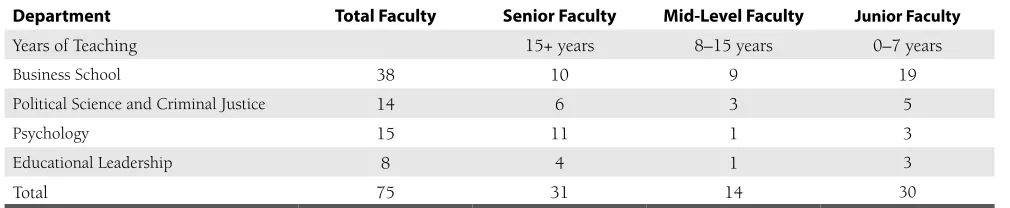
Having settled on the aforementioned framework for clas-sifying faculty members by the duration of their college-level teaching, the breakdown for the study is shown in table 3.
OVERVIEW OF USD’S COLLECTION
DEVELOPMENT
USD’s collection development apparatus is largely driven by faculty book orders. The $152,000 budget line that USD has for its book collection is approximately 3 percent of the library’s total operating budget (which includes salaries and benefits for every library employee). Each department on
campus is allocated a percentage of this amount, with most of it being derived from a formula that has been in place lon-ger than the twenty-five years that I’ve been at USD. While I recognize the importance of journal literature, I also want to help develop a vibrant and up-to-date academic press book collection, and I want that material to be utilized by stu-dents in their research. My colleagues and I are responsible for assigning Library of Congress subject headings to the doctoral dissertations and master’s and honors theses from the departments with which we work. All too frequently, I see virtually no monographs cited in the reference pages of those theses.
Some faculty members are always enthusiastic about submitting book orders, while others submit infrequently. I still feel that my efforts are a good way to keep open the lines of communication with them. I have had a number of bib-liographic instruction opportunities with faculty members who sporadically submit orders, but for still others, I receive virtually no book orders. My working theory is that book Table 1. Faculty in five departments (2017–18 academic year) by rank
Department FacultyTotal ProfessorFull Associate Professor ProfessorAssistant Instructor
Lecturer or Visiting
Professor
Business School 38 6 10 13 7 2
Political Science and Criminal Justice 14 4 5 4 — 1
Psychology 15 7 5 3 — —
Educational Leadership 8 2 2 2 — 2
Total 75 19 22 22 7 5
Table 2. Approximate breakout for the seventy-five faculty members if generational labeling were used
Department Total Faculty GenerationSilent Baby Boomers Generation X Millennials
Year of Birth pre-1943 1943–1960 1961–1981 1982–1996
Business School 38 — 11 18 9
Political Science and Criminal Justice 14 — 2 9 3
Psychology 15 1 6 5 3
Educational Leadership 8 — 4 3 1
Total 75 1 23 35 16
Table 3. Classification for the seventy-five faculty members by number of years of teaching
Department Total Faculty Senior Faculty Mid-Level Faculty Junior Faculty
Years of Teaching 15+ years 8–15 years 0–7 years
Business School 38 10 9 19
Political Science and Criminal Justice 14 6 3 5
Psychology 15 11 1 3
Educational Leadership 8 4 1 3
ordering is skewed heavily in favor of the senior-level faculty members, and that more junior faculty members are submit-ting more e-book requests, which I neglected to capture three years ago. If it is the case that book orders are largely being submitted by senior faculty, then I need to develop a strategy to engage those who are more junior.
THE BOOK-ORDERING PROCESS
The focus for book ordering is our third-floor hard-copy collection, along with an e-book collection for my five areas of responsibility. USD’s library uses a “jobber” known as the Yankee Book Peddlers (YBP) for its book ordering. YBP produces a weekly list online of the newly published aca-demically oriented hard copy and e-books relevant to each discipline; their electronic list is e-mailed to me. I scale the list’s contents back to ten fields to make everything easier to
browse for my faculty members. The matrix I create is then exported into a spreadsheet that is copied and pasted into the body of an e-mail message sent to the faculty in each of my departments. Table 4 shows a portion of what I sent to the psychology department sometime in August 2018.
Faculty members with interest in anything on these weekly lists can e-mail their order requests directly to me. I then place the order for the book with YBP. This process helps me keep track of what faculty might be interested in various books and serves as an easy way to communicate with the seventy-five faculty members I liaise with.
Following receipt of any request, I input the information into a database I created using Microsoft Access (see table 5).
I have maintained separate Access files for each fiscal year since 2016, forming a data set for this study that ends with fiscal year 2018. A significant mistake I made starting in FY 2016 was failing to differentiate between orders for hard-copy and e-books.
Table 4. Typical example of a book availability notice sent to department faculty
Title Reporting Quantitative Research in
Psychology: How to Meet APA Style Journal Article Reporting Standards
Skill Development in Counselor Education: A Comprehensive Workbook
Author Cooper, Harris M.
Editor Joy S. Whitman
Publisher Amer Psychological Assn Routledge
Year Published 2018 2019
ISBN 9781433829376 9781138695542
Binding Paper Cloth
Library of Congress Subject Headings Psychology--Authorship--Style Manuals. Counselors--Study and Teaching.
Where the Author Is from or Something
Else about This Book Auth: Duke University. Ed: Northwestern University.
Net Price $24.56 $114.80
Table 5. Access file for book order requests from faculty members
Book Title ISBN Individual Making Request Date Faculty Member Made Request Dept. Graphics for Statistics and Data Analysis with R [2nd Edition] 9781498779838 [Name omitted] 22-Jun-18 BADM
Salafism in Lebanon: Local and Transnational Movements 9781108426886 [Name omitted] 18-Jun-18 POLS
Table 6. Book purchasing by department over the three-year period of 2016–2018
Department Total Faculty Books Purchased Fiscal 2016 Faculty Books Purchased Fiscal 2017 Faculty Books Purchased Fiscal 2018 Faculty Books Purchased
Business School 180 38 66 76
Political Science and Criminal Justice 123 16 55 52
Psychology 132 28 59 45
Educational Leadership 131 20 51 60
RESULTS
Since 2016, 566 books have been ordered by faculty mem-bers in my departments. I was disappointed with the total, which I expected would be much higher. The data breaks down by department and year (see table 6).
From the 566 book orders during this three-year span, I discovered that:
z 289 books (51 percent) were for senior faculty
mem-bers who make up 41 percent of the faculty in my five departments.
z 85 books (15 percent) were for mid-level faculty
mem-bers who make up 19 percent of the faculty in my five departments.
z 192 books (34 percent) were for junior faculty
mem-bers who make up 40 percent of the faculty in my five departments.
These results pleasantly surprised me. Although it proved to be true that senior faculty members accounted for a higher percentage of total book orders (51 percent) than their representation on the faculty (41 percent), the differ-ence of 10 percent is not dramatic. Similarly, more junior faculty members are “underperforming” in book orders compared to their representation on the faculty, but only by a difference of 4 percent in the case of mid-level faculty and 6 percent in the case of junior-level faculty. Arguably, these results are what one might anticipate given the difference seniority makes in terms of awareness of the literature and confidence about spending decisions.
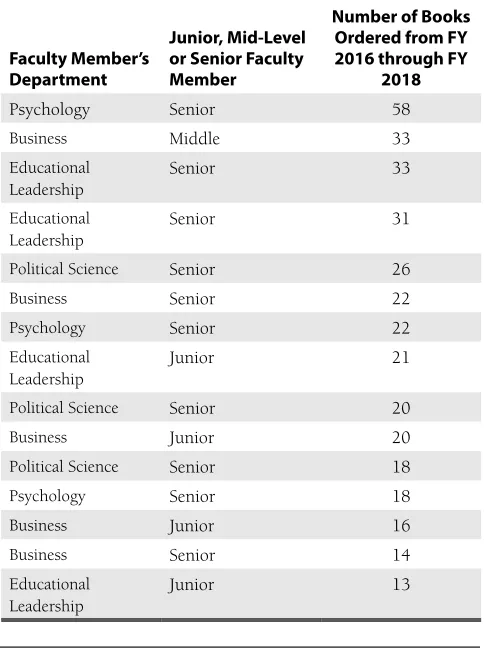
One additional aspect of this study that initially inter-ested me involves the so-called 80/20 rule. I work with seventy-five faculty members, so I was interested in whether approximately fifteen (or 20 percent) of them might account for 80 percent of the orders. The data indicates that my top fifteen “performers” generated 65 percent of book orders in my department (see table 7).
One significant trend in the data shows which faculty members do not engage in book ordering. Of those faculty members with whom I work, thirty-five of the seventy-five (or 47 percent) have not submitted any book orders over the past three years. This amounts to more than 50 percent of
junior- and mid-level faculty members across the five depart-ments (see table 8).
CONCLUSIONS
This study of faculty book ordering helped me to evaluate my efforts to enhance our monograph collection in the five departments with which I work. As a result, I was able to begin to quantify some frustrations or problems from the standpoint of marketing. Getting buy-in from the 47 per-cent of faculty members who have not requested any book
Table 7. Top fifteen book-ordering faculty, responsible for 65 percent of overall book ordering over the three-year period of 2016–2018
Faculty Member’s Department
Junior, Mid-Level or Senior Faculty Member
Number of Books Ordered from FY 2016 through FY
2018
Psychology Senior 58
Business Middle 33
Educational Leadership
Senior 33
Educational Leadership
Senior 31
Political Science Senior 26
Business Senior 22
Psychology Senior 22
Educational Leadership
Junior 21
Political Science Senior 20
Business Junior 20
Political Science Senior 18
Psychology Senior 18
Business Junior 16
Business Senior 14
Educational Leadership
Junior 13
Table 8. Faculty members not engaged in book ordering
Department
Total Faculty Not Engaging in the Ordering Process
Senior Faculty Not Engaging in the Ordering Process
Mid-Level Faculty Not Engaging in the
Ordering Process
Junior Level Faculty Not Engaging in the Ordering Process
Business School 20 4 4 12
Political Science and Criminal Justice
7 4 2 1
Psychology 7 3 2 2
Educational Leadership 1 1 — —
purchases will be a challenge. I suspect that the worst thing I can do is to engage in “overkill” by sending more e-mail mes-sages. My conclusion is that I need to engage in far more rela-tionship building with the more junior faculty members but not solely the most junior. The data presented above shows that the underperformance rate of mid-level faculty is only two percentage points better than that of junior-level faculty.
I discussed this topic as part of a poster session at our recent state library conference. The feedback I received from a number of my counterparts was most helpful. Each talked about their own frustrations in dealing with departmental or teaching faculty, particularly new faculty, who are seemingly oblivious to the benefits of their university’s library system. An academic library director suggested I make individual contact with faculty members who never respond to group e-mail messages anytime I come across something in their “departmental sphere,” asking if they would like it ordered for the USD library. A counterpart from another institution felt that I should highlight by e-mail new acquisitions that have arrived relating to their department, which could gen-erate more excitement.
With this new data and input, I clearly have some think-ing and experimentthink-ing to do at the start of next semester!
References
1. See https://www.usd.edu/about-usd/usd-at-a-glance.
2. Kuo Hui-Min, “Surveying Faculty Book Selection in a Compre-hensive University Library,” Collection Building 19, no. 1 (January 2000): 27–35.
3. Larry Hardesty, “Book Selection for Undergraduate Libraries: A Study of Faculty Attitudes,” Journal of Academic Librarianship 12, no. 1 (March 1986): 19–25.
4. Felix T. Chu, “Collaboration in a Loosely Coupled System: Librarian-Faculty Relations in Collection Development,” Library & Information Science Research 17 (Spring 1995): 135–50; Felix T. Chu, “Librarian-Faculty Relations in Collection Development,”
Journal of Academic Librarianship 23 (January 1997): 15–20. 5. ALEPH was USD’s online library catalog until May 2017. 6. University of South Dakota, Faculty Handbook and Resource Guide
(Vermillion, South Dakota, 2017): 9–16.