439
IDENTIFICATION OF RESIDUES INVOLVED IN NUCLEOTIDYLTRANSFERASE ACTIVITY
OF JHP933 FROM
HELICOBACTER
PYLORI
BY SITE-DIRECTED MUTAGENESIS
Xianren Ye1, Yanhe Zhao2, Xiuling Wu2, Yintao Su2, Yunkun Wu2,* and Feifei She1,*
1Key Laboratory of Ministry of Education for Gastrointestinal Cancer, School of Basic Medical Sciences, Fujian Medical
University, Fuzhou 350108, China
2State Key Laboratory of Structural Chemistry, Fujian Institute of Research on the Structure of Matter, Chinese Academy of
Sciences, Fuzhou 35002,China
*Corresponding authors: [email protected]; [email protected]
Received: June 22, 2015; Accepted: June 30, 2015; Published online: November 3, 2015
Abstract: Helicobacter pylori is a well-known bacterial pathogen involved in the development of peptic ulcer, gastric adeno-carcinoma and other forms of gastric cancer. Evidence has suggested that certain strain-specific genes in the plasticity region may play key roles in the pathogenesis of H. pylori-associated gastroduodenal diseases. Therefore there is considerable inter-est in the strain-specific genes located in the plasticity regions of H. pylori. JHP933 is encoded by the gene in the plasticity region of H. pylori strain J99. Recently, the crystal structure of JHP933 has confirmed it as a nucleotidyltransferase (NTase) superfamily protein and a putative active site has been proposed. However, no evidence from direct functional assay has been presented to confirm the active site and little is known about the functional mechanism of JHP933. Here, through superimposition with Cid1/NTP complex structures, we modelled the complex structures of JHP933 with different NTPs. Based on the models and using rational site-directed mutagenesis combined with enzymatic activity assays, we confirm the active site and identify several residues important for the nucleotidyl transferring function of JHP933. Furthermore, mutations of these active site residues result in the abolishment of the nucleotidyltransferase activity of JHP933. This work provides preliminary insight into the molecular mechanism underlying the pathophysiological role in H. pylori infection of JHP933 as a novel NTase superfamily protein.
Key words:JHP933; nucleotidyltransferase; site-directed mutagenesis; enzymatic assay; Helicobacter pylori; plasticity regions
INTRODUCTION
Helicobacter pylori is a widespread bacterial pathogen, which infects approximately 50% of the world’s popu-lation. H. pylori infection plays an important role in chronic gastric inflammation, developing into a va-riety of diseases ranging from mild gastritis to peptic ulcers and some forms of gastric cancer [1, 2]. The complex pathology for the various clinical outcomes remains elusive. However, it has been proposed that genetic variability underlying the host adaptation dif-ferences of various H. pylori strains may manifest in various degrees of disease severities [3, 4].
It is demonstrated that nearly half of the strain-specific genes of H. pylori are preferentially located in
located in two different plasticity zones of H. pylori, have been characterized as a Type IV secretion system (T4SS) apparatus, playing important roles in DNA transfer and contributing to bacterial genetic vari-ability [6,9,12,13].
Jhp933 is a conservative gene of the plasticity re-gion of H. pylori and is associated with gastritis and peptic ulcer by analyses of clinical prevalence rate [12, 14,15]. Performing conserved domain search has sug-gested that JHP933 might be classified into the nu-cleotidyltransferase (NTase) superfamily. The NTase superfamily constitutes widely diverse proteins with distinct biological functions, including chromatin re-modeling, RNA polyadenylation, RNA editing, DNA repairing, protein activity regulation, and antibiotic resistance [16-18]. Though NTase family proteins have different biological roles, it is recognized that almost all of them have the common function of transferring NMP from NTP to their distinct second substrate ac-ceptor [16]. Recently, two similar crystal structures of JHP933 from the H. pylori strain J99 have been determined and the structural information indicated that JHP933 is an NTase superfamily protein with a characteristic αβαβαβα topology. Several conservative active site motifs, which are critical for maintaining the NTP hydrolysis function, have been suggested [19, 20]. However, the putative active site of JHP933 awaits confirmation by direct functional evidence and the NTP-binding property needs more studies for clarifi-cation. Moreover, the determination of the exact role and molecular mechanism of JHP933 remains to be done.
Here we have modelled the complex structures of JHP933 with different nucleotide substrates by su-perimposition of JHP933 structure with Cid1/NTP complex structures. Based on the structural informa-tion, we have performed the rational site-directed mu-tagenesis and enzymatic activity assays on pinpointed residues; the results confirm the active site of JHP933 and identify several conservative residues key to the nucleotidyltransferase activity of JHP933. Our work paves a preliminary way towards exploiting the func-tional mechanisms underlying the role of JHP933 in H. pylori pathogenesis.
MATERIALS AND METHODS
Homology modelling of JHP933/NTP complex structures
By superimposition of the JHP933 structure (pro-tein data bank (PDB) code: 4O8S) with the known complex structures of Cid1/NTP (PDB codes: 4FH5, 4FHV, 4FHW, 4FHY) as a reference template, 4 differ-ent NTPs (ATP, GTP, UTP, CTP) were superimposed onto the structure of JHP933, respectively. The super-imposition was performed by using PyMOL (www. pymol.org) and CCP4 LSQ [21].
Recombinant DNA constitution
The gene encoding the full-length JHP933 was am-plified from DNA of the H. pylori strain J99 by PCR. The amplified gene was fitted with BamHI and XhoI sites at the 5’ and 3’ ends, respectively. The cassette was cloned into modified pET32a with inserted N-terminal Trx and Histidine-tag. Based on the consti-tuted pET32a-JHP933, different point mutations were introduced using the QuikChange® II mutagenesis kit.
Expression and purification of proteins
Enzymatic activity assays
The EnzCheck® pyrophosphate assay kit from Invitro-gen was used to analyze the activity of the wild-type and mutant JHP933 proteins based on a previously de-scribed method [22]. The standard 1 mL reaction mix-ture contains:720 μL-x μL dH2O, 50 μL 20X reaction buffer containing MgCl2, 200 μL MESG substrate solu-tion, 10 μL NTP, x uL protein, 10 μL purine nucleoside phosphorylase and 10 μL inorganic pyrophosphatase. The components are added to the reaction mixture in the order listed above, then incubated for 30-60 min at 22°C. The absorbance at 360 nm was measured and corrected for a control reaction lacking JHP933.
Site-directed mutagenesis
QuikChange
®
II Site-Directed mutagenesis (Strata-gene) was used to generate mutants G39A, D55Q, D57Q and E113N of JHP933 in a pET32a-JHP933 vector as per the manufacturer’s instructions. The mu-tagenesis results were confirmed via DNA sequenc-ing. The recombinant DNAs were transformed into E. coli Top10 and proteins were expressed in E. coli BL-21(DE3).RESULTS AND DISCUSSION
Homology modelling of JHP933 for NTP binding
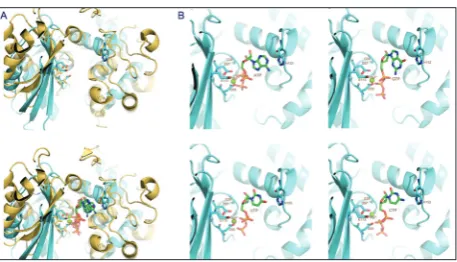
The crystal structure of JHP933 points to a putative active site for substrate binding [23]. However, the special second substrate is unknown, except that NTP is recognized to be a common first substrate for most of the NTase superfamily proteins. By superimposi-tion with the known complex structures of Cid1/NTP, the structures of JHP933 complexed with magnesium ions and 4 different NTPs (ATP, GTP, UTP, CTP) were modelled (Fig. 1). A groove conserved in both struc-tures of JHP933 and Cid1 was identified, which is formed mainly by β-strands β1, β2, β5 and α-helices α2, α4, α5 in JHP933 (the numbering of the second-ary structure follows the definition in the structure of JHP933 [19]), and is large enough to accommodate
NTP, divalent ions and the unidentified second sub-strate. Zooming into the active site for NTP-binding, the strictly conservative residues among the orthologs in H. pylori, including G39, D55, D57 and E113, were pinpointed according to the modeled complex struc-tures. These residues mainly contribute to chelating magnesium ions and coupling the interaction with triphosphate tail of NTP (Fig. 1) [23]. In all 4 mod-eled complex structures, the base of NTP is located adjacent to the loop connecting α-helices α4 and α5 containing residue H152, implying this loop region may play an important role in NTP substrate recog-nition, and the flexibility property of this loop may endow the capability of JHP933 for accommodating different NTP substrates.
NTP transferring property of JHP933
To test the nucleotidyltransferase activity of JHP933, pyrophosphate assays of wild-type JHP933 for 5 dif-ferent NTPs were performed. The results indicated that JHP933 could catalyze all five nucleotides and liberate the inorganic pyrophosphate at a high level with no obvious preference (Fig. 2). This provides the first direct evidence that JHP933 has the capacity to hydrolyze NTP to NMP, and the in vitro nucleotidyl transferring function of JHP933 is likely independent of its second substrate.
Fig. 1. Modelled JHP933/NTP complex structures. A.
Active site residue mutations abolish JHP933 nucleotidyltransferase function
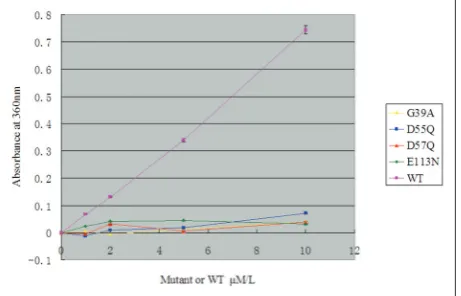
Based on the structural information of the different JHP933/NTP models and the sequence homology analysis, the strictly conservative residues critical for divalent ion chelation and NTP triphosphate tail interaction including G39, D55, D57 and E113 were mutated for further investigation of the NTP-binding and enzymatic activity property of JHP933. All these variants were shown to maintain correct monomer folding when purified with a size exclusion column (Fig. S1). Using the pyrophosphate assay of wild type for reference and UTP as a NTP substrate to test the enzymatic activity of JHP933 mutants, all mutations of these residues individually almost completely abolished the NTP nucleotidyl transferring activ-ity of JHP933, demonstrating their important role in NTP hydrolysis (Fig. 3). This work also confirms that this putative active site is involved in the NTP-binding of JHP933. The signature motifs, including these residues, are highly evolutionary conservative NTase superfamily proteins, implying that the NMP transferring function might be prerequisite and es-sential for NTase family proteins to play their different biological roles.
For almost all known members of NTase super-family proteins, with the common function of trans-ferring NMP from NTP to their different accep-tor, some NTase fold proteins may have preference for their NTP substrate selectivity, such as poly(A) polymerases (PAPs), poly(U) polymerases (PUPs), ter-minal uridil transferases (TUTases) and CCases. How-ever, some may not have any selectivity. By structural comparison with another NTase protein, S. pombe Cid1, it has been suggested that JHP933 may have a substrate preference for molecules resembling UTP [20]. However, this hypothesis needs further investi-gation due to a lack of any direct evidence. Cid1 was first identified as a PAP and later reclassified as a PUP [24-26]. The structures of Cid1 have demonstrated that it can still accommodate 4 different NTPs at the active site and a residue mutation H336N can switch its selectivity from UTP to ATP [27]. Here, our
en-Fig. 2. Nucleotidyltransferase activity of JHP933 for different NTPs. The absorbance of OD360 measurement of JHP933 catalytic activity for 5 different NTPs, including ATP, GTP, CTP, TTP, UTP, with UTP (without purine nucleoside phosphorylase) as a control. The following reagents were combined in 1 mL reaction volumes: 1 mM NTP, 0.2 mM MESG, 1 U purine nucleoside phosphorylase, 0.03 U pyrophosphatase, 1× reaction buffer and various dilutions of JHP933. UTP (without PNP) was used to confirm that the protein had no absorbance at 360 nm. After incubating at 22°C for 45 min, the absorbance at 360 nm was measured and corrected for absorbance at 360 nm of a control reaction lacking JHP933. Values represent the mean of three independent experiments; bars represent standard error of mean (SEM); p<0.05.
zymatic assay of JHP933 on different NTP substrates failed to show JHP933 has a preference for nucleotide recognition in vitro. The modelled JHP933/NTP com-plex structures indicated that the nucleotide recogni-tion motif loop is located between the α-helices α4 and α5, which may give JHP933 certain flexibility in accommodating different NTP substrates, and thus might be a better strategy for H. pylori to survive during the evolution process. With the rational site-directed mutagenesis and enzymatic assay, we further pinpointed the residues key to JHP933’s nucleotidyl transferring function and confirmed the active site for JHP933, thus providing a preliminary insight into the molecular mechanisms of the nucleotide-binding and transferring activity of JHP933. However, to elucidate the exact roles played by active site residues and to decipher the biological roles of JHP933, the three-dimensional structure determination of the JHP933/ NTP/second substrate complex is needed.
Acknowledgments: This work was supported by the Key Project
of Science Research in Fujian Medical University (09ZD018), the National Nature Science Foundation of China (31470741, 31270790 and 81271784), the Nature Science Foundation of Fu-jian Province (2013J01151) and the National Thousand Talents Program of China.
Conflict of interest disclosure: The authors declared that they have no conflicts of interest to this work.
REFERENCES
1. Covacci A, Telford JL, Del Giudice G, Parsonnet J, Rappuoli R. Helicobacter pylori virulence and genetic geography. Sci-ence. 1999;284(5418):1328-33.
2. Franco AT, Johnston E, Krishna U, Yamaoka Y, Israel DA, Nagy TA, et al. Regulation of gastric carcinogen-esis by Helicobacter pylori virulence factors. Cancer Res. 2008;68(2):379-87.
3. Atherton JC, Peek RM, Jr., Tham KT, Cover TL, Blaser MJ. Clinical and pathological importance of heterogeneity in vacA, the vacuolating cytotoxin gene of Helicobacter pylori. Gastroenterol. 1997;112(1):92-9.
4. Blaser MJ. Not all Helicobacter pylori strains are created equal: should all be eliminated? Lancet. 1997;349(9057): 1020-2.
5. Alm RA, Trust TJ. Analysis of the genetic diversity of Heli-cobacter pylori: the tale of two genomes. J Mol Med (Berl). 1999;77(12):834-46.
6. Fischer W, Windhager L, Rohrer S, Zeiller M, Karnholz A, Hoffmann R, Zimmer R, Haas R. Strain-specific genes of Helicobacter pylori: genome evolution driven by a novel type IV secretion system and genomic island transfer. Nucl Acids Res. 2010;38(18):6089-101.
7. Santos A, Queiroz DM, Menard A, Marais A, Rocha GA, Oliveira CA, Nogueira AM, Uzeda M, Mégraud F. New pathogenicity marker found in the plasticity region of the Helicobacter pylori genome. J Clin Microbiol. 2003;41(4): 1651-5.
8. de Jonge R, Kuipers EJ, Langeveld SC, Loffeld RJ, Stoof J, van Vliet AH, et al. The Helicobacter pylori plasticity region locus jhp0947-jhp0949 is associated with duodenal ulcer dis-ease and interleukin-12 production in monocyte cells. FEMS Immunol Med Microbiol. 2004;41(2):161-7.
9. Kersulyte D, Velapatino B, Mukhopadhyay AK, Cahuayme L, Bussalleu A, Combe J, Gilman RH, Berg DE. Cluster of type IV secretion genes in Helicobacter pylori’s plasticity zone. J Bacteriol. 2003;185(13):3764-72.
10. Alm RA, Ling LS, Moir DT, King BL, Brown ED, Doig PC, Smith DR, Noonan B, Guild BC, deJonge BL, Carmel G, Tummino PJ, Caruso A, Uria-Nickelsen M, Mills DM, Ives C, Gibson R, Merberg D, Mills SD, Jiang Q, Taylor DE, Vovis GF, Trust TJ. Genomic-sequence comparison of two unre-lated isolates of the human gastric pathogen Helicobacter pylori. Nature. 1999;397(6715):176-80.
11. Lu H, Hsu PI, Graham DY, Yamaoka Y. Duodenal ulcer promoting gene of Helicobacter pylori. Gastroenterol. 2005;128(4):833-48.
12. Yamaoka Y. Roles of the plasticity regions of Helicobacter pylori in gastroduodenal pathogenesis. J Med Microbiol. 2008;57(Pt 5):545-53.
13. Fernandez-Gonzalez E, Backert S. DNA transfer in the gas-tric pathogen Helicobacter pylori. J Gastroeneterol. 2014; 49(4):594-604.
14. Occhialini A, Marais A, Alm R, Garcia F, Sierra R, Megraud F. Distribution of open reading frames of plasticity region of strain J99 in Helicobacter pylori strains isolated from gas-tric carcinoma and gastritis patients in Costa Rica. Infect Immun. 2000;68(11):6240-9.
15. Salih BA, Abasiyanik MF, Ahmed N. A preliminary study on the genetic profile of cag pathogenicity-island and other virulent gene loci of Helicobacter pylori strains from Turkey. Infect Genet Evol. 2007;7(4):509-12.
16. Kuchta K, Knizewski L, Wyrwicz LS, Rychlewski L, Ginalski K. Comprehensive classification of nucleotidyltransferase fold proteins: identification of novel families and their represen-tatives in human. Nucleic Acids Res. 2009;37(22):7701-14. 17. Aravind L, Koonin EV. DNA polymerase beta-like
nucleotid-yltransferase superfamily: identification of three new fami-lies, classification and evolutionary history. Nucl Acids Res. 1999;27(7):1609-18.
func-tion of the C-terminal domain. J Mol Biol. 2003;326(5):1449-61.
19. Zhao Y, Ye X, Su Y, Sun L, She F, Wu Y. Crystal structure con-firmation of JHP933 as a nucleotidyltransferase superfam-ily protein from Helicobacter pylori strain J99. PLoS One. 2014;9(8):e104609.
20. Yoon JY, Lee SJ, Kim do J, Lee BJ, Yang JK, Suh SW. Crys-tal structure of JHP933 from Helicobacter pylori J99 shows two-domain architecture with a DUF1814 family nucleotid-yltransferase domain and a helical bundle domain. Proteins. 2014;82(9):2275-81.
21. Winn MD, Ballard CC, Cowtan KD, Dodson EJ, Emsley P, Evans PR, Keegan RM, Krissinel EB, Leslie AG, McCoy A, McNicholas SJ, Murshudov GN, Pannu NS, Potterton EA, Powell HR, Read RJ, Vagin A, Wilson KS. Overview of the CCP4 suite and current developments. Acta Crystallogr D Biol Crystallogr. 2011;67(Pt 4):235-42.
22. Upson RH, Haugland RP, Malekzadeh MN, Haugland RP. A spectrophotometric method to measure enzymatic activ-ity in reactions that generate inorganic pyrophosphate. Anal Biochem. 1996;243(1):41-5.
23. Wu W, Yang Y, Sun G. Recent Insights into Antibiotic Resis-tance in Helicobacter pylori Eradication. Gastroenterol Res Pract. 2012;2012:723183.
24. Wang SW, Toda T, MacCallum R, Harris AL, Norbury C. Cid1, a fission yeast protein required for S-M checkpoint control when DNA polymerase delta or epsilon is inacti-vated. Mol Cell Biol. 2000;20(9):3234-44.
25. Kwak JE, Wickens M. A family of poly(U) polymerases. RNA. 2007;13(6):860-7.
26. Rissland OS, Mikulasova A, Norbury CJ. Efficient RNA poly-uridylation by noncanonical poly(A) polymerases. Mol Cell Biol. 2007;27(10):3612-24.
27. Lunde BM, Magler I, Meinhart A. Crystal structures of the Cid1 poly (U) polymerase reveal the mechanism for UTP selectivity. Nucl Acids Res. 2012;40(19):9815-24.
SUPPLEMENTARY MATERIAL (Available online)
Supplementary Fig. S1. Size exclusion chromatography of
con-structs of JHP933. The JHP933 variants were purified and assessed by size-exclusion chromatography (Superdex 75 pg, column volume 120 mL), the single sharp Gaussian peak migrated to 31 kDa as compared to a standard chro-matogram test, implicating that the variants were well-folded and stable.