Hedychium putaoense
(Zingiberaceae), a new species
from Putao, Kachin State, Northern Myanmar
Hong-Bo Ding1,2, Yang Bin1,2, Shi-Shun Zhou1,2, Ren Li1, Mya Bhone Maw1,
Win Maung Kyaw 3, Yun-Hong Tan1,2
1 Southeast Asia Biodiversity Research Institute, Chinese Academy of Sciences, Yezin, Nay Pyi Taw 05282, Myanmar 2 Centre for Integrative Conservation, Xishuangbanna Tropical Botanical Garden, Chinese Academy of Sciences, Menglun, Mengla, Yunnan 666303, P.R. China 3 Forest Research Institute, Forest Department, Ministry of Environmental Conservation and Forestry, Yezin, Nay Pyi Taw 05282, Myanmar
Corresponding author: Yun-Hong Tan ([email protected])
Academic editor: X.-H. Jin | Received 24 November 2017 | Accepted 13 January 2018 | Published 29 January 2018
Citation: Ding H-B, Bin Y, Zhou S-S, Li R, Maw MB, Kyaw WM, Tan Y-H (2018) Hedychium putaoense (Zingiberaceae), a new species from Putao, Kachin State, Northern Myanmar. In: Jin X-H, Shui Y-M, Tan Y-H, Kang M (Eds) Plant diversity in Southeast Asia. PhytoKeys 94: 51–57. https://doi.org/10.3897/phytokeys.94.22065
Abstract
Hedychium putaoense Y.H. Tan & H.B. Ding, a new species of Zingiberaceae from Putao, Kachin state, Northern Myanmar, is described and illustrated. It is similar to H. densiflorum Wall. and H. longipedun-culatum A.R.K. Sastry & D.M. Verma, but differs by its very small bract (4–6 × 2.5–3 mm vs. 18–19 × 5–5.5 mm and ca. 11 × 7 mm, respectively), semicircle and dark red bracteole, orange flower and broadly falcate to lanceolate lateral staminodes.
Keywords
Hedychium, Myanmar, Taxonomy, Morphology, Zingiberaceae
Introduction
The pantropical Zingiberaceae is the largest family in the monophyletic order Zingiberales with 53 genera and more than 1377 species (Kress et al. 2002; Pederson 2004; Kong et al. 2010). Hedychium Koenig, commonly called the “ginger lily” or “butterfly lily”, produces one of the most beautiful and fragrant flowers in the family Zingiberaceae (Sanoj et al. 2010). The genus was established by Koenig in 1783, based on the species H. coronarium
Koenig. There is currently little consensus on the number of species, with recent estimates varying from about 50 (Wu and Larsen 2000) to 80 (Sirirugsa and Larsen 1995) and these http://phytokeys.pensoft.net
Copyright Hong-Bo Ding et al. This is an open access article distributed under the terms of the Creative Commons Attribution License (CC BY 4.0), which permits unrestricted use, distribution, and reproduction in any medium, provided the original author and source are credited.
are mainly distributed throughout most of tropical Asia (Sirirugsa and Larsen 1995; Wood et al. 2000). The genus has its highest species diversity in the tropical and subtropical Hima-layan region (Sanoj et al. 2010). Hedychium is characterised by flowers with very long (rarely short) filaments, dorsifixed anther and usually fragrant flowers (Hu and Liu 2010a). Mem-bers of the genus can be easily recognised by their showy, many-flowered terminal spikes, some of which have been cultivated worldwide (Picheansoonthon and Wongsuwan 2011).
Several new species of Hedychium have been described in the last few decades (Williams et al. 2003; Wongsuwan 2008; Picheansoonthon and Wongsuwan 2009, 2011; Sanoj et al. 2010; Hu and Liu 2010a, 2010b; Sanoj and Sabu 2011; Thomas et al. 2015; Odyuo and Roy 2017). So far, 15 species of Hedychium have been re-corded in Myanmar: H. bordelonianum W.J. Kress & K.J. Williams, H. coccineum
Buch.-Ham. ex Sm., H. coronarium Koenig, H. elatum R. Br., H. ellipticum Buch.-Ham., H. flavum Roxb., H. forrestii Diels, H. gomezianum Wall., H. gracile Roxb.,
H. marginatum C.B. Clarke, H. spicatum Sm., H. stenopetalum Lodd., H. thyrsiforme
Sm., H. venustum Wight, and H. villosum Wall. (Kress et al. 2003).
From April to May in 2017, a team from the Xishuangbanna Tropical Botanical Garden (XTBG) in collaboration with the Forest Research Institute of Myanmar, con-ducted field work in Northern Myanmar to survey plant diversity. During field work, some interesting specimens of Hedychium were found in Putao, Kachin state. Based on a detailed examination of the morphological characteristics of the collected material and those of the closely related similar species, the authors have arrived at the conclu-sion that the specimens of Hedychium collected in Myanmar belong to a species new to science, which are described and illustrated herein.
Material and methods
Measurements and morphological character assessments of the new species
Hedychi-um putaoense have been examined based on fresh materials and dried specimens. It
has been compared with the morphologically similar species H. densiflorum, H.
lon-gipedunculatum, with affinities inferred using descriptions, type specimens and other
herbarium specimens (Wallich 1832; Sastry and Verma 1968; Wu and Larsen 2000; Moaakum and Dey 2013). Protologues and images of type specimens were gathered from JSTOR Global Plants (http://plants.jstor.org).
Taxonomic treatment
Hedychium putaoense Y.H.Tan & H.B.Ding, sp. nov.
urn:lsid:ipni.org:names:77175483-1
Figure 1
Diagnosis. Hedychium putaoense Y.H. Tan & H.B. Ding is morphologically similar
it can be easily distinguished by its very small bract (4–6 × 2.5–3 mm vs. 18–19 × 5–5.5 mm and ca. 11 × 7 mm, respectively) and bracteole (2–2.5 × 3–3.5 mm vs. ca. 9 × 2 mm and ca. 6 × 4 mm, respectively), orange flower and broadly falcate to lanceo-late lanceo-lateral staminodes.
Type. MYANMAR. Kachin State: Putao District, the top of the mountain from Masabu village to Namti village. Epiphytic herbs in tropical montane forests, 97°17'42"E, 27°25'29"N. 1700 m a.s.l., 13 May 2017, flowering, Myanmar Exped.
M1724 (holotype: HITBC!; isotypes: HITBC!)
Description. Epiphytic, sometimes terrestrial, perennial rhizomatous herbs, light greyish-green externally. Leafy shoot 20–50 cm high, slanting with erect inflorescence. Leaves 4, spreading, sessile, upper petioled; petiole 2–10 mm long; ligule ca. 8–19 mm long, apex obtuse, glabrous, membranous, translucent, reddish brown when fresh, yellowish brown when dry, closely appressed to the stem; lamina 13–23 × 3–7 cm, lanceolate, dark green above, pale green below, or sometimes light purple-tinged be-low, glabrous; margin undulate, membranous, non-ciliate; apex narrowly caudate, twisted, base attenuate. Inflorescences 7–10 cm long, cylindrical, dense, erect, rachis glabrescent. Bracts 4–6 × 2.5–3.0 mm, ovate, purplish-red, glabrous, convolute, mar-gin ciliate, membranous, tip acute, cincinnus 1-flowered. Bracteoles 2.0–2.5 × 3.0–3.5 mm, semicircular, dark red, glabrous, membranous, acute at tip, margin ciliate. Flower 2.8–3.9 cm long, small, orange, nearly entire inflorescence open at a time, ascending. Calyx 1.2–1.4 cm long, 2.0–2.5 mm wide at mouth, tubular, pale light red, densely vil-lous, tufted hairs at tip, membranous, upper half inflated, lower part closely appressed to corolla tube, unilaterally split up to ca. 5 mm depth. Corolla tube 10–13 mm long, creamy yellow, glabrous, tube intensely curved towards tip about 90° to 180°. Corolla lobes 10–16 × 1–2 mm linear-lanceolate, red, membranous, glabrous. Lateral stami-nodes 11–13 × 3–4 mm, broadly falcate to lanceolate, clawed towards base, orange, spreading on flower, obtuse at tip, intensely reflexed back. Labellum 12–14 × 4–7 mm, widely obovate, orange, spreading on flower, base cuneate, sinus ca. 2–3 mm deep, lobes oblong, obtuse at tip. Stamen 1.4–1.7 cm long. Filament 1.1–1.2 cm long, ca. 2 mm wide at base, orange, creamy yellow towards base, intensely curved towards tip about 180°. Anthers ca. 5 × 2 mm, oblong, orange, split opens from top to bottom, attached with the filament at ca. 1 mm above from base, thecae parallel with the filament; con-nective red, glabrous, non-crested. Ovary ca. 2.5 mm diameter, sub-globose, densely villous. Style filiform, creamy white, glabrous, dark red-tinged towards stigma. Stigma ca. 0.5 mm wide, dark red, cup-shaped, mouth margin ciliate, ca. 1 mm exserted from the anther. Epigynous glands 2, ca. 1 mm long, oblong, orange. Fruit unknown.
Phenology. Flowering from May to July.
Distribution and habitat. This new species is known to grow at the top of the moun-tain from Masabu village to Namti village, Putao District, Kachin State, where it grows epiphytically on the trees of tropical montane forests at an elevation of ca. 1400–1800 m.
Etymology. The species is named after the type locality, Putao county, in Kachin State, Myanmar.
Figure 1.Hedychium putaoense Y.H. Tan & H.B. Ding. a–b Habit c–d Inflorescence e–f Front and lat-eral view of flower g Bract h Bracteole i Calyx j–k Corolla lobe l–m Lateral staminodes n Labellum o Co-rolla tube with anther and calyx p Ovary with pistil and glands. Photographed by Y.H. Tan & H.B. Ding.
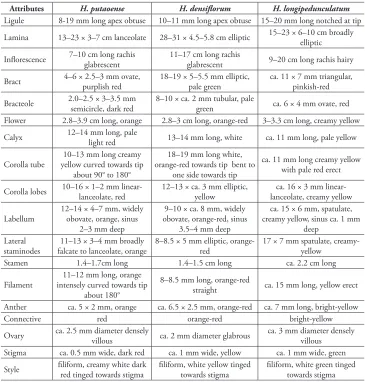
with that of the calyx (ca. 11 vs. 11 mm). H. putaoense, furthermore, differs in having semicircular and dark red bracteole, corolla tube curved towards the tip by about 90° to 180°, orange lateral staminodes and labellum, filament intensely curved towards the tip by about 180°, densely villous ovary and dark red stigma. H. densiflorum has tubular and pale green bracteole, corolla tube slightly bent to one side towards the tip, orange-red lateral staminodes and labellum, straight filament, glabrous ovary and yellow stigma. H. longipedunculatum from India has notched ligule, hairy rachis, trian-gular bract, ovate bracteole, creamy yellow flower, erect corolla tube, straight filament and green stigma. A detailed comparison of the morphological differences amongst these taxa is given in Table 1 and the evidence from morphological analysis supports the recognition of H. putaoense as a distinct species.
Table 1.Comparison of key morphological characters of Hedychium putaoense, H. densiflorum, and
H. longipedunculatum.
Attributes H. putaoense H. densiflorum H. longipedunculatum
Ligule 8-19 mm long apex obtuse 10–11 mm long apex obtuse 15–20 mm long notched at tip Lamina 13–23 × 3–7 cm lanceolate 28–31 × 4.5–5.8 cm elliptic 15–23 × 6–10 cm broadly elliptic
Inflorescence 7–10 cm long rachis glabrescent 11–17 cm long rachis glabrescent 9–20 cm long rachis hairy
Bract 4–6 × 2.5–3 mm ovate, purplish red 18–19 × 5–5.5 mm elliptic, pale green ca. 11 × 7 mm triangular, pinkish-red
Bracteole 2.0–2.5 × 3–3.5 mm semicircle, dark red 8–10 × ca. 2 mm tubular, pale green ca. 6 × 4 mm ovate, red Flower 2.8–3.9 cm long, orange 2.8–3 cm long, orange-red 3–3.3 cm long, creamy yellow Calyx 12–14 mm long, pale light red 13–14 mm long, white ca. 11 mm long, pale yellow
Corolla tube yellow curved towards tip 10–13 mm long creamy about 90° to 180°
18–19 mm long white, orange-red towards tip bent to
one side towards tip
ca. 11 mm long creamy yellow with pale red erect
Corolla lobes 10–16 × 1–2 mm linear-lanceolate, red 12–13 × ca. 3 mm elliptic, yellow lanceolate, creamy yellowca. 16 × 3 mm
linear-Labellum 12–14 × 4–7 mm, widely obovate, orange, sinus 2–3 mm deep
9–10 × ca. 8 mm, widely obovate, orange-red, sinus
3.5–4 mm deep
ca. 15 × 6 mm, spatulate, creamy yellow, sinus ca. 1 mm
deep Lateral
staminodes falcate to lanceolate, orange11–13 × 3–4 mm broadly 8–8.5 × 5 mm elliptic, orange-red 17 × 7 mm spatulate, creamy-yellow Stamen 1.4–1.7cm long 1.4–1.5 cm long ca. 2.2 cm long
Filament intensely curved towards tip 11–12 mm long, orange about 180°
8–8.5 mm long, orange-red
straight ca. 15 mm long, yellow erect Anther ca. 5 × 2 mm, orange ca. 6.5 × 2.5 mm, orange-red ca. 7 mm long, bright-yellow
Connective red orange-red bright-yellow
Acknowledgements
The authors are grateful to the Forest Research Institute of Myanmar for permission to conduct this study in Northern Myanmar and for their support and collaboration. We are grateful to Myint Zaw for his kind help in the field work. We are also grateful to Yuwen-Cui for editing the photographs. This work was financially supported by a project of the Southeast Asia biodiversity research institute, Chinese Academy of Sci-ences (Y4ZK111B01).
References
Hu X, Liu N (2010a) Hedychium longipetalum (Zingiberaceae), a new species from Yunnan, China. Annales Botanici Fennici 47(3): 237–239. https://doi.org/10.5735/085.047.0311 Hu X, Liu N (2010b) Hedychium menghaiense (Zingiberaceae), a new species from Yunnan,
China. Journal of Systematics and Evolution 48(2): 146–151. https://doi.org/10.1111/ j.1759-6831.2009.00060.x
Koenig JG (1783) Descriptions monandrarum pro annis. In: Retzius AJ (Ed.) Observationes Botanicae. Lipsiae, 3: 73–74.
Kong JJ, Xia YM, Li QJ (2010) Inflorescence and flower development in the Hedychieae (Zingib-eraceae): Hedychium coccineum Smith. Protoplasma 247: 83–90. https://doi.org/10.1007/ s00709-010-0145-5
Kress WJ, De Filipps RA, Farr E, Kyi DYY (2003) A checklist of the trees, shrubs, herbs, and climbers of Myanmar. Contributions from the United States National Herbarium 45: 1–590.
Kress WJ, Prince LM, Williams KJ (2002) The phylogeny and a new classification of the gin-gers (Zingiberaceae): evidence from molecular data. American Journal Botany 89(11): 1682–1696. https://doi.org/10.3732/ajb.89.10.1682
Moaakum, Dey S (2013) Rediscovery of Hedychium longipedunculatum A.R.K. Sastry & D.M. Verma (Zingiberaceae) from Nagaland, India. Pleione 7(1): 290–294.
Odyuo N, Roy DK (2017) Hedychium chingmeianum (Zingiberaceae), a new species from Nagaland, India. Telopea 20: 193–199.
Pederson LB (2004) Phylogenetic analysis of the subfamily Alpinioideae (Zingiberaceae), par-ticularly Etlingera Giseke, based on nuclear and plastid DNA. Plant Systematics and Evolu-tion 245: 239–258. https://doi.org/10.1007/s00606-004-0126-2
Picheansoonthon C, Wongsuwan P (2009) Hedychium champasakense (Zingiberaceae), a new species from Southern Laos. Taiwania 54(2): 145–148.
Picheansoonthon C, Wongsuwan P (2011) A new species and a new record of Hedychium J. König (Zingiberaceae) from Thailand. Taiwania 56(3): 231–239.
Sanoj E, Sabu M, Kumar TR (2010) Hedychium forrestii (Zingiberaceae) with a new synon-ymy and a variety from India. Journal of the Botanical Research Institute of Texas 4(2): 633–639.
Sastry ARK, Verma DM (1968) Hedychium longipedunculatum, a new species of Zingiber-aceae from Subansiri District. North East Frontier Agency. J. Bomb. Nat. Hist. Soc, 65: 293–295.
Sirirugsa P, Larsen K (1995) The genus Hedychium (Zingiberaceae) in Thailand. Nordic Journal of Botany 15(3): 301–304. https://doi.org/10.1111/j.1756-1051.1995.tb00156.x
Thomas S, Mani B, Britto SJ (2015) A new species of Hedychium (Zingiberaceae) from the southern Western Ghats, India. Webbia 70(2): 221–225. http://dx.doi.org/10.1080/0083 7792.2015.1082270
Wallich N (1832) Numerical list of dried specimens in the East India Company’s Museum (Wall. Cat.). London.
Williams KJ, Kress WJ, Htun T (2003) A striking new epiphytic Hedychium (Zingiberaceae) from Myanmar with a discussion on some anomalous related genera. Edinburgh Journal of Botany 60(1): 43–48. https://doi.org/10.1017/S0960428603000040
Wongsuwan P (2008) A new species of Hedychium (Zingiberaceae) from Southern Laos. Taiwania 53(4): 401–405.
Wood TH, Whitten WM, Williams NH (2000) Phylogeny of Hedychium and related genera (Zingiberaceaae) based on ITS sequence datsa. Edinburgh Journal of Botany 57: 261–270. https://doi.org/10.1017/S0960428600000196