ISSN: 2347-7474 International Journal Advances in Social Science and Humanities
Available Online at: www.ijassh.com
RESEARCH ARTICLE
Concepts and Categories of Modality
Ho Van Han
School of Languages-Cultures-International Relations-Ba Ria-Vung Tau University, Vietnam.
Abstract
Modality is a basic meaning combined into an utterance, each of the utterances is always divided up two parts: dictum and modus. Dictum is the main information; modus is the additional one of the utterance to express an attitude of judgement, assumption or a status of the speaker to the state of affairs. Nowadays, modality has been concerned by linguists due to its complexity but its full interest. In any languages, if people take modality out of an utterance, its state of affairs will become dry, poor and lose the beauty of the language. Cao Xuan Hao stated that the proposition of any utterance must contains a modus (or combine many segments of modus). Based on this statement, this paper desires summary different concepts and categories of modality in order to help us recognize easy epistemic modality and have a plan to study it fully.
Keywords: Modality (modus), A state of affair, Dictum, Parole, Langue.
Introduction
In recent years, modality has attracted by famous linguists such as Perkins [1], Palmer [2], Halliday [3], Lyon's [4], Cao Xuan Hao [5], etc. The basic reason is not only its complexity, but also its interest when expressing the propositional meaning in an utterance. For instance, Perkins said, studying modality is like trying to walk in a room crowded and trying not to step on others. Although modality is independent on the structure of the utterance, its pragmatics has a great influence on hearers. When they receive an utterance, they must understand: (1) its denotation, (2) its implication of the speaker in the context, and (3) its metalinguistics.
These are necessary conditions to be understood the utterance. To make a complete statement semantically, one must mention modality worked in the predicate of the sentence. Thus, it’s said that modality refers to the relationship between the content of information towards its factual value, and, attitudes and emotions of the speaker towards its proposition.
In the state of affairs, “John is in his office”, the speaker can rely on his knowledge and attitude to make various expressions:
1a. Perhaps John is in his office.
1b. John must be in his office. 1c. I think that John is in his office. 1d. It is possible that John is in his office. 1e. I know that John is in his office. 1f. I believe that John is in his office.
The examples above show that they are all epistemic modality marked by different evidential ties based on the degree of the commitment of the speaker. The sentences (1a, 1c, 1d) represent non-factual modality because these sentences’ presupposition is “John is impossibly in his office" while (1a, 1e, 1f) express the necessity based on some real evidence or knowledge, so they represent factual modality because their presupposition is “John is certainly in his office”.
Epistemic modality does with possibility or necessity of the truth of propositions, and is thus involved with knowledge and belief whereas, deontic modality is concerned with the possibility or necessity of acts performed by morally responsible agents, and is thus associated with the social functions of permission and obligation.
The logical objectivity is based on the random necessity and possibility of the proposition. If the propositional meaning is absolutely correct or completely wrong, its modility is necessity. And if the propositional meaning shows only some scalar of truth, its modality lies in the possibility (the judgment of possibility is one-way entailment). If all judgment is necessity, it also means the judgment of the possibility too. (the judgment of neccesity is two-way entailment).
Concepts of Modality
We firstly would like to mention the person who made the greatest contribution to the later study is Bally [6], his successor to Saussure, who was also interested in langue and parole. However, unlike Saussure [7], who studied langue but little interest in parale, Bally studied personal psychology, considered parole as a means of expressing feeling and emotional life of human. He introduced into his structuralism a new concept of expressiveness and laid the foundation for generative grammar.
It is therefore arguable that Bally himself was a pioneer in generative grammar. Therefore, It’s said that Bally’s the first person of generative grammar because he put into linguistics the basic principles of transformation in language while studying the relationship between language and mind. Grammatical transformation allows the language to change from one grammar category to another, or change a clause into another.
2a. I gave John a book. 2b. I gave a book to John.
3a. I think I don’t agree with you. 3b. I disagree with you.
Direct and indirect expression in 2a-2b or 3a-3b are the most basic difference. Also, Bally claimed that modility of the utterance belongs to syntactic and semantic. When analyzing semantics, he divided modality into two parts: modus and dictum.
In this case, modus is within the scope of beliefs, attitudes and commitments of the speaker towards the dictum, while the dictum is the meaning of the state of affairs. Resee example 1a-f, Palmer [2] showed that there are at least four ways in which the speaker can indicate that he does not present what he is saying as a fact:
That he is speculating about it
That he is presenting it as a deduction
That he has been told about it
That it is a matter only of appearance, based on the evidence of possibly fallible senses
These four ways are concerned with the indication by the speaker of his commitment or lack of commitment to the truth of the proposition contained in an utterance.
Saussure's suggestion is that modality belongs to parole because he distinguishes langue from parole: Langue is the social language, exists outside the individual, a social product that saves in the human mind. In contrast, Parole is an individual act, the whole of what someone says.
Unlike Saussure, Austin [8] distinguishes between three concepts (1) locutionary acts, (2) perlocutionary acts, (3) illocutionary acts. Austin acknowledges that all paroles are actions and all forms of paroles, including making statements, asking questions, etc,. are coordinated by central concepts of authority and commitment. In other words, each statement contains at least one meaning of acts or a sense of modality.
When making an utterance, the speaker is doing something rather than saying something by using a language. This theory gives us a close picture of the interaction between people in communication. So, the meaning of the utterance must be considered based on its ability to influence on the hearer and create a response of the act of behavior or psychology with a certain degree. This is the process of pragmatic of the purpose of the utterance. This process reflects many different social aspects of the proposition, the communicative situation between the speaker and the hearer, etc,.
There are five types of illocutionary acts: representative, commissive, declarative, directive, and expressive. Based on this theory, we think that the relationship between langue and parole is particularly emphasized. Specifically, the relationship between modality and speech acts.
Ayer [10] in logical modality, he considers it to be in the relationship between knowledge and belief. He thinks that when something is considered true belief, it creates knowledge. He defines knowledge as sufficient and necessary conditions to know that something is said to be true first, then to determine exactly what it is, and finally to make certain it is.
To prove this, he gives a model "X knows it is Y" then implies that "X believes it is Y". Given this definition of knowledge, Gettier [11] examines a situation to prove: Does the man X feel wrong a dog replaced by a sheep when he looks at the field (remember that the dog was dressed up as the sheep by the
farmer and assumed that the man X didn’t see). Then, indeed, the man X believed there was a sheep in the field. This statement is true and reasonable. However, it is necessary to rethink the nature of this sheep.
Halliday [3], Lyons [4], Palmer [2], defines modality based on the attitude and beliefs and meanings of the speaker through semantics and pragmatics. Or modality is the information of the meaning related to the attitude, judgment of the speaker about what he is said.
Categories of Modality
Givón [12] claims that epistemic modality is based on evidentiality and inference. Evidentiality and inference allow the hearer to perceive the factivity of the statement as a factivity, non-factivity, and contra-factivity based on presupposition that is conventionally right, wrong, or possible.
Table 1: Epistemic modality of Givón [12]
Epistemic Truth category
modality Mode of knowledge Mode of inference Linguistic necessary truth analytic deduction presupposition observed truth synthetic induction REALIS-assertion possible truth (???) abduction IRREALIS-assertion
Also, he shows the scalar of evidentialities as following:
Table 2: The scalar of evidentiality of Givón [12]
Epistemic modality evidentiality
Personal speaker> hearer > third party
Sensory vision > hearing > other senses> feeling Directness senses > inference
Proximity Near the scene > away from the scene
Palmer [2] offers different types of modality. First, he distinguishes between the mood of realis and irrealis and the modal systems as two grammatical expressions of the concept of modality. The mood system is described by the binary distinction between indicative and subjunctive, realis and irrealis. In the modal system, he divided into two main
categories: propositional modality and event modality. propositional modality is related to the attitude of the speaker to the true value or the real status of the proposition, and the event modality refers to events unrealized or occurred but only within potential status. Next, he continues to divide modality into four categories: epistemic. Evidentiality, deontic and dynamic. Table 3: Palmer’s modal system (1986)
Propositional modality Event modality
Epistemic Evidential deontic dynamic Speculative
Deductive Assumptive
Reported
Sensory Permissive Obligative Commissive
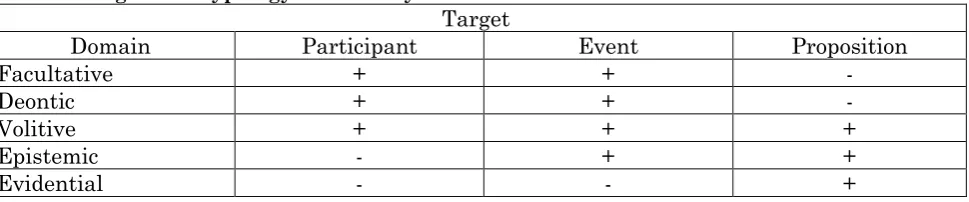
Other proposes a typology of modality that reflects the different layers of the clause structure in the functional grammar tradition. That is, modal elements can be seen as modifiers (also called operators) at different layers of the clause (predication, event or proposition). Two classifying parameters: the target of evaluation and the domain of evaluation. The target of evaluation is crucially the part that represents these different layers of modification in the clause. It is thus constituted of three different parts:
Participant-oriented modality.
Event-oriented modality.
Proposition-oriented modality.
The first type characterizes those modal items that somehow modify the relation
between a participant and an event. The event-oriented type concerns the assessment of the descriptive content of a sentence and most importantly, doesn’t involve the speaker’s judgement. The last type, propositional modality, specifies the speaker’s judgement, or attitude, towards the proposition (notice the similarity with Palmer’s notion of propositional modality)
He put forward the opposition between the purpose of the assessment and the scope of the assessment. The purpose of the evaluation (similar to propositional clauses) is to assume that the speaker's intention for the operators and the combination of operators in a sentence are compulsory for their association. The scope of the assessment (similarity to dynamic modality) belongs to the participant and the event.
Table 4: Hengeveld’s typology of modality
Target
Domain Participant Event Proposition
Facultative + + -
Deontic + + -
Volitive + + +
Epistemic - + +
Evidential - - +
The aim of Van der Auwera and Plungian is to provide a picture of the paths grammarticalized of modality issues. They define modality as a semantic domain that implies necessity and possibility. They
divide into four categories: participant-internal modality, participant-external modality, epistemic, and deontic. Each of them is resolved based on necessity and possibility.
Table 5: Van der Auwera and Plungian’s typology of modality Possibility
non-epistemic epistemic
(necessity) Participant-internal Participant-external Non-deontic Deontic (permission)
Participant-internal Non-deontic Deontic (obligation) epistemic (possibility) Participant-external
non-epistemic Tất yếu (necessity)
By classifying modality of some of the linguists above, we found that although each linguist has a different classification, there are some similarities. In particular, necessity, possibility, epistemic, deontic, objectivity and subjectivity, etc,. In contrast, the boundaries between types of modality are really ambiguous if we do not analyze the evidential element because this element allows us to infer additional conditions to show how high or low the factivity of the
state of affairs can reachin the world of possibility or necessity [13].
Conclusions
with language, mind is the core. Therefore, when studying morality, more or less
linguists are influenced by logical points, even though they are studying modality in terms of language. Through study of modality, we found it difficult to distinguish purely logical and linguistic modality.
However, it is most obvious that the difference between them is that the logic deals with only the state of affair mentioned is realis or unrealis in the world of objective judgments, while modality in language concerns to the speaker's beliefs, attitudes, and attitudes towards the hearer in the state of affairs in the world of subjective judgments of the speaker. Therefore, when studying modality in language, it is necessary to consider the pragmatic used in the state of affairs.
In summary, through the concepts and categories studied above, we thinks if we want to fully understand an utterance, we must consider the modal factors of the proposition under many different meanings. Subjective or objective, realis or unrealis, necessity or possibility, evidentiality marked or unmarked, etc,.
However, it is necessary to base on the relationship between language and mind, the speaker, the hearer, the content of speech, the factual value of speech in the context of communication connected with cultural interaction and society. It means that we need to consider every aspect of the pragmatic of the state of affairs. Therefore, when analyzing the modal structure, we need to integrate all of these elements into social interactions, metalanguage to see the real power of modality and understand the information of the speaker in a good way.
References
1. Perkins Michael R (1983) Modal Expressions in English. Longman Press.
2. Palmer FR (1986) Mood and Modality, Cambridge University Press, Cambridge.
3. Halliday MAK (1970a) Functional diversity in language, as seen from a consideration of modality and mood in English. Foundations of language 6:322-361.
4. Lyons (1977) Semantics. Cambridge: Cambridge University Press.
5. Cao Xuân Hạo (1999) Tiếng Việt - Mấy vấn đề về ngữ âm,
ngữ nghĩa, ngữ
pháp, Nxb Giáo dục, Thành phố Hồ Chí Minh.
6. Bally CH (2003) General Linguistics and questions of English Language. Science Journal.
7. Saussure F de (1983) Course in General Linguistics. (Ch. Bally, trans.). London: Gerald Duckworth.
8. Austin J.L. (1962) How to do things with words, Cambridge University Press, UK.
9. Searle J (1969) Speech Acts. Cambridge: Cambridge University Press.
10. Ayer AJ (1956) The Problem of Knowledge. Macmillan, London.
11. Gettier EL (1963) Is justified true belief knowlegde? Analysis, XXV.
12. Givón T (1982) On understanding Grammar. New York: Academic Press.
![Table 1: Epistemic modality of Givón [12]](https://thumb-us.123doks.com/thumbv2/123dok_us/7829847.2088962/3.595.49.551.371.455/table-epistemic-modality-of-givon.webp)