Bolanthus turcicus (Caryophyllaceae),
a new species from Turkey
Murat Koç1,2, Ergin Hamzaoğlu3
1 Department of Biology, Faculty of Art & Sciences, Bozok University, 66100, Yozgat – Turkey 2 Animal Production High School, Bozok University, 66100, Yozgat – Turkey 3 Department of Elementary Education, Gazi Faculty of Education, Gazi University, 06500, Ankara - Turkey
Corresponding author: Murat Koç ([email protected])
Academic editor: Pam Soltis | Received 8 January 2015 | Accepted 23 June 2015 | Published 8 July 2015
Citation: Koç M, Hamzaoğlu E (2015) Bolanthus turcicus (Caryophyllaceae), a new species from Turkey. PhytoKeys 52:
81–88. doi: 10.3897/phytokeys.52.4479
Abstract
A new species Bolanthus turcicus Koç & Hamzaoğlu, sp. nov. was discovered on Hasan Mountain
(Tur-key, Aksaray province) where it grows on volcanic stony slopes and alpine steppe. its description, images, chorology and ecology, and threat category are provided in this article. It was compared with a closely re-lated species, Bolanthus minuartioides (Jaub. & Spach) Hub.-Mor., B. huber-morathii C.Simon, B. spergu-lifolius (Jaub. & Spach) Hub.-Mor., B. frankenioides (Boiss) Bark., B. mevlanae Aytaç based on its general morphology and seed micromorphology.
Keywords
Anatolia, new species, Bolanthus, taxonomy
Introduction
Bolanthus (Ser.) Reichb., in the family Caryophyllaceae, is one of the smallest genera
of the family. This genus resembles especially the species of Gypsophila L. and
Acantho-phyllum C.A.Mey by its physical appearance. Nevertheless, it differs from Gypsophila
in that Bolanthus are calyx tubular and do not include druses. Besides, it is different from the species of Acanthophyllum as its fruit is 8–28-seeded, dehiscing by valves http://phytokeys.pensoft.net
Copyright Murat Koç, Ergin Hamzaoğlu. This is an open access article distributed under the terms of the Creative Commons Attribution License
(CC BY 4.0), which permits unrestricted use, distribution, and reproduction in any medium, provided the original author and source are credited.
Authors / PhytoKeys 52: 81–88 (2015) 82
or teeth, leaves, bracts, and calyx never spiny, stamens included calyx. In addition,
Bolanthus basically spreads across the Meditarranean Region, while Acanthophyllum is
an Irano-Turanian genus (Bittrich 1993, Huber-Morath 1967, Huber-Morath et al. 1968, Davis et al. 1988).
Bolanthus consists of approximately 15 species and is mainly distributed in Greece,
Palestine and Turkey (Bittrich 1993, Huber-Morath 1967, Davis et al. 1988).
Bolan-thus includes six species one of which is represented by 2 varieties in Flora of Turkey
(Huber-Morath 1967, Huber-Morath et al. 1968). Bolanthus is represented by 8 spe-cies in Flora Europaea (Barkoudah and Akeroyd 1993), 1 spespe-cies in Flora Palaestina (Zohary 1966). As a result of recent studies, 2 species (B. huber-morathii C.Simon, B.
mevlanae Aytaç) and 1 subspecies (B. creutzburgii Greuter subsp. zaffranii Phitos,
Tur-land & Bergmeier) have been added to this genus (Aytaç and Duman 2004, Özhatay et al. 2009, Phitos et al. 2011). As a result; the total taxa number of this genus has been increased to 20. Anatolia is a prominent centre for Bolanthus and 8 species grow in Turkey.
Materials and methods
We came across some interesting Bolanthus specimens while conducting field work on the Hasan Mountain above Karkın town (Turkey, Aksaray province), as two authors actually having the goal of finding the Minuartia L. and Dianthus L.. These specimens were compared with related species in the herbarium of Biology Department of Bozok University, GAZI, K and with records in the literature (Barkoudah and Akeroyd 1993, Zohary 1966, Huber-Morath 1967, Huber-Morath et al. 1968, Davis et al. 1988, Bojňanský and Fargašová 2007). The images were taken using the Canon EOS 60D digital camera, and the seed surface micromorphology was visualized using the LEO 440 scanning electron microscope. Normal visualization of the specimens was carried out using the Olympus SZ61 microscope. The vegetative characters were measured us-ing a ruler with 0.5-mm accuracy and the floral characters were determined usus-ing an ocular micrometer.
Taxonomic treatment
Bolanthus turcicus Koç & Hamzaoğlu, sp. nov.
urn:lsid:ipni.org:names:77148111-1
Figs 1, 2
Diagnosis.Bolanthus turcicus is related to B. spergulifolius (Jaub. & Spach) Hub.-Mor.
Figure 1. A: Bolanthus turcicus (EH 7110). 1 Habit 2 Inflorescence 3 Flower 4 Petal 5 Capsule 6 Leaf
7 Leaf axillary fascicles.
Type. TURKEY, Aksaray province, Hasan Mountain above Karkın town, Hamzaoğlu 7110 and Koç (holo GAZI, iso GAZI, ANK, Dept of Bozok Univ., Her-barium of Biology), 1950 m, volcanic stony slopes and alpine steppe, 18 June 2014.
Authors / PhytoKeys 52: 81–88 (2015) 84
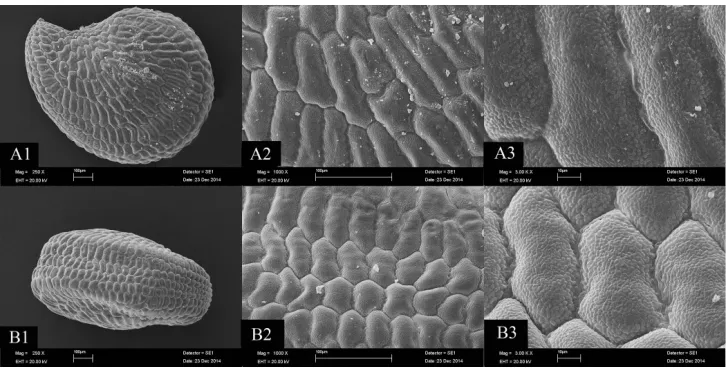
Figure 2. SEM photographs of the seed coat. Bolanthus turcicus – A1–3 ventral surface B1–3 dorsal surface (Scale bars 100 μm).
pedicels 1–2 mm or absent. Calyx tubular, 3.5–4.5 × 1–1.4 mm; tube 5-ribbed, her-baceous, commissures whitish, scarious; teeth narrowly triangular, 1–1.3 mm, apex acuminate. Petals linear-spathulate, 3.3–4.5 × 0.8–1.2 mm, emarginated, as long as calyx; limb whitish with transverse deep purple stripe near middle or base. Stamens 10. Styles 2. Capsule sessile, oblong-ovoid, including calyx, dehiscing by 4 teeth. Seeds black, comma-shaped, 0.8–1.1 × 0.5–0.7 mm, tuberculate. flowering in June and July, volcanic stony slopes and alpine steppe.
Seed micro-morphology. Seeds of Bolanthus turcicus are comma-shaped, 0.8–1.1 × 0.5–0.7 mm, granular; ventral surface with regular elongated rectangular cells, tu-berculate, obscure teeth on each margin, teeth S-undulate; dorsal surface with regular rectangular cells, tuberculate, obscure teeth on each margin, teeth S-undulate. The seeds of B. turcicus aren’t different than the seeds of Bolanthus minuartioides (Jaub. & Spach) Hub.-Mor., B. huber-morathii, B. spergulifolius, B. frankenioides (Boiss) Bark.,
B. mevlanae in terms of dorsal and ventral surfaces (Figure 2).
Chorology and ecology. Bolanthus turcicus grows on volcanic stony slopes and alpine steppe and Irano-Turanian phytogeographic regions (Davis 1965). Many plants in the alpine steppe have distinctive adaptations to the harsh environment. On moun-tain slopes in the alpine steppe, grasses decrease and forbs increase (Huang 1987). The species grows on volcanic stony slopes and alpine steppe together with Scleranthus
Conservation status. Bolanthus turcicus is an endemic species known only from the type gathered in the Hasan Mountain (Aksaray province). Informal grazing and land-use changes could have a detrimental impact in the future. For this reason this species should be classified as “Critically Endangered” (CR-B1a) according to the World Conservation Union categories (IUCN 2014).
Results
The specimens introduced as the new species in this study were collected from Aksaray province, Hasan Mountain above Karkın town. All the 20 taxa, which spreads across the world as well, exist in the Meditarranean Region; however, this taxon exists in the Irano-Turanian phytogeographic region. Firstly collected specimens resemble Bolanthus
spergulifolius and Bolanthus huber-morathii at first glance. Yet, comprehensive studies
that were subsequently carried out revealed that they belonged to a new species.
Distinction from other taxa
Bolanthus is represented by 8 species in the flora in Turkey. Three species (B. cherl-erioides (Bornm.) Bark., B. thymoides Hub.-Mor., B. stenopetalus Hartving & Strid)
among them differs from the others as these three have tight cushion-shaped, leaves that have intensive imbricates and their internodes are scarcely visible. Therefore,
Bo-lanthus turcicus is similar to the other 5 species (B. minuartioides, B. huber-morathii, B. spergulifolius, B. frankenioides, B. mevlanae) as it branches loosely, its leaves do not
imbricate and the gaps between the internodes are wide. Each of these species has its own character by its pedal color, shape of leaves and pubescence. According to the examined specimens and the Flora of Turkey and the East Aegean Islands, Bolanthus
turcicus differs from the species of B. frankenioides and B. mevlanae with its loose
branching, wide distance internodes, shapes and vein number of leaves, length of petal and ratio of petal-calyx. The increases in differences suspend it from these taxa while approximating to Bolanthus minuartioides, B. spergulifolius, B. huber-morathii. However, B. huber-morathii is a distinctive species, whose its glabrous stems, shape of leaves, rate of bracts to calyx and loose inflorescence,. On the other hand, B.
minu-artioides is a distinctive one as well with its petal colour, length of calyx-teeth and
Authors / PhytoKeys 52: 81–88 (2015) 86 Tab le1. D iagnostic characters Bolanthus fr ankenioides
, B. mevlanae
, B. huber-mor
athii
, B. minuar
tioides
, B. spergulifolius
and B. tur cicus . Characters B. fr ankenioides B. mevlanae B. huber-mor athii B. minuar tioides B. sper gulifolius B. tur cicus Plants loosely tufted loosely tufted many branched many branched many branched many branched Stems 2–15 cm 3–5 cm 8–15 cm 3–15 cm 5–15 cm 8–14 cm densely co ver ed
with glandular and eglandular hairs
puber
ulent
glabr
ous
long eglandular hairs
densely glandular and eglandular
hairs
densely glandular and eglandular hairs
Leav es 2–7 mm 2–5 mm 5–8 mm 3–7 mm 5–10 mm 6–10 mm linear-setaceous setaceous subulate-setaceous subulate subulate linear 1-v eined 1-v eined 1-v eined 1-v eined 1-v eined 3-v eined B racts
2/3 or as long as calyx
2/3 or as long as calyx
up to 1/2 as long as calyx
2/3 or as long as calyx
2/3 or as long as calyx
2/3 or as long as calyx
Flo w ers 1–3-flo w er ed 5–10-flo w er ed 5–15-flo w er ed (5-)10–25-flo w er ed 5–15-flo w er ed 5–10-flo w er ed Inflor escence Solitar
y in the axils
or loose fe
w flo w er ed dichasial dense dichasial subcapitate subsessil clusters
lax dichasial clusters
dense dichasial subcapitate
subsessil clusters
dense dichasial subcapitate
subsessil clusters
dense dichasial subcapitate
subsessil clusters C alyx 3–3.5 mm 4–5 mm 4.5–6 mm 4–5 mm 4.5–5.5 mm 3.5–4.5 mm C alyx teeth 0.5–0.7 mm 1.5–2 mm 0.7–1 mm 0.7–1 mm 1–1.5 mm 1–1.5 mm Petals linear-cuneate linear-oblong linear-spatulate linear-lanceolate linear-oblong linear-spatulate 5–7 mm 5.5–6 mm 7–8 mm 5–7 mm 6.5 mm 3.3–4.5 mm
white with purple v
eins
white with purple v
eins
white with purple v
eins
white without purple v
eins
white with purple v
eins
white with purple v
eins
1.5 times longer than
calyx
1.5 times longer than
calyx
1.5 times longer than
calyx
1.5 times longer than calyx
1.5 times longer than calyx
as long as calyx
H abitat alpine meado ws steppe serpantine dr
y hills, limestone, mountain steppe
steppe, stony places fields
volcanic stony slopes and
Key to closely related Bolanthus species
1 Plants loosely tufted; leaves setaceous or linear-setaceous, internodes 1–5 mm 2 Stems densely covered with glandular and eglandular hairs, leaves linear- seta-ceous; calyx 3–3.5 mm, teeth 0.5–0.7 mm; inflorescence Solitary in the axils or loose few flowered dichasial. ...B. frankenioides
2' Stems puberulent, leaves setaceous; calyx 4–5 mm, teeth 1–1.5 mm; inflores-cence dense dichasial subcapitate subsessil clusters ...B. mevlanae
1' Plants many branched, not tufted; leaves subulate, subulat-setaceous or lin-ear, internodes 5–20 mm ... 3 Stems glabrous; bracts up to 1/2 as long as calyx; inflorescence lax dichasial
clusters ...B. huber-morathii
3' Stems glandular and eglandular hairy; bracts 2/3 or as long as calyx; inflores-cence dense dichasial subcapitate subsessil clusters ... 4 Stems long eglandular hairs; calyx teeth 0.7–1 mm; petals white without pur-ple veins. ...B. minuartioides
4' Stems densely glandular and eglandular hairs; calyx teeth 1–1.5 mm; petals white with purple veins ... 5 Leaves linear, 3-vained; calyx 3.5–4.5 mm long; petals 3.3–4.5 mm long, as
long as calyx ...B. turcicus
5' Leaves subulate, 1-vained; calyx 4.5–5.5 mm long; petals 5.5–6.5 mm long, 1.5 times longer than calyx ...B. spergulifolius
Specimens examined
Authors / PhytoKeys 52: 81–88 (2015) 88
Acknowledgements
We wish to thank TÜBİTAK (Project number: KBAG-111T873 and KBAG-113Z260) and Bozok Univ. (Project number: HÜY/A97) for financial support.
References
Aytaç Z, Duman H (2004) Six new taxa (Caryophyllaceae) from Turkey. Annales Botanici Fennici 41: 213–223.
Bittrich V (1993) Caryophyllaceae. In: Kubitzki K, Rohwer J, Bittrich V (Eds) The Families and Genera of Vascular Plants, Magnoliid, Hamamelid, and Caryophyllid Families, Vol. 2. Springer, Berlin, 206–236. doi: 10.1007/978-3-662-02899-5_21
Barkoudah YI, Akeroyd JR (1993) Bolanthus (Ser.) Reichenb In: Tutin TG, Burges NA, Chater AO, Edmondson JR, Heywood VH, Moore DM, Valentine DH, Walters SM, Webb DA (Eds) Flora Europaea, Vol. 1. Cambridge University Press, Cambridge, 222–223.
Bojňanský V, Fargašová A (2007) Atlas of seeds and fruits of Central and East-European Flora: The Carpathian Mountains Region. Springer, Netherlands, 47–91.
Davis PH (1965) Flora of Turkey and the East Aegean Islands, Vol. 1. Edinburgh University Press, Edinburgh, 1–25.
Davis PH, Mill RR, Tan K (1988) Dianthus L. In: Davis PH, Mill RR, Tan K (Eds) Flora of Turkey and the East Aegean Islands (Suppl. 1), Vol. 10. Edinburgh University Press, Edinburgh, 76.
Huang R (1987) Vegetation in the northeastern part of the Qinghai-Xizang Plateau In: Ho-vermann J, Wang W (Eds) Reports of the Northeastern Part of the Qinghai-Xizang (Tibet) Plateau. Science Press, Beijing, China, 438–489.
Huber-Morath A (1967) Bolanthus (Ser.) Reichenb. In: Davis PH (Ed.) Flora of Turkey and the East Aegean Islands, Vol. 2. Edinburgh University Press, Edinburgh, 171–174. Huber-Morath A, McNeill J, Reeve H (1968) Materials for flora of Turkey XIV:
Caryophyl-laceae. Notes Royal Botanic Garden 28: 17–23.
IUCN (2014) Guidelines for Using the IUCN Red List Categories and Criteria. Version 11, February 2014. http://jr.iucnredlist.org/documents/RedListGuidelines.pdf [accessed 25 December 2014]
Özhatay N, Kültür Ş, Aslan S (2009) Check-list of additional taxa to the supplement Flora of Turkey IV. Turkish Journal of Botany 33: 191–226.
Philos D, Turland N, Bergmeir E (2011) A new subspecies of Bolanthus creutzburgii (Caryo-phyllaceae) from coastal SW Kriti (Greece). Flora Mediterranea 21: 317–323.