M a r k e t i n g . E x p e r t J o u r n a l s . c o m
The Effects of the Value Co-Creation Process on the Consumer and the
Company
María Ángeles GARCÍA HARO, María Pilar MARTÍNEZ RUIZ
*,
Ricardo MARTÍNEZ CAÑAS
University of Castilla-La Mancha, Spain
This article analyzes the concept of value co-creation, which has arisen due to the combination of various modern influences - including economic globalization, changes in consumers’ buying habits, and the emergence of the Internet and social media - that have changed the way companies innovate. These factors also have transformed the traditional marketing paradigm, such that companies must continually innovate to create and maintain long-term relationships with their consumers and thus competitive advantages. This study analyzes practices of co-creation and seeks to establish a theoretical research framework; the authors also identify the key effects and results of co-creation activities for both companies and consumers. By integrating situational and moderating variables, the proposed theoretical model covers multiple dimensions and offers a comprehensive approach to the topic.
Keywords: co-creation, open innovation, competitive advantage, social media, consumer, collaboration, technology, customization.
JEL Classification: M30
1. Introduction
Continuous advances in technology have altered the way users communicate, make decisions, relate, learn, interact with other users, and even buy, because they have modified the structure of market power and prompted a shift in power, from the producing agents or distributors to customers (Constantinides and Fountain, 2008). That is, in a traditional value creation model, providers sell inputs to producers, which then develop products and services for consumers. Value gets created by the company or manufacturer, in the form of the product being distributed in the market, through exchanges of monetary compensation (Vargo et al., 2008). Thus, companies focus on the interaction and seek to extract economic value (Prahalad and Ramaswamy, 2004a). Furthermore, the traditional paradigm regards customers as passive buyers and users (O'Hern and Rindfleisch, 2010), leaving companies with a limited understanding of their experiences or knowledge. Little or no interactive dialog takes place between the company and consumers (Sawhney et al., 2005), and communication instead is unidirectional, from the company to the consumer.
*Corresponding Author:
María Pilar Martínez Ruiz, University of Castilla-La Mancha,Faculty of Economics and Business, Albacete, Spain
Cite Reference:
García Haro, M.A., Martínez Ruiz, M.P. and Martínez Cañas, R., 2014. The Effects of the Value Co-Creation Process on the Consumer and the Company. Expert Journal of Marketing, 2(2), pp. 68-81
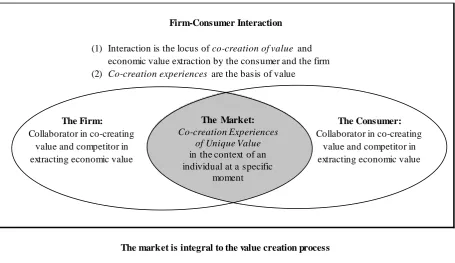
In contrast, continuous advances in technology, linked to globalization, changes in buying habits, and consumers’ revised behaviors, have made it more difficult for firms to differentiate themselves from competitors in saturated markets. This new economic and social framework demands a rethinking of the role of marketing in value creation process (Kotler et al., 2010). As a result of this paradigm shift, companies must stop focusing solely on increasing their internal efficiency and instead seek to develop external resources in their search for value co-creation with consumers (Prahalad and Ramaswamy, 2004a). In the resulting personalized interactions, the roles of the company and the consumer converge (see Figure 1); both actors become competitors and collaborators simultaneously—partners in the creation of value and competitors for the removal of economic value (Prahalad and Ramaswamy, 2004b).
Figure 1. The Emerging Concept of the Market Source: Prahalad and Ramaswamy (2004a)
Because the Internet and social media grant modern consumers access to vast amounts of information and content, they feel more qualified to exert power and are willing to participate substantially in the value-creation processes (Ernst et al., 2010). That is, consumers have become active co-creators of the products and services they buy and use (O'Hern and Rindfleisch, 2010), and they create value through offers that they co-produce and customize with the company (Payne et al., 2008). In this new value-creation process, companies cannot regard users as passive recipients of value, to which they deliver goods, services, and experiences (Ramaswamy, 2009). Instead, consumers and users now constitute the core of any business and serve different roles in innovation processes that create value (Edvarsson et al., 2010). The objective of the company is to customize offerings and achieve maximum participation by customers in this customization process, to better suit customer needs (Vargo and Lusch, 2004).
Unlike the traditional value-creation process, in which communication moved solely from the company to the customer, interactions between companies and consumers increasingly entail continuous dialogues, in which both parties are active and engaged in the learning process (Ballantyne, 2004), so they co-create joint value for both parties (Grönroos, 2008). If these interactions enable consumers to co-create unique experiences, companies likely enjoy a new competitive advantage, which explains why the value must be created jointly (Prahalad and Ramaswamy, 2004b). That is, the co-creation of value is a desirable goal for both companies and consumers, to help companies understand the needs and preferences of consumers (Lusch and Vargo, 2006). It also supports fast learning and decision making by the committed enterprise, because customer experiences represent efficient means to create value (Prahalad and Ramaswamy, 2004b).
The aim of this study is thus fourfold: We first seek to identify the process of value co-creation as it emerges through co-creation activities, market testing, open innovation, and product customization; second, we study the effect of these co-creation activities on outcome variables associated with the consumer and the
(1)
(2) Co-creation experiences are the basis of value
The Firm: Collaborator in co-creating
value and competitor in extracting economic value
The Consumer: Collaborator in co-creating
value and competitor in extracting economic value Interaction is the locus of co-creation of value and
economic value extraction by the consumer and the firm Firm-Consumer Interaction
The market is integral to the value creation process The Market:
Co-creation Experiences of Unique Value in the context of an individual at a specific
company; third, we analyze whether company, environmental, and consumer variables affect the relationship between co-creation activities and their outcomes; and fourth, we propose a general theoretical model that encompasses all these dimensions.
2. Literature Review
2.1. Co-Creation Activities
The term co-creation initially was used by Kambil et al. (1999) to refer to co-creating value for consumers, in which context they propose that co-creation activities give rise to a new dynamic in the relationship between the company and the customer, because customers participate in the production process and the distribution of value. Because customers can participate in every stage of the value chain, they become partial "employees" of the organization. Prahalad and Ramaswamy (2000) then adopted the term to refer to those activities in which both the consumer and the company are involved together in the creation of value.
Although marketing literature provides different definitions for co-creation, the concept sometimes has been used incorrectly and synonymously with other concepts, such as co-production (Auh et al., 2007, Lengnick-Hall et al., 2000, Soltanzadeh, 2014) or consumer participation (Dong et al., 2012; Fang et al., 2008). Because these terms do not necessarily equate with co-creation, a lack of clarity about the specific meaning of the term “co-creation” remains (Rajah et al., 2008). However, an exhaustive literature review reveals some central, relevant definitions of creation. For example, Piller et al. (2012) consider co-creation as an active, creative, social partnership process between producers (retailers) and customers (users), facilitated by the company. For O' Hern and Rindfleisch (2009), co-creation stems from collaborations to develop new products, such that consumers actively contribute and select elements of the new product being offered. Rajah et al. (2008) assert that co-creation happens when the consumer and the company work together to create a consumer experience that adds value to the buying process; Zwass (2010) defines co-creation as the participation of consumers with producers in the co-creation of value in the market. Thus, these definitions share several features:
- Co- creation is an activity or process between the company and the consumer. - It requires the joint collaboration of both sides.
- The objective is to create value for both sides.
Therefore, we propose that co-creation refers to any activity in which the consumer participates in an active and direct way with the company to design and develop new products, services, or processes.
Although marketing literature acknowledges the participation of customers in innovation processes (Auh et al., 2007; Piller et al., 2012), empirical studies of co-creation are scarce (Zhang and Chen, 2008), leaving gaps in our knowledge about the nature of this phenomenon (O' Hern and Rindfleisch, 2010). Accordingly, the Marketing Science Institute declared co-creation activities as a priority topic for investigation for 2014– 2016. Interest in co-creation results from its potential strategic use for both theoretical study and practice (Ehrenthal et al., 2012).
Prior studies analyze co-creation activities on the basis of different theoretical frameworks, including the theory of user participation (Fang et al., 2008), the user-centered approach (Karahasanović et al., 2009), user-generated content (Banks and Humphreys, 2008), and the service-dominant logic (SDL; Vargo and Lusch, 2004). The SDL in particular shifts the perspective to company–consumer communication (Lusch et al., 2008; Vargo and Lusch, 2004) and regards consumers as proactive co-creators rather than passive recipients of value, while companies are agents that facilitate this process, instead of merely producers of a standardized value. In a goods-dominant logic, communication moves in a single direction, but in the SDL, a continuous dialogue between the company and consumer seeks to create the service on a joint basis (Payne et al., 2008).
marketing professionals to extend the traditional paradigm for developing new products (O'Hern and Rindfleisch, 2010).
2.2.Open Innovation
With continuous technology advances, company–customer interactions take on new forms, moving beyond the sale of goods and services in exchange for money (Saarijärvi, 2014). Organizations innovate using customers that innovate for them and therefore using their knowledge and ideas for the development of new products, services and processes.
In tradition new product development strategies, companies innovated and introduced new products to the market that failed to meet customers’ expectations (Henard and Szymanski, 2001), because the firms were relying solely on internal ideas, generated through their R&D activities, to develop, manufacture, market, and distribute the innovative product (Chesbrough, 2003). Only large companies with substantial resources and long-term research programs could compete effectively, but even these well-funded research programs could not always cope with the rapid release of new products into the market as product lifetimes grew shorter (Chesbrough, 2003). In response, the model of closed innovation, in which ideas were generated and developed internally (Chesbrough, 2006), shifted to a model of open innovation that sought to include the ideas of other agents, external to the organization.
Open innovation reflects the general premise that more potential knowledge and ideas for creating new products and processes exist outside a company than within it (Zwass, 2010); this external knowledge complements internal knowledge to accelerate innovation (Chesbrough, 2006). In addition, open innovation can offer insights into how consumers use products, which can lead to creative ideas about how to meet their needs and create a brand identity (Zwass, 2010).
Continued technological improvements in hardware and software enable expanded development of innovation tools that require less effort and less cost (von Hippel, 2005). Technology and social media development supports open access, such that companies can establish mechanisms to integrate innovation with the customer into their internal processes (Nambisan and Nambisan, 2009) while also encouraging greater customer participation. Technologically supported concepts such as open source, crowdsourcing, and mass customization thus are central to competitive strategies (Rayna and Striukova, 2014). This paradigm shift is what von Hippel (2005) calls the democratization of innovation, such that consumers take a prevailing role in creating new products and processes.
In an open innovation model, companies turn to R&D that takes place beyond their boundaries (Chesbrough, 2003), with the recognition that they cannot complete the whole innovation process on their own but instead require external ideas to move forward and develop new strategies for innovation. With open innovation, companies have gone from using their knowledge of the customer to co-creating knowledge with the customer (Sawhney and Prandelli, 2000). Consumers help companies become knowledgeable about their tastes and preferences, so companies often provide consumers with virtual tools to enable their design, prototyping, and product testing efforts (von Hippel, 2005).
In parallel, companies increasingly support the development of personalized new products and services. Concepts such as mass customization have gained popularity as means to meet consumers’ demand more accurately (Zhang and Chen, 2008). Mass customization requires that consumers choose among a range of default options, according to their preferences (Rayna and Striukova, 2014). However, mass customization cannot secure a sustainable competitive advantage, which instead requires the continual delivery of maximum value to each individual customer (Pine, 1993). As organizations proactively searched for new ideas and solutions to make the innovation process more effective (Rayna and Striukova, 2014), they began to involve the consumer more in the design and development of new products and services. In the mass customization process, customers were limited to making suggestions about a prototype product at the end of the innovation phase; in a co-creation process, customers actively collaborate in the very first stages of innovation and share their experiences, thus forcing the company to alter its portfolio of products and services (Kristensson et al., 2008). The key is the experience gained by the consumer through using the product or service (Vargo and Lusch, 2004).
3.Outcomes of Co-Creation
To study the effects or outcomes of implementing co-creation activities, we consider both consumers and the company. We start with the effects of co-creation on consumers and consider how customer satisfaction, trust, and loyalty might be affected by their participation in co-creation activities.
3.1. Satisfaction, Trust, and Consumer Loyalty
Engaging customers in production processes helps companies develop new products and services, but it also enables them to establish long-term relationships with their customers. Customer satisfaction has long been established as a primary determinant of consumers’ long-term behavior (Oliver, 1980). Accordingly, companies need to understand the impact of co-creation on customer satisfaction, trust, relationships, and loyalty (Rajah et al., 2008). Despite the many studies focused on the relationships among these variables, empirical investigations of the impact of co-creation activities on levels of satisfaction, trust, and loyalty are limited (Dvorak, 2013; Grissemann and Stockburger-Sauer, 2012; Vázquez et al., 2014). According to Grissemann and Stockburger-Sauer (2012), a greater degree of co-creation should lead to higher satisfaction and loyalty and enable the company to charge higher prices. But for this relationship to be positive, the customer needs the support of the company. Vázquez et al. (2014) also suggest a positive relationship between co-creation behavior and consumer satisfaction with the service experience. Dvorak (2013) establishes a positive relationship between the level of consumer satisfaction and co-creation activities for product design and development, as well as to influence other customers’ use of the product.
In co-creation processes, customers become fully involved in various stages. For these active users, the highest level of satisfaction should result from their participation (Grönroos, 2008), because then they obtain a product that fits their needs perfectly (Vázquez et al., 2014). When customers participate in the development of a new service, they also gain a sense of belonging to the firm, which increases their levels of satisfaction and loyalty (Grissemann and Stockburger-Sauer, 2012). Greater satisfaction stems from more positive experiences with the company; in turn, satisfied customers likely share their positive experiences with other users, which should improve the firm’s reputation (Cronin and Taylor, 1992). When the product is co-created and fully consistent with their needs, customers perceive the effort they expended in the process positively, as a rewarding, pleasant experience that increases the subjective value that accompanies the product (Franke and Schreier, 2010).
According to Rajah et al. (2008), improving co-creation interactions has two potential effects for the customer: (1) It reduces transaction costs, risk, and uncertainty, and (2) it reduces the costs of the interaction for the consumer, which leads to greater satisfaction with and trust in the company (Vandenbosch and Dawer, 2002). In effect, more tailored, customized products, compared with standardized products (Franke et al., 2009), generate more value and increase customer satisfaction (Franke and von Hippel, 2003). The level of consumer satisfaction also depends on the degree of fun and entertainment that the customer experiences during the co-creation process. If a customer voluntarily participates and enjoys the process, she or he likely develops a positive attitude, which should lead to greater satisfaction (Hoyer et al., 2010). Consumers perceive greater value from their participation if they really enjoy it (Franke and Schreier, 2010), so they likely are willing to pay more for products they have designed than for standardized products (Franke and Piller, 2004).
3.2.Effects on the Company
Implementing co-creation activities has several effects for the company, including better product quality (Fuller et al. 2009); less business risk (Maklan et al., 2008), especially in the process of entering a new market or introducing a new offering; lower costs; greater productivity and revenue growth, but with a smaller capital base (Ramaswamy and Gouillart, 2010); new competitive skills (Whiteley and Hessan, 1996); wider product acceptance in the market, with greater commercial potential (Oldemaat, 2013); and reduced uncertainty (Prahalad and Ramaswamy, 2004b).
them access to information generated by other consumers. Thus, consumers focus more on the brand, which should increase the amount of positive discussions about the brand and its products, as well as the consumer’s identification with these products and brands (Roser et al., 2009).
Thus the traditional brand model has changed, because consumers play more active roles (Prahalad and Ramaswamy, 2004a). Consumers have access to vast amounts of information and share their experiences with other users. As a result, the power of advertising to create or maintain a particular image of a product or company has greatly declined (Prahalad and Ramaswamy, 2004b). The brand is created by the experiences of consumers, such that the challenge for companies is to ensure consistent quality and personalized experiences for each individual consumer during the co-creation process (Prahalad and Ramaswamy, 2004b). A unique product or brand value should increase customer loyalty and prompt greater trust in the brand (Chaudhuri and Holbrook, 2001). Then brand loyalty leads to greater market share, because consumers repeatedly buy the same brand (Chaudhuri and Holbrook, 2001). That is, a loyal consumer provides a continuous flow of benefits to the company, along with reduced marketing costs and higher barriers to change, because he or she is less likely to pay attention to promotions by competitors (Yi and La, 2004). Loyal brand consumers even are willing to pay a higher price for that product or brand, because they perceive the unique value of the brand (Chaudhuri and Holbrook, 2001).
4.Moderator and Situational Variables of the Relationship
On the basis of an extensive literature review, we chose four situational variables pertaining to the company: (1) technology, (2) activity sector, (3) adoption of social media, and (4) organizational structure. The identified consumer variables involved (1) habits/buying preferences, (2) values and ethical dimensions, (3) incentives or reasons to co-create (intrinsic vs. extrinsic), and (4) social and subjective norms, related to environmental pressures on the consumer.
4.1.Company-Related Situational Variables
4.1.1. Technology
Continuous changes in technology have altered the way businesses operate. Information and communication technologies (ICT) now represent one of the most important elements for product innovation and marketing processes, providing routes to strengthen cooperation and communication, reduce barriers to innovation, and enhance the development of differentiated products (Requena et al., 2007). The ICT advances also enable customers to be more active, better informed, more aware at a global level, and more willing to use virtual environments to interact with companies to obtain new products and services (Seppä and Tanev, 2011).
The use of ICT in turn might offer an important source of competitive advantage (Roberts, 2000), because it brings the company closer to its surroundings, such that it can acquire knowledge and up-to-date information about the different agents in a quick, easy, relatively inexpensive way (Requena et al., 2007). In addition, ICT allows companies to communicate with different agents quickly and smoothly, by eliminating the barriers of space and time, such that it supports an effective transfer of knowledge (Grönroos, 2000). Leenders and Wierenga (2002) further suggest that the use of ICT in communications influences the degree of cooperation among agents. In closed relations, members share the same principles and values; thus, they are willing to devote more effort to achieve a common, strategic goal. When the company establishes connections with external agents, ICT can stimulate collaboration and the transfer and use of knowledge among members (Smith and Blanck, 2002), which makes the construction of virtual working groups throughout the world possible (Roberts, 2000). Therefore, ICT improves the development of new products, while saving time and monetary costs; facilitates the transmission of information; and encourages collaborative behaviors that improve decision-making quality (Sorensen and Lundh-Snis, 2001).
4.1.2. Social Media
allow them to access information about how customers use their products and services, as well as how customers perceive their offers (Eloranta and Matveinen, 2014).
Currently, many social media applications (e.g., blogs, open collaborative projects, social networking sites, content communities, virtual worlds, games) enable individual consumers, communities, and businesses to connect and exchange information (Kaplan and Haenlein, 2010). These social media also enable companies to interact in real time and more frequently with users, which accordingly increases customers’ participation (Sawhney et al., 2005). With these tools, companies monitor the content that gets shared, deal with potential problems, obtain new ideas, and use this information as a basis for value creation. To establish such continuous interactions, companies also need to provide tools that help consumers exchange their views and solutions with other users. This provision should lead to a dynamic environment, marked by creative and social partnerships between the company and its customers in a new product development context (Kang and Young, 2014).
4.1.3. Activity Sector
Quick and unpredictable changes in the environment make innovation a key element for achieving competitiveness and success in markets (Lee et al., 2012). Organizations rely on innovations to adapt to changes in their internal and external environments, though the external factors mean that outcomes of these innovation processes differ for each organization, depending on its industry sector (Van de Ven, 1986). Accordingly, co-creation processes have been analyzed in various sectors, including financial services (Auh et al., 2007), beauty and personal care (Vázquez et al., 2014), retailing (Shamim and Ghazali, 2014), tourism (Binkhorst and Dekker, 2009), the public sector (Wise et al., 2012), furniture (Andreu et al., 2010), luxury (Tynan et al., 2010), construction (Ordanini and Pasini, 2008), video games (Banks and Potts, 2010), health (Kantola et al., 2014), and education (Fagerstrøm and Ghinea, 2013).
4.1.4. Organizational Structure
To facilitate external collaborations, an organization needs a culture of internal collaboration (Lee et al., 2012) and innovation (Griffin, 1997; Menor and Roth, 2007), because such a culture determines if the organization can support the development of innovations, exceed customers’ expectations, and gain a competitive advantage (Hult et al., 2004). Organizational characteristics have been widely studied in terms of their effects on innovation in general, but few studies address the specific effects of organizational characteristics on particular stages of the innovation process (Troy et al., 2001). For example, open mindedness and open communication likely are moderators of the relationship between the amount of information available on the market and the generation of ideas for new product development. When organizational members are encouraged to think in different ways, previously undetected patterns in the market become evident, and the range of market opportunities increases (Senge, 1990), which is crucial for generating new product ideas (Slater and Narver, 1995). Open communication also implies greater exchanges of information, which can facilitate the creation of new ideas (Aiken et al., 1980). The implementation of these new ideas then largely depends on characteristics of the organizational structure, such as formalization, centralization, and specialization (Aiken et al. 1980). In particular, a high degree of formalization and strict hierarchies tend to hinder the generation of new product ideas (Johne and Storey, 1998). An organization with strict rules and procedures likely responds with routine solutions (Harvey and Mills, 1970), though some studies also suggest that a more centralized structure can disperse information more widely and thus facilitate the creation of ideas (Troy et al., 2001) and the development of new products (Froehle et al., 2000).
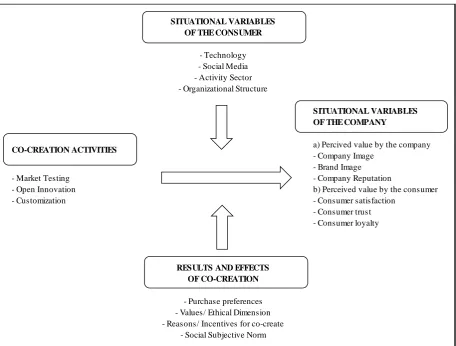
Figure 2 depicts our proposed model, in which co-creation activities (market testing, open innovation, customization) affect the creation of value at the consumer level (satisfaction, confidence, loyalty) and the company level (brand image, company image, prestige, company reputation). In Figure 2, value is contingent on situational variables pertaining to the company and the consumer.
4.2. Variables Associated with the Consumer
4.2.1. Purchase Habits and Preferences
look for new methods to develop new products and services, such as by involving users in the early stages of new product development, namely, in the idea generation stage (Kristensson et al., 2008). If they plan to invite customers to suggest ideas for innovative products and services, companies also must understand the customer needs intended to be met with the new product or service and know if it adds value. To comprehend current customer needs, companies must grant those customers a more active innovation role (von Hippel, 2005).
The consumer's ability to take such an active role in new product development has increased greatly with the arrival of recent technological advances, especially the development and growth of the Internet (O’Hern and Rindfleisch, 2010). Users can access virtually unlimited amounts of information and share it in real time with other users and companies all around the world. If consumers want a greater role in their interactions with the companies, they can take it, which should increase the value of the process for them (Hoyer et al, 2010).
4.2.2. Values and Ethical Dimensions
The continuous advance of technology and the globalization of the economy together have generated new economic and social frameworks, making it necessary to rethink marketing. Organizations, consumers, and economies are connected and interdependent (Lee et al., 2012), in such a way that companies cannot focus solely on their domestic rivals but also must compete effectively with companies all over the world, to achieve unique competitive advantages. When the macroeconomic environment changes, so do the conduct and attitudes of consumers, which requires a change to marketing practices too (Kotler et al., 2010). In particular, recent changes have induced a new era of marketing that Kotler et al. (2010) call the era of society and creative collaborative marketing. That is, marketing 1.0 focused on the product; marketing 2.0 focused on the consumer; marketing 3.0 is based on values. Products and services thus are generated to account for what the consumer thinks, feels, and needs, such that the offerings address those wishes and needs. Marketing 3.0 also regards consumers as human beings, with intelligence, heart, and spirit (Kotler et al., 2010), and emphasizes activities that result from bidirectional communication between company and consumer. Increasingly, customers seek solutions that improve the world, as well as companies that meet their deep needs and contribute to social development, economic security, and environmental protection (Kotler et al., 2010).
4.2.3. Incentives to Co-Create
Despite the importance of co-creation, companies still struggle to find customers who are willing to collaborate and share their knowledge and ideas (O'Hern and Rindfleisch, 2010). Consumers vary in their interest and ability to participate in co-creation activities, such that relatively few consumers fully collaborate to develop and launch products (O'Hern and Rindfleisch, 2009).
Participating in co-creation activities requires consumers to use their time and knowledge to generate new ideas for products and services (Brunink, 2013). Some consumers compare the costs and benefits of participating (O'Hern and Rindfleisch, 2009), such that they might be more motivated to participate if they receive some financial reward (Boudreau et al., 2011) through an innovation lottery, prize, special offer, or sweepstakes (Fuller, 2010). Beyond monetary rewards, other reasons that drive consumers to collaborate include social benefits, such as reconnaissance of the environment or strengthening links with others. Some consumers are motivated by learning and the knowledge acquired about a technology-based product or service (Nambisan and Baron, 2009) or by recognition, thanks, or feedback (Fuller, 2010). Finally, some consumers might collaborate for altruistic reasons (believe strongly in the goals achieved as a result of this effort) or their enjoyment of psychic involvement (Hoyer et al., 2010).
According to Fuller (2010), motives that drive consumers to cooperate consist of two categories: intrinsic and extrinsic. Consumers are motivated intrinsically if they assess the activity as valuable (e.g., fun, entertainment). They are extrinsically motivated if their focus is on the results of the activity (e.g., rewards). If companies simply assume that consumers will offer their ideas in co-creation processes, the co-creation process is likely to fail (Nambisan, 2002), because not all consumers are intrinsically motivated to participate (Xia and Suri, 2014). Rather, co-creation requires a flexible network of experiences that enable consumers to co-create and personalize the results (Pralahad and Ramaswamy, 2004a); companies should take these motivational factors into account when they search for new potential customers (Dvorak, 2013).
4.2.4. Social and Subjective Norms
when a user accepts information from other users as evidence of reality, and those that arise when the user seeks to meet the expectations of others to obtain a reward or avoid punishment (Deutsch and Gerard, 1955). If consumers have positive attitudes toward and the means to make a purchase, their reasons to act still might not be sufficient. Instead, subjective standards and pressures from the environment are influential.
To explicate the various influences on people’s behavior, Ajzen and Fishbein (1980) propose the theory of reasoned action, based on the proposition that a person’s behavior is determined by her or his intention to perform that behavior; this intention in turn depends on the person’s attitude toward the behavior and subjective standards. Attitudes refer to the person’s sense of whether the behavior is favorable or not; subjective standards are perceptions that others, whom the actor regards as important, believe the behavior is favorable (Ajzen and Fishbein, 1980). Social norms include subjective social pressures that reach consumers in their proximal environments (Descals, 2006). Thus people assess what they think about their own behavior according to the norms established by relevant other people, such as family or friends. These social norms are based on normative beliefs about what people in this environment expect the consumer to do, as well as the motivation to secure the good opinion of these influential others. Therefore, the actions, thoughts, and statements of others influence a user’s purchase and collaboration behaviors. If friends, family, and coworkers participate in co-creation processes, a consumer likely is more interested in participating too, to feel integrated into this environment.
Figure 2: Proposed theoretical model
5. Conclusions, Limitations, and Research Directions
This article has analyzed value co-creation activities as an important business strategy, necessary to support innovation processes and the achievement of competitive advantages. The co-creation process has transformed the traditional functions of a company, in which the producer and the consumer had different roles. Today, the consumer also serves as a producer, and both of them combine their efforts to develop new products and services together. To establish a conceptual framework for analyzing this process of value co-creation and its implications for the company and the consumer, we first built the theoretical foundations
SITUATIONAL VARIABLES OF THE CONSUMER
- Technology - Social Media - Activity Sector - Organizational Structure
SITUATIONAL VARIABLES OF THE COMPANY
a) Percived value by the company - Company Image
- Brand Image
- Market Testing - Company Reputation
- Open Innovation b) Perceived value by the consumer
- Customization - Consumer satisfaction
- Consumer trust - Consumer loyalty
RESULTS AND EFFECTS OF CO-CREATION
- Purchase preferences - Values/ Ethical Dimension - Reasons/ Incentives for co-create
underlying the process of co-creation and defined and delimited the concept. From a review of existing literature, we also identified potential moderators and situational variables that likely influence the company–customer relationship. From these developments, we have derived a general theoretical model that encompasses all these relations.
In turn, our study contributes to extant research in several respects. First, it offers an initial conceptualization of value co-creation and its associated variables. Second, despite the importance of this topic for marketing and business strategy, few studies have investigated the process of value co-creation as a competitive strategy. Third, we provide a better understanding of the co-creation process, which should facilitate relevant actions and business policies. Our work is based on an extensive theoretical and empirical review, which supports the proposed model and reveals the direct and indirect effects of co-creation activities on companies and consumers.
Further research might undertake an empirical study to test the proposed model and identify real-world, direct and indirect co-creation activities that influence companies and consumers. Additional literature reviews could go into greater depth to identify other possible variables that might mediate the central relationship in our model. Research that identifies co-creation opportunities in emerging technologies, such as mobile phones, could help enhance company–customer relationships and clarify the effects for the firm’s brand image. Finally, we call for further studies of social influences when peers engage in co-creation activities.
6. References
Aiken, M., Bacharach, S., and French, J., 1980. Organizational structure, work process, and proposal making in administrative bureaucracies. Academy of Management Journal, vol. 23, pp 631-652.
Ajzen, I., and Fishbein, M., 1980. Understanding attitudes and predicting social behavior. Englewood Cliffs, NJ: Prentice-Hall.
Andreu, L., Sánchez, I., and Mele, C., 2010. Value co-creation among retailers and consumers: New insights into the furniture market. Journal of Retailing and Consumer Services, vol. 17, pp 241-250.
Auh, S., Bell, S., McLeod, C., and Shih, E., 2007. Co-production and customer loyalty in financial services.
Journal of Retailing, vol. 83, pp359-370.
Ballantyne, D., 2004. Dialog and its role in the development of relationship specific knowledge. Journal of Business and Industrial Marketing,vol. 19, nº 2, pp 114-123.
Banks, J. and Humphreys, S. 2008. The labour of user co-creators. Emergent social network markets? The International Journal of Research into New Media Technologies, vol. 14, nº 4, 401-418.
Banks, J., and Potts, J., 2010. Co-creating games: a co-evolutionary analysis. New Media & Society, vol. 12, nº 2, pp 253-270.
Binkhorst, E., and Dekker, T., 2009. Agenda for co-creation tourism experience research. Journal of Hospitality Marketing & Management, vol. 18, pp 311-327.
Bogers, M., Afuah, A., and Bastian, B., 2010. Users as innovators: A review, critique, and future research directions. Journal of Management, vol. 36, no 4, pp. 857-875.
Boudreau, K., Lacetera, N., and Lakhani, K., 2011. Incentives and problem uncertainty in innovation contests: An empirical analysis. Management Science,vol. 57, nº 5, pp 843‐863.
Brünink, L., 2013. Co-creation: Customer integration in social media based product and service development. In Proceedings of the 1st IBA Bachelor Thesis Conference. Enschede, the Netherlands. Chaudhuri, A., and Holbrook, M., 2001. The chain of effects from brand trust and brand affect to brand
performance: The role of brand loyalty. Journal of Marketing, vol. 65, April, pp 81-93.
Chesbrough, H., 2003. Open Innovation: The New Imperative for Creating and Profiting from Technology, Cambridge: Harvard Business School Publishing.
Chesbrough, H.W., 2006. Open Business Models: How to Thrive in the New Innovation Landscape, Cambridge: Harvard Business School Publishing.
Cronin, J., and Taylor, S., 1992. Measuring service quality: A reexamination and extension. Journal of Marketing, vol. 56, nº 3.
Descals, A., 2006. Comportamiento del consumidor, UOC, Barcelona.
Deutsch, M., and Gerard, H., 1955. A study of normative and informational social influences upon individual judgment. Journal of Abnormal and Social Psychology, 51, nº 3, November, pp 629-636.
Dong, B., Evans, K., and Zou, S., 2012. The effects of customer participation in co-created service recovery.
Journal of the Academy Marketing Science, vol. 36, pp 123-137.
Dvorak, T., 2013. Co-innovation: Customer motives for participation in co-creation processes via social media platforms. Proceedings of the 2nd IBA Bachelor Thesis Conference. Enschede, the Netherlands.
Edvardsson, B., Tronvoll, B., and Gruber, T., 2010. Expanding understanding of service exchange and value co-creation: a social construction approach. Journal of the Academy of Marketing Science.
Eloranta, V., and Matveinen, J., 2014. Accessing value-in-use information by integrating social platforms into service offerings. Technology Innovation Management Review, vol. 4, nº 4, April, pp 26-34. Ehrenthal, J., Stölzle, W. and Rudolph, T., 2012. A Service-Dominant Logic View of Retail On-Shelf
Availability. University of St. Gallen, Germany.
Ernst, H., Hoyer, W., Krafft. M., and Soll, J., 2010. Consumer Idea Generation, working paper, WHU,Vallendar.
Fagerstrøm, A., and Ghinea, G., 2013. Co-creation of value in higher education: using social network marketing in the recruitment of students. Journal of Higher Education Policy and Management, vol. 35, nº 1, pp. 45-53.
Fang, E., Palmatier, R., and Evans, K., 2008. Influence of customer participation on creating and sharing of new product value. Journal of the Academy Marketing Science, vol. 36, pp 322-336.
Franke, N., Keinz, P., and Steger, C., 2009. Testing the value of customization: When do customers really prefer products tailored to their preferences? Journal of Marketing, vol. 73, nº 5
Franke, N. and Piller, F.., 2004. Value creation by toolkits for user innovation and design: The case of the watch market. Journal or Product Innovation Management, vol. 21, nº 6, pp 401-415.
Franke, N. and Schreier, M., 2010. ‘I designed it myself’ effect in mass customization. Management Science, pp 125-140.
Franke, N., and von Hippel, E., 2003. Satisfying heterogeneous user needs via innovation toolkits: the case of Apache security software. Research Policy, vol. 32, nº 7, pp 1199-1215.
Froehle, C., Roth, A., Chase, R., and Voss, C., 2000. Antecedents of new service development effectiveness. An exploratory examination of strategic operations choices. Journal of Service Research,vol. 3, nº 1, August, pp 3-17.
Füller, J., 2010. Refining virtual co-creation from a consumer perspective. California Management Review, vol. 52, nº 2, pp 98–122.
Füller, J., Mühlbacher, H., Matzler, K., and Jawecki, G., 2009. Consumer empowerment through Internet-based co-creation. Journal of Management Information Systems, vol. 26, nº 3, pp 71–102.
Griffin, A., 1997. The effect of project and process characteristics on product development cycle time. Journal of Marketing Research, vol 34, nº 1.
Grissemann, U., and Stokburger-Sauer, N., 2012. Customer co-creation of travel services: The role of company support and customer satisfaction with the co-creation performance. Tourism Management,
vol. 22, pp1483-1492.
Grönroos, C., 2000. Creating a relationship dialogue: Communication, interaction and value. Marketing Review, vol. 1, nº 1, pp 5-14.
Grönroos, C., 2008. Service logic revisited: Who creates value? And who co‐creates? European Business Review, vol. 20, nº 4, pp 298-314.
Harvey, E., and Mills, R., 1970. Patterns of Organizational Adaptation: A Political Perspective, Nashville, TN: Vanderbilt University Press.
Henard, D. and Szymanski, D., 2001. Why some new products are more successful than others. Journal of Marketing Research, vol. 38, nº 3, pp 362-375.
Hoyer, W., Chandy, R., Dorotic, M., Krafft, M., and Singh, S., 2010. Consumer cocreation in new product development. Journal of Service Research, vol. 13, nº 3, pp 283-296.
Hult, G., Hurley, R., and Knight, G., 2004. Innovativeness: Its antecedents and impact on business performance. Industrial Marketing Management, vol. 33, pp 429-438.
Ind, N., Fuller, C., and Trevail, C., 2012. Brand Together: How Co-Creation Generates Innovation and Re-energizes Brands, London: Kogan Page.
Johne, A., and Storey, C., 1998. New service development: A review of the literature and annotated bibliography. European Journal of Marketing, vol. 32, nº ¾, pp 184- 251.
Kambil, A., Friesen, G., and Sundaram, A., 1999. Co-creation: A new source of value, Outlook, vol. 2, pp 38-43.
Kang, M., and Young, J., 2014. Repurchase loyalty for customer social co-creation e-marketplaces. Journal of Fashion Marketing and Management, vol. 18, nº 4, pp 452-464.
Kantola, T., Hirvikoski, T., Lehto, P., Aholaakko, T., Kukkonen, M., y Partamies, S., 2014. Towards co-creation of eHealth services. Interdisciplinary Studies Journal, vol. 3, nº 4, pp 192-205.
Kaplan, A., and Haenlein, M., 2010. Users of the world, unite! The challenges and opportunities of social media. Business Horizons, vol. 53, nº 1, pp 59-68.
Karahasanović, A., Brandtzg. P., Heim, J., Lüders, M., Vermeir, L., Pierson, J., Lievens, B., Vanattenhoven, J., and Jans, G., 2009. Co-creation and user-generated content–elderly people’s user requirements. Computers in Human Behavior, vol. 25, nº 3, pp 655–678.
Kotler, P., Kartajaya, H., and Setiawan, I., 2010. Marketing 3.0: From Products to Customers to the Human Spirit. New York: John Wiley & Sons.
Kristensson, P., Matthing, J., and Johansson, N., 2008. Key strategies for the successful involvement of customers in the co-creation of new technology-based services. International Journal of Service Industry Management, vol. 19, nº 4, pp 474-491.
Lee, S., Olson, D., and Trimi, S., 2012. Co-innovation: Convergenomics, collaboration, and co-creation for organizational values. Management Decision,vol. 50, nº 5, pp 817-831.
Leenders, M., and Wierenga, B., 2002. The effectiveness of different mechanisms for integrating marketing and R&D. Journal of Product Innovation Management, vol. 19, nº 4, Julio, pp 305-317.
Lengnick-Hall, A., Claycomb, V., and Inks, L., 2000. From recipient to contributor: examining customer roles and experienced outcomes. European Journal of Marketing, vol. 34, nº ¾, pp 359-383.
Lusch, R. and Vargo, S., 2006. The Service Dominant Logic of Marketing: Dialog, Debate and Directions. Armonk, NY: M.E. Sharpe.
Lusch, R. Vargo, S., and Wessels, G., 2008. Toward a conceptual foundation for service science: Contributions from service-dominant logic. IBM Systems Journal, vol. 47, nº 1.
Maklan, S., Knox, S., and Ryals, L., 2008. New trends in innovation and customer relationship management.
International Journal of Market Research,vol. 50, nº 2, pp 221-240.
Menor, L., y Roth, A., 2007. New service development competence in retail banking: Construct development and measurement validation. Journal of Operations Management, vol. 25, nº 4, pp 825- 846.
Nambisan, S., 2002. Designing virtual customer environments for new product development: toward a theory. Academy of Management Review, vol. 27, pp 392-413.
Nambisan, S. and Baron, R. 2009. Virtual customer environments: testing a model of voluntary participation in value co-creation activities. The Journal of Product Innovation Management, vol. 26, nº 4, pp. 388-406.
Nambisan, P. and Nambisan, S., 2009. Models of consumer value co-creation in health care. Health Care Management Review, vol. 34, nº 4, pp. 344-354.
O’Hern, M. and Rindfleisch, A., 2009. Customer co-creation: A typology and research agenda. Review of Marketing Research, vol. 6, pp 84-106.
O’Hern, M. and Rindfleisch, A., 2010. Customer co-creation. Review of Marketing Research, pp 84-116. Oldemaat, L., 2013. Co-creation: The ‘P’ of Participation. How co-creation affects product and brand
attitudes and behavioural intentions of non co-creative consumers. Universtity of Twente.
Oliver, R., 1980. A cognitive model of the antecedents and consequences of satisfaction decision. Journal of Marketing Research, vol. 17, nº 4.
Orcik, A., Tekic, Z., and Anisic, Z., 2013. Customer co-creation throughout the product life cycle.
International Journal of Industrial Engineering and Management, vol. 4, nº 1, pp 43-49.
Ordanini, A., and Pasini, P., 2008. Service co-production and value co-creation: The case for a service-oriented architecture (SOA). European Management Journal, vol. 26, pp 289-297.
Payne, A., Storbacka, K. and Frow, P., 2008. Managing the co-creation of value. Journal of the Academy of Marketing Science, vol. 36, pp 83–96.
Pine, B., 1993. Making mass customization happen: Strategies for the new competitive realities. Planning Review, vol. 21, nº 5, pp 23-24.
Prahalad, C., and Ramaswamy, V., 2000. Co-opting customer competence. Harvard Business Review.78 (1), 79-90.
Prahalad, C., and Ramaswamy, V., 2004a. Co-creation experiences: The next practice in value creation.
Journal of Interactive Marketing Volume, vol. 18, nº 3, pp 5-14.
Prahalad, C., and Ramaswamy, V., 2004b. The co-creation connection. Strategy & Competition, vol. 27. pp 50-61
Rajah, E., Marshall, R., and Nam, I., 2008. Relationship glue: Customers and marketers co-creating a purchase experience. Advances in Consumer Research,vol. 35, pp 367-373.
Ramaswamy, V., 2009. Leading the transformation to co‐creation of value. Strategy & Leadership, vol. 37, nº2, pp 32 – 37.
Ramaswamy, V., and Gouillart, J., 2010. The Power of Co-Creation, New York: Free Press.
Rayna, T. and Striukova, L., 2014. Open innovation 2.0: Is co-creation the ultimate challenge? International Journal of Technology Management.(In press)
Requena, J., Sellens, J., and Zarco, I., 2007. ICT use in marketing as innovation success factor. European Journal of Innovation Management, vol. 10, nº 2, pp 268-288.
Roberts, J., 2000. From know-how to show-how? Questioning the role of information and communication technologies in knowledge transfer. Technology Analysis & Strategic Management, vol. 12, nº 4, pp. 429-43.
Roser, T., Samson, A., Humpreys, P., and Cruz-Valdivieso, E., 2009. Co-Creation: New Pathways to Value. An Overview, London: LSE Enterprise.
Saarijärvi, H., Kuusela, H., Neilimo, K., and Närvänen, E., 2014. Disentangling customer orientation: Executive perspective. Business Process Management Journal, vol. 20, nº 5, pp 1-20.
Sanders, E., and Stappers, P., 2008. Co-creation and the new landscapes of design. International Journal of CoCreation in Design and the Arts, vol. 48, nº 1, pp 5-18.
Sawhney, M. and Prandelli, E., 2000. Communities of creation: managing distributed innovation in turbulent markets. Californian Management Review, vol. 42, nº 4, pp 24–54.
Sawhney, M., Verona, G. and Prandelli, M., 2005. Collaborating to create: the Internet as a platform for customer engagement in product innovation. Journal of Interactive Marketing, vol. 19, nº 4.
Senge, P., 1990. The Fifth Discipline: The Art & Practice of the Learning Organization, London: Random House.
Seppä, M., and Tanev, S., 2011. The Future of Co-Creation. Open Source Business Research, 2011(March), pp 6-12.
Shamim, A., and Ghazali, Z., 2014. A conceptual model for developing customer value co-creation behavior in retailing. Global Business and Management Research, vol. 6, nº 3, pp 185-196.
Slater, S., and Narver, J., 1995. Market orientation and the learning organization. Journal of Marketing, vol. 59, nº 3, pp 63-74.
Smith, P., and Blanck, E., 2002. Leading dispersed teams. Journal of Product Innovation Management, vol. 19, pp 294-304.
Soltanzadeh, S., 2014. Co-creation strategies and high-tech companies’ performance. International Journal of Economics, Finance and Management, vol. 3, nº 3, pp 121-128
Sorensen, C., and Lundh-Snis, U., 2001. Innovation through knowledge codification. Journal of Information Technology, vol. 16, pp 83-97.
Troy, L., Szymanski, D., and Varadarajan, P., 2001. Generating new product ideas: An initial investigation of the role of market information and organizational characteristics. Journal of the Academy of Marketing Science, vol. 29, nº 1, pp 89-101.
Tynan, C., McKechnie, S., and Chhuon, C., 2010. Co-crating value for luxury brands. Journal of Business Research, vol. 63, pp 1156-1163.
Van de ven, A., 1986. Central Problems in the Management of Innovation. Management Science, vol. 32, nº 5, pp 590-607.
Vandenbosch, M., and Dawar, N., 2002. Beyond better products: Capturing value in customer interactions. MIT Sloan Management Review, vol. 43, nº4, pp 35-42.
Vargo, S. and Lusch, R., 2004. Evolving to a new dominant logic for marketing. Journal of Marketing, vol. 6, pp 1-17.
Vázquez, M., Camacho, M. and Silva, F., 2013. The value co-creation process as a determinant of customer satisfaction. Management Decision, vol. 51, nº 10, pp 1945 - 1953
Vernette, E., and Hamdi-Kidar, L., 2013. Co-creation with consumers: Who has the competence and wants to cooperate? International Journal of Market Research, vol. 55, nº 4, pp 539-561.
Von Hippel, E., 2005. Democratizing Innovation, Cambridge: MIT Press.
Westerlund, M., and Leminen, S., 2011. Managing the challenges of becoming an open innovation company: Experiences from living labs. Technology Innovation Management Review, October, pp. 19-25. Whiteley, R., and Hessan, D., 1996. Customer-centered growth: Five strategies for building competitive
advantage. Managing Service Quality, vol. 6, nº 5, pp 47-52.
Wise, S., Paton, R. and Gegenhuber, T., 2012. Value co-creation through collective intelligence in the public sector. A review of US and European initiatives. Journal of Information and Knowledge Management Systems, vol. 42, nº 2, pp 251-276.
Xia, L. and Suri, R., 2014. Trading effort for money: Consumers’ co-creation motivation and the pricing of service options. Journal of Service Research, vol. 17, nº 2, pp 229-242.
Yi, Y., and La, S., 2004. What influences the relationship between customer satisfaction and repurchase intention? Investigating the effects of adjusted expectations and customer loyalty. Psychology & Marketing, vol. 21, nº 5, pp. 351-373.
Zaltmann, G., 2003. How Customers Think. Boston, MA: Harvard Business School Press.
Zhang, X., and Chen, R., 2008. Examining the mechanism of the value co-creation with customer.
International Journal of Production Economics, vol. 116, pp 242-250.
Zwass, V., 2010. Co-creation: Toward a taxonomy and an integrated research perspective. International Journal of Electronic Commerce, vol. 15, nº1, pp 11–48.