Proceedings of the
4th International Workshop on Petri Nets and Graph
Transformation
(PNGT 2010)
RONs Revisited: General Approach to Model Reconfigurable Object
Nets based on Algebraic High-Level Nets
Claudia Ermel, Sarkaft Shareef and Winzent Fischer
19 pages
Guest Editors: Claudia Ermel, Kathrin Hoffmann
Managing Editors: Tiziana Margaria, Julia Padberg, Gabriele Taentzer
RONs Revisited: General Approach to Model Reconfigurable
Object Nets based on Algebraic High-Level Nets
Claudia Ermel, Sarkaft Shareef and Winzent Fischer
Institut f¨ur Softwaretechnik und Theoretische Informatik Technische Universit¨at Berlin, Germany
[email protected], [email protected], [email protected]
Abstract: Reconfigurable Object Nets (RONs) have been implemented in our group to support the visual specification of controlled rule-based transformations of marked place/transition (P/T) nets. RONs are high-level nets (system nets) with two types of tokens: object nets (P/T nets) and net transformation rules. System net transitions can be of different types to fire object net transitions, move object nets through the system net, or to apply a net transformation rule to an object net. The disadvantage of the RON approach and tool is the limitation of object nets to P/T nets and the limitation of the underlying semantics of RONs due to the fixed types for system net transitions. Often, a more general approach is preferred where the type of object nets and the behavior of reconfigurations may be defined in a more flexible way. In this paper, we propose to use Algebraic High-Level nets with in-dividual tokens (AHLI nets) as system nets. In this more general approach, tokens may be any type of Petri nets, defined by the corresponding algebraic signature and algebra. To support this general approach, a development environment for AHLI nets is currently implemented which allows the user to edit and simulate AHLI nets. We present the formalization of RONs as special AHLI nets and describe the current state of the AHLI net tool environment.
Keywords:algebraic high-level net, reconfigurable Petri net, graph transformation, tool environment, RON
1
Introduction
Reconfigurable systems may be reconfigured at run-time to adapt to a changing environment. Application areas cover e.g. computer-supported cooperative work, multi-agent systems, namic process mining or mobile networks. One approach to combine formal modeling of dy-namic systems and controlled model reconfiguration are reconfigurable Petri nets. The main idea is the stepwise development of place/transition nets by applying net transformation rules [EHP+08,
PEHP08]. Think of these rules as replacement systems where the left-hand side is replaced by the right-hand side while preserving a context. This approach is more expressive than immutable Petri nets since it allows in addition to the well known token game a formal description and analysis of structural changes of nets.
net transitions can be fired but also the net structure can be changed with respect to some new requirements of the environment by applying net transformation rules. In order to control the firing and reconfiguration of P/T nets, a high-level net (system net) is defined, where P/T nets (object nets) and P/T net transformation rules are used as tokens. A special type of system net transition applies a transformation rule to object nets on its pdomain places and puts the re-sulting object net after the net transformation step to the system net places in its post-domain. Reconfiguration steps and object net firing steps may be interleaved. With the RON tool, it can be analyzed whether firing steps and rule applications are in conflict.
The disadvantage of the RON approach and tool is the limitation of object nets to P/T nets and the limitation of the underlying semantics of RONs due to four fixed types of system net transitions. Often, a more general approach is preferred where the type of object nets and the behavior of reconfigurations can be defined in a more flexible way.
In our approach, we propose to use Algebraic High-Level nets with individual tokens (AHLI nets) as system nets which in turn use tokens containing flexible data. In this way, different kinds of objects used as tokens in the system net can be defined by suitable algebraic signatures and algebras, e.g. for simple datatypes, different kinds of Petri nets, and net transformation rules. Even AHLI nets themselves might be used as object nets which leads to a hierarchical nesting of nets using nets as tokens, and allows us to model reconfigurable high-level nets [BEE+09]. In a previous paper [HME05], a signature for so-called algebraic higher-order nets was defined with the aim to define AHL nets with nets and rules as tokens. This approach was based on classical P/T nets, where rules could not be defined that were able to change markings since rules had to be strict on the marking. This was one motivation for us to use the definitions of AHL nets and P/T nets with individual tokens (AHLI nets and PTI nets), where marking-changing rules can be formulated as well. As main contribution of this paper, we formalize the behavior of RONs by defining a special kind of AHLI nets with a signature for P/T nets and P/T net transformation rules. Furthermore, we sketch a tool for AHLI nets that allows the user to define algebraic signatures and algebras, to model AHLI nets in a visual editor and to simulate their firing behavior.
The paper is structured as follows:Section 2reviews the RON tool and sketches its limitations. InSection 3, we formalize RONs by defining datatypes for P/T nets and P/T net transformation rules which are used as tokens in our special kind of AHLI nets, called AHOI nets (Algebraic Higher-Order nets with Individual tokens).Section 3.2presents the current state of the AHLI net tool. InSection 6, we conclude the paper and give directions for future work.
2
The RON Tool Environment for Reconfigurable Object Nets
(making e.g. evacuations necessary) [Tro09].
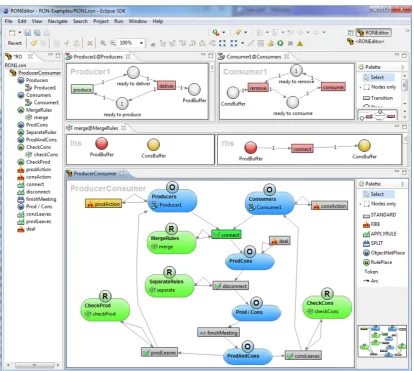
RONs are high-level nets (system nets) with two types of places, i.e. Object netplaces which carry object nets as tokens, andRuleplaces which are marked by net transformation rules. Sys-tem net transitions can be of typeFIRE,STANDARD,SPLITorAPPLYRULE. Firing of system net transitions thus either trigger the firing of an object net transition (typeFIRE), or transport object net tokens through the system net (type STANDARD), or apply a net transformation rule to an object net (typeAPPLYRULE), or separate a single object net into its unconnected components (typeSPLIT).
A visual editor and simulator for RONs has been developed as a plug-in for ECLIPSE
us-ing the ECLIPSEModeling Framework (EMF) and Graphical Editor Framework (GEF) plug-ins [BEHM07]. A screenshot of the RON tool is shown inFigure 1.
Figure 1: The RON environment for P/T Net Reconfiguration
correspond-ing object net placesProducersandConsumers, and the reconfiguration rulemergeis a token on the rule placeMergeRules.
In our example, RONs are applied to model a distributed system of producers and consumers where several producers and consumers may interact with each other. In the initial state of the sample RON inFigure 1 potential producers and consumers are distributed on differentObject netplaces as independent object nets without interaction. Producer object nets may fire, e.g. they can produce items and place them on thebufferplace. Firing in object nets is triggered by firing a system net transition of typeFIRE, which takes one object net with markingMfrom theNetplace in its pre-domain and puts the same object net, now marked by one of the possible successor markings ofM, into all of its post-domain places.
For producer-consumer interaction, a producer object net can be merged with a consumer object net by firing theAPPLYRULEsystem transitionconnect. A transition of this type takes an object net from each of the pre-domainNetplaces, a rule from the pre-domainRuleplace, applies this rule to the disjoint union of all the taken object nets and puts the resulting net to all post-domainNetplaces. The rulemerge, depicted in the center ofFigure 1, glues a producer object net and a consumer object net by inserting aconnecttransition between both buffers. Note that the system transitionconnectcontrols which producer interacts with which consumer.
By firing the FIRE transitiondeal, in the glued object net the consumer now can consume items produced by the producer as long as there are tokens on the placeProd-Buffer. Moreover, the producer may also produce more items and put them to the buffer. After the deal has been finished, the nets are separated again by firing theAPPLYRULEsystem transitiondisconnect. This applies a ruleseparate(which is the inverse rule of rulemergeinFigure 1whith LHS and RHS exchanged) to the glued net, thus deleting the connect transition from the net. Note that the resulting net, which is put on placeProd/Cons, is still one single object net which consists of two unconnected components. In order to split a net with two components into two object nets, a system transition of typeSPLITis used. Firing theSPLITsystem transitionfinishMeetingresults in two separate object nets on placeProdAndCons. In a last step, the now separated producer and consumer nets are returned to their initial places by firing theSTANDARDsystem transitions ProdLeavesandConsLeaves. STANDARDtransitions simply remove a net token from each pre-domain place and add the disjoint union of all removed object nets to each of the post-pre-domain Netplaces. In our example, theSTANDARDtransitions may also put the object nets back to the “wrong” initial place. It is possible to avoid such behaviour by using APPLYRULEtransitions instead where rules check the object nets for the occurrence of aproducer orconsumerplace, respectively.
Up to now, the RON tool is limited to P/T nets as object nets and to the four fixed types of system net transitionsFIRE,STANDARD,SPLITorAPPLYRULE. The aim of this paper is to come up with a more general approach and tool where the type of token objects and the behavior of reconfigurations can be defined in a more flexible way.
3
Algebraic High-Level Nets with Individual Tokens
AHLI net tool, an ECLIPSEplug-in, is sketched inSection 3.2.
3.1 Algebraic High-Level Nets with Individual Tokens (AHLI Nets)
AHLI nets [MGE+10] are a new formal definition of Algebraic High-Level (AHL) nets [PER95], where in addition to classical AHL nets [PER95], tokens are defined as individual objects. The overall motivation for this is a closer relationship to graph transformation systems, with the aim to translate Petri net firing behavior and net reconfigurations to graph transformation rules for simulation and analysis. In [MEE11], it has been shown already that for P/T nets with individual tokens, a category can be defined in a way that a suitable functor maps P/T net transformation systems to graph transformation systems with equivalent behavior. It remains to show similar properties also for the category of AHLI nets.
In this section, we review the basic definitions for AHLI nets from[MGE+10].
Definition 1(Algebraic High-Level Nets with Individual Tokens) We define a marked AHL net with individual tokens, short AHLI net, asAN= (Σ,P,T,pre,post,cond,type,A,I,m), where
• AN= (Σ,P,T,pre,post,cond,type,A)is a classical AHL net with
– signatureΣ= (S,OP,X)of sortsS, operation symbolsOPand variablesX= (Xs)s∈S,
– sets of placesPand transitionsT,
– pre,post:T →(TOP(X)⊗P)⊕1, defining the transitions’ pre- and postdomains,
– cond:T →Pf in(Eqns(S,OP,X))assigning a finite set of Σ-equations (L,R,X) as
firing conditions to each transition,
– type:P→Styping the places of the signature’s sorts, – aΣ-algebraA,
• Iis the (possibly infinite) set of individual tokens ofANI, and
• m:I→A⊗Pis the marking function, assigning the individual tokens to the data elements on the places. m(I)defines the actual set of data elements on the places ofANI. mdoes not have to be injective.
Remark 1 (Individual tokens vs. classical algebraic data tokens) Each AHLI net with finite individual token marking(I,m)can be interpreted as a classical AHL net with marking
M=
∑
(a,p)∈A⊗P|m−1(a,p)|(a,p) =
∑
i∈I
m(i)
where|m−1(a,p)|denotes the cardinality of individual tokens inIthatmmaps to(a,p).
The main difference to classical AHL nets is that in AHLI nets, we can distinguish tokens of the same algebraic value on the same place. Moreover, the individuals equip data tokens with identities. When firing a transition, we now can relate the input and output tokens so that a token’s history can be traced along the firing steps.
1TOP(X)⊗P={(t,p)∈TOP(X)×P|t∈T
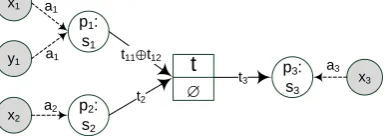
Example1 Figure 2shows the graphical representation of an AHLI net with
• signatureΣ= ({s1,s2,s3},{t11:→s1,t12:→s1,t2:→s2,t3:→s3}),
• algebra carrier setsAs1 ={a1,b1,c1},As2 ={a2,b2},As3 ={a3,b3,c1}
• pre(t) = (t11,p1)⊕(t12,p1)⊕(t2,p2),post(t) = (t3,p3),
• type(p1) =s1,type(p2) =s2,type(p3) =s3,
• cond(t) =/0,
• I={x1,y1,x2,x3},m(x1) =m(y1) = (a1,p1),m(x2) = (a2,p2),m(x3) = (a3,p3),
Note that the algebraic value of an individ-ual token is given next to the dashed arc to its carrying place. In the following, if a transition has an empty set of conditions we just denote the transition name without an explicit /0below.
t ∅ p1:
s1
p2:
s2
p3:
s3
t11⊕t12
t2 t3 x1 y1 x2 x3 a1 a2 a1 a3
Figure 2: Example AHLI net
In Definition 2, we define firing steps in AHLI nets. We have to take into account assign-ments evaluating the variables at the arcs and in the transition conditions to check for enabled transitions. Therefore, we first introduce some additional notations:
• Var(t)⊆X is the set of variables occurring in equations and on the environment arcs oft,
• CP= (A⊗P) ={(a,p)∈A×P|a∈Atype(p)}as the set of consistent value/place pairs,
• CT={(t,asg)∈T×(Var(t)→A)|∀(L,R,X)∈cond(t):asg(L) =asg(R)}
as the set of consistent transition assignments, i.e. all firing conditions oftare valid when evaluated with the variable assignmentasg2,
• preA,postA:CT→CP⊕, defined by
preA(t,asg) = (asg⊗idP)⊕(pre(t)),
postA(t,asg) = (asg⊗idP)⊕(post(t))
We can express e.g. the concrete requirednumberof a token(a,p)fort to fire under as-signmentasgwithpreA(t,asg)(a,p)by interpreting the monoidpreA(t,asg)as a function
CP→N. Similarly, we get the producednumberof(a,p)with postA(t,asg)(a,p).
Definition 2(Firing Behavior of AHLI nets) A consistent transition assignment(t,asg)∈CT for an AHLI netANI= (Σ,P,T,pre,post,cond,type,A,I,m)isenabledunder atoken selection (M,m,N,n), whereM⊆I,mis the token mapping ofANI,Nis a set with(I\M)∩N=/0, and n:N→A⊗Pis a function, if it meets the followingtoken selection condition:
∑
i∈M
m(i) =preA(t,asg)∧
∑
i∈Nn(i) =postA(t,asg)
2 whereasg:T
If such anasg-enabledtfires, the successor marking(I0,m0)is given by
I0= (I\M)∪N, m0:I0→A⊗Pwithm0(x) =
(
m(x), x∈I\M n(x), x∈N
leading toANI0= (AN,I0,m0)as the new AHLI net in thefiring step ANI−it−−,asg→ANI0via(M,m,N,n).
Remark 2 (Token Selection) The purpose of the token selection is to specify exactly which tokens should be consumed and produced in the firing step. Thus,M⊆I selects the individual tokens to be consumed, andN contains the set of individual tokens to be produced3. Functions
mandn relate the tokens to their place/value pairs. It would be sufficient to consider only the restrictionm|Mhere or to infer it from the net but as a compromise on symmetry and readability
we denotemin the token selection.
In [MGE+10], also AHLI net morphisms are defined which extend classical AHL net mor-phisms to individual tokens. It is shown that AHLI nets and AHLI net mormor-phisms form a cat-egoryAHLINets. Moreover,AHLINets, together with a set of AHLI net transformation rules according to the double pushout approach are shown in [MGE+10] to beM-adhesive transfor-mation systems [EGH10], i.e. important results like the Local Church-Rosser and the Parallelism Theorem hold for AHLI net transformations.
3.2 The AHLI Net Tool
Tool support for AHLI nets has been implemented in our group4which allows the user to model and simulate AHLI nets in a visual editor.
Based on the Eclipse Modeling Framework [EMF11], the AHLI net environment comprises components to define algebraic signaturesΣandΣ-algebras, as well as a visual editor for AHLI nets which also serves as simulation viewer.
Creating Algebraic Signatures and Algebras
The main challenge while implementing an AHLI net editor except for the graphical editor itself is to provide a user-friendly way of creating an algebraic signature along with its algebras. This includes the evaluation of terms over the signature in a given algebra.
To provide a user-friendly editor for algebraic signatures, the XTEXTframework [Xte10] was used: from a textual grammar of algebraic signatures defined in EBNF, XTEXTgenerates a tex-tual editor along with an EMF model for algebraic signatures5. The editor generated by XTEXT
has been extended by additional validation and formatting features. The validation feature en-hances the checks performed by the editor for syntactical correctness of the algebraic signature,
3We require that(I\M)∩N=/0 must hold because it is impossible to add an individual token to a net that already
contains this token.
4Available at the TFS update sitehttp://tfs.cs.tu-berlin.de/software, packages agg, ahli, alspec and muvitor
5The grammar even defines algebraic specifications, i.e. signatures together with equations. Since AHLI nets are
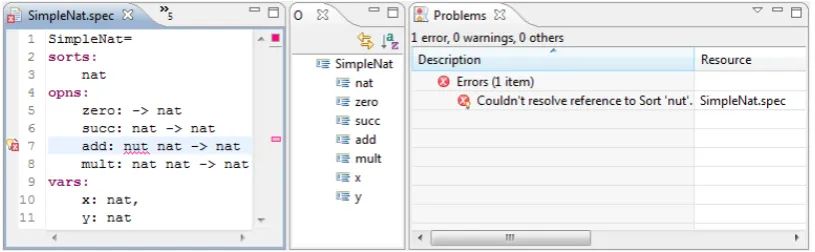
whereas the formatting feature provides the layout of the notation as it is used in the literature (e.g. [EM85]). Figure 3 shows the editor for algebraic signatures where a simple signature
SimpleNatfor natural numbers has been edited. The figure also shows an example for an error
message which has been issued due to a syntax error of the specified signature.
Figure 3: Editor for algebraic signatures of the AHLI net tool.
Using the editor, on the abstract syntax level, an algebraic signature is defined as model in-stance of the EMF model for algebraic signatures. Thus, other EMF-based tools may use the EMF model for signatures and model instances without caring for our textual representation of an algebraic signature. A Σ-algebra over a given algebraic signature Σcan be defined by the user of the AHLI net tool by implementing a suitable Java class. This allows us to use Java data types such asInteger to implement sorts from the signature. As example,Listing 1shows the Java classSimpleNimplementing an algebra for the signatureSimpleNatinFigure 3. The evalua-tion of terms of the signature to elements of the given algebra is provided by an evaluator class written especially for this purpose. This evaluator provides evaluation of terms with and without variables.
Listing 1: Java classSimpleNimplementing an algebra of signatureSimpleNat
1 p u b l i c c l a s s SimpleN {
2 p u b l i c s t a t i c f i n a l I n t e g e r ZERO = I n t e g e r . v a l u e O f ( 0 ) ;
3
4 p u b l i c s t a t i c I n t e g e r add ( I n t e g e r i 1 , I n t e g e r i 2 ) {
5 r e t u r n ( i 1 + i 2 ) ; }
6 p u b l i c s t a t i c I n t e g e r m u l t ( I n t e g e r i 1 , I n t e g e r i 2 ) {
7 r e t u r n ( i 1 ∗ i 2 ) ; }
8 p u b l i c s t a t i c I n t e g e r s u c c ( I n t e g e r i ) {
9 r e t u r n ( i + 1 ) ; }
10 }
The Visual AHLI Net Editor and Simulator
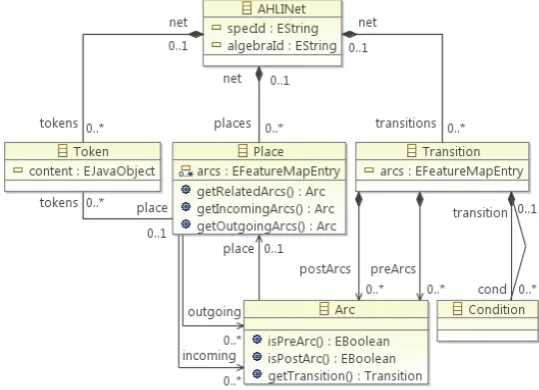
corresponding extensions used as signature and algebra for the AHLI net. Moreover, anAHLINet containsPlaces,TransitionsandTokens. ATransitioncontainsArcsandConditions. ATokenholds a Java object as content (its value)6.
Figure 4: EMF model for AHLI nets
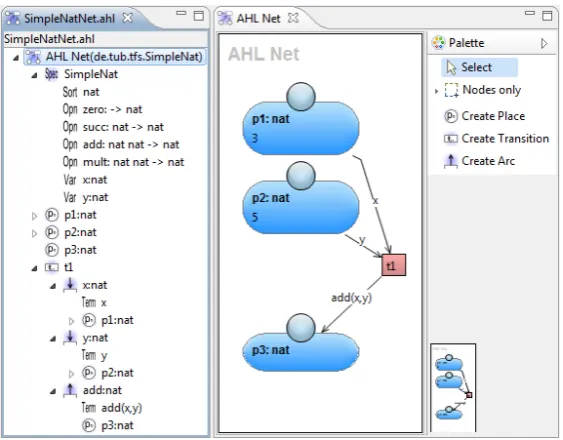
The main component of the visual editor is the tree editor, which contains all model elements of an AHLI net. The model elements can be altered by the user via context menus, which show the appropriate selection of actions that can be performed on the currently selected model element. Additionally there exists a graphical view of the AHLI net. The graphical view provides also context menus and a tool palette with a set of tools to alter the model graphically. Figure 5
shows the editor with the tree editor, the graphical view and the tool palette. In the tree editor, the elements of theSimpleNatsignature and algebra can be seen. The visual editor panel contains an AHLI net with one transition modeling the addition of two natural numbers.
The key benefit of modeling an AHLI net using a tool is to be able to actually simulate the firing behavior of the net. This means to calculate the activation state of a transition (the consis-tent transition assignments) and the successor marking of a firing step. In the visual AHLI net tool, a transition firing step is triggered by the transition’s context menu. One of the possible consistent transition assignments is selected randomly, and the successor marking is shown after completion of the firing step.
Note that in the current state of the AHLI net editor, tokens on AHLI net places are string representations of the data contained in them. One of the main tasks is to provide an adequate visualization for complex data representing e.g. P/T nets or P/T net transformation rules. The extension mechanism of ECLIPSEis well suited to achieve this goal and it we plan to implement an extension point supporting the flexible visualization of data structures.
6 The classes AHLINet, Place, Transition and Arc also inherit from class NamedElement, i.e. they have name
Figure 5: Visual AHLI net editor with the simple Nat example
4
Formalizing RONs as Special AHLI Nets
In this section we formalize RONs as a special type of AHLI nets: the data structure for tokens formalizes P/T nets and P/T net transformation rules, and operations to fire P/T net transitions, to compose and decompose P/T nets, and to apply net transformation rules to P/T nets.Section 4.1
defines this data type, and inSection 4.2we show how the four standard transition types of RONs are specified.
4.1 Definition ofAHOIPTI Nets
We now formalize RONs as special AHLI nets. That is, we define data types for AHLI net tokens which correspond to P/T nets and P/T net transformation rules, respectively, to model the token types in RONs. More precisely, we here use the formal definition of P/T nets with individual tokens (PTI nets [MGE+10,MGH11]) where classical P/T nets are extended by individual tokens in a similar way as we generalized AHL nets to AHLI nets. To distinguish this special kind of AHLI nets from general AHLI nets introduced inSection 3.1, we call AHLI nets with PTI net tokensAHOIPTI nets (Algebraic Higher-Order nets with Individual Tokens). AHOIPTI nets are
AHLI nets with a well-defined signatureΣPT I and a fixedΣPT I-AlgebraAPT I.
Definition 3(Algebraic Higher-Order Nets with Individual Tokens (AHOIPTINets)) AnAHOIPTI
netAHOIPTI = (Σ,P,T,pre,post,cond,type,A,I,m),is an AHLI net according toDefinition 1
withΣ= (ΣPT I)(seeDefinition 4), and aΣPT I-AlgebraAPT I(seeDefinition 5).
With the signatureΣPT I forAHOIPTI nets inDefinition 4, we can use PTI nets as object nets
Definition 4(SignatureΣPT I forAHOIPTI Nets)
ΣPT I= sorts: Transition,Bool,Mor,Rule,
Ob jectNet,ONMSet,Selection,
opns: tt,ff:→Bool
enabled:Ob jectNet Transition Selection→Bool fire:Ob jectNet Transition Selection→Ob jectNet applicable:Rule Mor→Bool
transform:Rule Mor→Ob jectNet empty:ONMSet→Bool
coproduct:Ob jectNet Ob jectNet→Ob jectNet isomor phic:Ob jectNet Ob jectNet→Bool left:Rule→Ob jectNet
insert:Ob jectNet ONMSet→ONMSet make:Ob jectNet→ONMSet
splittable:Ob jectNet→Bool dom,cod:Mor→ObjectNet split:ObjectNet→ONMSet
vars: X:= (Xs),s∈ {Transition,Bool,Mor,Rule,Ob jectNet,ONMSet,Selection}
Sort ObjectNet denotes object nets (PTI Nets) over setsP0,T0 andI0, Ruledenotes PTINet
transformation rules,ONMSetdenotes the monoid over the set of object nets,Mordenotes PTI net morphisms, Selection represents the set of the token selections, and Transition the set of object net transitions.
The semantics of the operation symbols inΣPT I is formally defined by theΣPT I-AlgebraAPT I
inDefinition 5.
ConstantenabledAtakes an object net (PTI net) from setAOb jectNet, one of its transitions from
set ATransition and a token selection from set ASelection and returnsttA (true) if the transition is
enabled to be fired under this token selection, otherwiseffA (false). If a given transition of an
object net is enabled to be fired, operationfireAreturns the object net with its successor marking
after firing this transition.
To model rule application, operation applicableA checks whether a rule is applicable to an
object net at a given match morphism. OperationtransformA applies the rule at this match if
applicable (since the match is a morphism, the object net the rule is applied to can be inferred as the morphism’s codomain), realizing the rule-based transformation of an object net. Operations dom(resp.cod) yield the domain (resp. codomain) of a given morphism.
For moving object nets and rules through the system net, composing them by disjoint union and splitting a disjoint union into component nets, we need some auxiliary operations:coproductA
builds the disjoint union of two given object nets, operationemptyA checks whether a given set
of object nets is empty, theisomorphicAoperation checks whether two given object nets are
iso-morphic to each other, operation insertA adds an object net to a sum of object nets, operation
makeAgenerates a sum of object nets containing exactly one given object net,splittableAchecks
Definition 5(ΣPT I-AlgebraAPT Iof AHOI Nets)
APT I = ATransition:=T0,ABool:={true,false},
AOb jectNet:=PTIobject∪ {undef},
withPTIobject:={NI|NI= (P,T,pre,post,I,m),P⊆P0,T ⊆T0,I⊆I0}
AMor:={f| f: NI1→NI2PT I Mor phism with NI1,NI2∈PT Iob ject}
ARule:={r|r= ((L i1
←−I−→i2 R),NAC)rule with in jections i1,i2
and NAC⊆ {c|(c:L→Nac)}}, AONMSet:=A⊕Ob jectNet,
ASelection:={(M,m,N,n)|M,N⊆I0,m:M→P0,n:N→P0}
ttA:=true∈ABool, ffA:=false∈ABool
enabledA:AOb jectNet×ATransition×ASelection→ABool
(on,t,s)7→
ttA , foron= (P,T,pre,post,I,m),t∈T,s= (M,m,N,n)
andtis enabled unders ffA , else.
fireA:AOb jectNet×ATransition→AOb jectNet
(on,t,s)7→
(
(P,T,pre,post,I0,m0) , ifenabledA(on,t,s) =ttA
undef , else. for:on= (P,T,pre,post,I,m),I0= (I\M)∪N,
m0=I0→P with: m0(x) =
(
m(x) , ifx∈I\M n(x) , else. applicableA:ARule×AMor→ABool
(r,f)7→
(
ttA , ifris applicable at match f
ffA , else.
transformA:ARule×AMor→AOb jectNet
(r,f)7→
(
NI2 , ifapplicableA(r,f) =ttA
undef , else.
with the direct transformation is written as: NI1 r,f
=⇒NI2
emptyA:AONMSet→ABool
(m)7→
(
ttA , ifm=0
ffA , else.
coproductA:AOb jectNet×AOb jectNet→AOb jectNet
(NI1,NI2)7→
(
undef , ifNI1=undef or NI2=undef
NI3 , else.
with:
NI3= (P3,T3,pre3,post3,I3,m3),P3=P1]P2,T3=T1]T2
pre3:T3→P3⊕, pre3(t) =
(
pre1(t) , ift∈T1
pre2(t) , else.
post3:T3→P3⊕, post3(t) =
(
post1(t) , ift∈T1
isomor phicA:AOb jectNet×AOb jectNet→ABool
(on1,on2)7→
(
ttA , ifon1∼=on2
ffA , else.
on1∼=on2: there is a PT I−Mor phism f :on1→on2
with: f= (fP,fT,fI), and fP,fT,fI are bijection functions.
insertA:AOb jectNet×AONMSet→AONMSet
insert(n,m) =m⊕n makeA:AOb jectNet→AONMSet
(n)7→n
splittableA:AOb jectNet→ABool
(n)7→
ttA , if∃n1,n2∈AOb jectNet,
with:
coproduct(n1,n2) =n and n16=/0
and n26=/0
ffA , else.
domA:AMor→AOb jectNet
domA(f :on1→on2) =on1
codA:AMor→AOb jectNet
codA(f :on1→on2) =on2
splitA:AOb jectNet→AONMSet
(n)7→
makeA(n) , ifsplittable(n) =ffA orn=undef
insertA(n1,splitA(n2)) , else.
with:
splittable(n1) =ffA
and coproduct(n1,n2) =n
and n16=/0
and n26=/0
4.2 Expressing RON Transition Types in AHOI Nets
Using the signatureΣPT I and theΣPT I-algebraAPT Iintroduced inSection 4, we now can express
the firing behavior of RONs in AHOI nets. The four transition types available for RONs corre-spond to constructions of AHOI net parts as follows:
Transitions of kind STANDARD
These transitions are used in RONs to move (or copy) object net or rule tokens in the system net without actually changing object nets. We can realize the behavior of STANDARD transitions using anAHOIPTI net transition with the firing condition{on0=on1coproduct(on2coproduct
from the pre domain of the transition to which the coproduct operation is applied iteratively. The resulton0 of the operation is the object net constructed as disjoint union of alloni. The
neton0 is put onto all object net places in theSTANDARDtransition’s post domain. In addition, theSTANDARD transition may take a rule from aRule place in its pre-domain and puts copies of this rule to all post domainRuleplaces. Figure 6shows how RONSTANDARDtransitions are modelled as AHOI net transitions. Note that we here depict a scheme for all possibleSTANDARD transitions with an arbitrary number of object net places in the pre- and post-domains, and an arbitrary number ofRuleplaces in the post-domain.
Figure 6: Modelling RON STANDARD transitions inAHOIPTInets
Transitions of kind FIRE
AFIREtransition in a RON takes an object net from its pre domain place (there must be exactly one), fires a selected enabled transitiontof this object net, and puts copies of the object net with the successor marking to all post-domain places. The condition set for an AHOI net transition modeling a FIRE transition is defined by{enabled(on,t) =tt, on0= f ire(on,t)}, whereon is the PTI net from the pre-domain,tis the transition ofonthat has to be fired, andon0is object net with the successor marking.Figure 7shows how FIRE transitions are modelled in AHOI nets.
Transitions of kind APPLYRULE
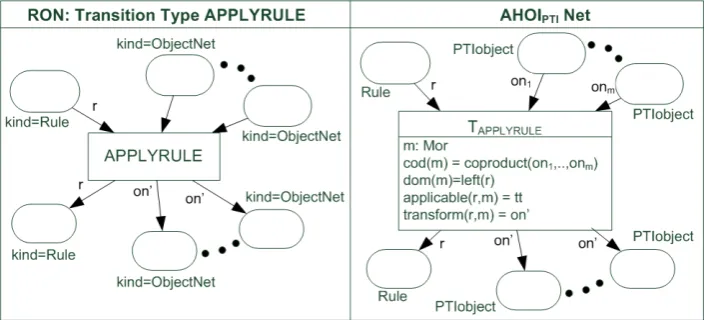
In RONs,APPLYRULEtransitions take a rule from the onlyRuleplace in the pre-domain, apply this rule to the disjoint union of all object nets taken fromOb jectNet places in the pre-domain, and put the transformed object net to allOb jectNet places in the post-domain. Moreover, the rule is moved to the post-domainRuleplace.
The condition set for anAHOIPTInet transition modeling an APPLYRULE transition is defined
by{dom(m) =left(r),cod(m) =on,applicable(r,m) =tt, on0=transform(r,m)}, wherer is the rule to be applied to a netn in the codomain of a morphismm, n0 is the resulting net after applying the rulerif it is applicable at match morphismm,XRuleis the set of the variables of the
sortRule, andXMoris the set of the variables of the sortMor.Figure 8shows how APPLYRULE
transitions are modeled inAHOIPTInets.
Figure 8: Modelling RON APPLYRULE transitions inAHOIPTInets
Transitions of kind SPLIT
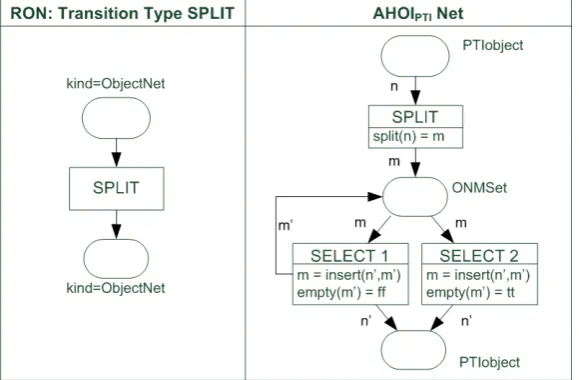
In RONs, a SPLIT transition has exactly one pre-domain place and one post-domain place, both of kindOb jectNet. The transition takes an object net from the pre-domain place and puts all unconnected components of this object net as new object nets to the post-domain place. This kind of transition is the most complicated transition to be modelled inAHOIPTI nets. The main
problem is how to split one object net (PTI net) consisting ofncomponents intonindependent single object nets. We use the recursive operationsplitA that uses the operationsinsertA,makeA
andsplittableA. The operationmakeAmakes a set containing a net that cannot be split, otherwise
the operationinsertAputs the nets stepwise recursively in a set. The split operation in AHOI nets
is well-defined, because it puts only those nets that consist of exactly one component into the sum of the split net, and the termination is also ensured.
In order to simulate the firing of a transition of kind SPLIT in AHOI nets we need two more transitions and one more place then in RONs. Note that for one firing step of a SPLIT transition in a RON, we get a firing sequence in theAHOIPTI net. In this sequence, transition SPLIT is
SELECT1 fires as many times as there are unconnected components in this sum. Each time, one unconnected component is put to the PTIobject place in the bottom, while the sum containing the remaining unconnected components is put back to the ONMSet place. When there is only one component left in this sum, transition SELECT2 is fired, which puts this last remaining component as object net to the PTIobject place. Figure 9 shows how a SPLIT transition from RONs is modeled as AHOI net.
Figure 9: Modelling RON SPLIT transitions inAHOIPTI nets
5
Related Work
There exist related approaches and tools that follow the “nets as tokens”-paradigm, based on elementary object nets introduced in [Val98]. Mobile object net systems [FK04] are an algebraic formalization of the elementary object nets that are closely related to our approach. Mobile object net systems are implemented in theRenew tool [KMR03]. The data types, respectively the colors represent the nets that are the token nets. Our approach goes beyond those approaches as we may additionally have rules as tokens, and transformations of nets as operations. In [KR03] concurrency aspects between token nets have been investigated, but naturally not concerning net transformations. In [LO04], rewriting of Petri nets in terms of graph grammars are used for the reconfiguration of nets as well, but this approach lacks the “nets as tokens”-paradigm.
6
Conclusion and Future Work
In this paper we formalized the approach and tool for Reconfigurable Object Nets (RONs) to a special kind of AHLI nets, calledAHOIPTI nets. We defined an algebraic signature and algebra
that formally specify RONs. This fixes a formal semantics for RONs, using a framework that can easily be extended towards other kinds of Petri nets as token objects (e.g. using AHLI nets and AHLI net transformation rules as tokens).
Moreover, in future work, this formal basis will be used to analyse the behavior ofAHOIPTI
nets and object net reconfiguration based on the interleaving semantics of the corresponding graph transformation system, including rules for firing and for reconfiguration. This semantics specifies the equivalent orderings of a given transformation sequence. Formal equivalence re-sults (e.g. on permutation equivalence [HCEK10]) allow all equivalent transformation sequences to be constructed in an efficient way. In [Sha10], the permutation equivalence analysis has been performed exemplarily for the producer/consumer system AHOIPTI net on the level of object
nets.
We have described in this paper an ongoing implementation of a flexible AHLI net tool en-vironment that supports editing and simulation of AHLI nets in general. In particular, up to now AHLI nets with primitive data types as tokens can be edited and simulated in the visual modeling environment. The visual appearance of different token types in AHLI nets shall be implemented using the extension points of the AHLI net tool. With respect to the tool, the next steps will be to provide pre-defined visual layouts forAHOIPTInets (P/T nets and P/T net
trans-formation rules as tokens) as well as algebraic specifications and algebras for nets with AHLI nets and AHLI net transformation rules as tokens, and for other kinds of reconfigurable dynamic modeling techniques.
References
[AGG10] TFS-Group, TU Berlin. AGG. 2010. http://tfs.cs.tu-berlin.de/agg
[BEE+09] E. Biermann, H. Ehrig, C. Ermel, K. Hoffmann, T. Modica. Modeling Multicast-ing in Dynamic Communication-based Systems by Reconfigurable High-level Petri Nets. InProc. Int. Symposium on Visual Languages and Human-Centric Computing (VL-HCC’09). Pp. 47–50. IEEE, 2009.
[BEHM07] E. Biermann, C. Ermel, F. Hermann, T. Modica. A Visual Editor for Reconfigurable Object Nets based on the ECLIPSE Graphical Editor Framework. In Proc. 14th Workshop on Algorithms and Tools for Petri Nets (AWPN’07). GI, 2007.
[EGH10] H. Ehrig, U. Golas, F. Hermann. Categorical Frameworks for Graph Transformation and HLR Systems based on the DPO Approach. Bulletin of the EATCS102:111– 121, 2010.
http://tfs.cs.tu-berlin.de/publikationen/Papers10/EGH10.pdf
[EHP+08] H. Ehrig, K. Hoffmann, J. Padberg, C. Ermel, U. Prange, E. Biermann, T. Modica. Petri Net Transformations. InPetri Net Theory and Applications. Pp. 1–16. I-Tech Education and Publication, 2008.
[EM85] H. Ehrig, B. Mahr.Fundamentals of Algebraic Specification 1: Equations and Ini-tial Semantics. EATCS Monographs on Theoretical Computer Science 6. Springer, Berlin, 1985.
[EMF11] Eclipse Consortium. Eclipse Modeling Framework (EMF) – Version 2.5. 2011. http://www.eclipse.org/emf
[FK04] B. Farwer, M. K¨ohler. Mobile Object-Net Systems and their Processes.Fundamenta Informaticae60(1–4):113–129, 2004.
[HCEK10] F. Hermann, A. Corradini, H. Ehrig, B. K¨onig. Efficient Analysis of Permutation Equivalence of Graph Derivations Based on Petri Nets .ECEASST 29:1–15, 2010.
[HME05] K. Hoffmann, T. Mossakowski, H. Ehrig. High-Level Nets with Nets and Rules as Tokens. InProc. of 26th Intern. Conf. on Application and Theory of Petri Nets and other Models of Concurrency. LNCS 3536, pp. 268–288. Springer, 2005.
[KMR03] M. K¨ohler, D. Moldt, H. R¨olke. Modelling Mobility and Mobile Agents Using Nets within Nets. In Proc. Int. Conf. on Applications and Theory of Petri Nets (ICATPN’03). LNCS 2679, pp. 121–139. Springer, June 2003.
[KR03] M. K¨ohler, H. R¨olke. Concurrency for mobile object net systems.Fundamenta In-formaticae, 54(2-3), 2003.
[LO04] M. Llorens, J. Oliver. Structural and Dynamic Changes in Concurrent Systems: Re-configurable Petri Nets.IEEE Transactions on Computers53(9):1147–1158, 2004.
[MEE11] M. Maximova, H. Ehrig, C. Ermel. Formal Relationship between Petri Net and Graph Transformation Systems based on Functors between M-adhesive Categories. In Ehrig et al. (eds.),Proc. of 4th Workshop on Petri Nets and Graph Transformation (PNGT). Volume 40. ECEASST, 2011.
[MGE+10] T. Modica, K. Gabriel, H. Ehrig, K. Hoffmann, S. Shareef, C. Ermel, U. Golas, F. Hermann, E. Biermann. Low- and High-Level Petri Nets with Individual Tokens. Technical report 2009/13, Technische Universit¨at Berlin, 2010.
http://www.eecs.tu-berlin.de/menue/forschung/forschungsberichte/2009
[PEHP08] U. Prange, H. Ehrig, K. Hoffman, J. Padberg. Transformations in Reconfig-urable Place/Transition Systems. InConcurrency, Graphs and Models. LNCS 5065, pp. 96–113. Springer, 2008.
[PER95] J. Padberg, H. Ehrig, L. Ribeiro. Algebraic High-Level Net Transformation Systems. Mathematical Structures in Computer Science5:217–256, 1995.
[RON11] TFS, TU Berlin. Reconfigurable Object Nets. 2011. http://www.tfs.cs.tu-berlin.de/roneditor
[Sha10] S. Shareef. Formal Modelling and Analysis of Reconfigurable Object Nets Based on the RON Editor. Master’s thesis, TU Berlin, Fak. IV, 2010.
[Tro09] F. Trollmann. Modeling Emergency Scenarios using Algebraic Higher Order Nets. Master’s thesis, Technische Universit¨at Berlin, 2009.
[Val98] R. Valk. Petri Nets as Token Objects: An Introduction to Elementary Object Nets. In Proc. Int. Conf. on Application and Theory of Petri Nets (ICATPN ’98). LNCS 2987, pp. 1–25. Springer, 1998.
[Xte10] Eclipse Consortium. Xtext - Language Development Framework – Version 1.0. 2010.