© 2019 by the Serbian Biological Society How to cite this article: Dragićević MB, Ćuković KB, Zdravković-Korać SR, 443 Simonović AD, Bogdanović MD, Todorović SI. Elucidation of the role of glutamine synthetase seed isoform GLN1;5 in Arabidopsis thaliana (L.) with a reverse genetics approach. Arch Biol Sci. 2019;71(3):443-53.
Elucidation of the role of glutamine synthetase seed isoform GLN1;5 in Arabidopsis
thaliana (L.) with a reverse genetics approach
Milan B. Dragićević1, Katarina B. Ćuković2, Snežana R. Zdravković-Korać1, Ana D. Simonović1, Milica D. Bogdanović1 and Slađana I. Todorović1,*
1Institute for Biological Research “Siniša Stanković“ – National Institute of the Republic of Serbia, University of Belgrade,
Bul. despota Stefana 142, 11000 Belgrade, Republic of Serbia
2Institute for Multidisciplinary Research, University of Belgrade, Kneza Višeslava 1, P.O. Box 33, 11030 Belgrade, Republic
of Serbia
*Corresponding author: [email protected]
Received: March 15, 2019; Accepted: April 4, 2019; Published online: April 10, 2019
Abstract: Glutamine synthetase (E.C. 6.3.1.2) is a key enzyme of plant nitrogen metabolism that assimilates ammonia into
glutamine. The Arabidopsis thaliana genome encodes one chloroplastic (GLN2) and five cytosolic (GLN1;1 – GLN1;5)
isoforms withdifferent expression patterns, kinetic properties, regulation and functions. Physiological roles of different
isoforms have been elucidated mainly by studying knockout mutants. However, the role of GLN1;5, which is expressed in
dry seeds, remains unknown. To clarifty the function of GLN1;5, we studied a GLN1;5 knockout line (GLN1;5KO)
homo-zygous for T-DNA insertion within the GLN1;5.GLN1;5 deficiency results in a phenotype with slightly delayed bolting
and fewer siliques. The dry weight of GLN1;5KO seeds was 73.3% of wild-type (WT) seed weight, with seed length 90.9% of WT seeds. Finally, only 18.33% of the mutant seeds germinated in water within 10 days in comparison to 34.67% of WT
seeds. KNO3 strongly stimulated germination of both GLN1;5KO and WT seeds, while germination in the presence of
increasing NH4Cl concentrations potentiated the differences between the two genotypes. It can be concluded that GLN1;5
activity supports silique development and grain filling and that it has a role in ammonium reassimilation in the seed, as well as assimilation and/or detoxification of ammonium from the environment.
Keywords: germination; glutamine synthetase; grain filling; knockout mutant; phenotype
Abbreviations: glutamine synthetase 1;1 knockout mutant (GLN1;1KO); glutamine synthetase 1;2 knockout mutant
(GLN1;2KO); glutamine synthetase 1;5 knockout mutant (GLN1;5KO); cytosolic glutamine synthetase isoforms (GS1);
plastidic glutamine synthetase isoforms (GS2)
INTRODUCTION
Glutamine synthetase (GS or GLN, E.C. 6.3.1.2) is a central enzyme of plant nitrogen metabolism that catalyzes ATP-dependent assimilation of ammonia into glutamine, which serves as amido-donor and N-transporting amino acid. The ammonia may originate from the soil, nitrate reduction, photorespiration, as well as from different catabolic processes including protein degradation during senescence [1]. Higher plants have one plastidic (GS2) and one or more cyto-solic (GS1) isoforms. The Arabidopsis nuclear genome encodes one chloroplastic (GLN2) and five cytosolic
isoforms named GLN1;1 through GLN1;5 [1,2]. The
Arabidopsis GS1 genes have different spatiotempo-ral expression [3-5] and different kinetic properties [2]. They are differentially regulated by both internal cues such as amino acids and carbon skeletons [6] and plant hormones [7], and by external signals, including ammonia [2], nitrates [8] and light [6,9]. For these reasons, specific and non-redundant functions have been suggested for Arabidopsis GS isoforms [1,4,10].
In leaves, this isoform is light-inducible [6,9], while in roots its expression is stimulated by nitrates [8].
According to sequence clustering, isoforms GLN1;1, GLN1;2, and GLN1;4 are grouped together, while GLN1;3 and GLN1;5 belong to another cluster
[1]. GLN1;1 and GLN1;4 are characterized as high
affinity isoforms, whereas GLN1;2 and GLN1;3 have low affinities for substrates [2]. Finally, based on over-all expression, GLN1;1, GLN1;2 and GLN1;3 can be
classified as major and GLN1;4 and GLN1;5 as
mi-nor isoforms [3,12]. Major isoforms can combine in all stoichiometric relations to form heterodecamers, thus expanding the possibilities for their regulation – a feature that has yet to be determined for minor isoforms [12].
The physiological roles of major isoforms GLN1;1, GLN1;2 and GLN1;3 and to some extent that of GLN1;4, have been investigated in great detail. GLN1;1 is expressed in most organs, but primarily in dry seeds, senescent leaves and flowers [3,13], as well as in the root surface layer [2,4]. This isoform accumulates during N limitation and is downregu-lated by ammonium excess in roots, so it is thought to be responsible for ammonium assimilation under limited N supply [2,11] and for primary root develop-ment during germination [4]. In addition, GLN1;1 is a stress- and senescence-responsive isoform, since it is upregulated during salinity stress and senescence [1,13,14] and is inducible by abscisic acid (ABA) [7]. GLN1;2 is the main isoform in vegetative tissues and some reproductive organs, being expressed more than
any other GLN1 isoform in both shoots and roots
[4,5,7,12]. Specifically, GLN1;2 is expressed in the vas-culature of roots, leaves, petals and stamens, as well as in companion cells, old parenchymal cells, mesophyll, cortex, leaf and sepal epidermis, trichomes, nodes be-tween the pedicel and the developing silique and other tissues [1,2,4,5]. GLN1;2 is significantly upregulated by ammonium and nitrate, establishing its role as es-sential for ammonium assimilation and amino acid synthesis, ammonium homeostasis and detoxification in both roots and shoots under ample ammonium or nitrate supply [1,2,5,11]. In addition, GLN1;2 plays an important role in N remobilization during seed production and seedling establishment [4]. GLN1;3 is significantly expressed in the roots [2], rosette leaves [1], young seedlings [12] and generally in proliferating
tissues [3]. It contributes to ammonium assimilation as a low affinity isoform that is inhibited by a high concentration of glutamate [2,5]. GLN1;4 is a minor isoform with very low expression in young seedlings [12], roots [2,7,11] and rosette leaves [1], but with higher expression in senescent cauline leaves [3], so it is thought to be involved in N remobilization during senescence [1].
In the abovementioned studies, the expression of GLN1;5 was not detected at all, or was at the limit of
detection in Arabidopsis roots or shoots under
dif-ferent conditions [1,2,7,8,11,12]. This isoform is only expressed during seed maturation and in dry seeds [3,13], but it disappears during germination unless the seeds are exposed to salt stress [13]. The physi-ological role of this isoform is unknown. Since the most valuable data on physiological functions of ma-jor Arabidopsis GS isoforms have been collected us-ing knockout mutants and double mutants of these genes [1,4,5], we decided to exploit GLN1;5 knockout mutants and to study their phenotype with the aim of elucidating the physiological function of GLN1;5.
MATERIALS AND METHODS Plant material
Arabidopsis seeds were obtained from the Nottingham
Arabidopsis Stock Centre (NASC). Arabidopsis
thali-ana (L.) Heynh., ecotype Columbia (NASC:N60000),
was used as the WT plant; NASC:N660998 line (SALK_086579C, [15]) had a T-DNA insertion in the GLN1;5 gene. Homozygous GLN1;5 knockout mu-tants (GLN1;5KO) were selected from T1 progeny as described previously [12]. Pools of obtained WT and mutant (T2) seeds were used for RNA extraction, for germination tests and for production of plantlets for morphometric measurements.
RNA isolation and RT-PCR
Total RNA was isolated from 10 mg of Arabidopsis
(#K1622, Fermentas). Since standard PCR was un-successful, presumably due to the presence of some inhibiting compounds from the seeds, the cDNA was amplified using the Maxima SYBR Green mix (#K0221, Fermentas), which is commonly used for qPCR. The optimized buffer of undisclosed composi-tion of this mix allowed for successful amplificacomposi-tion with the cDNA template prepared from 50 ng RNA,
0.3 mM specific GLN1;1 or GLN1;5 primers and the
PCR program as described by Dragićević et al. [12].
Southern hybridization
Southern hybridization was performed to estimate the copy number of T-DNA within the genome of
mutant A. thaliana line. Genomic DNA was isolated
from ~500 mg of leaf tissue by the cetyl trimethyl-ammonium bromide (CTAB) miniprep method [17]. DNA was treated with RNase A (#EN0531, Fermen-tas) and quantified spectrophotometrically. Twenty
μg of genomic DNA of the mutant A. thaliana line
were digested with HindIII, EcoRI or BamHI
endo-nucleases (Fermentas), while DNA isolated from WT plants was digested with HindIII. Digested DNA sam-ples were loaded on a 1% agarose gel (Sigma-Aldrich Co., USA), separated electrophoretically and blotted onto a positively-charged nylon membrane (Roche, Indianapolis, IN, USA) by capillary transfer. A 362-bp fragment was used as a probe for detection of the NPTII gene, which is located in close proximity to the right T-DNA border. The probe was labeled by PCR with digoxigenin (DIG)-dUTP (Roche), using the forward primer: 5’-GATGTTTCGCTTGGTG-GTCG-3’ and the reverse primer: 5’-ATTCGGCTAT-GACTGGGCAC-3’. Hybridization was performed in DIG Easy Hyb buffer (Roche) for 16 h at 50°C. The membrane was then washed 2×5 min in each of the following buffers: 2×saline-sodium citrate buff-er (SSC)+0.1% SDS and 1×SSC+0.1% SDS at 50°C and 0.5×SSC+0.1% SDS and 0.1×SSC+0.1% SDS at 68°C. Hybrids were detected with anti-digoxigenin antibody (Roche), visualized with chemiluminescent substrate CDP-Star (Roche) and recorded on X-ray film (Kodak, Rochester, NY, USA). For fragment size estimation, a DNA molecular weight marker II (Roche) labeled with digoxigenin was used.
Morphometric measurements
WT and GLN1;5KO seeds were stratified for 72 h at
4oC and set to germinate in 10x10 cm pots with
Flo-radur B Pot Medium (Coarse, Floragard, Odenburg, Germany). The plantlets were grown in a greenhouse (location: Belgrade, lat: 44.817048, long: 20.487303, time of sowing: middle of May 2015) under 80±5% humidity at 25±2°C. The obtained plants were used for morphometric measurements and DNA extrac-tion. Growth and development of 30 WT and 30 mu-tant plantlets was followed over 9 weeks. Emergence of the main inflorescence stem was recorded for all plantlets as days after sowing (DAS); the length of the main stem was periodically recorded.
The number of developed siliques was recorded 7 weeks after sowing, separately for the main stem and side branches. Siliques from both groups were further sorted into those shorter and those longer than 5 mm. The dimensions of 40 immature (10 days after emer-gence) and 40 mature siliques (collected 9 weeks after sowing) and seeds from them (n=40) were measured using ImageJ ver. 1.5. The dry weights of 1000 mature seeds were also recorded for WT and mutant lines, each in 3 replicates.
Seed germination
In order to determine whether nitrate (in the form of KNO3) and ammonium (applied as NH4Cl) differen-tially affect the germination of WT and GLN1;5KO seeds, batches of 100 seeds, each in 3 replicates, were placed in 6-cm Petri dishes with either 2 mL of dis-tilled water or the test substance. KNO3 and NH4Cl were applied in a range of 0.1-10 mM concentrations, with pH adjusted to 7. The seeds were germinated in a growth chamber at 25±2°C under white light (32.5 µmol m−2 s−1) applied as a 16 h photoperiod. The number of germinated seeds (with radicle >2mm) was counted after 1, 2, 3, 4, 5, 7 and 10 days following the onset of imbibition.
Statistical analyses
statistics as proposed by McNair et al. [18] utilizing R package survival (Therneau TM, 2015) [19]. The proportional hazards assumption was checked for all explanatory variables by testing if the scaled Schoen-feld residuals are significantly correlated with trans-formed survival time [20]. Ties were handled using the Efron approximation as suggested by McNair et al. [18]. The concentration variable did not meet the
pro-portional hazards assumption in both NO3- and NH
4+ data, so this variable was stratified (separate baseline hazard functions were fit for each strata). The non-independence of observations within a Petri dish was accounted for by using robust estimates (observations were clustered within Petri dishes and generalized es-timating equations were utilized as incorporated by the R survival package). The effect of genotype on time-to-inflorescence-stem emergence was estimated by creating Kaplan-Meier curves for each genotype and testing whether they differed significantly using the G-rho family of tests [21]. Welch’s t-test was used to estimate the effects of genotype on silique count, seed dimensions and 1000-seed weight. The effect of genotype on inflorescence stem height was analyzed by multiple regression. All other measured parameters were examined graphically and tested with appropri-ate statistical methods but did not show differences between the genotypes.
RESULTS
Molecular characterization of the GLN1;5KO mutant line
In order to investigate whether T-DNA insertion
com-pletely prevents the formation of GLN1;5 mRNA,
RT-PCR was performed. Total RNA was successfully iso-lated from dry WT and mutant seeds using a slightly modified Meng and Feldman [16] protocol (Fig. 1A).
RT-PCR analysis showed that GLN1;5 was indeed
ex-pressed in dry seeds, although at a significantly lower
level in comparison to GLN1;1, which was used as a
positive control. As expected, the WT seeds expressed both isoforms, while GLN1;5KO seeds expressed only GLN1;1 (Fig. 1B).
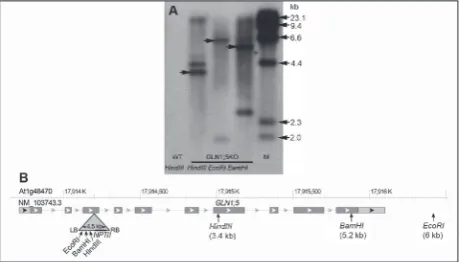
Тo estimate the copy number of T-DNA inser-tions within the GLN1;5KO line, the DNA was di-gested with three restriction enzymes and Southern
hybridization was performed using neomycin
phos-photransferase II (NPTII) 362-bp fragment located
near the right T-DNA border as a probe (Fig. 2). Based on the SALK_086579C LB flanking sequence, the ex-pected size of the restriction fragments should be 3.4 kb after HindIII, 5.2 kb after BamHI and 6 kb after EcoRI digestion (Fig. 2B). The probe hybridized with 2-3 T-DNA insertions in the mutant genome depend-ing on the used restriction enzyme. The restriction fragments obtained by Southern hybridization were
Fig. 1 Expression of glutamine synthetase isoforms GLN1;1 and
GLN1;5 in WT and GLN1;5KO seeds. A – Total RNA isolated from seeds of WT and GLN1:5KO plants; B – Expression of glutamine synthetase isoforms GLN1;1 and GLN1;5 in WT and GLN1;5KO seeds by RT-PCR. The expected size of the amplicons is 286 bp and 495 bp for GLN1;1 and GLN1;5, respectively
0.3-0.4 kb longer than predicted; specifically, HindIII produced 3.8 and 4.3 kb fragments; EcoRI a 6.3 kb and a <2 kb fragment, while BamHI digestion gave 5.6 and a 2.5 kb fragments (the underlined values are indicated by arrows on Fig. 2A).
The GLN1;5 knockout mutation slightly delayed bolting
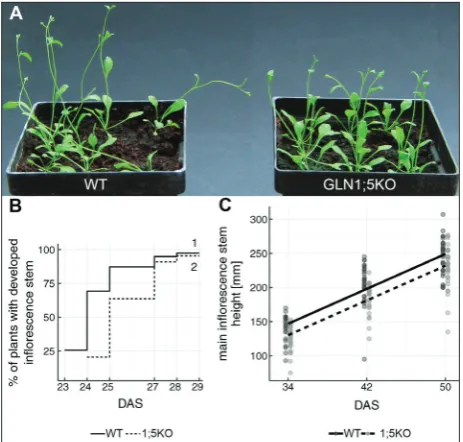
The GLN1;5KO plantlets visibly lagged behind the WT plants as regards the inflorescence emergence (Fig. 3A). The effect of genotype on bolting was evaluated by constructing Kaplan-Meier estimators of time-to-inflorescence-stem formation for each genotype (Fig. 3B). This showed that almost all WT plants formed the inflorescence stem over the period of 23-29 DAS, just as expected for WT Columbia, for which the average time for bolting (principal growth stage 5) is 26 ± 3.5 DAS [22]. The significance of the bolting time-lag was estimated by the log-rank test, which indicated that the curves for the inflorescence emergence for WT and GLN1;5KO plantlets (Fig. 3B)
were significantly different (for ρ=0, p=1.66·10-4,Table 1). This difference specifically relates to the early days of bolting, because when a higher weight is given to the initial part of the curves (ρ=1), the difference is highly significant (p=5.86·10-6), but later on the curves for WT and GLN1;5KO plantlets do not differ signifi-cantly (for ρ=-1, p=0.27, Table 1).
Table 1. The G-ρ family statistic for Kaplan-Meier estimates of the effect of genotype on inflorescence stem emergence1.
ρ p-value
0 1.66·10-4
1 5.86·10-6
-1 0.27
1For ρ=0 this is the log-rank test.
The GLN1;5KO genotype also affected the height of the inflorescence stem as estimated by multiple re-gression (Fig. 3C and Supplementary Table S1), which showed that GLN1;5KO plants were on average 17 mm shorter than the WT plants at 34 DAS (Supple-mentary Table S1). However, this is just a consequence of the initial delay in inflorescence emergence, and not an effect on the inflorescence stem growth rate. Namely, the growth rate of both genotypes seemed to be the same (the slopes of the regression lines on Fig. 3C) and was, on average, 6.367 mm/day (Supple-mentary Table S1). The number of nodi on the main inflorescence stem, as well as the number of formed side branches did not differ between the two geno-types (data not shown).
GLN1;5 knockouts develop fewer siliques with smaller seeds
To estimate the effect of GLN1;5 deficiency on silique development, the number and the size of siliques were compared for GLN1;5KO and WT plants. The number of siliques shorter than 5 mm and those longer than 5 mm was determined for the main inflorescence stem and the side branches separately. While the two geno-types have a comparable number of shorter siliques on both main inflorescence stem and side branches, the number of siliques >5 mm was significantly smaller in the GLN1;5KO plants (Fig. 4). The WT plants de-veloped, on average±SD, 7.55±2.31 siliques on the main inflorescence stem and 26.51±8.13 siliques on side branches, while the mutant plants developed
4.81±2.51 and 15.19±8.39 siliques on main and side branches, respectively, which was significantly less according to Welch’s t-test at the confidence level of
p≤0.001 (Fig. 4). To evaluate the effects of GLN1;5
deficiency on seed yield structure elements, different
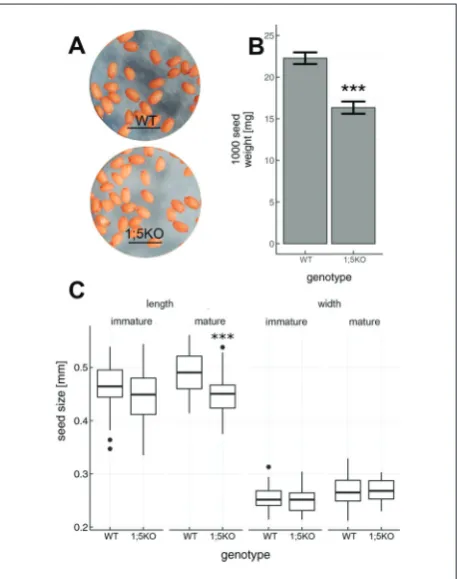
parameters were measured and expressed relative to WT values (% of WT) for each seed yield structure element (Table 2). The number of siliques developed on the main and side branches measured 7 weeks after sowing were significantly decreased in the GLN1;5KO mutant in comparison to the WT (63.7% and 57.3% of WT, respectively, Table 2). The length and width of immature and mature siliques (9 weeks after sow-ing) and the number of seeds in them did not differ between the two genotypes (Table 2). Although the seeds developed on GLN1;5KO plants did not dif-fer visually from the WT seeds (Fig. 5A), they were 26.67% lighter in comparison to WT seeds (Table 2). Specifically, while a sample of 1000 WT seeds weighed on average±SD 22.27±0.70 mg, many GLN1;5KO
Fig. 4 Box-plots of silique counts on main and side branches. Siliques were separated according to length in two groups: shorter and longer than 5 mm. The differences in the means of GLN1;5KO mutants and WT plants were assessed by Welch’s t-test: *** de-notes a p-value smaller than 0.001; 29-32 plants were assessed per genotype
Table 2. Comparison of the effects of different GS1 knockout mutations on seed yield structure elements. Data obtained for GLN1;5KO mutants are compared to previously published data for GLN1;1KOandGLN1;2KOmutants andGLN1;1:GLN1;2KO double mutants [4]1.
Knockout mutant Seed yield structure
element [% of WT] GLN1;1 GLN1;2 GLN1;1:GLN1;2 GLN1;5
Number of siliques
on the main stem 94 9 was 87 9 was 85 9 was 63.7 7 was Number of siliques
on the side stems 92 9 was 85 9 was 75 9 was 57.3 7 was Silique width N/A N/A N/A 100 104 9 was (2)9 was (3)
Silique length N/A N/A N/A 99.9 9 was (2) 96.9 9 was (3)
Seeds per silique 94 10 wag 83 10 wag 84 10 wag 103.6 9 was (2)
102.8 9 was (3)
Seed dry weight 94 12 wag 90 12 wag 82 12 wag 73.3 9 was
Seed length 109.7 10 wag 97.4 10 wag 91.4 10 wag 96.5 9 was (2)
90.9 9 was (3)
Seed width 100.9 10 wag 97.6 10 wag 96 10 wag 98.4 9 was (2)
101.1 9 was (3) 1The effect of the mutations is expressed relative to wild type values (% of WT) for each seed yield structure element. Superscripts indicate the time of recording (was – weeks after sowing; wag – weeks after germination).
2Immature siliques, measured 10 days after emergence. 3Mature siliques.
seeds weighed only 16.33±0.74 mg (Fig. 5b). In addi-tion, both immature and mature mutant seeds (from 10-day-old and mature siliques, respectively) were shorter in comparison to immature and mature WT seeds, but this difference was statistically significant only for mature seeds (Table 2, Fig. 5C). Finally, the width of immature and mature WT and mutant seeds did not differ (Table 2, Fig. 5C).
Effect of GLN1;5 knockout on seed germination
In order to elucidate whether GLN1;5 has a role in
seed germination, we compared the germination of WT and GLN1;5KO seeds in water and in
increas-ing concentrations of nitrates (KNO3) or ammonia
(NH4Cl). After a period of 10 days, 34.67% of WT
seeds germinated in water in comparison to only 18.33% of mutant seeds (Fig. 6).
Germination in KNO3 solutions of increasing con-centration decreased the difference in germination be-tween WT and GLN1;5KO seeds that was observed in water (Fig. 6A, Table 3 and Supplementary Table S2). In fact, while there was still a small difference between the two genotypes for germination in 0.1 mM nitrate (73.88 %, Table 3) at any concentration >1 mM KNO3, the two types of seeds germinated at similar rates.
Table 3. The ratio [%] of germination potentials of GLN1;5KO and WT seeds during the first 10 days of germination1.
treatment GLN1;5KO / WT [%]*
H2O 0 46.63
KNO
3
[mM]
0.1 73.88
1 118.64
3 112.48
10 93.54
NH
4
Cl
[mM]
0.1 26.21
1 16.14
3 20.31
10 15.7
1Bold values represent significant differences (p<0.01) between the
corresponding treatment and H2O (control). The values were calculated
from the hazard ratios obtained by semi parametric time-to-event analyses (Cox proportional hazards) presented in Supplementary Table S2.
Unlike germination in nitrate solutions, germina-tion in increasing NH4Cl concentrations potentiated the differences between the two genotypes (Fig. 6B, Table 3). Ammonium up to 10 mM did not inhibit germination of WT seeds and even slightly stimulated it (Fig. 6B). However, germination of GLN1;5KO seeds in any NH4Cl solution appeared to be slightly lower in comparison to germination in water (Fig. 6B).
DISCUSSION
The GLN1;5KO mutant is a SALK_086579C line, with a T-DNA insertion in the 3rd exon of the GLN1;5 gene (AT1G48470). The production of homozygous mutant plants and their testing by genomic PCR and RT-PCR were described in detail previously [12]. Total RNA is isolated from WT and GLN1;5KO seeds, since lit-erature data indicate that GLN1;5 is expressed in dry seeds [3,13]. GLN1;1, is known to be highly expressed in dry seeds [13], and hence it was used as a positive control. RT-PCR confirmed that the insertion
com-pletely prevents GLN1;5 mRNA formation. It was
al-ready shown that the expression of these two isoforms rapidly declines during the course of imbibition and germination [13], so this was not studied here.
Southern hybridization confirmed the presence of T-DNA inserts containing an NPT II fragment in GLN1;5KO genomic DNA, but not in the DNA of WT plants. The fact that the restriction fragments obtained by Southern hybridization were 0.3-0.4 kb longer than
Fig. 6. Cumulative event survival curves of Cox PH models for
predicted implied that the T-DNA RB could be long-er, perhaps containing a part of the vector sequence, which was the main reason behind the mapping of only LB positions during the Signal project [15]. The results of the Southern analysis suggested the possibil-ity of more than one insertion in the GLN1;5KO line. Seed germination and early seedling
establish-ment in Arabidopsis require N remobilization, when
N stored in the cotyledons is used to sustain the growth of new sink leaves [4]. In knockout mutants lacking GLN1;2, in double GLN1;1:GLN1;2KO mu-tants and, to a lesser extent, in GLN1;1KO mumu-tants, the N remobilization from cotyledons and during early seedling establishment is impaired, resulting in smaller seedling size of mutants as compared to WT
plants [4]. The authors concluded that GLN1;2 and,
to a lesser extent GLN1;1, have a function in N remo-bilization from cotyledons during seed germination and seedling establishment. However, it is unlikely that GLN1;5, as a minor seed isoform, has a function similar to that of GLN1;2 and GLN1;1, particularly be-cause GLN1;5KO did not affect the number of rosette leaves (data not shown) but merely the time of bolting. The studied effect of genotype on bolting showed a significant difference in the inflorescence emergence for WT and GLN1;5KO plantlets, which specifically relates to the early days of bolting. This result can be interpreted as a short delay (≈1 day) in the inflores-cence emergence for GLN1;5KO as compared to WT. However, since all plants, regardless of the genotype, eventually form the inflorescence stems, this difference is likely of marginal physiological importance. It can-not be excluded that GLN1;5 expressed at a very low level in young seedlings [12] may have supported the reallocation of N related to inflorescence emergence.
Recent work on cereals and on Arabidopsis has
revealed that specific GS1 isoforms have important roles with respect to seed yield structure. In maize, at least three out of five cytosolic GS1 isoforms affect kernel development. Using knockout mutants, Mar-tin et al. [23] showed that the maize gln1-4 knockout phenotype displayed reduced kernel size, while gln1-3 mutants had reduced kernel number. Interestingly, both isoforms are expressed in leaves, where GS1-3 is present in mesophyll cells, whereas GS1-4 is spe-cifically localized in the bundle sheath cells [23]. In
addition, GS1-2, which is specifically expressed in the basal maternal tissues of the developing kernel, including the surrounding pericarp and specifically in the pedicel parenchyma but not in the endosperm and embryo, is suggested to have a role in nitrogen metabolism during grain fill [24]. A rice knockout mutant lacking OsGS1;1 showed severe retardation in growth rate and grain filling when grown at normal nitrogen concentrations [25].
In Arabidopsis, the main isoform GLN1;2, ex-pressed in the vasculature of different organs and oth-er tissues, plays an important role in N remobilization during both seed production and seedling
establish-ment [4]. The authors showed that GLN1;2
knock-out mutants, GLN1;1:GLN1;2 double mutants, and to
lesser extent GLN1;1 mutants, exhibit a decrease for several seed yield structure elements. To evaluate the physiological importance of GLN1;5 for silique de-velopment, the effect of GLN1;5 deficiency was com-pared to the previously described effects of GLN1;1 and GLN1;2 deficiency [4] on the number of siliques developed on the main and side branches of different knockout mutants relative to WT plants (Table 2). It is clear that, relative to WT plants, the GLN1;5KO plants develop fewer siliques than GLN1;1KO or GLN1;2KO mutants and even double GLN1;1:GLN1;2 mutants.
The fact that the length and width of immature and mature siliques and the number of seeds in them did not differ between the two genotypes suggests that GLN1;5 activity did not contribute to the growth of siliques nor to their final size. Guanet al. [4] found that GLN1;1 and GLN1;2 deficiency reduces the num-ber of seeds per silique, but the authors did not as-sess the dimensions of the siliques. It should be noted that silique dimensions and the number of seeds per silique in our experimental setup were somewhat smaller than listed as a standard for WT Columbia [24], probably due to different growth conditions.
According to Guanet al. [4], both GLN1;1 and
double mutants [4]. Finally, the width of immature and mature WT and mutant seeds did not differ; mu-tants investigated by Guanet al. [4] also had unaltered
seed width. Our data suggest that the isoform GLN1;5
was involved in seed formation and grain fill, since several seed yield structure elements were significantly decreased in the GLN1;5KO mutants, including the number of developed siliques and seed dry weight. In Arabidopsis seeds, most of the N is incorporated in the form of storage proteins, which accumulate during seed maturation and late maturation [26]. The seed filling requires both N uptake and assimilation and N remobilization from maternal tissues to seeds as
new sinks [4]. Since GLN1;5 transcripts accumulate
during seed maturation to reach maximum in mature dry seeds [3], we can speculate that this isoform was responsible for N assimilation within the seeds. Other isoforms expressed primarily in maternal tissues, par-ticularly GLN1;2, are responsible for N remobilization to support the seed development [4].
The degradation of seed storage proteins during germination produces ammonium that has to be reas-similated into Gln to be remobilized to support early seedling establishment. Since Gln acts as a sink for ammonium released from storage protein degrada-tion and amino acid deaminadegrada-tion and as a source for de novo amino acid synthesis by transamination, GS enzymes have a key role in N metabolism during ger-mination [27]. In the absence of an external N source, germination and early seedling establishment depend exclusively on the N stored in seeds, mostly in the form of storage proteins [26]. As mentioned, GLN1;5 tran-scripts accumulate during seed maturation and are stored in dry seeds, to be rapidly degraded over the course of imbibition [3,13]. However, transcript levels do not always correlate with the presence and activity of specific GS isoforms in a tissue, since posttrans-lational modifications such as phosphorylation and interaction with 14-3-3 proteins can significantly mod-ulate GS activity, stability and turnover [28].In other words, GLN1;5 proteins may be present and active in N remobilization in germinating seeds after their
tran-scripts have been degraded. Along with GLN1;5, the
isoform GLN1;2 has an important role in seed reserve N remobilization, since GLN1;2 knockout mutants are impaired in seed germination, N remobilization from cotyledons and early seedling establishment [4].
Simi-larly, in maize, two isoforms – GLN3 and GLN4, were shown to have important roles in germination [27].
WT and GLN1;5KO mutant seeds germinate at similar rates in KNO3 solutions, since nitrates strong-ly stimulate germination. One interpretation of this finding is that nitrates compensate for GLN1;5
defi-ciency simply as an external N source. While KNO3
in the medium may indeed be a nutrient, it should be noted that nitrates generally promote germination independently of nitrate reduction [29,30], therefore having a signaling rather than merely a supplying role. Namely, nitrates, various organic nitrogenous com-pounds, NO-donors as well as NO by itself, potentiate germination of different photoblastic seeds, including Arabidopsis seeds, based on the release of NO as a signaling molecule [30,31]. In Arabidopsis, where seed dormancy is largely due to mechanical constraints imposed by the seed coat, this stimulatory effect of nitrates and the abovementioned compounds on ger-mination is based on interaction with phytochrome A signaling [31] and with ABA and gibberellin signaling pathways [29]. Since the stimulatory effect of nitrates on Arabidopsis seed germination is so pronounced, it is hard to distinguish whether any part of this
stimu-lation was actually due to compensation of GLN1;5
deficiency in mutant seeds or to stimulatory signaling that overrides other factors.
Germination of WT seeds in increasing NH4Cl
concentrations was not impaired, although ammo-nium in excess is toxic. It seems that WT seeds are able to efficiently cope with it and probably use it as a nitrogen source. However, lower germination of
mutant seeds in any NH4Cl solutions in comparison
to germination in water provides good evidence that the role of GLN1;5 is not only to reassimilate ammo-nia within the seed (as discussed for germination in water), but also to assimilate and detoxify ammonia
from the environment.The GLN1;2 isoform that was
shown to be involved in germination [4] is also the main isoform that can be upregulated to relieve am-monium toxicity [2,11]. Even though the expression of GLN1;5 declines during imbibition in water, if Arabi-dopsis seeds are germinated under salt stress (50-200
mM NaCl), the expression of GLN1;5 is upregulated
[13], which also suggests a possible role for GLN1;5
Comparison of the WT and GLN1;5KO phe-notypes suggests several physiological roles for the Arabidopsis GS isoform GLN1;5. The GLN1;5activity supports silique development and grain fill, probably by N assimilation within the seed, since it is expressed during seed maturation and in dry seeds. Even though the transcript levels of GLN1;5 declined during imbi-bition, we speculate that the GLN1;5 enzyme was ac-tive in seeds during imbibition and germination, and that it had a role in ammonium reassimilation within the seed, as well as assimilation and/or detoxification of ammonium from the environment. Finally, small levels of GLN1;5 that are expressed in young seedlings may have a minor role in promoting inflorescence stem emergence.
To the best of our knowledge, the work presented herein is a first attempt toward the elucidation of the physiological role of the GLN1;5 isoform based on a reverse genetics approach.
Funding: This study was supported by the Ministry of Education, Science and Technological Development of the Republic of Serbia, Projects ON173024 and ON173015.
Acknowledgments: The authors would like to thank Prof. Dr. Alain Tissier, Head of the Cell and Metabolic Biology Depart-ment at the Leibniz Institute of Plant Biochemistry, Austria, for his careful review of the manuscript and valuable suggestions.
Author contributions: MD performed statistical analyses and interpreted the data. KĆ and MB were involved in morphometric data collection and RNA and DNA isolation. SZK performed the Southern analysis. AS wrote the manuscript and was involved in data interpretation. ST designed the experiments, carried out most of the work regarding morphometry and seed germination and was involved in data interpretation and finalizing the manuscript. All coauthors approved the final version of the manuscript.
Conflict of interest disclosure: The authors report no conflicts of interest.
REFERENCES
1. Lothier J, Gaufichon L, Sormani R, Lemaître T, Azzopardi M, Morin H, Chardon F, Reisdorf-Cren M, Avice JC, Masclaux-Daubresse C. The cytosolic glutamine synthetase GLN1;2 plays a role in the control of plant growth and ammonium homeostasis in Arabidopsis rosettes when nitrate supply is not limiting. J Exp Bot. 2011;62(4):1375-90.
2. Ishiyama K, Inoue E, Watanabe-Takahashi A, Obara M, Yamaya T, Takahashi H. Kinetic Properties and Ammonium-dependent Regulation of Cytosolic Isoenzymes of Glutamine
Synthetase in Arabidopsis. J Biol Chem. 2004;279(16):16598-605.
3. Schmid M, Davison TS, Henz SR, Pape UJ, Demar M, Vin-gron M, Schölkopf B, Weigel D, Lohmann JU. A gene expres-sion map of Arabidopsis thaliana development. Nat Genet. 2005;37(5):501-6.
4. Guan M, Moller IS, Schjoerring JK. Two cytosolic gluta-mine synthetase isoforms play specific roles for seed germi-nation and seed yield structure in Arabidopsis. J Exp Bot. 2015;66(1):203-12.
5. Konishi N, Ishiyama K, Beier MP, Inoue E, Kanno K, Yamaya T, Takahashi H, Kojima S. Contributions of two cytosolic glu-tamine synthetase isozymes to ammonium assimilation in Arabidopsis roots. J Exp Bot. 2017;68(3):613-25.
6. Oliveira IC, Coruzzi GM. Carbon and Amino Acids Recip-rocally Modulate the Expression of Glutamine Synthetase in Arabidopsis. Plant Physiol. 1999;121(1):301-10.
7. Dragićević M, Simonović A, Bogdanović M, Subotić A, Ghalawenji N, Dragićević I, Todorović S. Differential tion of GS-GOGAT gene expression by plant growth regula-tors in Arabidopsis seedlings. Arch Biol Sci. 2016;68(2):399-404.
8. Wang R, Okamoto M, Xing X, Crawford NM. Microarray Analysis of the Nitrate Response in Arabidopsis Roots and Shoots Reveals over 1,000 Rapidly Responding Genes and New Linkages to Glucose, Trehalose-6-Phosphate, Iron, and Sulfate Metabolism. Plant Physiol. 2003;132(2):556-67. 9. Coschigano KT, Melo-Oliveira R, Lim J, Coruzzi GM.
Arabi-dopsis gls Mutants and Distinct Fd-GOGAT Genes: Implica-tions for Photorespiration and Primary Nitrogen Assimila-tion. Plant Cell. 1998;10(5):741-52.
10. Arabidopsis Genome Initiative. Analysis of the genome sequence of the flowering plant Arabidopsis thaliana. Nature. 2000;408(6814):796-815.
11. Guan M, de Bang TC, Pedersen C, Schjoerring JK. Cytosolic Glutamine Synthetase Gln1;2 Is the Main Isozyme Contrib-uting to GS1 Activity and Can Be Up-Regulated to Relieve Ammonium Toxicity. Plant Physiol. 2016;171(3):1921-33. 12. Dragićević M, Todorović S, Bogdanović M, Filipović B, Misić
D, Simonović A. Knockout mutants as a tool to identify the subunit composition of Arabidopsis glutamine synthetase isoforms. Plant Physiol Biochem. 2014;79:1-9.
13. Peng Y, Zhang X, Takano T, Liu S, Bu Y. Functional Com-parative Study of Arabidopsis thaliana Glutamine Synthetase gene GLN1;1 and GLN1;5 in Response to Salt Stress during Germination Molecular Soil Biology. 2014;5(4):23-30. 14. Debouba M, Dguimi HM, Ghorbel M, Gouia H, Suzuki A.
Expression pattern of genes encoding nitrate and ammonium assimilating enzymes in Arabidopsis thaliana exposed to short term NaCl stress. J Plant Physiol. 2013;170(2):155-60. 15. Alonso JM, Stepanova AN, Leisse TJ, Kim CJ, Chen H,
16. Meng L, Feldman L. A rapid TRIzol-based two-step method for DNA-free RNA extraction from Arabidopsis siliques and dry seeds. Biotechnology Journal. 2010;5(2):183-6.
17. Haymes K. Mini-prep method suitable for a plant breeding program. Plant Mol Biol Report. 1996;14(3):280-4.
18. McNair JN, Sunkara A, Frobish D. How to analyse seed ger-mination data using statistical time-to-event analysis: non-parametric and semi-non-parametric methods. Seed Sci Res. 2012;22(02):77-95.
19. Therneau TM, Grambsch PM. Modeling Survival Data: Extending the Cox Model. New York: Springer; 2000. 20. Grambsch PM, Therneau TM. Proportional Hazards Tests
and Diagnostics Based on Weighted Residuals. Biometrika. 1994;81(3):515-26.
21. Harrington DP, Fleming TR. A class of rank test procedures for censored survival data. Biometrika. 1982;69(3):553-66. 22. Boyes DC, Zayed AM, Ascenzi R, McCaskill AJ, Hoffman NE,
Davis KR, Görlach J. Growth Stage-Based Phenotypic Analy-sis of ArabidopAnaly-sis: A Model for High Throughput Functional Genomics in Plants. Plant Cell. 2001;13(7):1499-510. 23. Martin A, Lee J, Kichey T, Gerentes D, Zivy M, Tatout C,
Dubois F, Balliau T, Valot B, Davanture M, Tercé-Laforgue T, Quilleré I, Coque M, Gallais A, Gonzalez-Moro MB, Bethencourt L, Habash DZ, Lea PJ, Charcosset A, Perez P, Murigneux A, Sakakibara H, Edwards KJ, Hirel B. Two Cyto-solic Glutamine Synthetase Isoforms of Maize Are Specifi-cally Involved in the Control of Grain Production. Plant Cell. 2006;18(11):3252-74.
24. Muhitch MJ, Liang H, Rastogi R, Sollenberger KG. Isolation of a promoter sequence from the glutamine synthetase1–2 gene capable of conferring tissue-specific gene expression in transgenic maize. Plant Sci. 2002;163(4):865-72.
25. Tabuchi M, Sugiyama K, Ishiyama K, Inoue E, Sato T, Taka-hashi H, Yamaya T. Severe reduction in growth rate and grain filling of rice mutants lacking OsGS1;1, a cytosolic glutamine synthetase1;1. Plant J. 2005;42(5):641-51.
26. Baud S, Boutin J-P, Miquel M, Lepiniec L, Rochat C. An inte-grated overview of seed development in Arabidopsis thaliana ecotype WS. Plant Physiol Biochem. 2002;40(2):151-60 27. Limami AM, Rouillon C, Glevarec G, Gallais A, Hirel B.
Genetic and physiological analysis of germination efficiency in maize in relation to nitrogen metabolism reveals the importance of cytosolic glutamine synthetase. Plant Physiol. 2002;130(4):1860-70.
28. Miflin BJ, Habash DZ. The role of glutamine synthetase and glutamate dehydrogenase in nitrogen assimilation and pos-sibilities for improvement in the nitrogen utilization of crops. J Exp Bot. 2002;53(370):979-87.
29. Alboresi A, Gestin C, Leydecker MT, Bedu M, Meyer C, Tru-ong HN. Nitrate, a signal relieving seed dormancy in Arabi-dopsis. Plant Cell Environ. 2005;28(4):500-12.
30. Bethke PC, Libourel IG, Reinohl V, Jones RL. Sodium nitro-prusside, cyanide, nitrite, and nitrate break Arabidopsis seed dormancy in a nitric oxide-dependent manner. Planta. 2006;223(4):805-12.
31. Batak I, Dević M, Gibal Z, Grubišić D, Poff KL, Konjević R. The effects of potassium nitrate and NO-donors on phyto-chrome A- and phytophyto-chrome B-specific induced germination of Arabidopsis thaliana seeds. Seed Sci Res. 2002;12(4):253-9.
Supplementary Data
Supplementary Tables S1 and S2.