521
© 2018 by the Serbian Biological Society How to cite this article: Krstić MR, Kanjevac BR, Babić VP. Effects of extremely high temperatures on some growth parameters of sessile oak (Quercus petraea/ Matt./Liebl.) seedlings in northeastern Serbia. Arch Biol Sci. 2018;70(3):521-9.
Effects of extremely high temperatures on some growth parameters of sessile oak
(
Quercus petraea
/Matt./Liebl.) seedlings in northeastern Serbia
Milun R. Krstić*, Branko R. Kanjevac and Violeta P. Babić
Department of Forestry, Faculty of Forestry, University of Belgrade, Kneza Višeslava 1 Belgrade, 11000, Republic of Serbia
*Corresponding author: [email protected]
Received: December 15, 2017; Revised: March 2, 2018; Accepted: March 26, 2018; Published online: March 30, 2018
Abstract: This paper presents research results on the effects of the extremely high temperatures during the heat wave of August 2017 on the growth and development of injury symptoms in sessile oak (Quercus petraea /Matt./Liebl.) seedlings of different age in the area of the Majdanpek municipality in northeastern Serbia. The starting hypotheses of this study is that the resistance of sessile oak seedlings to extremely high temperatures changes with age and that the stand canopy has a significant protective role in situations where sessile oak seedlings are endangered by extremely high temperatures. The extreme weather conditions at the beginning of August manifested themselves in extremely high temperatures and prolonged absence of precipitation. The average temperature at the beginning of August 2017 was 5.0 to 5.1ºС (depend-ing on the altitude) higher compared to the period of seedl(depend-ing growth (2010-2016). Dur(depend-ing the heat wave, the recorded precipitation was in the range from 0 to 1 mm. These climate conditions significantly affected the development of young seedlings, causing wilting of smaller or larger parts of the leaf surface and sometimes leading to plant death. Using analysis of variance, differences in the intensity of seedling damage were found to depend on age, height, and the protection pro-vided by the mature stand canopy. The obtained results point to the very important role of mature trees in the protection of seedlings from the dangers of extremely high temperatures.
Key words: northeastern Serbia; sessile oak; extreme high temperatures; heat wave; seedlings
INTRODUCTION
The problem of climate change is one of the most important facing the world today. It is characterized by increasing temperatures, unbalanced amounts of precipitation, frequent occurrences of extreme climate events, such as floods, storms, heat waves, cold waves, ice storms, etc. [1-5]. The Synthesis Report of the In-tergovernmental Panel on Climate Change [5] indicates that moderate risks of future extreme climate events such as heat waves already exist and they will increase progressively with further warming. Furthermore, the
report of working group 2 [6,7] indicates, inter alia,
that many ecosystems will become more sensitive, the conditions for development of many species will be lim-ited, and the conditions for rejuvenation will be critical. Many authors have shown that the rise in tem-peratures in the last decades have caused increased drought stress to many tree species [2,4,8,9]. Drought and heat stresses have direct or indirect effects on the
main physiological processes in plants crucial to forest production, photosynthesis and respiration [10]. Heat stress leads to changes in plant metabolism and to the integrity of cells, causing phenomena such as inhibi-tion of photosystem II, heat denaturainhibi-tion of proteins and the formation of reactive oxygen species [11].
a significant problem. With regard to extremely high temperatures, sessile oak belongs to a group of sensi-tive tree species. The critical stage is the earliest stage of development when seedlings require the protection of mature stand trees [17]. If sessile oak in the juve-nile phase suddenly loses the protection of the mature stand, it suffers from the effects of solar radiation [18].
According to the source literature, sessile oak is a species that tolerates shading of a parent stand during the juvenile stage, which is very important to its protec-tion from extremely high temperatures [19-21]. The re-lation of sessile oak to light changes with environmental conditions, so that in thermophilic conditions (warm aspects), the need for light decreases and it can tolerate partial shade, while in mesophilic conditions the need for light increases [20,22]. Depending on environmen-tal conditions and stand characteristics, the highest rate of seedling rejuvenation and survival is achieved at av-erage light penetration of 19-50% [20-22]. Sessile oak can survive at 15% relative radiation exposure of the open area for several years, but for sustainable growth it requires at least 20%. However, in such conditions, height increments and in particular diameter incre-ments, are reduced by half and the metabolism and development of roots are retarded [21]. The number of seedlings is smallest when light penetration is about 15% of the total radiation in the open air [23].
Based on the above, the starting hypotheses of this paper were that the resistance of sessile oak seedlings to extremely high temperatures changes with age, and that the canopy of the stand has a significant protective role in situations where sessile oak seedlings are endangered by extremely high temperatures. Based on this, the aim of this study was to define the relation of sessile oak seedlings to extremely high temperatures depending on their age. Furthermore, since the protective role of the mature stand canopy is very important with regard to its influence on microclimate conditions in the un-derstory, a study of this parameter was also performed.
MATERIALS AND METHODS
Study area
The study was conducted in sessile oak (Quercetum
montanum s.l.) forests in northeastern Serbia within
the SE “Srbijašume” experimental plot I (44°26ʹN; 21°59ʹE) and experimental plot III (44°25ʹN; 21°52ʹE), and in the Education Base of the University of Bel-grade, Faculty of Forestry, “Debeli Lug”, experimental plot II (44°21ʹN; 21°55ʹE), in the area of Majdanpek municipality (Table S1, Fig. S1).
Experimental plot I (EP I) has a forest of sessile
oak with hairy sedge (Carici pilosae-Quercetum
pe-traeae, B. Jov. 1989) on a dystric brown soil on gneiss; experimental plot II (EP II) has a forest of sessile oak
with forest fescue (Festuco drymeiae-Quercetum
pe-traeae, Janković 1974) on ilimerised (luvisol) soil on a silicate substrate; the forest of experimental plot III (EP III) belongs to a group of forests of sessile oak
with hornbeam (Querco-Carpinetum betuli, Rudski
1949) on eutric brown soil on neutral and basic erup-tive rocks (Table S1).
Analysis of climate characteristics
The study of climate characteristics was based on data obtained from the Republic Hydrometeorologi-cal Service of Serbia weather stations located in the vicinity of the experimental plots. According to the Thornthwaite climate classification, the belt of ses-sile oak forests in northeastern Serbia has a subhumid
moist climate (C2) [25]. The analysis of climate
char-acteristics for the study area was carried out using the method of altitudinal gradients of climate elements, which provided the values of climatic elements for the altitudes from 300 to 500 m where the experimental plots were located. Climate data were obtained from the meteorological stations in field research: they were a lowland station (Veliko Gradište, 82 m a.s.l.) and a mountainous station (Crni Vrh, 1037 m a.s.l.) for the period of seedling growth (2010-2016) and the first decade of August 2017, when the damage was first recorded on the seedlings.
At the beginning of August 2017, the central and southern parts of Europe were affected by a heat wave and the most intensive influence of this heat wave was recorded in southeastern Europe [26-27]. August
2017 ranked as the 7th warmest in Serbia in the period
from 1951 to 2017, and the 3rd warmest in Belgrade,
Ćuprija, Novi Sad and Smederevska Palanka. The highest maximum daily air temperature of 41.6ºC
temperatures in the period when damage to the seed-lings was recorded (first decade of August 2017) were 5.0-5.1ºС higher (depending on altitude) compared to the temperature during seedling growth (2010-2016). The absolute maximum temperatures were higher by 4.1-4.2ºС in the same period. The absolute maximum temperature for this period measured under the open sky of the experimental areas was 47.0ºС on August
4th, 2017. Furthermore, the recorded amount of
pre-cipitation for the first decade of August 2017, which ranged from 0 to 1 mm depending on altitude, points to extreme climate conditions during the period when the damage was recorded on the seedlings (Table S2).
Depending on altitude, the Palmer Drought Se-verity Index (PDSI) came to -3.5 at 300 m a.s.l., -3.4 at 400 m a.s.l. and -3.3 at 500 m a.s.l., indicating severe drought at these altitudes in the first decade of August.
Analysis of the protection role of mature tree canopy
In order to define the protective role of a mature tree canopy, the condition of 4-year-old seedlings that grew without protection was compared with seedlings of the same age that had the protection of different canopies: from the canopy provided by individual trees to a very dense canopy (1.0). For this purpose,
10 small experimental plots of 1 m2 were established
for each canopy situation. Random sampling was ap-plied. The openness of the canopy was defined based on hemispherical photographs, using specialized GLA software (Gap Light Analyzer 2.0).
Sampling and analysis of plant material
To define the sensitivity of seedlings of different age to extremely high temperature, research was performed on 3 square experimental plots 50x50 m in size (Fig. S1.). Experimental plots were undergoing natural re-generation, with the final shelterwood cutting con-ducted on EP II and EP III, while EP I had individual trees of sessile oak left for further seed reproduction of the clear cut area. Systematic sampling was applied
on smaller sampling plots of 1 m2 established in the
experimental plots (Fig. S2.). These sampling plots were used to analyze the following characteristics of seedlings: their number, height, root collar diameter and degree of seedling damage caused by extreme
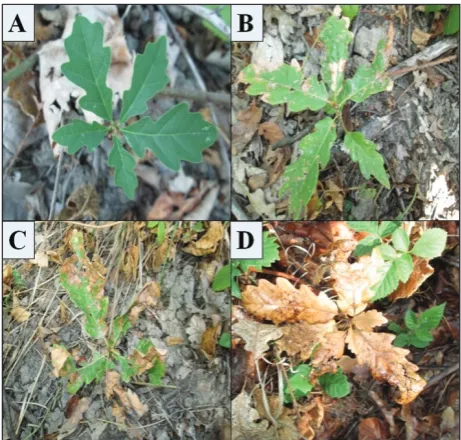
high temperatures. A four-degree classification was used for defining seedling damage (Table S3; Fig. 1).
The age of seedlings was determined by monitor-ing acorn production. The majority of seedlmonitor-ings on EP I was from the mast year of 2013, on EP II from 2012, and on EP III from 2009. To determine the age of seedlings more precisely, we cut fifteen naturally regenerated seedlings on each experimental plot: the five tallest, five smallest and five medium-sized seed-lings. We counted the number of growth rings of these seedlings to accurately determine their age.
The damage to seedlings caused by extreme high temperatures is expressed in relative and absolute val-ues, as well as in the form of the susceptibility index (SI). The SI of seedlings was calculated by the method (adapted to these investigations) used to determine the damage to different tree species from ice storms [28]. The SI was calculated as the scalar damage (from 0=none to 3=severe damage), multiplied by the per-centage of seedlings in the category, summed across all categories as follows:
SI=damage category 1 (%) х 0+damage category 2 (%) х 1 + damage category 3 (%) х 2 + damage
category 4 (%) х 3
Statistical analysis
The main characteristics of sessile oak seedlings, i.e. the number of seedlings, their heights and diameters, were presented using descriptive statistics. The rela-tion between the average degree of damage of seed-lings of different age and their height, as well as the correlation between the average degree of damage of 4-year-old seedlings and different conditions of mature stand canopy, were determined by regression analysis. We also used correlation analysis to obtain a more precise determination of the relationship be-tween the average degree of damage of seedlings of different age and their height.
The exponential function Y=a*exp(-b*X) was used to fit the data on the dependence of the degree of damage of seedlings of different age on height. We used the linear function Y=a*X+b to fit the data on the dependence of the degree of damage of seedlings on mature tree canopy openness. High values of the coefficient of determination indicate that the degree of seedling damage is significantly explained both by the height of seedlings and the canopy openness.
Statistically significant differences in the degree of seedling damage in relation to their age and different degrees of protection of mature stand canopy were determined by the analysis of variance (ANOVA) and LSD post hoc analysis.
RESULTS
The main growth parameters of seedlings
Sessile oak seedlings on the experimental plots were of different age. They were 4 years old on EP I, 5 years old on EP II and 8 years old on EP III. The average number of seedlings per square meter was 20.3 on
EP I, 15.6 on EP II and 13.4 on EP III. The maximum number of seedlings per square meter on EP I was 74, while it was 44 on EP II and 31 on EP III (Table 1).
The average height of 4-year-old seedlings was 17.3 cm. Their maximum height was 66.0 cm and minimum 6.0 cm. For 5-year-old seedlings, the average height was 39.9 cm, the maximum was 124.0 cm and the minimum 7.0 cm, while the average height of 8-year-old seed-lings was 55.8 cm, with the maximum 175.0 cm and minimum 7.0 cm. The average diameter of 4-year-old seedlings was 2.7 mm, with the maximum 11.0 mm and the minimum 0.6 mm. For 5-year-old seedlings, the average diameter was 4.7 mm, the maximum was 13.0 mm and the minimum 1.0 mm. The average diameter of 8-year-old seedlings was 7.1 mm, with the maximum 22.0 mm and the minimum 1.0 mm (Table 1).
Effects of extreme high temperatures on seedlings of different age
The SI is an illustrative indicator. On the scale from 0 to 3 it shows the degree of stand damage while taking into account the number of damaged seedlings as well as the damage intensity [28]. The experimental plots had an SI in a range from 0.16 to 1.13, and it decreased with increasing age of seedlings. This parameter indi-cates that the greatest damage is to 4-year-old seed-lings where the SI was 1.13. For 5-year-old seedseed-lings, the SI was 0.52. This parameter is the smallest for 8-year-old seedlings where it was only 0.16 (Table 2). If we take into account only the percentage of dam-aged seedlings without considering damage intensity (percentage of the damaged leaf area), the largest num-ber of damaged seedlings was recorded among 4-year-old seedlings (78.5%). In the case of 5-year-4-year-old seed-lings, the percentage of damaged individuals was 45.3%, while the percentage of damaged seedlings was the smallest for 8-year-old seedlings (only 14.1%) (Table 3).
Table 1. Main characteristics of seedlings on the experimental plots. Depending on age, the following characteristics are presented: the average, minimum and maximum number of seedlings per square meter, and the average, minimum and maximum heights and diameters of seedlings.
Experimental
plot Age N– per mN – number of seedlings2 N H – height (cm) d – diameter (mm) min per m2 Nmax per m2 h– hmin hmax d– dmin dmax
I 4 20.3 0 74 17.3 6.0 66.0 2.7 0.6 11.0
II 5 15.6 2 44 39.9 7.0 124.0 4.7 1.0 13.0
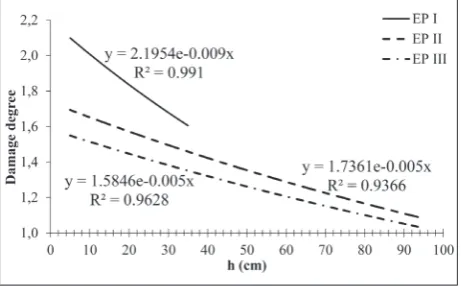
There are significant differences (p<0.01) in the responses of oak seedlings of different age to high temperatures. The resistance of seedlings to high temperatures increased with increasing age. Further-more, with the increase in seedling height, the degree of damage caused by extremely high temperatures decreased. These differences depend on the age of seedlings. Thus, when seedlings of the same height and different age were compared, the older seedlings appeared less damaged (Fig. 2). Negative correlations were determined at the level p<0.01 in all the cases of seedlings of different age. For the 4-year-old seedlings, the coefficient of correlation was r=-0.991, while it was -0.978 for 5-year-old seedlings, and -0.975 for 8-year-old seedlings.
Effects of extreme high temperatures on seedlings in different canopy conditions
Depending on canopy openness, the SI of seedlings ranged from 0.18 to 1.13, increasing with the increase in canopy openness. This parameter also indicates that the seedlings without any canopy protection suffered the greatest damage, while the smallest damage was recorded on seedlings growing under a very dense canopy. The SI also decreased with canopy closure of 0.3-0.4; the decrease of this parameter becomes more intense with the increase in canopy density and its protective role (Table 3). A change in the number of damaged seedlings was recorded depending on dif-ferent canopy openness, but not when the intensity of damage (the percentage of damaged leaf area) was taken into account. The largest number of damaged seedlings was recorded among seedlings without canopy protection (78.5%). The number of damaged seedlings decreased slightly with canopy closure of 0.3-0.4, and then significantly decreased with the increase in density of the mature tree canopy. With seedlings under a very dense canopy, the percentage of damaged seedlings was only 13.6% (six times less than in the area without canopy protection where 9.1% of the seedlings were slightly damaged) (Table 3).
Analysis of variance (ANOVA) established statisti-cally significant differences in the damage of seedlings grown in different situations of mature tree canopy closure. Using LSD post hoc analysis, statistically sig-Table 2. Characteristics of seedling damage at different ages.
Experimental
plot Sum 0 – Undamaged 1 – Light damage 2 – Moderate damage 3 – Severe damageN N % N % N % N % 0 - 3SI Damaged seedlings%
I 107 23 21.5 58 54.2 15 14.0 11 10.3 1.13 78.5
II 468 256 54.7 189 40.4 16 3.4 7 1.5 0.52 45.3
III 361 310 85.9 46 12.7 2 0.6 3 0.8 0.16 14.1
N – Number of analyzed seedlings; SI − Susceptibility Index
Table 3. Characteristics of the degree of damage of four-year-old seedlings depending on the canopy openness.
Canopy closure Sum 0 – Undamaged 1 – Light damage 2 – Moderate damage 3 – Severe damageN N % N % N % N % 0 - 3SI Damaged seedlings%
0.9-1.0 22 19 86.4 2 9.1 1 4.5 / / 0.18 13.6
0.7-0.8 33 20 60.6 12 36.4 1 3.0 / / 0.42 39.4
0.5-0.6 173 95 54.9 54 31.2 18 10.4 6 3.5 0.62 45.1
0.3-0.4 129 42 32.6 69 53.5 11 8.5 7 5.4 0.87 67.4
Individual trees 135 38 28.1 72 53.3 16 11.9 9 6.7 0.97 71.8
Open area 107 23 21.5 58 54.2 15 14.0 11 10.3 1.13 78.5
N – Number of analyzed seedlings; SI – Susceptibility Index
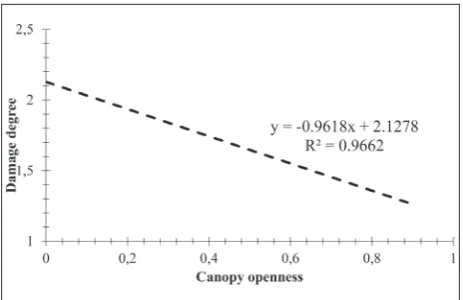
nificant differences in seedling damage at the level p<0.01 were observed between seedlings under the canopy of 0.9-1.0 and 0.7-0.8, and in seedlings without canopy protection, as well as between seedlings under the canopy of 0.1-0.2, 0.3-0.4 and 0.5-0.6. Statistically significant differences in the damage of seedlings at the level p<0.01 were also recorded between seedlings under the canopy of 0.5-0.6 and seedlings without canopy protection, as well as between seedlings un-der the canopy of 0.1-0.2. A statistically significant difference at the level p<0.05 was recorded between seedlings under the canopy of 0.5-0.6 and seedlings under the canopy of 0.3-0.4. After comparing seedling damage caused by extreme high temperatures in dif-ferent canopy situations, it was noted that the degree of damage decreased linearly with increasing canopy protection provided by mature trees. The damage to seedlings without the protection of a mature tree canopy was almost two-fold higher when compared to seedlings under a very dense canopy (Fig. 3).
The obtained results point to the very important roles of mature trees in the protection of seedlings from the harmful effects of extremely high tempera-tures. A stand canopy of 0.5-0.6 was observed as a critical value, which means that under this canopy, seedlings do not have adequate protection and were significantly more damaged by the high temperatures.
DISCUSSION
Since 1990, the literature has described numerous declines caused by heat stress and droughts in
for-ests of different species in different parts of the world [29-32]. In Europe, the decline of forests of Mediter-ranean species has been especially emphasized, as well as forests of oak, beech, fir, spruce and pine due to extremely dry and warm conditions [32].
Considering that future projections for global climate change [5] forecast an increase in the inten-sity and frequency of extreme climatic events, such as heat waves, the negative impact on forest vegetation is very important. Some authors have emphasized the vulnerability of vegetation to extreme temperature conditions in southern Europe [33]. The influence of climate change on the decline of sessile oak forests in Serbia has been highlighted by several authors [20,34]. Climate can be considered as a sudden first-degree factor which affects the presence of other factors that lead to the decay of oaks [34]. The occurrence of oak tree decline in the area of Majdanpek was recorded
at the beginning of the 20th century. A new wave of
massive decline of sessile oak forests in northeastern Serbia was recorded at the beginning of the 1980s on a larger area, and very quickly it affected nearly the entire area of sessile oak forests in Serbia. The decline of sessile oak forests occurs because of the complex interaction between biotic and abiotic factors [17,20]. The damage that was inflicted on sessile oak seedlings during the heat wave in 2017 manifested as wilting of smaller or larger portions of leaf tissues, which indi-rectly caused physiological weakening of the seedlings and in some cases their decay. Wilting of parts of the leaf surface can be explained as the plant’s need to control its evapotranspiration deficit, meaning that in this way the plant maintains a higher level of wa-ter in the rest of the leaf and thereby avoids drought stress [35].
A study of the influence of a heat wave on red
oak (Quercus rubra L.) seedlings revealed that the
greatest negative influence was on the exchange of gases and seedling growth, and it concluded that the
resistance of plants to a heat wave depends on CO2
and soil moisture [36]. The higher resistance of older individuals is most certainly related to the develop-ment of a root system, which in these situations must be sufficiently established for seedlings to survive during periods of moisture deficit in the soil. This is confirmed by the increase in the resistance of seed-lings that accompanies the increase in their height. In Fig. 3. Linear regression of the degree of damage of seedlings in
other words, more developed individuals have more developed root systems, providing them with greater chances for survival in extreme situations.
The protective role of a canopy of mature trees is primarily to prevent the exposure of seedlings to direct sunlight, which is indirectly reflected in a de-crease in temperature, a lower moisture deficit in the soil and lower transpiration. This was also confirmed by the findings from beech-dominated and Douglas-fir-dominated forests, where the soil moisture corre-lated positively with air humidity and negatively with air temperature [37].
The seedling survival of oaks Quercus ilex and
Quercus suber is significantly higher if they have cano-py protection. The protective role of the canocano-py is pri-marily reflected in the decrease in high temperature, especially when the soil moisture decreases below the average values [38]. Moderate canopy openness has a positive influence on the development of seedlings, but extreme droughts have a significant impact on the success of this type of silviculture treatment [39]. Op-timal forest microclimate conditions (light regime, air and soil temperatures, humidity and solar radiation) are closely related to the main purpose of silviculture, forest tending, methods of natural regeneration, in-tensity of felling and productivity growth [20,23,40]. The application of shelterwood cutting in the nat-ural regeneration of sessile oak forests implies the ex-ecution of a few cuts at specific intervals with the final cut being performed when seedlings no longer need the protection of mature trees. The final cut needs to be performed when seedlings are 8-10 years old and when slower growth is observed [17]. The results of this study are in accordance with this statement and indicate that 8-year-old seedlings that did not have the protection of a mature tree canopy suffered minimum damage from extremely high temperatures.
As it is clear that younger seedlings are less re-sistant to the impact of extreme temperatures, they need to have some protection of a mature tree canopy. Climate factors such as temperature, air humidity, soil moisture and light have the greatest influence on the survival and development of sessile oak seedlings. The research area in northeastern Serbia has favor-able light, temperature and humidity conditions and
a stand canopy closure from 0.5 to 0.7, thus favoring successful natural regeneration. A sparse stand canopy creates unfavorable microclimate conditions [17, 20].
The results obtained in this study indicate that the degree of damage decreased linearly with the increase in canopy closure and canopy protection of seedlings (p<0.05) (Fig. 3). Taking into account other factors, i.e. that the sustainable growth of seedlings requires at least 20% of available light [21], and that a satisfactory increment requires between 30 and 60% of relative radiation [19], the obtained statistically significant dif-ferences in seedling damage in different canopy situa-tions indicate that in order to protect young seedlings from extremely high temperatures, it is necessary to maintain the canopy at 0.5-0.6 in the beginning, and to subsequently reduce it to 0.3-0.4.
Based on the above, the results in this study con-firm the starting hypotheses that the resistance of sessile oak seedlings to extreme high temperatures changes with age, and that the stand canopy has a sig-nificant protective role in situations when sessile oak seedlings are endangered by high temperatures. The obtained results can be very important in planning measures related to regeneration and development of sessile oak with the aim of protecting young seed-lings, which are very sensitive to climate extremes. Furthermore, the obtained results indicate how cli-mate extremes affect seedlings in the forest, and for a more detailed analysis of this, it would be necessary to take into account other tree species, which offers new possibilities for continuing this research.
Acknowledgments: This paper was realized as part of the project “Investigations of ways and possibilities of regeneration of ses-sile oak in Serbia”, financed by the Ministry of Agriculture and Environmental Protection of the Republic of Serbia, within the framework of integrated and interdisciplinary research for the period 2014-2016.
Author contributions: Milun Krstić and Branko Kanjevac col-lected, organized and analyzed the data and wrote the manuscript. Milun Krstić designed the basic idea, content and method of work, and Branko Kanjevac technically prepared the paper. Violeta Babić provided the original data of climate characteristics and analyzed them. All authors read and approved the final manuscript. The publication of this article was approved by all authors.
REFERENCES
1. Beniston M, Stephenson DB, Christensen OB, Ferro CAT, Frei C, Goyette S, Halsnaes K, Holt T, Jylhä K, Koffi B, Palu-tikof J, Schöll R, Semmler T, Woth K. Future extreme events in European climate: an exploration of regional climate model projections. Clim Change. 2007;81(1):71-95. 2. Adams HD, Luce CH, Breshears DD, Allen CD, Weiler M,
Hale VC, Smith AMS, Huxman TE. Ecohydrological con-sequences of drought- and infestation-triggered tree die-off: insights and hypotheses. Ecohydrology. 2012;5(2):145-59. 3. Smith, MD. An ecological perspective on extreme climatic
events: a synthetic definition and framework to guide future research. J Ecol. 2011;99(3):656-63.
4. Cavin L, Mountford EP, Peterken GF, Jump AS. Extreme drought alters competitive dominance within and between tree species in a mixed forest stand. Funct Ecol. 2013;27(6):1424-35.
5. Intergovernmental Panel on Climate Change (IPCC). Cli-mate Change 2014-Synthesis Report. Contribution of Work-ing Groups I, II and III to the Fifth Assessment Report of the Intergovernmental Panel on Climate Change. Geneva, Switzerland: IPCC; 2014. 151 p.
6. Intergovernmental Panel on Climate Change (IPCC). Poten-tial impacts of climate change. Report of Working Group 2, Intergovernmental Panel on Climate Change, 1-1 to 2. Geneva: World Meteorological Organization (WMO)/ United Nations Environment Programme (UNEP); 1990. 7. Intergovernmental Panel on Climate Change (IPCC).
Cli-mate Change 2007-Mitigation of cliCli-mate change. Contribu-tion of Working Group III to the Fourth Assessment Report of the Intergovernmental Panel on Climate Change. Cam-bridge, United Kingdom: Cambridge University Press; 2007. 8. Bernhofer C, Matschullat J, Bobeth A. Das Klima in der
REGKLAM-Modellregion Dresden. Berlin: Rhombos-Verl.; 2009. 117 p. German.
9. Gillner S, Vogt J, Roloff A. Climatic response and impacts of drought on oaks at urban and forest sites. Urban For Urban Green. 2013;12(4):597-605.
10. Mészáros I, Veres S, Szőllősi E, Koncz P, Kanalas P, Oláh V. Responses of some ecophysiological traits of sessile oak ( Quer-cus petraea) to drought stress and heat wave in growing season of 2003. Acta Biologica Szegediensis. 2008;52(1):107-9. 11. Hasanuzzaman M, Nahar K, Alam MM, Roychowdhury
R, Fujita M. Physiological, Biochemical, and Molecular Mechanisms of Heat Stress Tolerance in Plants. Int J Mol Sci. 2013;14(5):9643-84.
12. Grace J, Berninger F, Nagy L. Impacts of Climate Change on the Tree Line. Ann Bot. 2002;90(4):537-44.
13. Ducić V, Milovanović B, Đurđić S. Identification of recent factors that affect the formation of the upper tree line in eastern Serbia. Arch Biol Sci. 2011;63(3):825-30.
14. Liang E, Wang Y, Piao S, Lu X, Camarero JJ, Zhu H, Zhu L, Ellison AM, Ciais P, Peñuelas J. Species interactions slow warming-induced upward shifts of treelines on the Tibetan Plateau. Proc Natl Acad Sci U S A. 2016;113(16):4380-5. 15. Reichstein M, Bahn M, Ciais P, Frank D, Mahecha MD,
Sen-eviratne SI, Zscheischler J, Beer C, Buchmann N, Frank DC, Papale D, Rammig A, Smith P, Thonicke K, van der Velde M,
Vicca S, Walz A, Wattenbach M. Climate extremes and the carbon cycle. Nature. 2013;500(7462):287-95.
16. Reyer CPO, Leuzinger S, Rammig A, Wolf A, Bartholomeus RP, Bonfante A, de Lorenzi F, Dury M, Gloning P, Abou Jaoudé R, Klein T, Kuster TM, Martins M, Niedrist G, Ric-cardi M, Wohlfahrt G, de Angelis P, de Dato G, François L, Menzel A, Pereira M. A plant’s perspective of extremes: terrestrial plant responses to changing climatic variability. Glob Chang Biol. 2013;19(1):75-89.
17. Krstić M. Research on Ecological and Production Char-acteristics of Sessile Oak Forests and Selection of the Best Regeneration Methods in the Area of Northeastern Serbia. [dissertation]. [Belgrade]: Faculty of Forestry, University of Belgrade. 1989. 247 p. Serbian.
18. Březina I, Dobrovolný L. Natural regeneration of sessile oak under different light conditions. J For Sci. 2011;57(8):359-68. 19. Lüpke von B. Silvicultural methods of oak regeneration with special respect to shade tolerant mixed species. For Ecol Manage. 1998;106(1):19-26.
20. Krstić M. Sessile Oak Forests of Djerdap region – State and Silvicultural Measures. Belgrade, Serbia: Akademska misao; 2003. 137 p. Serbian.
21. Röhrig E, Bartsch N, von Lüpke B. Waldbau auf ökologischer Grundlage. Stuttgart: UTB; 2006. 479 p. German.
22. Krstić M, Stojanović Lj. Silviculture in sessile oak forest. In: Stojanović Lj, editor. Sessile oak (Quercus petraea agg. Ehrendorfer 1967) in Serbia. Belgrade, Serbia: University of Belgrade – Faculty of Forestry; 2007. p. 209-77. Serbian. 23. Govedar Z. Effect of canopy and light regime on natural
regeneration in sessile oak stand in the region of Čelinac. Forestry. 2006;58(3):99-108. Serbian.
24. Relief map of Republic of Serbia [Internet]. 2015 Mar 1 [cited 2017 Dec 15]. Available from: http://beautifulmaps. blogspot.rs/2015/03/serbia-relief-map-2015.html.
25. Krstić M, Stojanović Lj. Contribition to the study of climatic characteristics of the east Serbia. In: Proceeding of the 7th Symposium on Flora of Southeastern Serbia and Neighbour-ing Regions. 2002 June 5-9; Dimitrovgrad (Serbia). p. 213-7. Serbian.
26. Archives of Republic Hydrometeorological Service of Serbia [Internet]. Belgrade: Republic Hydrometeorological Service of Serbia. 1949 - [cited 2017 Dec 15]. Available from: http:// www.hidmet.gov.rs.
27. Drought Monitoring Bulletin - 22 Sep 2017 [Internet]. Drought Management Centre for Southeastern Europe – DMCSEE. 2010 [cited 2017 Dec 15]. Available from: http:// www.dmcsee.org/en/drought_bulletin/
28. Rebertus AJ, Shifley SR, Richards RH, Roovers LM. Ice Storm Damage to an Old – growth Oak – hickory Forest in Missouri. Am Midl Nat. 1997;137(1):48-61.
29. Fensham RJ, Holman JE. Temporal and spatial patterns in drought-related tree dieback in Australian savanna. J Appl Ecol. 1999;36(6):1035-50.
30. Van Mantgem PJ, Stephenson NL. Apparent climatically induced increase of tree mortality rates in a temperate for-est. Ecol Lett. 2007;10(10):909-16.
32. Allen CD, Macalady AK, Chenchouni H, Bachelet D, McDowell N, Vennetier M, Kitzberger T, Rigling A, Bres-hears DD, (Ted) Hogg EH, Gonzalez P, Fensham R, Zhang Z, Castro J, Demidova N, Lim J-H, Allard G, Running SW, Semerci A, Cobb N. A global overview of drought and heat-induced tree mortality reveals emerging climate change risks for forests. For Ecol Manage. 2010;259(4):660-84.
33. Baumbach L, Siegmund JF, Mittermeier M, Donner RV. Impacts of temperature extremes on European veg-etation during the growing season. Biogeosciences. 2017;14(21):4891-903.
34. Karadžić D, Mihajlović Lj, Milijašević T, Keča N. Sessile oak forest protection. In: Stojanović Lj, editor. Sessile oak (Quer-cus petraea agg. Ehrendorfer 1967) in Serbia. Belgrade, Ser-bia: University of Belgrade – Faculty of Forestry; 2007. p. 153-208. Serbian.
35. Filewod B, Thomas SC. Impacts of a spring heat wave on canopy processes in a northern hardwood forest. Glob Chang Biol. 2014;20(2):360-71.
36. Bauweraerts I, Wertin TM, Ameye M, McGuire MA, Tes-key R, Steppe K. The effect of heat waves, elevated [CO2] and low soilwater availability on northern red oak (Quercus rubra L.) seedlings. Glob Chang Biol. 2013;19(2):517-28.
37. Vukov D, Galić Z, Rućando M, Ilić M, Ćuk M, Igić D, Igić R, Orlović S. Effects of natural broadleaved regeneration vs. conifer restoration on the herb layer and microclimate. Arch Biol Sci. 2016;68(3):483-93.
38. Caldeira MC, Ibáñez I, Nogueira C, Bugalho MN, Lecomte X, Moreira A, Pereira JS. Direct and indirect effects of tree canopy facilitation in the recruitment of Mediterranean oaks. J Appl Ecol. 2014;51(2):349-58.
39. Rodríguez-Calcerrada J, Cano FJ, Valbuena-Carabaña M, Gil L, Aranda I. Functional performance of oak seedlings natu-rally regenerated across microhabitats of distinct overstorey canopy closure. New Forests. 2010;39(2):245-59.
40. Babić V, Krstić M, Govedar Z, Todorić J, Vuković N, Milošević Z. Temperature and other microclimate condi-tion in the oak forests on Fruška Gora (Serbia). Thermal Sci. 2015;19(2):415-25.
Supplementary Data