503
© 2018 by the Serbian Biological Society How to cite this article: Terzi R, Saruhan Güler N, Güven FG, Kadioglu A. Alpha lipoic acid treatment induces the antioxidant system and ameliorates lipid peroxidation in maize seedlings under osmotic stress. Arch Biol Sci. 2018;70(3):503-11.
Alpha lipoic acid treatment induces the antioxidant system and ameliorates lipid
peroxidation in maize seedlings under osmotic stress
Rabiye Terzi1, Neslihan Saruhan Güler2,*, Funda Gül Güven1 and Asim Kadioglu1
1Department of Biology, Faculty of Science, Karadeniz Technical University, 61080, Trabzon, Turkey
2Department of Nutrition and Dietetics, Faculty of Health Sciences, Karadeniz Technical University, 61080, Trabzon, Turkey
*Corresponding author: [email protected]
Received: December 18, 2017; Revised: February 22, 2018; Accepted: March 20, 2018; Published online: April 4, 2018
Abstract: Plants are markedly affected by drought stress caused by fluctuations in global climate, reduction in rainfall and a decrease in soil fertility. Therefore, some mechanistic strategies to cope with adverse effects of drought stress are needed. Alpha lipoic acid (ALA), a potent antioxidant molecule, is known to function in abiotic stress tolerance. In the current study, we investigated the ALA-stimulated physiological role in tolerance to osmotic stress induced by polyethylene glycol in two maize (Zea mays L.) cultivars (cv. Helen and cv. Akpinar). Application of ALA increased the leaf water potential of maize cultivars under stressful and stress-free conditions but decreased lipid peroxidation and the hydrogen peroxide (H2O2) content. Additionally, enhanced activity of the antioxidant defense system was observed following ALA application. Exogenous ALA elevated the activities of enzymatic antioxidants such as superoxide dismutase (SOD), catalase (CAT), guaiacol peroxidase (GPX), glutathione reductase (GR) and monodehydroascorbate reductase (MDHAR) under osmotic stress as compared to seedlings not exposed to ALA. Conversely, ascorbate peroxidase (APX) activity was decreased by ALA application in both cultivars. Higher GR and MDHAR activities of both cultivars were simultaneously observed in ALA treatments under osmotic stress. Taken together, the data indicated that exogenous ALA may function in arranging resilience against osmotic stress by reducing oxidative damage through induction of the antioxidant machinery in maize cultivars.
Key words: alpha lipoic acid; antioxidant system; osmotic stress; tolerance; Zea mays
INTRODUCTION
Plants growing in the natural environment are often subjected to various abiotic stresses. Drought-affected land has increased more than two-fold in recent years, and it is considered as one of the biggest threats to agriculture in the near future. Basic agricultural prac-tices are markedly affected by drought stress because of fluctuations in global climate, reduction in rainfall and a decrease in soil fertility. Therefore, several adap-tations and mitigation strategies are required to cope with drought stress. The standard effect of drought stress is oxidative damage. Exposure to drought results in a disruption of balance between reactive oxygen species (ROS) production and removal or scavenging [1]. Overproduction of ROS is a prominent anomaly in plants under unfavorable conditions that can cause an oxidative burst, thus blocking plant growth and de-velopment, or even leading to death. Therefore, plants
always try to maintain a well-developed enzymatic and nonenzymatic antioxidant defense system that can confront the deleterious effects of ROS [2].
present in all types of eukaryotic and prokaryotic cells. Antioxidant substances typically possess antioxidant properties in their reduced form. Among antioxidant molecules, ALA is unique because it can retain power-ful antioxidant functions in both its reduced (ALA) and oxidized (dihydrolipoic acid, DHLA) forms. Furthermore, both ALA and DHLA have a metal-chelating capacity and can scavenge free radicals [4]. In addition, ALA plays a crucial role in energy me-tabolism. The research on ALA in plants has attracted considerable attention in recent years, and evidence indicates that ALA can act in plants similarly to the way it does in animals [5,6]. The presence of ALA is of particular importance under excess copper [6] and salinity [7]. Furthermore, it affects specific proteins and enhances salt-stress tolerance [8]. In addition, it may mitigate oxidative stress by modulating ion ho-meostasis and the antioxidant system in salt-stressed wheat seedlings [9].
Maize is of pivotal economic importance globally as it has basic characteristics that make it extremely desirable for human consumption, animal feedstuff, as well as biodiesel/bioethanol production to scale down the dependence on fossil fuels [10-12]. Maize production is, however, negatively affected by some environmental factors, in particular, by drought and salt stress. Given the fact that maize is an agroeconom-ically important crop worldwide, it plays a pivotal role in producing abiotic stress-resistant and high-quality maize plants in the current scenario of global climate fluctuations and population explosion.
Studies examining the effect of exogenous ALA on plants exposed to stress are few and the mecha-nisms of ALA in promoting stress tolerance in plants need to be elucidated. Although there are studies that evaluated the role of ALA in the recycling of other antioxidants in plants under stress [6,7], no studies have evaluated the response of exogenous ALA on the antioxidant system under osmotic stress condi-tions in plants. In this study, we hypothesized that ALA pretreatment can increase the tolerance of maize seedlings to osmotic stress induced by polyethylene glycol (PEG6000) by enhancing antioxidant activity and decreasing ROS levels in plants. Therefore, we investigated the influence of ALA as a signal molecule by examining whether exogenous ALA pretreatment can alleviate the adverse effects of osmotic stress and
its relations with antioxidant systems. Furthermore, we determined the comparative performance of two maize cultivars differing in their water status in or-der to unor-derstand their adaptive mechanisms unor-der drought stress with or without ALA. To determine the relationship between ALA and the antioxidant system, osmotic stress was applied to detached leaves of maize cultivars for a short period. However, this study is the first to demonstrate the capability of ALA in protect-ing maize seedlprotect-ings against osmotic stress and should contribute to the understanding of the role of ALA in promoting osmotic stress tolerance.
MATERIALS AND METHODS
Plant materials, growth, and alpha lipoic acid treatment
Two maize (Zea mays L.) cultivars, cv. Helen and cv. Akpinar, differing in water status, were obtained from Advanta Seed Production Company Istanbul, Turkey and the Black Sea Agricultural Research Institute, Es-kisehir, Turkey, respectively. The seeds were surface sterilized with 0.1% HgCl2 for 3 min, followed by re-peated washings with sterilized distilled water. The seeds were then sown in plastic pots (14 cm height, 16 cm top and 11 cm bottom diameters) containing peat and sand (5:1). The seedlings were grown in a green-house (temperature 21°C±2; relative humidity 60% ±5; light intensity 400 µmol m-2 s-1) for 25 days. The pots
con-trol seedlings only exposed to Hoagland solution; (ii) PEG − osmotic stress treatment with 10% PEG6000 with -0.3 MPa as the osmotic potential; (iii) ALA − exposed to Hoagland solution containing 0.02 mM ALA; (iv) ALA+PEG − osmotic stress combined with 0.02 mM ALA. After the treatments, the second leaves of the plants were used for assays.
Measurements of the water potential
Leaf water potential (Ψleaf) was measured with a C52 thermocouple psychrometer (Wescor, Inc., Logan, UT, USA).
Dry weight measurement
To obtain adequate data on the growth variations of the seedlings, the dry weight was measured. The leaves were harvested from four group pots and fresh weights of the leaves were determined. The samples were dried in an oven at 85°C for 72 h [14].
Lipid peroxidation
Lipid peroxidation was measured in terms of the malondialdehyde (MDA) content (ε=155 mM−1 cm−1),
a product of lipid peroxidation, following the method of Heath and Packer [15].
Determination of the hydrogen peroxide content
The endogenous H2O2 content was determined ac-cording to the modified method of Velikova et al. [16]. Leaves (0.25 g) were ground in 3 mL of 5% trichloro-acetic acid with 0.1 g of activated charcoal at 0°C. To 0.5-mL aliquots of the supernatant, 0.5 mL of 10 mM potassium phosphate buffer (pH 7.0) and 0.75 mL of 1 M KI were added. The absorbance was measured at 390 nm and the H2O2 content was expressed as µmol g-1 FW.
Antioxidant enzyme assays
Frozen leaf samples (0.5 g) were ground to a fine pow-der in liquid N2. The powder was homogenized in 5 mL of 50 mM potassium phosphate buffer (pH 7.0) containing 1% polyvinylpyrrolidone and 1 mM EDTA. For the ascorbate peroxidase assay, 5 mM of ascorbic
acid were added to the buffer. The homogenate was centrifuged at 20000 ×g for 20 min at 4°C, and the supernatant was used for enzyme assays.
SOD (EC 1.15.1.1) activity was measured (25°C) based on the method of Beauchamp and Fridovich [17]. GPX (EC 1.11.1.7) activity was measured ac-cording to the method of Urbanek et al. [18] at 470 nm (25°C, ε = 26.6 mM−1cm−1). APX (EC 1.11.1.11)
activity was determined according to the method of Nakano and Asada [19], which is based on ascorbate oxidation at 290 nm (25°C, ε=2.8 mM-1 cm-1). CAT
(EC 1.11.1.6) activity was measured according to the method of Aebi [20] (25°C, ε=39.4 mM-1cm-1) at 240
nm. GR (EC 1.6.4.2) activity was determined fol-lowing the decrease in absorbance at 340 nm (25°C, ε=6.22 mM-1 cm-1) associated with NADPH oxidation
[21]. MDHAR (EC 1.6.5.4) activity was determined by following NADH oxidation at 340 nm (25°C, ε=6.22 mM-1 cm-1) [22]. The protein content was measured
(25°C) according to the method of Bradford [23]. Bovine serum albumin was used as a standard. En-zyme activities were expressed as units per milligram of protein.
Statistical analysis
All experiments were performed in triplicate with four biological replicates. Duncan’s multiple range test was used to perform variance analysis of means by SPSS software for Microsoft Windows (Ver. 15.0, SPSS Inc., Chicago, IL, USA). Statistical significance of the means between control and treatments was evaluated at 5% (P<0.05) probability level.
RESULTS
The effect of ALA pretreatment on the leaf water status
respectively. However, ALA+PEG seedlings sustained the Ψleaf at a higher level than the PEG seedlings. ALA+PEG enhanced the values of Ψleaf in cv. Helen and cv. Akpinar by 14% and 11%, respectively, as com-pared to the PEG seedlings (Fig 1A). Ψleaf values of cv. Helen and cv. Akpinar were increased by 30% and 18% in the ALA seedlings as compared to the control, respectively (Fig 1A).
The dry weight of cv. Akpinar but not of cv. Helen increased after the ALA treatment in comparison with the control seedlings. PEG treatment resulted in lower dry weight in cv. Helen than that of the control, but the dry weight of cv. Akpinar did not change after the PEG treatment in comparison with the control (Fig. 1B). The dry weights of neither cultivar changed after the ALA pretreatment under stress as compared to seedlings that were not exposed to ALA.
Effects of ALA pretreatment on lipid peroxidation and H2O2 content
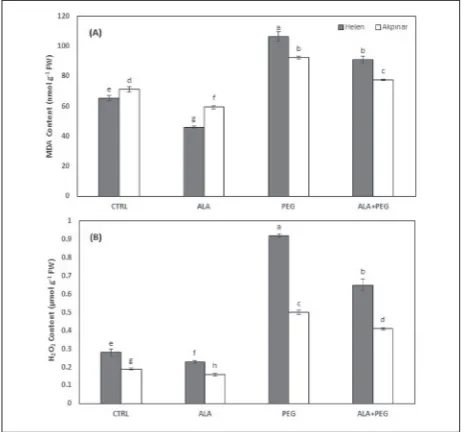
The exposure to osmotic stress greatly increased membrane damage of both maize cultivars. The MDA content increased in cv. Helen and cv. Akpinar, 1.63- and 1.30-fold, respectively. However, the exogenous application of ALA alleviated the membrane damage of both cultivars under osmotic stress. Membrane damage was reduced in cv. Helen and cv. Akpinar, 1.16- and 1.19-fold, respectively (Fig. 2A).
The osmotic stress caused up to 3.28-fold accu-mulation of H2O2 in cv. Helen and 2.63-fold in cv. Akpinar when compared to matching controls. This indicated that oxidative stress occurred in osmotic-stressed maize seedlings. Exogenous ALA alone re-duced the increase in H2O2 accumulation in both cultivars. The ALA+PEG pretreatment decreased the H2O2 content when compared with the PEG treat-ment. The decrease caused by exogenous ALA was relatively more pronounced in cv. Helen than in cv. Akpinar (1.41- and 1.22-fold, respectively) (Fig. 2B).
Effects of ALA pretreatment on antioxidant enzymes
All antioxidant enzyme activities increased under PEG-induced osmotic stress in both cultivars, and this increase was higher in the ALA-pretreated
seed-Fig. 2. The effects of ALA on lipid peroxidation (A) and hydrogen peroxide (H2O2) content (B) in two maize cultivars, Helen (filled square) and Akpinar (open square), under osmotic stress condi-tions. Vertical bars represent the standard deviation. The different letters denote significant differences between the two cultivars along with the different treatments (P<0.05).
Fig. 1. The effect of exogenous ALA on leaf water potential (Ψleaf)
(A) and dry weight (B) in two maize cultivars, Helen (filled
lings. Exogenous PEG alone increased the SOD activ-ity of both cultivars as compared with that of their controls. Increases in SOD activity by 14% and 11% were recorded in cv. Helen and cv. Akpinar under os-motic stress, respectively. However, the application of exogenous ALA alone did not cause a change in SOD activity. Furthermore, an increase in the activity was observed by the application of ALA+PEG when compared with that of PEG alone. Increases in SOD activity by 23% and 28% were recorded after ALA application in cv. Helen and cv. Akpinar, respectively, under osmotic stress (Fig. 3A).
Osmotic stress increased CAT activities in cv. Helen and cv. Akpinar; however, the effect was not as high as that of ALA treatment alone. The activ-ity increased by 172% in PEG seedlings of cv. Helen, while it increased 14% in cv. Akpinar, as compared to the control, respectively. CAT activity was increased in ALA-treated seedlings compared with that in con-trol seedlings in both cultivars. The ALA application
under osmotic stress considerably increased CAT activity in both cultivars when compared with the PEG-treated seedlings. Increases in activities by 6% and 27% were recorded in cv. Helen and cv. Akpinar, respectively (Fig. 3B).
The PEG treatment increased GPX activity in both cultivars. As compared to the control, the activ-ity was increased by 26% in PEG-treated seedlings of cv. Helen while it increased 62% in cv. Akpinar. GPX activity of the greatest magnitude was observed in ALA+PEG-pretreated seedlings; GPX activity in ALA+PEG applied seedlings increased by 53% and 4% in cv. Helen and cv. Akpinar as compared to the PEG seedlings, respectively (Fig. 3C).
APX activity of both cultivars increased under osmotic stress. Increases in activity by 41% and 14% were recorded under osmotic stress in cv. Helen and cv. Akpinar, respectively. In contrast, the ALA treat-ment alone did not cause a change in APX activity of
cv. Helen; however, it led to a considerable decrease in APX activity in cv. Akpinar as compared with that of their controls. ALA+PEG treatment caused a decrease in APX activity of both cultivars as compared with the PEG treatment. In ALA+PEG-treated seedlings, the activity decreased by 12% and 30% in cv. Helen and cv. Akpinar, respectively (Fig. 3D).
GR activity of maize cultivars was induced by the PEG treatment. Increases in activity by 24% and 123% were recorded under osmotic stress in cv. Helen and cv. Akpinar, respectively. However, no consider-able differences in GR activity in cv. Helen between control and ALA-treated seedlings were determined. GR activity of the greatest magnitude was observed after the ALA+PEG pretreatment. When compared to PEG-treated seedlings, increases in activities by 35% and 25% after ALA application were recorded in cv. Helen and cv. Akpinar exposed to osmotic stress, re-spectively (Fig. 3E).
In both maize cultivars, osmotic stress caused a decrease in MDHAR activities when compared to matching controls. In PEG-treated seedlings, the ac-tivity decreased by 11% and 19% in cv. Helen and cv. Akpinar, respectively. The application of exogenous ALA alone markedly reversed the reduction in MD-HAR activity. The ALA+PEG treatment consider-ably increased MDHAR activity in both cultivars in comparison to the PEG treatment; however, the effect was not as high as that observed in seedlings treated only with ALA. In ALA+PEG-treated seedlings, the activity increased by 23% and 45% in cv. Helen and cv. Akpinar, respectively (Fig. 3F).
DISCUSSION
The protective mechanisms of ALA, an antioxidant molecule, in inducing osmotic stress tolerance in plants remain to be elucidated. The present investi-gation suggests that the exogenous application of ALA can help reduce the adverse effects of osmotic stress in maize cultivars. The water status of maize cultivars was reduced under osmotic stress, while the ALA pre-treatment substantially enhanced the leaf water poten-tial. The pretreatment with ALA further enhanced the leaf water potential in cv. Helen in comparison to cv. Akpinar. A strong correlation exists between the plant
water content and accumulation of compatible solutes under drought stress [24]. Therefore, the improve-ment in leaf water potential by the exogenous applica-tion of ALA may be the result of osmotic adjustment due to the accumulation of compatible solutes, such as proline and sugar. Indeed, our results show that the proline and total soluble sugar contents in ALA-treated plants were higher than in PEG-ALA-treated plants (unpublished data). In addition, our findings show that the improvement in water status following the exogenous application of ALA may be the result of the alleviation of the detrimental effects of osmotic stress. Similar to our findings, Görcek and Erdal [9] reported that exogenous ALA treatment mitigated the salt-induced decrease in water status and, hence, contributed by increasing the leaf surface area. In ad-dition, the authors indicated that enhancement of the water status and leaf surface area due to foliar appli-cation of ALA was due to its modulating role in ion homeostasis, osmotic regulation and the antioxidant system. In this study, osmotic stress markedly reduced the dry weights of cv. Helen but not Akpinar. When treated with ALA alone, a slight increase in the dry weight of cv. Akpinar was observed as compared to the control. The applied ALA was easily taken up by maize seedlings because they were detached and did not have a root system. It could be transported to the leaves and thus exogenous ALA could increase the dry weight of the leaves during the experimental pe-riod. Similarly, Mohammadkhani and Heidari [25] reported that dry weight changed in maize cultivars exposed to PEG-induced water stress for 24 h. Also, no significant differences were observed in the dry weights of PEG- and ALA+PEG-treated seedlings in both cultivars. We can say that exogenous ALA may not affect dry weight of the leaves under short-term osmotic stress conditions.
was highest in PEG-treated seedlings, indicating that the generation of endogenous H2O2 exceeded the ca-pacity of the cellular antioxidant defense system to eliminate H2O2 [27]. However, the exogenous appli-cation of ALA considerably reduced the endogenous levels of H2O2 and MDA by inducing the antioxidant system. The reduction in H2O2 content after ALA ap-plication may be due to its ability to scavenge ROS, as antioxidant enzymes. This correlates with the findings of Gorcek and Erdal [9] who observed that ALA sig-nificantly reduced H2O2 and superoxide contents and contributed to the response to oxidative damage and metabolic distortions in salt-stressed wheat seedlings. Likewise, in another study, it was shown that ALA can have protective and antimutagenic effects against oxidants (particularly H2O2) in yeast cells via its an-tioxidant activity [28]. Indeed, using various model systems, ALA was found to be highly reactive against a variety of ROS in vitro. ALA at concentrations of 0.05-1 mM scavenged H2O2, the hydroxyl radical, hy-pochlorous acid and singlet oxygen. ALA also formed stable complexes with Mn2+, Cu2+, Zn2+ and chelated
Fe2+. Several studies provided evidence that ALA
application decreased oxidative stress and restored reduced levels of other antioxidants under different physiological conditions in vivo [4,29]. Furthermore, ALA is highly effective in protecting stress-induced lipid peroxidation. It has been reported that ALA acts as a free radical scavenger and plays a crucial role in the recycling of other oxidized radical scavengers such as glutathione and ascorbate [4,5]. The results suggest that the reduction in MDA content was because of increased antioxidant enzyme activities that reduced H2O2 levels and membrane damage.
Plants possess efficient systems for scavenging ROS that protect them from destructive oxidative re-actions. As part of this system, antioxidant enzymes are key elements in defense mechanisms [26]. In this study, we found that osmotic stress increases antioxi-dant enzyme activities, except MDHAR, in both maize cultivars (Fig. 3). In addition, cv. Helen had higher APX and CAT activities and lower GPX and GR activ-ities than cv. Akpinar. Moreover, the exogenous appli-cation of ALA under osmotic stress further increased the activities of all these enzymes in both cultivars, with higher increases in GPX and GR activities in cv. Helen than in cv. Akpinar (Fig. 3C and E). APX
activ-ity, which was highly increased under osmotic stress in cv. Helen, was decreased in ALA-treated seedlings under osmotic stress. Therefore, ALA application to the cv. Helen exposed to osmotic stress may not in-duce some antioxidant enzymes such as APX under stress. In addition, the decrease in APX activity may be a result of ALA using other antioxidant enzymes instead of APX to remove H2O2. Furthermore, the in-hibition of APX activity by ALA may be because of downregulated gene expression or degradation, de-naturation, or inactivation of this protein. However, in ALA-pretreated seedlings, the higher activities of antioxidant enzymes (except APX) correspond to a decrease in the endogenous H2O2 level, suggesting that pretreatment with exogenous ALA increases the ability of maize cultivars to scavenge H2O2 through antioxidant enzymes under osmotic stress. Similarly, Görcek and Erdal [9] reported that ALA application resulted in further increases in enzyme activities when compared to salt-stressed wheat seedlings, suggesting that ALA may contribute to increased plant resistance against salinity by effectively scavenging ROS through enhanced antioxidant activity.
func-tion of ascorbate depends on its redox status, which is closely related to MDHAR activity, and the higher MDHAR activity induced by exogenous ALA applica-tion under osmotic stress is crucial for efficient anti-oxidant activity.
CONCLUSIONS
Maize is a valuable crop and it is very important to establish mechanisms for developing drought-tolerant plants that can produce sufficient yields under adverse stress conditions. In this study, we describe the protec-tive roles of ALA in maize seedlings under osmotic stress via modulation of H2O2 accumulation, allevia-tion of the water status and reorganizaallevia-tion of the an-tioxidant machinery. Exogenous ALA may be consid-ered a potential signaling molecule for augmenting the antioxidant potential of maize plants under osmotic stress conditions. In our opinion, ALA may have high potential impact for crop quality and sustainable ag-riculture but we are just beginning to understand its role. In the coming years, we assume that ALA will be able to improve plant growth and yield quality by increasing the antioxidant capacity of plants under water stress, and could become a novel candidate for sustainable agriculture. In our future research, we plan to analyze transcript levels of genes involved in osmo-lytic metabolism by quantitative PCR.
Acknowledgments: This work was supported by the Research
Unit of Karadeniz Technical University (BAP, 8922).
Author contributions: RT and FGG designed the study and
per-formed the experiments. NSG and AK evaluated the data and wrote the paper.
Conflict of interest disclosure: The authors state that they have no conflict of interest to disclose in the subject matter or materials discussed in this manuscript.
REFERENCES
1. Smirnoff N. Plant resistance to environmental stress. Curr Opin Biotechnol. 1998;9:214-19.
2. Hasanuzzaman M, Hossain MA, Teixeira da Silva JA, Fujita M. Plant responses and tolerance to abiotic oxidative stress: antioxidant defense is a key factors. In: Bandi V, Shanker AK, Shanker C, Mandapaka M, editors. Crop stress and its management: perspectives and strategies. Berlin, Germany: Springer; 2012. p. 261-316.
3. Hasanuzzaman M, Alam M, Rahman A, Hasanuzzaman Md, Nahar K, Fujita M. Exogenous proline and glycine betaine mediated upregulation of antioxidant defense and glyoxalase systems provides better protection against salt-induced oxi-dative stress in two rice (Oryza sativa L.) varieties. Biomed Res Int. 2014;2014:1-17.
4. Packer L, Witt EH, Tritschler HJ. Alpha-lipoic acid as a bio-logical antioxidant. Free Radic Biol Med. 1995;19:227-50. 5. Navari-Izzo F, Quartacci MF, Sgherri CLM. Lipoic acid: a
unique antioxidant in the detoxification of activated oxygen species. Plant Physiol Biochem. 2001;40:463-70.
6. Sgherri C, Quartacci MF, Izzo R, Navari-Izzo F. Relation between lipoic acid and cell redox status in wheat grown in
excess copper. Plant Physiol Biochem.2002;40:591-7.
7. Perez-Lopez U, Robredo A, Lacuesta M, Sgherri C, Mena-Petite A, Navari-Izzo F, Munoz-Rueda A. Lipoic acid and redox status in barley plants subjected to salinity and
ele-vated CO2. Physiol Plant. 2010;139:256-68.
8. Yildiz M, Akçali N, Terzi H. Proteomic and
biochemi-cal responses of canola (Brassica napus L.) exposed to
salinity stress and exogenous lipoic acid. J Plant Physiol. 2015;179:90-9.
9. Gorcek Z, Erdal S. Lipoic acid mitigates oxidative stress and recovers metabolic distortions in salt-stressed wheat seedlings by modulating ion homeostasis, the osmo-regulator level and
antioxidant system. J Sci Food Agric.2015;95:2811-17.
10. Crutzen PJ, Mosier AR, Smith KA, Winiwarter W. N2O
release from agro-biofuel production negates global warm-ing reduction by replacwarm-ing fossil fuels. Atmos Chem Phys. 2008;8:389-95.
11. Food and Agriculture Organization of the United Nations. Save and grow in practice maize rice wheat. A guide to sus-tainable cereal production. Rome: Food and Agriculture Organization of the United Nations; 2016. 109 p.
12. Pehlivan N, Yesilyurt AM, Durmus N, Karaoglu SA.
Tricho-derma lixii ID11D seed biopriming mitigates dose depen-dent salt toxicity in maize. Acta Physiol Plant.2017;39(3):79. 13. Terzi R, Kalaycioglu E, Demiralay M, Saglam A, Kadioglu A.
Exogenous ascorbic acid mitigates accumulation of abscisic acid, proline and polyamine under osmotic stress in maize leaves. Acta Physiol Plant. 2015;37:43.
14. Fu J, Huang B. Involvement of antioxidants and lipid per-oxidation in the adaptation of two cool-season grasses to localized drought stress. Environ Exp Bot. 2001;45:105-14. 15. Heath RL, Packer L. Photoperoxidation in isolated
chloro-plast. I. kinetics and stochiometry of fatty acid peroxidation. Arch Biochem Biophys. 1968;125:189-98.
16. Velikova V, Yordanov I, Edreva A. Oxidative stress and some antioxidant systems in acid rain-treated bean plants, protec-tive role of exogenous polyamines. Plant Sci. 2000;151:59-66. 17. Beauchamp C, Fridovich I. Superoxide dismutase: improved assays and an assay applicable to acrylamide gels. Anal Bio-chem. 1971;44:276-87.
18. Urbanek H, Kuzniak-Gebarowska E, Herka H. Elicitation of defense responses in bean leaves by Botrytis cinerea polyga-lacturonase. Acta Physiol Plant. 1991;13:43-50.
20. Aebi H. Catalase. In: Bergmeyer H, editor. Methods of enzy-matic analysis. Chemie: Weinheim-Verlag; 1983. p. 273-86. 21. Foyer CH, Halliwell B. Presence of glutathione and gluta-thione reductase in chloroplast: a proposed role in ascorbic acid metabolism. Planta. 1976;133:21-5.
22. Hossain MA, Nakano Y, Asada K. Monodehydroascorbate reductase in spinach chloroplasts and its participation in regeneration of ascorbate for scavenging hydrogen peroxide.
Plant Cell Physiol.1984;25:385-95.
23. Bradford MM. A rapid and sensitive method for the quanti-tation of microgram quantities protein utilizing the principle of protein-dye binding. Anal Biochem. 1976;72:248-54. 24. Farooq M, Basra SMA, Wahid A, Ahmad N, Saleem BA.
Improving the drought tolerance in rice (Oryza sativa L.)
by exogenous application of salicylic acid. J Agron Crop Sci. 2009;195:237-46.
25. Mohammadkhani N, Heidari N. Water stress induced by polyethylene glycol 6000 and sodium chloride in two maize cultivars. Pak J Biol Sci. 2008;11:92-7.
26. Lai QX, Bao ZY, Zhu ZJ, Qian QQ, Mao BZ. Effects of osmotic stress on antioxidant enzymes activities in leaf discs of PSAG12- IPT Modified gerbera. J Zhejiang Univ Sci B. 2007;8:458-64.
27. Liu ZJ, Guo YK, Bai JG. Exogenous hydrogen peroxide changes antioxidant enzyme activity and protects ultra-structure in leaves of two cucumber ecotypes under osmotic stress. J Plant Growth Regul. 2010;29:171-83.
28. Della Croce C, Bronzetti G, Cini M, Caltavuturo L, Poi G. Protective effect of lipoic acid against hydrogen peroxide in yeast cells. Toxicol in Vitro. 2003;17: 753-9.
29. Moini H, Packer L, Saris NEL. Antioxidant and prooxidant activities of α-lipoic acid and dihydrolipoic acid. Toxicol Appl Pharm. 2002;182:84-90.
30. Ksouri R, Megdiche W, Debez A, Falleh H, Grignon C, Abdelly C. Salinity effects on polyphenol content and anti-oxidant activities in leaves of the halophyte Cakile maritime.
Plant Physiol Biochem.2007;45:244-9.
31. Foyer CH, Noctor G. Ascorbate and glutathione: the heart